Why Most Academic Startups Fail (And What the Ones That Win Do Differently)
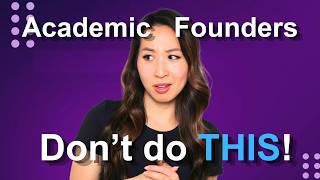
Stacy Chin, who advises science startups, breaks down why academic spin-outs usually fail. She covers eleven lessons: listen more than you talk, put customers first, take action even with incomplete information, and know when to quit. The ones that win show up consistently and don't take rejection personally.
Chapters
After advising hundreds of science and tech startup founders for the past decade, let's face it, the majority of the spinouts that spin out of academia simply won't make it. And while in general half of new businesses only see the 5-year mark, only a small fraction of academic startups ever reach meaningful commercial scale. And I've worked with hundreds of startup founders developing new exciting innovations from top universities, hospitals, and research labs, from first-time PhD founders to those with successful exits. And after seeing so many up close, I can't help but notice some patterns between founders that run successful academic startups and founders that simply didn't. So in this video, I'm going to share my top 10 observations so that you can avoid some of these mistakes in your own startup. And let's get into it. Hey guys, welcome back to the channel. If you're new here, I'm Stacy Chin, a professional federal grants and contracting consultant who has helped to raise over $50 million of non-diluted funding for startup founders developing innovations in climate, biotech, and defense. I remembered how difficult it was spinning my first startup coming out of academia. It felt like day one I was finishing my grad school work, submitting papers to peer-reviewed journals, giving academic presentations, pipetting in the lab, and then all of a sudden I had to jump headfirst into the startup world. It felt like the very next I had to learn to pitch to investors, talk to customers, and figure out how to do business negotiations and legal work. And ooh, that was hard. Fast forward 10 years later and I'm now a 3-time founder who has worked with hundreds of startups, and I had the grateful opportunity to work with so many talented founders. I support their non-diluted fundraising strategies, which has given me a front row seat to see what actually worked, what doesn't. And it gave me a few lessons that became impossible to ignore. And trust me, I've made many of these mistakes myself as a founder too. So if you're building a startup right now, especially as a first-time founder, here are the top 10 things I wish I understood earlier and what I've seen when founders don't. So let's jump into it. Never be the smartest person in the room. The strongest startup founders I've worked with are the ones that ask the most questions and happily seek out people who know way more in their specific areas. And this is really counterintuitive, actually, especially for new minted PhDs, researchers, engineers, and clinicians who have spent years being trained to be the expert, the the person with the answers and the one person people defer to in the room. And then suddenly, when you're in the founder seat, that mindset can work against you because now it's your job to not be the smartest person in the room. It is to build the room. You have to talk to customers, listen to investors, lean on legal experts, and take feedback from people who don't care how impressive your CV or resume is. And I've seen the founders who struggle are the ones that take that expert mindset and carry that into the startup world. I've seen the founders that succeed were able to put their ego aside, start from zero, and learn fast from the experts. And yes, that means being uncomfortable and asking the questions you think you should know the answers to. Second, it is never about you. As a founder, your job isn't to be right. Your job is to serve your customers, your investors, to serve— they are the ones that will decide whether you actually have a product-market fit and whether you're heading in the right direction for your startup. And one of the biggest warning signs I have heard is when a founder starts a sentence with, "I think this makes sense," and that usually means the problem and solution are being defined through the founder's perspective rather than the person who they're trying to serve. And this comes up all the time, especially with founders I've seen coming out of academia, where you're trained to defend your ideas, not pressure test them. And this shift is hard. A lot of founders assume that they understand the problem deeply, even without validating the market need. Outside of their own experiences. But at the end of the day, the market doesn't care how smart you are and how elegant or innovative your solution is. And the only way to know if you're building the right thing is to get out of your own head, talk to the customers, and listen to the people that actually matter. Third, listen more than they talk. And I used to think communication is all about speaking clearly and confidently, but over time I realized how the most powerful communicators are the ones who listen. They truly listen, and they don't just hear people talk and pick up sounds, but rather they're intentionally listening what's being processed in the information given to them and then taking that and forming them into actions. I've worked with some of the most fascinating leaders that are constantly getting information, paying attention to nuances and learning from the people around them before they make a decision. And that's really hard to do if you're the one that is talking nonstop. And the founders I've seen who struggle are the ones filling in those silences constantly. The founders that are the ones that succeeded and grow are the ones that pause, Ask better questions and let others speak because getting the right information is how you make better informed decisions as a leader and also how you can build trust as the founder. Next up, soft skills will take you further than as a founder than any hard skill ever will. I've worked with many fascinating startup technical founders who came in with really strong technical backgrounds and impressive resumes. And early on, yes, those technical skills truly do matter. And these skill sets sets the foundation that allows you to build the first version of your technology, which is really important. But where I see a lot of founders struggle with, especially those coming out of academia, are the ones that continue to over-index on those hard skills and they under-invest in the soft skills. And that's when this becomes a bottleneck. Soft skills are anything involved communication and learning how to engage people, reading the room, building trust with your customers, your partners, and your investors. It's knowing when to ask questions, when to delegate, and how to lead a team, which are all, in my opinion, extremely difficult skill sets to adopt. But at the end of the day, those skill sets are the ones that accelerate startup growth and success, not because they replace technical skill sets, but because these soft skill sets allow everything to move faster. And the best founders I've worked with are constantly working on themselves as leaders, not just the X, experts, and that work never stops. So if you want your company to grow, you have to keep investing in your soft skills as well. Next up, taking action will always move you further along than inaction. One of the hardest shifts founders have to make is learning to decide in the face of uncertainty. Sometimes you might only be 50% sure, and that's okay. And this is not a flaw, it's part of the job, and this is a muscle that you have to build. The uncomfortable truth is that making decisions in the face of uncertainty doesn't get any easier, and why I've seen founders' flaw is that they're always waiting for more information, the perfect timing, and when things feel ready in order to move forward. But that's how momentum can quietly die. And the strongest founders I've worked with, I've seen work in incredible speeds because they know speed in startup matters more than anything, especially when time is your worst enemy. And when founders make these decisions, they aren't just random decisions. Rather, they're informed bets. Based on what they know and where they are at that stage. I've seen many founders struggle in the face of uncertainty, especially early on, and that leads to a paralyzed feeling of getting stuck. And consequently, they can spend days and weeks trying to think through different ways to overcome this hurdle before even taking the first step. Yes, planning does matter, but action is really where it creates clarity. The market, the customer, and real-world feedback will give you far more information than any other spreadsheet will. Next, Simplicity is one of the most underrated advantages a founder can have. Yes, new ideas are exciting, and most founders have plenty of them, but one of the biggest mistakes I see in many founders is trying to tackle too many things at once. And yes, I've been there myself. Founders have these big visions, and they like to jump from idea to idea, and they can stack multiple objectives into a single plan without seeing any one through. And this shows up constantly in startups when I work with them in grant applications. I can see sometimes founders might propose too many things to do for a very limited timeline and with very limited funding, and the results doesn't lead to ambition, but rather just confusion. The story can become unfocused, execution gets diluted, and confidence from reviewers, investors, and even customers will start to fade. I've seen some of the strongest founders are incredibly disciplined about scope and very narrow in their focus. They're clear on the single goal that they're trying to achieve, and they're ruthless about prioritizing what truly matters, because focus makes your strategy easier to execute and your processes much easier to see through. You can always expand later on, but in early-stage startups, simplicity might actually give you momentum. Next, know when to give up and know when to let go. There are a million of good ideas, but you don't know which will work until you put them into practice. I've worked with so many founders whose persistence I truly appreciate and admire, and that grit is often what gets a startup started. But not every good idea idea will lead to a good outcome, and that's okay. But it's the founder's responsibility to validate that honestly, to test real assumptions, gather real signals, and let the market weigh in. Persistence is powerful, but persistence without evidence becomes stubbornness. And at the same time, this is a delicate balance because it's also easy to give up way too soon when things feel uncertain or uncomfortable. Some founders might walk away too early before they gather enough information to actually know what is happening. And the strongest founders sit in that tension. They don't quit at the first sign of friction, but they also don't cling to ideas that the market has clearly rejected. Letting go isn't failure. Giving up without learning is. And the goal for founders is to learn fast enough to know which one you're doing. And that's really hard. Next, this is a numbers game. Volume matters in startup. I remember when I was a scientist in the lab running experiments, I thought to myself, If I tested 2 or 3 different conditions in this experiment, the chances of finding truly groundbreaking might be pretty low. But if I tested something between 10 or 20 variations, my odds of uncovering something might increase way up. And that's not luck, it's just statistics. And I've carried that same mindset through my startup journey. Whether you're fundraising, selling, trying to land your first customer, you're far more likely to get a yes if you talk to 100 investors instead of 10. You're more likely to land a customer if you speak to 100 potential ones rather than a handful. And what I've seen in first-time founders is that they underestimate how much time and volume it really takes to fully succeed to get that single yes. They might reach out to a few people, hear a couple nos, and assume something is wrong. But I've seen successful founders understand that rejection is just part of the game. And if they stay persistent enough and put in the volume and the reps, the numbers might eventually work in their favor. Next, just show up. Early in my journey as a founder, I knew I wasn't the smartest person in the room. I wasn't the most experienced, and I wasn't the most polished. But what carried me forward was just showing up, taking ownership, and following through what I have said I would do. Even though that sounds basic, I was blown away how surprisingly rare it was just to do those simple aspects and to just show Fuck. A lot of people have excellent ideas, but way fewer actually consistently execute, meet commitments, or just even close the loop. And in startup, these basic foundational aspects truly matters. And this helps to build trust faster than pretty much anything else. And this is how you accelerate building credibility, not just in yourself, but also in your teams, your partners, your market, and in your investors as well. And some of the most effective founders that I've met and worked with aren't the flashiest or the smartest either. They're actually the ones that show up every day, try to put in 110% to send up their efforts and try to deliver the best of their ability. Over time, that reliability continues to compound and actually turns into one of the strongest advantages. Next, simply put, be kind. I don't say that lightly. Academia has a reputation being tough, competitive, and sometimes not very forgiving, and a lot of that behavior can unintentionally carry over into the startup world. But startups can be different. You're building something with people, not just proving something on paper. Yes, it is cutthroat. Yes, it is competitive. And yes, it's high pressure. I found some of the most successful founders I've worked with are consistently kind. Kind to themselves, kind to their teams, and kind to their vendors, their partners, and their investors. And that matters more than people realize, especially when things aren't going well. Because here's the reality: you're gonna hear no a lot, and rejections will pile up. Grants won't come through, customers will say no, and deals will fall fall apart. And in those moments, it's really easy to become defensive, short-tempered, or closed off. And the founders who last are the ones that stay grounded, treat people with respect, and don't let their frustrations impact their ego. And kindness doesn't mean being soft or lowering your standards, but rather it means leading with empathy, communication, and clearly remembering that people want to work with founders they can trust. And over time, that reputation compounds again and will also become another great advantage for you. All right, number 11, here's the bonus one. Don't take anything personally. And honestly, this is one of the hardest lessons I had to learn as a startup founder myself. In both worlds, as a researcher and a startup founder, you're going to pour an incredible amount of time, energy, and effort. You will invest your blood, your sweat, and your tears. And time and time again, you're going to face rejection and so much pushback than you'll ever experience than before. An experiment won't work. A paper will get rejected. A grant will not get funded. Customers will say no. Investors will pass on you. And every time you get one of these rejections, they can sting and unfortunately build up. They can be deeply disappointing and impact your ego. I totally get that, and I've been there before. But the most successful founders I've seen actually don't let them internalize these impacts. They understand that rejection is just part of the process, and then they keep going. Because the way they frame it, these rejections and these disappointments aren't personal. That's just part of the startup process. And that really helped me to reframe my thinking. Instead of asking, what did I do wrong? It helps me to ask, what can I learn from this? How do we adjust and how can we improve for future references? Because at the end of the day, when you take the emotion out of these instances and treat feedback as data, everything becomes clearer. Stop becoming— and the feedback and rejection, disappointment stops being personal. Rather, it becomes objective. I've seen that mindset help many founders push further along. So if there's one thing you can take away, it's that building a startup isn't about being perfectly brilliant or having it all figured out from day one. It's about showing up, staying curious, listening carefully, and being willing to learn faster than your ego. Every founder you've admired has faced rejection, uncertainty, and self-doubt. It's that the difference is that they just keep going, adjust when they need to, and stay grounded throughout the process. And these are some of the lessons I had to learn doing startup coming out of academia. And hopefully these lessons are something you can take away in your startup journey as well. If you found any of these tips helpful, I'll greatly appreciate it if you like this video and subscribe to this channel. Here I share lots of tips on how founders can navigate their non-dilutive fundraising strategy and also their startup journey. You can also check out our website at keepyourequity.co for additional guidance and support on how to secure more non-dilutive funding through grants and contracts. Thank you so much for joining me today, and I'll see you in a video very soon.
More from Stacy

Applying for NIH SBIR in Jan 5, 2027? You Should Be Starting NOW. Here's why...



How to Get Invited to Apply for $305K in NSF SBIR Funding || Step-by-Step Guide




