What makes a great commencement speech | Studio 2 from WHYY | 05/21/26
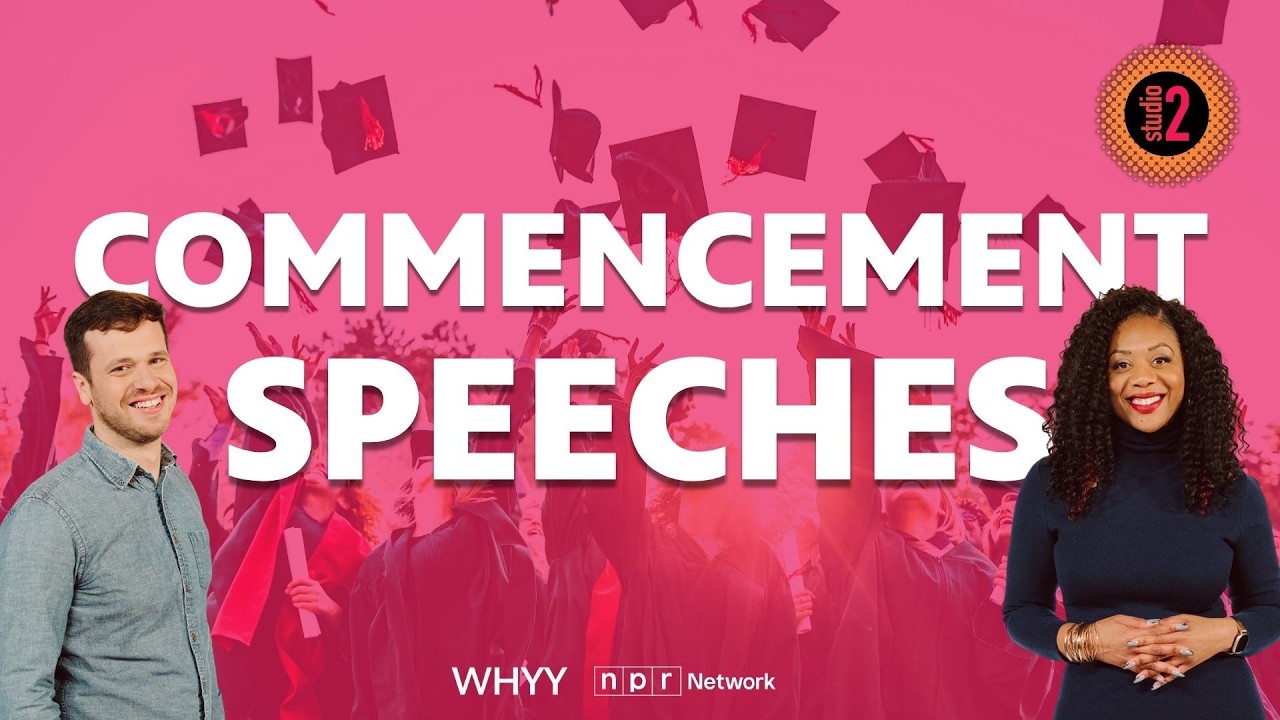
Cherry Greg and Avi Wolfman-Arendt explore what makes commencement speeches stick. Former Harvard president Drew Faust and Obama speechwriter Stephen Krupin say the best ones use personal stories and concrete details, not clichés like "follow your dreams." They play clips from Steve Jobs, Roger Federer, and others to show what works.
Chapters
Live from the Ken and Valerie Baker Studio at WHYY, this is Studio 2. On Thursday, May 21st. Welcome, welcome, welcome, friends, on into the program. I'm Cherry Greg.
I'm Avi Wolfman-Aaron.
So, Avi, every spring the same ritual unfolds across America. Thousands of graduates, they sit in these folding chairs under gray skies and blazing suns while someone rich or famous, or at least honorary degree worthy, imparts wisdom. I'm talking about the commencement speech. Do you remember who gave your commencement speech?
I looked it up today.
You had to look it up? I don't remember who gave my speech from any of the schools from which I graduated.
You have quite a few degrees.
And I don't remember. Did you look it up? I didn't even— I tried, but I—
You gave up. I gave up, yeah.
So, but let me just tell you this. We are not alone because most commitments commencement speeches are forgotten before the graduates even leave the parking lot. Okay. But there are a few that resonate.
Have they been drinking?
I don't know. But, but look, there are a few that resonate years, even decades later. And so today we're going to talk about commencement speeches. We're going to talk about the history, the pressure, the politics, the clichés. Follow your dreams.
Yeah, follow your dreams.
Fail forward.
Change the world. Oh yeah.
All of that.
I like that. But we're also gonna talk about some of the best speeches.
Yeah.
Some of the dos and don'ts.
Play some clips.
We got— we're gonna play some clips. So today is gonna be a great show. I'm really excited. And of course, our question to you friends is, do you remember who spoke at your graduation? And do you remember what they said? Give us a call, 888-477-9499. The email is studio2@whyy.org. And if you're watching on Facebook or YouTube, you can Put those memories in the chat.
I am very curious if people are going to call in and write in today because I don't know, this could go either way. A lot of people will be like, I have no idea, like us, or they might remember. I hopefully remember something about your graduation you can share with us, whether maybe it's funny, maybe it's sad, maybe it's poignant, maybe, or maybe it was something crazy happened.
I don't know.
Yeah, protest.
Yeah, protest anything. So this is your memory. Please share 888-477-9499. The email is studio2@whyy.org and I will wish I remembered, you know, but it's okay because I'm sure you guys have memories. And it's also DJ of the Day because it's Thursday.
Yeah, which means we will end the show with a song selected by one of you on the topic of today's show, as we do every Thursday. And so the topic today is speeches, graduations, whatever. Get your suggestions into epkevinstudio2@whyy.org, and perhaps you will be our DJ of the Advice could be one too, because that's what most speech—
you know, most of our speakers, they give us life advice.
Bob Herbert.
Bob Herbert.
That was your speaker?
Yep.
Who is Bob Herbert?
I had to look it up. He's a newspaper columnist. Okay. All right, Bob. Yes, salute, Bob. I'm sure it was a good speech. I just didn't remember.
I know.
I have a bad memory.
Me too. Me too. Don't feel bad.
Anyways, let's get into our trio of local news stories. A little more post-Primary Day fallout here in Philadelphia.
Ooh, I like that.
As you very likely know, Chris Rabb won the Democratic race for Pennsylvania's 3rd Congressional District pretty easily. This was a landmark win for Philly progressives, and now they've got their eyes on the future of the city's Democratic Party. So as you might know, the city party, which has been led by Bob Brady since 1986, lined up behind Sharif Street in that congressional race and lost. Well, today, District Attorney Larry Krasner, a longtime thorn in Brady's side, was outside his office filming a video calling on him to resign. Let's hear a little bit of that social media post.
I am asking you, Mr. Chairman, to have the wisdom that your friend Joe Biden had, which is to put the outsiders ahead of the insiders, to put the future ahead of the past, and understand That after 40 years serving as chairman of this party, there needs to be some new leadership that will embrace the future, not reject it.
Hmm, okay. So there's also been a lot of chatter just generally online about progressives trying to like push out the city's party leaders. I'll also note this tweet from Chris Rabb's campaign manager, Alon Gore, quote, the party apparatus is going to be replaced. So what do you think, progressives just kind of Feeling the high right now? Is this legitimate? You think there's change coming? What's your sense here?
Honestly, a lot of folks have been feeling like it's time for a change for a long time. And, you know, and I think part of it is because the ward leaders make this decision and they've been entrenched for so long. And I looked at some of the comments under that video of Krasner and people were like, yes, you know, we are the laughingstock of voter turnout. The Philadelphia political process needs to be resuscitated. They want Change. At the same time, the pushback is 10 years ago, if you Googled news stories, they were saying the exact same thing, that it was time for a change. But the momentum has been building for well over a decade at this point.
Yeah. And well, and look, it's part of this is there's, there's change sort of vaguely speaking. Mm-hmm. And then there's actually changing this particular job.
Yeah.
That Bob Reddy holds. And what you need is a majority of the ward leaders.
Ward leaders.
Exactly.
And that gets a little tricky, right? Because you can have a lot of grassroots support, but if it's concentrated in a minority of the wards, then it does not translate to a vote that can change the leadership. So a little bit, you have to get your message to penetrate widely across the geography of the city. That might be a challenge, but we'll see. Obviously, you said there is momentum here, and momentum can carry you a long, long way.
Yeah, so we'll be watching it. And then there was this talk about new ward leaders and new committee people and all the things, so there's a lot of building blocks you have to Yeah. To rearrange in order to change Bob Brady. So there you go.
Just something to note.
Note, yes. Story number 2, apparently the job of crossing guard, it's a gig that has been attractive for those who are retirement age or older. It has become increasingly more dangerous and even deadly over the years. Really interesting story by nj.com about how 3 crossing guards have been killed and nearly a dozen have been seriously injured in New Jersey in just 3 years. And this apparently is a national crisis. The Associated Press did an investigation last year reporting that dozens of crossing guards have been killed and hundreds have been hit by vehicles, suffering injuries like broken pelvises and legs, all just doing their jobs protecting kids in the rain, sleet, and snow as they cross the street. And I recall a viral video of a crossing guard in Darby who was punched in the face by a driver who got tired of waiting for the kids to cross.
Ooh.
He got out of his vehicle and attacked the woman. She quit the job just a few days later. And, uh, Avi, a big part of the problem is that distracted drivers are not paying attention. People are in a hurry, and vehicles are just huge.
Yes.
So people just ride right over the crossing guards, and there's no real way to track this. Plus, the law doesn't distinguish between you hitting a crossing guard or a regular pedestrian. So most people just get traffic Citations, and that is it, even if someone is killed.
Which is horrible. And, you know, this is part of a larger trend. There's been a steep increase in pedestrian deaths starting in around 2010. So it had been falling, actually, for many, many years, and then it started to go back up. And you mentioned distracted driving as one cause, larger, heavier vehicles with higher hoods, right? So it's harder to see, necessarily, someone at the pedestrian level. So, and people just driving a lot, too. We drive a lot in this country. And so when I saw this story, I thought this fits in sadly with a much larger trend, which is that pedestrians are less safe in America than they had been.
Yeah. And it's crazy because you think crossing guards, they're— I remember my crossing guard in my neighborhood. They're keeping kids safe, and here they are risking their lives.
Yeah.
So there's that.
Story number 3. We got an important lesson today that sometimes the greatest agent for change Is a very strongly worded letter. I'm gonna explain.
Yeah.
So the city accidentally painted over a community landmark near Manayunk. Neighbors got really pissed, but don't worry, a remedy is in the works. The landmark is called the 100 Steps. It's an outdoor staircase with a stone wall made of Wissahickon schist. It dates back to 1901. Very old staircase, Jerry Gregg. So typically, typically the wall gets covered in little bits of graffiti. The graffiti gets periodically removed. It's kind of a cat-and-mouse tradition. But recently, according to a staffer with the local councilman, workers from the city's Community Life Improvement Program doused the entire wall with a coat of gray paint. Big mistake.
Wow, wow, wow, wow.
And it looks bad. So before it was known who did it, an anonymous neighbor left a blistering note at the scene of the crime, which then went viral. The note partly said the wall was, quote, the product of millions of years of unique Wissahickon geology, and in one night you decided to smother it with flat gray paint like any other boring corporate-funded wall in the city. I actually don't know what a corporate-funded wall is, but I liked the energy.
Yeah.
So why did the city workers do this, Cherry?
Uh, graffiti?
Yeah, why did they paint over this wall?
I think it was a mistake. They didn't mean to do— I feel like they didn't mean to do this.
Exactly, exactly.
If they know Philly, you didn't mean to do this.
So according to the, the city council staffer, they were trying to clean it with a hose, but the hose didn't reach, so they were just like, let's paint over it. Obviously—
Whose idea was that?
Obviously a big mistake, but the good news is this: the city workers are apparently coming back today to remove the paint, and so hopefully A happy ending, and again, a great lesson that angry letters can be very, very effective.
I just want to say, way to advocate for your hood. And I want to say this to city workers, you know, people in Philly feel some kind of way about their landmarks. Don't you change a statue, don't you change the architecture, or even a street name without asking somebody first. That's so Philly, but they learned their lesson.
They learned their lesson and they're gonna fix it, so, and we salute our city workers. Yeah.
Overall.
And the neighborhood advocates.
And the neighborhood advocates. I like a good happy ending. They converted the whole block. This, by the way, you might think this is a strange story for us to talk about. This was blowing up online when they painted over this—
Yeah.
The stone wall.
I was shocked, actually.
But yeah, people were upset.
We don't live up there, so we didn't know anything about it.
We were like, what the heck is going on?
Philly gonna rise up, though. They love their neighborhood.
Philly's gonna rise up. Philly is going to rise up. We are going to stand and rise and talk about commencement speeches on the other side of this break.
Don't go anywhere.
You're listening to Studio C.
Supporting WHYY are—
Visit at hagley.org/250. That's hagley.org/250.
When I was 17, I read a quote that went something like, if you live each day as if it was your last, Someday you'll most certainly be right. It made an impression on me, and since then, for the past 33 years, I've looked in the mirror every morning and asked myself, if today were the last day of my life, would I want to do what I am about to do today? And whenever the answer has been no for too many days in a row, I know I need to change something.
Before I begin—
And welcome back to Studio 2 right here on WHYY. Too many speeches all around.
I know.
We'll get to them later. Hold your horses, folks. I'm Avi Wolfman-Arendt.
And I'm Cherry Greg. That was then Apple CEO Steve Jobs giving Stanford University's 2005 commencement address.
And a little bit of Conan O'Brien for some reason.
Yeah, that too.
But we'll get to that one later. And that speech by Steve Jobs, it's often hailed as one of the great graduation speeches. Instead of straight up advice, Jobs shared personal stories. He talked about his failures and fears. From getting fired from Apple, the company he built, to his pancreatic cancer diagnosis.
And that's what we're talking about today, graduation speeches and what makes a great one. We'll talk about the evolution of commencement speeches, the art of writing one that resonates with young people, and of course, the clichés to avoid, like follow your dreams.
Oh yeah.
We'll also discuss and listen to some of the best ones. Let me introduce our guests this hour who are also great. Drew Faust is professor of history and former president of Harvard University from 2007 to 2018. Drew Faust, thanks for joining us on Studio 2.
My great pleasure to be here.
And let me also introduce Stephen Krupin, a former speechwriter for President Barack Obama. He teaches speechwriting at the Kennedy School and writes for leaders in business, philanthropy, and politics. Stephen, nice to see you.
Nice to see you. Great to be with you and, and an honor to be with Drew.
Wonderful.
And for you, our listeners on the phone, on the road, or elsewhere, our question of the day is: Do you remember who spoke at your graduation? Do you remember what they said? You can give us a call. The number is 888-477-9499. The email is studio2@whyy.org. And for our YouTube and Facebook streamers, you could put those comments in the live chat.
Actually getting some fun comments.
Yeah, we are.
So far, so keep those coming. Great one from Christine, who says, Hubert Humphrey spoke at my college graduation, Temple University, 1966. The portion that I remember most was his describing what he learned from his deep unconditional love for a great-granddaughter who had Down syndrome. His remarks were educational, inspirational, and moving.
Wow. Remember that.
On the flip side, on the flip side, Bondi says, Widener University class of '82. The speaker was the U.S. Ambassador to Switzerland. No idea what she said. So you get, you get the full range there. By the way, Drew Faust, can I put you on the spot? You graduated from Bryn Mawr, I believe.
I did.
I did. Do you remember who spoke at your college graduation? Now, you've been to so many.
I do remember. I don't remember anything he said. He was the father of one of my classmates who was president of Harvey Mudd College in California.
Interesting. So, let's go back, I guess, further to this tradition and how this tradition began, because I know you've looked a little bit into it. Why do we even have a tradition of people getting up and speaking at a ceremony that's ostensibly about people just finishing their education and getting a degree? What is the idea of there being oratorical remarks at this particular occasion?
It is a curious ritual, and one that I'm struck by every year as the newspapers fill with descriptions and rankings and so on. The notion of speaking at graduations began, at commencements, really began as part of the educational process for the students. It was the students who got up and performed their accomplishments in a sense and showed they could speak in public. Sometimes they were interrogated, asked questions more or less like an oral exam. And so they were the spectacle until late in the 19th century when that began to shift, partly because college classes got so big that not every student could be accommodated. There wasn't time to have everyone speak. And so it emerged that a single person spoke. And I think that the tradition emerged somewhat from another tradition, which was that the college president would, in many cases, teach a senior course on moral philosophy and was meant to impart moral wisdom to the students. And so I think the speaker at commencement has kind of shifted towards that notion of moral philosophy and a message. And then it became an individual speaker, and then it's evolved in, in the ways it has since, where celebrity is a big part of it. And, and we see the various permutations that so captivate everyone every spring.
Yeah. Andrew, could you just tell us like some of the goals? Like how, how did the goals of these types of speeches shift over the years? Because now it seems like you, you wanna impart some wisdom. Did it always start like that?
Well, I think we should remember there are other kinds of commencement speeches even now. The public policy speech, for example, is one that has a deep-seated tradition. If you think about Kennedy at American University essentially calling for the Nuclear Test Ban Treaty, or George Marshall announcing the Marshall Plan after World War II at Harvard's 1947 commencement, or other kinds of public policy addresses that sometimes a leading political figure will choose to announce at the occasion of a commencement address. But I think we tend to focus much more on something that's a little unusual in the panoply of American speechmaking and oratory, which is this self-revelatory aspect, the moral lessons by revealing the interior of my own life. And it's a little bit like voyeurism to get this insight into Steve Jobs and who is really there behind all this success. And I think that is what has taken people and really made them feel that they are connected to these addresses because real human beings emerge from them and reveal themselves in a way that they don't necessarily any other occasion or time during the year.
Right, sort of deconstructing the celebrity or revealing something about this figure that feels very flat, making them more 3-dimensional, which is interesting. That's an interesting point to bring you into this conversation, Stephen. What makes— as a speechwriter, as you sort of analyze these as a speechwriter, is that the thing that stands out that you think makes this class of speeches different than other types of speeches that you might help write? Are there other aspects of these that you find really categorically separate them from a typical political speech?
I think one of the things that makes them different than typical political speech is the way that we talk about them.
Yeah.
More than the way that others talk about them. I see the same rankings and we have these conversations year in and year out about what is the best commencement speech ever. No one ever says, you know, what was the best ever corporate conference keynote speech? Or let's rank the best wedding toasts of all time. And somehow, for some reason, we feel this hobby around commencement speeches. And I think it's because people have high expectations of them. I think it's because they are a set piece on the calendar. And not to denigrate them, I think that they do serve a purpose. This is a major milestone in somebody's life.
Yeah.
This is a major milestone in a family's life, perhaps.
Yeah.
And this is a time when hard-earned wisdom deserves to be shared. The execution of that, I think we've all seen people do that well. or not well. But I think something that commencement speech does exceptionally well, especially when a school chooses to follow this tradition that we've been discussing of a celebrity or a high-ranking official giving this advice, is something that Drew mentioned about the Steve Jobs speech. This is breaking down the barrier between somebody who feels so different than us.
Yep.
And the audience.
Yeah.
And that is true when someone is on a podium, when someone has an honorary degree, when there is a physical distance and a chronological distance and a distance in accomplishment between the speaker and the audience. The speaker's job is to reduce that distance and to shake hands with the audience and to say, I sat where you sat. Yeah, I also have faced difficulties. and I have accomplished something. And of course, again, the execution of this can be corny or it can be meaningful, but it's a way of saying, I am a person too.
I actually wanted, on that sort of that note, I wanted to bring in this speech from tennis pro Roger Federer, which was delivered in 2024 at the Dartmouth commencement address. And it really, it goes straight to the point you both are making where he sort of says like, I am very human and I may seem great, but behind this greatness, there's, there is a lot of struggle, um, and even maybe mediocrity. So I want to play that clip from Roger Federer in 2024.
In tennis, perfection is impossible. In the 1,526 singles matches I played in my career, I won almost 80% of those matches. Now, I have a question for you. What percentage of How many points do you think I won in those matches?
Only 54%.
Only 54%. In other words, even top-ranked tennis players win barely more than half of the points they play. When you lose every second point on average, you learn not to dwell on every shot. You teach yourself to think, okay, I double faulted, it's only a point. Okay, I came to the net and I got passed again, It's only a point. Even a great shot, an overhead backhand smash that ends up on ESPN's top 10 playlist, that too is just a point.
I love that speech. I love that speech. Let's bring in a caller. By the way, if you forgot our question of the day, it is, do you remember who spoke at your graduation? Do you remember what they said? The number is 888-477-9499. The email is studio2@whyy.org. And for our Facebook and YouTube streamers, you can put your comments in the chat. Nick from Northeast Philly is on the line. Nick, you were on Studio 2. Do you remember who gave your graduation speech and what they said? Go right ahead.
Hello, Sherry. Sherry, I don't remember the name of the person, but it was like a cardinal of, of, or, or an archbishop. It was a highly religious figure. It was in Cardinal Dougherty from Uh, graduation class from way back in 1967.
Wow.
What'd they say?
And this is the only thing I remember from his speech. He said something like, I'm not going to tell you that you're the people who are going to change the world, because history shows that by the time you're old, you'll be lucky If the world isn't worse.
Yeah.
Oh my God. I've always remembered that.
Well, thank you so much, Nick from Northeast Philly.
So first of all—
Stephen would not write that speech.
Stephen, I wanted to get, first of all, your reaction to Nick from Northeast Philly's memory. But also, when you sit down with folks, how do you sort of figure out Is this the kind of advice, you know, I'm not gonna tell you to change the world because the world could be worse, or what kind of advice do you help people wrangle to sort of put pen to paper, you know, to give to these young people who are eager for advice?
Well, it's interesting that Nick brought that up. There are kind of 2 tropes at play here at the same time. The first is the advice of, please go save the world because we messed it up and you are the future. That comes up again and again, and the fact that it keeps coming up maybe should tell us something about our, our ability, our agency to change the world. The second is the broader question that we have to the audience today is one of the tropes of a commencement address. How many speakers have gone up and said, I don't remember who spoke at mine, I don't remember what they said? Yeah, and it's kind of a defense mechanism. It's kind of like letting yourself off the hook or lowering your expectations. I think there's probably a negative to that as well as a positive. But to your question about how we work on this behind the scenes with a speaker, we try to remind them that the best speeches are the ones that can be delivered only by you to only this audience at only this moment.
Yeah.
And that means we have to do a little bit of thinking about this specific moment in time. Let's make sure that we center the students. Let's make sure that we're matching the mood of that room or of the world. If there's anxiety right now around the job market or anxiety around war or polarization, to call out those elephants in the room and making sure it's a speech that only you can give. What is the advice that only you can give and how is it hard earned? How is it hard won? What are the concrete stories that, that you can tell? So this is the process that most speeches should go through. I think where commencement speech is different in 2 regards is one, at the beginning of the process, we have to build in some time to get all of these trite clichés out of our system so that we can then focus on what is different. I think one of the challenges of writing or giving a commencement speech is it feels like everything has been said before.
Yeah.
There's probably not another category of speech where in a conversation like this about it, we comment so explicitly about the fact That so many are so repetitive. And then the second thing that we try to do is we mine for stories to make abstract ideas or values or advice concrete. And the beauty of that process is you don't just have to find the anecdotes, but you can also find metaphors. I mean, Roger Federer, we just heard do that. I mean, maybe he was the best Swiss ambassador to give a speech.
Yeah, yeah, that was great.
The previous one wasn't remembered.
Yeah.
But these don't have to be epic tales. They don't have to be stories of saving a life or changing a life. They can be something mundane. And that's what Federer does, is he talked about just your average point in a tennis match.
Yeah.
And, and I—
that is relatable.
It is. It, it's very relatable. Um, by the way, some great comments. Michelle graduated from Wellesley in '88, heard from Gloria Steinem on that day.
Wow.
Wow.
Matt from Bucks County, uh, went to LSU and heard a commencement address from Shaq. And remember is a Shaq quote.
Go ahead.
Quote, your character will take you further than your resume. Got some callers lined up as well. But on the note of Shaq, Drew Faust, I am so curious about how these celebrity commencement addresses are lined up. Now, to be clear, Shaq went to LSU, so it makes sense. But yeah, you know, when you were at Harvard, you brought a lot of big names came through in those years. How does that whole process work and how much sort of backroom politics is involved?
Well, I don't know how it works at places other than Harvard. At Harvard, I'd call people up and ask them if they'd do it, and mostly they said yes.
That's it?
Wait, it was up to you? It was just up to you?
Well, there was a little committee that talked about who would be an appropriate speaker, and I'd consult with representatives from the Alumni Association and from the deans and things like that. And then we'd think of somebody and I'd call them up. So it was pretty informal.
And do they get the degrees too? Is it like, do you care?
They do.
And so what kind of consideration goes into deciding whether or not to give them? I mean, to get an honorary degree from Harvard is a pretty big deal.
Well, you might say that if you're the commencement speaker, you sort of sneak around the usual process. There is a committee of faculty and others who choose the honorands who are going to get the regular honorary degrees. But when the speaker is chosen, I would go to that committee and say, well, we'd like to give this person— I mean, ask this person to be speaker. Is that okay to give them an honorary degree? So it's a bit of a rubber stamp on that end. of it. So, yeah, that's kind of the network there.
And in your mind, was it about striking a balance year to year? How did you think about it? Because, and I got this off the internet, maybe these records are incomplete. I know there was multiple speeches in a year, right? But I think when you were there, Oprah was there at one point. And if I have this right, Mark Zuckerberg, who's not an alum but went there, John Lewis. It feels like there's some sort of balance being struck here year to year, or do you not think that holistically about it? I'm just curious how much thought you put into kind of like, I don't know.
Well, I tried to think, we tried to think broadly about it. We had some international representation, Ellen Sirleaf.
From Liberia, yeah.
One year, Mike Bloomberg came and excoriated us for threatening free speech on campus. and nurturing cancel culture. So we tried to be open-minded about the perspectives people might bring to the occasion. I think we tried to represent different parts of the university. Harvard's very large and has a lot of different professional schools. And so we had David Souter come.
Yeah.
He had gone to the law school. We had John Lithgow came one year. He was obviously in the arts. And so we tried to sort of represent different forms of excellence. That's really what was in my mind.
And did you have—
What is excellence and how can we portray it in its different manifestations?
On the Bloomberg point, do you guys review the speeches beforehand or is it like carte blanche? Like, if you want to come in and just—
You get free rein.
Put Harvard down, you are allowed to do that. You were invited.
You're allowed to do that, but we do get the speeches in advance so that the public affairs office can get ready to distribute them and so forth. I would always read them in advance because I didn't want to step on the same messages in the remarks I made that the speaker was making. But in my experience, nothing was ever changed and the speaker was never asked to modify their remarks in any way.
So interesting. Let's bring in another caller. We have Romy or Rami from Lawrenceville on the line. Romy or Rami, I'm sorry if I'm messing up your name, but you're on Studio 2. What's your question or comment?
Oh, it's Romy. And I graduated from the University of Rochester in 1985. And we actually had 3 speakers, um, Governor Cuomo, Chuck Minjone, who didn't speak but played amazing music, which is a different way of really getting a message. But what stood out for me was Desmond Tutu.
Wow.
And, and, and I still remember this and use this all the time. He said, you need to stand up, Speak up and shut up.
Wow.
And those 3 things, really, like standing up really reminds me how we need to have courage to show up no matter where we end up. And then speak up to be concise and to the point and really make our opinion known and our passion known. And then shut up, you know, like speak enough and then be silent and pause and wait. I love that and carry that with my life.
I love that message.
Wait, this was like the most epic commencement of all time.
I know.
Momo, Desmond Tutu, and a jazz legend in one year. That's wild.
Yeah, she felt really blessed.
Wow.
Thank you so much, Romy, for that one from Lawrenceville. That is amazing. And so, Stephen, I wonder, like, when you try to help people put together messaging, I mean, stand up, speak up, shut up. I mean, those are— this is years. Romy still remembers those 3 you know, pieces of advice from Desmond Tutu. I wouldn't forget that either. But just sort of how do you sort of package the message and help people package it so that 10, 20 years later, people have those 3 things that they can recite off the top of their head just like that?
I think that's a pretty good mark of a successful speech that it's remembered so much later. But I think that's a difficult place to start as a writer or as a speaker. I would say that that triplet that's so memorable this many years later is kind of the how. How are we going to package up these ideas? But that's for later in the process. I think first we need to establish the why and the what. Why are we speaking again? What is the advice that only we can give? And let's make sure again that we're centering the audience. How are we evaluating where they are today versus what we want them to think or know or feel or do after? this event, let alone decades later, if they happen to remember it. How does that contrast from what they're feeling walking in to what we want them to feel walking out with the tassels on the other side of their mortarboard as they walk up the aisles? I love something that I've heard Drew say, which is the best speeches make audiences who walk in as listeners walk out as actors. And that thought process from a speechwriting perspective can help us clarify what this speech really should be about. And then making sure that, again, it's at this intersection of this speaker, this moment, this audience, this message to make sure that it is successful. Then we get into the fun research and interviewing and story mining that can bring it to life before we get to any kind of soundbites that people are going to remember.
We do have a break coming up. Heidi remembers University of Delaware, 1980, hearing from the maverick architect Buckminster Fuller. Doesn't remember the message, but thinks that was very cool. And I agree. That is cool. Um, we're gonna talk more about graduation speeches on the other side of this break here on Studio 2. Who spoke at your commencement? What do you remember? 888-477-9499. The email is studio2@whyy.org.
Before I begin, I must point out that behind me sits a highly admired President of the United States. and decorated war hero, while I, a cable television talk show host, has been chosen to stand here and impart wisdom. I pray I never witness a more damning example of what is wrong with America today.
I love that.
Welcome back to Studio 2 here on WHYY. I'm Cherry Gray.
I'm Avi Wolfman. Aaron, I love that speech. by Conan O'Brien at Dartmouth in 2011, partly because it does poke fun at how graduation ceremonies and celebrity culture have collided in this strange way. And that's kind of what we're talking about today, the art of graduation speeches, why some enter the canon of the greats and others just fall flat.
Yes, let me reintroduce our 2 guests. We have Drew Faust, professor of history and former president of Harvard University from 2007 to 2018. We also have Stephen Krupin, Former speechwriter for President Barack Obama. He teaches speechwriting at the Kennedy School and writes for leaders in business, philanthropy, and politics.
We're asking, do you remember who spoke at your graduation? Do you remember what that person said? Our number is 888-477-9499. Our email is studio2@whyy.org. If you're on YouTube or Facebook, drop a comment in the live chat.
And I wanna bring in a caller. We have Daniel from Germantown on the line. Daniel, you're on Studio 2. What's the speech that you remember and what did they say?
It was actually 2 different speeches. So in 2003, my girlfriend at the time was graduating before me and the commencement speaker was none other than Bill Cosby. And the main message that he was pushing forward in that speech, although his contract actually stipulated that we couldn't record with audio or with video what he said, It was about honesty and integrity.
Wow.
Yeah.
They don't always age well.
They don't.
In 2018, actually, the university rescinded the honorary degree that they gave to him. So, you know, caveat emptor, that whole idea of just saying treat everything with a grain of salt.
Yeah.
Although, piggybacking off of a previous caller, the next year The speaker that we had was in fact Desmond Tutu, and the takeaway that I had from that, which was my graduation year, was him saying at a certain point we have to stop pulling bodies out of the river and go upstream to figure out why people are falling in. And that message has definitely resonated with me for years and years.
Wow.
Wow.
Thank you. That's Daniel from Germantown.
You see the comment from Gabrielle who says her graduation speaker at Wesleyan was also Bill Cosby.
From 1987.
Yeah.
And Gabriel did not care for the speech and felt like it was a pitch for his book, which is probably a bad tack to take.
And, and I, I wonder if there's some things you shouldn't do, and maybe should read the room a little bit. And I wanted to tee up this clip from former Google CEO Eric Schmidt, who delivered this year's speech at the University of Arizona's graduation ceremony. He spoke about the rise of artificial intelligence, And it did not go over well. Let's take a look. Listen.
It will touch every profession, every classroom, every hospital, every laboratory, every person, and every relationship you have. I know what many of you are feeling about that. I can hear you. There is a fear. There is a fear. In your generation, if that the future has already been written.
And so when I hear that, Stephen, I'm thinking to myself, that was something not to do. People don't like when you push your books. People don't like it when you, when the thing that they're most afraid of, you make the center of your speech. Are there some don'ts when preparing a speech?
Yeah, we've talked about some of the tropes that are good to stay away from, but here's what I think is the biggest don't, which is Don't reach for marble. Don't try to write for posterity. Don't try to be named decades later on WHYY as the best commencement speech ever. Speakers who think they need to write for posterity often ignore the room right in front of them. And maybe these AI examples this year are good proof of that. Speakers actually need to do the opposite. If you write for the room, maybe it will last forever. That would be nice, but that's not necessarily the goal. The goal is to give good advice, encouragement, recognition to the people who are sitting right in front of you at this important, important moment in their lives. This is one of those rare speeches that is much more about the audience than the speaker. And if you write for posterity, I think it'll be hard to fulfill your most important responsibility as a commencement speaker.
Hmm. Kevin says he graduated from Duke in 1981. William Styron was the speaker. I don't remember the subject. Chris from Doylestown heard from Malcolm Forbes in 1984, says it was a great speech. Jamie from Monaco heard from Meredith Vieira. I don't remember the content, just that it was abnormally awesome, I think, because she's a television journalist, very good at this type of thing. I'm curious, Drew Faust, do you think we've leaned too far into the celebrity aspect of this tradition? Is there a chance to pull back and maybe leave graduates with more? Or at the end of the day, is that really what the graduates want? They want to have said, like I heard from Beverly, Joe Biden in 1975. Ultimately, that's really what they want. I'm curious how you consider that give and take.
Well, we talked about competitive speeches and the listing of what's the best and what survives for posterity. There's also pre-speech, a certain competitiveness among student bodies about who they got, who they snared, who their institution's going to have. And I do think that's destructive. There's some celebrities who are going to be fabulous speakers, and you can look at speeches they gave before and guess that they'll probably give another one, a great one again. Or you can think about certain attributes that will make that conjunction that Stephen described of the person, the moment, and the message make that really work. So we should not be entirely influenced by student opinion or outside opinion about who can send a message. I think what I said earlier, I'd reiterate, which is it's nice to think of the commencement speaker embodying some sort of excellence. that will rivet the attention of the students enough for them to think, that might be a place to go, that might be somebody who can tell me something about where I might aspire to be at a later time. So there are many kinds of excellence in many fields, and some come with great public acclaim and are people who are really well known, some with less acclaim or public knowledge. But what is the excellence that you can ask someone to share with students. I think giving a commencement address is an act of tremendous generosity if you do it right. You are giving those students and that audience something. And who is going to be a generous speaker who will open up and say something true? It can be hard to say something true, not something that flatters you or flatters others or paints a pretty picture, but something true. And who is the person who can say in a moment like this something true?
I like that idea of being a generous act. That actually reframed the way I think about it.
Yeah.
Let's bring in another caller. We have James from Phoenixville on the line. James, you're on Studio 2. What's your question or comment?
Hi, good afternoon. My son graduated from Harvard in 2013. The speaker was Soledad O'Brien, who was excellent. But Dr. Faust, I think it was actually your remarks where you had referred to the parking lot theory of life, if I remember correctly.
Oh, wow.
And our family is still in disagreement as to exactly what that meant, whether that meant don't take the first spot you find or take the first spot and, you know, move on and do great things. So I don't know whether you recall that, and if you did, whether you could help break our family disagreement.
Interesting. Okay, so this— it's gonna be tough because we're talking about a speech from 13 years ago, and even then I don't know if James remembers it perfectly. Do you remember this, Drew Faust? Do you have any idea?
Yes.
You do? Okay, go ahead.
So break it down for us.
Clarify.
Yes, the parking space theory of life was something I delivered in every baccalaureate address that I gave between 2007 and 2018, so I said it many times. And the parking space theory of life is that you ought to go to where you want to be. If you're headed to a certain destination, go right to that destination and see if there's a parking space there. And if there's not, then settle for second best, then institute Plan B. But start with Plan A, which is parking near where you want to be. And of course, the message of that is If you have something you really want to do, try it before you give up on it. And don't just say, oh, I'll settle and I'll do this thing that I don't really care about because I'm afraid I'll never get the parking space near the destination. So that, that's the message of the parking space theory of life. And it seems to have stuck in people's brains, even if they can't remember what the meaning is.
And James is like, James wanted to call in and get you to break this down.
So I'm curious how you came up with that. How did you come up with that metaphor? So obviously it's something that you cultivated over time, but initially, do you remember how you even came up with the theory? Was it someone else that you heard it from and then you said, I like that, or is it something that just occurred to you?
I think I said it, I was telling it to students at the University of Pennsylvania when I was a faculty member there in the '80s and '90s. So maybe it just sort of came out of my interactions with students. I don't know.
Huh.
I love that about it.
It's the magic of it, really.
Parking lot theory. Let's bring in another caller. We have Dorothy from Newtown Square on the line. Dorothy, you're on Studio 2. Who was your commencement speaker and what did they say?
Commencement speaker was the Reverend Martin Luther King Jr. And he was the invited speaker for the City College graduation. Which was on June 12th, 19— what did we say— '63. And the day that he spoke, in the morning of that day, Medgar Evers had been assassinated.
Wow.
The ceremonies were outdoors at Lewisohn Stadium, which was part of City College in Harlem. So there was concerns about possible unrest. And in fact, a friend of mine was sitting in his cap and gown and said to the young man next to him, what did you study? What's your degree in? And he said, I'm a cop, because apparently there were some authority security in caps and gowns through the crowd in case there was a problem. There wasn't a problem. And the speech is kind of almost preparatory to the I Have a Dream speech, which was a little bit after, later than this. And it's aimed toward educators and the graduates and, you know, talks about, you know, the need for education.
Wow.
And, you know, I don't think it would have been that memorable a speech And it knocked them for in the context.
Yeah.
Wow.
Thank you for reading that.
Lump in my throat hearing that.
It gave me goosebumps just her remembering that day. I'm sure it's something she's never ever going to forget.
Absolutely. And so for those that don't know the timeline there, Medgar Evers was assassinated in June 1963. The speech, the I Have a Dream speech is in August of that year. So they're right in between.
Yeah.
So I want to play a clip off of that actually. This is in 2016, then First Lady Michelle Obama addressing the 170th Graduating class of the City College of New York, believe it or not. Let's play that clip.
And graduates, it's the story that I witness every single day when I wake up in a house that was built by slaves and I watch my daughters, 2 beautiful Black young women, head off to school waving goodbye to their father, the President of the United States, the son of a man from Kenya who came here to America for the same reasons as many of you, to get an education and improve his prospects in life.
Wow, what lucky students to have Michelle Obama, and then before that, Martin Luther Wow.
Yeah, and so we talked, Drew, fast. We're getting ready to wrap up, but obviously, and I agree with Stephen's advice, you can't play to posterity, but there is the possibility of creating a moment that people never forget. And I do think there is something about, we have so many ways of communicating now. We don't need to give speeches like they probably did in ancient Rome or Greece to communicate with lots of people. And yet the speech, and this type of speech, still holds a magic and a power. How do you explain that?
Well, it is in part this gift that the speaker is offering to the people there and offering in a physical presence that is affected by tone of voice, by the crowd, by the speaking back, whether it's boos or not. That does affect how it is heard. And you could hear in the Michelle Obama speech, you could hear the crowd responding to her and cheering her. It's— she was giving the I Have a Dream speech in a sense.
Yeah.
And many, many years later. And so the resonance of the traditions of commencement address and these tropes which reinforce what people say. I mean, as Stephen said at the beginning, it's a moment and you're there for that moment. And it's a moment that's very meaningful to you because it's a transition of great importance to graduate. But it's a moment that can be captured in a speech and in a language and in an interaction. And that, I think, makes it very special for everyone.
Well, I did not expect to end on such a poignant note, this conversation. And that's the beauty of live radio. Thank you, Drew Faust, professor of history, former president of Harvard University from 2007 to 2018. Thank you so much for your wisdom today on Studio 2. And let me also thank Stephen Krupin, former speechwriter for President Barack Obama. He teaches speechwriting at the Kennedy School and writes for leaders in business, philanthropy, and politics. Thank you, Stephen, for being here on Studio 2.
Thank you.
Thank you both.
And now it is time to reveal our Studio 2 DJ of the Day song selection. Lots of great creative suggestions today, but we're going with a mashup. So Al, hit it.
People all over the world, join in. So, uh, that's Love Train. Yeah, by the O'Jays. That's not what it says here in our script. No, but shout out to the O'Jays. That's the sound of Philadelphia. Gamble and Huff. We love the O'Jays. Yeah, and I don't know it was picked or who picked it, but you are our DJ of the day, uh, unless I'm missing something.
Yeah, yeah, shout out to, uh, to you, to you, whoever picked these songs. And got to shout out, of course, our producers Debbie Bilder, Hazel Mae Bryant, and Paige Murray-Bessler. Mike Schiffler is our visual producer. Al Banks engineered today's show. Our executive producer is Kevin McCoy. Joan Isabella is WHYY's audio general manager from Studio 2 here at WHYY in Philadelphia. I'm Cherry Greg.
I'm Avi Wolfman, and congrats to the grads. My advice to you is to find a love train and join it.
Yes.
Okay, uh, on Memorial Day Monday coming up next week, we're gonna listen back to some fun recent Studio 2 interviews. One of them is a closer look at accents, why we talk the way we do, from Delco twang to that friendly Minnesota dialect.
I love it.
We'll also revisit the '90s as the golden age of Black TV sitcoms with PBS NewsHour's Geoff Bennett. Then we're back live Tuesday with a national political roundtable. So join us for those shows and a whole lot more. And have a great weekend, friends. Coming up next, it's Here and Now.
People all over the world.
Lantern Theatre Company supports WHYY and presents the Philadelphia premiere of Franklinland by Lloyd Sa. Nobody knows Benjamin Franklin better than Philadelphians. Franklin was a publisher, inventor, political agitator, and diplomat, and he wanted his son William to follow him into the sciences. When William rebels and becomes the royal governor of New Jersey, the stage is set for a father-son conflict of international proportions in this endearing comedy. Starting May 7th in Center City, Lantern Theatre Company presents Franklinland. Lantern Theatre Company presents Franklinland.