Detoxing Your Mind: An Interview With Dr. Caroline Leaf
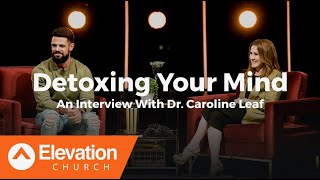
Steven Furtick talks with neuroscientist Dr. Caroline Leaf about rewiring toxic thoughts through a five-step daily practice that takes 7 to 16 minutes. She explains how triggers activate stored memories, why 21 days stabilizes change, and how one unplugged 16-minute break daily protects your ability to focus.
Questions this video answers
September 8, 2018
16 minutes
7–16 minutes per day
21 days
63 days
Chapters
Hey, when we started this series, triggered, I promised you that we were going to get practical. We're not just going to be up here preaching about the peace of God and preaching about self control without giving practical handles for how to apply it. I wanted to take that to a new level this weekend, so I sat down with Dr. Caroline Leaf, who is a. Are you ready for this? Cognitive neuroscientist. That's right. It's a little intimidating. I'm a preacher. Dr. Leif has studied the human brain for decades, and not only studied it, but now she has a passion for taking her knowledge to the body of Christ. You know, connecting the science and the scriptures. I had the most amazing conversation with her. I thought I would share it with the entire church family and our efam around the world. Of course. Dr. Leif is the author of, I think, five different books. The newest being Think, Learn, Succeed, and you can pick that up. I think you are going to love this conversation. You'll see. In the conversation, I got a little personal. I had some questions about my own brand of crazy that I wanted help with. Dr. Leaf spoke to some things that I'm still thinking about even now as I speak to you. So get ready. Enjoy this conversation. I know it's not a normal sermon format, but I believe it's going to help you to put the things you know and believe into practice in your everyday life. Well, Dr. Lee, thank you for being with us today.
Thank you.
You're amazing.
So are you.
When you speak, I feel, you know. All right. So the first time I ever remember hearing about my brain was my dad telling me not to drink alcohol when I was 7. And he was telling me that when you drink, it kills your brain cells. And it embedded the image in my mind because all I could picture was like the packing wrap popping. And I pictured my brain being like, you know, like. Like packing. Like the bubbles. Yeah, the bubbles popping in my brain. And when I hear you speak about the brain and about God, number one, you make me feel. You make me feel smart, which I like. But then I'm afraid on some level that maybe as pastors, we've. We've failed our people in this regard to help understand the connection between the way that we think and the way that we believe and how that all plays out. And I'm so grateful that God has raised you up in the body of Christ to help us understand this.
Oh, thank you.
I was wondering what you think about my series. I'm in a series called Triggered.
I love it.
All the time. Do you ever get triggered?
Oh, yes, we all do.
What do you think of when you think of triggered?
There'll be certain things that will definitely activate existing thoughts that you have that then you're going to respond. So these things are real. So triggers. So it could be some sort of trauma. It could be a facial expression, it could be a smell. So we do respond to that because we've actually experienced and built this matter into our brain. So we've actually got physical thoughts in our brain. So a trigger will bring that up into our conscious mind. So that's what a trigger does. It's an external stimulation that then activates an internal storage of a memory in your physical brain and our mind. And then it comes into the consciousness and then you're aware of this and you have to make a decision so you can react positively or negatively. We have that control. That's the nicest thing, is that we have so much more control than we are told. I think that's probably one of the most powerful things that I have ever learned in this process.
You're big on this idea that we do have more responsibility for our reactions than sometimes we act like. Do you think sometimes religion and preaching has blamed the devil too much or almost uses God as a cop out not to take control of our own responses?
Am I allowed to tell the truth?
I want it absolutely unfiltered today. This is Caroline Leaf. Unfiltered.
Okay, That's a good one. Okay. I like being unfiltered. Okay. I definitely do. I think religion has killed our respect for God. I think it has turned us into very dependent on blaming. We've become victims. And it's become. And I often talk about Pastor Buck prayer, where it's okay, well, I'll just say the little scripture. I'll just say, I'll pray for you. But there's no real responsibility involved. We've become a culture of just blame everyone for everything and blame the devil, as you say, devil on every doorknob. That has gone on way too long in religion. So. And I don't like religion at all. I like God. And I think that we need to look at what love looks like. And yes, I think we've caused a huge problem in the way that we've done church for many years now and done religion and stuff. So we've got to. And I say done for a reason because it's a relationship. It's a way of being. It's being human. We've almost forgot our humanity. What really worries me is the disconnect between the beautiful story of the scriptures and the beautiful way that we've been created and the disconnect between the two. Because it's, like, so illogical that we would voluntarily damage our brain. But that's what we do every time we choose wrong. It's so crazy that we would be judgmental or harsh or unkind or anything in the toxic zone when we realize that it's completely out of alignment with our natural nature, it's causing brain damage, it's damaging the world around us. And I think that's where the church has failed to make us be aware of that, to be aware of our responsibility. It's just so easy to say, oh, I'm being attacked by the devil, and because I'm doing the right thing. This is a big excuse to actually carry on behaving in a bad way, because it's not justification for, well, if I'm being attacked, it means I'm doing the right thing. You know, that teaching has been quite dominant, and that's dangerous because we can't use that as an excuse if something. We can't also say, well, I'm now rich and wealthy, and so now I'm doing the right thing and God's on my side. You know, that doesn't. It's all illogical. We have to look at the human side. What did Jesus model? What does love look like? What does kindness really look like? That's for me, what we should be focusing on and not blaming.
You can't see it, but you got me on the edge of my seat right now because I didn't plan to go here this early, but since you went there, I'm big on this idea that there are certain buttons that we hit sometimes when we're preaching and teaching. And you don't come from a background of a theological school, you're coming at this from a completely different perspective. And so there are phrases that preachers say like breakthrough or destroying strongholds. And we sing about these things and we talk about these things, but they don't even get us out the parking lot before we're right back into the same patterns, before we're right back into the same predictable behaviors. We're doing the same things Tuesday afternoon after the sermon on Sunday that we were doing before we heard the sermon. That sounded so nice. I wonder what are the cliches that you hear that get on your nerves when you hear Christians just saying these phrases, or maybe even you've said some yourself, that we really don't even Understand what we're talking about, but it just sounds nice. Do you have some phrases like that?
I love what you've just said. And you've really now hit also that this is just fantastic. You've triggered me in the right way. Okay, so Christianese. I deliberately don't talk Christianese. I will use scripture in a teaching sense. And if you notice, when I use a scripture, I always link it back to the science because I'm trying to make people think. Because 25, 30 years ago, I remember driving to collect. It was 25 years ago. I remember driving to collect my oldest daughter, who was two years old, from her playgroup and the one who's getting married. And I remember saying, why am I so obsessed with understanding the mind and the brain? Because it really is. I spend two, three hours a day researching. If you see me on my phone, I'm talking to my kids or I'm reading research on the brain and the mindset, because at that time, and I remember saying to God, why am I so obsessed? And the clearest answer, and I'm not trying to sound super spiritual, and I heard some sounds from heaven I didn't hear. I just knew this answer was, if you teach people to think, they will find God. So that's what, for me, that's been my life mission. Christian Knees has blocked people's ability to, you know, like, renew the mind. It's just overuse. Bring all thoughts into captivity. Well, are you doing it? Don't say it if you're not going to do it. You know, we need to realize the profound impact of. When you say something, you need to make sure that you mean that. Otherwise you have cognitive dissonance in your.
Brain where you say, break that down a little bit.
Okay, so you're saying what you know you should be saying, because that's the culture. So Christianese is a culture, and it's a cultural trend. And this is how we speak, and this is what the preachers say. So you listen to the preachers and they all say the same thing, but they just have their own styles. And I'm not. I'm talking in general. Now, obviously, each preacher is going to have a message that they deliver, but there's a certain language that is spoken in Christianese. And we're so used to hearing that that we don't think about it. And that was my point that I was making earlier on. We don't really think about it. We recognize the familiar term, so we just repeat that. But then we don't actually absorb and make that part of our thinking and spend the 63 days, which is what it takes to build a long term memory that will actually cause change. We're just saying those phrases over and over, but we don't really build them. They just kind of a surface thing that's hovering around. Well, I should be saying this because I'm in this cultural mindset. So it's actually toxic. It's a toxic tree, this wiry thing. Because this is what I should be saying.
I've heard you talk about this before.
That's what thoughts look like in your brain. Thoughts are real things. Thoughts occupy mental real estate. A thought is a memory. We build them. Every time we think, feel and choose, we build a thought. So we design to build healthy thoughts. That's an unhealthy thought. So cognitive dissonance. If I say God shall meet all my needs, but then I'm whining about everything or bring all thoughts into captivity and all you do is spend all day gossiping and whining and complaining and being a victim and judging others because they're different to you, well then you're actually speaking that language. So that scripture actually is not. It's just, it's a cultural thing. It's not something you believe. You're saying it because it's expected of you. But actually this is where you're operating from. So now we have a contradiction between what you're saying because what you're saying is coming from a toxic root. So it sounds good, but it's not good because it's not a reality in your life that causes brain damage. So we literally causing brain damage that will cause nagging worry, nagging anxiety because you're operating against your natural nature, which is if I say something, I must mean it. So it's actually toxic as opposed to healthy, even though the words sound healthy. Does that make sense?
Okay, so a toxic thought to you. It does make sense. And it's actually to me refreshing because I'll never forget talking to a scripture quoting Bible totem, holy ghost filled devil, chastened word of God, believing person one time and trying to explain to them that I was bad at math. They said, don't say you're bad at math, don't confess that. I said, well, what should I confess now? This is not when I was 10 years old. This was at a stage in my life where I knew that I do not have the aptitude for this certain type of intelligence. And I've run into so much of that over time. You know, don't say I have a headache. Cancel that word. Don't confess that. While I believe that's very scripturally powerful, you know that we have to use our tongue like a rudder, like James says, and all of that to steer the ship where it's going to go and it can get kooky. And the first time I was introduced to your teaching, I thought that might be what you would teach that, hey, here's going to be a scientific spin on this idea that we need to confess what we want to possess and other things that rhyme all the time. Wouldn't that be sublime? Meanwhile, we're all addicted and we're all miserable, but now we're not allowed to say it, so it's even worse. And we end up punching a hole through a wall one day because we can't even get it out of our mouth. And so that's what I wanted to hear you about is this tension of being honest, being able to take a thought and say, wow, this is a dark thought. You know, some of our best literature and movies and the concepts that really connect with people's hearts, even some of the Psalms, if you look at David, he wasn't always making a positive confession. And yet there seems to be a sense in which we do need to regulate what we allow ourselves to think on. So I was curious about that tension because for me, and maybe it's just me, I go through seasons where I'm not going to complain, I'm not going to judge, I'm not going to complain, I'm not going to judge. And then the pendulum swings and I can't hold it anymore. And then I eat all the Oreos and go into road rage. I wonder, is there a better place to live? Not in this polarity of don't confess it. When you have a bad thought, don't dwell on that, whatever things are lovely and true, where you almost feel like it's a legalistic sort of thought process that isn't allowed to be human. And the idea where we just let our minds run wild and say and think whatever we want and in the name of honesty just ruin our lives.
Well, what you've just said is outstanding. You've explained the problem exactly how it is. So now let me give me give you the science behind that. So first of all, when you say something you first thought about it, it's not physically possible to utter words that you haven't first got some foundation from. So even now I'm speaking from my years experience in the field of brain research and the mind brain connection. I'm not just speaking randomly about. I couldn't give you a lecture on actuarial science because I don't have any knowledge about it. So that's an extreme example to gives you an understanding. So essentially it starts with what you're thinking about. Your thinking has to have more attention paid to it. And that's why that every 10 seconds research is incredible.
And what about every 10 second rule?
Yes, every 10 second rule. So neuroscientifically I wanted to see, first of all, I wanted to see my research. If we're supposed to control our thoughts, can we, how do we control our thoughts? What does it mean to control a thought? How often can you do it? All these were the questions that I was looking at in my research. What is the impact physically in the brain? What level of control do we have as humans? And all of it's very positive. We control every single thing that we utter from first thinking. So you think as you thinking, you are responding to the signals of life. So you're thinking about something that you've experienced where you some, the more you go through life, the more you have inside that you built inside of you. So you, you think about things from the inside. You respond to external signals. So the easiest thing is to think like now we're talking about something that maybe a lot of people haven't heard about. So it's new information. So they're hearing stuff, they're seeing us. So these input information that we've all got a level of experience of ourselves. We all understand that we think, we all know, we all know about our inside feelings to a certain extent, et cetera. So these existing memories coming up. So we have incoming signals, we have upcoming signals. And we as humans are able to stand back and observe our own upcoming signal and incoming signal and compare them. And we can do that every 10 seconds. And it's happening much faster on an unconscious level, but that's another whole level. So consciously and deliberately we are designed to be very deliberate, very intentional. Because as soon as you start paying attention, you start causing structural change in your brain. As soon as you start going beyond paying attention to the next four steps. Because paying attention is the first step and there's five steps involved in building a memory. The next four steps turn that into an actual structural change there often you keep repeating that process and you build something that then produces an output which is what you and what you do, what they're trying to do with that kind of description that you said, that religious kind of approach where you don't speak the negative is this exists, but you actually trying to take the external and put it into the internal without changing this. But it's got to start from here. You've actually got to be able to self evaluate. Socrates once said, the unexamined life is not worth living. It is complete and utter self regulation and self evaluation. It's standing back and saying, okay, what is this issue that I'm facing? What am I doing? How am I reacting to my spouse, to my whatever? How am I doing as I wake up in the morning? What am I saying? What am I feeling? Am I whining and moaning? Am I negative as I wake up in the morning? How am I responding to my kids, to my husband, to my wife? How am I going through the day to my friends, colleagues? If you're a student, whatever. What am I thinking about in every moment? Self evaluation, deliberate, intentional regulation of this is coming in. This is the email, this is the phone call. This is the conversation. This is the situation. That's the incoming. What is my upcoming trigger, toxic trigger, positive trigger. And I've got this combination. And you go into what we call in quantum physics, superposition. And superposition is this phenomenal ability that we have as humans to stand back and observe. Okay, I'm doing it right now. You're also doing it now that I said it. You're aware of it, and the audience will be as well. I'm literally watching myself respond to you. I'm very aware of how I sound, what I'm saying, my delivery, the content, the emotions behind it. And that's what we're supposed to be doing. I'm self evaluating, I'm considering, and I'm speaking to the spirit of God as I'm doing this, saying, okay, what am I? What's the best answer to give Stephen? What is the best way of. So there's a conversation going on in my head as I produce the words that I'm speaking. And that's the deliberate renewing of the mind. That's the deliberate bring all thoughts into captivity. That's the self regulation that we actually physically are designed to do.
Because when I ever hear the take every thought captive scripture, it's always this violent, aggressive, overpowering. I even wrote a book that I wish I could changed the title of or modified. It was called Crash the Chatterbox. And it was about self talk and it was about fear and it was about condemnation. And I still think what I said about most things is true. But I think the level I was Approaching it at doesn't work because it didn't really start with nonjudgmental self awareness of what I was thinking. It started in a sense with an expectation to be able to obliterate that.
And I'm very good. What you've just said is excellent because that's exactly where people fall. So that expectation mindset creates. Sorry, I interrupted you.
No, as long as you're agreeing with me, it's fine to interrupt me.
I'm agreeing to tell you how you did it, how you had insight to think that you've maybe got some right and some wrong. But that expectation mindset of we've got to obliterate the chatter is correct. But the way we're doing it and the way we taught religion to do it, if you get very legal, is you've got to just speak the thing over it. But it's not that you said the correct thing two sentences back where you picked up on the self regulation concept. That's where it starts. If you think of what Jesus and I use this all the time. Jesus in the Garden of Gethsemane, there was a self evaluative, self regulatory process that was going on. He demonstrated, he modeled what we're supposed to do as humans. What are we supposed to do? We're facing stuff. Life is full of people making bad decisions and we, we all make each other victims of our bad decisions. We are all victims of each other's bad decisions. And that's what Jesus modeled. He said, this is a decision that the world made and I'm facing that consequence and I have to look at that consequence. I have to self regulate. How am I going to do this? How am I going to operate in love? How am I going to move through this? The model is in what he did in the Garden of Gethsemane. Take that back into life. We have to self evaluate. Look at the scriptures. When it says think on these things, it's not just quote the scripture, you're not going to whatever or God shall meet all my needs or whatever. That's an abuse of scripture, if I may say that. It's a complete abuse when we say.
That because it's bypassing the process.
The process is you may be in a financial problem. The process is you may have been traumatized by a rape or attack or something like that. You may be in a bad marriage, you may be working for someone who's the devil wears Prada or whatever there could be. You've got a real, you've got a story. So you have to say, this is my story. I'm facing a cross, I'm facing a Gethsemane. I am in this situation, I've got to deal with this stuff. And that is a self regulatory process and that's where it starts. So just ignoring that, suppressing it and saying, okay, I'm just gonna put a band aid on and I'm just gonna quote scriptures, quote scripture over this thing. But I never deal with that. That doesn't go away. That's real, it's alive, it's living, it's dynamic, it's in your brain, it's physically built, it's connected to your mind. It has a spiritual element to it and it has a physical element to it. It's dynamic, amount of toxic. Speaking of scriptures and that sounds like a paradox or a contradiction because of.
Scriptures, what makes it toxic? The fact that it avoids reflection, dealing with the issue.
So you're not saying the scriptures, you're just using the scriptures to try and hide this, to suppress this. So you're taking the scriptures and putting a band aid on. That will fall off eventually, but you haven't dealt with it. Whereas this power in the scripture is. It's not the words, it is the behind. What does it mean? What does bring all thoughts into captivity? What does think on these things? What does choose life? What does it really mean? That's self regulation, that self reflection. That's deep thinking. And then you see, okay, well this is bad. And then you do something that I call freaking out in the love zone. You cry, you shout, you scream. You acknowledge that. David modeled that for us. Jesus modeled it for us. You don't pretend everything's fine and smile. It's not. That's an ostrich in the sand mentality. Do you see what I'm saying?
That's what I'm freaking out in, the love zone.
That's one of my favorite terms, freaking.
Out in the love zone. I'm intrigued. Teach me how to do this. Because I think I freak out in the zone quite often. I'm afraid I do. I'm afraid that for me, my emotions a lot of times, while being one of my greatest strengths, to be able to connect with people in the way that I do. Feels like they turn on me of my private moments. And I was thinking about the Bible story about Elijah and you know, how bold he was. And he said, I'm the only one of the Lord's prophets left, you know, and he calls down fire. Of course there's an Old Testament story and Jesus didn't come to call down fire. But Elijah in that moment was able to be very effective. Until you read a little bit later, after God sends the rain and he's running from Jezebel. And you know, there have been a million sermons on this. But the thing that got me was when he was telling God in the cave why he was wanting to die and why he didn't want to go forward and why it's too much, you know, that's his phrase. I've had enough. When we've all been there, I feel like I get there quite often more than I would like to admit as a pastor. Just the idea that I don't know if I can take anymore. I don't know if I but am enough for this. Just all these challenges that come in. He said the same phrase in the cave. I am the only one of the Lord's prophets left. That he said on the mountain, it made him bold on the mountain. But when he was in the cave by himself, in isolation, it's almost as if that same uniqueness turned on him. And the way he processed it. And what was happening in that cave, that has to be an analogy or metaphor for what happens in our minds. Because I bet you come to that scripture with all kinds of different meanings from your background.
Absolutely. I think the advantage of having a scientific background and being a Christian my whole life being a bit, as I always say, I'm a follower of Jesus or follower of love, is seeing it from a very different angle. So every story that I will read in the Bible is for me a story of how much we need God and how much we need to be honest. We can't deny. That's where religion can teach us to deny what's a reality. Because we're not supposed to be thinking like that. Meanwhile, every single one of us is making wrong decisions daily. And if we deny that, we actually grow the decision. Because the toxic decision and whatever you think about the most grows. If you don't deal with this, it doesn't go away. You have to deal with it. So when I talk about dealing with it, there is the mental, the spiritual, non physical mental decision to say, all right, I recognize a trigger, I recognize a pattern of behavior. I recognize why do I feel like I can't go on at this moment? Why do I feel like this is too much self regulation? Then starts getting on our knees, freaking out in the love zone, saying, I don't know how to deal with this. I'm crying. Whatever it is, I feel broken. Say it because that's honest. And say it knowing that you're in the love zone. So you don't go. Think of. Like, when I was teaching earlier on, I had the green tree on one side and the toxic tree on the other side. And anyone who's watched me, that's how I always teach. On the one side, I have the green tree and the other side, the toxic tree. So we've got the love zone, and we've got the fear zone. And what you've got to do is step into the love zone. The love zone is completely honest, but it's very safe. It's where you'll have clarity of thought. It's where you can be. God knows it anyway, so why pretend that it's not an issue when it is? You feel like gossiping or you feel like being angry or you feel like not choosing correctly. You've got to say those things. You've got to recognize this is painful. I don't like the situation.
Where does it become appropriate to say to another person, I'm thinking some crazy stuff? And I don't even mean a therapist. Maybe you get one or two. I have one friend who I feel like I can say anything to. Of course, I have Holly. I feel like I can say almost anything to Holly. I don't want her to worry about me, though. The other guy, his name is Eric. I've known him forever, and I start talking to him like I don't talk to anybody else. And maybe it's because I'm a pastor and. And we don't know when we can share our humanity, but this is the guy who I feel comfortable saying anything to. And I often wonder, I think a lot of people do, what level of saying. This is something I've been thinking lately. This is something that I can't say on camera talking to Caroline Leaf, because it's going to be on YouTube. This is something that I can't share from the pulpit, but I want to say it to another person, because as you talk about getting outside of your thoughts, it sounds great. It sounds also impossible at times when I'm really in that cycle, when I'm in a healthy place. I know what you're saying, but when I am in that place, it is like Elijah in the cave, and I don't see the way out. And I am irrational. And sometimes Eric, to me, almost feels like a part of my prayer. And we're not necessarily talking to God, but just saying things to each other helps me put it out there. And now all of a Sudden I don't feel so much shame. Is that good? Should I draw a line? Am I able to say 57%? What's the scientific, cognitive, neuroscientific percentage that I can say of what I feel without sinning or being evil or making it worse? I wonder about that sometimes.
100% speak it all. Because when it's out in the open, it's in the light, and that's when you can deal with it. So here's how it works. So here you're sitting, talking to a friend, and those conversations. We've all got someone like that. We've all got a person that we feel we can really share. And maybe we've got one or two people that we really feel we can share a lot of stuff with. And as you're talking, it's amazing how one thing leads to another and one thing leads to another. And your question is how much of the one thing leads to another? Should you say. I say all of it. If you feel safe with that person and in that moment, as much as you can handle, you may not be able to handle more than X and you may get to a point. And if you really are and you are praying, this is a form of prayer. God is in everything. So you are. It's a safe place. You're in the love zone. You're kind of freaking out in the love zone in that discussion.
I like this. I'm going to say this to Eric. Hey, Eric, let me freak out in the love zone. He's not going to know how to take that at first, but he'll learn.
So basically now here you say something. So now this is an unconscious. And you start talking and suddenly this thing comes up and you think, wow, Eric. And you start saying this thing, and it's like, I thought this and whatever. And you're safe with him. You know, he's not going to judge you. You feel comfortable. So just the fact that you trust each other, you. You trust Holly. You've got that trust, that relationship immediately. Your brain chemistry's changed. Certain genes have been activated to help you to have the courage to face it. So God gives. Has designed our body to benefit tremendously from dealing with stuff. So you're actually quite strong. But where are you getting your strength from? Loveness. Where's the loveness coming from? Through your friend, through your wife, through your people that you trust. They're not judging you. You feel safe. You feel you can say all this ugly stuff and they're not going to say you're going to hell. You're this, you're that, or whatever. I don't know what they're going.
Derek's worse than me. So that's part of the advantage.
There we go. So there, you're safe already. So you're totally fine. So you're safe already. So this comes up and as soon as. Now, here's the wonderful, wonderful part of this. This thing comes up and you're talking about it. Just the fact that you're talking about it, it is weaker. It's malleable. So when I shake this little tree and I've dragged this around the world, and it's from South Africa, and it's like one of my favorite props, so it's kind of all bent up, but it works really well. But this toxic tree is malleable over here. It's not changeable, but when I bring it up, it's in the light, it's manageable. It's weakened. The minute you are aware of something, this is the key, and I can't stress it enough. The minute you're aware of something, it's weakened. Anything that's weakened is changeable. So we see from the brain science that a thought that you're aware of physically changes structure. The energy starts changing, the branches start wobbling, the bonds start weakening, the whole electrical chemical, quantum balance. In response to the fact that you're saying, hey, I do this, and I really don't like doing this. I don't like getting irritated in this situation. I don't like reacting like this. I'm sorry I did this. I shouldn't have done. For years, I've spoken like this about this or whatever. I've handled this situation. I'm so sorry. I don't want to. Whatever. That is a reconceptualizing of this situation. And as you're talking it through with your friend, with your wife, with your people that you trust, you are slowly but surely popping these branches off, and you're not getting immersed and stuck in, oh, guilt, shame, condemnation. I shouldn't do this. I must quote the scripture. I mustn't confess. That leads to the guilt, shame and condemnation. The Christian world is producing more books on guilt, shame and condemnation because they don't know how to handle guilt, shame and condemnation. They're trying to put another plaster on the wound. But this is something that is a Gethsemane. We cry about this, we freak out in the love zone, but it's weak. This is a celebration. This is an absolute celebration. I know when I acknowledge, when I have done something wrong. And I can say sorry to my kids for something dumb that I did when they were growing up because I was too fundamental with something. Because we all go through those fundamental stages. We were way too fundamental with our kids or something. And then they tell you when they're teenagers, mom, you did this, or, dad, you did this. If I can listen and say, I'm so sorry, if I can hear the pain that I've potentially caused them or something, and I can, that's something. I don't have to feel guilt and shame. I can celebrate, because now it's weak. Now I can reconceptualize, okay, that child tells me this or this person, or I see this. So now I reconceptualize into there. I don't get stuck here, which is guilt, shame and condemnation. I say, okay, well, that's not what I want to be. I celebrate. So what should I be? Let me redesign. Now, you remember, once I did think like that, but now there's a realization that that's not who I am. I've redesigned it. I've reconceptualized, but it's part of my story. Once I was like that, but now I'm like this. I've stepped back in the love zone. I've redesigned, I've reconcepted. I'm honest. Do you see what I'm saying?
I do. Because all you're saying, in a sense, is that awareness is the first and probably most crucial part.
It's the crucial part. It starts the process. Then what we do after awareness, which is the mindfulness, really, mindfulness awareness can kind of be in the same zone, is we have to realize that there's a physical remnant and physically in your brain. It's going to take 63 days to physically get rid of this thing and.
Show me how this would work. I have an area of my life. Can we identify one? If I was willing to say, here is an actual thought pattern in my life, could we work through one together?
Absolutely. That's a good way.
Story's always the I've been thinking lately and even sharing with our church in this series triggered about how a lot of my anxiety comes from pride. And not just pride in the sense that I think I'm so grateful, but pride in the sense of thinking that it's more about me than it is. So taking things personally is one manifestation of that, but also the fear of disappointing people and not relying on God and thinking that I need to be something else and thinking that it's a matter of time before people figure out that I'm not what I need to be. If you were to ask me to identify one thought pattern that I need to reconceptualize. Reconceptualize. And freak out in the love zone about it would be. I'm getting into this freaking out. I've got the freaking out part down. I just need the love zone. I'm halfway there. It would be this idea that in its most basic form, I'm not enough. But let me say it a little bit more plain. It would be the idea that I am letting you down, or I will let you down. And. And you say that we're wired for love, but we learn fear. A lot of times I feel the exact opposite. I feel as if I'm wired for fear. And when you Talk about every 10 seconds choosing to commune with God, it sounds exhausting. I mean, don't get me wrong, I want to do it, I hear, but I feel tired even thinking about, thinking about what I'm thinking about. I need a nap. And.
And I know, but you're doing it anyway.
So you're just saying if I'm going to do the work of overthinking.
But you're not. You're thinking anyway. This is the shift we have to make. There's a mindset shift here. When we talk about thinking every 10 seconds. It's the quality of your thinking. So you are always thinking, whether you like it or not. If you're alive, you're thinking, so you may as well make it good thinking. You may as well make it quality thinking. So it's the most natural thing in the world to think about our thinking because we're actually doing it. But we've become very undisciplined in doing that. We've fallen into sort of this mode of numbing. And the church has contributed hugely to that.
How does our technology contribute to that?
Our technology hugely?
I've been wanting to ask you about this. I feel like I need to.
There's a whole chapter in this, my whole introduction in this new book. I talk about the impact of technology taking away our thinking mindset. And one of the most important things for survival as a human to deal with, like to deal with. All the stuff we're talking about now is you have to get your thinking under control. And you know, the scriptures say it very clearly, if your soul's not well, nothing else will be well, so. And we know that the heart, soul, whatever, there's many words that if you Go back to the original Greek. But what they're referring to is your mind. You don't do without thinking. Every moment you're thinking while I'm talking, you're always thinking. So it's not actually exhausting to think because we're thinking. It's the decision that we need to make to how do we want to think, what do we want to do? That's the discipline that's renewing of the mind. Society has contributed to the that we're so connected that we disconnected.
How is this contributing to my inability to think about my thought and connect with God every 10 seconds if I'm constantly connected to everything else all the time? Is it as big as I think it is?
It is as big. Now technology is tremendously advantageous. There's many benefits and I think we can all guess, we can all understand that there are benefits. The problem is how we're using technology. So it's essential for brain health, for mind health, for humanity's health, that we take time to think because thinking is how our brain functions properly. One of the quickest ways to balance technology is to take at least one 16 minute time period during the course of a day. This is a really good tip where you don't do anything except sit 16 minutes. 16 minutes where you just sit, find somewhere nice, get rid of the computer and the phone and anything that can bug you in that moment that can distract you and for 16 minutes just sit and daydream. So daydreaming and imagining is actually a way of kind of housekeeping in the brain. Once you clean up your thought life, you will know what to think about. You will know how much time to spend on technology. There may be some days where you do have to spend eight hours because that happens to be your job. You're at a computer all day long and that happens happens to be the eight hours. But you will know then within the eight hours how to. Every 45 minutes or so, even if you, whatever, you close your eyes, you just stare at the screen blankly, but you start training yourself to be much more aware. So once your body's, your thinking's clean, you will work out how to use it in your life. But if your thinking's not cleaned up and how do you clean it? You've got to start with these 16 minute bursts.
Subtitle of this series Triggered is Taking Back youk Mind, which I think you would like in the Age of Anxiety.
Yeah, it's a very good time.
Am I right? Are we in the age of anxiety or Is this just business as usual?
No, we are. We have changed the way we are doing life. Our lifestyles have changed. The way we manage. Our mind has so dramatically changed in the last 50 years that we have actually literally. We literally are gathering. We're gathering pieces like a puzzle, but we're not building our puzzles and our brain can't handle it. So what we're doing as a society, we've changed the way we. Technology and the way that we've. All the advances have actually we are making them work against us instead of for us. Just basically, we need to start learning how to think again, how to balance, get our thinking cleaned up so that we can actually balance and get the right mindsets on. So it's a very good title. You will feel very anxious if your brain doesn't get a chance to rest.
Yeah, I had that realization a few years ago when we were in a beautiful place on vacation. I realized my body wasn't tired, my mind was. And I realized that if I didn't change the patterns of disengaging, then I could be anywhere in the world and still stress.
Exactly.
You're so good about breaking down things into, I guess, manageable ways of making a small change. Rather than let's eliminate all toxic thinking, you teach us to identify one area or one toxic thought pattern. And I just mentioned one, that I have this constant feeling of unworthiness, which I guess if I think about that thought comes from a place of realizing that, hey, it is the grace of God and I'm not where I am in life because I'm so good, which could be a positive thing to think. Right. I mean, it's not necessarily bad to say I haven't earned everything I have in my life, but it becomes toxic when I start. Start feeling unworthy to the point of wanting to give up or feeling a sense that, you know, I don't have what it takes to do what God has called me to do or however that expresses itself. Once I identify it, what do I do next if I'm going to take 21 days or 63 days to really get the change implanted?
So first of all, you identify. So you identified the big picture and you started going to detail. So first of all. So the first thing that you literally, on day one, what I've just said now is the big picture. So that's. So you've taken. You've started reconceptualizing this pride thing and you've got a few little details and is it really pride? So you started Reconceptualizing. So you identified something, so it weakened it. So in other words, you're going to spend seven to 16 minutes a day and you're going to do five things for seven to 16 minutes a day. And I described this in that book, Switch on youn Brain. And I've got an online program. You do five things. First of all, you gather when you get mindful, what am I going to work on? So you. Day one is the pride thing. We almost at day four where we've gone now, but you gather awareness of the big picture. You spend like a minute and a half. It's not long. Then you go into ask, answer, discuss, what does this mean? Which is kind of what we were doing back and forth. You started talking to me. I asked you a couple of questions. You asked yourself the questions. You answered yourself. You actually walked yourself through it minutes and a half. So you're not going to do that much. Then you're going to write that down and it's going to be a big jumbled mess. But that's okay because it's day one. And then you're going to read what you've written, think. Nothing here makes sense, a bunch of junk. But anyway, it all does make sense when you wrote one word or whatever, but it's okay. Then you're going to say, okay, what am I going to do today? So now I'm going to have some sort of active thing that's going to relate around what I've just read and what I've just written. And it may just be, hey, maybe there's another reason why I feel this. And that's all you get that day. It may not be enough, but tomorrow's coming. And then the next day, you do the same five steps for seven to 16 minutes and you take it another level. So at this stage, you're popping off. You've popped off a whole bunch of branches that have led you to that place. And you're starting to get a revelation of the root. Then you go to day six and day seven. By day seven, you're starting to see, hey, there is really a transformation. I am starting to see where this thing is supposed to go, where I've been, how I've been held back. Day seven is a very revelationary day because you have a major change in your brain. You're starting to have major changes, physical changes in your brain driven by the mind. Remember, brain is always driven by mind. They are separate. Mind and brain are not the same thing. Mind, thinking, feeling, choosing non physical 99 brain physical 1% brain responds to mind. So as you're doing this work, you start changing the structure of your brain. The structure of your brain is going in a very healthy direction because you're eliminating these which make you feel sick and anxious and worried and whatever and drained and tired and confused. And you're starting to build more of those that make you feel great and wonderful. And day seven is such a revelationary day where you see this transformation that people can often give up at that point. They also can give up at day four and day five because day one through four you get a huge rush of dopamine and serotonin. So you're starting to feel such a high. I can do this. This is amazing. I'm so motivated. Like people when they go to a three day conference and you know everyone's on a high and then they go home on day five and they're all depressed and unmotivated and they stop.
It's like youth camp.
Youth camp, exactly. So the first people give up at day four and day five when the neurotransmitters drop and they don't, they don't feel. But they've been so taught in church. You've got to feel everything. You've got to feel the buzz. Meanwhile, you've got to go beyond the feeling to the intention. You've got to go beyond just the now moment. The now I feel like this. I feel this buzz, I feel this heart. You've got to learn to also push through. When I feel nothing, when I feel actually quite scared, when I feel depressed, when I feel anxious, when I'm feeling. That is a message, that is a celebration of your humanity. That is you saying, hey, I'm experiencing something. God, what is it? What does this mean? Why am I feeling on edge? Anxious? What? And so if you can push through that, you get to this. Day seven. Day seven is almost a dangerous point because you think, hey, I've got this under control. If you stop now, the work you've done over seven days, the brain changes that you've grown physically in. Your brain will denature. Denature means they will literally convert to heat energy. What that means is that you haven't stabilized the memory. The memory has to be physically stabilized. So the mind and the brain have to connect in such a way. And that takes time. So then the next seven days you keep going or five seconds for seven to 16 minutes a day. More revelation, more things popping off new branches. And it's a very, very. When you get past day seven. It's very. You're very driven. You get to day 14 and you say, I got it. I've nailed this. I can work on this, I can work on this. And that's a danger point because you feel the change so well, people are starting to notice the change that if you. But if you stop there, the whole thing will denature. You'll be back at square one within a few days. You'll be totally frustrated because I got this. Why is this happening again? Does this sound familiar to people? Like, this is what happens. People give. They think, I've got it. What's happened? Oh, God, le get. You know, Stephen Lohan hands. Pray for me, pray for me. Don't pray for those people because they need to take responsibility. You need to say, you said it, you need it. You go to say, the love that we show is I'm loving you by saying, hey, go back. Did you get beyond 14 days? Because you still got that thing. The work you've done just gone away. If you give up, you've got to get to day 21. Science shows us that it takes a full 21 days to change the proteins in the those tall trees from short term to self sustaining. Self sustaining means that they can keep on going, they can be changed, you can add to them, you can grow them at any stage, you can expand and enrich at any stage, but they're in a format that will actually physically stay there. Then you now have something you can work with. Now you've got to practice using that. So you've got to actualize it. You've got to turn it into a habit, which is automatization in science. And that takes a consistent daily practice of that every single day. I put reminders on my phone. It's just a reminder. And you're practicing. So each day it's getting stronger. Because as you do it now, I'm not going to. If only I'm going to stop the. If only I'm going to do this. I'm not going to think like that. You've now given that more energy and so that can't come back. By day 63, you have turned something into something that has sufficient energy to move up. Remember I said things are going to move up, up. Things will not move from the non conscious to the conscious unless they've had at least 63 days of energy poured into them. They're not strong enough. So they stay down there. So there's this nagging worry, I fixed that. Why am I still doing this? Why am I still snapping? Or why am I still. Whatever triggered what? Why am I. Why do I still feel this nagging anxiety? Because you didn't give it enough energy. That good one. So you built. This is gone. You built this one, but you didn't give it enough energy for it to move into your conscious mind to influence your daily activities.
This is why believers are so frustrated, taking notes, sermon after sermon, podcast after podcast.
Exactly. They're gathering data like puzzle pieces, but they're not building the puzzle.
Well, thank you for bringing the brain back to the body of Christ, teaching us we don't have to check our minds at the door and come in and enter some willing suspension of disbelief to be followers of Christ, that we can actually embrace the natural mechanisms that create spiritual growth. Because I really want to help people, and I feel there may be many people listening to us today who gave up on God in a sense, because they were doing this formula that was missing the part where we actually have to get this stuff in our lives, not only in our hearts, where we feel good about it or where it's comforting, but really challenge ourselves and discipline ourselves. So I want to thank you for helping us to do that. Thank you. Amazing.
My pleasure.