Expert Panel Insights & Pro Tips : Unlocking Short-Term Rental Success
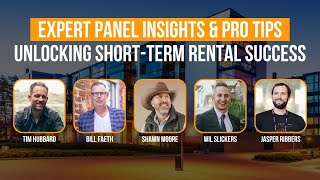
Tim Hubbard moderates a panel with Bill Faith, Jasper Rivers, Sean Moore, and Will Slickers on short-term rental investing. They emphasize picking markets with clear regulations, designing for a specific guest experience, locating near attractions like water or national parks, and budgeting heavily for maintenance and launch costs.
Chapters
Well, welcome back to the Short Term Rental Riches podcast. This week we have an extra, extra special episode for you. And I put the extra in there twice because it truly is. This week's episode is not just yours truly, but I'm going to be joined by several expert panelists in the industry. They have a ton of wisdom and insight, actionable advice that are going to help you along your real estate journey. We're going to be joined by Bill Faith, Jasper Rivers, Sean Moore and Will Slickers. And if any of you don't recognize any of those names, please know these expert panelists have a ton of industry knowledge. They all also happen to have their own podcast. So what we've done is we've condensed this episode down into a bite sized format because our full panel was actually an hour and a half. So if you want to catch the full panel, you can go over to restmethods.com forward/panel and there you can get the full hour and a half. But what we've done for this episode since we try to deliver short, actionable advice, is we've cut it down a little bit. So in this episode we're going to touch on the top three criteria that all of our expert panelists use to acquire to find profitable short term rental properties. We're going to talk about how they address management and maintenance efficiently. We're going to talk about unforeseen expenses that new hosts come across when they're first getting into the as well as challenges, we'll be breaking down essential strategies for guest occupancy and retention. And then last but not least, and none of us have a crystal ball, but we went into where we see the short term rental industry heading trends, disruptions and opportunity in the industry. So this episode is going to be jam packed. Once again, we've condensed it down but if you want to get the full version, head over to restmethods.com.
And there you can get the video or the audio format. And you can also get in touch with all of our amazing expert panelists that have a ton of knowledge. Stay tuned. Let's get right into it. We'll just kick it off with you Will, if you want to give a quick intro and then jump into Jasper next.
Yes, sir. Well, thank you Tim again for inviting all of us. This is going to be a fun panel. I'm Will Slickers. I'm the founder and CEO of Hospitality fm. They also have a management company called Recreation Rentals and we're based out in Seattle and we have a couple of properties in Florida as well. I got started in the industry with hotels. I was a Marriott guy, discovered podcasting in 2018, was able to quit my Marriott and hotel management job in 2019 a year later due to the podcast. And then fell in love with this industry beyond hotels and vacation rentals. And 2021, we launched our podcast network. So now we have over 30 shows. And yeah, we work with amazing creators and amazing audiences and groups. So that's kind of my. My spiel.
Awesome. Thanks for joining us, Will. Jasper, let's jump over to you.
Still waiting for the invite, Will. My name is Jasper Rivers. I, I wrote a book about 10 years ago, get paid for your pad and also the host of the get paid for your pad podcast. I also have a educational company, overnight success where we have different courses, where we recently launched a new hospitality brand called free Wild where we were developing and purchasing old, old school vacation rental communities in old vacation rental markets and really bringing up the experience and bringing a new level of experience to those, to those markets. We have our first property in Idaho and we're hoping to acquire another 20 to 25 in the next three to five years.
That's awesome. Thanks for joining us, Jasper. Sean, we'll jump over to you.
Awesome. Appreciate you having me, Tim, and excited for this panel. This is like the, the heavyweights in the business, so I'm thrilled to be a part of it. And with these guys, I've been a full time real estate investor for 23 years. That's all I've ever done since 2000 and got into short term rentals in 2006, kind of before it was popular. I started buying these little vacation rentals and putting them on Craigslist and local classifieds way before the Airbnbs and Verbose were really even popular. Back 2017, I wrote a book called what the hell is a lifestyle asset? And since then we've launched a company called Vodicey and we're the founder and CEO where we help other investors get into this game that we all love so much and so really appreciate you having me and being part of this.
Yeah, thanks for being here, Sean. And Bill, that that leaves you last.
And definitely least, you know, in this group. I mean, I'm just here for two reasons, Tim, and I really appreciate it. I wanted to see how Sean was going to be dressed today and I wanted to see, I want to see Will's, you know, hair. I mean, he's got like the best hair in the industry. So in all seriousness, I've been doing Real estate since I was 1992. Commercial, multifamily, single family home, short term rentals, you name it, I've done it all in the space. I migrated all of my assets on the real estate side into strs in 2015. I still believe today it is the best asset class in real estate for us to invest into. I'm still seeing 5 to 6x returns on LTR and 2 and a half to 3 and a half on MTR. And I'm sure we're going to talk about that today. I'm the founder of Build Short Term Rental Wealth, Kiva Vacation Rentals and the STR Wealth Conference.
Awesome. Thank you Bill. Ton of industry knowledge here, authors, people put on events. I'm excited to dig into it. My name is Tim Hubbard. I'll be moderating the panel today. So I'm the CEO and founder of Midtown Stays. I built a portfolio on my own about 70 properties and since then we started managing properties virt and and I'm also working on development International, host of the Short Term Rental Riches podcast. So let's just go ahead and jump into it. Okay, question number one. And I realize these questions are pretty general. Each of these could have a week long explanation. But for the sake of our audience's time and just trying to get a general consensus, consensus we'll try to keep them down to just like two or three minutes per person. So first question is what are your top three criteria for selecting a profitable short term rental property?
Bill, why don't we just start with you and then we'll work our way backwards.
Okay, sure. Number one is marketability, number two is proximity and number three is location. So all of those things I believe in value stacking and that's why I'm able to just annihilate the 90th percentile of Air D&D with my own portfolio and co hosted portfolio. I perform about 67% above the 90th percentile. I am only in vacation rental markets that have long standing regulation as well. I'm pro regulation. I'm not in urban areas. So what I'm looking for is and Sean can appreciate this, you know he's got his Montana Wyoming gear going there. I bought a property two and a half years patience. I finally found my first property in Montana in February and it's literally about 23ft 16 steps to the river to where and you and I talked about this on your podcast. I can be grilling out, you know, doing a brisket on my Traeger and I got the Fly rod going into the water from the deck. So proximity is huge for me. Marketability is huge. A lot of people don't visualize when they're walking through a property for the very first time or looking at it on Zillow realtor.com how are they going to market?
Awesome.
Okay.
Sean, I love you. Yeah.
And I think that I agree with a lot of what Bill said. The number one thing we look at is rules, regulations, can we operate a short term rental and we want somewhere that has a definite yes. We do stick away from like very much like Bill. I go to destination areas. I'm very, I don't go to the urban areas. Typically we have, we stay in very conservative type of markets. Next thing is going to be what is, what does our investability look like? And that is based on revenue, like market revenue projections and the ratio between that and my acquisition costs. There's a lot of really great areas that I'd love to invest, but they just don't have, they don't have the investability. For me, I live in the mountains in Utah and Park City area. This is not one of those areas that cash flows really well. We love the, we love the properties here, but the investability is not great for us because acquisition prices are so high versus revenue. So I'm really looking at that investability as an investor. And then that third thing is we're not buying any properties that we can't create that unique experience. Like what, what Bill saying proximity is huge. Right. Are we on I love water. I might. If I, if you're going to catch me, it's going to be either at the office or in a river with a fly rod in my hand.
Right.
And so we, we like properties that we can go create these unique experiences. We're in the game of experiences, not properties. I think it's the biggest mistake a lot of investors make right now is they think that we're selling a property that's not what we're selling. Right. We're selling an experience. And so when you do have that proximity to the, the amenities, the big profit drivers that people are coming in there for, what you can do, property can be part of that experience. But how close are we to those certain profit drivers in the amenities that people are coming in for?
Okay, well, Jasper, let's bring it over to you.
Yeah, I mean, definitely agree with, with everybody's saying here. You know, we, the way we look at it is, you know, we have to be in the mindset of create selling experience versus setting A space. Right. So totally agree with what everybody's saying. So, you know, just to add a couple things to this is for us, the alignment with our brand is very important. Right. We have a very specific experience that we're bringing to the, to the industry where we're helping people disconnect from their digital devices and reconnect with nature. Right. So we always want to be very close to, to nature, whether that's the mountains, whether it's. That's in a national park, whether that's a river like Bill mentioned or the ocean. We want people to, to be able to disconnect and really reconnect with what really matters, like how people used to spend quality time with each other in the past.
Right.
Playing board games, music, sitting around the campfire. Right. We feel people get too, too lost in their. On their devices. So to us, that's the number one important, most important thing is, you know, does this property align with our brand?
Right.
We want to be two to four hours from major cities, driving distance. We want to be in those unique natural environments. And then one thing that I'll add as well is, you know, obviously everything that, that these guys mentioned we look at as well. But one thing that's important to us as well is the value add. You know, can we build additional cabins? Right. What can we do with this property to really raise the, the value of the property and raise the ADR on it?
Right.
Can we install hot tubs or different, different amenities? What are. Obviously the regulations are really important as well, the zoning. You know, do we need to get conditional use permits, things like that. But I'd say, you know, alignment with the brand, value add and, and the experience are the top three things for us.
Love it.
Experience. Yeah. That's a consensus, that's for sure. If we set the wrong expectations, the whole thing falls apart, doesn't it?
For our management company, we're not like, we don't call ourselves co hosts, we don't call ourselves. We're not arbitrage, we're not. This. We don't also own, but our management company, when we're working with investors or owners that have properties, just like all these guys are saying, regulation is super key. So not being in an urban destination, but being on the outskirts is great. And what I've been obsessed with since 2017, 2018, is creating a destination. So we used to have this castle property that was under our management, and it was 22,000 square feet, had a checkered board floor, it had multiple dining rooms. It has a safe Room that was actually an arcade that we built out and it was the destination. So our guests never had to leave. They had instacart ability, so we were able to have them get groceries stocked up. Before that we had private chef offerings. Literally, our guests never had to leave. But if they did leave, the community, which is my second or third piece, is the community around them, the local businesses that you're able to partner with, to showcase and put on a spotlight for them. That's where the real value add piece is going. Because then when they do leave, or if they do want to leave the property and experience the local town or destination, you're able to offer some really great insider stuff that, you know, Google or Yelp wouldn't be able to offer. So it's always about creating a destination. Whether you have a simple home in a nice quiet neighborhood or if you have a beautiful 22,000 square foot castle just hidden in some, you know, corner of the world.
Yeah, that sounds awesome. Well, awesome. Great advice too. Well, great advice from everyone. That was a really good, really good start. I think one thing I might just add in here is that it experience is pretty much across the board. Everyone realizes that we have to have a good, unique experience, provide amenities, but before that, we kind of need to know who we're providing that experience for.
Right.
Our guest avatar. And so I think that's an important piece that I would just add in there that you guys all of course already know.
Making sure that this experience that we create is always consistent and that the operations behind it are consistent is a huge piece of the puzzle as well. I'm going to go ahead and just jump into this question on how do you address property management and maintenance efficiently? And so Bill, let's just bring it back to you and then we'll go through the lineup again.
Yeah, I think that's actually one of the biggest fears for people when they're looking to self manage remotely. I live 20 minutes south of Nashville, Tennessee. Nashville from like 2013 to 2018 was the number one market in the country probably in the world. I think maybe according to Air DNA. I've never invested there because of like what Sean brought up, the regulation, it's way too volatile. So basically that meant I had to start self managing remotely and I still do today. Every one of my properties. It's honestly, if you have your shit together and you have some process on the back end and you, you leverage relationships, referrals and go to the local Facebook groups, you can find that the reliable handyman. But I think one of the things that I've learned and I've done 29 startups and had probably close to 16, 17,000 employees. Tim and I used to be a really really bad manager and I learned to become a really, really good manager. So one of the things that's as important and people will probably think this is crazy. So every market that I go into I typically invest into two to three properties and I build my properties in what's called pods, right. So people talk about the scales of economy, I talk about the scales of relationship. I invest into my boots on the ground. I will only use a cleaning company that has a handyman that has their own connections and then I help them build out their company. Right. So I leverage my influence if you will in this industry to be able to help them gain and build their business. I teach them how to run P Ls I teach, I invest into them. That's the deal. Because I want to become the most important person to them.
Great advice Bill. Investing in the team.
Sean, what are your thoughts on properly addressing management and efficient.
I love it and I love this question because I differ a little bit than a lot of these guys on the panel and a lot of people in this industry is I don't self manage any of my own properties. We've been doing this for a long, long time and we've never taken on management we believe in like I'm a big proponent of full service property managers and finding the right ones to help us manage our properties. And I and wanted going back to a couple of Bill's points, the reason we don't and the week that I haven't is I've never. There is economies of scale in, in your people. Right. And it's not as efficient for me to go because my properties are spread out. I don't buy in pods. I buy one property here, one property over here, one property over here because I buy my, my portfolios properties in areas that I want to go use them. I use all of my properties and I don't need two properties in each area. There's nothing wrong with that. Some of our most successful members, they have pods of properties and they get that those better returns because they understand the market, they build that team on the ground all those different things that as an investment but personally my portfolio is very spread out and so what we do is go spend a lot of time and effort to figure out who the best management partners are. I always believe like that it's, it's a little bit hard to be honest, because management partners are the Achilles heel there. It's. As an investor, it's one of the, it's the most important relationship I have long term is with my management partners and, and they're not all created equal. And it's, it's. But when we find the right ones, like the first question I asked my management partners when I'm interviewing is how can I be your best client? Just like Bill. Bill says, I want them, I be really, really valuable to them and make sure that that one. That they can help us deliver this great experience.
Great input. Jasper, let's jump over to you.
Yeah, I mean our current approach is kind of in the middle between what Sean and Bill were saying. So we partner with a management company for the underground stuff. So the cleaning, the maintenance. But we, we own the online side of it. Right. So the messaging, the listings, like all of that. So anything we can do remotely, we'll own it. But then we partner with a management company to, to do the on the, on the ground work. Now the reason that we're doing that is because like Sean is saying, like we, we want to expand to multiple locations. So we rather have one, one community or property in 25 different markets versus expanding in one market right now. If we were to purchase multiple properties in the same market then we might eventually shift to a self management approach. But as of right now, yeah, we look for the best management company and then we try to support them as much as possible. I think one thing that's very important for us, we have very high standards. So the management company has to understand that because they might have other clients that don't have those expectations. So I think that's really important to set the expectations and then hold them accountable and support them as much as we can with our systems and our knowledge of the industry as well. So kind of help them, you know, raise the bar for, for them as a management company as well.
Awesome.
Yeah.
So somewhere right there in between. But also strategy that can absolutely work as long as we get it right. Right. So Will, let's jump over to you.
Yeah, I was gonna say, man, Sean, I wish I had more owners like you because on our side we actually have to handhold a lot of our owners and investors because they buy a property because of how popular short term rentals or Airbnb became during COVID that they're like, oh, I could buy anything and it's gonna be a great short term rental. I'm gonna make a ton of money and I don't have to do anything. It's passive income, right? Wrong, that's not the case. And they buy a hole or they buy something that's not in a good destination that's got bad regulations X, Y and Z. They don't know how to fur because you know, their sister in law is an expert designer that's designed their house only that they live in and has never actually designed a short term rental. So like you have that happen and so we have to kind of say, hey, as a management company we're going to buy the linen and we're going to buy the amenities, we're going to buy the furniture. Like we like legit will finance the whole design and the aspect of the destination that we're going to manage. And then say, look, our management fee is obviously this but with you having to have 20,000 and pretty much financing done with us we take more throughout every monthly payout. But our team on the boots, on the ground, you know, we use Turno to help find cleaners and it's been a great kind of marketplace for us. But ideally once we get a cleaner on board for about 90 days, we bring them internally if they're really, really good because then we can control better incentives and instead of doing like extra payouts and stuff with cleaning fees, there's more margin to be made as a manage management company for us if we can actually pay our team on hourly rather than just giving them the whole cleaning, cleaning fee. So for us we focus on investing like Bill said, investing in the team, making sure that the properties are gradually good and when the team is crushing it, they get rewarded.
It's awesome. Well, yeah. Yet again another note on how important it is to take care of the people that we're working with. And there's no doubt about it, like the short term rental space is a team sport. Right. I mean we can't do this all on our own. If we're planning on doing it all on our own, then we're going to get maxed out really quickly. I mean so definitely team sport, taking care of everyone that we work with, no matter whether it's some sort of a hybrid approach like Jasper does or myself. And our team is sort of a similar approach. You know, we have properties scattered around multiple states and countries now and so we rely heavily on our, our teams on the ground to, to, to be professional and we support them in every way we can. And then we handle all of the online piece. So a lot of different ways to do it, a lot of different the software options and Everything out there. Now let's jump over to a question that hopefully will help some of our new hosts or people looking to get into the space and that is what are the top three unforeseen expenses or challenges? So this is pretty broad again that new hosts should prepare for. So someone that's looking to enter the short term rental space but hasn't quite taken the leap. Bill, let's jump back to you.
I think the biggest issue outside of an expense. I'll get there in a second. Is they don't learn how to underwrite a property and that's why they've made bad investments and that's why so many of the professionals that got into this very passively and they wouldn't even go and put their own eyes on a property and they trust their agent made bad Investments. In 20 from 2020 till today. There is a science and there is, you know, some non data components that go into underwriting or performa. I have 16 tabs on my massive performa that I teach my mastermind members and I use for every single property. Some of the unforeseen expenses are when you buy a property that's not new construction or specifically when you go to the beach or you buy something today that's, you know, close to water. The salt air, the water, the moisture, the humidity. I mean stuff just rots, it breaks. The maintenance costs are always underwritten way too low. And I think the other thing John's brought it up is just, is regulation. So I believe that you have to do way more than just look at today's current regulation. You need to look at the history of regulation in a market. It, everything. Every bill that is passed is public record and you should go back at least pre Covid in my opinion. If you're going into a market that does not have sound regulation and then the last thing I'll tell you, do deep research, right? Find out about lots and about beach trends and about access points for ski in, ski out, all these things. Deep research that is that other people are not going to do.
And there no are, there are no free lunches. Right. We have to, we have to put some work into this. Underwriting a property. Crucial, the, the most crucial step. I love that. Unexpected expenses being next to water and knowing that a lot of times when someone's selling a property they downplay those maintenance costs because they want to sell the property. So love that regulations. Super important. Sean, let's, let's jump over to you.
Yeah, I don't want to be a beat A dead horse. But I, I do want to put an exclamation point on what Bill said, underwriting. And, you know, I think that that's one of the biggest mistakes that new investors are doing. We all want the easy button, right? And there's a lot of software tools out there that tell you, hey, throw the address in here, put the bedroom and bathrooms in there, and I'm going to spit you out a revenue number. That is not how this game works, I can promise you. Right. Simple is not always easy. The way we underwrite properties is fairly simple. I'm like, Bill, we, we have, we do all of our own underwriting. We've got all kinds of spreadsheets and things that we pull data from some of those same exact tools that you can just put an address in and it'll tell you to tell revenue number. There is a. Like Bill said, we say that there's an art and there's a science to underwriting. And those tools cannot measure the experiences. They can't measure the proximity to certain profit drivers because they're just not data points that they're pulling. And if you're going to rely on somebody else to underwrite your deals, don't blame anybody but yourself when you, you know, a couple years down the line or the year down the line, you're not performing how you thought you were going to perform. Unexpected expenses on the back end that I see is we all, you, you know, you spend, you save up for the down payment, you get this property and you think, well, I'm just going to go, you know, to yard sales and everything else. In fact, I see people saying, you don't have to have these great furnishings. You don't have to have all this awesome artwork and do this in your properties. You can, you can operate on a shoestring budget. That may be true, but I hope you didn't underwrite at the luxury side of the market.
Right.
You better have underwritten more at the budget or economy side. And so the unexpected. I see people all the time buy properties, and then they start. Start trying to furnish them, and then they start trying to get their marketing assets. And like, Sean, I can't. I can't afford the photo shoot you're talking about and getting this property set up. I'm like, listen, you need marketing assets for the next three to five years. You. You should have budgeted that because a lot of people just run out of steam right after they buy the property. And so you have to budget to get yourself all the way through that launch, right? These properties need to be set up. They need to have marketing assets. We need to be able to launch a property and get through that setup phase. And that can sometimes take people six to nine months.
Let's go ahead and jump to Jasper. We still have a couple questions. We want to make sure that we get through, but I love everything you guys said there. I think, you know, we have to be very diligent, right? When we do our due diligence. That's kind of big piece there.
Go ahead, Jasper. What I'll add is I'll tell a funny story. So, you know, I've done close to 600 podcast episodes on Airbnb hosting, and I still remember when I. When I was at number 100, I had a friend who, who asked me, how many. How many podcasts do you do? And I said, well, twice a week. And he started laughing. He's like, twice a week? What are you.
Are you kidding me?
Like, I mean, you're talking about Airbnb. You're talking about buying a house and creating an Airbnb listing. Like, what on earth do you talk about? Right? And I think that's. That's. It's very funny because this person is actually not one of our investors. So. But, you know, a lot of people who are new to Airbnb, that's how they think about it. It. They think you buy a home, you toss. Toss it on Airbnb, put some photos up, takes two hours, and then you sit back and, you know, the bookings will come in and everything will be, you know, everyone's going to be a happy bunny. Well, that's not how it works. I mean, you. You know, the moment you have an Airbnb, you're in business. You're now an entrepreneur. You have departments, you have your marketing, you have your. Your operations, right? You have your revenue management. You could argue you have your sales, even, right? Like, how do you. How do you convince people to actually stay? When you get an inquiry or people reach out, you have to answer the phone, right? You have to have a website where people can find you. Like, there's so many aspects of this business that I think people usually underestimate how much work and how much education is required these days to be successful. That was when I started in 2012. That wasn't the case at all, right? You could literally just toss it. If you're in a city or you've got a nice location, you toss it Airbnb, and boom, you make money. Money. You know, that's. It's what we call like the set it and forget it host. And that game is, is over. It just doesn't work anymore.
It is over, isn't it? So much to learn. I just want to remind everyone that's watching this or this can be catching the recording that everyone here has a podcast and has lots of amazing advice that goes in much more depth on these topics that we're talking about today. So we'll make sure to get all this information, everyone that's joining us and on the recording so that everyone can tune in to everyone's podcast. Will, let's, let's jump over to you.
Yeah, again, Sean said it, I'll say it. I don't want to beat a dead horse. At the end of the day, the one thing, you know, Tim, you asked the question of like, what can hosts expect or what are the three costs that kind of creep up on you? And I think from a hosting standpoint, if you're going to be a property manager, I hate the word hosting. I just like Jasper just said, you're in a business, right? You're, you're not a host. You're a hospitality entrepreneur. You're supposed to create experiences. You're supposed to run a business. Coming from the hotel world. That's just how I look at it. But at the end of the day, the locks are super crucial. Whether you're in a beach destination, the Saltier, like Bill said, or if you're like in Steamboat where it gets negative 30 degrees, if your guests are trying to check in and your lock freezes, you're kind of screwed, Right? And especially if you're a remote host or operator, hospitality entrepreneur, as I just said, that's a big cost. And then so also internally, as the operator, when your team is doing turnover, you're gonna have the number one thing is going to be white linens are going to get stained. Whether it's blood, other bodily fluids or makeup, that's a big one. We have a lot of bachelorette parties and after a crazy night, someone sleeps on the white, you know, pillowcase and forgets to take off their eyeliner or cake of makeup that they put on to, to show up. And at the end of the day, that's a cost that you're going to have to, you're going to have to eat.
And I appreciate you adding some insight in for those of you, those of you out there listening that want to build a business, because a lot of us can get into this, you know, for the, the lifestyle asset side of it, a Lot of us want to build businesses out of this and the expenses are different. I'll just add one in terms of not maybe our, you know, breaking dishes and linens, but when we get some big, large cap X expenses. I'll give you an example that I just had in my fun little portfolio. We had a delivery truck rip the power line off one of the properties, recently ripped the meters. Right. Of two apartments. And so we not only have a large expense from that, but you also have the time that it takes. We can't rent out a property with no power. Right. So when you guys are budgeting, this goes back to Bill and Sean. You guys talking about underwriting? We need to allow for that budget too, because, you know, these things can really crush someone. Now, a lot of insurance policies cover loss of rents and things like that. So I'll kind of just leave it there. But make sure you've got a rainy day fund as well. Well, okay, so, and this is a doozy of a question, you know, this is the crystal ball that everyone always wants to know. But let's, let's take this back to you, Bill. There's a lot of different ways to do this. As we've heard just on this panel, what does the future of short term rentals look like to you? Any trends, challenges, disruption? Well, I gotta say, that was not only awesome, but it was a ton of fun having all those expert panelists on and a ton of valuable advice in this week's episode. Remember, we did con condense this down to a shorter format just for this podcast release since most of our episodes are a little shorter. So if you want to get the full version, which I highly suggest you do, it's packed full. There's not a minute in this panel that you want to miss. So you can get that full version if you head over to restmethods.com forward slash panel. There you can also see the contact information for all of our panelists, how you might get in touch with them and any resources that they have to share with you. So I hope you enjoyed that episode. If you haven't left us a review yet, if you haven't left us a review yet and you are enjoying the podcast, let us know if you have any ideas that you would like us to talk about in the future. You can send us an email or go to Strict. There's a spot to submit comments there. So I hope you enjoyed this extra special episode this week. And until next time, have a wonderful week.
More from Tim

Airbnb profit insights to get your business ready for sale! #podcast #realestate










What Most Successful STR Investors Are Focussed on Today: From a 300+ Investor Meetup