My Experience Hosting 30,000 Guests and Counting
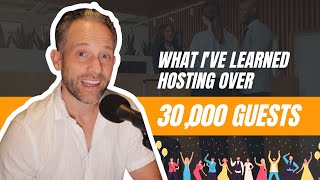
Tim Hubbard has hosted over 30,000 guests across 45 short-term rentals built over four years. He's learned hard lessons from guest lockouts, double-bookings, and a failed laundromat, and built a remote team of 15 to manage the operation. He sees AI and medium-term stays reshaping the industry.
Questions this video answers
Episode 200
Over 30,000 guests
2010
2015
Around 70 properties total; about 45 are short-term rentals
Chapters
I can hardly believe it. Here we are at episode 200. Every single week for nearly four years, we've been coming out with a quick, actionable episode to help you along your real estate journey, but with a focus on short term rentals. And we have covered a lot, A lot, a lot, a lot has happened over the last nearly four years. So I want to recap that this week and go over some of my biggest failures, things that I've learned managing with my team now over 30,000 guests. When we first got started, that very first episode was my journey from 0 to 10,000 guests. So we've come a long way, we've learned a lot. And I want to share it with you this week on the Short Term Rental Riches podcast.
Welcome to Short Term Rental Riches. We'll discuss investing in real estate, but with a specific focus on short term rentals, quick actionable items to acquire, manage and scale your portfolio. I'm your host, Tim Hubbard.
So, yep, here we are years later. Thank you for everyone that's tuned in. I can't believe we have hundreds of thousands of people who have listened in from nearly 100 countries around the world. Yes, short term rentals exist in the whole world. That's one of the exciting things about them. I want to share a little bit of my backstory because a lot has changed since that first episode four years ago. Those of you that have tuned in each and every week, well, you know, a lot of the changes. But for anyone joining us for the first time, I want you to know that our advice comes from real world experience. We are in this and we are doing it along with my personal portfolio. So when I got started a long time ago in real estate, that was back in 2010, I was doing long term traditional rentals for quite a while. For about six years. Five, six years. And it was a very slow route, as real estate often is. I got my license to be a licensed real estate agent in California. Definitely not necessary if you want to be investing in real estate. But it did allow me to land a position working as a commercial broker where we sold investments, all kinds of investments. So shopping centers, apartment buildings. We didn't sell short term rentals actually, but land, warehouse, basically everything else. And I learned a lot in that job. It basically gave me the foundation for my investment career. So I was building slowly but surely. My first property was a fourplex. I moved into it, I did the house hacking thing and then I just kept sort of adding properties. And then in 2015, that's when I switched my first long term rental over to a short term rental and I never looked back. So from those very first guess, that's when the learning curve started and it hasn't stopped. There is so much information out there. So I'm excited, excited to be able to do these podcasts every week because it helps me sharpen my skills. I'm constantly studying, constantly going to conferences, constantly listening to other podcasts or YouTube channels, or learning whatever I can to improve my business. And I hope that it's helped improve yours as well. So once I got started with those first short term rentals, well then I realized, wow, this is making so much more money than my long term rentals were once I found some opportunity outside of California. I only found that by the way, by doing research and getting out there and actually checking things out. Luckily we've got a lot of that research at our fingertips. But that brought me to Tennessee. After that I actually moved out of the country. A lot of, you know, I spent most of the last six, seven years in Colombia, but that didn't stop me from building my portfolio in the us. I also expanded into Oklahoma. I'm now looking in other markets, but I've also acquired in Brazil. So it's been a fun journey. It's definitely had its ups and downs, but now I've got around 70 properties. They're not all short term rentals. About 45 of them are though, and I'm constantly looking to add more. I'm actually working on a development down here, Medellin, where I currently am. Purpose built short term rentals on a beautiful lot overlooking the city. I'm really excited for it. It's a new venture for me. I hope it works out. But construction is a different ballgame, especially in a different country. So I will continue to keep you posted on that. But needless to say, I'm not stopping in the short rental industry. And so I'm excited for the next 200 episodes to come. Short term rentals have allowed me to do what I really got into real estate in the first place for. And that was so that I could travel. I love traveling and I was really fortunate to go to Spain when I was in high school. I got to live there for a few weeks in the summer and it was just enough for me to realize that this is a really big world. There's a lot of cool places to see and everywhere is different. Every city within every state, within every country, it's all different. It all has a different vibe and different energy. And so I love exploring in Fact, when this episode airs for the first time, I'm actually going to be in Europe. I'm really excited, getting ready for a four week trip actually heading to Poland, heading to Albania, heading to France, heading to Portugal. It's going to be a really good time. I am going to be working a little bit, but it's also going to be a good time just to reflect on the journey up until now. So that has been the journey up until recently this year. And then an exciting thing happened. We realized that the team we had built to help manage my own portfolio was big enough to where we could start taking on properties wherever they happen to be. So we begun working with other short term rental owners everywhere from Canada to the east coast, from studio apartments to properties that fit 20 people. So that has been a lot of fun. We've built an amazing team, nearly 15 people now from all over the world, the world, mainly Philippines, mainly Europe, mainly Mexico. But we don't discriminate against countries. We're going to hire the best talent that we can find. So that's been a lot of fun and I'm excited to see where it takes us in the near, near future. Before we jump into my biggest failures, I just want to go over a few of the pros, the positive things that have happened in the short term rental industry since we published our first episode in November of 2020, 2019 quite a while ago. One big thing that's happened is we have more OTAs now. We have more online travel agencies, more places for us to list our properties. And it's also easier for us to list our properties than it's ever been. We have more software programs than we've ever had. We also have an industry supporting short term rentals now. When I first got started, trying to find a housekeeper was not that easy. You might be able to find a good housekeeper to clean your house with a bunch of furniture in it while you're living living in it, you know, maybe once a week. Or you might be able to find a housekeeper to help clean your property when you're getting ready to sell it. But someone that specifically worked in the short term rental industry was a lot harder to find than it is now. So now we have professional companies that we can look out to. We have applications geared towards helping us find people to help service our short term rental properties. We have new tools that have been created to help protect our properties. So that's one big lesson I'll get to, is that the property protection piece is an important one. But the nice Thing about it is that we've pretty much got it figured out. Now, another one that is really positive for the STR industry as a whole is that we've generated billions of dollars in tax revenue for cities and municipalities, and that has helped boost a lot of local economies and global economy. Just Airbnb alone has collected over 7 billion in tax revenue just from the US and just from Canada. Now, again, this doesn't sound like, oh, a bunch of taxes is a good thing, but this is helping so many people, it's helping so many jobs. It's provided business for restaurants and local entertainment, and it's helping to keep the gears move and the wheels turn of so many local economies and big economies. And so this is something that's not going away. Short term rentals are not going away. We know that for a fact. And now onto the failures. And you better believe after over 30,000 guests, we've had our fair share. You name it, we've pretty much come across it. But we've learned from all of those issues, all of those failures. And so that's the goal. So you don't have to recreate the wheel. You can learn from our mistakes. I think the biggest failure that we've ever made, and unfortunately it's happened more than once, is when a guest shows up to our property. Something happened at some point and they weren't able to get in the property. So. So luckily, this hasn't happened in a long, long time. I actually did a whole episode on this. You can go back and check that out. But that is the biggest failure as an STR, or short term rental operator. If our guests can't get in, boom, we failed. So that's number one. The second failure or set of failures I should say is just all of the issues we've had with guests. Yeah, I don't want to PA all daisies and roses here because we've definitely gone through some tough times. Going through Covid. Those were tough times when, when our normal guests switched from being an international traveler, from flying in from across the US or from a long drive in to local guests. Well, we had issues. We had issues with parties, but we learned how to combat those. We learned how to protect our properties. And so we've learned from these mistakes. We now have processes in place where our guests are signing digital contract. They're uploading their ID so that we can match it with their credit cards. We have cameras in place, we have deposits, we have signage. We have all sorts of things to help protect our properties, not to Mention insurance specifically for short term rentals, which was much harder to find back in 2015 when we got started. So we've learned how to protect our properties. Go back to Strict, where we have all of our episodes and just search for property protection. You'll find a whole bunch of things that pop up to help you protect your property. The same thing that we're doing with ours and now our partner's properties. So yeah, we've had some bad guests. We've also had some crazy stuff happen. And you know that these types of things happen in hotels as well, right? Anywhere where people are living for long periods of time or staying over and over, stuff's just going to happen. So yes, we have had attempted suicide before. We have found dead animals that fell down through the roof rafters and got stuck behind walls, creating lots of odor. Stuff that you really couldn't even think about. But what do we do? We learn from these things. That's just the name of the game. That's how we continue to improve, that's how we continue to get better and that's what helps us continue on. Right. Knowing that we've come across most issues, knock on wood. I know there's some out there that we still haven't come up with, but we've come across a lot. And so it's removed a lot of the fear. We're open to, to just diving in now. So the next failure, or I guess system you could say that I didn't really put in place soon enough was an excellent bookkeeping system. As you know, with the short term rental, we have lots of transactions, much more than we have with long term rentals. Where I started with my real estate career, so I was adding properties, I was adding properties all the time whenever I could. And that created a lot of transactions. And they're coming in different ways, right? They come in differently from booking.com than they do for Airbnb, for example. Then we have the tax remittance on the back end. So I feel really fortunate now to have an excellent team helping out with all this and also have the right software systems in place. But this is one that I kind of let go a little too far. And bookkeeping, if you've got hundreds of thousands of transactions that add up, that can take a little bit of work going back through. So if you're building your portfolio right now, take a second look at that. Make sure you have something and you're not overlooking anything. Another failure during the COVID time, actually, I. I was sort of stranded outside Of Colombia, where I had been living. I was down in Brazil, so you could say stranded. But luckily I was stranded in what I'd call a paradise. So I really lucked out there. But before I could go back to Columbia, I went back to the US And I was just waiting for the borders to open up in Colombia before I could go back there. And I've got a type A personality, I guess it can't just sit still for a really long time. So I was there in one of the markets where we have most of our properties and I was looking to improve things, Looking to make systems better and looking to make it easier for everyone too, is the other thing to make our operations easier. So I got the idea which a lot of short term rental operators that are doing a lot of volume get the same idea. It is a natural progression for a lot of us to start doing all of our laundry in house, actually to the point where I bought a commercial property and I was going to build a laundromat. And so I went through the plans, I spent a lot of work and a lot of money on that property getting it ready to put in a laundromat. And then the machines were not available because of COVID And so that set it back. And then the construction costs went way up. So I still have the building. I ended up getting a few just industrial machines. We still use them till today. But I don't make money on that property. In fact, I lose money each and every month on that property. It does help us with our operations and I do see that property being a good asset in the future. But right now that is not one that I'm winning on. So lesson learned here. There's a lot of work that goes into creating a new business. And that was the other part of this, a laundromat. It's a totally new business. So not only did we have the setbacks with construction and the machinery, but at a certain point the borders opened down in Columbia and I wanted to go back home. And so I was not there to continue setting up this business. Yeah, not a total failure, something we still use, but something or someplace where I probably could have invested my money a little bit more wisely. The next major failure, or really lesson learned, has to do with the team, has to do with your employees or contractors that are helping you out. And so I've learned a lot working with a lot of different people. And I learned that sometimes we have to rip the band aid off. Even when it doesn't seem easy. Sometimes we have someone working with us that just doesn't fit our culture or maybe doesn't have our company or our property's best interest in mind. And so I've worked with a lot of different team members. Fortunately, I've had to let some of those go. And it was never easy, but I learned a lot. And the lesson here is that sometimes we know this and we procrastinate. We procrastinate and we push it off until maybe we have to or we just can't take it anymore. So do yourself a favor, really consider who you're working with. And if there's someone that just just bad energy all the time when you're working with them, or they keep dropping the ball no matter what you do, maybe it's time to look for some different help. So that of course, is not fun. Okay, so to recap the biggest failures there, the number one, the granddaddy of them all, is if your guest can't get in, well, then you failed. You dropped the ball. Same goes for a double booking. Don't, don't let that slip by you. That can happen if we're not monitoring things right, if we don't have our property management system set up properly. Double booking is basically the same as someone not being able to get in cause you're leaving someone stranded. And hospitality is the name of the game in this business. We can't let that happen. So that's the first one. Second one is get ahead of your bookkeeping and your finances. Know all of your numbers. I was just growing really quickly like I said, and so didn't really matter to me at that point. But I'm sure I could have trimmed down a lot of unnecessary expenses had I paid a little bit more attention. So use some of the systems in place like QuickBooks and use your property management software and hire additional help if you can't handle it all on your own. The next big failure I had was with the Laundromat. And so that's not one that a lot of us are going to have. So lesson learned there. If you're not willing to put in the time to make your property successful, to make your business successful, or learn what you need to know, or hire who you need to hire, if you're not willing to put in that time, then it's very unlikely that you're going to have a venture workout out well for you. And so that was a big lesson learned for me with the Laundromat. And then the last one there, if you're working with A housekeeper. If you're working with a maintenance person, some sort of team member, someone that helps you out and the relationship always seems a little rough, things aren't always working out right. Maybe the ball's getting dropped and they don't have your best interest in mind. Well, maybe it's time to rip the band aid off and to find some new help. It's going to make your life a lot easier, I promise. Okay, so a lot of failures. This was just scratching the surface. I mean we've really gone through so much more than you could probably imagine. So check out our prior episodes. You can also go to restmethods.com you can see recommended resources there. We have all my favorite resources, software programs, used information from my accountant, all kinds of stuff for free for anyone out there listening. It will help you with your STR journey, I promise. So onto the fun stuff stuff, onto the good stuff, the positive side and where I see the short term rental industry heading. So the first thing is we have a lot of venture capital entering the space. We have hotels building short term rentals into their portfolio. So we're going to be working with the big dogs here pretty soon. When I first got started with short term rentals in 2015, you could throw up a property, you could do fine because people were loving it. But now we've got some increased competition coming in. Is there an Airbnb bus? No, I don't think so. Our properties are doing just fine. Our partners properties are doing well. So don't let the media intimidate you. If there's a good opportunity out there, run the numbers and I suggest jumping on it. A really exciting thing that's happened for all industries is AI. And we know that there's lots of different ways to use AI in our short term rental business to help, right? Write listing descriptions, to help write reviews, to do market research. We can save a ton of time with AI and you better believe it, that is making its way into the short term rental industry. We have medium term reservations, really making headway in the short term rental space because why? Well, people are living in short term rentals now. They're not just traveling in them. So that is an opportunity for a lot of us. And for a lot of us that is an opportunity we can use maybe just in our slow season. We've talked about that one before as well. This next one you could call a positive. But unfortunately for the other side of the equation, it's actually negative for a lot of people and that's that rents are Very likely going to continue to increase with higher interest rates. People cannot afford to buy properties right now. Construction companies have higher cost to build properties, which means the supply isn't going to keep up, assuming interest rates stay this way. Of course, every market's different, but the reality here is that we're entering a renters nation, which means more people are being forced to rent. But that does on the other side, that pushes up our rents. Right. And it also pushes up our short term rental rent. Well, I'm really rambling here. I mean, there's so much to talk about for the last four years. I just want to give you an idea of our background, where we started, where we're going, where some of this information is coming from. I hope it's helping you through your journey. I want to leave you with some of my favorite favorite books that have also helped. These have been my biggest mentor. Yeah, we don't necessarily have to be working with someone physically to be mentored by them. And so find your favorite YouTube channels, find your favorite podcasts, and if you can't work with someone locally or physically to mentor you through some of these things, then books can be your next best friend. So I'm just going to read through some of my favorite books here, ones that I really highly suggest that you read as well. They will change your life. If you're not a big reader, maybe go to YouTube, check out a 30 minute summary on these books. I swear, they really change your life. So the first one is the Gap and the Gain. And this is by Benjamin Hardy and Dan Sullivan. And I want to read a quote from this one. It says the way to measure your progress is backwards against where you started, not against your ideal in the future where you want to be. Because if we're always looking out into the future where we want to be, then we always feel behind and we can't apprec all the things that we've accomplished. And so I hope over the last four years you've grown, your short term rentals have done really well, you've acquired more or you're at least heading in that direction and you can go back and see these moves you've made to go where you want to go. So I really like that book. It really makes you think differently about things. And if you're a type A personality like me or an entrepreneur, we're always just looking into the future and so sometimes we've got to take a second and just look at all we've accomplished and where we've come from. So that's a great one. Napoleon Hill, Think and grow Rich. Can't say enough about that one. It's almost 100 years old and it's as timeless as ever. The slight edge. I've talked about that one a whole bunch of times, but doing little things over time equals big results. Traction. That is an excellent one if you're just starting your business, whatever business it happens to be. It also can relate really well to our short term rental portfolios and we can structure our team who not how. Excellent book also by Dan Sullivan, Benjamin Hardy about who we can hire and not how we can do things ourselves. Excellent, excellent book. I've talked about a while, of course, Rich dad, poor dad. That is like the foundation for the mindset for most of us real estate investors out there, and that is that our our house is not an asset. If it's not making us money, then it's not an asset. Buying rental properties with cash flow that pay us to own them, that is an asset. That's the main point of the book. But definitely check that one out. If you haven't, they'll change your life. There's so many good resources, but the reality here is that the more we learn, the more we can eliminate fears, the more we can eliminate uncertainty, the better investment decisions we will make. Remember, investing in real estate is not a guessing game. We have tons of information out there. We can run the numbers to see if something makes sense or not. I know that interest rates are higher right now. If you've been following the podcast for a while though, well, you would have heard my episode back in November 2021, which was literally titled why you need to refinance now. And so I didn't come up with that on my own. I didn't have a crystal ball knowing that interest rates were going to go up. Obviously there's a chance that they could couldn't. But from everything I learned and the people I follow, that's what I saw. And so I follow people that are smarter than me that have been through a bunch of cycles. We're going through one right now. In fact. I'm looking for new properties at the moment. And you know, a great thing about a lot of the properties that I've seen recently is that they have price drop after price drop after price drop. I'm sure you've seen this out there. If you're also looking. We are now in a buyer's market, so there's always two sides to every story. I know I'm totally rambling, but I just get really excited about short term rentals. There's so much opportunity. There's also opportunity for us to have it as a lifestyle asset where we can partially use it for our lifestyle but then we can also make money off of it too. So there's lots of ways to do it out there. I hope you've had a great journey over the last four years and I'm really excited for the next 200 episodes. I am a lifer in real estate and I hope that you'll stick around with me. Thanks for tuning in again. Until next time. I hope you have a fabulous week.
Want to get on the fast track to financial freedom through short term rentals? Well, it all starts with the properties you acquire, but you want to make sure that you acquire the right properties. I want to give you my ebook.
That will show you how to do just that.
There is no charge. It's my gift to you for being one of our subscribers. Just go to restmethods.com that's R E S T methods dot com.
More from Tim

Airbnb profit insights to get your business ready for sale! #podcast #realestate










What Most Successful STR Investors Are Focussed on Today: From a 300+ Investor Meetup