NEW Compliance Rules Every STR Host Must Know
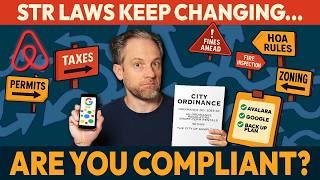
Tim Hubbard breaks down how to keep your short-term rental legal as rules change constantly. Identify your zoning, find which authority governs your property, set up Google Alerts for regulation changes, and handle permits, licenses, and taxes. He shares a personal fine and ban in Oklahoma City, and recommends Avalara or MyLodgeTax if you want help staying compliant.
Chapters
Hosts and multi regulated zones are three times more likely to get a fine or to miss an inspection or to miss a permit requirement and that results in a hefty fine. Regulations for short term rentals are changing fast and if you don't know the rules in your short term rental market, well then you're gambling with your income. In today's episode, I'm walking you through five must do steps to understand and stay compliant with with changing laws to help you avoid hefty fines. Spoiler alert. I just got a fine. And to help you keep your listing running smoothly no matter where you operate. Stay tuned.
Welcome back to the Short Term Rental Riches podcast. I'm happy you're here. Again, we're going to go ahead and just jump into these five must do items to comply with your short term rental regulations. I also have a couple two bonus tips for you to to make things a lot easier. The first part of this process is just identifying our type of short term rental and understanding what type of category it falls under. So if you're using Airbnb specifically, hopefully you've got your property listed on all the different platforms. But on Airbnb we have the option to rent buy a room or we have the option to rent our whole property. This is going to make a difference. When it comes down to the laws around operating as a short term rental, we need to know the zoning where our property is located. Remember, zoning can change from one property to the next. Your next door neighbor could have different zoning than your property. Maybe one's zoned residential, maybe one is zoned commercial. And so we need to know this ahead of time. And some cities treat multifamily buildings or condominiums different than they do single family homes. Even though the zoning might all be residential, the zoning might all be the same. But just because the type of property is different than your city or the neighborhood, there's a lot of different jurisdictions. They might have different rules for you. And so that brings me to point number two. You need to know who sets the rules for your short term rental. So we know it's not just the city. It could be the county, it could be an hoa. You might have a neighborhood that has its own CC and rs they're called. So you really have to drill down to as far as you possibly can go. And you have to look at each of these steps. And just a quick example, your city or, or your state might say, yes, you can do short term rentals in this state, but your property happens to have an HOA that says, no, you can't do short term rentals in this complex. These are the rules and you got to stick by them. So if you don't already know what your rules are, I've got some tips for you. An obvious one is just to call the city planning department and find out what their process is. Of course you can just jump on Google and you can search for short term rental laws, Airbnb rules or regulations and you're going to find some really good results. But we know that these things, things are changing all of the time. And so the better thing to do would be to jump over to Google and set up an alert. To set up an alert, just simply head over to google.com forward/alerts. You're going to see this search box there and when you start to type something in the search box, you're going to see all of what Google results would be. And so I put an example here. Short term rental laws, Nashville, Tennessee. And I can see one of the searches it found here popped up on the news. Apply for short term rental property permit Nashville. Now, we don't probably want all of these results coming in, so there are some filters here. So you're going to want to jump down to how often, I would say at most once a week. You don't need to get this every day. It doesn't change that quickly. Right. Sources you could check out, but I would probably go to automatic. There's another option for region, so you might want to limit this just to that area. And then it's got your email here and it's going to send a result to you once a week if there happens to be some updates. And so now you want to make sure that you're getting these updates or someone that's helping you with your property is doing this for you. Because these things change. And most planning departments or most cities when they make a change like this, they of course legally have to notify everyone. And so this Google alert is going to help you stay ahead of those changes. And the quicker you are to jump on them, the better it is for you. So we know that there's a lot of cities out there that don't have regulations set up that puts you in a bit of risk. There's jeopardy with your property. Right. It's possible that all of a sudden they could make that illegal. But what a lot of cities do is they have a grandfather type law or rule that goes into place. It says if you've been operating as a short term rental for a Long time, then we're going to allow you to continue to operate as a short term rental. But you still have to fill out the permits and the process. And so that is clearly not always the case. But if you're making sure to get these alerts and something changes, then you can jump on that if that's an option. Had I had these Google alerts set up and I wouldn't have received a fine where I did recently in Oklahoma City, unfortunately, I am no longer able to operate a short term rental there. They posted a letter on the building, this is a multifamily building. But they basically said you need to pay this right away. You're not allowed to offer short term rentals and if you would like to fight this, then you're going to have to show up in court. I happen to live thousands of miles away from Oklahoma City, so I did have a backup plan in place. In fact, I had one before I even bought this property. It actually operated as a long term rental and so I switched it to a short term rental to improve income income on that specific unit. The city found out about my short term rental just by searching on Airbnb. As far as I can tell, that's how they went about it. And one of the neighbors complained. I assume one of the long term tenants said, hey, you know, this owner is running short term rental. Long story short. Now I am not, but I am still renting that property as a midterm rental. If you're new to this channel. Well, we've talked about basically all of these concepts and we've definitely talked about midterm rentals. Before you can head to Striches, we've got a little search box there. Look for midterm rentals or download our free midterm rental guidebook which runs through our whole process for managing midterm rentals. My team and I have managed over 50,000 guests in over two dozen cities now and internationally. So we've learned a lot and we've got all these resources for you for free on our website if you're enjoying the content. Well, a little like and a subscribe helps out a lot. Now back to today's topic. So the fourth point here is to understand what you're actually responsible for. We know that these cities pass laws because they want tax money, but that's not the only piece of the puzzle. Very often we need to apply for permits, we might need the licenses, we might need inspections. And so there can be a lot of pieces that you have to comply with and they're not just a one time thing. You know, some of these things you have to do annually, some of these things you might have to do quarterly. It really just depends on where your property is located. A lot of cities are choosing to put a cap on the max amount of nights that you can rent. A short term rental might be 90, it might be 180 days. And this is one of the ways they're trying to reserve long term rentals as long term rentals instead of short term. Whether that's the right thing to do. Well, we'll save that topic for another episode. But in general, this is happening more in dense urban areas. So think San Francisco, think New York, think London. Dense cities are often the ones that are creating some of these rules first and having more regulations in place. There's often many requirements in terms of health and safety. So having a carbon monoxide detector, having a smoke alarm requirement for a fire extinguisher, the requirement to have a posted emergency contact at your short term rental. Some jurisdictions might mandate that you need liability insurance, and so I would highly recommend that one as well. If you have a common homeowner's policy on your property is very likely not covering your property as a short term rental, you might want to check out proper insurer. I use a lot of their policies specifically for short term rentals and I know that they come with commercial liability policies. They're a little bit more expensive, but I'm covered up to a really large amount. Someone slips, if someone falls, then I am protected. So fifth tip here. Sometimes the listing sites like Airbnb make it pretty easy for us and they lay out all of the tax requirements and compliance laws right on Airbnb's website. You can go into your settings, click on the tax section and they'll have a link to your local area resources if they have it for that specific city. Now, you got to take this with a grain of salt. It doesn't mean that this is 100%, but it is an Airbnb's best interest to comply and make sure that all their hosts are complying so that they don't get banned from the city either. So quick side note, Airbnb, vrbo, they may be collecting your taxes for you or remitting them. Airbnb might be doing it and VRBO might not be doing it. It really depends on your city. Again, this changes across all markets as well. We know that booking.com never collects your taxes, your transient occupancy taxes, nor does a direct booking site. And so These are requirements that your city or state's going to have as well. They want want that tax income. The sixth piece here is having a backup plan. So I mentioned when my property recently got banned from the short term rental, I simply switched it to a midterm rental. So I'm allowed legally to rent it 30 nights or more, which works out really well in some markets. And some owners actually prefer this because there's a little less operations going on. And if you can still earn a great monthly rate and you can minimize gaps in your calendar, then you're going to have less expenses throughout the year and your net income at the end of the year might be quite a bit more than is a short term rental. That's something you'll have to figure out on your own. Although we do have another episode in this channel to help you calculate that. So having a backup plan is really important. Anytime we're making an investment decision, if there is no backup plan and there's no rules in place in the market where we're acquiring our property, then we really need to be comfortable with knowing that that property is potentially not going to earn nearly as much as it is as a short term rental. A lot of markets aren't set up as well to take long term rentals. You know, urban markets, of course that's an easy transition from a short term rental to a long term rental. But if you've got a vacation rental that's super far out away from everything, it's less likely that you would keep that property rented on a long term basis. You're going to have less rental tenant pool looking at that property. Now seventh tip here. If you're out there and you're like Tim, I don't want to set up a Google alert. Fortunately, there is a company that can help you do that. We refer a lot of our partners to them. It's called the Avalara or you can search my lodge tax for a small monthly fee. They will help you process all the permits no matter how often they need to be processed. They'll help you comply file for the license, they will remit your taxes for you. You need to send the money to them. But they that part a little easier as well just to ach deposit or a transfer and they're going to handle that and they guarantee your compliance. And so if you don't want to mess with all of it or you happen to be in a state that has lots and lots of regulations, then this might be a better option for you. So there you go. Seven steps for complying and making sure that you don't get caught off guard when it comes to regulations with your short term rental. Remember, when it comes to regulations and laws and fines, if you don't know about them, then that's going to hurt you. Just like me, you could find yourself receiving a fine and your property could get shut down. So I hope these tips will help you stay a little more proactive. And until next time, I hope you have a fabulous week.
More from Tim

Airbnb profit insights to get your business ready for sale! #podcast #realestate










What Most Successful STR Investors Are Focussed on Today: From a 300+ Investor Meetup