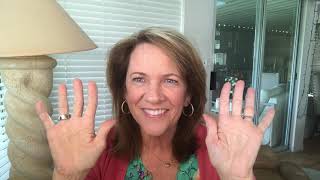
In this short instructional video, Susan Britton MCC explains why hand gestures are crucial for effective communication, especially in Zoom meetings where only faces are visible. She cites evolutionary research showing the brain weighs hand cues 12.5 times more than verbal cues, and references Vanessa Van Edwards' analysis of viral TED Talks, which found that talks with roughly twice as many hand gestures (465 vs. 272) were far more successful. Susan then offers four concrete tips for using gestures to create safety and clarity on video calls: (1) wave with both hands when joining a call to signal openness; (2) accompany ideas with purposeful gestures (e.g., counting points, indicating a grand idea); (3) place a hand on your heart to convey empathy; and (4) use a circular hand motion to invite others and foster inclusion. The video aims to help viewers improve remote communication by leveraging our innate sensitivity to hand movements.
Chapters
Hey everybody, it's Susan, and I am waving hello, and there's a reason for doing that because today's message about encouraging your brain has to do with hand gestures. So in these days of so many Zoom calls, we spend a lot of time looking at each other from sort of the neck up, and that's all that we see. And there's some interesting and unintended consequences that come about just seeing people's head or neck. And it turns out that the brain gives 12.5 times the weight to hand gestures as it does to verbal cues. And this stems back to ancient days that we have sort of this primordial primitive threat response that we're always watching for whether or not somebody is foe or friend. So if you couldn't see somebody's hands thousands and thousands of years ago, you wouldn't be sure whether or not they had a rock or a spear or they came with a peace offering. And so there's this biological threat protection system that's wired into us around being able to see people's hands. So this hand gesture finding came from Vanessa Van Edwards, and she did a TED Talk on "You Are Contagious." And the interesting thing is that she wanted to find out why some TED Talks had gone just crazy viral and others had not, even though they had good content. And in analyzing all of the bits of data, she found that the most viral TED Talks box had 465 hand gestures, appropriate hand gestures, to be able to convey the message that the speaker had, and the least effective had 272 hand gestures. So practically half, or, you know, somewhere around half. So back to our Zoom meetings where we spend a great deal of our day. So I'd love to offer to you 4 tips— notice my hand gesture— on how we can use hand gestures to create that sense of safety for other people and be able to communicate as well as possible. So the first one is wave to people when you get onto the Zoom call. Could be something simple, and it's interesting, if you show both hands, it sends an even greater message of safety. So that's the first tip. The second tip is to think about when you're sharing an idea, use some appropriate hand gesture. So maybe it's, I've got this grand idea, or if we took a little step, or we've got two points that are coming to mind. Those kinds of hand gestures can add, and to make sure that they're not distracting, to be able to bring home your point. Third, when you're wanting to convey empathy or something that's true for you, simply putting your hand on your heart can do that easily. And then fourth, if you want to be inclusive or add other people's ideas, you can use this sort of circle idea that invites others to complete the circle and says you're part of this conversation. So that's what I have to encourage your brain for today, and I'll say bye-bye.