Holding Space through Coaching | Neuroscience, Psychodynamics, & the ICF Competencies
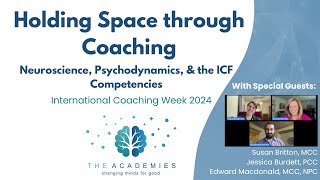
In this International Coaching Week livestream, host Jessica (Director of Coaching Education) moderates a deep conversation with coaches Susan Britton MCC and Edward MacDonald about what it means to "hold space" in coaching. Susan shares her learning from an Executive Master in Change at INSEAD, which uses a systems‑psychodynamic lens to view individuals within the multiple systems (family, teams, organizations) that shape behavior, and how silence and awareness of unconscious patterns can create the space needed for change. Edward describes his work in a neuro‑therapy clinic using biofeedback and neurofeedback (EEG, HeartMath HRV) to observe clients’ nervous‑system states in real time, noting physiological markers of coherence, delta/theta/alpha/beta ratios, and how these shift when space is held. The discussion weaves these scientific insights into the International Coach Federation (ICF) Core Competencies, especially Competency 5 (Maintaining Presence) and Competency 7.5 (Sharing without attachment). Both coaches explain how they integrate silence, co‑created agreements, non‑judgmental observation, and whole‑brain engagement to help clients move from passive observation to meaning‑making, decision‑making, and action. They also explore the nature of “aha” moments, hypothesizing that such insights involve more entrenched neural connections than ordinary learning. Practical suggestions include using heart‑rate variability monitors, creating personal coherence before sessions, and addressing organizational cultures that rush and deny space. The conversation closes with each participant reflecting on how the dialogue itself expanded their own sense of space and presence.
Chapters
Welcome back for International Coaching Week. We are so happy to have you joining us for our conversation today around holding space, and we'll be talking about neuroscience, psychodynamics, and the ICF Core Competencies, 3 topics that are fascinating and we will barely touch the surface of and wish we had more time for today, but it's going to be a great conversation. I have with me Susan Britton and Edward MacDonald, who are coaches that I get to work with on the regular with the academies and always love getting to have conversations about topics far and wide with. So to start us out, I wanted to let you introduce yourselves a bit more specifically around what you've been learning, because you've both been learning really deeply about topics in the past year plus. So share with us what your learning focus is and what the program or role is that your learning is part of.
Sure. So I, I have mentioned, I think, on some other conversations this week in our LinkedIn Lives that I started a master's degree program last year, a little over a year ago, at INSEAD in France. It's called Executive Master in Change, and it focuses on change from a systems psychodynamic approach. And so if you break those two words down, systems means that we all operate in systems, whether it's the coaching relationship that can be a system or our relationship with immediate family or extended family. And certainly on the work front, we have systems that are teams and companies and industries and geographies and cultures. So we are always in a system. So I think our topic today, listening, I'm really thinking about what is the system within which this human being is operating in. How is that person contributing to it? How is the system influencing them? So that's the systems part of systems psychodynamics. And then the psychodynamic part has to do with sort of what's under the surface within us individually, as well as within the system. And so recognizing that we have things that we do that might be unconscious, might be patterns of behavior, might be defenses that we might have, resistances that we might bring to things. We have those, systems have those as well. And so as it relates to the space today, looking at that space, looking at the silence necessary to see, feel, hear, and get below the surface of the systems for change.
I love how you broke that down, Susan. I'm looking forward to this conversation even more now. Yeah. So I've been working in a neurotherapy clinic for the last year and a half. We do a combination of biofeedback, neurofeedback, and some other holistic approaches. Biofeedback and neurofeedback are just ways of using technology to let you observe pieces of your biological systems and processes. So neurofeedback, we use EEGs. The kind of neurofeedback I've been doing is linear channel training where we're actually doing targeted approaches to different regions of the brain. And I've gotten to do coaching sessions with clients hooked up to EEG on a daily basis. That's really fun too, watching changes in the brain as I, as I coach them, watching changes in their, their nervous system with biofeedback as I coach them, and really enjoying pairing the two together and learning a ton about neurobiology in the process. So that's been a deep dive recently. I'm really enjoying it.
Awesome. And as Director of Coaching Education at the Academy, I've been very focused on making sure we have our neuroscience linked very closely to the core competencies, and we've got articles on our website you can deep dive on that more. So I will probably bring a lot of the connections where I can here around the ICF core competencies. All right, would love to hear how is your learning focus impacting the meaning of holding space for you both?
Edward, do you want to start?
Yeah, I think what's really neat about space in a relationship or in a conversation or in between people, there's a sense of spaciousness, not just silence, but there's a 3D sense to it. And what's really neat about the brain, brains record and memorize spatial relationship, even if it's irrelevant. I was reading about that yesterday, actually. It's a unique part of the brain. Even if we don't need to know where things are in relationship to other things, we still record it. Space matters. You look at the brain, most of the brain is glial cells. It's, it's the structure of the brain. It's not the neurons, it's the stuff in between the neurons. Um, and even looking at the little minute connections between dendrites on neurons, they're connecting in space. So I think even at a neurobiological level, when you're looking at the gap between neurons where the electrochemical signal gets sent, kind of like a spark plug gap, all the way out to a conversation where I sit with someone else and we hold space together, There's a very crucial element of space between things. And you can zoom out even further and look at space. Space is mostly space, not stars. There's something pretty profound about existence from the smallest to the largest that we know of. And the importance of— it's not nothing, but it's not something. It's something other than something. It's space. And that fascinates me, getting to see that in real time with clients, getting to— you can watch a brain settle into itself when you hold space for it. I get to see it every day. I see that every single client session.
So what does that look like?
So from a biofeedback standpoint with HeartMath, it looks like getting into a state of coherence. You can see heart rate variability go from chaotic to a nice even sine wave. You can watch someone go from a sympathetic nervous system bias, which is fight or flight activation, to a place of coherence between that and parasympathetic, where it's— they're alert and awake, but they're relaxed and calm and present. On a brain, it's watching delta come up a little bit. It's a nice slow wave. It's rest, relaxation, sleep, deep meditation. It's the brake pedal for your brain. It kind of feels like floating on your back in a pool with your eyes closed. Very— not disembodied, but universal feeling. You can see that come up. You can watch high beta come down. High beta is 20 to 32 hertz. That's like a pinball game in your head. It's also muscle tension. Muscle tension shows up on an EEG. And you can watch it come down. Yeah, there's so many markers for it. But as someone begins to hold space for themselves, because you're holding space for them and their brain settles and the nervous system settles, it's a different brain. It's a dramatically different brain and nervous system.
Before we hop to you, Susan, I just want to say if you're listening and you have questions, please put them in the comments and I will try to get them worked in because I get to ask my questions. There's probably a million questions you're having if you're listening. Susan, what about you?
So I love your response, Edward. The details on the neuroscience piece and more broadly, we were— I was talking about and introducing the system at the beginning here and the way you just described that to me, I see the system I see the system of the brain. I see the system that is between the coach and the client. And it strikes me that space is— in a lot of organizations and companies, space is not a comfortable place or a comfortable thing because there's such a drive to get things done that there isn't space a lot of the times. So somehow I'm just tying together the space between the neurons, the space of outer space, the stars, but there's space in between all of those stars. The same thing happens on a real practical level in our businesses where we back-to-back schedule things. We've got calendar appointments. We've got stuff to get done and we rush from here to here to here to here to here. There's not space. And if you don't have space, there's no way that people are going to communicate, no way that the, the brain can communicate, nor can people communicate. So I don't know if I captured that, that quite, but it was a new idea that I heard from you, and I think I need space to be able to start connecting the dots there. But something is connecting for me on that.
That's making me think about Competency 5, Maintains Presence, and how part of that competency is being able to hold space, hold reflective space for the client so that they can do that internal work. And being able to connect the dots that neuroscientifically what we're doing is allowing their brain to settle in and make connections rather than bombarding them, which may distract them, may stress them out, may— it could do so many things. So there's a lot of power in that. How is what you are both learning impacting your coaching?
I can start. I would say that I am very intentionally— two things— listening for the system, and that causes me to be a little quieter so that I can take in the system better and listen at a deeper, broader level. And then secondly, I think it's also causing me to make agreements with the client to say, take your time to think about that, so that they're comfortable with that silence, so that they can make those connections. So I think And especially having just received the MCC designation, I worked a lot on allowing silence, getting comfortable with myself to allow silence, co-creating and partnering with the client so that they could also be comfortable in that silence because a lot of people aren't. So I would say that's what I'm noticing for me.
As I reflect on the question, I think what comes up first is how important awareness of something is first. I've been coaching since 2012. I had lots of theories and lots of ideas and lots of hypotheses on how coaching worked and why coaching worked. But when you can be truly aware of something that you can see and measure dramatically in real time, it's a different ballgame. It's not, I think they might be experiencing this. It's not, my intuition says there's something here. It's both of those things, and I know what what they're experiencing. And I can, I can link their posture, their tone of voice, their breathing cadence, the dilation of their pupils, all of it. I can link what I'm seeing to what I know is happening here and throughout the entire nervous system, and that informs how I coach. So it, in some ways, I think it builds builds confidence in your intuition. It deepens your intuition, um, or it's deepened my intuition. I think it's, um, it's given me a lot of respect for just the space.
It makes me think systemically we are part of a culture that does not respect or prioritize space. And that is a huge shift over the last several hundred years. And it's kind of like we have to allow our skepticism to be sated by these scientific theories and facts with what has been known and is evidenced in the world around us, in even the structure of space that is naturally present.
Well said.
Yeah, and so just your comment there, Jessica, if I can hop on. Yeah, about the stated by the scientific facts. I mean, they're the beauty of the research, like what Edward's doing, and he can see actual data right in front of his eyes. And then the neuroscience researchers— there's a Duke researcher, um, it's not— her name's not going to come to me at the moment, but she researched silence and how she discovered that silence is associated with with the development of new cells in the hippocampus, which is that key brain region that's going to be associated with learning and memory. And if we're talking to someone, whether it's a leader talking to an employee, a coach talking to a client, if there is too much noise in the room, whether it's your words, your energy, your physical presence, if there's too much noise, you are robbing the client of the ability to have the things happen in their brain that are necessary for those new insights, for the learning, for all of that to come online.
So, yeah, I mean, neuro and biofeedback shouldn't work. I'm not doing anything. All I'm doing is letting— I'm holding space in a room in someone's schedule for them to come in and sit with themselves and observe themselves. That's it. And the repetitive, spacious observation and reflection dramatically changes the nervous system. Dramatically. I have yet, in a year and a half of doing this, I have yet to see a single thing in the brain that we can't positively influence. From anxiety, depression, sleep apnea, seizures, motor tics, neuropathy, suicidal ideation, ADD, autism spectrum. Like, if it originates in the brain, you can change your brain yourself by observing it and holding space for it. But I have to hold space for you to hold space for yourself. And that's it. That's the whole reason it works.
The question coming to my mind is, how do you bridge— how do we bridge when someone is not comfortable with space being held for them?
My, my first thought on that is leaning into the ICF core competencies. The— if we set agreements about how we're going to communicate together, if we make observations without judgment towards the client, like, gosh, if I just— if I were to say to the client, what's it like to have that silence in the room right now? What are you noticing? If I observe those things, going back to what Edward was saying about observation changes things, we know that through quantum physics, right? If I make that observation from a place of quietness, from a place of non-judgment, from a place of really feeling that that person sitting across from me is creative and resourceful and whole and brilliant. I think that's a piece of it. And I will ask questions. What's it like within your organization to do something non-threatening? Ask a non-threatening question. What's it like in your organization to have back-to-backs from 7 AM until 6 PM? What, how does that affect you as a leader? If I start there, something that's maybe outside of themselves, that can sometimes open the door to some— to a more comfortable conversation about slowing it down.
What I'm noticing there, Susan, is you're using this system awareness that you've been deepening to encourage them to consider how they fit into the system and how the system is impacting them, which is about them but is much less direct if they're uncomfortable with it and that's not something that can be immediately addressed.
I agree with Susan and it comes back to the competencies, particularly competency 7 comes up for me at 7.6, or I guess marker 7.6, or 7.5 rather, code sharing without attachment. There's more than just observation there has to be evoking awareness, right? So very crudely speaking, your occipital lobe back here takes in data. So your 5 senses plus proprioception, so how much force it takes to move something, right? How much force does it take to do a thing? Vestibular system, so inner ear balance, sense of body in space. So 7 senses, that's occipital lobe. Parietal lobe back here, top of your head, processes that data. It's the computer. Then your temporal lobes make meaning of it. What does all that mean? I make a decision with my frontal lobe. This is executive function, higher brain function, decision-making. Then I make decision into action with my sensory motor cortex right here. It all works together. All I'm doing is observing, and I'm not making it a whole-brained activity. There's no insight, there's no learning, there's no action, there's no meaning-making, there's no change. It's got to be whole brain. Like, you have to, you have to coax someone to go from observing something passively to processing it, to making meaning out of it, to coming to a decision with it, to doing something with it. And that's where I think coaching shines so much because it's, it's a conversational model for whole-brained activity. It's really well designed.
Yeah.
Go ahead, Susan.
So can I hop on? You chose the marker of 7.5, which is coaches sharing without attachment, and it could be an observation, intuition. It can be a number of those things. But I always think of 7.5 as having a 7.5A and 7.5B. A is the sharing. And then the B is inviting the client to be able to respond to that. And so as you just walked us through what's happening in the brain, I can so clearly connect the dots by the way you did that of how the brain now is being engaged by that invitation so that you're not just staring at the thing, you're doing something with it. And that then can lead to the insight and the, the change then after.
There's an acronym the military uses: Observe, Orient, Decide, Act. And it's Observe, Orient, the whole systems thing you were talking about, Susan, making meaning of it, make a decision, then act on it.
I want to appreciate the great comments coming in around different PCC markers and competencies and reflecting on the systems and how much space we're given by the systems. There's a comment from Irwin that says, I noticed the client aha moments often are followed by a pause or moment of silence. This is the moment I love to provide space. Edward, what is happening physiologically in that moment, or what are your theories of this if not yet known?
Yeah, it's a new neural connection. So neurons have these things called dendrites. They're like tails. They're actually really like movie Avatar, the little neck things they have that connect, they look just like that. It's a little tail with a hand on the end, and they connect. And they don't actually connect, they almost connect. There's a little gap, and there's an electrochemical signal sent across, and there's a flash of light visible. You can see it. That's a new neural connection, and it's happening all the time. Right? That aha moment, though, is that happening in a new profound way. And I think, Mike, this isn't a theory, this is a hypothesis. There's something about an aha moment that's a little more profound than just a new neural connection. If you look at an entrained neural pathway, so this is a practiced neural pathway, this is the thing you've done a lot. So tying your shoes, riding a bike, um, saying your name, things you've done a lot. If you look at an entrained neuropathway, it's more like a tube. There's a lot of signals being sent across it. And if you look at videos of neural connections, you'll see two very distinct kinds. You'll see the one of two little brain cells connecting and a little flash, and and you'll see what looks like a highway with signals being sent across constantly. And that's an entrained neural pathway. And I think in that moment when there's a flash that changes someone's life, it's a little more entrained than just a connection. We've all had coaching conversations as clients and as coaches where it wasn't just a new thought. That person's different. Something happened in their brain. The, the person walking out of that session is not the same person that walked in. We learn things all the time that aren't that profound. What makes that moment more profound, I don't know, but I suspect the nature of the neural connection is, is different, whether it's more entrained, whether it's a stronger connection, a deeper connection, a more profound connection. I don't know what it is, but there's something about that moment that's a bit more profound than the average connection.
What, if anything, can you see when you're doing EEGs and coaching when those aha moments are happening?
You just, you see ratios change. So we train delta, theta, alpha, beta. Those are the 4 primary bandwidths in the brain from 0 to 32 Hz. Hz is just a fancy way of saying waves in a second. So that's like at the beach, it'd be really slow waves and really fast waves. And we measure amplitude. So how high the wave is, same thing at the beach, how big is the wave? A healthy brain has a ratio of delta, theta, alpha, beta, roughly 4 times delta of beta. A nice even curve, right? There's some exceptions to that. Eyes open and eyes closed are different. Different regions of the brain are different. Different age groups are different. But by and large, you want that curve. You see ratios in the brain change. You can watch the spectrum graph and things just go— they just, they change. Beta drops significantly. So their inner voice, that inner critic that we talk about in coaching, or the just the voice in our head kind of calms down, goes away. That's usually elevated beta. Elevated alpha is often anxiety and brain fog. That comes down. They're not feeling anxious. They're feeling clear. We don't mess with gamma much. I really want to. You need a clean room to do it, like a Faraday cage. It's 32 to 50 hertz, and it's really sensitive stuff. So, um, not many places to train it. I suspect things are happening in gamma. Um, delta and theta— delta can come up a little bit, they're more relaxed. Um, theta is a lot of imagination, so a lot of times I'll see things in theta. Um, visualization meditation, pre-sleep, watching a movie in your head is theta. So you just see things change.
It sounds like a very physical spaciousness, like the things that have been noisy and filling up the space settle and there's space to expand in a way there wasn't.
It's a good way of putting it. Yeah.
All right, we've got another question from James. What are some of the things that we as coaches can do for ourselves to create the space for ourselves to be better able to co-create this with others, including clients?
I wish every coach had a heart math monitor or some kind of, of coherence training device.
There's a bunch of them now, but, um, and for those listening, if you're not aware, that's a biofeedback tool that allows you to see what your heart rate variability is doing and notice how that's connected to your thoughts and emotions.
And then change it gradually and in real time. Yeah. If we all just as a profession made a pact to hop on a HeartMath monitor for 5 minutes before coaching sessions, we'd change the world. It's your incoherence. And we know there's an electromagnetic field or electromagnetic field around people and animals in coherence. So horses, you can actually do— there's really cool research on this. One of my colleagues is— this is a specialty of theirs. Horses have a huge bioelectric field. Horses can tell when you're not in coherence. Horses can tell when you are in coherence. You can put a person on a horse in coherence and they're just— they're working as a team. You can put a person on a horse not in coherence and the horse is not having any of You can actually use horses to train coherence. People are the same way. You can, you can be in coherence and invite someone else into that space with you. It's, it sounds really woo-woo, but there's, there's, there's mountains of data on it. And somehow it works across the miles.
Yeah, it's incredible.
No, it works. So if we just got in coherence, and literally we're creating, we're creating space in ourselves, inviting others into that space. And really, I think it blurs the line between self and other in some really cool ways.
And Susan, where would you go with this question?
Well, I know we're at the bottom of the hour, so I, I think I would step back, look at the whole system again, just with that theme, and recognize that we're talking about space. But when we create these spaces, when we are in coherence, like Edward was saying, something happens where the client is able to take up more space. They are bigger in the room, in their world, more authentic in a way that doesn't rob anybody else of space. I mean, there is such an amazing paradox about that, um, and, and that's, I think, what people come to coaching for, is to be their best self, their biggest, boldest, most spacious self. So, um, I would just put a bow on the conversation in that direction.
I got so many chills as you said that, Susan.
I didn't hear you, what was that?
So many chills as you said that.
So on the topic of holding space, I think I'd like to close this way today. Give you a second to hold space, to check in with yourself, what you are taking away from this. And then those of us live here, we can share in a sentence And if you're in the chat, you can share there, and then I'll close us out.
I've had little scenes from Interstellar flashing through my head for the whole conversation, and I think what I'm sitting with now is just the concept that space is expanding, and what Susan just said about people taking up more space when you hold space for them, and that space itself can be expansive. Space is huge, and yet it contains so much. I'm really grateful for the profundity of this conversation and for both of you.
Beautiful. How about you, Susan?
Creating space allows people to learn things. I have learned things from Edward. I've heard you speak about some of these things before, and yet I feel bigger and deeper and stronger as a result of Jessica, the way you facilitated this. Edward, your calm wisdom and insights and connecting dots. So it just feels like a gorgeous conversation. Thank you both.
And personally, I'm taking, it's okay for me to take up space and expand as a person too. And I think as coaches, part of allowing others to expand is allowing ourselves to expand. Thank you all for joining in the conversation in the comments. We can certainly continue to respond there after this conversation. Always love getting to be in the space of neuroscience, psychodynamics, systems coaching, learning over at the Academies. So we look forward to continuing to connect in the future. Have a great day and see you tomorrow if you join us for our last livestream of International Coaching Week.
More from Susan








Susan’s ICF Educator Award | The Heart Behind the Impact Katy Montgomery, PCC


