ICF Credentialing Exam | Test Taking Strategies & Testing in the Blue Zone
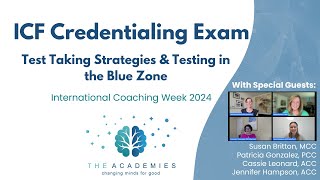
In this live panel hosted by Susan Britton MCC during International Coaching Week, three coaches—Cassie Leonard (ACC), Patricia Gonzalez (PCC) and Jen Hampson (career & leadership coach)—share their firsthand experiences with the ICF Credentialing Exam and how to remain in a calm, focused "Blue Zone" state while taking it. The discussion covers the exam’s structure (approximately 80 situational‑judgment questions, each requiring a best and a worst answer), the difficulty of pinpointing the worst choice, and the importance of understanding ICF competencies at a nuanced level. Logistical challenges such as proctoring, computer setup, identity verification, and timing (two 40‑question halves with a break) are described. The panel offers concrete test‑taking strategies: pre‑exam visualization and a 30‑day sprint, scouting the testing center, managing nutrition and sleep, using flagging tools, avoiding clock‑watching, employing breathing or yoga techniques, and creating green‑/red‑flag word lists. Resources mentioned include the Academies’ PCC marker self‑assessment tool and a three‑part YouTube series that walks through eight practice questions. The coaches conclude with encouraging messages that the exam is passable with diligent preparation, use of resources, and staying in the Blue Zone mindset.
Chapters
And welcome everyone, it's the Academies and we are celebrating the International Coaching Week. That's an annual event that International Coaching Federation honors each and every May, and we've been doing live streams on LinkedIn with interesting topics this week. And this is our final session, and I'm excited to be able to bring the topic to you of the ICF Credentialing Exam. We've got test-taking strategies from 3 experienced coaches who have passed the exam, and then also talking a little bit about testing in the Blue Zone. And so more on the Blue Zone in just a moment, but before we do that, I would love to have our guests introduce themselves. We have been grateful at the Academies to be able to walk alongside these three gorgeous human beings who are spreading coaching far and wide in the world. So Cassie, could you start us off?
Yes.
Thank you, Susan. I'm Cassie Leonard. I am an ACC certified coach, and I've been on this journey for about a year and a half. I started a company called Elm Coaching, and I focus on supporting women and working parents in technical careers.
Good. So Elm Coaching. Thank you. And Patricia.
Thank you, Susan. It's such a pleasure to be here with the academies today. My name is Patricia Gonzalez. I am a PCC and I've been on this journey for about the past 2 years alongside having the Academy's courses and the entire faculty support me on getting my credential, which I'm very grateful for. I've started a coaching practice called Coaching with PCG. My niche is moms in the workplace. Mom business owners and mom executives. They have a dual role and they're balancing a lot and they're quite fierce. So happy to be coaching in that niche.
And can I add that Patricia has quite a few mom experiences to be able to bring to that as also a corporate executive in her, her, her life. So, and Jen, thanks for being here. Go ahead and introduce you.
Thank you for having me. Hi Susan, my name is Jen Hampson. I am a career and leadership coach based out of Calgary, Alberta, so I'm probably representing the Canadians here. I started my journey with, uh, towards my ICF credential also about 2 years ago, and I just wrote the exam in December, so fairly, fairly recently. And I work with a group here called Canada Career Counseling, which supports science across the country in achieving their career goals.
We are grateful that we have the Canadian-US contingent here today. Thank you, everyone. So I mentioned our topic is going to be around test-taking strategies and testing in the blue zone. And so I want to just quickly mention something about the blue zone. And if you've been around the academies or seen any of our posts or know of our curriculum, we talk about the red zone, blue zone as a core neuroscience concept that sort of simplifies what happens to our brains and hearts when we are either in that fight-flight state, which is that red zone, or when we're in the blue zone state, which is more of a flow-flourish sort of fluid state where we can much more easily be alert, calm, connect, get creative, reach out to others, and have really the best part of our brain, whole brain thinking available to us. So again, if you hear anyone here today mention the red zone, it's really think of, I've kind of done this do-it-yourself lobotomy on my brain. All of me is not here. I am not thinking as strategically and calmly and capably as I normally would be able to. Blue zone is that state where you are alert, able to address, see the bigger picture, think creatively and strategically, calm your body down so that you can access the best part of you. Okay, so, and I think I saw— I'm also trying to keep a little eye on the chat, so, and I see another Canadian has joined us. Go Canada! Thank you, Lee, for being here. And if you'd like to drop in questions into the chat, please feel free to do so. As you hear everyone sharing their thoughts, it may spur some sort of a question for yourself, and it's probably a question that others would benefit from hearing as well, so do engage as you wish there. All right, so a few questions. So I'm going to start off with like, what was the most challenging aspect of the credentialing exam for you all?
I'm happy to get us started, I think we'll probably all agree that it is very challenging to find the worst course of action when so many of them are horrible. So the exam gives you a scenario and then it asks you to, to pick the best course of action, which you as a coach would take. And then it asks you, you know, what would be the worst course of action, right? And I just found it very challenging when you're given 3 kind of bad choices to find the worst of the bad. So I'll get us started there.
I definitely agree with Patricia in, you know, there could be multiple good or multiple bad responses and trying to determine which one's just that hair more. I actually found the most challenging part of the exam to be the physical setup. The program itself that the exam goes through requires a lot of, a lot of power, so you have to make sure that your computer is set up properly. You can't read the questions out loud, which was a little unnerving for me, and so just getting into that zone and knowing that it's being proctored, um, and being— you're being observed, uh, can be a little nerve-wracking as opposed to just going in and answering the questions.
And I'll just add on to that, uh, I took the exam at a proctored center, so I didn't have to do any of the preset, and I'm quite happy I did that, which meant that choosing the worst was really the focus of my trying to stay in that blue zone. And part of the challenge I had was, yeah, like Patricia said, there's so many bad options. I'm like, no, I wouldn't do any of those. And then you had to start figuring out based on the 8 ICF criteria— I forget the word now— which one would be most important. But they're not ranked in importance, so you're really trying to thread the needle on nuances.
Yeah, nuance is a really good way to describe it, and so you do have to kind of dig into the actual response and consider, you know, what really is different of these three bad ones. What's that nuanced difference? It's a good word, Cassie. Yeah.
It is, and I may occasionally toss in an idea or two as well because I, like Cassie and Patricia and Jen, also took the exam fairly recently, so I had that experience. So the computer piece, that's, that's one of those things that I've heard other people mention as well, and Jen, so, you know, thinking about do I decide to go to a test testing center and then I don't have to do that because I had some myself with the computer piece. I had to like reboot my system even though I thought it was completely set up. I had to reboot the system and you know that just every little thing that can add to the unexpected or the uncertainty can then kind of also impact how much brainpower you've got to be able to really be present for those questions. And to clarify, both Kathy and Patricia were mentioning the worst-case scenario, that is the situational judgment aspect of this exam exam. So it's— oh my goodness, is it 140 questions? Does that sound right? 160 questions?
Uh, it's just gonna say 80.
80. It feels like 140, right? I just made it twice as big as it was. About 80 questions. 40 questions in the first approximately hour and a half, another 40 in the next hour and a half. And just being able to, um, get through time-wise on that situational judgment, meaning every one of those questions has a best answer and a worst answer. And so it can be a little challenging to think, well, okay, I can get one of those, I can do the, the best answer, and then to start sorting through and thinking, oh wait, those are both bad. So having that, that piece of it, um, I was going to add one more thing about that, and but now it's evaporated, so maybe it'll come back.
Yeah, I think there's a question that came from the audience around, you know, what's— what is the reasoning behind the ICF asking us to identify what would be the worst case?
Well, and that's a great question, right? So it is— I'll take a stab at it, and I'm thinking it's just situational judgment. Like, they are looking for what is your judgment in in this scenario? How close are you? How far off are you? And you do get a point if you get the best answer, you get a point for that. If you don't get the wor— if you get the worst answer, you also get a point for that. But if you don't get the worst answer, um, it doesn't take away from your best answer. So that's, I think, gauging things. That, that's a thought that I have. I would love to hear others' insights on that.
I also feel like by taking some time to think about the worst, you really need to understand those competencies on a deeper level. Like, the— I found a lot of the worst answers, you were looking for the nuance between word choice, like asking the client to, to do something and inviting them to do something. Like, so it's client-led. And so those nuances really get into the depth of those.
Yeah, that's a good point. And, you know, really understanding the competencies, which I, you know, found myself not just looking at the competencies on the ICF listing, you know, but going back to our classroom. And, you know, we've spent so much time learning each of them in all the classes that we had and just really getting to what really is this competency, what does it really look like in action, not just the words, but what, what is the action the coach takes to demonstrate that competency. So again, nuance.
And Jennifer Kinder, I see your comment there, thank you. Does anybody know if you get partial credit? I want to add one more thing to that item, and that it is that be sure to answer a worst even if you're not certain about it, because no answer obviously increases your chances of not getting any credit for that question.
Yeah, that's a great test-taking strategy to remember, and I would also add to that something that I was surprised by was the timing. You know, you have the first half of the exam and when you're done with the first half, you can't go back to that and change any answers. You have a break and then you have the second half. For me, the first half came very quickly, um, and, and so thinking of your test-taking strategies, remember, you know, how many minutes you have, how far along you should be, you know, by halfway through the questions, that, that those kind of strategies are important to remember.
My setup, because I did opt to do it online, I didn't have a testing center, near me, so I opted to do the online version. And similar, there's the two halves and you do get a break in the middle, but even online you are able to flag certain questions so that you can go back and review them. So if anyone is planning to take it online, just know that that is an option. You do get to go back and review before you submit that first half and take the break and then commit to starting the second half.
Yeah, yeah, I definitely use the flag, thank goodness. Um, but I also feel like a slower reader traditionally, and so that just automatically brought me a little stress point because I felt the time ticking away. And I thought before I went into the test, maybe I'll just read the first few sentences because sometimes they're a very large paragraph you're reading. Um, but I was coached, reminded, read the whole thing, and it really made a difference because there's subtle nuances all the way through that really give some clues to the right, or the what I hope was the right answer, um, for each section.
Um, and I see a question that didn't appear in the feed. It is a closed book test? Yes. It is not only closed book, you can have nothing even close to your computer. If you don't do it in a testing center and you do it at home, you have to remove books that might be nearby, anything around your computer. And so when my proctor got on, I had to like pick up my laptop and show all the 360 view so that they could see there wasn't anything taped to the wall or the window or anything like that.
I had to take photos of my, my entire room and my desk and, and show that there was nothing there. So you're not allowed to have anything on or near the surface at all if you're taking it online, for sure. And I'm just going to go ahead and answer Kim's question here about the time ticking down. So yes, there is, if you're taking it on the computer, um, there is a, uh, sort of clock in the corner that tells you how much time you have remaining. I think I had 3 hours to complete the full exam and I used less than 2 hours. So, um, even with going back and re-reviewing some of those flagged questions, they give you plenty of time to get through the content.
So I'm sorry, I had about 3 minutes at the end of each half, so I felt much more time pressured. Might be my reading pace.
I'm going to agree with you, Cassie, because the first half for me, while I get there is a timer up, for some reason I didn't connect with that for the first half. But as soon as it flashed, you have 5 minutes remaining for the first half, I recognized how many questions I still had to answer, and that really caught me by surprise. I was not ready to end the first half. I left some questions unanswered in the first half. It was quite, quite frustrating for me.
So I'll, I'll add to that. I'm sorry, did I interrupt somebody? I heard an echo. No, I'll, I'll add to your comment, Patricia, because I almost ran out of time on the first segment. The second segment I had about 3 minutes left, more like you, Cassie, and I went in with it thinking— now I do remember that I knew how many questions were in there, 40 questions in the first, 40 questions in the second. So I just take my little math brain and I think I've got 90 minutes, that gives me about 2 minutes per question, maybe a little bit over, and then I can come back. And those flags that people had mentioned, you can flag the question that says I want to come back to this, and then at the end it shows you all of the flags as part of the screen. But my strategy didn't work because I realized I, halfway at question number 20, I was beyond where I should have been minute-wise, and I started to panic just a little bit. And I think we've had several people share some good test-taking strategies. I would love to segue now to thinking about the test-taking strategies that really puts you into the blue zone in that space of being able to remain in your body fully present, etc. So I wonder if you'd like to, um, would like to start us off on thinking about that aspect of the exam.
I will. Um, for me, so it's interesting to hear everyone's experience because I, I obviously, uh went through fairly quickly, which I didn't— I haven't compared that to anyone else's, so I'm surprised. But for me, one of the things that I found kept me calm, because as I mentioned, you log on, you have to show your workspace, someone's watching you the whole time. So you start off definitely in the red zone because it's very nerve-wracking. And so what helped me the most was just to, to read through each question, to read through each response and select right away what I thought was the best and what was the worst. I could flag it and come back to it, but I, for me, I had to do that selection right away just based off of like what I had learned and my gut instinct and then come back to it because I found that if I reread the responses too many times, it would start to get too muddled and became really hard to identify those nuances. So that is something that I found to be really helpful for me. And also I blocked out the clock part and I just moved through. So I tried not to look at it at all because that immediately, you know, did add a bit of stress and a bit of red zone. Um, so I tried to just move through the questions at whatever pace I could and, uh, you know, hopefully get them all done, which I did. But that was something that, uh, it's very easy to find yourself looking at the clock or, or checking in on, oh, I've used my 2 minutes for this question and now I have to, I have to hustle, right?
Yeah.
Wow. That really sounds like flow.
Yeah, Susan, I would add that I really started my Blue Zone practice way before I got to the test. So I, once I signed up for the test, saw what the testing center was, I took a drive over there to make sure that I knew where is this, where do I park, how do I get in, what, you know, dry run. So way ahead of time. I envisioned myself going in and passing that test. I put that in my mind. I knew that I would be able to do this. I have the education I need. I'm prepared for this. And so I kind of had this 30-day sprint, right? Kind of starting backwards. I'm going to go in and I'm going to pass that test. What am I doing the morning of, right? What time am I going to wake up? What am I doing the night before, right? I'm going to have some good protein, right? You need protein. It's good for your brain. Night before, morning of, and kind of went backwards, um, allowing myself to stop studying for it the day before, right? Let it settle. I'm not going to, you know, get too crazy and cram to the last minute. So that meant that 48 hours before would have been my last big push of, do I know all of this? And kind of, you know, like I said, 30 days leading up to it, having a focused 60 minutes of practice. Work on it really hard and then put it down. So I, I would say my test-taking strategy starts with really envisioning, I'm going to go in there and I'm going to pass this test. And I think that helped me stay in the blue zone.
I love that, Patricia. I, I did similar but in like much shorter amount of time, um, the day of. I chose to do a test center as well, um, and I'm so glad because I set my boundaries I knew the space, I had all the documents printed out that you have to bring, and I went about an hour and a half ahead of time just to make sure I found this community college that I was going to. And it's a beautiful campus. I got myself a cup of coffee, I walked around the center outside for half an hour. During that time, my son called and said the pipes had burst at the school and it was shutting down, come pick me up. But I'd set my boundaries. I was like, Good luck to you. And then I closed. He's fine. Um, and then when I went in, I actually went in about 20 minutes early so I could just be in the space and they instantly worked me through the system and I was doing the test within about 4 minutes. So that kind of threw me back into the little more stressed, but then I settled in and I remembered, or I tried to hold 3 things in my mind. Is it ethical? Is it client-centered? And is it maintaining presence? And if I could keep reminding myself on every question to keep those 3 things— I know it's not all the competencies, but it gave me a confidence I had the coaching mindset kind of held in front of myself.
Can I ask you to repeat that? Those 3 pieces? Yes.
Ethical, client-centered, and Is it maintaining presence? Not escaping the situation.
I actually did something similar, Cassie, and not the, the 3 things necessarily, but one of the things I did in studying for the exam and preparing was to create a list of sort of green flags and red flags in terms of specific words and phrases that I knew were going to come up. So a lot of that language, we've talked a lot about nuance, but that language around being client-centered, asking versus telling, those types of things. I actually had a little chart and I found that to be really helpful to identify, okay, that's like you say, client-centered language. So that's going to be probably one of the better responses. And so on and so on.
Yeah, it's interesting how the, the brain, if you give it a focus like Cassie's tripart focus there, and you also think about contrast, that's often how the brain sort of organizes information. One tip that I would add to what you're saying there, Jen, at the Academies we have a PCC marker self-assessing tool, a guideline, and, and in that we use specifically behaviors to avoid along with the behaviors to do. But sometimes just having the brain be able to see, okay, so if I'm setting an agreement, it's got to be client-centered, um, in that. And then if I'm choosing the topic for the client, then that's going to be completely off. So when you go to prep, consider just going through it and refreshing on what is a behavior to avoid for each of the the core competencies. And that can also help add to the what's the worst thing to do here. Patricia, I want to circle back where you were talking about sort of your 30-day sprint. And sprint just made my, my brain think about like running a marathon, right? You carb up the night before, well, you protein the night before, you visualize success, that gives your brain some neural pathways to feel like this is not totally novel and new. I've sort of been here, done this. So all of those things are very brain-friendly, Blue Zone-oriented. Cassie, you mentioned, I walked in and I thought I'd have my 20 minutes, but wow, 4 minutes later. So what kind of got you back into that breathing Blue Zone space?
Breathing. I am a yoga instructor as well, so I did a few deep— I didn't have— I didn't think I had time for box breath, but I did some diaphragmatic, just inhale for 3, exhale for 3, and reset. Seemed to really help.
There is a little question that is related to something that you mentioned, Cassie, the documents that you bring, and what documents do you need to have if you go into the testing center? Or even I'd have it for the, the, the test at home too. What were your documents?
I believe it was like driver's license and more, maybe a passport.
It was—
I felt like it was you were going through TSA, maybe fingerprints. It was a lot. I'm sorry, I don't remember exactly, just I remember the stress of it more than the actual documents. But I'm sure it's all listed on the Academy's prep page.
Yes, your, your proof of identity. So you have options in what you can show. I believe I used my passport online, so I had to hold it up to the, hold it up to the camera, and they verified my identity before starting. Um, but I, I, there's a list of the, um, acceptable documents on the website.
And as we head towards closing, um, we will go ahead and pop in— there was a question I think from Craig that came in around are there practice tests that can be done? The ICF has prepared 8 test practice questions and our Director of Curriculum Jessica Burdette and I recently created a 3-part series on walking through each of those 8 questions and kind of sorting out like why might this be the best answer, why might this be the worst answer. We talk about paying attention to being in the blue zone, paying attention to your gut, thinking about some key themes like the ethical presence, etc., client-centered. And so, Emmeline, if you can pop that into the chat so that people have the link to that YouTube video. It's a 3-parter, so you can take a little piece, think about it, and go to the second part, go to the third part where we answer all 8 of those questions. That is available to you. And as we come to the bottom of the hour, I just love to hear, what would you— Cassie, Patricia, and Jen— what would you like to leave with the people who are listening? Because my assumption is that they have this test on their radar, it's down the road for them. So what would your, your thought be that you'd like to share?
My thought is that it is, it's achievable. It is passable. It is going to take attention though. It's going to take a little prep, a little bit of due diligence, um, respect the test because it is not an easy walk in the park, but with effort you can get there.
I would agree with that. It, uh, it definitely, um, well, is something you have to take very seriously and prepare for. I really like hearing that Susan has shared that we have, that Academy's put out a, you know, why, why was this answer the wrong answer? Why was it the best answer? So thank you for that because I feel like that is so critical to really touch base with the reason, like why, why this was the bad one. It really takes you back into learning. And so use all the tools. Is what I would say. Use all these resources.
Yeah, I, I agree with everything that Cassi and Patricia have shared. Um, I know that going into the exam for myself, since it was my, my first exam for the ACC, um, you know, it was very daunting. 3 hours, it's proctored, right? Nothing around you. It was very serious. Um, and, uh, just coming back to those core competencies and those, those principles around staying client-focused and client-led. You know, it was really— I think I hyped it to be harder or more, more stressful than it actually was. Right. We're well familiar with the competencies and it it all makes sense once you're actually going through those, those questions. Like, I, I think that the answers are clear. So that's just what I would leave it with.
Well, we want to thank you for joining us here at the Academies for Neuroscience Coaching, and I truly just want to bow before the 3 coaches who have joined us, taken the time to share their experiences share their wisdom, and obviously also making a difference in the world because of your coaching skills and your coaching mindset and operating in the Blue Zone. So hats off to each of you, and we wish every one of you success with the credentialing exam. Do find our YouTube videos on being able to prepare for that and reach out to us if there are places where we can be of support in that process. All right, thanks everyone.
Thank you.
Thank you.
Thank you.
Bye.
More from Susan








Susan’s ICF Educator Award | The Heart Behind the Impact Katy Montgomery, PCC


