Internal Coaching | Supporting Leaders in an Increasingly Complex World
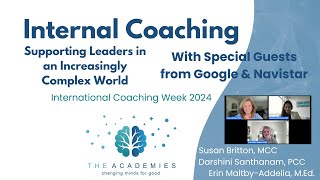
Susan Britton hosts leaders from Google and Navistar to discuss building internal coaching cultures. Google trains managers as coach-managers and runs a peer-to-peer program; Navistar built a central hub with ten ICF-certified coaches. Both emphasize starting now, measuring impact through employee surveys and case studies, and using internal champions to scale coaching across organizations.
Chapters
Greetings, it's Susan Britton with the Academies, and we are celebrating International Coaching Week as part of International Coach Federation's annual celebration. And so we've got every day this week LinkedIn Live sessions, and today I'm so tickled to get to be with Darshini Santhanam from Google, and she's based in London, and Erin Maltby Adelia, who is with Navistar, and you are based in Chicago area, I believe, right? And so happy that we're going to be able to talk to, to a topic that's near and dear to my heart, and that is internal coaching. Before we went live, we were talking about just the need for leaders to have that level of support and what a difference it makes in corporate cultures, what it makes in a difference in teams, etc. So happy to have that conversation about to launch. If you have questions specifically that you would like to pop into the chat, if you're listening live, please go ahead and do that, and we will try to be sure to see those. We have Jessica Burdette on our team who is in the background also supporting that, so she can also help get some of those questions to us. So before we get started with a few questions about why a coaching culture and how it can be implemented and the benefits of that, let me just ask both Darshini and Erin to introduce yourself briefly. So Darshini, would you You're at the top of my screen, so I'm just starting over there.
Wonderful. Thank you so much, Susan, and thank you for having me and Erin both here today. Very excited for the conversation we're about to have. So I will introduce myself by saying I play many different roles. I wear many different hats. In my main job, I'm responsible for scale training within the Google Cloud space globally. But in my more fun jobs that I do on the side, I get to focus on executive development and coaching. And as a coach, I find that to be a great way to be able to use my energy in my workplace and do more than just what my core job is. So that's a little bit about me. Outside of work, I'm also big on family, 2 kids and 2 dogs, and as Susan mentioned, live in London, so try to get as much time outdoors as I possibly can. Thank you. Erin, over to you.
Very good. Good. Well, thank you, Darshini. Erin Maltby Adalia. I work for a company called Navistar. Navistar sits within the Traighton Group, which is a subsidiary of the Volkswagen Group. And Volkswagen Group, of course, has many, many different brands and different kinds of products represented within the group. Navistar just happens to join a global team of brands that sit within Traighton. We are primarily based in Germany with our MAN brand, in Sweden with Scania, and Navistar with our US location, and then Volkswagen Truck and Bus in Brazil. So across all of those amazing locations, Communications. We work together to represent the commercial vehicle industry for the Volkswagen Group. But I specifically work on leadership and culture with the team here. We are just starting our scaled coaching practice. So I feel like you've got a, a wizard here behind the panel pairing both Darshani and I, as we've got a more experienced program and one that's just starting. So I hope we can offer two whole perspectives for the listeners today.
Thank you, Erin and Darshini. So let's jump into the why a coaching culture. Maybe share just a little bit about what makes it relevant now. I'm sure that in some cases, it's been going on for a couple of years in your organizations and that you've seen that. Why now so much more important?
Sure, I can start, kick off a response to that, Susan. When I think about the rate of change that's happening today and the speed of change that's happening today, it's unparalleled really. And with the onset of all things AI, there's a lot of noise and there's a lot of expectation around how we change and how we evolve. And how individuals and employees need to sort of elevate their own understanding and knowledge to be able to be relevant in this space. There's a lot of unknown as well. I think we need to recognize that. So I see a speed of change changing to be much faster. I see the amount of change also changing, and then all in the context of what's expected of human beings within organizations to be able to perform. And so it really feels more relevant than ever before that we support individuals at that level. To be able to withstand what lies ahead, to be able to handle the ambiguity of not knowing what all of these changes could mean for us. And I think today it's not just AI, it's also this idea of what does sustainability mean. There are all these big ideas that organizations and individuals need to be thinking about, and it's hard to do when you don't have perspective. And I think really what coaching does and having a coaching culture gives people is that perspective, to be able to go between the dance floor and go up into the balcony and to be able to see things in different lights. So that's why I feel like now more than ever coaching is important, but really coaching is important any day if you ask me.
Darshini, perfect look forward, because I think the perspective I bring is maybe even the look back when we look at what's just happened. Why now? I think Recently, there's been still a lot of discussion about the impacts of COVID and the pandemic globally. I think Harvard Business Review just a couple of months ago came out with a new article review, 69 articles included, that talked about the shift in management to becoming more empathetic, to becoming more adaptable and resilient in their leadership, to your many great points about change. But I think about my own experience and some of the experiences that I'm sure some of our listeners are thinking about right now. When you had the tough conversations with employees that maybe you never had before in the work setting before the pandemic. Conversations around childcare, health, wellness, relationship shifts, workplace setting shifts that oftentimes happened overnight, business shifts with some divestitures or changes in the business strategy around this. I think about that time and I think our managers were truly staying afloat, right? We saw a lot of articles around that at that time. And yet, how did we do with those conversations? What happened? Where did we turn to for help? I think a lot of the, the solution was looking internally among team members who you have around you. Whereas we have a coaching practice set up. I think we could have offered the kind of individualized attention that someone needs as they're exploring and uncovering some of these answers within themselves, what they know they want to try. And so I just, I think why now? It's because that we're experiencing more change than ever. But as we look back, coaching offers an individualized approach that we just can't accomplish through traditional L&D offerings in quite the same way.
So if I heard some themes in there, it's the speed of change, the amount of change, the shifts that are happening. And I really appreciate the looking forward and also the looking back and that word perspective and how important it is when there's so much uncertainty. For everyone and what that uncertainty brings in terms of our ability to stay connected, our ability to create the things that need to be created, the ability to move forward. So, so let's talk a little bit about the practicalities of, let's say, organizations are saying, yes, there is this speed of change, there is the rate of change, there is the ambiguity and the uncertainty and the shifts, and we need to be able to support leaders and teams in that process. There are a number of ways that one can go about getting that coaching culture started. Darshini, can I start with you? And you've got a pretty interesting novel approach to how you've implemented coaching culture at Google. So could you share a little bit about that? And then we'll go to Erin, who has a different perspective.
Absolutely, Susan. Now I've been associated with Google starting in 2005. And I can remember this idea of coaching existing in the air from day one. We probably didn't call it that, but, you know, it existed still very much in how we were managed, in how managers operated, in how leadership operated, in how we even worked with peers. So there was always this idea that it's really important for us to be able to listen, ask the important questions, and then support each other through it. More formally, of course, there are programs that exist today. It's, it's central to how we operate within Google, so much so that today every employee has access to coaching, and every employee has the ability or has the opportunity, I would say, to coach should they wish to. There are formal and informal structures in place that allow employees to be able to leverage that quite nicely. So irrespective of what level you're at, whether you're an individual contributor or a manager, small team, large team, global team, it doesn't matter. You get access to resources. So Susan, when you ask the question of sort of how does an organization approach this and how do you make it sticky, like what about it? I know that wasn't your exact question, but sort of The, the immediate thought that came to my mind was it has to be available at every level. Someone who's new to an organization is trying to figure out where to go to sign up for their first training, needs a bit of help, needs a bit of encouragement to get through their first couple of weeks because it can be overwhelming. But someone who's also been here 10 years, and I have experience having done that, and is looking to transition or grow their career or have a difficult conversation with their manager, also needs that support. So really, I mean, because coaching is ultimately here to support individuals, the topic doesn't matter, but what matters is access to a wide variety of coaching opportunities for really every level. So I hope that helps sort of give, paint a little bit of a picture to what we do internally, to give you a sense of how we make that pretty democratic for nearly everyone.
Democratized was a word that was coming to my mind as I heard you mention that, and that has been a question mark in the coaching community is how do you get people to have access on a scalable process. So it sounds like there's been ways that Google has figured that out. Let's hear from Erin and then see if we can circle back with more deep deeper questions.
I think, yes, ready to share. And there's one thing that's coming top of mind that maybe I'd love to address because, Darshini, you just raised it in me. And I think that is, I think, as we're just getting started, one of the things that we're having to think a lot about is differentiating coaching from mentoring or coaching from consulting, right? Helping people, as you democratize the offering, kind of really be intentional with how they're coaching. So, Darshini, I'm just, you know, at the edge of my seat to talk more about how that feels where you are. For us, just getting started out, I think we also completely agree. How do we make it more accessible across levels of the organization? And maybe a couple specific things we're thinking: we still believe that there's a place for objective, neutral, third-party, unbiased coaching at the executive level. So we will continue to make that available through vendor partners that we, we trust. But in terms of that term scalable, how do we then push down into the other levels of the organization and get the reach that Darshini was mentioning? That's where we've got two approaches that we're working on right now, we've just taken our very first steps to certify an internal coaching cohort with Susan's team at the Academies. So 10 of our very first employees who are interested in becoming Certified Individual Coaches are right in the middle of our program experience. And that will be our first attempt to build positive coaching culture through practice with those 10 internal individuals and really kind of focused on middle to upper-level context at that point too. Beyond that, then in time, we desire to democratize coaching by teaching people sound coaching practices inside of the company. So individuals who say, yes, I have this passion for coaching, but oh, I never realized that what I was doing was actually consulting or actually mentoring instead of coaching. How do I stay in that pure coaching mindset? Those are tools and experiences we'd like to build across levels to make sure that coaching reach and positive coaching culture spreading. So just taking those very few first steps has been really encouraging so far.
I'd love to jump in on that, Erin, and sort of, you know, introduce the idea of manager as coach. There's formal coaching, and there's the credentials, there's the stuff that you're working on with Susan and Susan's team. But then there's also a basic ability that nearly every manager can carry. Which may not be that of a full coach, but the ability to coach when required, to know when to switch from being manager and more directive to more coaching, and to be able to switch on sort of the listening ear, to be able to ask the right questions, to be curious, to ask questions in a way in which a coach would, but to switch back to being directive when the job needs to get done as well. I think there is something there. And I'll share this. Managers at Google get trained on exactly this, on this idea that you need to be manager as coach, not just manager, but there is a coaching element to your job. And there is a training element associated with it. Then there's an evaluation associated with it as well. Like there are manager surveys, that go out that ask these questions around, are you getting the support that you need? So there is an accountability with every manager to be able to do that. So when I think about sort of what you're saying about democratizing it, scaling it up, having it hit every level, there's a capability that, you know, anyone with more responsibility than one needs to consider carrying. And that comes from being able to be coaching your daily jobs.
Well said.
And I would love to just articulate that scaling coaching is a big undertaking. And Darshini, it happens that you have been with a company that's been working on that for a decade or more. Erin, I heard that coaching has been present in your organization, not just in the last year or so, as you're now is training ICF credentialed coaches because it's been available at the executive level. So wherever an organization might be in this process of just thinking about it or already starting with training of their internal team members, that it doesn't matter where you are. What's the best time to plant a tree? Is today, yesterday, today, if you want that to grow. There is a question that came in that could be relevant, I think, for you, And it is, I'm embarking on a similar journey. How did you choose the first 10? And that's for Erin.
Yeah, well, I think, Susan, you just start with planting a tree, right? We start, we started actually with a team of our members in our Leadership and Org Effectiveness team that sits within the university space. So part of our cohort includes those individuals who do a lot of leadership development-type type of programming or type of work naturally. So coaching kind of does become a natural part of their day-to-day as they're working with, with leaders. But then we also are working with our HR shared services area who does a lot with the employee relations side of things, right, where we see a lot of conversations coming up around conflict management, around the need for support to look at, you know, next options, career progression, etc. So our cohort is half and half. And that's been an incredible experience for our teams, you know, with a medium to large-sized company, being able to see from each other's perspectives, the differences in our day-to-day between more of an ER type of function and a more traditional leadership or learning and development function. I can't recommend it enough. Those blended perspectives has really, really added a lot of value to our cohort.
It reminds me of coaching itself, right? That ability to see diverse perspectives and connect and understand where people are. That's a huge piece of the puzzle in, in coaching. I think until you, until you get where somebody else is and they recognize where they are, it's very difficult to make movement forward. You have to start at that place of this is where we are.
Yeah.
Um, I'm curious, I talk to a lot of people that say we want to do this within our organization And we also have to justify the investment. And so, you know, there are studies that talk about the ROI of coaching. And, you know, there's, it's been one of those things that's sort of been difficult to measure in some cases. And so I'm just curious what, what thoughts either of you have about how is it that you justify, validate, point to the benefits of what coaching can do for a company.
I'd love to get started with this. Oh my gosh, how much time do we have? The rest of the day? You know, some of the early thoughts we're having is again around traditional L&D, the Kirkpatrick's methods of evaluation. If you've spent time thinking about that, it's just a nice framework to try to organize the levels of responses or the levels of input around Effectiveness. And we're thinking from an effectiveness perspective, looking at the experience people have with our coaches, first and foremost. Are they enjoying the experience? But then if we look at that next level, what have they learned or acted on as a result of coaching? So following up, we have that kind of in a position with our internal tools that we use with our growth plans and performance assessments, where we're inviting people to make those comments known. What are they focused on? What, where are the shifts happening? Make that a part of your growth plan or your growth reflection in that way. So in progress with those pieces. But then of course, the higher level, what if you— and I'm going to reference your, some of your material, Susan, I hope it's not blowing the lid on it, but your New, Do, Act, right? The end of your coaching session where something new is discovered, there's something you're going to do, there's something you're going to act on. How is that then influencing their day-to-day 6 to 8 months down the road? In the longer-term perspective where we can reasonably see that kind of behavior change. And that's where that employee experience survey starts to become a big piece we want to look at. Are the employees of managers going through these experiences or whatnot, are they noticing a change within that, that work? And so that EX experience survey, of course, you know, managers get access to that result. And so that's, that's where we're focused there. But the highest level, how it's impacting the business, we are a ways off from that. And I know the higher you climb at Kirkpatrick's, the harder that becomes to measure. However, what I would also say, and it ties back to the first part of your question, Susan, like, how do we get that, that interest? Why are people saying yes to this? And I think it comes down to Navistar in particular is going through, I think, a shift in what we understand to be true about coaching. Where coaching, I think, in the past might have had a little bit more of a, like a punitive tone to it. People who had experiences that they needed help with, or maybe they were struggling with, there's a career obstacle, go get coaching. But we're trying to know coaching is for all of us to experience and process all of the kinds of things we want to be intentional about learning. And so trying to make that shift as a company and the benefits that it brings to the competencies we want to spread throughout the company—things like being transparent, speaking up, following through on commitments, acting with integrity—all of those key competencies that we're in the process of introducing, coaching is the underlying theme that helps people get there. So I think there's buy-in because we want to make this culture shift. And we want to certainly help people reframe how they think about coaching especially those who may have had a different experience in the past.
Uh, go ahead, Darshini.
I was just gonna pipe in and say, I think, um, everything Erin's saying is, I think, what we attempt to do as well. Um, but what we also sort of, I would add on, uh, with is we, you know, there we recognize that ultimately with coaching you may or may not be able to see the impact on business, and the impact may fall on the individual instead, right? And the individual may choose to leave because they find that they're— through coaching, they find that there's no longer a fit for the work they did, that they do, for instance. And then the impact on the business is quite different and hard to measure and may even look bad when you put it down in terms of numbers. But I did want to say that I think, you know, while it is hard to read exactly how any of how these metrics may fall. What does happen, and I think is very important to building that coaching culture, going back to the first question, is celebrating good coaching. Where we do see the impact, turning that into a gorgeous internal case study, putting it out there, celebrating people who did a good job as coach, but also the people who reached out and took on coaching as a way to improve themselves. Themselves and progress themselves. I think it's really important to showcase both those sides of the story to encourage more people to do that.
Oh, I almost want to applaud that. It makes me feel— maybe a quick anecdote as we're coming up. I was speaking with a leader the other day who mentioned, after some experience with the coach, they said, I had never— I have never tried this before in my, you know, more than 25-year career. This is the first time that I've ever spent time opening up with this kind of coaching experience and being real or vulnerable with some of the experiences I've had in the past. And we agreed after that conversation that more of this, more of this. So Darshini, well said, and it just, it just brought a fresh example to my mind.
And Darshini, I also heard earlier, I think you mentioned that you have been important in helping to shape some of the internal coaching pieces And you've also benefited yourself in that process. I'm just curious if that adds to this idea that we're looking for is what are the returns that employees actually see that then impact the business in positive ways?
Susan, I feel so strongly about this. I feel so strongly about this. I mean, Coaching is for everyone. Coaching is not going to work when it's gatekept, if you will. It really has to be democratized in that way. And yes, absolutely, have I benefited from it? Yes. So we have a program, we call it the G2G program, so Googler to Googler program. And it has volunteers like myself who volunteer to either coach or to facilitate programs and workshops and so on. So, you know, if you're doing a team building thing and you want someone outside of the team to come facilitate 2 hours of a session for you, you can go up, look up someone, look through profiles, look up programs, and say, let's schedule this. Or as an individual, you can go in, look through coaches, filter through your needs, and we have specialist coaches internally as well. Find someone, sign up for one of their available slots, and go and attend it. So I have benefited tremendously over many years in different scenarios from being able to reach out to individuals like this. I have benefited in situations where I felt like, you know, younger in my career when as a woman in the workforce I was struggling to make some decisions and I had this incredible coach show up and just ask me the tough questions and that helped, right? Made me feel uncomfortable but got me to what I was looking for. In a wonderful way, right? Like gave me that space to have a conversation that I wouldn't have in a work context. That was great. More recently, for example, I was struggling to make some decisions about schools for my kids. And quickly I reached out to a parent specialist in the coaching community. And I was just like, listen, I'm struggling, help me think through this. She's like, all right, let's work through this together. And she spent 45 minutes with me Again, asking questions and offering support, non-work-related context, but hey, happier employee who's resolved whatever other questions were keeping me up at night so I could get on with work. So all in all, was that a win? Absolutely. Have I stayed in touch with her? Yes, I now have a new mommy friend, right? So this works out really, really well. So I think it's on so many levels being able to access that, again, you know, builds your internal network. There's a more casual conversation to be had outside of those coaching sessions as well.
And I do see another quick question, and before we have to wrap up, where does coaching sit? I see as a question. That is that right? Curious to learn where coaches sit within discipline of department, or are they in a more neutral capacity with broader reach?
From Google's perspective, I mean, because it's democratized, they don't actually sit within the human resources function or any other specialized function. Of course, there are some executive coaches focused on executive development within the human resources function. But in general, this community, the G2G community I was referring to previously, could be from anyone sitting anywhere, really. So they, you know, and sometimes it's useful to talk to someone from the business rather than from HR. So we found that to be quite popular.
And if I, if I'm not mistaken, excuse me, Erin, that looks like that was asked by someone who I believe sits in a VP sales position and is a huge advocate of coaching, knows the difference between the red zone and the blue zone and what happens in people's brains when they are not in that place of the Blue Zone. I wore my blue specifically today for that. Erin, did you— would you like to add anything to that?
Sure. I would say getting started, we do have a centralized position for now as we're getting started so that we can kind of centrally work on the mission of coaching versus consulting versus mentoring. And in time, it'll be important for us to again spread that more scalable solution where we're arming individuals who are interested in coaching with the right knowledge and the right tools to, to be able to serve as a coach as well. So all in good time, I think it will spread, but for, for right now, it does have a central position within the leadership and org effectiveness area.
Well, as we head towards the bottom of the hour— boy, this was a fast half hour for me, I could have gone on— advice that both of you would like to share for those who are looking to build a coaching culture within their organizations.
Darshini, would you like to start?
I'm gonna steal what you both said early on, plant the tree today. Yeah, right. There really is no time like the present. So if you're looking to start a coaching culture, you clearly value that. Don't wait, get started somehow with the first step.
And I'm going to be bold and say get started with Susan. Uh, not that that is the intent of this conversation, but I would say having having just researched a lot of providers, what I stumbled on in my research is there is a lot of customized, almost maybe like jargony content that is out there today. And my principle as I was researching offerings was to stick to the neuroscience. Let's use what we know about the brain and our natural behaviors and lean into that because that is what naturally happens, as Susan just articulated. And so I think the key is recognizing that the tendencies in heightened states and how to return back to a state of openness and learning where that can occur. That is the key to unlock all of it. So I think find the right partner whose curriculum you trust. And Susan, again, we're very grateful to you and the team at the academies for, for being that partner to us.
Erin, I'm just going to quickly plus one that Susan is awesome. But also there was a question around how do you handle potential resistance? And I think Erin's response, there's an answer in that response, which is to say bring in trusted coaches, bring in really good, you know, high-quality coaches and build high-quality coaching within the organization. So it's, you know, trust isn't going to be built in a day, but really good quality coaching will get you there.
I am so grateful that both of you have made space in your very, very busy calendars to talk about something that will make a difference, not just for your immediate teams, but your organizations. And as Darshini said, that then filters out so so that people go home happy, and then they can come back the next day to work and be able to be present and bring their full brains and themselves to very challenging changes and shifts that we had started the conversation with. So applause to both of you for the work that you're doing and the impacts that you're making. I would also like to be able to share there is a team behind us that has made this whole week possible. And I just want to do a quick shout-out. Jessica Bourbette Burdette was hosting yesterday and is behind the scenes, Emmeline with some technical help, Matthew Gardner, Lee Gauthier. Thank you for the team at the Academies who has made this possible. Appreciate that. And we'd love to have you tune in tomorrow. I'm actually going to be coached by one of our faculty members in MCC, Carissa Gay. So, whoop, authenticity and vulnerability on screen as I get coached. And then we've got other interesting conversations later in the week with other faculty members Edward McDonald is going to be talking about holding space, and then on Friday we'll talk about the ACC ICF credentialing exam. And so please join us, and we'll look forward to those conversations. Thanks both. Super.
Thank you, Susan. Take care. Thank you.
More from Susan








Susan’s ICF Educator Award | The Heart Behind the Impact Katy Montgomery, PCC


