Leading with Impact: Essential Coaching Skills for Non Coaches
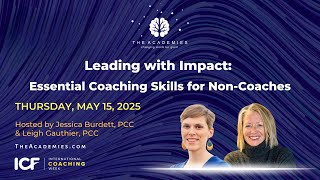
The webinar, hosted by coaching education director Jessica Burdett (PCC) and growth director Leigh Goetche, introduced leaders and non‑coaches to foundational coaching skills they can apply immediately. After a brief welcome and participant poll, the facilitators defined coaching using the ICF partnership model and presented a business case for coaching, citing global engagement costs, well‑being‑profitability research, and post‑coaching well‑being improvements. They explained basic neuroscience – the “red zone” (stress/threat) versus the “blue zone” (calm, creative) – and how stress pushes leaders toward expert‑mode and away from curiosity. The session then outlined when to use coaching versus directing, emphasizing situational tool selection. Three core coaching skills were taught: (1) creating clear agreements, (2) cultivating curiosity through open‑ended questions, and (3) co‑creating actionable next steps. Participants practiced feeling curiosity, discussed common leader challenges (trust, delegation, performance issues), and explored how to manage expectations when leaders are seen as problem‑solvers. A live role‑play demo illustrated a leader‑direct report conversation, showing how to ask exploratory questions, set agreements, and plan follow‑up while balancing firmness and support. Throughout, attendees shared insights, asked questions about applying coaching in friendships and leadership, and reflected on barriers such as time pressure and rescuer mode. The webinar concluded with a debrief on how the three skills can enhance psychological safety, employee well‑being, and organizational effectiveness.
Chapters
Welcome, welcome everyone. As you join, feel free to pop in the chat where you're joining from and what you're hoping for from this session today. And if you can join us with video, we'd love to see your face. Hello, Sudeep. Hello, Dan. Hello, Abby.
Hello.
Welcome. Feel free to pop in the chat where you're joining from, what you're hoping for from today's session. And I will just be letting people in as they join. I'm also going to go ahead and pop in our chat today. Handout we have for our session so that you can download that. Awesome, Abby. Glad to have you from Maryland. Sudeep, great, joining us from India. Dan joining us from Reston, uh, Neighbor to Abby, more or less. Uh, Mary from Northern California, awesome. And feel free to pop in the chat as well. What are you hoping for from this session? Um, love the ideas for non-coaches, Abby. That's great. Portugal, awesome Rita. Welcome, welcome Sharon. Hello, Maria. Great to see you. It's very fun to meet new faces and see alumni as well. Always a great part of International Coaching Week. All right, if you're just joining, pop in the chat where you're joining from and what you're hoping for from the session. Yes, replays, there will be. It will be recorded, Maria, and it'll be— we'll send it to you. We'll also have it posted on YouTube for access later. All right. Fantastic. Well, let's dig in. Our topic today is Leading with Impact: Essential Coaching Skills for Non-Coaches. And our hope with this is to be able to get deeper into some coaching skills for people who might not have any connection to coaching already, or little connection. So if you're joining us as a coach, that's great too. Um, but this is going to be pretty foundational pieces. It can be a great way to remember these are skills that you can share with people you're coaching as they develop their coaching, or if you're new to coaching, these are skills that are easy to start to plug and play. All right, today you have me. I'm Jessica Burdett, and I am a PCC coach. I'm the director of coaching education for the academies, and I have— I fell in love with coaching before I knew it was a thing and have been eagerly learning more and deeply involved in coaching ever since. I've gotten to coach a really wide range of industries, levels of leadership, and I love the space of being able to create the growth-oriented conversations with people around the world. And then we have Leigh with us today co-facilitating with me. So Leigh, I'll hand over to you for an intro.
Thank you, Jessica. Hi everyone. So my name is Leigh Goetche. I have held multiple leadership roles over the years from international firms to tech startups. and I've been coaching professionally for 17 years now. I currently coach leader managers individually and within corporations as well. I am on the team at the academies as an instructor and the director of growth. And like Jessica, when I found coaching, I knew it was the one thing that I would do for the rest of my life. And so here I am and happy to be with you today.
Awesome. Not that you don't do other things, Lee. You do a lot of other things. Coaching being a consistent for us both, right?
Consistently doing this. Yeah.
All right, so our agenda for today, we're going to talk about what is coaching, what's your perception on it, what do you hear if you're a coach, what do you hear leaders' perception on coaching as, what some basic neuroscience principles to build from, choosing a tool, when to use coaching, when to not use coaching as leaders, 3 core coaching skills, and then takeaways. So before we dig into that, would love to hear some responses in the chat. What are you hoping for from this conversation?
I'll share.
Go for it, Maria.
Hi there.
So although I'm trained as a coach, I think it's also important to be able to relate to people in a way without using as much perhaps coaching language or jargon. But there can still be an intentionality or a mindset of curiosity and inquiry and growth when connecting with others. So that's what I'm really curious about today is looking at it from that perspective.
Love that perspective. Almost a getting back to the basics and having some language that would work with anyone. Fantastic. All right, what else are people hoping for from today? To learn more about how to be a better coach and mentor. Thank you, Rita. Help others be equipped that aren't coaches but in leadership roles. Fantastic. Yeah, so often as a coach when working with leaders, I find myself coaching people on how to coach. So very helpful to think about as well what are Helpful skills there. All right. Just recently got certified and want to keep learning about different tools. Great. Learn about neuroscience. Fantastic. Okay, Lee, passing it over to you, and I will hit— I'll put the handout in the chat again for anyone who missed it coming in.
Okay, before we begin, let's just take a quick poll here to see who's in the room. That will help us guide our content a little bit better. Bonus points if you recognize the typo, just making sure you're paying attention there. But looking to know if you're a leader, manager, a leadership coach, a leader and a leadership coach. We'd just love to know who's here today. We're getting quite a cross-section, Jessica. Yes, got a few more in to come. If you haven't voted yet, you've got a second to do so. Okay, great. Well, interestingly, the spread looks pretty even. We have folks who are leader managers, that's their key role. We have folks that are leadership coaches, that's their key role, uh, and maybe a couple more there. And then it looks like we have, um, folks who do both, who both are leaders and leadership coaches. So real nice mix in the room. Thanks for, thanks for doing that poll for us. So we wanted to start actually with a question. And if you can just pop in the chat for us, what comes to your mind when you think of coaching? Common word. What do you think? No wrong answers, just love to know where your head's at. Thanks, Abby. Asking questions, absolutely. Sharing curiosity, Rita. Helping others that may be struggling, Rosina. Facilitation, helping guide others. Collaborative exploration, support success. Powerful to connections. Helping others who wish to increase their skill, supporting on journeys, collaboration. Yeah, it's fascinating. There is definitely a through line through all of those responses that has us connected to people, right? And based on where we come from and what our experience is, we will likely have a different definition of coaching. And I would say that one of the things that I've learned, if you are going to be coaching, you want to have an understanding of a definition, one that works for you and one works for your stakeholders. And I think the best place to start is actually the ICF definition, which is partnering with clients— and clients can be employees— in a thought-provoking and creative process that inspires them to maximize their personal and professional potential. So we see in there that through line, that partnership. We saw a little bit about creative. And we certainly saw inspiration in maximizing their personal and professional potential. So this is a definition that you can adopt and enhance your own as well. But again, my belief is that we should have at our core an understanding of what coaching is, whether we're simply coaching as a leader or coaching as a leadership coach or doing both. So why do we care, right? Like, why does this matter as, as leaders? Why does this matter as leadership coaches? Well, let's just look at a couple of stats for us to build a business case. I know we don't need one, but let's do it anyway. So low engagement costs the global economy A whopping $8.8 trillion according to Gallup. Okay, low engagement. And 70% of team engagement is attributed to their manager. A little bit of a connection there. Well-being is associated with firm profitability, and companies with the highest level of well-being also subsequently outperform standard benchmarks in the stock market. According to Oxford and Harvard research in 2023, companies with high levels of well-being outperform the stock market. Are you seeing that? And then 96% of participants reported an improvement in their general sense of well-being after coaching, according to the Global Wellness Institute in 2024. Continuing, 64%— or prior to coaching, 64% of participants felt empowered to take control of their well-being, yet 100% post-coaching felt empowered to take control of their well-being. So there is a beautiful pattern forming here. And we know that leaders taking a coach approach can have a huge impact on employee well-being, productivity, and overall organizational effectiveness. Jessica, that's why we care.
Yes. And so from that place, like, huge value here to a coaching approach. Why would we not coach? And a lot of that comes down to the neuroscience. We have neural pathways that we've built, and it's so much easier to utilize a neural pathway that exists than to create a new one. The way industry has typically worked is you come in as an individual contributor, you are required to be an expert, and that's the way to show up. And then as you grow into leadership, it's hard to then do the work to undo showing up primarily as the expert in order to go to curiosity and expand your team so that they're owning and leading themselves. So we are training towards this. This idea of leader as expert, leader with the insights, when we want to shift to the space of leader with the curiosity. And then that doesn't mean there's not a place for a leader with insight. We'll get there in a moment talking about when to use the tools. But another piece of this as well is when we are stressed, we default to what we know, what's easiest to access. So that's where our foundational neuroscience concept here at the Academies comes in, red zone and blue zone. Red zone being where our body goes when we are in a threat state trying to protect ourselves. And this could be from something we perceive as stress or threat consciously or something unconscious. And that's the direction of fight, flight, freeze. You can see different aspects here around how cortisol and adrenaline spike our stress hormones hormones and our blood flow goes farther out in our body. We get less blood to our brain. We go back to our more innate responses and it continues on. This really connects as well back to what Lee was sharing around wellbeing. When we have wellbeing, we can be more in this state of blue zone, in a state of flow, calm and connected, having happy neurochemicals that allow us to be creative and collaborate and connect with others. And this goes on too, we have felt safety and we can create from that state. When we are stressed, we're over here and this is not a great place for creative and novel solutions. It's not a great place for collaboration and getting productive outcomes together. And the more complexity we have, the more we need those creative outcomes where we're working together. So as we can shift towards wellness, which helps us be in the blue zone, that ties into profitability. Ability, it ties into collaboration, all those different aspects. And then tying back to why we don't coach, because when we get stressed, we default to what we know, and we don't have full access to our whole creative and thinking capacities. There will not be a quiz on the neuroscience, so you don't need to remember it, but as you think about that, what are the most common challenges you face as a leader that put you in the red zone? Or if you're a coach working with leaders, what do you see the most as challenges leaders face that put them in the red zone? Go ahead and pop those in the chat for me, please. Feeling pressure to make a decision, taking an action you're unsure of. Yes. Not feeling heard. Too busy and overwhelmed by time and commitments, many requests and responsibilities. Yes, absolutely. I would say I see pretty much all of these on a weekly basis with leaders that I coach. So these are great. Lack of expertise. Okay. And some of these are ones where we can give direct advice on how to solve it, but a lot of these are not areas where there is a specific solution. It's something that needs to be customized for the leader. They need to develop their skill and approach to how to navigate it. And that's where coaching comes in really effectively because if there's an answer, we can give an answer. But if there's not an answer and it's something that requires development and shifts of perspective and approach to be able to navigate, that's a space where when we can hold that space for growth for the person and support them to process through what it looks like to grow and design solutions that work for them, there's going to be much more effective outcomes. Yeah, Maria.
Hi, I'd like to ask a question on that, which is sometimes leaders are looked to, to be the answer-giver, problem-solver. That's kind of how they're perceived. And yet, and in this conversation, and it's also very important for leaders to be able to have that coaching skill set, especially when you mentioned there is a non-technical answer to be given it's more of a gray area. So how can leaders manage that expectation so that, say, employees, a staff, or a team don't— doesn't perceive the leader as not being competent, but they're actually using a different set of competencies of which to solve a problem?
Great question, Maria. And I think that ties so well into where we're going with choosing an effective tool, um, because it's not only coaching or only directing. And I think what's hard is, and doesn't work well, is when a leader only has one skill set they know how to use. I have had leaders I've worked with who needed to coach less to have effective teams and direct more, and, but that's usually usually not the case. Um, so specifically as we walk through this, I'm going to make sure we're targeting towards that. Like, what does it look like in a leadership context? Because leaders rarely get the opportunity, and it doesn't typically make sense with a team member of a leader to have a pure coaching approach where they're just holding a space as a coach because they also are the person giving the direction for the team. And that's a key part of their role. Lee, what would you add to that?
That was great, Jessica, and a great question, Maria. What I would add to that is coaching is something that we do with people and not to people. And so as you are adopting these different styles and these different ways of being, you can let your employees in and know that this requires a coaching approach and you're going to take a coaching approach for this situation, whereas you might take more of a directive approach for a different situation. And you're going to co-create that, how you're going to work together so that they don't feel confused that there's an inconsistent approach, but rather approach that absolutely fits the situation.
Thank you for sharing that.
Yeah.
And did you have more to say, Maria?
Just very quickly, that there's also a lot— this might go beyond this particular conversation, but I'll just add in that there's a lot of different leadership theories on leadership styles, but then also leadership approaches in the moment. And a lot of it has to do with the flexibility of what you're saying. It's flexing in the leadership style, but then also what's needed in the moment, whether it's an individual, a team, or a situation. So thank you so much.
Love that perspective. And I often say around coaching, and this applies to leadership skills too, there's style and there's skill. So we're all going to have our unique styles as leaders or as coaches, but there are skills we can develop and being able to know, okay, what is my style, but then how can I continue to develop up my skills to meet those needs of the moment. Brilliant. Yeah, so coaching is not a universal panacea. It is an effective skill to add to the leadership toolkit. I think the core pieces I would distinguish here are coaching from directing or managing. Coaching being most effective in spaces where there's development opportunity. Interest and opportunity to grow and a lot of complexity to work through. There's not a specific correct answer. It's more of an adaptive situation that requires us to adapt to what's going on. Directing, so important for sharing existing expectations. If the leader doesn't share the clear expectations, that creates so much red zone stress for the team. That I would say is probably the most consistent thing I hear from leaders of leaders right now. Their inability to set that tone for their team because their leader isn't setting it for them really takes down the level of trust possible for the whole team structure and layers. And then providing the structure, that's really important too. Leaders get to set the tone and there are pieces of the tone that are also set for the company. So those are elements that are unique to leading, that might look different from like a coach showing up, holding a space. But we can bring the coaching skills into the leadership space as well in so many areas. Anything you'd add to that, Lee?
Makes me think what you're saying, Jessica, about where we started earlier, how it's, is very important for a leader and for coaches to understand what their definition of coaching is. And equally important, I think it's important to understand what is their leadership style, what are their leadership skills, et cetera, as you just explained. So a lot of this requires some reflection on the part of the leader or a part of the leader coach.
That is making me think, Lee, about always going back to that partnership aspect. If it's not a place where you can partner with someone you're leading, don't make it look like it is, because there's nothing like that to discount trust. But if it is a space where there can be partnership, to offer that partnership and then the trust that it actually is something you respect. So one of the things that most underplays when a leader tries to show up with a coaching approach is if they create the coaching space and then the team member takes action based off of it, but then it, there, it isn't respected that, that was co-created together and that the team member has the autonomy to lead themself in whatever the project is. So yeah, love that thought on awareness. Okay, so any other questions here before we start diving into our 3 coaching skills we're gonna look at today? All right, let's dive in. Okay, so we're going to look at agreements, getting curious, and co-creating action, specifically from the lens of what do these look like for a leader when being a leader is their primary role rather than being a coach as their primary role. So agreements, part of this, we look, we modeled this in our conversation by at the beginning saying, what are you hoping to gain from this conversation? What are your challenges right now? This is what we're planning to talk about. So creating that alignment on where we're going. And I think there are two really important aspects of this. One, Creating alignment on what the focus is and why it matters for a conversation, and then creating agreement on where we're trying to get. So this can play into a one-on-one conversation with a team member. This can play into designing meetings that are effective with a team. How can we make sure we're on the same page? How can we bring that engagement of What do you want to gain from this conversation? So that everyone who's in the room gets to share why they care about being there instead of it being a space that people are not bought into or don't get to share their perspective on what they're hoping for. So it might sound like, what's most important to walk away from the conversation with today? Where does this need to be clarified? What have you heard it sound like? Work for leaders to set agreements around direction of conversations? Feel free to pop in the chat, and Lee, feel free to add.
Coming up for me, Jessica, is when we share this with leaders in creating agreements, oftentimes we get a little pushback on, you know, I don't have time for this.
Right?
Which is fair. I mean, the manager-leader group is really squeezed. And there's some great books out about this level and what it's becoming. And the one thing I would say is imagine what you have to do if this is not clear. All of the things afterwards that occur because of lack of clarity, not including performance, but also the erosion of trust that we talked about, et cetera. And so agreements, while do take a little bit of time, they pave the way for a much smoother process and a better working relationship all across the board.
And so much connection and learning happens in them as well. I think it takes longer to set agreements when it's something that is new than when it's something that is built in as part of the culture. All right, and our second one is get curious. And with curiosity, thinking about how can you as leader be curious around the employee, curious around the team, to pause the assumptions and the jumping to the insights yourself and start by what can you pull out from the wisdom of your team. And this to me also strikes as one that again, can feel like it takes more time, but is so essential for being able to get to a place where there can be trust from the leader to delegate to the team. Really commonly when coaching leaders, I see a lack of willingness to delegate because there isn't trust. And that to me comes back to, okay, how have you created the opportunities to build trust with your team? Because that is something that a leader can create through the way they set up the culture and the conversations. So I'd love to practice curiosity. Just try on for a second, like, what does curiosity feel like to you? If you really let yourself sink into the feeling of curiosity for a moment here and sit with it for like 20 seconds, the most curious you could feel in your body, then pop in the chat, what's it feel like? What's it sound like? What changes in your body.
Jessica, what's coming up for me is this delicious unknowing Yeah, and unknowing that is not bad.
Yeah, full of possibility.
Not one that puts you in the red zone, but right, one that's empowered.
Yes, you see open Sharon, and quite literally there is more openness in our thinking and perspective. Seeking to understand, love that tarot. Excitement Sarah. Learning, excitement, what's going on, how are you? Those are great open-ended, curious questions. Energized, being really interested in the other person and trying to understand what it's like for them. That's lovely. Obtaining different perspectives, imagining possibilities. So these are all so much more spaciousness and very much not feeling constrained to our own experience. And feelings in our body, there's this openness to connect with others as well. Fantastic. So curiosity typically shows up by starting with open questions instead of giving solutions. So it could sound like, I've got some ideas on this, but I'd love to hear first, what have you been thinking about it, team? What are you seeing that I might not see? So you might share like, here's how I think we could approach this. What are you seeing that I might not be? What excites you the most about this idea? Getting that, the juices flowing around possibilities, especially too, like very often there's this sense of my team members keep coming and bringing a lot of ideas and they don't know when to stop. Okay, when that happens, how can we find out what excites them about the idea rather than just shutting down the excitement and initiative that is coming? And what concerns come up for you? To hear those and respect those as well. And then as there's that curiosity, rather than, okay, we asked the one question, now let's move on. How might you challenge it to go even a layer deeper rather than defaulting to assuming or answering? To not assume that what the person on the team needs is a solution, a collaborator in thinking and creating? What do you think might happen if you could try on being curious one layer deeper? And noting that question, Joanna, one second. Lee, anything to add on curiosity? And then we'll jump to this question.
Be that you asked us to feel it because I think that there is a component of curiosity that is body and not mind. And so I really believe that that's a reminder for us as well as coaches and as leaders that we can start to feel this essence of curiosity And remember, what does that feel like? So that in the moment, again, we're just not speeding through things because we are so busy, but we actually take a moment to embody not just the mental, okay, I'm going through a checklist, I'm, I'm asking open-ended questions, but really mean it in our body and in our mind so that our employees and our team members can feel that it's genuine.
Yeah, and tapping into that curiosity is a great way physically as well to help our body move back towards the blue zone. Which is really helpful. I'm seeing Dan might hear things I fear. That makes a lot of sense as a red zone, like a thing that keeps you in the red zone might prevent going to a place of going to curiosity. So true. Might hear things you never expected, like, wow, what a great idea. Yes. And we don't know. We don't know what we would hear if we don't ask. And start from the curiosity. Love the rethinking. That's fantastic. Joanna, this question around using coaching in friendships, and I think this ties really well into leadership context as well. Curiosity is not limited to coaching, so I think curiosity can always show up. Creating agreements can have ways of organically showing up, like, "Hey, would you like to get together today? What would you like to be able to have as the feeling of getting together?" I might ask a friend that. It might be weird in some friendships, but like, I like to create friendships with a lot of intention. I think where it becomes problematic if we use coaching without communicating it is if the person we are using coaching on is not wanting to be coached. So we talked about this a little, about like if a team member that a leader is leading needs to be led, needs to be directed, and the leader just shows up in coaching without asking what does the team member need, that's a really frustrating experience for the team member. It feels like either the leader is not willing to take responsibility or ownership themself, or to play their role that they're being looked to. And it also can feel just like disconnected. And I would say similarly for friendships. So if a friend is showing up to feel connected with, and then we're showing up asking them lots of questions and trying to expand perspective, and that's not what they're looking for, that can feel really disconnecting too. So I actually, because coaching is so my core place I live, I will sometimes in friendships have to be like, hey, I'm having a lot of coaching questions coming up. Would that be helpful or not right now? And to be able to just check in. And another idea is like, would you be okay with me taking off my friend hat for a minute and putting on a coaching hat to give some different ideas and curious questions, and to create the partnership around there being agreement on what's happening. So, general concepts, always applicable. How intensely we go into them, worth creating agreements on, and that gets back to agreements. Let me know if there's anything coming off of that, that clicks, or there's more you'd like clarity on. All right, and then co-creating an action plan tied back to delegation. Again, it's so common to have that lack of trust to delegate, and a really powerful tool to this, creating that trust, creating the partnership, is around the way we co-create action plans. So rather than having a discussion and then leaving it and no one being quite clear on what's happening, to invite people to share. Okay, based on this conversation, what are the next steps you're going to take? Rather than telling, this is what I need you to do, which you may need to say that, but you could start with, what do you think needs to happen based on this conversation? And then to take it a layer deeper to what might get in the way of that? What support or accountability might be needed to set up the space? And this provides a great way to have trust as a leader in, I know what's going to happen, I know when it's supposed to happen by, and I know what we can do if it doesn't happen. And so that can scaffold for expanding the room for delegating and trust without it being a jump off the diving board for the leader in delegating or for the team member in not having the support and clarity that they may need from the leader as well. So what could sound like, based on talking this through, what would you like to do next? What support or accountability do you need in moving this forward? Lee, what would you add?
Loving how, how the ownership is landing for me as you're talking, Jessica, that, you know, the employee or the team member's there to do a role, and most people want to show up to work every day to do a good job. And so having this type of conversation on, you know, what they're doing and what their input is and what they need is just so empowering, um, for I think both the leader and the team member.
Yeah, yeah. Less than 1% of the people I have coached were not interested in showing up to do a good job. Most people are so committed, and to be able to shine would be their best dream at work.
100%.
All right, pausing for questions, and then we'll get into a bit of a demo. Hmm, great feedback, Dan. Most people want this kind of engagement with their manager. Yeah, it's a very respecting and empowering way of getting to show up. Yeah, and frustrating to have to ask for coaching support from a manager. It feels like, can't you just show up this way? All right, so on to a demo. Lee and I were going to demo around a one-on-one, how coaching could sound in a quick one-on-one conversation between a leader and their direct report. And in this instance, playing with, I'll roleplay the role of a leader and Lee's going to roleplay the role of a direct report of mine, but who is a leader of leaders. Because I think also that's very often a level where coaching becomes even more important because the tasks that are needing to get accomplished are much less defined and much more adaptive, complex situations where it all requires collaboration and creativity on how to approach. Anything else you want to add before we jump in, Lee?
You're my leader, though.
All right. Okay, Lee, I know that you sent me, um, some topics you wanted to discuss today. What's most important to dig in during our time together?
Yeah, thanks, Jessica. I think you might have noticed that I, um, put— I wanted to talk about Sarah on the agenda. I think that's probably the most pressing thing that I have today that I need your support in.
Okay. Yeah, and I, I think Sarah's come up a few times. So what's most challenging for you right now in what's going on with Sarah?
I think the most challenging thing is I'm— I've pretty much exhausted everything that I know how to do. So I have, you know, had the, you know, the coaching conversations, you know, see what the barriers are, what's getting in the way. I've checked in with her personally. Is there something that's going on outside of work that's maybe impacting your performance? I've outlined with her clear roles and responsibilities of when I need these tasks completed. And I'm still getting a lack in performance in terms of what we've agreed upon as the outputs. And so I'm kind of like scratching my head in terms of what's next.
Yeah, you've done a lot here and I've seen you do a lot here. So thank you so much for the way you have managed this. What would you like to be able to accomplish by talking about it together today?
I just want a sanity check. You know, I'm— I've coached a lot of people, as you know, big team, and I've had some great success. I'm just wondering if there's something that I'm missing. Am I missing a perspective here? Is there something that I should be trying that I haven't? Obviously, I want to make this work. I don't want to go down the, you know, performance improvement route, but it's really feeling like that may be my only option.
Yeah, yeah. And it may be— so before we dig into more, what would be most helpful for me today? Would you like some clear guidance on like next steps? Would you like some exploration and coaching around anything you might not have explored?
Exploration for a bit, and then if, uh, you know, if, if we uncover something there, then we can move to next steps.
Yes.
Yeah, sounds good. Okay, so what, what have you tried so far? And maybe we start there.
Yeah. Yeah. So when I first started noticing the performance slipping, my first sort of inclination was, you know, oh, like, is something off outside of work? So I created what I believe to be a safe space. I mean, Sarah and I, have worked together for many years, and so I know the family and I know, you know, generally what's going on. So I just checked in and just said, you know, how's everything going? And just really tried to allow space for her to open up in the event that something was off. Um, and there didn't appear to be anything forthcoming that might indicate, um, she just wasn't herself.
Okay, so it doesn't seem to be a personal thing. And what's your gut?
Yeah, I mean, her, um, it's not like she's coming in late or leaving early or anything like that, so I, I don't see any change in her day-to-day behavior. So I actually don't think it's anything home-related as far as I can tell.
Okay. And what conversations have you had with her since then?
Well, you know, our big project that we're working on, the deliverables are coming due, and I am not feeling that I'm seeing enough progress. And so, you know, if I look at the critical path, it looks like we might be at risk. And so I brought that up with her in a very clear way. We looked at the plan, we talked about the deliverables, and just checking in to ensure that she's going to meet that, um, and even setting up these sort of mini deliverables so that we would get there, and those just, you know, aren't getting done. Um, and so when I bring it up again, it's like, oh yeah, no, I know, I know, I know, I will, I, I am, I am. Um, but things are starting to slip, um, the small things. But as you know, the small things become big things, and I think we'll get to a place where we cannot recover and cannot deliver on time.
Yeah, I'd imagine too this is probably impacting your trust and how much you can let her manage at this point.
Well, I'm starting to think, you know, do I start taking stuff on myself? Do I start delegating it to someone else? Um, because obviously this project cannot not happen.
Yeah, and, and how clear do you think she would be on where you are at in your experience of how she's showing up performance-wise?
That's a good question, because as I'm talking, um, I'm feeling very clear that I've been very clear. But could there be a world whereby I have been not as firm, that maybe she's not understanding the gravity of the situation? Yeah, that could be true.
Okay, so some potential space there. And where do you see us being in terms of like, is it to the point where it's time to start documenting some things or worth having some conversations with her before we get to that?
You know, that's always my last, um, my last go-to, and I think I'd like to just give it one more shot. Before we go there. But I, I do, I do believe if I don't see an improvement after this next conversation, uh, I don't know, I think that's what's gonna happen.
Yeah, and, and full support with you on that, Lee. Like, if it's time, it's time, and I'll help you with that process, and we'll get HR involved too. Um, so this conversation, what would you like it to sound like?
You know, I, I want to come from a space of curiosity and, you know, a place of support, um, but I also think I've demonstrated that a lot. So I think from a firm perspective, I need to be— I need to lean in a little bit more to the consequences, um, because I don't think that's being heard.
Okay. And and what are the consequences she needs to know are there?
I think she needs to understand the impact of her, um, lack of contribution to the project in terms of what is going to happen, um, for the entire organization if we don't meet our deliverables. And so I think maybe, I don't know, for some reason there must be some sort of disconnect in understanding the gravity or the importance of the situation. So I think I think that's a big component that maybe I haven't spelled out clearly enough.
OK. Yeah, and what's your history with Sarah on how coachable she's been in the past?
This is the frustrating part is, you know, she's a good employee. And normally, she steps up. But this is like a different person.
OK. Yeah, I wonder if even being able to share that, like, you've been a great employee. You normally step up really quickly. Here's what I'm noticing.
You know, I like that a lot because, um, I think that works well with my style and with what she would, you know, expect to hear from me. Um, and it's got an open flavor to it. Um, I don't want to like switch gears and, you know, bring down a hammer, um, when we've up to this point, you know, generally worked very well together and, you know, she's performed very well.
And what I'm noticing too, Lee, is you're not saying, if you don't get this together, it's time to start documenting and putting you on a performance plan.
Yeah, I don't generally find the threats work.
And it sounds like this is not the conversation you want to say that in.
No, no, not yet.
This is a try the connect approach first.
Yeah, absolutely.
Okay. What else do you think might need to be explored for you to feel set up well for this conversation?
You know, to be honest, just to have your support, um, really makes me feel better. Um, because, um, you know, like I said, hearing myself talk out loud, I, I think I have been showing up in a certain way, but I just want to, you know, go back with a little more firmness and give her sort of the last chance to really bring it before we get into serious consequences.
Yeah, that makes me think too, sometimes people do better knowing in advance of the meeting what's coming. What do you think she needs there?
Yeah, she's, um, she's definitely, um, one who likes to, um, have things documented. So I'll draft up an email and just, you know, put a little bit more formality around our meeting, which also might help help set the tone.
Sounds good. And if you want to share what you have with me, you're welcome to. You can even CC me if you think that's helpful.
I'll give that some thought. Thank you.
Anything else I can do by way of support or accountability for her, for you in this?
No. I guess, I guess I should just call it out right now that, um, if we don't see an improvement, then I'm gonna ask for your support with, uh, those concrete next steps.
Yeah, happy to do so. When are you thinking we need to see improvement by?
Well, I, I really think that we need to see at least an effort in the next week or so, given the timeline and the path of the, uh, the milestones coming up. Um, this has got to be pretty quick. This isn't going to be a long drawn-out thing.
Okay. So when's the, like, what's your timeline you're thinking on when you have this conversation and then when would you like to be able to check in about it together again?
Yeah, let's, I'll drop her a note today. She and I have a one-on-one later this week and then I'll circle back with you at our next week one-on-one.
Great, sounds good, Leigh. I really appreciate that you always lead with the connection. That is such a great gift you bring to your team. Thanks, Jessica. How's that in terms of what you needed around this topic?
Good to go.
Appreciate you.
Okay, so that's, that's our demo today. Real. We did not practice that. What did you notice around curiosity, creating agreements, co-creating action? Feel free to raise your hand, come on aloud, or share in the chat. More questions rather than giving answers. Yes. Glad to hear you were able to work through a similar situation, Mary Lynn? Curious if you used some coaching in that. For the leaders in the room, what of this feels like something that you could implement? What, if anything, was harder to consider? How that I kept pushing it back to let her make the action plans of next step. Yes. And in the space of role-playing a leader, I'm not opposed to giving perspective. And so I showed up with that as well, like, let me know how you want me to come in and support this, not constantly pushing it back to her so much so that I'm not going to take responsibility for my role, because my role is to also provide that support. Yeah, sometimes coaching doesn't work, and that's part of where that question of, is, is this person coachable? Because if they're not, that's a really different situation. Support and willingness to participate provided the confidence, I think, for moving forward What do you need from me? Yes, that's a great agreement question as well. Rather than assuming solutions are needing— needed, remain neutral and don't push opinion. Maybe a door opener and valid check-in could be to ask the employee if all is okay personally. Yeah, like definitely when curious questions aren't getting somewhere or if there is a thought that something might be there, I think a stronger approach is to go with openness to being wrong, but say, hey, I've noticed these things, what's going on? And create the curiosity for a response rather than to kind of lead through questions that sound open but actually have an agenda. Staying true to coaching the person, not the problem. Yeah, because Lee's a capable leader. She doesn't need me to tell her how to solve this problem. And the more as a leader I take on solving the problems for my team, constantly, the more I create a system where I'm the solution, I carry all the weight, I will get burnt out, and I have a team who feels frustrated that they aren't being empowered to do the work and they're not getting to use their full potential, and then they're not going to show up in a way where I can trust them to lead. So it creates this whole cycle. All right, so zooming back out, to a bit of a broader picture debrief. Let me get our slides going again. Where do you see these core coaching skills supporting you? Or if you're a coach working with leaders, how's this perspective of these 3 coaching skills going to translate in for you? Let's hear some live. If you're here and you can come off mute and share, would love to hear. Uh, this is Dan. I think just asking more questions, open-ended, and see where people are and what solutions they can think of themselves rather than my trying to be the expert. I love the where people are also, because it's so easy to assume that people are in a place and who knows, they could be anywhere on it.
Yeah, I think it would have been really frustrating, Jessica, if you told me what to do when I had already tried all those things, to Dan's point. So, um, you coming in with real curiosity, uh, because we could have had a whole conversation, me just listening to you talk about the stuff I already tried, which would have been very frustrating and pointless.
Yeah. Or I could have just told you to do all the things and that would have also probably been very maddening. Yeah.
Yeah.
Wasted time. Exactly.
Yes, not jumping into rescuer mode, Dorota. Yeah, and such an interesting question as well here around like, what is it? What triggers us to go into rescuer mode? Or how often is that the red zone of there needs to be a solution? And if we can breathe and get to curiosity, what can help us support the growth of the person we're working with and really our own wellness? Because very often to empower the growth of the person we're working with is going to come back to our wellness and theirs as well. Yeah, Maria.
Hey there.
So what I would like to— oh, sorry. My camera here. You should be able to see me. So I realized here's something that was important, was that there were a lot of options as opposed to a reactionary leadership response. So as an example, an important underpinning of leadership is use of power, and it's very easy to go towards the consequence route. And so this allows for a lot more explaining, exploration before getting to that point. And to me, that, that's so important. It ties into organizational culture, psychological safety, and all those other aspects of where leadership and organizations overlap. And I wanted to say one other thing that I really appreciated about the demo, which was leveraging values as well as the relationship and recognition emotion, because it's so easy to be in the land of frustration as an example. But it was also really seeing, you know, this person did do XYZ in the past, and it also seemed to align more with Lee's— in the role, not you in real life, but in the role— of what resonated with them on how they wanted to show up as a leader/coach in terms of giving the person the— whether it was the dignity or opportunity to connect. And that was a powerful point in the call.
Thank you for those observations, Maria. Yeah, and, and that makes me think, what happens to the team culture if as a leader you are leading from a place of creating agreements and partnership, curiosity, starting without assumption, and co-creating action where you are empowering while also showing up support there. All right, thank you all so much for joining us today. Lee's gonna pop in the chat some links for ways to stay connected. We would love to stay connected with you, and, um, this has been a really valuable conversation. I'm really grateful for you engaging as leaders, engaging as coaches, engaging as coaches of leaders, and Both, thank you for the time and happy International Coaching Week. Lee, anything to add before we wrap up today?
Jessica, I'm just really thrilled that we had a mix of coaches and leaders today because I think, you know, back to that employee wellness, which I'm sure there's an organizational imperative to do that, but it's also the right thing. And so having leaders show up today and coaches showing up, all looking to improve our, our state of wellness and well-being in corporations or, you know, any business, really speaks to me. So thrilled to be here. Thanks, Jessica.
Fantastic. All right. Have a great rest of your day and hope to cross paths again.
Thanks, everyone.
More from Susan








Susan’s ICF Educator Award | The Heart Behind the Impact Katy Montgomery, PCC


