The Neuroscience of Uncertainty: How to Navigate the Unknown with Confidence
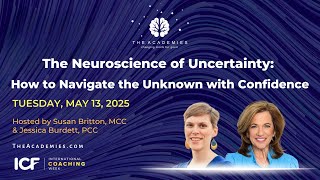
This recorded webinar, led by Susan Britton MCC (founder of The Academies) and Jessica Burdett (Director of Coaching Education), explored how neuroscience informs the experience and management of uncertainty. After brief introductions and a poll on participants' current uncertainty levels, Susan presented the core framework of "red zone" (sympathetic, stress‑response) versus "blue zone" (parasympathetic, flow‑state) and explained how neurochemistry (cortisol, adrenaline) and neurocircuitry (neuroplastic pathways) determine which zone a person inhabits. She described how the prefrontal cortex (PFC) both shuts down under acute stress yet ramps up when confronting uncertainty, leading to a paradox of heightened effort but reduced working memory, focus, and flexible thinking. The session highlighted metacognition and neuroplasticity as ways to shift out of the red zone, using a drawing exercise to externalize personal relationships with uncertainty. Participants broke into small groups, shared drawings, and identified emerging themes such as possibility, curiosity, rewiring, and the value of embodied tools (pen‑and‑paper, imagery, humor). Susan then expanded the discussion to systemic uncertainty, noting that organizations, teams, and larger social systems have their own defensive reactions and that leaders can influence outcomes by grounding themselves in the blue zone and modeling calm. The webinar concluded with practical take‑aways (breathing, movement, humor, coaching by drawing), resource links (Encourage Your Brain emails, LinkedIn, upcoming programs), and a call to stay connected.
Chapters
Welcome, welcome. So good to see everyone joining us. Welcome, Jane. As you join, feel free to pop in the chat where you're joining from, what you're hoping to take away from this session. Welcome, Rhonda. Hello, Elizabeth. Hello, friends. Hello, Cynthia. Great to see you.
It's been too long since I've seen your beautiful faces and talked to you. Hello, hello, hello.
So glad you're here. Oh, rainy Washington, DC, Sarah. That's where I grew up. Welcome. Stockholm, Sweden. So great to have you with us from across the world, Elizabeth. Alright, as you're joining, share your— where you're calling from and what you're hoping for in the chat. We've got all over the world. That's awesome.
I love it.
It's a great topic, hopefully really relevant for everyone. Hoping to learn more about the brain. Great, David. To learn more about dealing with all the uncertainty of the times. Absolutely. As we were planning for this, we were thinking, what does the world need right now? Yeah, so glad, glad it is hitting. Neuroscience is so interesting. We think so too. Absolutely. If you're just joining us and haven't gotten to share in the chat yet, please share where you're calling from and what you're hoping for from this conversation. Oh yes, the world does need love. Absolutely, Demetria. Using neuroscience for greater understanding of self and others. Love that. Well aligned with what we're talking about. We've got a couple folks from DC today. You can find your fellow connections here in the chat. To help Gen Z navigate next steps and uncertainty with so many options. Love that. All right, I'm gonna go ahead and pop in the chat, and I'll share this again later as more people join, but we have a handout for today that you can download.
Welcome.
Glad to have you back, Steve. That's awesome. All right. Well, I'll keep letting people in as they join, Susan, and if you want to go ahead and start kicking us off.
I would love to. So I will let you keep helping people in and love to say hello. Lots of familiar faces. I am Susan Britton, and I am founder and president of the Academies. In 1999, I discovered coaching, and I remember getting off an introductory class and just thinking, this is what I was put on the planet for, and have never turned back. And 25 years later, here we are. We are just excited to be at the intersection of neuroscience and coaching and have been for the past 10 years or so, really early adopters, and so excited to see people interested in this topic today. So my favorite things when I'm not learning about the brain and psychodynamics are playing golf. And so that is why I live down in the Indio area. Palm Springs area during the wintertime, and then home is the middle of California, Fresno. So glad to be here. Jessica.
Awesome. I'm Jessica Burdett. I am the Director of Coaching Education for the Academies and really love getting to instruct, to mentor coach, and interact with our fantastic alumni community. I fell in love with coaching before I knew it was a thing, and when I found the definition for it, realized it was right at home for me. So it's great to be able to celebrate International Coaching Week together. Home for me is Colorado Springs, and we are, we are getting spring. It comes in fits and starts. We had a little snow last week, but I think, I think we're fully into spring now.
Just on the temperature note, we had 105 Fahrenheit last week, so It's, it's too warm here. All right. So on our agenda for today, we are going to talk a little bit about uncertainty and start with ourselves, because if we can understand what's happening within ourselves and make it relevant for ourselves, then it adds to the expanded awareness that we might have in terms of how it relates to others, the uncertainties that they're experiencing. We'll talk a bit about neuroscience nuggets. It is a complex and vast topic. We'll just hit on a couple of things. And welcome items in the chat if you have additional nuggets. That's how we co-learn here. And then we'll talk a little bit about our relationship with uncertainty and have an exercise for that and do some breakouts. Then we'll come back and share some learning collaboratively. And then we'll talk a little bit about an even more complex level of uncertainty, and that is systems uncertainty. So systemic uncertainty, because systems, just like individuals, have their own defense mechanisms and to uncertainty. And then we'll finish with some takeaways. So that's where we're headed today.
And I will again share in the chat our handout for today if you want to use that to follow along, take notes on it, take away with you. And if you've got a writing or drawing implement around, I'd invite you to grab that for later on in the session. And then we also have a couple folks from our internal team in the chat who will be helping in the background.
And can we say who that is? So is it— we've got Leigh Gauthier from Canada who's on our team is here. We have Matthew Gardner from South Africa also on our team. And then I think Emmeline Whitcomb from Dallas is also here. So did I miss anybody?
Jessica? I don't think so.
Okay.
All right. So diving in, let's start with some interactive engagement around where everyone is experiencing uncertainty. So in the chat, share on a scale of 1 to 10, how would you rate your uncertainty level currently? 7, 6, 8, 7, 6. Okay, I see a couple 4s, but so far that's the lowest we've got. We've got 10. Lots of uncertainty. All right. Some 5s. So we've got a range, but everyone is experiencing at least a significant bit of uncertainty. All right, Susan, let's go to the next question. We all have uncertainties. They're not all going to get under our skin. So we'd love to know, what are some of the uncertainties throwing you off currently? The economy. Parents' health needs. Yes. Financial. Future of our democracy. New clients. New coaching business. Politics. Physical challenges. Personal energy level. How to spend every day now that I'm left the corporate world. Financial and politics. Career, couple starting new businesses, lots of political, AI, absolutely, relationship, family, schedules, kids, all across the board. Some of them we share, some are different. It's a couple in Italy, right?
No, no, in Ireland.
Ireland. Yeah. All right, I'm going to mute you, Miriam, unless you were trying to say something. Okay, let's go to the next one, Susan. And then when you think about those uncertainties you just shared, what reactions do you experience in your brain and body around those uncertainties? Headache, restlessness. Tension, gut tension, nervousness, brain feels full. Ooh, that's relatable. Anxiety, constant thought, sleeplessness, imposter syndrome, avoidance strategies, procrastination, brain wandering, shallow breathing, irritation. So many different things, and I love the awareness around what things come up. Acidity. Yeah, definitely relate deeply with so many of these things you're sharing. There's so much uncertainty and so much complexity. It's really much more than our brains can hold on a daily basis. Deeply feeling the attention and energy pieces myself. All right, so let's dig into the neuroscience.
All right, so we are confident that most everyone on the call is familiar with the physiological reactions that we have from a fight-flight reaction, which we term the red zone, to more of that flow-flourish peace possibility rest-digest parasympathetic nervous system reaction. And the slide there shows a number of things that actually happen within the body for that process. As Jessica said a minute ago, not everything will throw us off. Certain uncertainties are not red zone sort of threats for us. But it is something that certainly changes the way that our brain and body reacts and what we have available to us in terms of the cognitive power that we have, the relational power that we have. And so today we wanted to talk about just a couple of neuroscience nuggets that have to do with this red zone, blue zone reaction. And before I go to those, those specific items, the interesting thing is that our chemistry and our circuitry, our neurochemistry and our neurocircuitry, will have a great ability to impact whether or not we do slip into the red zone or the blue zone. So I'm sure everybody on the call has been in a situation where something happens, some level of uncertainty might hit, and it might really just be a no big thing. Like, you know, no big thing, I'll figure out what to do with it. And that's probably because you are in a regulated state. The parasympathetic nervous system is operating. And you just think, I can figure out what to do. However, have you ever been in a situation where the same thing happened that didn't throw you off now is throwing you off? And part of the reason for that, that is now throwing you off, is because there has probably been some sort of growing, growing, growing overload of things that you are handling, the proverbial straw that breaks the camel's back. And when that happens, now the neurochemistry within our body is amped up. You've got the cortisol, adrenaline, and that sort of thing. And that is now shifting us back into the red zone. And so what normally would not have been a problem has now become a problem for us in our minds. And so that neurochemistry is impacting whether or not we go to the red zone or the blue zone. The other thing that will impact whether or not we go to red zone or blue zone is our neurocircuitry. So this is the neuroplasticity that's in every one of our brains. At some point, we have developed coping skills and coping mechanisms to be able to navigate difficulties and challenges and uncertainties. And we've got a certain amount of, like, roadway laid down to be able to handle difficulties. And if we've handled something in the past, but we now can't in this very moment handle something that was easy in the past, again, you have to ask, what's going on with my neurochemistry? Just keeping the red zone, blue zone, the chemistry and circuitry as the variables for what is going to send us into the red zone and the blue zone in the back of our minds. Now we'll look at the neuroscience nuggets for today. No news, we've heard this before. The red zone is not a negative thing that we should always avoid and never be in. It is something that is just the body's protective warning system that says, hey, wake up. We need to be sure that we're going to stay alive and stay healthy and thrive. And so pay attention, we better do something with this. However, it does not like— the brain evolutionarily does not like uncertainty because it is always in this sort of predictive space to determine what's going to happen to me. Will I be able to navigate this? Will I be safe? And when things happen around us that we cannot be able to determine, will I be safe? Then we start really kicking into the PFC, so the prefrontal cortex. And it's a little interesting because the very thing that goes offline when we're under stress is the prefrontal cortex. And yet paradoxically, at the same time, when we face uncertainty, that part of the brain is amping up because it wants to get away from the uncertainty. So we have this aversion to uncertainty because it could spell threat in some form or fashion. And at the same time, we're trying to figure out what to do with it. So we've got the aversion, and now this PFC is working overtime to try to navigate and figure out, how am I going to get through this process? What am I going to do about the political uncertainty, about the parent's health, about my, my health diagnosis, about launching my new business? All those things that were listed in the chat. We're in this like overdrive mode trying to figure out how we're going to navigate and make the uncertain certain. If we can make the uncertain certain, we're going to feel better, we're going to feel a little more calm, we're going to feel like I'm safe. What's interesting is that when we're in that uncertainty overload, the cognitive load that we start picking up, we start looking for more and more answers, more and more pieces of information. What's happening with tariffs? What's happening with the economy? Maybe if I read this extra news headline, I'm gonna be able to figure out and get a piece of data that's going to fix this. Maybe if I research a little bit more about this health diagnosis, I'll be able to get the information I need and fix it. So we've got this cognitive load just going heavier and heavier and heavier. We've added pounds and pounds and pounds of data, so to speak. And at the same time, the research shows that we also lose 3 really important pieces of our prefrontal cortex 3 functions rather, and that is we lose working memory. So here we are trying to pick up more pieces of information so that we can solve something, but at the same time the brain can't hold as much information. So it's like a sieve or Swiss cheese is happening there. The other thing that happens with this cognitive load is that we lose our ability to focus on critical tasks. We start getting distracted, a little ADHD in nature. We pick up more information, we focus or hyperfocus or get tunnel vision about one piece of the puzzle and don't see the big picture as much. So that gets compromised, our ability to see the strategic critical pieces. And then the third thing that gets compromised is our flexible thinking. So if ever we needed to have some flexible thinking during uncertainty, this is the time. And yet that is a very much compromised function within the brain when we're in that uncertain state. So working memory diminishes, focus diminishes, and the flexible, flexible thinking diminishes. Okay, so we've got those pieces. Now, how do we get out of it? The third neuroscience nugget that we just love to be able to lay down here is that neuroplasticity to the rescue, right? We can stop for a moment and think about our thinking, think about our feeling. So I appreciated the question that we had just a moment ago. What reactions do you experience in your brain and body around these uncertainties? So that's a metacognitive sort of question. If you're coaching, that's a metacognitive question to be able to get out of this looped hamster wheel loop of cognitive load and think about what is really happening in my brain and what is happening in my body. The other thing that the metacognitive process helps with is that it stops us from getting into the analysis paralysis piece of things. It gives the right side of the hemisphere a chance to sort of kick in, because when the whole brain is functioning and not just this left, more analytical PFC function, that's where insight is going to happen. The default mode network may be something that you're familiar with. That's going to get kicked in when we have metacognition in place. That's when insights can start to come. Because up to this point, we've been in this cognitive load, picking up more data, trying to solve the puzzle, and just getting too much that we can actually carry. If we shift into the metacognition, if we shift into what's happening within us, if we can start to hear that still small voice and access the wisdom that we have, then insight comes. Once insight comes, we can choose much more strategically what is actually going to be proactive and productive in terms of the actions that I want to take. So those 3 pieces are what we will be building on today. Jessica, any questions or comments or additions that you would want to add?
Let's actually see if there are any questions coming up in the chat. So if you've got any questions on what Susan just walked through, pop them in the chat for us and we'll try to answer a few before—
Yes, that'd be great. —getting to our next piece. And I can't see the chat as I'm displaying easily, so that would be—
Okay. Diorella says, accessing metacognition doesn't automatically stop the bodily reactions though. At least from my experience with anxiety, that's been the case.
And that is true. It doesn't necessarily stop it. What it does do is shift. It does have the capacity to shift somewhat from the thought process. So at some point, if it is, I still feel nervous in my stomach, or I still feel stress in my shoulders, it can— we can shift to thinking, there is stress in my shoulders, there is butterflies in my stomach, as opposed to I am anxious, where we internalize it as much. So at that point, Yes, you're right. It won't just immediately shut it off. There's different research that talks about how long it takes for some of the adrenaline and cortisol to be able to dissipate in the system. And so it may take some time. It may take some breathing exercises. It may take some movement. It may take whatever pieces are going to be most effective for you. So I appreciate your, your addition there. Yeah.
And I'd add to that. There might be more that's needed. So maybe it keeps being there, and that's a message from the body that just thinking of strategies for shifting and ways to take ownership of the situation isn't enough. Maybe your body needs more, and you need to have some professional support there from a medical professional or a therapist. David is asking, please explain red zone and blue zone.
Thank you. So let me go back to red zone here for a moment. And people are typically familiar with the fight, flight, freeze. We also have flock as part of that process. So red zone is when the cortisol and adrenaline shifts into our system and takes over. And we get into a stress response. So it's the sympathetic nervous system in action. Instead of always saying fight-flight at the academies, we refer to it as red zone as a way to understand where am I, where am I right now in my body, in my brain. And so as that happens, when that cortisol and adrenaline amp up, again, an evolutionary process, that has protected us for eons and ages. Blood flow moves somewhat away from the prefrontal cortex. There's some research that says it does go to the prefrontal cortex, but only to solve something immediate, an immediate danger, but not see a bigger strategic picture. So the blood flow then goes out to the arms, the big muscle groups, so that we can indeed run away, flight. We can indeed fight if we wanted to. With muscles and things that would have helped support us to actually fight or flight literally. From that, the research that is done by Barbara Fredrickson, Amy Arnston, many, many others have really identified that we lose a measure of our creativity and our strategic thinking in the midst of that, and that our thinking becomes much more rigid, much more narrow-focused. And so that's when we start draining our resiliency and our optimism and our ability to look at things from a perspective of I have control, I have influence, what can I do? We lose sort of that perspective and get very reactive. Blue zone being very much the opposite. That's a state where we are much more likely to be able to be curious and not reactive. Curious, not furious is a phrase I've heard before. We're able to see the bigger picture and be curious and wonder about what are the options, what's really going on. We're in a place where we have a much greater capacity to connect with ourselves and certainly with others and to collaborate and to co-create and to take action in a productive, strategic manner.
Great questions. All right, so now we're going to take this idea of moving towards the metacognition, starting to think about the way we experience the situation. By doing some drawing. So if you can grab a drawing implement, or if you need to, you can draw on your computer, but being able to actually utilize your full hand muscles is going to be most helpful. What I want us to start with is thinking back to some of those uncertainties you shared in the chat earlier. Pick one and then draw a picture of what's your relationship with that uncertainty. When you're feeling it, what comes up for you? If you consider like the bigger picture of how you react, how you respond when you're encountering it, what's in the space for you? And then just find a way to capture that in a picture. And we'll give us a couple minutes for this. All right, hopefully you've gotten at least a start there. And now let's think about What would you like your relationship with that uncertainty to look like? And draw that. Um, that's more of a challenge. All right, might be more of a challenge, and this is going to really vary per person. We're all going to have different relationships with the uncertainties. Um, what is your relationship— what would you like your relationship with that uncertainty to look like, Cynthia? All right. So hopefully you've gotten something down or at least curiosity getting started. Glad to hear that's helpful, Renato. So we've got a large group today and as such we can't all share in a big group. So we're gonna break into breakouts now. I'm going to put people in groups of 3 or 4. That way if you aren't able to participate, there should still be at least 2 people who are fully engaged in the breakout. If you can't participate, please let your group know in the chat so they don't try helpless, like try without response to communicate with you. But if you can, please do like turn your video on, participate, because one of the greatest ways we can help with this uncertainty navigation is to connect and find how others are navigating it. So here's the goal in the breakout. So you're gonna have 10 minutes. And I would like you to make sure everyone gets to speak, that you approach it with curiosity. So we're not here to critique other people's drawings because probably a small, very small percentage of this group would consider themselves artists, and this was not the amount of time you would probably want for your art. So bring your curiosity. You're welcome to ask people questions, and I'd like you to share your drawings and maybe just briefly what stood out to you about them, and then to talk about where are you noticing that red zone or blue zone. In your drawings and see what themes come out for you that you can bring back to share with the broader group. Any questions about that before I kick the breakout rooms off? All right, here we go, and we'll come back here in about 10 minutes. Welcome back. Great to see some faces, which means we got some good connection happening there. All right. As you're joining us, feel free to— someone from each group, if you want to come off mute and briefly share something that you noticed as a theme. We won't get through every group, but we can hear a couple this way. You can also share in the chat as well.
And actually, I'd be happy to, to just start. We didn't really have a theme. Maybe we did, but I just noticed something brand new for me, which is that my monsters that are all around me in my red zone uncertainty picture, I am the center of it. I'm the center of everything. It's all revolving around me. It's all happening to me. As opposed to my blue zone was I had my little dog, which was labeled uncertainty, and I had it on a leash and I was walking with lots of curiosity bubbles and questions around my head and shifting to this is happening for me. What, what am I learning? So I just wanted to share that. It feels so good to have something new that I hadn't seen before.
So fun too that walking was part of your image. It's like an unfreezing. Unfreezing. That's good. All right, we'll take a couple shares aloud if there are themes you want to share from what you saw in your group, or you can also pop them in the chat.
I'll go, um, hi. Just really glad to be here. And I just wanted to say this because I really enjoyed my group. We all were saying, we all shared our vision, our visualizations, or our pictures, but we saw that the recurring theme among all of us was this idea of possibility. And despite the uncertainty, and at the end, we really, one of our group members talked about rewiring I can't— I'm sorry, I can't remember the name right now, but she talked about rewiring, um, the uncertainty with coming out of survival and overriding that survival by rewiring our brains to think differently. So, um, just rewiring the system. So we just talked about overcoming this uncertainty with possibility and curiosity.
Love that, Patrina. Thank you. Yes. And we literally are creating new connections in our brains as we find new ways of relating with uncertainty. And we really need to because the uncertainty is not going to go away. So we need new solutions for dealing with it. Possibility. Love that.
I'm sorry. It was Lee. Lee. Lee. I'm sorry. I was writing while I was talking, but Lee was the one that came up with that. I talked about the rewiring. Awesome.
Who else would like to share a theme that stood out from your group? Kathy, go for it.
So I just wanted to share what was helpful for me. Thank you, Elizabeth. In our— in my group is looking back. So if you're a data person, you've gathered data of your successes, what has worked for you, and it's good to look back at what uncertainties you faced and your success the data of your success. And you will find that oftentimes everything worked out. So looking back, looking at that data, um, and, and recognizing that you've had more successes than you are actually realizing at the moment, that was helpful.
Oh, love that. Maybe even the body needs an update, like, actually, this is okay, we've done this before. That's right. Awesome. Thanks, Kathy. All right, one more person.
We talked about how, um, interesting it was to actually be using pen or pencils to draw.
And that, that was a different experience than a computer-based interface. Yeah, that's such a fun thing to share, Lynn. I'm thinking as well about how when I feel really overwhelmed, that's where I pull out my paper and pen and it really changes it. And that's actually something that I have started doing much more and owning much more since reading a book called The Extended Mind. That talks a lot about how when we expand and use our whole body, create more ability to see, that can shift things for us as well. Writing that down.
Thank you. Yeah, I feel like it's a tool I want to use more.
I'm really not— I'm quick to go to the keyboard.
And Lynn, thank you. I just want to add too, that was very intentional because when you're in that cognitive overload state, you're grabbing more and more information and trying to analyze it. And right brain is going to be a little more inviting of associations, unconscious ideas, mental images, and imagery is a fantastic tool to be able to work with when you're coaching people in uncertainty because it does help get them out of that rigidity, you know, problem-solving space.
Thank you. Imagery in the body. I loved the comment on movement seems to be a theme of the blue zone in the chat. Beautiful. Great ideas coming up here in the chat as well. Thank you everyone for that. The connection, the possibility of excitement around uncertainty and being able to translate that in instead of the overwhelm. Expanding, changing our relationship with the thing, not necessarily the thing itself. Mm, love that. The relationships are the uncertainty rather than the thing. Um, all right, I will get the book in the chat in a moment, but Susan, handing back to you to get into systems.
Yes. All right, so thus far we've talked about our individual reaction to uncertainty, where we are currently, what we would like it to look like. We use drawing to be able to do that, to get a little underneath the surface of things. Now introducing systemic uncertainty. We do not operate in a vacuum, which we all know. We have relationships, we have one-on-one relationships. We have team relationships. We have, uh, company relationships. We have organizational culture relationships. We have relationships in neighborhoods and family systems. We have all of these systems that are overlapping. And even our image should probably have more complexity to it because there are systems that are upon systems that are upon systems. And we are a part of that. We are the system to some degree because we participate in it and contribute to it. And the system is also in a way separate from us. So if we can add this concept that systems also have responses to uncertainty that we could be curious about, it can also helpful— be helpful for us to understand when these extreme uncertainties or these red zone uncertainties hit, what pieces of the system are we able to influence? We certainly cannot control all of the system. Anybody want to raise your hand to control the political system in the United States or the global system happening around the world? We can't do that. We can have influence to some degree. One interesting thing to be aware of around the system's uncertainty is to be curious about how the system responds to uncertainty. So just like individuals, systems can have their own defense mechanisms. They can add additional levels of complexity or extra rules to follow or things that you should do or shouldn't do or teams that start separating and what they call splitting where one team is right and the other team is wrong. And if they would only fix it, then the uncertainty would go away. Or if they did something different, the uncertainty would go away. So just noticing that systems themselves can also carry uncertain reaction behaviors. So we are not here to, to solve that here today, but we are here to think about what pieces of this can we influence, because that reduces the uncertainty. If I can be certain about, let's say, the values that I want to operate by within the uncertainty, if I can be certain about that still small voice of wisdom that is telling me do this one thing that's at least clear, if there are people that I can influence in a positive way, not a controlling, micromanaging way. Those are some of the things that we want to think about when it comes to how do we navigate uncertainty, especially within systems. So Jessica, anything you would want to add on that?
Let's get some responses in the chat on these two questions. So Who are the people, the systems you have influence on by being part of them? And then as you think about Blue Zone, what's something you'd like to be able to offer yourself to be grounded in the Blue Zone? First for you, but also for the fact that it impacts others through emotional contagion. Absolutely, Steve. A well-differentiated leader can have a very calming influence on a system, for sure. How do we show up? What's the tone we bring?
And I'm not sure if you put those in the chat already, but I went ahead and act— you're duplicated. Sorry.
I've been coming back a lot lately to thinking about With so much I can't control, what are the places where I do have energy? What are the places where my values are? And how can I make sure I'm maintaining my energy in a way where I can engage in a way that's aligned? Can't change the world but can make sure it doesn't change me. Love that.
When I see this about the people and systems, that I have influence on by being part of them, I would say my family. So I have one daughter, just the one child, and she's married. She has two young sons. And as she struggles through parenting, tries to find her way through with all the challenges that all parents have, I can stay really calm and centered for her so that she can have her freakout moments when she needs to. And then know that there's this safe space available to her to talk through what she wants to do about it.
Love that. Yes. And sometimes holding that space for others becomes a gift for us because we're forced to stay in that space as well. In the, in the coaching space, I hold lots of space for people and those become moments where I'm like, here I am sitting holding the blue zone for you and it's happening to help my body out also.
So controlling your breath, diet, and I appreciate these comments and also recognize that it's It's often easier said than done. And so appreciate everyone on the call who is proactively routinizing and building the neuroplasticity that says, I will today take this step towards the thing that, that will be what I want to be in this world in the midst of uncertainty, the actions I need to take.
Yeah, humor. That's awesome. Me too, Jen.
And right, so there's the neuroscience behind the humor too, is that that releases different sorts of neurochemistry, uh, dopamine, etc., that's going to change your biology. And if you change your biology, you change your beliefs and your frames, your mental models. And if you change that, it's a lot easier to change behavior as opposed to think happy. Well, not if your tummy still has butterflies and stress in your shoulders and neck.
All right. So we've looked at neuroscience nuggets around uncertainty. What are our relationships with uncertainty? What would we like them to be? And starting to look at systemic uncertainty. Feel free to share in the chat what you're taking away today. What are you going to bring with you into your world? And then we'd love to stay connected with you. Encourage you to, if there's someone you connected with today, stay connected because connection is such a valuable tool for countering the uncertainty and adding to the creativity and curiosity. And then feel free to stay connected with us. Lee's going to drop in the chat links to our Encourage Your Brain emails, which Susan writes neuroscience content connected to coaching in. And then you can follow us on LinkedIn where we also put out a lot of different content. Susan, what would you add to that?
That we will be sending out the archive to this in case you'd like to revisit that. And for anyone who is in need of ICF continuing education, working on a credential or re— recredentialing, we do have a number of opportunities that you can find programs at theacademies.com. And special just for all of those who invest, have invested in yourself today, we do have May programs that are starting and have a $250 discount available for you as a gift to thank you for, um, investing in you and the people that you coach. And I think Lee is going to add something about that.
Yes, Lee added that. Loving the takeaways as well. Intentionality, use of drawing. What can I do now today to move into the blue zone?
You know, since there's several themes about the drawing, can I just put a plug in for a book that was written by a colleague of mine from Hungary? Thomas Jordan, I think, is pronouncing it correctly. Um, he wrote Coaching by Drawing. Oh, thank you, I sent you a copy. That's right, or you got one, I don't remember. Um, so Coaching by Drawing, and it's just got some lovely ideas, and it's, it's a fantastic tool to get out of the hamster wheel analytical loop and get, uh, get that shift happening with your clients. So Highly recommend.
Yeah, love this idea as well of helping the leaders you work with put on their oxygen masks first. Grounding in the smallest of moments. Why not take a couple extra breaths of fresh air before going inside? The little things. So glad the drawing was a hit. Wonderful. All right. Thank you all so much for the time today, for taking time out of your uncertainty and busy to engage in this. And yes, the recording will be available. I expect we'll probably have it up in the next couple days. We'll get it sent out to you. It'll also be on YouTube, so you're welcome to share it as well. Yes, we can include the slides as well.
Yes. Right. Can I give a special shout out to Jessica because she in 4 minutes is going in to teach a class. And so doing back to back, just tells me that you know how to lean into the Blue Zone, Jessica. I really just want to applaud you for that as an instructor. So thanks.
Well, so great to be with you all. Loved this time and look forward to seeing you in the future. And if you are a coach, thank you for what you're doing. Yes, taking International Coaching Week to celebrate getting to spread more Blue Zone to the people around us. And if you're not a coach, thank you for the ways that you are engaging to find ways to manage yourself, coach yourself, so that you can show up and influence others meaningfully as well.
Thank you, everyone.
Bye, everyone. Bye-bye.
More from Susan








Susan’s ICF Educator Award | The Heart Behind the Impact Katy Montgomery, PCC


