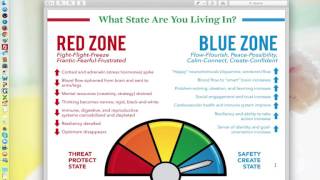
In this solo talk, Susan Britton MCC contrasts two physiological states she labels the "red zone" and the "blue zone." The red zone corresponds to the classic fight‑flight‑freeze response: heightened arousal, cortisol surge, and blood flow diverted from the prefrontal cortex to large muscle groups, which in modern life manifests as stress, anxiety, and over‑reactivity. The blue zone represents a calm, focused, and engaged state similar to an athlete’s flow state, where blood flow returns to the "smart" brain, neurochemicals promote relaxation, and broader thinking, social connection, cardiovascular health, and immune function improve. Britton argues that coaches must be able to assess where they and their clients sit on this spectrum and deliberately create conditions that shift clients into the blue zone, thereby enabling them to perform at their best and maintain well‑being.
Chapters
We've all heard of that fight, flight, freeze state. I like to call that the red zone, and that is a place where we're biologically sort of ramped up, ready to go, and probably even more ready to go than we need to be, but we're— because we're focused on solving a specific problem that's in front of us. We see a problem, we see a danger, we see a threat, we see a crisis, and when we do that, all of this blood flow just kind of gets siphoned off of our smart brain and sent out to our big muscle groups, our arms and our legs, so that we can, quote, fight or flight. And Obviously in the 21st century we don't fight or flight so much as we do argue or get stressed or get worried or kind of spin, spin in the hamster wheel. And then on the other side of the coin is this blue zone, this idea where we're in that zone, sort of like how athletes get in that zone, or we feel sort of like I am on top of this. I feel like I'm on top of it as opposed to it's on top of me. Or we feel like, hey, this is a challenge, but I'm going to rise to the occasion. And when we're in that state, state, we've got a very different sort of neurochemical cocktail mix going on, and we serve our brains better because we've got now this blood flow going to the smart part of our brain. We relax. As we relax, we're able to think of broader possibilities. We're able to engage with other people more easily. It just really impacts all sorts of parts of our body— our cardiovascular health, our immune system is improved when we don't have this sort of overflow crashing red zone cortisol creep going on. So being in that blue zone is really an important piece for the coach to pay attention to, to understand where is the, the client on that scale, where am I as a coach on that scale, and how can I get myself there, how can I invite my client there as well, such that we will be more capable of being our best self.