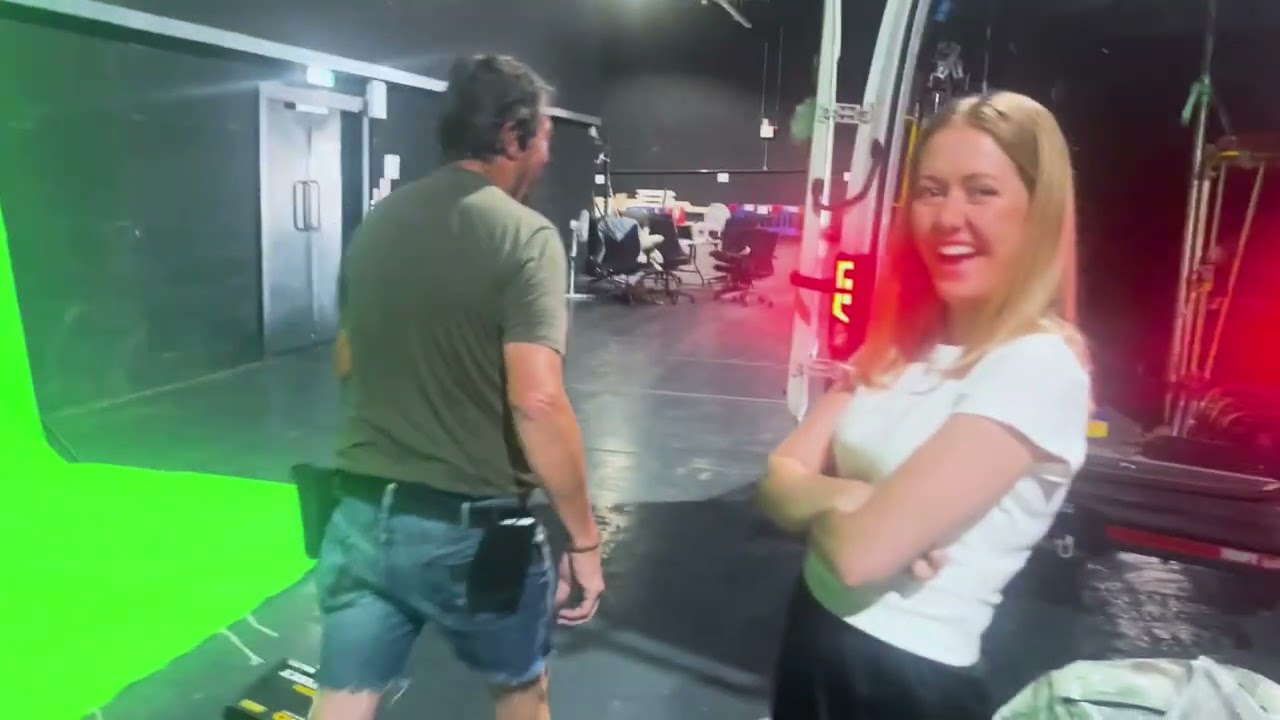
In this on‑set video, AI consultant (Speaker A) joins commercial director Henry Mason and veteran gaffer Mark at Troubadour Studios to explore how generative AI can augment a real‑world shoot. The team plans a short commercial featuring a boy with a rugby ball, filming him from multiple angles. Using AI‑driven relighting, they test whether a subject’s lighting can be altered in post‑production, something that previously required physical light changes. Throughout the shoot, Mark shares colorful anecdotes from his decades‑long career, illustrating how lighting technology has evolved—from heavy soft‑light rigs to the ability to capture high‑detail footage on an iPhone. The conversation shifts to broader implications: how AI might streamline traditional filmmaking processes, whether it could devalue the craft and labor of human creators, and what a hybrid workflow where artists guide AI might look like. The video balances technical demonstration, industry storytelling, and philosophical reflection on what constitutes art in an AI‑augmented era.
Chapters
For the past few years, AI has been able to generate words as good as, if not better than, most humans. In the past year or so, AI's ability to generate images and video has been improving at a ridiculously fast speed. As someone working in the creative industry, I get asked quite often how I feel about this. In short, I'm very excited about AI as a new tool, and I think the interesting question is: Can AI make art? Today, I'm at Troubadour Studios in West London with my friend, TV and commercial director Henry Mason.
All right, here we go. Day one of the future.
Day one of the future, and who's You're not that late.
I'm only, uh, 5 minutes late. That is pretty good.
That's a huge achievement.
I didn't— no one picked me up. I had to drive myself.
Henry's preparing to shoot a commercial for a major client in a few weeks' time in collaboration with production company Darling Films. He asked me to join him today as his AI consultant to help him test how potentially useful generative AI can be as part of a real-world production. I can't really share too much about what we're shooting because it's confidential, but the main thing we wanted to see was how much traditional filmmaking procedures can AI improve on. We're gonna have a boy with a rugby ball, and we're gonna film him from different angles. So he's gonna be running forward, running to the side, moving. The cool thing is, look, We can do today what we couldn't do before, is the AI can relight the boy's face. So we're gonna have some lights, we're gonna put different lights on him, but with AI we're gonna see if we can change the lighting. And go. Okay, ready and roll. Good, nice hands. For some reason, I've always found that gaffers on film and TV sets are the most entertaining people to talk to. This is Mark, experienced gaffer whose father started what is now the oldest lighting company in England.
So I spent 20-odd years at ITN getting blown up, shot at, all the rest of it.
News.
Lots of fun doing news as well.
Did you travel to war zones?
Yes, I got blown up in Northern Ireland 3 times.
Oh my gosh,
broken collarbones. I won't tell you too many stories.
These girls can't comprehend.
About 100 years. I always remember when I was a little boy, my mum Slapping 2 men. I'm holding my mum's hand and I'm going, Mummy, why are you slapping those men? She said, because they brought Daddy home drunk again. One was Richard Burton and the other one was Michael Caine.
No way! Your mum slapped Richard Burton and Michael Caine?
She was slapping them.
Mark had so many entertaining stories, I think I should save them for a separate video. But talking to him, I did learn to see the effects of technology from another point of view.
It's big soft lights with lots of tracing paper because you needed soft lighting because the cameras became more and more
sensitive.
Totally, yeah. Cameras have got better and better and better, as you know.
Capture more detail.
We can shoot stuff now on an iPhone. I mean, that's incredible.
Yeah.
And transmit it.
So what does that mean for lighting? Do we need less lighting or different lighting?
Yeah, it's an old thing. You need less lighting, but if you've got the know-how, it is so nice just to add more shadows or create a negative fill, make it moody.
And do you think it's different to doing it digitally in post?
Oh, always. Always. Well, I say always, but the technology moves so fast that it is hard to keep up with.
This made me think about whether the new technologies might devalue the labor and the craft of human creators. If we don't put in the time and effort and the blood, sweat, and the tears and the pain Is it still art?
Artists, we want to actually— we want to get what's in our head out onto the screen. I think that there will still be a quest— sorry, there'll still be a need and a want for humanity. I think they'll still— that the artist still needs to have involvement, and I think people will want that. If we can make AI work for us and work for the artists, Rather than, rather than just like completely entrusting it to an algorithm, creating the content out of a— and sticking it out on TV. But I'm sure people will try that, and I guess the reaction of the public will dictate what happens. But... My hope is in the hybrid model of, of artists leading AI.