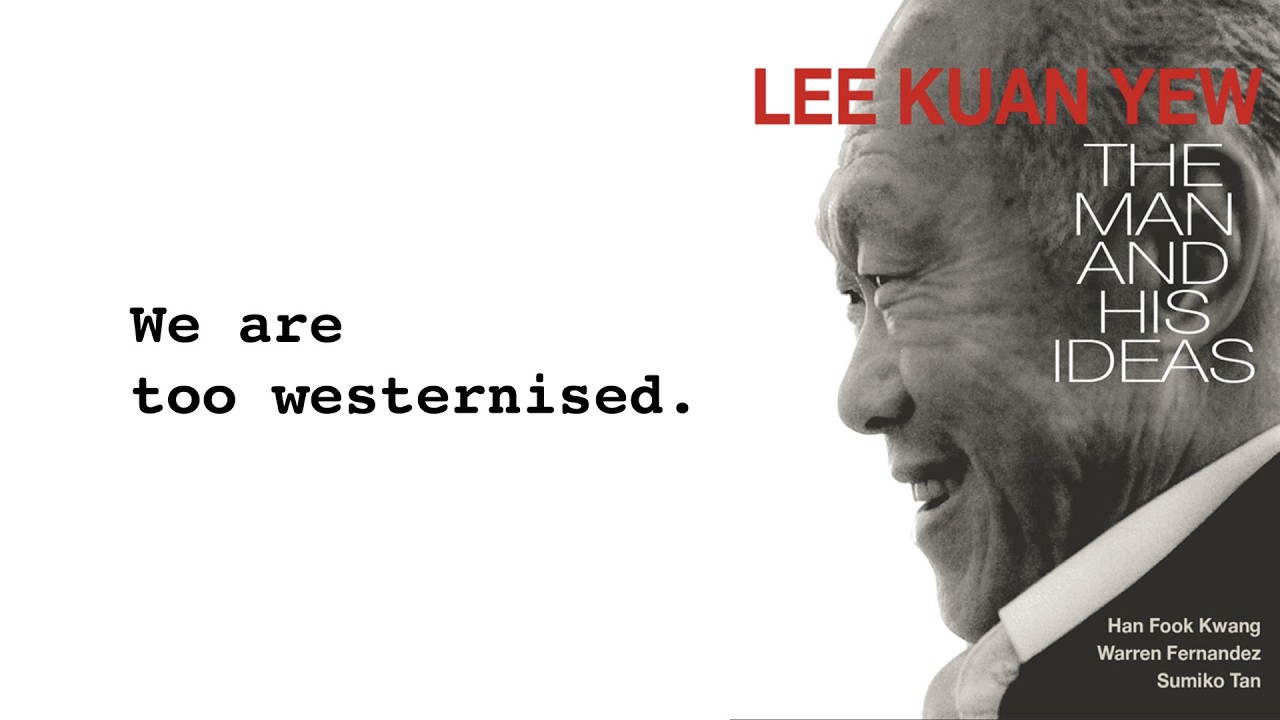
In this extended monologue, Lee Kuan Yew reflects on the factors that propelled Singapore’s rapid development and warns of the cultural challenges posed by increasing Westernisation. He attributes early success to a “bicultural” leadership that combined an understanding of the Chinese‑dominant, hard‑working, thrifty workforce with modern, Western‑oriented policies, especially the adoption of English as the national language. He discusses how religion (Islam for Malays, Hinduism for Indians) and Confucian relational values have historically anchored Asian societies, contrasting these with the erosion of extended‑family ties, arranged marriages, and teacher prestige in contemporary Singapore. Lee examines the generational shift toward Western habits, the decline in teacher morale, and the risk that younger Singaporeans may lose the inner drive that built the nation. He also touches on language policy choices, the perception of race and identity abroad, and predicts that other Asian economies (Taiwan, Korea, Hong Kong, Japan, China) will soon surpass the West, but only if they retain their core values. The speech ends with a caution that unchecked Western influence could lead to a loss of Asian cultural foundations, urging conscious preservation of those values for the next two decades.
Chapters
The people who work in the lower echelons, they were hardworking, thrifty, had tremendous stamina, grit, and they put society above self, particularly the Chinese who formed the majority. If we had a British-type workforce, we would not have made it. We had a Singapore-type workforce that produced the results. So it was the bicultural leadership that understood them and at the same time understood the modern world and therefore meshed in the desires, the urges of the people at large, and the mechanisms, investments, manufacturing processes, services that we were able to export to the world, primarily the West. I met a group of Hong Kong professionals who were extremely uneasy, and we discussed a scheme that would make it possible for them to consider using Singapore as a perch in case of need and continue to work in Hong Kong. At the end of their stay, when I met them, they said, you are a very Western society. We are very Chinese. I said, what's the difference? They said, your people, right down to ordinary workers, they look so Westernized. Their behavior is extremely Western. We are very Oriental. I then started to probe this as I met friends, looked up their data, I discovered that this casual remark had profound significance. This was 1984. It's the software in the younger generation which will determine whether Singapore continues to thrive, to prosper, to be a dynamo as it used to be, as it has been, or whether it will plateau like so many Western societies, like Europe or Britain, where they've just lost steam. They don't see the point of striving and achieving anymore. They're just comfortable and they're happy. And the Europeans in particular, more than the Americans, they feel comfortable with an enlarged community in 1992. They can afford some protectionism. It does not matter if world trade becomes too fierce and too competitive for them. Life could go on for at least some time. One problem, therefore, is a difficult almost an intractable one. We can't reverse track. In fact, there was no option. We couldn't have used Chinese. It would have caused tremendous conflict, would have not got us here. If we continued with Malay as a national language, our economy would not have made it and the people would have rejected the government. Tamil was out of the question. So there was no choice. The consequence is to ask ourselves, is it possible to maintain How can we maintain our core values in spite of this barrage of books, television, magazines, travel, people? First, to succeed, we must decide, yes, this is a problem. We are under assault. What is it we want to keep? I'm not familiar with basic Malay and Indian values as much as I am with Chinese values, but I do not believe there's all that much disparity between the Asian cultures. The Malays are least under assault because they have religion, Islam. The strongest single factor in any culture is your religion. It is the book by which you live, your behavior, your rituals, your prayers, the things you say and do, your day of remembrances, and theirs is strong and resurgent. The Indians, more than the Chinese, attend their temples. Keep to custom, and I agree with this writer in the Sunday Times. I think it was yesterday, Miss Tan Sai Siong, that Indians have changed less than Chinese, Malays least of all. Indians still observe their customs, still have arranged marriages. What is it we should consider core values? I don't think how you dress, whether you wear shorts or ties or open-neck shirts, or wear your hair short or long, makes. the slightest difference unless it's a manifestation of an inner urge. But these core values, I believe, are basic. Do you consider your basic relationships to be fundamental? The human relationships, what Confucius described as the 5 critical relationships. Mencius epigrammatized it in this way. I read it to you in translation. Mo-tse taught the people how to cultivate land. He appointed Sheer as the Minister of Education, whose duty was to teach the people human relationships. 1, love between father and son. 2, duty between ruler and subject. 3, distinction between husband and wife. 4, precedence of the old over the young. And 5, faith between Father and son, ruler and subject, husband and wife, old over young, faith between friends. In other words, the family is absolutely the fundamental unit in society. From family to extended family to clan to nation. In the West, with the tendency of modern government taking over more and more the functions of caring for the young and caring for the old, And in fact caring for everybody, the unemployed, the disabled, and so on. The family is becoming irrelevant. So much so that half the children born in some American societies are born out of wedlock. They are living together, but they don't feel like there is any need yet to make a commitment to each other. But they have committed the next generation. Have we changed? Let's go through some of the basic core values. Strong family ties? Yes, but only the immediate family, the nuclear family. Father, mother, children. It does not include grandfather, uncles, cousins. They're remote. They live somewhere else, in some other flat, perhaps nearby, and they can leave the baby with them. But the links are not as close as when I grew up. I grew up in a big extended family home. A rambling house in Siglap, Katong. I grew up with a wealth of cousins. There were 5 households, grandparents and 4 married sons and daughters and their children. So the relationship was a close one until just before the war, we set up home on our own. But because the years of childhood were years of living in an extended family, the bonds are close. Marriage pattern altered beyond recognition. The arranged marriages are gone. Children are better educated than their parents. They decide the parents' ways and tastes and choices are not acceptable. The result, you all know. Relationship with authority, ruler and subject, by and large, still abiding. But the older generation is more deferential, respectful of ministers, of officials, than the younger generation. I'm not saying it's good or bad. It's just an observation. The younger generation feels more equal with the official they deal with. Or better educated than the counter clerk. And because it's one man, one vote, the ministers go out of their way to be approachable, friendly, and a sense of equality, of talking on level terms, has become the norm. Not necessarily bad, provided that doesn't lead to what it's led to in the West, in Britain and America, where they are contemptuous of politicians. Politicians make them promises with no intention, with no capability of ever fulfilling them, and they carry out polls discover who are the people least respected or honored or thought well of. Politicians and journalists way down at the bottom. Why? Multiple reasons. If you keep on making ingratiating statements put out in response to secret polls you have taken, it must lead to cynicism and eventually to scorn, contempt. Thrift, hard work, Faith between friends. Hard work, yes. Thrift with CPF, less so. Faith between friends, I have not noticed deterioration. But with time, with mobility, we may get what Alvin Toffler once described as the disposable society. As you move up, you dispose of your furniture, your old wives, your old clothes. And you acquire new ones, and you dispose of your friends too. I do not think we've come to that, but we are becoming a rapidly mobile population. If you're good, you've got a personable character, you've got the right drive, you get into the right career path, it's the expressway to the top, and rapid change in lifestyles as you get up to the top. And now all that we can get is in our stride. Provided core values remain. The ones who are 30 and above probably are already secured because they grew up at one time when their parents had large families and plenty of time to spend on them. It's the ones now in primary school, perhaps even in lower secondary school. Both parents working, huge classes, one teacher to 40 students, no individual attention. And the nature of the teacher also has changed. She used to be, or he used to be, a very respected member of society because there were very few educated people in the 1940s, in the 1950s. Teachers were educated and they were well paid. They had good moral standards, were well behaved, and imparted by example those values. Then came rapid growth. The late '60s and into the '70s and onto the '80s. Good teachers left by the droves. I see it because I get the CVs. They're in the Foreign Office. They're going abroad. They're in the Economic Development Division. They've left the schools. The enterprising, the able, the ones with the drive. The result? If you become a teacher, you are less successful. Morale goes down. The less successful stay behind and are recruited. They are less of a model for students. We've spent the last 10 years reversing that trend, trying not only to pay them more, but also to give them a status in our very achievement-conscious society. By and large, it's a problem still at the top. Only the highly educated have that degree of biculturalism where they are more Western than Eastern. At the middle and in the lower ranges, it's still very much an Asian society. The Western habits, songs, dances, whether it's a disco or Swing Singapore, their dress styles or their fast foods, that's just a veneer. But if it seeps down, if we're not conscious of what is happening and we allow this process to go on unchecked and it seeps down, then I believe we have a bigger problem to deal with. where the middle ranges will also be more Western than Asian. The problem is going to be acute over the next 10, 15 years. If we can hold out in these next 10, 15, at the most 20 years, I believe the pendulum will swing the other way. It is based on my observation. It's human nature. Race is an obvious part of your being. I once turned up after the war in a hotel in Switzerland. I was not a wealthy student, but I had some savings and decided I'd have holiday in 1947-48. And the hotel manager looked at me and said, ah, Chiang Kai-shek. I said, no, no, I come from Singapore. He says, yes, Chiang Kai-shek, good man. So whether you like it or not, your identification is settled by how people perceive you to be. And if you're not a Caucasian or an African, you're just not. That's all. You can think like one, you can behave like one, but you're not accepted as one. That creates very big problems for those who have emigrated and for their children too. A sense of frustration, of non-fulfillment, because you're not functioning as a full member of that society. So every vacation you will notice we have Nobel Prize winners and other very distinguished scholars Happy to come to Singapore, Asians to give of themselves. Most of them are from China, not from Singapore, but they feel a certain ethnic affinity. They feel at ease. They are accepted as what they are: Chinese or Indians, whatever. In ten fifteen years, Taiwan, Korea, Hong Kong are going to be successful beyond doubt. Industrial modernized society. By that time, Japan will be even further ahead, and China would have got going. I remember this distinctly as part of my vivid experience traveling on a bullet train in the early '60s in Japan, when the Japanese were still unsure of themselves and the Americans were the models. And I saw them earnestly in conversation with the Americans, almost obsequious, and I shook my head. Almost fawning to please the Americans. I've seen less and less of that. as they've discovered that they've learned almost everything they needed to learn from the Americans. Now they're on par except for the armed forces, and they're ahead in several fields of research. And with it has come pride in being Japanese, and of course admiration from other Asians and the rest of the world. I would hate to believe that the poor, ragged, undernourished Chinese coolies and the equally rugged Malay peon and driver and Indian labourer had the inner strength to build today's Singapore. And their children, with all their nice mod clothes, well-fed, all the vitamins, all the calories, protein, careful dental care, careful medical checks, PT, well-ventilated homes, they lost that inner drive. It's not something which we can treat as fantasy and unlikely to happen. If you search within yourself, and see how different am I from my father and my mother and from my older cousins and brothers, you will begin to know what I mean. If we're unconscious of these stimuli that are working on us, that make us automatically accept certain norms of behavior as desirable because the people who behave like that are successful or apparently successful, then we run a risk of losing that set of core values And unconsciously absorbing one which is not suitable to us as a people and to our environment.