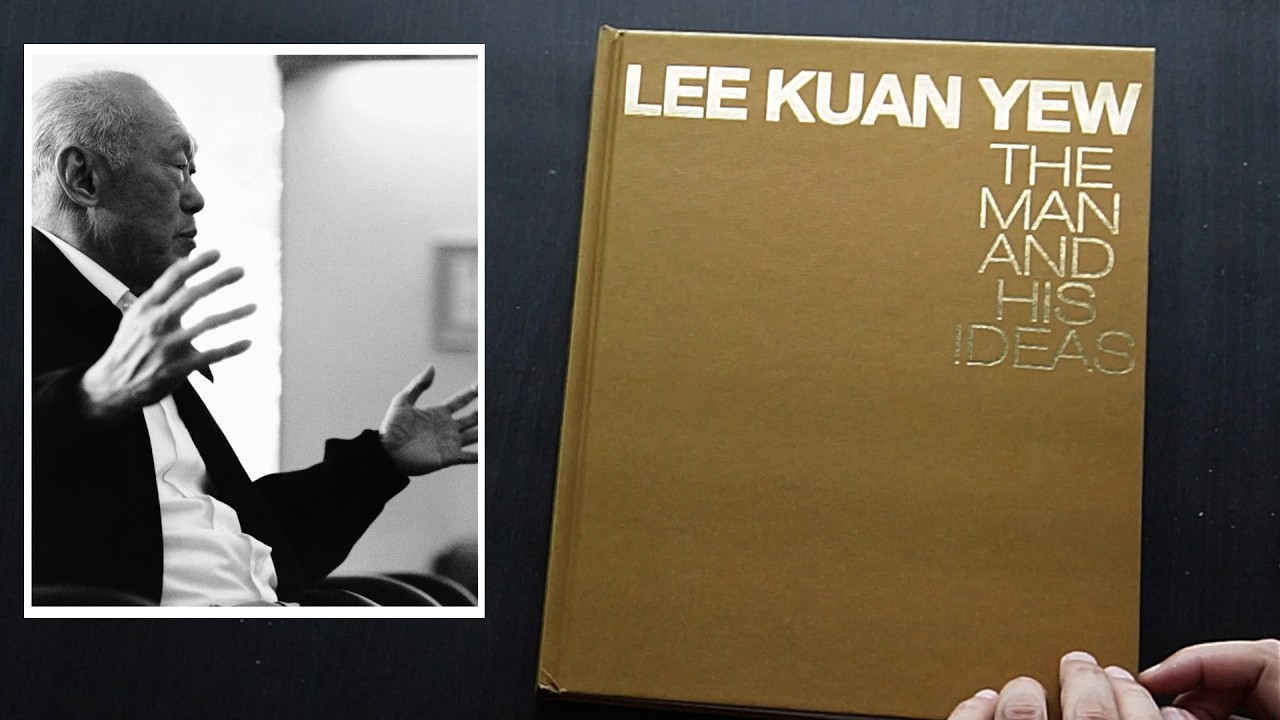
In this YouTube video, the presenter showcases his personal copy of the 1998 first‑edition hardcover of Lee Kuan Yew: The Man and His Ideas, praising its physical design and gold‑sturdy binding. He explains that the book is not a conventional biography but a curated collection of Lee Kuan Yew’s ideas, assembled by authors Warren Fernandez, Phuc Quan Hanh, and Sumiko Tan. The work is divided into two parts: Part 1 contains 11 chapters—three that recount formative events (Japanese occupation, anti‑communist battles, and the Malaysia merger‑separation) and seven that distill key ideas drawn from over 2,000 speeches, plus a final chapter on Lee’s personal life; Part 2 offers transcripts of 46 selected speeches. The reviewer highlights the “golden thread” identified by the authors—Lee’s pragmatic willingness to learn from experience and change beliefs when reality demands it. He affirms this assessment, summarises Lee’s hallmark as “pragmatic,” and mentions plans to create future videos analysing his favorite speeches.
Chapters
This is my copy of the book Lee Kuan Yew: The Man and His Ideas. I bought this for about $30 from a used bookstore in Singapore. Of course, I love the content of this book, which I'll talk about in a minute, but I also really love the physical design aspect of it. This is the first edition printed in 1998. It's missing the paper cover, but I'm fine with that. I love the gold sturdy hardcover. It feels like a true work of art and something very valuable. Now the content. This is not an autobiography or even a biography in the traditional sense. It's a curated exploration of Mr. Lee's ideas with commentary from the authors Warren Fernandez Phuc Quan Hanh and Sumiko Tan, ideas that the authors say shaped modern Singapore, making it what it is today. Most of the content in the book is made up of 13 interviews that the authors conducted with Mr. Lee Kuan Yew in 1994 and '95, and there are some really rare and beautiful photographs. The book is separated into 2 parts. The first part is made up of 11 chapters. The first 3 chapters cover 3 events that shaped his outlook on life: the Japanese occupation, the battles with the Communists, and the trauma of Of merger with Malaysia in 1963 and separation 2 years later. The next 7 chapters cover 7 key ideas from over 2,000 speeches that he made. And the last chapter is devoted to his personal life— how he described himself, what he holds most dear, and his thoughts on subjects like religion, family, and personal wealth. The second part contains transcripts of 46 speeches which the author selected from the over 2,000 that they studied. This is my favorite part because I'm very interested in the words that came directly from Lee Kuan Yew. I'll probably make videos about a couple of my favorite speeches in the coming weeks. For now, I guess I'll end with the observation made by the authors of this book on one golden thread running through Mr. Lee's views, and that is his capacity to learn from experience and, if necessary, to change his beliefs even radically when they do not conform to reality. Another way to describe it would be a constant striving to seek results. Rather than proving a theory right. As a student of Lee Kuan Yew's words, I would very much agree with the author's assessment, and I think I can summarize it in one word. It's a word that is commonly used to describe Mr. Lee, and it's good to be reminded of it here. And that word is pragmatic. That's what Lee Kuan Yew was. Thanks for watching.