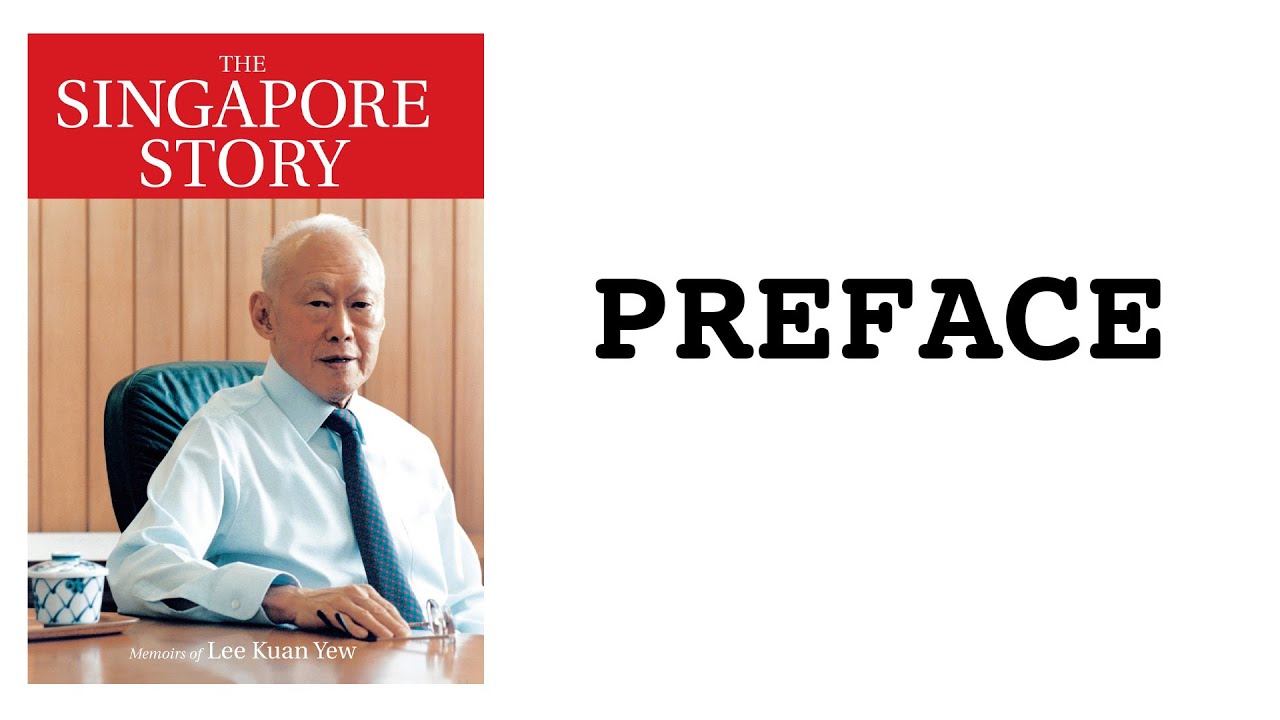
In the preface to his memoir The Singapore Story, Lee Kuan Yew explains why he reluctantly agreed to write his memoirs five years after leaving office, describing the encouragement from Lim Kim San and his concern that younger Singaporeans, accustomed to stability and prosperity, were unaware of the nation’s precarious past. He outlines the turbulent history that shaped Singapore – British colonial rule, the Japanese occupation, post‑war communist insurgency, communal riots during the Malaysia period, and the sudden independence of 1965 – and stresses that Singapore’s achievements were not inevitable but the result of honest, effective government and collective sacrifice. Lee recounts the painstaking research he undertook, the critical editorial role of his wife, Chu (Choo), and the emotional support of his family, noting that their children’s futures were central to the nation‑building drive. He positions the memoir as a personal, non‑official account meant to teach future generations about vulnerability, danger, and the hard work required to transform a resource‑poor island into a developed nation.
Chapters
The Singapore Story by Lee Kuan Yew. Preface. I had not intended to write my memoirs and did not keep a diary. To do so would have inhibited my work. 5 years after I stepped down as Prime Minister, my old friend and colleague Lim Kim San, Chairman of Singapore Press Holdings , convinced me that the young would read my memoirs since they were interested in a book of my old speeches that SPH has published in Chinese. I was also troubled by the apparent overconfidence Of a generation that had only known stability, growth, and prosperity. I thought our people should understand how vulnerable Singapore was and is, the dangers that beset us, and how we nearly did not make it. Most of all, I hope that they will know that honest and effective government, public order and personal security, economic and social progress did not come about as the natural course of events. This is not an official history. It is the story of the Singapore I grew up in, the placid years of British colonial rule, the shock of war, the cruel years of Japanese occupation, communist insurrection and terrorism against the returning British, communal riots and intimidation during Malaysia, and the perils of independence. This book deals with the early years which ended with our sudden independence in 1965. My next book will describe the long, hard climb over the next 25 years from poverty to prosperity. Many, not born or too young when I took office in 1959, do not know how a small country with no natural resources was cut off from its natural hinterland and had to survive in a tough world of nationalistic new states in Southeast Asia. They take it as quite normal that in less than 40 years, the World Bank has reclassified Singapore from a less developed to a developed country. To write this book, I had to revive memories of events long forgotten, reading through minutes of meetings, letters written and received, and oral history transcripts of colleagues. It was psychological stocktaking, and I was surprised how disturbing it was occasionally, Although these events were past and over with, I had one powerful critic and helper: my wife Chu. She went over every word that I wrote many times. We had endless arguments. She is a conveyancing lawyer by profession. I was not drafting a will or a conveyance to be scrutinized by a judge. Nevertheless, she demanded precise, clear, and. And unambiguous language. Choo was a tower of strength, giving me constant emotional and intellectual support. I have not written, except incidentally, about what was an important part of my life: our 3 children. They have been a source of joy and satisfaction as Choo and I watched them grow up and, like their peers, build successful careers in the Singapore My policies had transformed. For my cabinet colleagues and me, our families were at the heart of our team efforts to build a nation from scratch. We wanted a Singapore that our children and those of our fellow citizens would be proud of. A Singapore that would offer all citizens equal and ample opportunities for a fulfilling future. It was this drive in an immigrant Asian society that spurred us on to fight and win against all odds. Singapore, July 1998.