Tom Eisenmann Harvard Professor of Entrepreneurship on Why Startups Fail

A recorded interview with Harvard Business School Professor Tom Eisenmann about his book Why Startups Fail. Eisenmann explains why he researched failure (case studies, interviews, a 500-founder survey), walks through recurring failure patterns (e.g., false starts, help wanted, execution risk), and uses multiple company case examples (notably Quincy Apparel) to give practical advice on MVPs, team composition, fundraising choices, processes, and leadership.
Chapters
Good morning, good evening, good night. NBN entrepreneurship and leadership.
Personally, I'm fascinated by the story.
Trust is an underrated weapon in the business landscape.
I'm a really, really strong believer in learning by doing.
What's the definition of success?
He's trying to come up with an answer to the question, but go ahead, Richard.
You could be right, but you're wrong. Good morning, good evening, good night. Entrepreneurship and Leadership Channel listener. On the New Books Network today, we've got a very special guest, Professor Tom Eisenman from Harvard Business School, who is the author of a new book called why Startups Fail in America and the Fail Startup Here in Europe. And I'm together with my business partner and friend, Kimon Fontegidos. Professor Eisenman, can I call you Tom?
Yes, please.
Tom.
Thanks for hosting.
Pleasure to have you on the show. If someone meets you at some social engagement.
And you're introducing yourself, how do you go about it? What's your sort of standard introduction?
I teach entrepreneurship at Harvard Business School.
Okay. And I've done my homework. So I know that you've had what looks like a glittering education. Stanford, Harvard, and then in professional services, working in Booz Allen and then McKinsey before you ended up doing what you're doing now. Can you just talk about in your childhood, were you ever thinking that you might be an entrepreneur? Do you have any, did you have any exposure of entrepreneurship or any expectations from your, like, have you, in the eyes of your family, have you succeeded? Is this what you were destined for? And just like, where do you fit in the sort of the expectations of the background you come from?
Yeah. So it depends on, on what you define as entrepreneurship.
My father was a small business person, self employed.
He made the living as a television repairman back when people still repair televisions when they had tubes and so forth. And.
He had, as a sideline, it probably broke even, a tropical fish store. And both of those stores, we lived in a small apartment building with just three units of family. In all three units, the stores were underneath. So in a sense, my father launched those businesses, ran those businesses up and down.
But I consider entrepreneurship now, 63 years later.
Pursuing novel opportunities, something new, without resources. So my father surely lacked the resources to get those business started. So he met that part of the definition. But I don't think you'd consider a tropical fish store or a TV repair shop.
To be something new in the sense of how we think of a startup. But so, yeah, so an independent streak. He wasn't a guy who would have Been very happy working for other people. When money got low in the family, which it did all the time, my mother pressed him to go to work for a bigger television repair company. And that lasted about two years before he got fed up with working for other people. So that independence streak that's so important to so many entrepreneurs was definitely in the genes.
And what about your ambitions when you were a teenager? Did you look at his life and think, I want something different? Was he a role model? Or were they more thinking, we want our son Tom to have a better life than us?
Yeah, I think that neither of my parents finished high school and. But weirdly, there are five of us in the family. We were the first generation to go to college. And two of my other siblings are also professors. So you can go figure. That's pretty weird, right? To come from a family with that background and have three academics. I have a younger brother who's a molecular biologist. He's a basically fiddles with the genetic structure of tiny little worms to sort of see what happens. And an older sister who's a feminist historian of higher education. So that's fascinating. We could take the whole podcast to.
Sort of talk about how was it? It is interesting. Was that like, was education something that they were. It must have been like a priority or there. Was it. Was it something that your. Your parents were like, how did that happen? That's amazing.
You know, it never felt like a push. We were just smart kids and they wanted us. Where I grew up, which was a lower middle class neighborhood in Cleveland, Ohio, the public schools weren't very good and the parochial schools, the Catholic schools, were better. So even though the family had very little money, they made the sacrifice to send us to parochial schools. I worked my way through. I sort of started earning enough money to go to school as a paper boy at age 10 and worked pretty much nonstop every summer to sort of pay the tuition, maintenance jobs and so forth. And that was true for all of my siblings. Same approach. My father died when I was 11, so there was none of that. That wasn't the push from that side. And my mom was just sort of trying to keep the wheels on the vehicle. It was five kids.
And.
So, yeah, no, it just sort of happened by itself. When you're smart kids, you get affirmation from certain people in your life. They're teachers who take a special interest to you. And it was enough of a community. I think a lot of people knew the family was in a tough spot, so teachers sort of spent, gave us a lot of Attention. And I think that sort of found its way to wanting to someday be a teacher.
Do you think? Because this is now interesting, just made me think of something that's just interesting. So, like, you came from that background, so, you know, does that incentivize you and your sort of values or what you were looking to do? Like maybe to be less risk, more risk averse. Like, I'm going to take the guaranteed job, I'm going to take the really high paid job. And then really the question that I want to ask is, and this leads into the entrepreneurship, is there some, do some entrepreneurs in your studies, does it come from people that are actually, are well off? It's like, oh, I can afford to just, you know, whatever, like, take a risk. And like, like, or maybe are they even encouraged when they grow, as they grow up to, you know what, you're well off, take a risk. Nothing's going to happen. We've got plenty of money.
Yeah, I'll do the second part first. So academics who study this recognize two extremes, right? There's an awful lot of entrepreneurship that comes from people who've got means, you know, they inherited money, or, you know, their family can support them, or they've got a spouse who's earning enough money that they can take the plunge. And then there's the entrepreneurship of necessity. And, you know, that's true all over the world, right? So some people just can't hold a job, right, because they just don't have the personality to do it. Some people can't get a job because they're in a racial or socioeconomic group that's disadvantaged. So, yeah, it comes in lots of shapes, sizes and colors. Entrepreneurship and both extremes, I think, are quite common. For me, I would say.
Prestige was a driver. I always, I cared about going to a place that was prestigious, which is how I found my way to McKinsey. McKinsey is actually a really risky place. It seems counterintuitive, right? Cause it sort of seems, as the British would say, say if it's houses, but your chance of getting fired at McKinsey. So I left as a junior partner. My chances were one in six of making it that far. And then only half the junior partners made it to senior partner. And then I went into academia where my chance of getting a job at all was incredibly low. Coming out of a doctoral program.
Probably one in three. And then once you're a starting assistant professor, only one out of four make it to tenure. So I've been through these tournaments that you actually, you see a Lot of failure along the way and run the risk of rejection. And I almost got fired sort of halfway through my first few years at Harvard Business School, so.
Well, I think that if you wanted prestige in the world you're in, you probably got there. So congratulations, even before you wrote the book. But obviously there are other motivators. But.
Let'S focus on the book, for it won't be the only things we ask about, but it'll be the center stage. It's why we invited you on and why you wanted to come. So why did you write the book?
Okay, I'll be candid with you. There are origin stories for every entrepreneur. I'll bet you both are serial. So you probably have serial origin stories. So I'll give you the origin story and then we can talk about.
If it's of interest, the real story.
You know what I'm talking about, right? The sort of ebay being launched because Pierre's fiance collected Pez dispensers and so forth. Sometimes these stories are true.
So I would say that a decisive moment for me was the failure of a. Of a startup launched by former students of mine. It's described in the book Quincy Apparel. They wanted to create affordable, stylish. And this is the key part, better fitting work apparel for young professional women. And former students of mine. I had a lot of confidence in them as entrepreneurs. I liked the idea they had done textbook. I had just discovered this is 2011. I had just discovered Lean Startup and Steve Blank and Eric Ries and all those ideas and pushed them to do minimum viable product tests to validate demand for their thing, which they did textbook perfect punk shows where you test the apparel. It all looked good. They raised a million dollars and ran out of a million dollars a year in and failed summarily. And it hurt like crazy for them. I mean, a little bit for me, but a lot for them because I knew them well, I got to see the pain. And I could point to a lot of things that went wrong that might have been reasons why this, this business failed, but I couldn't pinpoint the root cause. And that was disconcerting. Here I was supposedly an expert on entrepreneurship and what could be more important in the field than explaining failure? Since depending on what you describe as a startup, it's actually pretty tricky to define one. And what you define as failure, also pretty tricky. Anywhere from half 50% to probably more than 90% of startups fail. So I was a failure at explaining failure and made me question did I actually understand what was going on Was I teaching the right things? Was there anything I could do? So sent me on a quest to talk to lots and lots, scores of failed founders and the investors who backed them. Read everything every academic had ever published on the topic. Hundred, literally hundreds of first person and third person accounts from failed entrepreneurs. From the practitioner side, a survey of 500 early stage founders to sort of try to sort out what predicts success and failure management practices, sort of attributes of the, of the founder and the startup itself. And all of this stuff sort of swirled a pot. And actually.
Your listeners may know that the dominant way of teaching at Harvard Business School is through the case studies. And So I wrote 20 and you really get, when you write a case study, really get deep into the company, get to know the entrepreneur, the entire management team, the investors and so forth. So I wrote 20 cases on failed startups, which actually form the backbone of the book.
Most of the chapters profile in depth a company that was the basis for one of these case studies and have taught for the last two years an elective course in the MBA program at Harvard Business School called Entrepreneurial Failure, which was just stunningly informative for me in terms of crystallizing my thinking. So that's how the book came about. So the book is a culmination of all that work and what's the real.
You said that's the origin story. What's the real story? You hinted that there was another one.
The real story is like a lot of academics, you want to find something to work on where you can make a splash, sort of new ideas, rigorously supported. And I realized nobody had done good work on startup failure. I also was getting so, so, you know, I started the first 10 years of my career at business school were all focused on platform strategy, network effects, businesses and you know, high level strategy stuff. I wouldn't say I understood the first or second thing really about managing a startup, creating a business, sort of what motivates entrepreneurs. And as I came up for tenure, they have a lot of.
Clout over you at that particular moment in your life. So they said you have never taught the required first year introduction to entrepreneurship course. We know you were working on this platform strategy course. Why don't you do that other thing too? And I said okay, please promote me. And I taught it and I just fell in love with this stuff. This was 2008 and.
And was just eye opening for me, sort of how founders raise money, what motivates them, how the challenges you face when you scale the business. And I really started coaching. I eventually was a course head. So all 900 first year MBAs at Harvard Business School have to take this course. And I retooled the curriculum. I introduced the lean Startup ideas really quickly into the HBS curriculum. And students kept telling us, you know, we'd get feedback at the end of the course, how do we do? And one of the things they told us over and over again is you tell us three quarters of startups fail. And yet the 30 case studies we did in this course, 29 of them were successful entrepreneurs. And so like, are you really teaching us the right stuff? And I actually tried before the. I really got going on this stuff, tried a couple of failure cases, and it turned out MBAs were terrible at. They hated them, number one. And they weren't particularly good at analyzing them. MBAs are. I love them, I am one.
But they're very, very good at analyzing a situation and finding the problem. And if you look at any entrepreneurial venture, it's full of problems. So particularly if you know one has failed, just looking in the rearview mirror and saying, yeah, it' crystal clear why that failed. So those. I actually failed at teaching failure the first couple times I tried it. And I faced the challenge of like, can I actually.
Teach my students something? Sort of figure out a way to present this material and teach this material in a way that people would learn from it rather than just sort of throw up their hands and say, oh, it's obvious why this entrepreneur was a failure. Well, yeah, but like, this person's really smart. Did you look at their background? And like, these smart people invested in this business, like, do you think they're idiots? So, you know, congratulations for being so clever. But it was much more complicated than. Anyway, I eventually figured out how to, how to teach these cases.
Well, it's an excellent book. And there are these sort of, there are these six areas. The bad bedfellows, the false starts, the false positives, the speed traps, the help wanted, which is who's missing in the team, and the cascading miracles. And each of. We could spend an hour talking about each of them. And I'd like you to. You talk about what's wrong with the minimum viable product approach. And I think that's very, very powerful that, you know, it sounds so reasonable to build them in a viable product. But could you explain? Well, if someone's read the book Lean Startup and they think, well, I must definitely do that, what's the, what's the thing that they need to be careful about before they plunge into the MVP approach?
Yeah. So Two things just in case you have. My guess is most of your listeners are familiar, but let's be clear what the minimum viable product is. The idea here is to apply the scientific method to startups.
You can call them hypotheses, that's very scientific, but just call them assumptions about.
How the venture is going to work, how it's going to make money, how it's going to acquire customers.
And most particularly what's the value proposition, what problem are we solving and what's the differentiated defensible solution and who's the target customer for all that. And the lean startup approach says you want to test those assumptions in a way that's rigorous and do it with. Because you're an entrepreneur with scarce resources, without much in the way of resources, with as little waste as possible. And we neither want to waste time because that shoes through whatever capital you've raised or capital. So if you can test the assumptions about the value proposition by showing people a version of the product that actually doesn't exist yet, but they can actually visualize and sort of envision what you're trying to do and give you feedback on the concept, that's minimum viable product. And it doesn't always mean shoddy, cheap, fast. It's whatever level of quality in the product is necessary to get rigorous and reliable feedback.
So there are a bunch of mistakes that entrepreneurs make with this approach.
I'll start by saying there's certain things that are crucial to the success of any entrepreneurial venture that simply cannot be tested with a minimum viable product.
One is many businesses won't work until you have repeat customers, that you've got retention and if it's a subscription business or just some kind of repurchase, and by showing somebody something and getting feedback on it, you may get the enthusiastic rush of yeah, I'll try that. But trying it doesn't mean you're going to become a good loyal customer. So that's important to understand. Second thing is there are. And Quincy Apparel, the dress company I mentioned before, is a perfect example.
The mvp. The minimum viable product is good for validating demand. It doesn't. It's very hard to show you can actually execute on the promise on the, on the value proposition. And apparel design and manufacturing is a wonderful example of an incredibly complicated process. You've got pattern makers, you've got fabric sourcers, you've got quality control. And all these steps in the process have to be done and they have to be done in the right sequence and coordinated and so forth. And for an entrepreneur Putting that together from scratch, particularly an entrepreneur as in this case, we've never done it before.
You just can't possibly assert that we're going to have a stable cost effective production process. So you can't know the operations are going to work until you've built the operations. Doing something at a sample level is entirely different than doing something at scale. So there's no minimum viable product to test the operations.
So sorry, in the Quincy example, they didn't have clients. They never got to the stage of.
Oh no, no, no, they got there. But. So the promise was better fit and.
35% of what they sold. And they had good. The sales growth, the value. People love the idea. The sales grew. Well, they eventually got, you know, month five was 40,000 in sales, month six was 60,000 in sales. So they were on a nice trajectory. They actually got repeat purchase. So the people that bought the first collection, 39% repurchased, right. Bought, bought from the subsequent collection, which is great. But their return rate was a direct to consumer company so marketed through the Internet and the return of the merchandise was 35% which is on a par for other e commerce companies that offer free shipping like they did. But they budgeted in their planning for 20% and of course if your promise is better fit to just hit the averages in terms of return rates is a pretty big disappointment. Hurt the brand. The brand kept. The business kept growing strong. But they were burning through cash because to process the returns and sort of ship them something that fit better, et cetera, et cetera.
Was this the case that they didn't have enough Runway then? I mean I'm trying to get. I know that this is only one example and you can't.
No, no, no, no, you're right on it. Kimon. They targeted. They wanted to raise 1.5 million which they've done great MBAs, right? They've done fantastic financial planning and understood the economics of the business quite well. They tried to raise 1.5 million and which would have given them enough Runway. 18 months, 3 seasonal collections. The season last 6 months they only raised a million which meant they had to enough capital for two seasonal collections. They proceeded anyway, risky move. And while they were making progress, they burned through all their capital inventory is just like a crazy expenditure in a business like this. They had VCs who were. They branded themselves as direct to consumer which was a hot thing back then, still hot today. And.
The VCs did what venture capitalists do like grow, grow, grow, grow, grow. We have 60 things in our portfolio. If three of them yield a 10 or 20 fold return on our original investment and 30% of them make a little bit of money and the rest lose everything, we're fine. That's our business model. So everything in the portfolio has to have the potential to be a tenfold return. And they push everything in the portfolio to swing. If we can use American baseball analogies who swing for the fences. And when you swing for the fences, you miss a lot.
And that's what happened. So these founders should not have taken venture capital. They should have taken angel money.
Yeah, that's my question, actually, because, well, first of all, my first thought is, oh my God, this is so intimidating. Like if 75% of Harvard MBAs with all this know how and all this great, they can't, they can't do it. How can any normal person who's potentially listening to this do it? But then my thought on listening to what you were talking about was how, you know, did they like, did they, did they get them? Was the mistake getting the money.
It was a mistake getting. And it goes to the root of elite, elite business schools like we lionize venture capital.
And they're heroes, right? And so if you come out of a school like Harvard Business School or Stanford or one of the other top business schools, I suspect this is true at European business schools too. You just assume if you're going to start a business that you have to go raise venture capital. And as you guys know, there's many, many other ways to.
You know. And the money that would normally come into apparel companies is a lot more patient. They don't expect a tenfold return or they're not, they're not targeting a tenfold return. Two to four times with a lower failure rate is just fine for a typical apparel manufacturer. That's the money they should have gotten.
Also, the angels are more patient, right? They don't get fired from being an angel just because it takes eight years rather than four. Whereas a VC on a career path, actually they're getting annual appraisals. And so it's a bit different. But you touched on something to do with execution of. You talked about how the MVP doesn't test execution and how, and it seems to me that this is a generalization which is almost always true, that is very hard to execute even in a simple business like your, your dad's TV repair business, you know, current, you know, just to start that from scratch actually requires much more know how than a man or a woman off the street will realize that. And whether a Pizza place. You know, you're competing with people who've been doing it for years and if you just come in thinking you can do it better, you're probably wrong. So when you're, imagine someone's read the book and they kind of, they know the ideas in the book and they're figuring out, well, I've got an idea in sector X doing Y. And because of this execution risk, I want to have at least one person in the team who knows roughly about this business, like with Zappos and the shoe business. And then what, what are the risks in and based on what you know and what you've observed, what would you say the biggest execution risks are? Assuming that the cap table is okay, you're not, you're not being constrained to do crazy stuff by your investors that. Where do you see things going wrong most often? What are the biggest failures in execution?
Yeah, so it comes back and I'll sort of do the other half of the answer to how do people get Lean Startup wrong? Because I only gave you part of it, which is there's certain things, certain places where the method just doesn't work well. By the way, it doesn't work very well for science based businesses that have got a 10. You know, you want to do biotech or something. But here's the big mistake that a lot of entrepreneurs make and they make it when they have domain expertise, you know, the ability to understanding how you run a pizza restaurant. It goes to the false start pattern that the book talks about. And what this is is an entrepreneur who, in their zeal to be an entrepreneur, right, do what's at the core of entrepreneurship, a bias for action, people who get things done. And the impulse for a lot of.
Founders with a new venture is to build the thing and sell the thing as quick as possible. They've got burning in their brain a concept for what they want to do. It's a vision of the problem I want to solve and I've got the right solution for that problem. And what Lean Startup actually would have an entrepreneur do is, is go through Steve Blank, who's one of the gurus who sort of has pushed these ideas, talks about a period of customer discovery before you start building anything, where you're basically doing a lot of interviewing, rigorous interviewing. This is very hard for an entrepreneur to do because the impulse when you talk to somebody is to start pitching.
I'm going to tell you what I want to do and I'm going to see how you react and I'm going to spill out the pitch. And then I'm going to ask you, will you buy it? And, and you're going to say, yeah, I'll buy it because you're a crazy person and I just want you to go away. So I'm going to tell you what I know you want to hear. And so it's. So it's really hard to talk to customers. And what you're really, what you're looking for is have you actually identified a strong unmet need? If you don't have a strong unmet need, there's no point in building a business. It's going to fail. And so your solution has to be differentiated from what is other, what else is out there. And in some ways, it has to be defensible too, right? Because if it can be immediately copied.
You'Re going to face other entrepreneurs are going to scramble and catch up to you. So that's the point of this early work. It's to. Is to identify strong needs. What of all the many, many needs that customers have, which can I satisfy? And of the many ways to satisfy those needs, the different solutions that are possible, which ones are actually feasible and promising and so forth. And all that can be done before you, if you're in a software business, before you write a line of code, if you're in a hardware business before you sort of go to the contract manufacturer and have them bang out, you know, start to cut the molds and so forth. And it doesn't. Entrepreneurs skip this step because they're sure they're right. They're sure they have the vision, and sometimes they're right, and that's fantastic for them, but often they're wrong because the world's a complicated place and you don't really understand, even if you've got experience in the industry, you probably don't understand this problem as well as you think you do.
And so if you've raised, in Quincy's case, 12 months of capital, in a better case, 18 months of capital, and you waste the first four months on a flawed version of the product, you can still pivot away from that based on the feedback, pivot towards something better.
But you've burned through. If you've only got a year's worth of capital, a third of your Runway, and that's horrifying, right? You've really boosted your failure odds by doing that. So basically, the big mistake a lot of entrepreneurs make is going too fast and skipping. It's a step that can take as little as three weeks. It rarely takes more than a couple of months to do this kind of work. Um, but, but just how accurate?
Because I'm thinking, I'm listening to you and I'm wondering how. Because it was so funny, you know, what I was about to ask was like, how important is it to be able to pivot? Because I was thinking that might be a skill that allows you to have success. Because if I can't. Because I think that the research I've done, some of that, you know, I've done that as well. And yeah, it definitely gives you a background, but sometimes you really don't know until you're in it what the issue is and what you can find. And so like I would like the agility. I've also was wondering, but like, you know, as you said again, I think we're coming back the second time here. It's coming back to the money. It's like getting yourself in a situation where you're sort of restricted by, you know, and I'm just wondering all the time, you know, again, for people who are listening to this is like if already, I mean, I know that there may be many lessons we're going to have here, but if one of them isn't, just don't like, like don't get money unless you absolutely like have to. And give yourself time, as much time as possible to do as much as you can on your own, if that makes sense.
And some of that can come. I mean, I think a mistake the Quincy Founders made. They graduated from business school, they went to work for BCG consulting. High paying jobs, stable jobs, at least for the few years you're not fired until it's not up or out, until you're a few years in. And one of them was married and could be supported by her spouse. The other one was single and came from a family with no means. And so the minute she quit the job, she needed to raise money and the clock was running. And so if they just stayed in the BCG jobs and nights and weekends, spent more time learning the ins and outs of apparel design and apparel manufacturing.
I think they would have had a better job of structuring operations that actually worked and chewing through less of their capital, processing the returns and so forth, and might have discovered that the wrong way to fund this business is there are other ways to fund an apparel company other than venture capital.
And for those of you who read the book, Tom has some excellent ideas about how to structure the interview to avoid people saying what they think you want to hear. And it's, you know, there's a way to do these interviews, which doesn't push people to say, this is wonderful, just because they think that's what's helpful. And I often get business proposals across my desk and people want to show me their product, show me their demo, and I say, look, just tell me what the customers think about this. It doesn't matter what I think. Tell me what the customers think. And they say, oh, that's not going to be a problem. And I say, well, if that's not a problem, it's going to be super easy for you to find those customers. And it turns out they haven't got any. And the other thing is, I say to people, go to people, your family and friends, and say, tell me what's wrong with my idea. Don't tell me what's right with my idea. Tell me what. Because you'll be helping me if you tell me what's wrong. Because six months down the road, I.
Would go a step further, Richard. I'd go a step further. I'd say, don't even ask, don't even talk about the idea. Talk about the problem. Because again, even by talking about the idea, you're starting to suggest something maybe. Let's talk about whatever the problem is that you're trying to solve, because problem.
Is usually the first step. And by the way, there's some businesses down the river from me is mit, where you actually do start with the idea, the solution, the invention, and then you go search for the application. So sometimes entrepreneurship works the other way around, but usually it's problem first and then solution and then so. So you're right, hold off on the solution. But then even getting feedback on solutions, there's some tricks that, that listeners can use. So it turns out if you put one prototype in, in front of somebody, and a prototype can be as simple as a sketch on a piece of paper. I mean, it's just some representation of the thing that's coming, a storyboard that sort of shows steps in a process. If it's a service business, if you show people one thing again, they're going to feel sorry for you because they can sort of sense that you're a stressed.
Person. But if you show them so they're going to tell you they love it. You work so hard on it and you seem needy. If you put two things in front of them and ask them, which do you like better? It's actually a very good way to get, to get accurate feedback. So all of this, and these are the skills of market researchers, the skills of user experience designers, and Every entrepreneur needs to have some of that DNA and training in them if they're going to be successful or you can get. Or you just need to be very, very lucky.
Being lucky is a very good tip, actually. I think we could learn from that. Thank you for actually winding back because I was leading onto what things people can get wrong in terms of execution, which was part of the example of the startup, the difficulties of operating in the apparel and fashion space in terms of building things on time and to budget and getting lead times right and stuff like that. I was. And we covered the MVP problems and you brought us back to some of the other things that can go wrong with that. But moving back to the execution, if you're looking at entrepreneurs and you know they're knowledgeable, they've read your book, they're, you know, let's say they've discovered the problem. If you're thinking of the things that can go wrong with the execution piece, the getting it done, there is a market and the unit economics stack up, you know, there's a big gap between how much you can can sell it for and what it costs to make. Where do you see the biggest risks for not actually being able to get it done in terms of whatever the value of the business is creating?
The big one here is.
Team. And so.
In the. And the team problems are most likely to manifest themselves if the founder lacks experience in a key function or if industry experience is important and they lack deep experience in the industry. Sometimes it's a function. You know, some businesses just really depend on operations, logistics. And if the founder, if the entre, if neither of the, you know, if they're multiple founders, two founders, co founders, and neither of them has that experience, you're going to need somebody on the team who does. And so in Quincy's case, they had never designed or manufactured apparel before. They lacked industry. They knew that. They knew they needed to bring people on board. They hired a bunch of industry veterans and they made the mistake of taking people out of established apparel companies who knew exactly how to do that specialty function, fabric sourcer, pattern cutter, and plopped these people into a startup where we would normally expect jacks of all trades to sort of shift. Wherever the fire is burning hottest, everybody sort of dive in and solve the problem. These people kind of sat on their hands and said, I don't know how to do that. I've never done that before.
I take the pattern and I sort of cut it out. And so these people were, in theory have the specialty skills. In practice, they didn't have the attitude. They didn't have any fit with what needs to happen in an early stage startup. And this, I think, is true early stage. It's actually true late stage too, when a founder lacks crucial experience. So there's another example of a late stage failure in the book Dot and Bo. They are an online retailer of home furnishing. So if you look around, wherever you're sitting, you know, the lamps, the chairs, the tables, it's all bought somewhere. These people did that online. The founder was a genius at actually figuring out how to. This is a sector that's famous for people burning through hundreds of millions of dollars, sort of generating sales quickly and then they just can't. They don't have loyal customers, they can't sustain it. And by the way, the operations are brutally difficult. And this guy actually had the right demand formula. He came, his background was in television and he envisioned all the stuff in the room. The room is an episode of a TV show and all of the items in the room are characters, you know, so the chair is essentially, you know, has a relationship with the table and so forth. And it worked. Amazingly, it worked. People wanted to buy the entire room because it all fit together. And they came back and bought more, you know, when the episode continued. So they had fantastic demand. But this guy didn't know anything about operations. And it turns out that shipping pouches across the sofas across the country is really, really difficult. And unlike, say, Amazon, if your books arrive two days early, if your sofa arrives two days early, that's a big problem because you were supposed to. Not during the pandemic, because you probably are home, but back in those days, you took a day off from work to meet the sofa.
He knew he didn't have the operational expertise. He had his jacks of all trades sort of hack it together at the beginning. And that worked for a while, but eventually it got to a scale where you needed a specialist. And his first hire for VP of operations was somebody envisioned to be the chief operating officer across all the functions. Bad idea. The guy bought the wrong ERP system. Enterprise Resource Planning System. This is a system, and for your listeners, if they're not familiar with it, that keeps track of inventory and orders. And if you don't have a system that actually knows what's in inventory and you can't keep track of your orders as a retailer, you've got huge problems. And so they bought the wrong system. It was a mess. Fired. That guy, hired another one. The second one came out of Netflix, I think many Listeners will remember a day when Netflix, instead of about streaming, was all about shipping little red envelopes. With DVDs.
Yeah, with the DVDs. That's right.
Exactly. So this guy knew how to ship things. That was the good news. The bad news is there's a massive difference between shipping a sofa and shipping a little red envelope. So. And he was a big company guy who was a master, like so many big company people at Obfuscation. So I will show you the numbers that prove that I'm making progress on the things you wanted me to make progress on. I won't tell you much about how everything else is sort of wobbly over here. He's not thinking like an entrepreneur. He's thinking like a big company manager. So they fired him too. Even though he was making some progress. It took three tries. And so the point here is, if you've got a founder, an entrepreneur who doesn't have the experience, they won't have a network rich with people who actually know how to do that thing. And even if you can generate candidates, you won't have the experience to sort of pick the right idea, like, what the right skills and experiences are. So you're prone to make mistakes. And, you know, there are ways around that. You can have investors who can actually help you. You can have advisors, but boy, execution, rich Richard, execution risk comes a lot from hiring the wrong people, hiring people when they don't fit the company people.
I want to talk a little bit. You're talking about people, and I think this, for me would be my guess to also be one of the reasons why these things succeed and they fail. We had a previous podcast, we had an interesting conversation with somebody who described the early stage employees as entrepreneurial.
Right.
That you can't get people that just want a job. They have to be a special breed of people. But I want to ask you how important. So there's various different sides of this, but how important? Because this is like a cauldron for these startup people and like the founders themselves, the relationships they have with each other, I mean, like, how important? Obviously you're going to say it's very important, but, like, is this a big.
Determinator of the success and the failure of these things? I mean, like, you know, on the level of this initial core team, are they able to work in the pressure cooker? Because it's a pressure cooker. And are they prepared for that? Because I don't know that MBA can, like, can prepare you for that. That's like a different.
It can't and one of the, you know, we try now to do a lot of learning by doing and sort of give them at least a feel for. They work on ventures while they're in school. And it's a real thing, right? You build it and you try to sell it and they get a taste of it and it scares the living hell out of some of them. And they correctly make the decision that they're not temperamentally suited for it. But yeah, so the ability to handle the pressure and the ambiguity is important, but also just being able to. One of the problems my MBAs have is they all want to be the boss, right? They're wired up, run things, and it's good to have somebody who's accountable and, you know, takes responsibility. But when you have two people who think they're the CEO.
And it's very natural to feel that way for the co founders, usually they spend months just, you know, just the pair of them, and they talk through every decision. They're sitting in the same room shoulder to shoulder when we could sit in the same room. And.
So, you know, eventually comes a time when the thing is big enough and complicated enough that if you're going to move fast, you can't talk through every decision. You've got to allocate. And then the classic split is inside, outside, like you take care of marketing, branding and fundraising, I will take care of operations, maybe recruiting, et cetera, et cetera. And that can work for a long time, but if there's still. And this was a problem at Quincy, they both thought they were.
They were best friends and they vowed at the beginning to not let disputes over the business ever get in the way of their friendship. And they effectively functioned as co CEOs and they talked through every decision and it slowed them down because they didn't always agree. They actually had very different key issue in an apparel company is like, what does the apparel look like? And they had different design, aesthetics and preferences. And so they never sorted that out. When the business actually failed, one of them forced the other one out of the company in a board dispute. And they didn't speak, despite having vowed best friends to never let the business get in the way of the relationship. They were not on speaking terms. They've since repaired, but it took two years before they.
So, Tom, how important is it for these people? Because what I'm hearing is that they have the tough conversation at the beginning, like we're sitting down and we're going to be founders of this company. And if this thing works, this is what I'm going to like this is how we're going to go forward so that we're clear from the beginning. Is that what they do?
I mean it's crucial we push, push, push when we coach the MBAs to do it. And it's a hard conversation. Right. We basically make them sign. To sign a founders agreement you've got to specify.
Who owns what share of the equity. You know, we're going to give is going to be 50, 50. Are you going to give a little bit more to the person who's worked harder on it for longer or who had the idea or maybe put more capital in? And it's a rough conversation and it also needs to, it needs to specify the mistake a lot of our teams make and we try to not let them make it is to not put vesting provisions in. Right. So these, these founding teams can be very unstable. And if the worst thing in the world is a 50, 50 handshake, you know, and sign a contract that, that validates that legally and then the people split up and they have 50% and.
They have 50% and you're stuck and you can't move forward.
Yeah, we actually some of your listeners may be familiar with a business called Zipcar. It's basically, it's a car sharing model and a very successful business in the US got started around the year 2000 and the founders did that handshake and one of them never left her day job and just wasn't carrying her weight. So the other one who was CEO and able to fire the co founder did, but they didn't have a founder's agreement. So there was no vesting of the founders equity. And basically the person who stayed with the company gave up half her founder shares to somebody who made at best a modest contribution to the early success and then left the company. So you need vesting and it varies in different parts of the world. East coast of the United States is four years, west coast is three years. But founders need to vest and they need.
An understanding of how they would divorce. Right. So who's going to make the decision? If they both want to keep going with the thing but they can't work together anymore, can they both take the intellectual property and whatever progress they've made out? So we force the students to hammer this out and many still avoid it just because it's like, oh, we can do that later.
Comfortable?
Yeah.
That is a super, super yes. That's in my opinion for anybody listening, it might not sound, that is a super valuable piece of advice to basically.
Even Having the conversation. Even having the conversation. How are we going to. Not necessarily a divorce, although that too. But how are we going to handle it if we disagree? What are we going to do? And you know, and like. Well, let's suppose Tom's the angel investor. Well, we'll ask Tommy. At least you've got a. At least you've got a process in place. You're not, you're not. It's easy to forecast.
Do you know the how. Do you know how. Atlassian. You know Atlassian, the GitHub guys. Do you know how they do it? They're 50.
50.
They do rock, paper, scissors. That's what they had. Of course now they're a gigantic. But they used to do rock paper, scissors. Because I listen to those guys.
Right.
I mean, you know it's fast and fast. You know, if you're both sure you're right, somebody's right. Maybe. Yeah. I love it.
No, they were saying though actually because it was rock paper, scissors and the decisions were important, they never let it get the rock paper scissors because this is ridiculous. We're going to decide this huge decision based on rock paper, scissors. So they actually forced them to get to the. Whatever to get to the decision.
Yeah.
And in terms in the book, you mentioned the issues of the tension between bureaucracy and processes and systems against the flexibility and formality of the startup and.
I've probably been involved in 35 businesses and I'm always. There's a stage at the beginning where you're basically looking for product market fit and you know, there's a fair degree of chaos once you get to that stage where there are customers who actually want this damn thing and we're going to make money doing it. It seems to me that that kind of obsession with getting processes and systems in place to start optimizing and once you do it more than once, how can we make this stable and repetitive is really important. But not, not all people, not many, maybe many entrepreneurs don't have the character for that. It's not like they're more like prefer the new, the exciting, the fun stuff. And I was wondering whether. Is that a co. Is that. You also mentioned how hard it is to hire people if you're not an expert. Like you know, if you have two co founders and we need a. We need someone who knows about logistics. But if neither of you know about logistics, then how do you manage and support that key person, your team, they may be bunking off and you don't even realize because you don't understand what they're doing. So how do you resolve that? Because processes and it doesn't sound exciting, but it's important, isn't it?
Yeah. And many entrepreneurs hear process and think bureaucracy. And they're wired up, they're allergic to bureaucracy. They worry that sort of the scrappy.
Approach to innovation, you know, just moving fast, is going to disappear when they put in process. And in some cases they're probably right. You know, we, we explore this with our MBAs through a case. There's a company called Cloudflare. It provides Internet plumbing, speeds up the Internet and makes it faster. It's got a $30 billion valuation. Now, amazingly, we started at Harvard business school in 2009 and the case is set. They're three years in, they have 30 employees, 26 of whom are engineers in this kind of company. And five engineers have just left voluntarily. The first five, first five defections, and all within the space of three months. And the question the case raises is, is this Silicon Valley engineer turnover, as usual.
A place in the world where that kind of thing happens, or is there something deeply, fundamentally wrong with what's going on at the company? And as you dig in, you find out the company, like a lot of early stage companies, has zero process. There's no recruiting process, there's no onboarding process, there's no head of human resources, there's no employee handbook. And they recruit basically by asking an engineer, do you know anybody who can do this thing?
And they're running the thing very hot, and some crucial functions. They're taking their time trying to find a truly excellent provider. And so the question to the MBAs is, do you slow this down and do you put some process in to keep some of these basically get better control over all this stuff? And the MBAs, they're not crazy about slowing it down, but they love the idea of putting process in. And we bring the founders to class and they basically say, nope, you know, you don't need a head of human, you don't need a vice president of human resources in a 30 person company. And we're going to resist it as long as we can. There's a risk if you put the process in, you'll put the wrong one in. You'll hire somebody who will try to just sort of drag and drop the process from their last company into our setting and it may not fit. And so they resisted it. And boy, it's a real lesson for the MBAs, because it's hard to. I mean, this company had such a powerful business model. They may have made it to, you know, with all sorts of management disasters as possible. They still would have made it to 30 billion in valuation just because the model was working so well. But there's something there about waiting and it's a very, very hard thing for entrepreneurs to sort of figure out how to time it right because it does bring it, you know, you hire specialists, specialists need ways to control their specialty, they need ways to coordinate with the other specialists and you need systems and processes in finance, you know, for basically keeping the cash under control, you know, for understanding unit economics, which customers are profitable, for managing the orders, for managing inventory, for managing human resources processes everywhere you look and eventually the company is.
Going to need them.
And Cloudflare put them in eventually, but.
They took a go slow approach and it worked.
We had a wonderful social entrepreneur called Tessa Clark on the show a couple of months ago who's got the world's leading app for food sharing is a social benefit company called Olio. And she worked in corporate before going to business school and starting this company with someone she met there. And she said there are things that you learn working in big corporate world that you don't realize, you don't know until you've done them. And she gave examples of like having one on one meetings with people who report to you and how to do a meeting. And I suppose in the case of Harvard, most people have actually worked somewhere before they do their MBA.
They'Re to.
Trying 28 when they start. So most of them have got about five years of some kind of business experience. That's right, yeah. No, I think that's powerful and I think if you look in the world of product.
Product managers who were trained at a Amazon or in the tech world at a Microsoft, at a Google, they've learned a lot of good habits and they can come into a startup and still be very scrappy and entrepreneurial, but they know how to run a meeting, which is a good thing to know as a business person.
Absolutely. So interpersonal skills and leadership, there isn't a lot in your. It's not explicitly written about but obviously there are many occasions when leadership's needed and that ability to. When you're looking at people you think are going to succeed, suppose you're going to make another angel investment in the next three to six months and you're trying to put your finger on the features, the characteristics of the people or the team or the individuals in the team who are going to make it work. From an interpersonal skills point of view, what are the things that you think are most important there because it's obviously vital and you can have all the processes you like and all the systems you like, but if the guys running it are complete jerks and deter talented people, it's not going to work. So if you're trying to identify those factors for success or failure, what are the ones you think are most important?
Yeah. So I'll give you the angel investor answer, which is one hat I can put on. I've done plenty of that. And then I'll give you the academic answer, which is actually a pretty interesting answer. I'll give that first. So the academic answer is we all think we can look at stuff in people's backgrounds, who they are, what they studied, what prior work experiences they've had, et cetera, et cetera, and improve our ability to predict whether they'll be successful as entrepreneur. There's very, very little of that that actually.
Really improves the odds that you're going to spot a good entrepreneur. Age doesn't matter much older is actually better than younger because older is correlated with experience and experience actually helps. So industry experience helps, but it's not decisive.
Education is a weird one. Usually the.
People who have gone to elite schools.
One thing maybe they're smarter or more ambitious or something. So hard to know what's going on there. They're also privileged in some ways, so they have access to. So they may be more able to take a bad idea and get it started. So when you look at the failure rates of people who've gone to.
Yeah, that's very interesting. So just to clarify, what you're saying is that somebody with a prestigious education is more likely to convince an investor to invest money in a potentially bad idea. So you could end up having a inverse failure rate as a result of this.
Some of them may have family means that allow them to work on a bad idea for a while. And just going to Cambridge or University of Wisconsin or Harvard gives you access to people. And if you're a good salesperson, you can maybe talk somebody into giving you money to try your thing. And that opportunity may not be available. Depending on other people's racial, socioeconomic, gender, backgrounds may be less available. So you gotta be careful with anything you can sort of spot on a resume whether it's going to be predictive of success.
And there are some correlates, but they're not very strong predictors.
Past experience helps. And as an entrepreneur, right, because, I mean, there are people who get into it who shouldn't be getting into it because temperamentally they're just not suited for it. So that's the academic side, which is you sort of throw up your hands and you say, meh. I'm not sure what predicts the, not only the propensity to be an entrepreneur, but more importantly for this discussion to succeed as an entrepreneur. As an angel investor.
I look for people who can sell, sell the concept with passion, vision. Because you're going to be doing that over and over again, right? You're going to sell potential employees, you're going to sell investors, you've got to sell customers. You got strategic partners. But.
In anybody who's done sales training, you go back to my days as a McKinsey partner.
They would shudder in horror at any McKinsey person saying that they sell their services. But of course they do. And as a partner, you go through IBM style sale, at least you did 35 years ago or however long ago it was for me. You go through sales training. And anybody who's been through sales training learns the most important thing is you learn to listen to. Right. It's not all about pushing the idea. And so that's, you know, when I say that the entrepreneur knows how to sell, they not only can present the idea with conviction and clarity, but they listen and you can actually tell they're processing, they're being flexible about what they're hearing. And you know, and I work closely enough with my students, so I pretty much only invest in startups by former students because I've spent enough time with them to know if they've got these traits.
That's a nice segue for me to ask how, how valuable is a Harvard education for starting a business?
Yeah, I get this one a lot. Are the failure odds, success odds exactly? I don't know. I wish I knew. We probably whatever your alma mater, I.
Think you need to put your sales hat on here.
Thank you.
Yeah. No, so I mean, there's a bigger question here, which is can, which I know is one you're fond of, can entrepreneurship be taught? And what I'd say in response to that is absolutely, positively yes. Because every entrepreneur, if you're going to have any measure of success, there's just stuff about business you need to know. You need to know marketing, you need to know finance, you need to know something about leadership, which actually.
At least exposure to different leadership styles can be taught. You need to know about accounting.
And in a business program, whether it's exec ed or undergraduate or an mba, you get all this stuff. And there are other ways to get it. Drew Houston, who's the entrepreneur who built Dropbox, was a computer science major at MIT and knew he had a good idea for Dropbox, knew he didn't know anything about business, nor did his co founder. They were both software engineers. And so he did what a smart person would do. He went to Amazon and basically said I understand there's this thing called marketing that I'm going to have to. So he bought the top 10 marketing books, the top 10 sales books, the top 10 finance books he taught himself. Most entrepreneurs I know aren't readers and certainly don't have the patience to do it that way. There are other ways to do it. You can find mentor, you can acquire the skills on the job, but that's at a prior employer. But that's tricky because most people work in one function. They may learn a lot about finance as a financial analyst but know nothing about marketing. So it's only when you eventually get to a general management position that you're exposed in a cross functional way to all this stuff. So business education I think is helpful for a lot of entrepreneurs and we do that. And then when you start to look through the lens of business education, each of those functions I just mentioned we have a course at Harvard Business School on entrepreneurial marketing. Because if you have no brand and no customer relationship, very different marketing a thing out of Procter and Gamble than it is out of Quincy Apparel. And so there are things you can teach a first time entrepreneur about entrepreneurial marketing. Entrepreneurial finance is fundamentally different than big corporate finance. I mean sort of the world of stock exchanges and public company share trading and are the capital markets efficient? Like you know, that's a question my colleagues in finance obsess over. Like.
It'S a completely meaningless. The most important question in finance academic question is like completely meaningless. In the world I live in we worry about staged financing and term sheets, you know, the terms that are in term sheets and you know, when, when do you take venture capital and so forth. So if you go into each of the functions and even leadership I would say sort of viewed through an entrepreneurial lens is a different thing because the challenges are so different.
Yeah, I think this is, yeah, I think this is like just to be clear, I actually do believe that you can learn a lot of this stuff. What I think the problem is where I think the potentially the problem is is that how do you choose? Because like, okay, I think I could have gained a lot from getting this education to be honest with you. But I think it's also in my. Something is in my Character. And I think that there's an. How do you measure that the person is an entrepreneur. Those are the people that are going to get value out of it. I mean, I know that there's people who that are going to do it and then they're going to go and do something else and maybe they're not going to use it. But I mean I think that's really. I think the answer is actually in the pre selection process more than it is in the actual. I think the education itself is probably perfect. But is it? Is it? Are the right people getting it?
Yeah, you know, so a thing that will surprise I would bet a lot of the listeners is, you know, we tend to think of Harvard Business School in particular as a factory for big corporate types and consulting firms and investment banks and so forth. And by the way, we are such a factory. But over the course of careers it turns out that half, 50% of Harvard business School graduates launch a business. So it's actually a pretty. It turns out a lot of people go into consulting and it's up or out. Right. Five out of six get fired. We don't, no one calls it that, but that's what happens. And they go off and do other things. And a lot of times the other thing is, you know, you go buy a small company and you build it up or, or you start one. Same thing with investment bankers and so forth. So it's a pretty entrepreneurial group, but still it's not suited for everybody. And at school, Kimon, we have a bunch of courses that focus on deep self reflection. So it turns out if you get people who've studied career management and sort of psychology.
They'Ve created structures that really let the students introspect and do it often with peer to peer feedback. You know, you got to build a trusting environment where you can sort of let your hair down a little bit and disclose stuff about yourself. And that can be super valuable in helping somebody sort out whether they're actually suited for it. But the most important thing is just try it a little bit. So they get a summer to play with in between the first year and second year and going into an early stage startup and sort of seeing people with their hair on fire sort of running around, you know, and sort of helping to try to put out the fires can be decisive for a lot of them.
Yeah, I want to jump back to. You mentioned leadership a few times and you sort of think of the different characteristics. Obviously there's tenacity and grit and determination and persistence. Theoretically we all know These, but people's attitude to those things is really important. And if we say that a leader is someone who is able to get a group of people to work towards some goal willingly, where can someone listening to this get that experience? Because, you know, working big corporate, you may get some leadership training in Unilever, but you're not going to be the guy or the woman running, running the show probably. So what for you are the key characters of a leader who's likely to be the sort of person you'd invest in or the team you'd invest in. I'm not talking about experience, but characteristics as people that you think are the important ones. And where can people get that if they're. So there's a 15 year old listening and say, I really care about this. I want to be an entrepreneur and I need to get these skills.
Boy.
There'S a couple of things going on there. There's the grit and persistence, which is important. I just want to underline that it has a dark side if it goes too far. If you become headstrong and so convinced you're right and you're not going to change what you're doing that you keep barreling down a flawed path. So the persistence can get in the way of sort of recognizing a failure for what it is. And it's one of the things that keeps people going too long as entrepreneurs when they and others around them would be better off if they threw in the towel. So again, it sort of takes a certain emotional flexibility to basically, you know, be persistent and project that to the world. Because, you know, if you're tentative, people are going to pick that up and they won't follow you. Your definition of a leader is exactly right. A leader is somebody who has followers.
And so where can you get the experience?
You know, it's may sound cliche, but sports, right. So so much of the persistence is getting knocked down and getting back up again. And.
I have Christina Wallace, who's the entrepreneur behind Quincy, is now a faculty colleague. So I get to do. We're doing this circuit now because her book is, excuse me, her venture is featured in the book. And she's very thoughtful about gender differences in entrepreneurship. And one of the things she points out is so it turns out when investors are grilling.
A want to be entrepreneur, somebody who's trying to raise money, they pose very different questions to male and female founders. The questions that get posed to male founders are all about the promise, the big potential of the thing. And it turns out males are really good at like Telling the story, the story about how great this is going to be and doing that with passion and so forth. And on average, the questions that are posed to female founders are all about prevention. How are you going to keep me, the investor, from losing? How are you going to not lose my money? And there's something deeply gendered about this difference, and Christina would say that, that men are willing to just sort of go out there and sort of boldly assert, basically because they're more likely to have played sports where you try and fail and sort of get knocked down. I have to get back up again. And she said in most societies, it's the male who asks out the female, and that comes with a lot of rejection, too. So she thinks that males have just gone, have had the experience of rejection more in their lives, which in some ways prepares them to be this kind of entrepreneur who's going to put themselves out there and sort of spin up the big vision and sort of hope that you'll buy it. So sports helps ask people out on dates and get rejected and learn from it.
Tessa mentioned that the Olio founder, that Richard, female founder who has to fight to get the money, she mentioned that exact thing, that that's one of the biases. And I think, Richard, to the people that are interested in the answer to that question.
Tom may be joking, but I think it is actually.
Outside your comfort zone and try things and fail and it's not always going to work out. But the younger you are and the more you get used to that. I think I would add another thing. Seeing bad leaders is good too. I mean, like, if you think about people that were poor.
It helps you sort of know what kind of leader you don't want to be.
Yeah, I like that insight. You know, and life is full of small leadership opportunities. Most, you know, people are still in school, whether it be high school or college, they're going to be group projects. And it's particularly good practice because you're leading peers, which is a lot. You know, in the early stages of many startups, that's what it feels like. It's, you know, it's not you're the boss, but you actually have to sort of convey your vision. And boy, the undergraduates I work with, this is uncomfortable for them. Right? You know, to suddenly tell a group of four equals that they have to figure out which way to go and how to get there. So there are lots of small practice opportunities.
I was going to jump in and say apart from group projects, if you can afford it, if you're privileged enough not to need to work for the money. Volunteering opportunities that if you're leading a volunteer usually there are more volunteer organizations around needing help than there are than there are people around wanting to give away their time for free. So you can get given quite a lot of responsibility if you choose the right one. And you're going to have to motivate people without the tools of money because you know, if you in your company you can say if you don't do this, I'm ultimately going to stop paying you in a volunteering organization, I'm going to stop not paying you. Isn't quite the same isn't quite the same lever. And so I'd really encourage anyone who has that opportunity find some cause you believe in and volunteer to help them because that will give you some experience early on, often on your cv, on your resume. That actually may help you get a regular job as well because employers are looking for that sort of experience as well.
So we're getting towards the end of our time and I was just thinking that going forward from now, if you're going to invest in another startup, obviously there's no pressure on you now you've written the book about how not to fail and so obviously realistically you're not going to become the 100% successful investor in the future that if there was like you're going to pick out one or two things that you think that despite having written the book that you're likely to get wrong next time. You know, where do you see that? Where is it hardest to draw the lessons of your book? You know, what's the hardest thing to spot? Would you say?
The.
Hardest thing to spot as an investor for me is when does deep domain expertise matter and when is it less important? So my Cloudflare founders didn't really know a great deal about the plumbing of the Internet Internet infrastructure and yet they built this incredibly successful business. Another team I worked very closely with, Rent the Runway also fashion one year ahead of it one year earlier than the Quincy founders. In fact, the Quincy team had helped them. When the Quincy team was still in school, they worked with the Rent Rent the Runway is rental started as rental of Bardi dresses. So the dress that would cost $800 that you probably will only wear once because the pictures are on Facebook. You know, you can rent it for four days for $120. It's now subscription like the old Netflix red envelopes to a wardrobe you can wear at work. And so it's evolved but you know, company with a $900 million valuation, big success. They didn't know anything about fashion and they didn't know anything about running a subscription business that ships dresses around the countries. And yet they succeeded. And actually their success gave me confidence to invest in Quincy because, like, there's two women who seem to work well together. They've got complementary skills and personalities. Same thing. But it turned out that renting dresses and designing and manufacturing dresses, our worlds apart. And I think as an investor, you just can't know.
When domain unless you yourself have experience in the domain. For the same reason, the founder can get into trouble trying to recruit the right people. You as an investor can't spot when it's important. And I think that's what I'm going to be much more tuned into, sort of asking lots of people who do have experience, like, is that team capable of pulling it off in this business? And very often the case is going to be, doesn't matter. You know, starting Twitter.
You didn't need to. What would you even have been an expert in? You know, it was a brilliant idea. And so some startups need domain expertise much, much, much more than others. And that's important to the entrepreneur. I think it's equally important to the investor.
Good. Well, I'm going to ask.
I think we've covered. We haven't covered the whole book. The book is excellent. Again, even if you don't want to be an entrepreneur yourself, there's a lot to learn from this book. But particularly for people who are thinking about entrepreneurship, I'd strongly, strongly recommend. There's a lot of good lessons to learn. So it's getting a thumbs up from me. So thank you very much and I'll just hand over to Keeman to wrap up the.
I just have one more question.
Sorry.
It's okay. So I'm 51 and I've successfully set up a business and I have money. Should I go to Harvard?
I should get in. If I could get in. If I can get into. If I could get into. If I could get into the entrepreneurship. No, And I'm going to say that I'm being completely serious.
You shouldn't come and get an mba. You have an mba. Don't worry about that.
But I don't think I know everything. That's what I'm trying to say.
I don't think I'm going to sell you on a program that we created for people who looked exactly like you. It's called the Advanced Leadership Institute. Look at, look it up. When we get done with this ALI Advanced Leadership Institute. It's for people in their 50s and 60s who've had successful careers, who can afford a pretty good dose of tuition, by the way. And they come with a project, something that they've been burning to do. It's usually got some social impact spin on it, and they work on it for a year. There are 30 of them. These are incredibly accomplished, interesting people. And they can take any course throughout, not just Harvard Business School, but any course at Harvard University. Not a single course, but like a whole. You know, you normally take four courses at a time. So they take a load of courses, they work on a project. They're in this cohort of equally interesting people. And then the organizers of the program basically bring in faculty and alumni and so forth to talk to them and sort of get their wheels turning and so forth. Be perfect for you.
And then how is that is really, really, really interesting. And actually, I had heard of that, I think, you know, believe it or not, my mom had been suggesting that. She's been like, you need to do something good with your life. Now go and do the social program at Harvard. She literally told me about that. But what about the network? Is the. You didn't. We didn't talk a lot about the network. You know, I know this in your book, but we talk a lot about Harvard and the education. I imagine that the network is a valuable element.
Yeah, yeah, it's. I'd like to think that our students think they learn a lot, and I believe they do. But I think if they told you, like, you know, if you're going to pay $75,000 a year in tuition, what are you getting? The first thing they will tell you about is not only the peers. The structure of the HBS MBA is unique because you spend the first year with 90 people and you get to know those 90 people, you take all the classes together. No one can opt. You can be an expert on finance, and you still have to take introductory finance with these 90 people. And they become lifelong friends. They're from all parts of the world. If you want to know something about cement in Brazil, there's probably somebody in your section that is one phone call away from putting you in touch with that expertise. So, yeah, and then it's a pretty loyal alumni group. So 70, 80,000 alumni who are going to be inclined to answer your email or take your phone call.
Yeah, that's good. Anyway, so I'm going to start to wrap it up. I want to just say thanks to all the people that spent an hour, hour and a half of their time listening to Tom. I think this was a super. This was unusual, Tom, for us. We normally interview entrepreneurs and I think this was super interesting. It's great to get like sort of a theoretical. And you're not only theoretical, you have tons of, like, practical insights as well. But I thought that this was really, really interesting. And so obviously, thanks to everybody who listened. Thanks to my daughter, Magda Fanta Ken. She does the graphic design and the video editing. Magda, maybe you go to Harvard after you listen to this.
Magda Buiskosz is our talk about young people who are learning by doing. She's a PR and she does marketing promotion for us, but amongst lots of other things, she's actually learning leadership. I think at the tender age of 17, everybody at NBN for who produces this does all the technical stuff that makes this work and get up on the Internet. And so if you liked it, please, like, share, subscribe at NBN, YouTube, wherever you listen to podcasts. And yeah, Tom, thank you so much. It was really, really interesting. It was getting nice getting to know you.
That's an awful lot of fun and interesting for me too. Thank you very much.
Thanks a lot, guys.
Sa.
More from Tom
"Why Startups Fail" with Tom Eisenmann, Author & Harvard Business School Faculty Chair
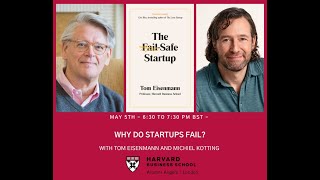



Why Startups Fail with Tom Eisenmann (HBS Professor) || Harvard Alumni Entrepreneurs


12. Tom Eisenmann & The Other F Word (Failure) | FOMO Sapiens with Patrick J. McGinnis