Why Do Startups Fail?
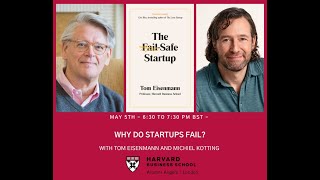
Tom Eisenmann breaks down why startups fail in two stages: early on through false starts and bad partnerships, later through speed traps and cascading miracles. He uses cases like Quincy Apparel and Better Place to show how founders can learn from failure and when to shut down.
Chapters
Storm here that we're at a point in time where entrepreneurial success is more dominant than ever before. It's clearly a triggering topic, with loss aversion being something that all of us kind of hold near and dear and that we have here a professor who in his 25 years at HBS has really embodied entrepreneurship at the school and inspired a lot of us to choose the entrepreneurial path or learn more about it. So Tom, it's really great you're here and thanks for taking the time. A lot of people focus on iconic successes in venture like a Spotify or an Uber, or spectacular failures like a Terranos or WeWork, but you've dedicated real and serious time to the study of the vast majority of everyday kind of startups that fail. Why have you done that?
Well.
It goes back.
By the way. Thank you Michelle and Matilda and all the club organizers and good evening London. Delighted to be here.
The catalyst for the book was A Failure of a Startup. I'd worked closely with two alumni founders who had been my students. I encourage them to launch a business and in fact after they graduated, invested in the company. And.
A lot of listeners will be familiar with lean startup techniques. They had followed them in a textbook perfect way, minimum viable product testing to validate demand for their concept. Everything we had tried to teach, raised a million dollars raised, wanted to raise a million and a half. And that's part of the failure story. And a year later the business was shut down. So I could point to a lot of reasons, but I couldn't pinpoint the precise, the root cause. And that was disconcerting because in theory I was an expert on entrepreneurship, but I was a failure at explaining failure. And if indeed two thirds of of venture capital backed startups failed to earn a positive return. Failure is important. So here's one of the most important phenomena in my field and I didn't really understand it. So set out on a quest to learn everything I could. Did failure follow predictable patterns? Were there ways to avoid that? And if a founder did fail despite their best efforts, was there a way that they could fail less painfully? And in this particular instance, I saw the pain up close because I knew these founders very well. But every, every time it hurts, it really hurts, personally hurts, the ego, hurts financially. And so that set me out to learn everything I could. Lots of case studies in the spirit of Harvard Business School and some survey work and lots of interviews with failed founders and investors. And here we are essentially seven, eight years later with the results.
And you're mentioning it, studying failure requires talking to a lot of failed people. And as we have as a method at the school, you bring them into your classroom, you do case studies, you kind of highlight them. Normally we put people on a pedestal with the successes that they've had. And now you've had those experiences of those founders. What was that like?
Well, so the first few cases I taught about failed companies didn't work very well. I think MBAs are great at analyzing and great if you give them a case on what happened. It's pretty easy to look in the rear view mirror and say, well, kind of obvious why that didn't work, you know. And the response, of course, as the instructor is, well, you know, it's a very smart person who launched this business and the investors who put money in, very smart. And the team members were very smart. So they saw some potential here. You know, I'm glad you think it's so simple, but eventually I learned how to, how to, how to get the stories across in ways that I think there was more learning value and eventually launched an entire MBA elective focused on entrepreneurial failure. I was a little worried about this, frankly. You know, so you can imagine class after class after class with, with failed founders, I frankly worried that I would scare off a generation of Harvard Business School students from entrepreneurship by just showing them the pain. So close. And in fact, it was just the opposite effect at the end. I've taught the course twice now, and at the end of the course, I actually survey the students and ask if the experience has changed their view on how likely they are to be an entrepreneur within five years of graduation. In fact, 20% do say, yeah, I'm less likely now. I've actually, I've seen it. It hurts. I don't think I want to go through that. 40% say they're more likely. They say, thank you for showing me up close what I've learned. I think I understand the stakes, the pain, and I think I can handle it. But most importantly, you've shown me these failed founders. And granted, it's a curated set of very thoughtful people and.
Most of them have had terrific success in the wake of their failure. But I've learned in studying failure more generally, that is the pattern. I mean, in fact, most people learn something from the failure and bounce back and do something very interesting. So These students said 40% of them, that they were more likely to do it and they know what they're getting into. And then the remaining 40% said I was likely to do it. I'm still likely to do It I may wait till I have a great idea and I may think twice before taking Michel Venture Capital. Because.
Taking venture capital was at the root of a lot of the failures we looked at in the course, the pressure for growth. Of course, if you're going to succeed as a venture capital backed startup, you must grow, but at the same time, growth can cause a lot of problems. If the company's not ready for it, that's great.
And what was the sort of experience of the, the failed founders of being in your classroom? What did they take away from presenting it and discussing it with the students?
I would say that they would say it's therapeutic. I think most of the folks on the call are alumni, so they'll remember the typical pattern of an HBS class session where you have a class guest is 60 minutes of professor and students talking and then 20 minutes of the guest. But I have a different rhythm in this course where I bring in the protagonist, the failed founder, right from the very start. And the students interact with that person throughout the class. And that actually has, I think it has an interesting effect. So normally if the person's sitting there and they only come in in the last 20 minutes, they've been listening to smart MBAs dissect their business and talk about the failings and faults and so forth, and they come up and they're sort of girded for battle and it's all packaged and so forth. But actually if they've come in throughout the class, they loosen up a little bit and they actually get comfortable. They trust the process, they trust the students. And by the end, there's a lot of candor and a lot of emotion tends to flow out in the course of the discussion. And I think the founders find it therapeutic and the students just find it eye opening. So yeah, it's, you know, and also, Michelle, at the beginning of the course, the first half, it's all focused on business model analysis, sort of what went wrong with the business. By the back half, what they want to know is who is this person, what did they learn, how did they react to the failure? So it becomes very, very focused on the personal experience of failure.
It really sounds like a very beautiful experience.
You're kind of touching on such an important subject of how do you do a startup and what can you do to avoid failure? But I guess as a devil's advocate, you could say startups are inherently risky. They're trying to achieve almost the impossible, so they're likely to fail. And can you actually avoid failure and still shoot for the moon.
We shouldn't try to avoid failure. In fact, you're exactly right. We want entrepreneurs to try risky things. In fact, I mean, the very definition of entrepreneurship.
Embodies that risk. Right? You're doing something new without resources. So of course there will be and there should be a lot of failure. What we want and we have in the course and in the book a concept of a good failure. And they are out there. Those are failures where the entrepreneur has a vision, a concept.
Launches the business. If you can test the assumptions you've made about the opportunity, you've done that rigorously and with as little waste as possible. This is the concept of the minimum viable product. And sometimes the universe shows you that that concept was. Was wrong. And no shame in that. You know, it was, it was worth the try for the team, for the founder, for the investors. And they'll have learned something. They'll move on to other opportunities. So those are good failures. And then there's another set of failures where it's for neither good or bad, it's just unavoidable. Right. Asteroid strikes. You know, consider the dinosaurs hundreds of millions of years ago during COVID Worldwide, probably millions of businesses, certainly hundreds of thousands, shut down that in other circumstances would have been viable. And same thing happened with the Great Recession of 2009. So we can't dwell on those failures. They're tragic. But there was nothing that the entrepreneurs could do to avoid those. What we want to do is isolate the failures where there was some mix, always a mix of misfortune, not controlled by the entrepreneur, and mistakes that the entrepreneur made. And we want to minimize those mistakes and boost the odds of survival of healthy and promising companies.
And you start the book with actually, what is the definition of failure? Which is probably good to mention here so people understand what you're talking about.
Yeah.
I think listeners may think, like, how could you possibly ask, Isn't it obvious what we mean by failure? But not at all. And this is not just a case of professors wanting to torture definitions, which we do love to do.
You know, is it a failure? Do you need to have a shutdown of a business? No, because actually many bankrupt companies continue operating. Do you need to go bankrupt? Not necessarily. There are many businesses that. That will never.
Return the capital that was originally invested in them. They generate enough cash flow to survive, but not enough to yield a positive return to the investors. That's actually the definition I use in the book. Some people might say, well, what about the founder's goals, the entrepreneur? And that's Important, of course. And it goes beyond finance, beyond personal wealth or the return of the business. The founder may want to change the world, may want to build a great team, leave an enduring legacy, and it's possible to accomplish some of those things and still have the business be a financial failure. So the reason I don't focus, I keep the founder's goals on radar throughout the work. But it is important to remember that if we look at later stage startups by series D, so perhaps five years into the life of the company, Maybe more, only 40% of venture capital backed startups are still run by a founder CEO. And basically it's often the case that the role outgrows the individual and you need somebody new to come in there. So for that reason, there's many more stakeholders than simply the founder in any kind of startup. We should still also look at society at large. So I use a financial definition. Investors did not or never will make money. But there are businesses that make money that we.
As societies would just wish they would go away. They exacerbate income inequality, they pollute, they have addictive products that we'd sooner be rid of.
It's important to keep negative externalities to society in view. And likewise, there's some failed businesses that generate positive spillovers that never go back to the investors. We've learned what not to do from this failure. And other entrepreneurs may pursue a better idea just learning from the failure. Individuals who worked in the company may pick up really valuable skills and go on to leverage those skills elsewhere. So the answer, like so many things academics like to talk about, is it's complicated. Failure is complicated.
Yeah. And the other thing that sounds complicated as well is to determine the reasons for failure. You looked at a lot of different companies, but obviously it depends a lot on who you ask and how you ask.
Yeah, I mean, the simple explanation for why startups fail is they run out of money and they can't raise more. That's true. Although it's worth noting. Some startups fail because they raise too much money and do crazy things with it. But that's a special case. But it is out there.
The reason, of course, we want to focus on cash flow as entrepreneurs, it's the cardinal sin to run out of cash. But it's not really a good explanation for failure because you just have to ask why. It's like a coroner saying this person died from loss of blood. Well, why?
And you keep asking why and what. I found with both early stage and later stage startups, there were some recurring.
Patterns.
And Is that very different in startups than general business failures?
Yeah, I would say a world of difference. Especially if we look at big companies, public companies, corporations, you know, they do fail and they fail from.
Hardening of the arteries. Right.
There's inertia that they can't respond quick enough to changes in the environment. I mean, that happens to startups too. But most startups fail for reasons that don't have to do with inertia.
And I'd say.
And again, even some big companies and some small businesses that aren't necessarily startup starting businesses fail due to causes not really under control of the business people involved in a bad economy.
And in the book you kind of differentiate between sort of early failures and later stage failures. So why don't we kind of touch a little bit on the early failures first? You give a number of great examples and different sort of mechanisms. So why don't we touch on a couple of those mechanisms and what you've.
Seen happen there in early stage. In the book I have three chapters devoted to three early stage failure patterns. And I think a lot of early stage failures can be explained either by one of the patterns or unfortunately in some cases combinations of the patterns. The most common one is probably what I call a false start. Just, just like in track and field or swimming where the athlete literally jumps the gun trying to get an advantage. These entrepreneurs are so eager to build and launch the product, they've got a vision burning bright of what they want to do. And the self image of an entrepreneur is somebody who makes it happen. So let's build it and get going and we'll get feedback and we'll iterate and improve the product in response and that's all good. That's actually very important part of the lean startup concept. What these entrepreneurs have done though is they've skipped another part of lean startup, which is the less fun part than actually building and launching. It's the upfront research where you talk to a lot of potential customers to explore demand is have we found an unmet customer need that's worth solving? And have we explained there's almost always multiple ways to solve a problem and an entrepreneur needs to explore those different solutions and figure out which one is most promising. And this work, you know, it might take four weeks.
To do it well. And.
The entrepreneur who skips this work and goes so assumes they found a problem, a solution, a pair of, and goes right at it is much less likely to have a product that will hit the mark that will work and they can pivot away they can iterate in response to the feedback. But this whole process probably takes four months of building, launching and figuring out if it's working and then figuring out what to do, what next.
If you've forfeited, if you sacrifice wasted four months to save four weeks, you've made a bad trade off as an entrepreneur. So that's. But it's very understandable, I would say technical founders are vulnerable to this pattern because they love to build their engineers. What do engineers do? They love to build. What do entrepreneurs do? They make things happen. So if you're an entrepreneur who's an engineer, you are vulnerable. But it even turns out many of our colleagues in the mba, many students in the MBA program are not technical, but they've heard correctly that you must have great product to succeed as an entrepreneur. And how do you get great product? You get a great engineering team. How do you do that? You exercise the fantastic networking skills you've developed as an MBA and you go out and find a technical co founder or a vice president of engineering, somebody who can build the thing. Once that talent is on board, you feel tremendous pressure to keep them busy because what do they do? They build. So both technical and non technical founders are vulnerable to this false start pattern. That's the first one, like you say.
That is sort of fits nicely with the lean startup philosophy, but at the same time is a bit of the result of people diving into the lean startup philosophy. What do you think that Eric Ries or Steve Blank would say of your finding?
Yeah, I think they both agree. Steve Blank would really agree because he's the champion of what he calls customer discovery. His exhortation is get out of the building, you know, before you start the engineering work, go talk. And he makes, in the courses he teaches, he makes the students in the courses do 100 interviews. I think it's too many. I think you probably hit diminishing returns after 20 in any given customer segment. But so Blank would. Absolutely. I think Reese is a more complicated issue because he's been so focused on build, measure, learn and the rhetoric that comes out of the lean startup movement. Fail fast, launch early and often. Actually, I think in some ways exacerbates the problem I'm talking about now, Eric. Nobody who understands lean startup like Eric Ries. So he absolutely understands the importance of the upfront research.
But I think many founders think they are running lean when they're actually headed for a false start. And I think the rhetoric of the movement actually reinforces that.
Yeah, another one you mentioned, which I thought was really telling. And for a venture capitalist, sort of an important one to take into account is the idea of bad bedfellows.
Yeah, this is a pattern. And it's also tragic because these entrepreneurs have the preface to bad bedfellows is good idea, comma, good idea, bad bedfellows. So the entrepreneurs have a good idea. But when we think of the bedfellows, all of the players involved in the venture, we tend to focus too much on the founders. The founders are absolutely crucially important and their abilities, their attitudes. But we need to look at the rest of the team. We need to look at the investors. They're going to contribute not only capital, but contacts and advice and so forth. And most startups, many startups will rely on partners, often bigger corporations, because definition of a startup, somebody who's doing this without resources. Who has the resources, some big partner. They'll have technology, they'll have distribution channels. And there are unfortunately, businesses out there that have a pretty good idea, but they can never get that constellation of players aligned with the right capability. And so if you're deficient or dysfunctional in one of those areas, partner, team, founder, investor.
You were much less likely to succeed.
The case study here in the book that illustrates this is it was the catalyst. As we talked about at the beginning of the call, Quincy Apparel and my former students had the concept of creating. They wanted to create a work apparel for young professional women that was affordable, stylish. And here's the key, better fitting. They were both tall and had trouble finding clothing that fit well. Turns out to be murderously difficult to design and manufacture apparel, especially if your promise is better fit. And these, these founders didn't have prior experience in the fashion business and the apparel business. And that just cascaded through their ability to get the players in place. So to compensate for their lack of domain expertise, they hired specialists out of industry. Unfortunately, big company people who didn't adjust to the rhythms of startups very well. And so these folks would quite literally sit on their hands when a fire was burning. Normally in a startup, everybody would shift over to help put out the fire. These people said, I'm the pattern maker, I don't know how to help with fabric sourcing. And so the team didn't do the job. The investors were, they thought they were investing in a direct to consumer concept at that point. It was early in DTC and this was a direct to consumer concept, but it was also an apparel company. A lot of direct to consumer companies don't actually have to design and make the thing they're selling. And this turned out to be really difficult. And so the investors neither brought deep expertise nor were they able to follow on and bridge the company, provide more financing when the team got in trouble. And the factories. It's quite common for an apparel company to outsource manufacturing to a third party factory. The factories ignored this team and basically they would push their orders to the back of the line when a bigger customer came in with something that needed to be expedited. No reputations, no relationships, small orders. And so they were making progress. They actually had strong demand for the product, they had good repeat purchases, but it just wasn't coming together fast enough to save the business and no one would put more money in.
And do you think there is a good method of validating that you have the right people around the table? And is that sort of at the start or is that something you repeatedly do?
I think yeah, it continues to evolve. Of course.
It is a repeated part of the process. I would say what this research in particular gave me new respect for is how crucially important domain expertise is and particularly industry expertise in some ventures but not others. There are many, many startups where you just don't need to have spent 10 years working in the industry to understand the opportunity. But apparel design and manufacturing is not one of those. By the way, if anyone on the call is an entrepreneur in food or beverage, wow. You know, that is a place where every single decision you make, you know, has to be informed by a careful consideration of the options and experience and so the packaging, you know, so how you, how you, how you contract out the manufacturing of the items, how you sequence distribution into the chains and pay this, you know, does it make sense to pay for slotting allowances? You know, there's dozens and dozens and dozens of decisions that you can make. Wrong. If you, if you lack experience or lack people on the team who can bring that experience.
Good. Let's jump maybe to the later stage lessons in failure. And I think the one I really recognize and have seen happen a number of times is what you call the speed trap. Because this kind of happens to very well financed kind of companies, right?
Yeah. The speed trap is growing too fast. And one of the reasons.
The venture grows too fast is people have pumped a lot of money in and they expect the growth. So it starts with a great idea, an idea that early adopters embrace, spread the word. So you get word of mouth referrals. You haven't spent anything on marketing yet that's good.
And there's repeat purchases. The growth attracts investors who come in at a high share price, a high valuation, and it also attracts typically clones. So fast moving other entrepreneurs will see the opportunity. They will put upward pressure on costs and downward pressure on prices.
The investors pay a high price, expecting continued growth and push for it. The entrepreneur doesn't need to have her arm twisted. Entrepreneurs love growth. It's how many keep score. So, so they try to acquire the next wave of customers. The next wave just isn't as interested in the product as the early adopters. Right? They, they'll buy, they're interested, but. But you're by definition a little further away from the sweet spot. So again, you have to market harder, you have to engage in paid marketing. So now the cost of acquiring a customer is rising. You don't get repurchases like you did with the early adopters. And you may have to reduce your price either because of competition or just to attract the customers. So the lifetime value of a customer is diminishing while the cost of acquiring a customer is rising. You're getting a squeeze, an LTV lifetime value CAC customer acquisition cost squeeze. And everybody will look the other way for a while because you're getting the growth. And there's some expectation you can improve both of these things and. But the reality is a lot is going on inside the company that could be dysfunctional. So if it's a business, if it's pure software business, you're lucky. If it's a business that requires human beings to do things, pack boxes, answer phones, answer emails, customer service, etc. Then you got to recruit all those people. You have to train them. That is difficult. You're doing all this in a startup where no management systems at the beginning exist. So you have to put in place inventory management systems, budgeting systems, customer service management systems, etc. Etc. And entrepreneurs may resist what feels like the imposition of bureaucracy, so they may be slow to move. You're bringing in legions of middle managers and specialists and you can get cultural conflict between the old guard. The team that was present at the creation, loves the idea, loves the founder. Who are these new specialists? What are they really doing? What's my job in this company? Meanwhile, the specialists don't feel appreciated. And they look at these people that are sitting on, at least for the moment, stock options that look like they're worth millions of dollars. So there's cultural conflict. Sometimes it leads to an ethical slippery slope where you do unethical things to sustain the growth. Usually not, but eventually the investors, new investors, look at the economics of the business and say this isn't getting better and they stop. And then the existing investors have to figure out whether to bridge and they start to get very nervous. If you do get more investment, it'll be a down round, a lower share price than the earlier round. And boy, that's a terrible signal for a startup. Employees leave because they're worried about the future, about their stock options, et cetera, and it can unravel very quickly. The management team can slam on the brakes, stop the marketing, refocus on the profitable customers, but it's often too late. Speed trap.
Yeah. If you read it in the book, and I recommend that everyone does, it's hair raising to kind of read this play out in real time, especially because it starts with such early success. And I think in my own experience, it's the abundance of capital that is kind of hiding a product market fit. And like you're saying, a team that is chasing top line growth over everything else. So I think installing the right kind of KPIs early on to see that everything else is diminishing.
Yeah. And what's vexing to your point is this is a business that actually had product market fit at the outset, but lost it over time. It's not a permanent thing. Product market fit, you actually can lose it.
Another one you mentioned in the chapter, there is something that is very close to what we're all really admiring in entrepreneurship, which is the cascading miracles. Right. So. So what is the difference between a better place and a Tesla, if you will.
Yeah, so I'm sure everybody knows what Tesla does. Better Place in many ways was after the same opportunity. This is a company that raised $900 million in the 2010 time frame before electric vehicles got going. They wanted to deploy around the world a network of charging stations for electric vehicles, including battery exchange stations where you would drive in with your depleted battery, a robot would pull the battery out and put in a fresh fully charged battery, all in five minutes. The amount of time it takes to refill a tank of petrol. They build this in Israel and in Denmark it was deployed, but it didn't work.
And this is an example of a cascade of miracles, by the way. So is Tesla. So the cascade of miracles, the concept is many, many things have to go right, each of which is very ambitious goal. So in the case of better place, fundamental change in customer behavior driving electric cars, those cars had to be designed by the automakers to have the replaceable batteries. Big deal. To get to get OEMs, the auto manufacturers to design their cars to fit the startup specification. We needed government subsidies for electric vehicles. We needed to raise a billion dollars in order to deploy the network.
And on and on like that. Some of the miracles actually happened. Things work, but not enough of them. And the tragedy of cascading miracles is if anything goes wrong, the entire venture can die. If you don't raise enough money, but everything else goes right, you lose. And it's like a mathematical equation where you're going to multiply a bunch of things together and if anything is zero, the whole equation goes to zero. And that's what happened. And it didn't happen with Tesla. So many things had to go right for Tesla to work. And so far, at least Elon has been lucky. Or very, very, very talented. Probably both.
Yeah, probably both.
Let's kind of jump a bit to the consequences. I'm an entrepreneur. I've read your book. How do I heed your advice?
Well, the last part of the book. So the book is divided into three parts. Early stage failure patterns, how to anticipate and avoid. Later stage failure patterns, how to anticipate and avoid. And the third part of the book brings it back to the entrepreneur and asks the following questions. How can I know whether and when to pull the plug on a struggling startup? It's a very difficult come back to why, but it's a very difficult decision. If I do shut the business down, how can I do so? Let's call it gracefully in ways that will preserve my reputation, my relationships with everybody involved.
And essentially the answer to that question is everybody who's owed money is paid back in full. Employees, customers who may have left a deposit, vendors who sold you something, etc. Now the investors don't get all their money back, but 10 cents on the dollar invested is better than zero.
And then having failed, the crucial question is how to heal it hurts. So what have we learned about the process of healing? We then explore how to learn. You actually can't learn much as long as you're in pain. The grief, literally the pain and the grief will cloud your ability to draw lessons. But then how to actually maximize the learning. And it turns out too many failed founders end up at one extreme or the other. There's a very natural human tendency, ego, defensive tendency, to blame others. My co founder dropped the ball. My investor pushed for the wrong strategy. The regulators did something irrational.
Et cetera. And those founders haven't learned much. They chose the co founder, they chose the investor so that they need to own the mistakes they made and put them in perspective, sometimes it is everybody else's fault. Sometimes the founder is indeed blameless, but not as often as the attribution suggests. At the other extreme is even sadder. These are entrepreneurs who just beat themselves up. They take too much responsibility. They say, I am hapless and hopeless. I never should have been an entrepreneur, I never will again be an entrepreneur because I just wasn't suited for the role and I made nothing but bad decisions. Again, there are some people that fit that description and they probably should never do it again. But more people feel that than probably is true. And that's sad because those folks actually could be great entrepreneurs and society could get the benefit of the jobs and the ideas they have. So we want entrepreneurs to end up in the middle with a little bit of distance from the pain, where they can actually put in perspective what they did right, what they did wrong, what they would do differently the next time. And that then gets to the last part of the process, which is how to figure out what to do next. I was surprised to find that half of, if you look at venture capital backed startups in the us, half of failed founders come back and do it again. Very high fraction. And some of them are the ones who were in denial and just, you know, it wasn't my fault, so I'm going to do it again and they will ride the horse over the same cliff the next time. And.
But I think the founders that are best equipped. There is a stigma associated with failure in all societies. I think it's weaker in the United Kingdom and in the United States and some parts of the world. You go to other parts of the world, you don't want to be a failure. In Japan.
And in some countries the financial consequences, the bankruptcy laws are such that the entrepreneur is actually personally liable for the losses of the business. And that can be brutal. But the entrepreneurs who are best equipped to do it again failed gracefully. So their reputations are intact, their relationships are intact.
And they can explain why it happened and what they learned and what they will do differently next time. Especially in the UK or the us an entrepreneur who looks like that I think is very backable again by a team, by co founders, by investors.
And do you feel that sort of people running into the traps that you've seen? Was it more a lack of awareness of the risks that you're describing or is there a strong correlation to certain personality traits that lead you into certain trouble here?
Yeah, we desperately want there to be personality predictors of entrepreneurial success and failure. I think we're all sure that it's something about risk tolerance and persistence and so forth. And I think there is some of that. I have to say a lot of other academics have spent a lot of time trying to stick the scientific thermometer into personalities and they don't get a lot back. It turns out that entrepreneurship is a very big tent and a lot of people can fit under that tent with different kinds of people with different values and motivations.
I myself did a survey of.
Late stage, excuse me, early stage founders who failed and succeeded. 470 founders, both successes and failures. And I asked them every kind of question you could imagine about how they ran the venture and organized it and so forth, including some self assessed personality predictors. Would other people describe you as charismatic, as visionary, as persistent, et cetera, et cetera, et cetera? The only personality trait that came out as statistically significant in my survey was methodical. The entrepreneurs who were more methodical were more successful. Take it or leave it. When you ask about 20 things, if your statistical confidence interval is 95%.
It'S often the case that you might expect one of them to show up as significant. Even if it's not. I think I have a lot of noise. And what it says is don't obsess about whether, if you're listening, whether you've got the right personality to be an entrepreneur. Pretty much everybody does. And personalities change.
In circumstances. Right. There's a lot of our behavior that is situation dependent. So.
Face a nasty negotiation with a partner and you'll find out how tough you are. You're probably tougher than you think.
Yeah. And I guess it also tells us we have to all go and invest in Germany. I guess.
Methodical. Yes.
Last kind of question on this. There's a bunch of people I'm sure in the audience that are either angel investors or professional investors from what you're describing here. Are these traits or are these kind of circumstances and settings that we can identify at the moment we invest or is it mostly post investment? Be the right partner and help people avoid these pitfalls? Yeah.
No, I think the good news, and this is true for co founders or early team members who might join, certainly true for seed stage investors is I think the early stage patterns are visible right from the start, even before the seed money comes in. If you are headed for a false start, if you skip the upfront research, the investors should be able to see that. Absolutely. A pattern. We didn't spend as much talking about an early stage failure pattern is a false positive. Just like in COVID testing.
In this case, the entrepreneur thinks that she has strong demand and she may have it with early adopters, but it doesn't extend to the mainstream. So the business won't grow as fast or as successfully as she thinks.
A smart investor will ask a lot of questions about the differences between early adopters and mainstream customers, which again, if the entrepreneur has done great thorough research, that is that that could be understood. And then lastly, the bedfellows pattern. Bad bedfellows. I think it's true that some businesses require domain expertise more than others. And I think a savvy investor will understand the types of businesses that require that and again can look at the team as the evolving team and see if in fact they have access to the industry expertise that they're going to need. So I think in all three fronts, an investor can anticipate some problems. Great.
Yeah. And then to sort of, kind of, kind of to close before doing the Q and A, you end the book with what I would kind of describe as a love letter to entrepreneurs where clearly your passion for the subject and the people starting companies and building a future kind of comes through. And one of the things you, I think very strongly and nicely point out is that there's all these traits and all these behaviors that we all recommend to founders that are good in moderation, but not in extreme. So what made you kind of come with that as a closing? And it must be close to your heart that you're saying that.
Yeah. So thank you for calling it a love letter. I think that's exactly what it is, Michelle. It's a letter to a first time founder. And the advice is there's a lot of conventional wisdom on what makes an entrepreneur successful. It's good in moderation, good most of the time, but be careful. It's advice like be persistent. We should be persistent. Right. If you, if you throw in the towel too quickly, you'll never build a business. But on the other hand, if persistence turns into stubbornness, you may not pivot when you need to. And that's a surefire way to burn through capital and boost your failure odds. Grow. Right. It's how, again I said before, how entrepreneurs keep score. But if you're too focused on growth, you may skip the upfront research and just try to get going. Be frugal. Entrepreneurs must be frugal. And it's true you're dealing with limited resources. If you're so frugal that you aren't willing to pay the appropriate market rate for the expertise you need to run the business. If you skip some hires, you may boost your failure odds. So again, in moderation, and I think the most important one is we tell entrepreneurs to trust their gut. Right? That's your big advantage, is you can move fast, you should trust your instincts. And again, an advantage much of the time. But there's some decisions where you just need to slow down, think once, think twice, sleep on it, sleep on it another night, talk it through with lots and lots of people you know. And because your gut when you're making these big emotional decisions is going to be racked by.
All sorts of things that'll keep you from thinking clearly. So slow down a little bit is my advice to the entrepreneur.
And I would say my advice to everyone here present is get the book. Read it. It is the best investment you'll make, whether you're starting a company, investing in a company, join a startup, or interested in this space in general, because it's very thoughtful. Clearly you've based it on a lot of research and we're really grateful you took the seven or eight years to work on this topic. Let's jump in on the Q and A. There's a whole range of questions there. I'll pick some from it. I think an interesting one, especially as a vc, to ask if someone says, is the system broken? Is the VC model one where all the risk is on the entrepreneur and the model doesn't fit all businesses? Should we all be shooting for break even first rather than the growth metrics that our VCs are putting on us?
Yeah. What a fantastic. Thank you for the question, whoever asked it. Many of us are from Harvard Business School. I'm an MBA on top of being a faculty member. We lionize venture capital. Michelle and his colleagues are heroes where we go to school. And I think there's an assumption too often held by HBS entrepreneurs and folks from other top business schools that if you're going to be an entrepreneur, you must raise venture capital. And I think a big lesson from the course that I'm teaching is there are other ways to finance a business. Not every business should be venture capital backed. Not every entrepreneur is temperamentally suited for the pressure that comes with it. I don't think the system is broken. I think venture capital is what it is. It's a business model where you make all of your profit from a handful of investments in the portfolio. 10 times, 20 times, 100 times returns on the initial investment and then another 30% kind of go sideways. You know, they double the money or triple the money, which over 10 years is not particularly exciting on an IRR basis, you know, and then a lot, 60% of the investments, something like that might lose most or everything. And that just is what it is. There are businesses out there that can grow like rocket ships and somebody wants to fund them. And.
If the rest of the portfolio is good failures, then I don't think we have any problem as society. The problem is when. And by the way, the entrepreneurs who come to my class as failed founders.
One after the other, they say, I knew what I was getting into. I understand the vc, I'm an mba, I understand the VC business model. I understood it intellectually, I didn't understand emotionally, you know, what, what kind of pressure I was going to feel and I'm not sure I would do it again. So that's, I think that's the message is that every entrepreneur really needs to soul search before they take the money. Are they willing to take the kind of risk that comes with shooting for hyper growth? For taking the kinds of business risks that come along with that? Many are my. I'm going to be joined. The book features a company called Baru, where the founder started out wanting to grow from internally generated cash flow. She deliberately avoided venture capital because of the pressure for hyper growth. She had early success, a false positive, grew too fast, ran out of money, and her assessment at the end is, I say, so you made the mistake, right? You should have stuck with the original plan. She said, no, I should have gone off and raised $40 million of venture capital. That's what I really should have done.
It just depends. It depends on what you want as a founder. The venture capitalists are not going to change and they shouldn't.
Here's another one which is kind of critical of academia. It says, tom, what do you think of a business education may help to avoid some of the pitfalls and perhaps which ones do you think it may make us more susceptible to? Are you in your teaching, creating new problems.
In trying to help us avoid the ones you describe?
Yeah, you know, I get this question. I don't think you're like as likely to get it at HBS Alumni Club. But there are a couple of versions of the question and they run along the lines of why in the world would you go to school to be an entrepreneur? And my answer to that tends to be, you know, an entrepreneur needs to understand a lot about marketing, a lot about finance, you know, something about organization design, about technology management. You go right down the list. What we teach in the core of the MBA program, the first first year is essential accounting.
But that's not the question here. The question here is are there predispositions? And I'll point to a couple. I think the very smartest MBAs, the folks who often will head off for a few years to BCG or someplace like that.
Have an incredible ability to connect the dots, to sort of see complicated patterns. And I would say there's probably a predisposition to launch an over complicated business. And again, it gets to cascades of miracles that there's a lot of moving parts and a lot of complexity, partnerships and assumptions and platform technologies and harnessing network effects and so forth. Just many more things that can go wrong. I do think.
There'S that. And then I think there's a general MBA tendency, I spoke about it before, to analyze and overanalyze. And indeed I think there are some founders that if they're tentative, they can fall back on their ability to analyze and look and look and look and slow themselves down and maybe vacillate between options and so forth. And I think that is out there and it's probably true that MBAs are more prone to that behavior.
Good. Another question that's coming up in a number of different ways and phrases is if you're seeing differences between male and female founders and maybe perhaps to broaden it in general, are you seeing the influence of cultural differences on the research you're doing and what are you seeing in terms of what is being funded and therefore the outside perception of risk?
Yeah. So on the gender question, the book sidesteps it because I didn't have.
For that survey that I mentioned before, the 470 founders, it turned out that a disproportionately high fraction of the female failed founders were likely to respond to the survey, which says something about egos and a willingness to help. They were overrepresented in the sample. And I didn't want to draw conclusions about gender differences, but I've since gone in and looked at the whole universe. There are databases that track every venture capital back. Michelle will be familiar with PitchBook.
With a couple of colleagues who are very interested in these gender issues. Looked at 14,000 startups that had raised in the US at least $500,000 between 2010 and 2015, and then looked at how many of them are said by PitchBook, the service in question, to have shut down, and then looked at gender differences. Turns out the female founded firms were slightly less likely to fail than the ventures with male founder CEOs. There were only 11% of the firms had a female founder CEO. So I mean they're well documented biases in the availability of capital to female founders, so that's there. But when they do raise the capital, their businesses don't fail at a higher rate. In fact it might, I'm not sure it's statistically significant, but slightly lower rate. An interesting gender difference that's I think a little disconcerting is this question of doing it again after you fail. And it turns out again from this data, it's not in the book, but subsequent data, I'll get it published at some point. Females are less likely to found again after a failure. So the male rate is a little bit over 50%. The female rate is a little bit under 40%. That's a pretty big difference. By the way, there's very little difference between first time founders. All of that difference is serial. So if you're a male serial founder and you do it over and over and over again, if your last one failed, you're just going to keep doing it. If you're female serial founder, you're less likely to keep going. So anyway, lots of differences. If people are interested in this, I would refer you to fascinating work by my colleague Laura Huang.
H U A N G who has done amazing work on the kinds of questions that female and male founders get in the fundraising process. Turns out that females regularly, both from female investors and male investors get questions that are focused on prevention. How are you going to protect my money? And.
Male founders are more likely to get questions focused on promotion. How are you going to launch this thing to the moon? And it's strange but really, really I think important for folks of all genders who are investors to understand these patterns and certainly for female founders to understand the kinds of questions they're going to get. And Laura has good advice on how to twist.
This adversity into advantage.
And what are you seeing on another day dimension, sort of more versus less privileged founders and what's happening there in success rates.
Yeah, I'm embarrassed to say I haven't looked at it deeply enough yet. That's a priority as we take the course forward. Underrepresented minorities and the special challenges they face. Likewise, you'd asked a minute ago about the cultural differences. Haven't spent enough time trying to understand especially the stigma of failure and how it varies in different societies and what that might do to to the kinds of risks that entrepreneurs take.
More to come, more to come.
It's a topic that probably will not exhaust as long as there's entrepreneurship there's ways to fail. Another interesting one here where there's a lot of movement in the business world to see sort of.
Businesses as forces for good and where societal goals, impact goals are embedded in organizations. Have you seen any impact of companies that take that more into account in terms of rate of failure or sort of trajectories of the companies?
It's again a great question. I haven't looked at it yet. I will say for folks who are sort of hoping that Harvard Business School is tuned in to these pressures. We are and it's coming, I look actually to inspiration. Stanford Engineering. You want to find a place that's doing a good job of teaching about the ethics of entrepreneurship and the ethics of emerging technology. We're actually.
A lot of my colleagues are spending time with folks there and we're trying to figure out ways to sort of move it throughout the HBS curriculum. It's a natural question to ask sort of if, if ESG is a priority, we know that there are positive returns for big corporations. Surely it must be the case that it's true for startups too. I will say I have colleagues at the Kennedy School, Harvard Kennedy School who have observed that already the private equity players that deal with.
Big private companies have worked ESG at the insistence of their limited partners into the decision making process about what to invest in. These are the Blackstones and kkrs of the world.
And the folks at the Kennedy School have observed that it hasn't hit venture capital yet with as much force and they're actually working pretty hard. And we've been helping them to sort of think about how do you, how do you come up with a process for figuring out whether a venture is sound on ESG grounds?
Yeah, I must say that sort of from our daily practice we see that a lot more and it is clearly coming up and it comes at every level, whether it's from the founders finding it important, the people working at the venture firms and sort of the customers. Kind of final question. There's a large group of people here. Is there anything we can do to help you for your further research, give you input? Is there anything you would kind of like to receive from the group?
No.
You know, at some stage we're going to keep the course was a half course. So we're expanding it, expanding it to full length. That means more cases. So.
And, and it means more international cases. It means I want to do family business, I want to do low tech. A lot of what I do because of my, what I've done in my career is higher tech. So I'm looking to broaden. I'm looking to do something with a social impact focus, you know, because I think failure in that context, failure plays out for different reasons in different ways. So case ideas and just spreading the word would be fantastic about the research in the book.
Great. And everyone buy the book, read it. I hope you guys found the conversation a success. Tom, thanks so much for taking the time and your insights to us as a group.
Thank you so much for hosting and thanks everybody for listening. Fail. Well.
Thanks.
More from Tom
"Why Startups Fail" with Tom Eisenmann, Author & Harvard Business School Faculty Chair


Why Startups Fail with Tom Eisenmann (HBS Professor) || Harvard Alumni Entrepreneurs


12. Tom Eisenmann & The Other F Word (Failure) | FOMO Sapiens with Patrick J. McGinnis