The Children's Book of the Future with Richard Watson
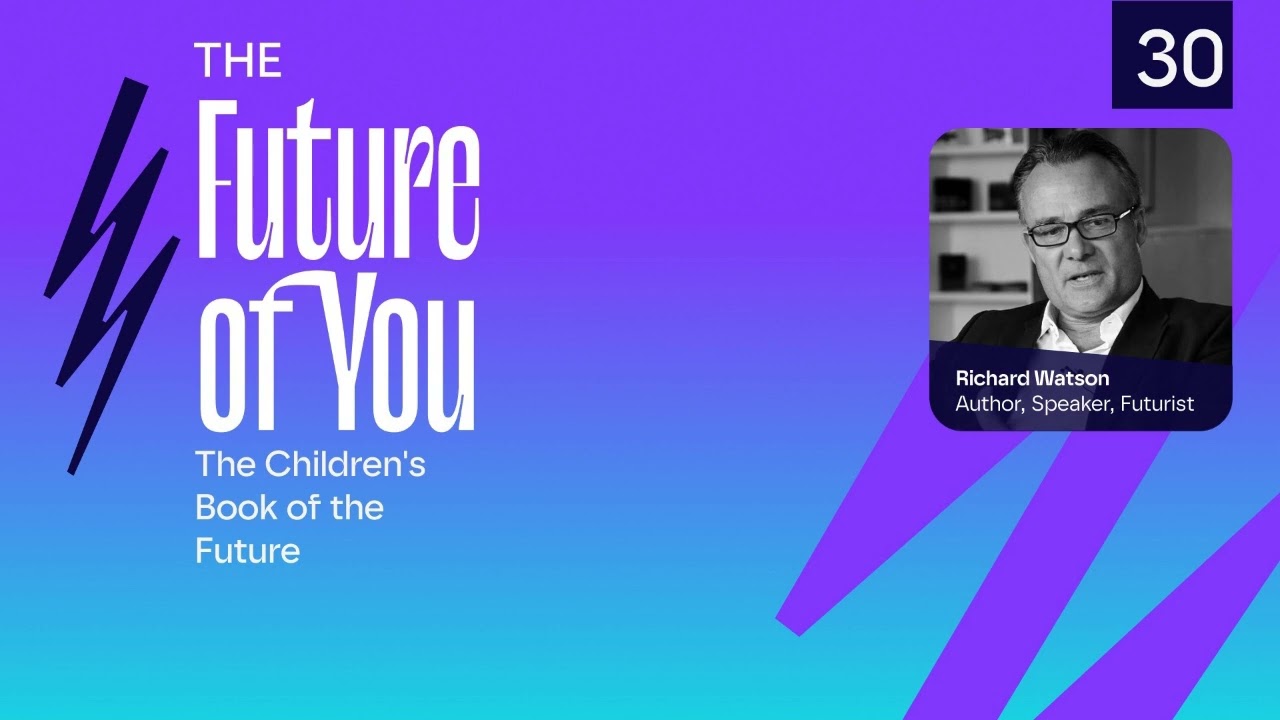
In the season‑4 premiere of Tracey Follows’ podcast The Future View, futurist Richard Watson discusses his newly released Children’s Book of the Future. The conversation covers how the book originated from a casual lunch idea, its target audience (7‑11‑year‑olds), and the market need for an optimistic, child‑friendly vision of tomorrow amid pandemic‑induced anxiety and climate‑change concerns. Watson explains the aesthetic choice of a 1970s California, blue‑sky style inspired by early sci‑fi optimism, and the deliberate exclusion of dystopian themes such as war or climate collapse. He details the collaborative process with illustrator Lavi (a Spanish artist) – Watson supplied “did‑you‑know” science boxes while Lavi wrote vignette stories, and they considered adding a “future homework” section that may later appear online. The hosts discuss the book’s reception: children and parents love the bright colors and universal characters, a Chinese edition has been sold, and the book is available through Dorling Kindersley/Penguin Random House in both physical and digital formats. Watson shares future plans, including a possible volume 2, animated shorts, and expanded educational resources. He critiques the common linear forecasting approach in past future‑for‑kids books, advocating for multiple scenarios to encourage kids to think like futurologists. The dialogue also touches on the value of paper books for learning, the lack of futures education courses in the UK, and the broader cultural shift from “futurism” to “foresight.” The episode ends with a call to action for listeners to purchase the book and submit ideas for future editions.
Chapters
Welcome back to The Future View. We've been away a while, but I'm pleased to say that Season 4 is now underway with this episode being the first of the new series. Regular listeners know that up until now, I've been chatting with incredibly interesting guests from around the world in academia, politics, futurology, technology, sociology, and a whole lot more. And the topic has always been the effects of technology on our sense of self. As I always say, we have three dimensions to the self: the psychology of the self, the biology of the self, and now the technology of the self. And it's this novel dimension that is the bit that we explore here. Well, in this season, we'll have an even greater focus on AI, particularly as it's the technology that seems to be accelerating lots of the emergent world around identity in education, in health, and even at work. So AI agents, longevity science, synthetic media and music, digital verification, and even weapons of personally targeted destruction. It's all on the agenda. In forthcoming episodes. But today, I chat with the brilliant Richard Watson. Richard is a very accomplished futurist, well known for his spectacular creative maps of trends that he's been publishing for years on nowandnext.com. He's the author of 6 books about all sorts of aspects of the future, including one about the scenario process. And his latest book, which is in the show notes, is the beautifully written and illustrated The Children's Book of the Future, a very important tool to keep anxiety amongst our youngest and brightest generation at bay and instead fill them with imagination and joy. So let's hear from Richard about why and how he wrote about the future for children.
It was unclear to me whether it was a book about the future for children or whether it was a book about the future by children. In other words, you know, you get kids to write the actual book and illustrate the actual book. But we settled on a book about the future for youngish children, youngish being about 7 to 10, 11. And Lovie and I, well, we disagree about where the idea came from exactly, or even when. I mean, I maintain it was a slightly boozy lunch at Sheikhi's in London's Theatreland where. He had a tower of seafood and got a little bit ill, and I had most of a bottle of wine and felt a bit woozy. He says we had the idea before that, we used the lunch to refine it. But anyway, we came up with the idea or refined the idea over lunch, and within about 2 weeks we had a book contract, which was pretty good. And it was relatively easy to write as well. And it was inspired to some extent by those books you got in the sort of '70s, '80s, the sort of books of How and Why and the Wonder Book of the Future and all those. Usborne up to a point. We felt there was a real need in the market for a book for kids that was sort of about universal optimism, positive futures, wonderful futures. Everything's gone a bit gloomy, particularly for younger kids. They got homeschooled, had the pandemic, climate change, we've got various wars going on, all sorts of sort of bad news. And we felt that it was time for some good news. So get rid of all the negative stuff, don't even talk about that, and just focus on stuff that's fantastic now and in particular stuff that's going to be fantastic in the future. And the illustration brief, for example, was California in the 1970s. So it's sort of blue sky and sun. And I suppose harks back to the likes of Star Trek. I mean, most sci-fi has gone very dystopian, or you could argue has always been fairly dystopian, but there is the odd bit of utopian sci-fi and we wanted to sort of tap into that a little bit.
Yeah.
Yeah. I was going to ask you about the aesthetic, cause it is a very, very beautiful book and it is very, well, it is very uplifting even as an adult to read it, you know, it is uplifting. So. But why do you think we were so optimistic or we had an optimistic aesthetic in the '70s or '60s, '70s? But not now. What is it?
Well, I don't know about Britain. I mean, America, I think, was obviously to do with their ascendancy or consolidation as a world power. Their economy was booming. We had the space mission, landing on the moon, all that kind of stuff. And everything was going terribly well. I mean, Britain wasn't quite the same. You know, even demographically, the US is different. I don't know why. I don't know. Beyond that, I just don't know. I mean, when was Britain last hugely optimistic? I mean, the '70s— I thought '70s, sorry, the '60s, I guess, was the time coming out of the bleakness of the '50s. The '70s was sort of, you know, industrial strife to some extent. I mean, maybe the '80s, but not for everybody. It's not really in the British psyche to be sort of that sort of gung-ho optimistic, is it? That's more of a an American thing. Although you also, I think, I mean, I've done enough workshops around the world where, you know, they're very optimistic in China, um, in India, and younger people, that certain younger people are very optimistic as well. I know plenty of very bright young things around London who think the future is absolutely brilliant. But there is definitely a slice of, um, the population out there that doesn't think that. I mean, I think anxiety was the children's word of the year in '22, I think it was, or it might be '23. I think it was 2022. And just, you know, just look at the, the statistics around, around health and depression and loneliness. And a lot of the blame here, I guess, could be pointed at social media, but not, not entirely. Just trying to readdress that.
I love that. Actually, I was going to ask you about whether you researched or not focus grouped it, but did you show it to some, some kids as it was in development and what were their thoughts if you did?
Uh, not really. I think Lavi showed it to his kid and I sort of mentioned the contents to a couple of others, but not, not in any, any kind of serious way at all. I say it was, it was extraordinarily easy to write. It just sort of fell out of our heads. In terms of the content. I mean, we played around with the content a little bit, and, you know, we took out stuff that, you know, I don't want to read about the future of war in this book, or sorting out climate change. Let's just take it as a given that we've sorted that out or learned to adapt, etc. I mean, kids have since seen it, so we know what the reaction is. But no, at the time it was more or less just done as a brain download.
So what has the reaction been then with kids?
What they said, people love it. I mean, it's, again, it's that optimism I think is tapping into, as much with the parents as the kids. I have to say, the optimism, as you say, it's got this sort of— I mean, the illustrator is Spanish and she's absolutely nailed it in terms of that sort of optimistic, bright look. And I've got quite a collection of books for kids about the future from the past, if you like, and they don't— even those, even the ones in the sort of '80s, which were a reasonably optimistic time, don't have that. It's just the colors. I think it's— she's just nailed the colors.
I think it is the colors, but it's also the way she's drawn the kids in this. You know, there's that aesthetic at the moment to draw humans and kids and people without faces, like they're some sort of like weird anonymous thing. And they've got a lot of character in them, these, haven't they? Even though it's kind of very global, very representative, they've got their own— you can see they've got personality. They're happy.
You remind me, they've just sold the rights to China, so there's a Chinese edition coming out. And that was always the intention to some extent. I mean, we deliberately designed it to appeal universally and not just sort of white British kids or anything. So that sort of hit the mark a bit.
Did the Chinese ask for anything to be taken out?
Not that I'm aware of, but I don't think there's anything in there that they'd object to.
Yeah, I was asked to take out a whole chapter of my book, so I didn't do it. So tell me, so we've got Part 1, the Earth, then we've got Life on Land and Sea. Welcome to the Solar System, and then The Far Future. Which is your favorite chapter?
Oh, I'd probably go Far Future. I mean, yeah, it starts sort of 50 years into the future or something. I mean, within the lifetime of an 8-year-old, 10-year-old, you get into that pretty easily. And then it, then it gets quite sci-fi quite quickly. Probably from the second half, it gets very sci-fi. And, you know, Lavie writes science fiction, so that's hardly surprising. And I, I've had— I wouldn't say conflict in the past, but we've had fun disagreements because we went to a workshop once looking at 2047 for the government. I found that quite easy and he found it absolutely impossible because he's used to dealing 200, 500 years into the future. He can't deal with 30, which is pretty funny. And again, it's— we've bypassed some of the problematic areas and gone straight into sort of, you know, trains on Mars and all the rest of it. So the imagination has sort of taken flight. I'm not sure I have a favorite as such. It's probably the space stuff, though. I like the bit about aliens is good. The bit about robots is going to be popular. I mean, it always is. I don't think we put dinosaurs in it, funnily enough, although we've got some creatures that we've sort of reintroduced from, from thousands of years ago are back in there. So there's some pretty marvels of science and all that kind of stuff. I mean, he was broadly responsible for doing the stories. I was broadly responsible for sort of doing the how and why and the sort of sciencey bit.
Um, how you work together on it, actually.
Yeah, we jointly created the contents, bouncing it between us, agreed on that. Then he wrote the, what you call the vignettes, the little stories, and I would do the sort of did you know or fantastic fact or, you know, the, the science explanation box. The one thing that didn't make it, unfortunately, I had a section in there called future homework with each story, which— so if you're talking about floating cities, there is instructions to how to build one in your bath. Although I'm— I think we're going to get it back online because of, um, teacher notes, or you can use it for sort of summer holiday, you know, avoid boredom, build a, build a future city in the bath. So I think we're going to get— it's all written, so we're gonna, we're gonna sort of put that online.
It's very, very different obviously to what kids are doing on Roblox where they are imagining and they are world building and all of that, but obviously it's taking place in a different space that's not in their reality where this book is actually in their reality, isn't it? And it's kind of shareable in a different way. Do you see that?
Yeah, it's quite old school. I mean, it's old school. It's old school futures.
And do you think kids need to go back to a bit more old school, a bit more paper, a bit more literacy?
Don't get me started on that. Yes, always. I mean, I've always been I mean, it's not binary. I don't think anything's bad, but I think the balance has tilted too much towards the digital and the virtual. And it's pretty clear to me with the research that's now around that, you know, certainly with education, kids learn better on paper. And that doesn't mean you can't use digital or screens, but it works in a different way. It's a fundamentally different technology, paper, than pixels. I mean, there's a little bit of nostalgia kicking in with the parents, I guess. And I'm seeing quite a lot of weak signals about— in fact, rather bizarrely, I was talking to somebody yesterday. There's a new Bugatti come out and it's all gone sort of analog. They've not got any screens in it and it's normally aspirated petrol engine. It's quite bizarre, although I don't think that's a weak signal at all. But we are beginning to see some interesting developments. And also, paper books never went away. I mean, there is an audio version of this book and I think there's an e-version. I'm pretty certain there's an ebook as well. I mean, why wouldn't you? Why wouldn't you? Again, it sort of taps into that sort of paleo-future type of aesthetic, so it works particularly well on paper.
What about Upgraded Aunt? She's a good one. She's a good character in it.
Yeah, we had some fun. I mean, we actually— I'll tell you my favorite one. I was just thinking there about the glow-in-the-dark popcorn, um, candy floss. No, my— the one I love, which was an idea of mine which Lovie actually accepted— most of my ideas got thrown in the dustbin— but the one where there's the old robots' home and the old robots are looked after people. So you've completely flipped the current situation. And you reminded me of that because of Upgraded Aunt with, you know, robots in care roles and all the rest of it. So we had, we definitely had a bit of fun with it.
So where do you go after, after this? You've, you mentioned a couple of other ideas or spin-offs. Are you going to make this into, I don't know, a little show? Can you do something with Netflix? Where's it going to go? Hollywood, baby! Hollywood!
Well, we'd like to do volume 2 because we've got a lot, a lot more ideas. There are people sniffing around TV land already. So we might— there might be— I mean, it's a vague possibility, but there might possibly be an animated series. I mean, we've got the characters. I mean, the only thing that's sort of lacking in the book is we don't have characters flowing through the entire book. There's different characters in different futures, if you like. But that, that could be sorted out. I would personally quite like to do horrible futures. Um, I, I would like, you know, AI runs amok You know, quantum computing is, you know, I can imagine we could have quite a lot of fun in the sort of Horrible Histories kind of sense, but for much older children, the sort of cynical generation. But no, I think we could squeeze out 2 or 3 more of the positive ones, and it's crying out for animation to me. Little shorts, and again, you know, universal optimism and ease in different languages. There is an example of something from the '70s that was animated shorts that were all about the future, and I think it was French. But yeah, it's a bit of a natural for that.
You must have had quite a lot of fun actually looking back and researching all the ways in which we thought about the future from the past and the way it's presented. What do you think the biggest insights are from that?
The big mistake they make, which everybody makes, is it's all linear. So you take the present day and you project it forward, and that is usually a recipe for disaster. The Usborne Book of the Future from about 1980, I really like that one because they gave you a For example, with The Future of Cities, there was the utopian version and there was the dystopian version. They gave you two spreads, you know, green city and smoggy, filthy one. And I really like that as a way of dealing with the future. There's a lovely book about— it was sort of the year 2000 written from the perspective of 1970, which is spookily accurate, actually. I mean, they've got, you know, online shopping, electric delivery trucks, you know, working from home. It's all in there. The funny mistake they make is that all of the fashion from the '70s is projected straight into 2000. So everyone's wearing— everyone's got afros and they're wearing jumpsuits, which is pretty funny. But yeah, it's that sort of linearity of just assuming that, you know, TVs are going to get smaller and they'll be on your wrist. Well, they kind of are, but nobody's using them. They've actually got bigger. So it's pretty hysterical. It's a lovely thing to collect, actually, old books. I've got the kids' selection, old books. About the future for kids. And then there's the, you know, the general science fiction stuff about aspects of the future, going back to, you know, going back more than 100 years. So that's, that's good to look at as well.
Yeah, I like some of the films as well. I mean, they're not for kids, but, um, like the old AT&T— oh, I think I showed it actually when we were at a presentation together, the AT&T film where back in the late '60s they're talking about the office of the future. And, you know, the technology is not too bad, but as you say, it's like the social situation— there aren't any women in it, for example. There's no women in the office, and So it's like the social change gets missed, even though you can perhaps more clearly sort of forecast the technology. Do you think your book and the way in which you're approaching this is going to encourage more kids to be futurologists, even if it's not their career, just to think like futurologists?
Yeah, I hope so. I mean, I've had quite a lot of tea. I mean, I've done a few school talks now, including actually the best one was I went back to my primary school and it was explained to the kids that I was at the primary school 50 years ago and the first hand shoots up, Mr. Watson. 'You were at this school 50 years ago. Why are you still alive?' Which is just classic futurism.
Oh my God.
And I lied. I said it was exercise and diet. The teachers are always, 'Oh, I didn't know you could do that.' And I'm sure that must, you know, by osmosis seep into kids' brains. I mean, I think at the moment there's a bit of a trend away, funnily enough, from futurism. I think it's interesting it's being rebranded as foresight and anticipatory studies and all that stuff. I think it's also got incredibly difficult to do because it's got so sort of volatile. But I think it's nice to suggest that there is something out there where you can, you can do this kind of thing. I haven't had any really young kids talk to me about that, but I've had plenty of sort of late teenagers go, oh, wow, how can I find out more about this? We're quite bad in the UK because I think in Melbourne there's courses, in Texas and Hawaii there are courses. I don't know about you, but I'm not aware of any courses in future studies in the UK.
There used to be some in Manchester and there is one sort of strategic foresight within an MBA type leadership management thing in Edinburgh. So I think it gets wrapped up into sort of business administration or something else. There's, I don't think there are any courses in the UK that have sort of imagination and creativity at the heart of futures.
Yeah.
And I think that is a problem, but also speaks to the insight that you were talking about, about the culture in the UK at the minute. But I think there are some solutions to that. Yeah. I mean, there's a lot of people with foresight and futures in their titles now, but they tend to be doing something that's a bit more like kind of forecasting or planning, things like that.
You've reminded me actually that, I mean, the other thing about the old books about the future, and it's still true today, is it's all right, this is what the future is going to look like, with hardly any dispute, doubt, or conversation. And then you get the odd one that's, well, it might go this, it might go that, which is rare. And what we're trying to tap into is the idea that, you know, this classic, it is unwritten. You can have the future any flavor you like. It's up to you, and you can't control everything, but if you get involved, you know, you can actually create a future you like. And if the future shows up that you don't like, you can still change it. That's the sort of the— for me anyway, that's the absolutely critical thought of think about what you want and then try and build it, which is a very positive message for kids.
Yeah, I couldn't agree more. Well, it's an amazing book. Is there anything else you would like to say about it? Any other messages? Around it. Obviously we need to tell people where they can get it.
Well, you can get it from everywhere. Um, God bless them, you know, it's, it's everywhere. I mean, it's published by Dorling Kindersley, so it's, it's Penguin Random House. So it's online, it's absolutely flipping everywhere. I mean, it's a bit early days yet, so it's— I mean, I know they've got it at Forbidden Planet. Um, I've yet to go into a big Waterstones. It's only— I mean, it's only been out about 7, 10 days, but in theory you could certainly order it from any good bookshop, including some bad ones. And anywhere online. I've yet to listen to the audio version. I'm intrigued to know what that's going to be like. I've got a feeling we've got an actress as the narrator.
Should be Judith Hanna, shouldn't it? Tomorrow as well?
Yes. Yeah, actually, she would be good. Yeah, I'd say it's very, very early days, but I'm hoping it's got pretty wide distribution. But it's, you know, these days you can get hold of pretty much anything. If any kids are listening or any parents of kids and they think we've missed something, you know, there is this possibility of a volume 2 and Send your suggestions in and we'll see what we can do.
Brilliant. I mean, I just think it's fantastic. Congratulations on it. A, it's a great idea, but B, it's been executed just perfectly and beautifully. And I'm sure once kids start getting their hands on it even more, there's going to be loads of suggestions. They'll want you to do loads of versions and, uh, and new scenarios.
Oh, you've reminded me what the other funny thing that happened with this school talk when they asked me why I'm still alive. There's a little story in there about mining the asteroid. So I took a bit of meteorite along, as you do to a primary school, and, um, they were all sort of holding it going, whoa, it's so heavy! And then it disappeared and somebody had pocketed it. The head teacher got everyone to stand up and say, right, who's got Mr. Watson's meteorite? That was a highlight.
There you are, future punishments.
Yes, there's no future of crime in this current version, but maybe, maybe later.
I bet it was quite hard actually to keep out some of the more, like you said, you know, we didn't want to do, you know, green, degrowth, war. It was quite hard, wasn't it, to keep out some of that stuff because it's all so complex and interconnected.
Yeah, and you know, to some extent, you know, you're telling a big fat lie in some instances because there is probably still going to be crime. There is still probably going to be problems with X, Y, and Z. I very much doubt war's gone away, but just You know, it's been well covered elsewhere. I mean, if I was going to sort of add anything, we'd probably sort of beef up the future of schools in it in a future edition. You know, holidays would be ripe for a sort of positive futures thing, how you spin that, and that would sort of bump into climate change in a positive way, possibly.
Animals. Do you got animals in here?
There are a few animals in there, but we could do a lot more with pets. Oh, there's so much more you could put in.
Yeah, well, it's a very noble lie, I think. So well done. Yeah. Thank you, Richard. Thanks for joining me and, um, everybody go and get the book. It doesn't matter whether you're adult or child, actually. Um, it's for everyone and it'll, um, I know, reinvigorate you and refresh you thinking about grandparents.
Grandparents, buy this book. Yes.
Thank you for listening to The Future Review hosted by me, Tracey Follows. Be sure to check out the the show notes for more info about the topics we covered today. If you enjoyed this episode, please like and subscribe wherever you get your podcasts. And if you know someone who would love this episode, please share it with them. For more on the future of identity in a digital world, visit futuremade.group/thefutureofyou. To explore the future of everything else, head over to futuremade.group. The Future of You podcast is produced by Big Ten media.
More from Tracey


Your Face May Be Training AI You’ll Never Use #TrainingData #ArtificialIntelligence #HollyHerndon



Why In-Betweeners See What Others Miss #Futurists #DiaryOfAFuturist #inbetweeners



Pick a System card. Pick a Self card. See your future in the connection #TraceyFollows #System&Self

Your Past, Your Present, Your Future #futurist #futuresthinking #TraceyFollows

