The State of AI with Richard Yonck and Lord Chris Holmes
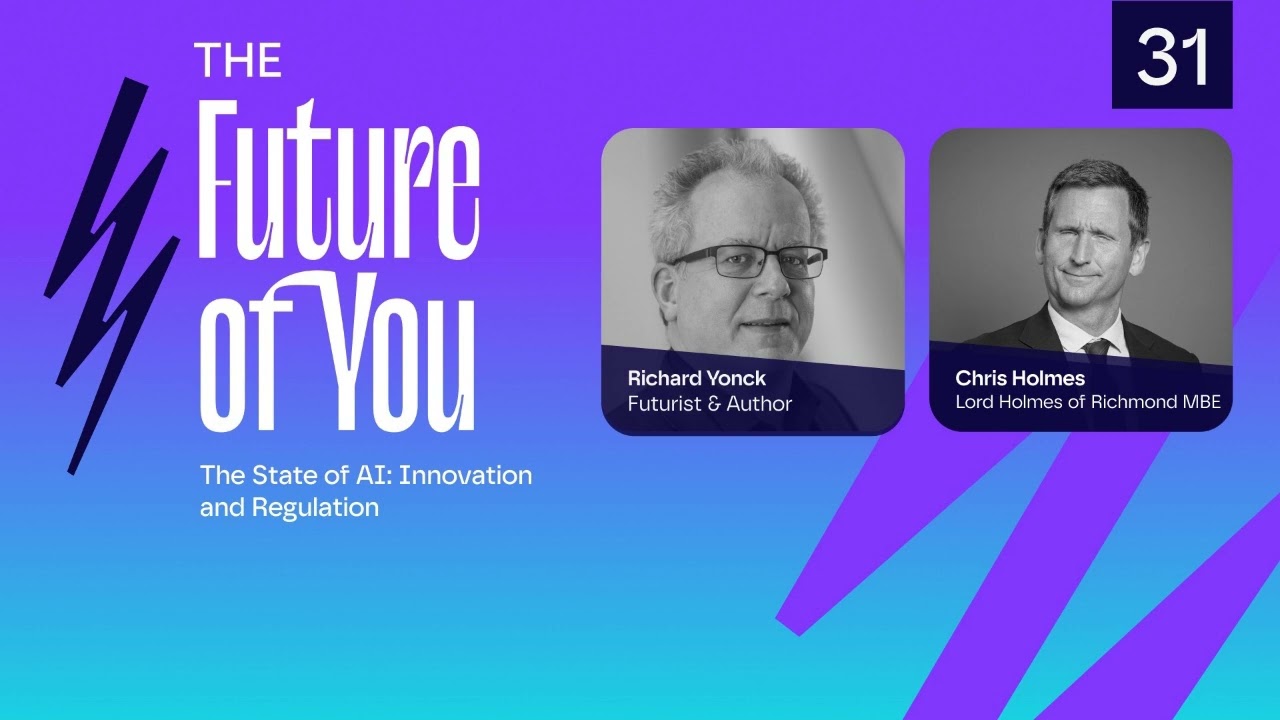
In this episode of The Future Review, host Tracey Follows interviews futurist Richard Yonck and Lord Chris Holmes about the current state of artificial intelligence, its regulation, and its societal impact. The conversation begins with Lord Holmes’s private‑member’s AI Regulation Bill, which proposes an independent AI Authority and AI Responsible Officer to provide horizontal, principle‑based oversight across sectors in the UK. Holmes explains the bill’s progress, its emphasis on trust, transparency, inclusion, innovation, and proportionality, and how it differs from existing sectoral regulators. Yonck then addresses widespread misconceptions about AI capabilities, emphasizing that today’s generative models, while impressive, lack basic reasoning and consciousness. He attributes the current hype cycle to a mix of marketing, founder ego, and rapid funding, noting that AI winters have historically cleared out weaker ideas. The discussion moves to regional governance, contrasting the EU’s prescriptive AI Act, the US’s fragmented approach, and China’s state‑driven model, and evaluates which aspects are most effective. The interview explores AI agents and digital twins, weighing their potential to augment personal identity against privacy and control risks. Yonck warns that most agents will be corporate‑owned, raising concerns about data silos and manipulation. They examine the prospect of AI consciousness and the singularity, concluding that any machine consciousness would differ fundamentally from human experience and is unlikely in the near term. Emotional AI is discussed, with Yonck summarising his book Heart of the Machine and highlighting current limitations in reading nuanced human affect. The timeline for self‑driving cars is pushed back to at least 2030, with full Level‑5 autonomy likely later, due to technical, regulatory, and societal hurdles. Both guests stress the emergence of hybrid intelligence—human‑AI collaboration—requiring new pedagogies and board‑level tools that provide real‑time, predictive insights while preserving human judgment. They caution that AI could compress performance differences, potentially flatten expertise, and stress the need for diverse human oversight rather than multiple AI judges. Finally, they discuss biometrics, data ownership, and the importance of labeling AI‑enabled products, arguing that transparency and consent are essential. The episode concludes with a consensus that AI will make the world more complex, but whether that complexity is beneficial depends on thoughtful regulation, ethical design, and maintaining human agency.
Chapters
Welcome to The Future of You. In this episode, we're diving into the world of AI. We chat with a return guest to the pod, Lord Holmes, who's been busy pushing for new laws around artificial intelligence. He thinks it's time to get ahead of the game with AI and make sure that we have the rules that both encourage innovation and protect people. So he talks to me about the private member's bill he brought that includes the notion of an AI authority to oversee the changing landscape in the UK. Now, the bill covers everything from consumer protection to intellectual property, but despite it moving through all of its stages in the Lords successfully, And as discussed before the general election, just as it was about to go to the Commons, it fell through the gaps in the wash-up of that general election. Several Lords had something to say about AI in the debate which followed the King's Speech. But as we wait for greater clarity on the new government's position, it's probably best to look at the written update from Chris on his blog, and I've popped in a link in the show notes. It's also my great pleasure to speak with futurist Richard Yonk. He's also a former computing AI contributing editor for The Futurist magazine and a writer for Scientific American, World Future Review, Fast Company, GeekWire, Salon, and many more. He's been interviewed and quoted in The New York Times, Wall Street Journal, Wired, BBC News, et cetera, et cetera, and guested on numerous podcasts and radio programs. Though The Future Review must surely be his favorite. He says it is his mission to provide organizations and individuals with insights that spark imagination, reduce risk exposure, and effectively connect the dots towards a preferred future. Now, today he helps us connect some of the dots on AI, clearing up some of the myths and fears about it, reminding us it's still not anywhere close to human intelligence, and talking about the ups and downs of its development, the realistic timeline for things like self-driving cars, and the importance of balancing AI's benefits with ethics. So tune in as we break down some of these complex topics over to you, Richard.
There's a lot of dis— misinformation and misunderstanding about where we are with artificial intelligence. Artificial intelligence has been around for literally 75 years or so and has been developing throughout that time. We have in these last few years reached a point where suddenly there's been some very big changes. People are of all sorts are very aware of it in a way that they never have been before. There's a lot of fear, there's a lot of concern, part of it built out of the narratives that we find from science fiction and movies and so forth, uh, that are perpetuated to a degree by, uh, some of the companies, uh, where we're worrying about AI taking over, AI replacing us entirely. Uh, but the fact is that when you talk to the the people on the ground, the researchers, the people in the labs, the people who are actually doing the work, we are so far away from the point where AI is anything close to being, uh, human intelligence level. Uh, we have a lot of things with generative AI, LLMs, uh, ChatGPT, where we competent at a particular task. It's, it's taken in this enormous corpus of information from the internet, pretty much, uh, everything that we've been pouring onto the internet and the web for the last 30 years, and through statistical analysis and different types of algorithms, be able to take that information and answer amazing things. And it seems very creative, it seems very human-like, but in fact what is, is it's us. We're seeing ourselves reflected back on us. And even though these programs can do amazing things, they can pass college exams, they can pass the bar, they can accomplish many different, very static tasks. They still don't have a lot of the very, very basic reasoning skills and understanding of causality and other aspects of our world that even a 4-year-old has. So we're We're still at a very, very early phase with AI, but we're also at a phase where we have to understand that it's a very different kind of intelligence and we end up often misunderstanding what level it's at and how we should be interacting with it.
Yeah, so that's very interesting. So what's driving the hype? Is it PR? Is it marketing? Is it all about research grants or is it just ego of founders? What is the main driving force for the hype cycle?
I think it's a lot of different things. We've been in a range of hype cycles. I feel like they've been accelerating during the past decade or so as different business models have been kind of accelerating. And there's this feeling and need that we have to— that companies have to turn around and be showing profit very quickly, getting to market as quickly as possible, and essentially racing things out before they're ready. And so we get metaverses that are not ready for prime time, we get NFT markets that crash, and so forth. So with AI, AI, as I say, has been around for 75, 80 years. It has gone through a range of ups and downs, AI winters, pullbacks in financing. And what these end up resulting in is actually a little bit of, you know, getting rid of the chaff, having a little clearing, and there's an opportunity to kind of restart and be funding viable directions and approaches again. The thing is that right now we're in a phase where there's a lot of money being thrown at it. You have Certainly the marketing departments, the founders wanting to talk things up as far and as fast as they can. But a lot of the dialogue and concern, the ways that they're hyping this draw a lot on a range of dialogues, a range of conversations that have been on the certain corners of the web for— and outside the web— for several decades now. Where we're talking about and worrying about what happens when AI reaches the singularity, when we reach an intelligence explosion and who's going to protect us? Well, these companies have to, they're the only ones who can take care of us. At a certain level, I think they believe it. I think that there is ego there. Everyone who's working on something major in terms of technology throughout the ages think that what they're doing is the thing that's going to save humanity. That is the the great thing that nobody else can do without, and they're the only ones who can bring it to light. The fact is that invention happens when it's ready, when the time is right, when the various infrastructure and conditions are set. So if not them, it will be somebody else.
What do you think in terms of the regionalization of AI and the way we're treating it, particularly from a governance point of view, but not just that? I mean, even just thinking about data security, all those sorts of things. I mean, obviously what China are doing is completely different approach to the EU, which again is a completely different approach to the States. You're in the States, I should say that for our listeners. What's your point of view on who's doing it best or better, or can anybody do it that well right now?
I think we're all finding our way, most certainly. And everybody's got a different internal narrative that they're working from. We've all got different political conditions and situations that we're starting from. So that alters the, the path and the course. The EU, I feel, has a, uh, a, a really good start in terms of protecting the user's interests, the, the citizens' interests. The GDPR is, is an example pre-AI that certainly is involved there. I think that the idea of Having that as a priority is important. I think that the idea where we have a free-for-all in the US where essentially we, you know, allow and have allowed even with a small amount of noise and pushback, um, the scraping of all people's information and data that, you know, that you've got artists, you've got writers. I mean, I'm pretty sure your books are, are, you know, part of ChatGPT. I know at least one of mine is, but it is, uh, a reality of our world right now. And the fact is that you've got these people who have said, okay, I'm going to basically create enormous profits for a very small number of people based on the product of the near sum of humanity. That's— there's something wrong there because one, we're not having a say, but two, we need to have a range of different types of protections, not least of which is a level of balance and recognition toward, you know, if not compensation, at least control over our product and our data.
What do you think about AI agents? Because obviously my interest is in the future of identity and particularly identity, how it is influenced by technology, but very particularly by AI as we go forward, particularly with this podcast series. A lot of probably the work you do is about AI at an organizational level. And, and some of mine is, but what do you think the impact is of agents or agentification on individuals, on persons, on personal identity?
If you look at it from a very idealized standpoint, it has such enormous potential for helping us as individuals to, whether it's possibly simplify our lives, possibly extend them in ways that simply has never been humanly possible before, uh, where our reality, our identity becomes something that extends well beyond us. It be— it is able to extend in ways where it diversifies in a way that, you know, we simply have never kind of inhabited throughout history. But that's a very idealized approach to it. At the more— call it cynical viewpoint, these are typically going to be algorithms that are built by and controlled by corporations. So how do we silo our personal information, personal data, privacy in such a way that we are protected? And of course, that's even in an, again, idealized way. That's much more easily said than done. Everybody these days, as we've seen in, in recent years, is, is hacked on a regular basis and are our data and information exposed. So trying to look at the two poles of this and figure out, okay, where do we consider it as a reality? And somewhere hopefully in the middle where we're as protected as we can be, we get as much benefit as we can, but we're also not blind to the idea or the fact that we're probably being exposed and made vulnerable in ways that we never have been before.
Cause I've looked at a lot of models where one is using AI to create a twin, a digital twin, an avatar, more than one avatar, agents that go out and do things or say things on our behalf, but obviously reflect and represent or re-present the self, you know, the tone of voice, the content, the preferences, all those sorts of things. It's not there yet, obviously. There's some early examples, but I think it's gonna be very interesting when people are met with representations or re-presentations of people and they don't really know whether it's the person or not. I think the assumption probably is going to be that you're a representation, you're an avatar, rather than the assumption being you're a real person. I think you've talked about this as well, that sort of flip where we assume that we're dealing with a non-human rather than dealing with a human first.
I think that's a fair assumption. It's going to depend on the modality. Right now, if we're back and forthing with someone in text, there's a whole range of things we don't get feedback on. And so it's pretty easy for us to say, okay, we're at a stage in technology where, yeah, there's a pretty good chance, you know, this is where I'm not dealing with the actual human being at this point. When we start talking about a range of, you know, visual feedback, you know, people being represented as avatars, even entirely photorealistic, perfect representations of their voices and and so forth, as we all become more familiar with the fact that yes, the technology is at this level right now, then we start to make a range of assumptions that we wouldn't have in the past. I think one of the things it brings to mind that I explored in my last book, Future Minds, was the idea that when you have all of these representations, all of these avatars, all of these identities going out into the world, if you go far enough into the future, and I'm not even sure how feasible this will ultimately be, you perhaps reintegrate that into your own memories, thoughts, and so forth. I'm not sure that if that's going to be feasible, but for the meantime, in the meantime, right now, what does that look like? If you have 100 or a dozen entities that are you or represent you going out doing things, a lot of that is only useful to you if you are able to consolidate and take some of that information that they've gathered or interacted with back. Now we're already dealing with a world of massive data overload. How do we as human beings contend with that? I think that's a really big question we have to ask ourselves because that's going to be the intermediary period before we ever get to that far future that I was talking about.
I was going to ask you about consciousness. You mentioned it earlier on about whether AI can be conscious. What's your view on the sort of, again, another hype cycle or hype idea concept the singularity?
So, um, how long do you have?
Till 2045.
Okay, well, yes, um, so when I wrote Future Minds, uh, one of the main things that was driving that was this desire to really explore the nature of intelligence, not just human intelligence, but what is intelligence. And, uh, that in part because it's such a big thing. It really, if you look at every form of life on this planet, it has a form of intelligence that is appropriate to the niche that it occupies. Similarly, if we look out at artificial intelligence, machine intelligence, is that going to be a continuation of this path or is it fundamentally different for a range of reasons, not least of which is the fact that it doesn't begin from a biological substrate? So I think that the recognition that no entity, no species shares the same kind of consciousness, all of it, all species have a different level of intelligence and what constitutes the consciousness they have is rather different. It goes back to the idea of you take a certain animal, a bat, for instance, we have no concept what it is like to be able to navigate with echolocation. And so this is a, a different way of being. Each entity has a very different form of it. What will AI have? What will machine intelligence have? I suspect there will be many, many different kinds of intelligence, many kinds of something of a form of consciousness, but it won't be like human consciousness. So let's back that up. Consciousness is what Marvin Minsky called a suitcase word. It's essentially a word that means so many things to so many people, or depending on the context that you're using it in at that moment. So if we talk about it right now, most people are thinking of consciousness in terms of, well, is it self-aware like I am? Is it able to self-reflect? Does it have a form of phenomenal consciousness, as Ned Block has talked about, where essentially it can, you know, register and appreciate a particular shade of red. But what is that? You know, it's, it's a phenomenal experience and not something that can really be explained in an objective way other than to talk about its wavelength. So in that sense, will AI have that? And I suspect that it very possibly will not. I think we may have a level or a type of subjective consciousness because it's an emergent property. Property of our minds that is unique in the universe. And until and unless we ever run across some other entity that has something we can at least partially agree is similar, then I suspect we may be very unique in that for a long, long time.
Do you think we're going to be able to preserve our consciousness or bring it back?
I'm thinking about cryonics and other technologies that are very emergent So again, so cryonics is kind of a subset of that. I think we have to back off a little bit and talk about, okay, if we are such a very different substrate, if our minds exist in such a way, you have ideas. Ray Kurzweil has talked about the idea, oh, if we can emulate— and he's hardly the only person— if we can emulate each neuron perfectly, you know, through electronic means, right, you know, transistors and so forth, then we can essentially replicate a human mind. It sounds good from a totally reductive standpoint, but the fact is that the nature of emergence, the nature of how some of these phenomena arise out of individual components that result through synergistic means to create a whole that is greater than the sum of its parts. I'm not sure that's going to be feasible. And if you extend that then to, okay, can we upload our minds? Can we record ourselves in a digital form in a computer and be able to continue to live and exist in that way? Or, you know, take that information and somehow put it back in a biological system? I think that that's going to be a really hard lift. I'm not sure that we have that capability in our future, but I'd love to be surprised.
It's interesting. It is reductivist, and it's also a very rational way of thinking about human beings, I think. And I think we forget a lot of the time just how emotional we are. So many of our responses are all, you know, they're all emotional, or our decisions are generated from emotions. I mean, obviously lots and lots of work on this in the past couple of decades, but you've written a lot, I know, about AI and machines and emotions, and can they understand or detect our emotions? What could we do with that? What kind of effect will that have on us? Will we even be aware of the nudges? Can you talk us a bit through your sort of philosophy around that and your beliefs about what will be possible and what won't?
Sure. Well, thanks for the lead-in. Yes, I wrote a book, Heart of the Machine: Our Future in a World of Artificial Emotional Intelligence. And essentially, it was looking at systems that are able to read, interpret, and interact with human emotions. This was work that started in really in the '90s, uh, really got going at MIT Media Lab in the mid-'90s, started to be commercialized toward the end of the 2000s. And there was a lot of significant interest in it and still is, but a range of concerns around the kinds of privacy, uh, that, you know, are— it involves when you're interacting with and, and being able to take in information about people visually, whether in a public environment or in a private one, you know, leads to a range of different types of problems. But then there's also the reality of what are these systems actually reading and, and recording. So human emotion is a core aspect of the human condition, something that essentially precedes our other forms of communication such as speech and so forth. So how fundamental that is, is I think something that is overlooked by a lot of people, especially in technology. But when you talk about taking a system that reads a person's face, for instance, person smiles, okay, it's— they're smiling, but there is a huge number of nuances there. And beyond that, for any of us that as human beings have interacted with others, people. We are continually in conversation, looking at their faces, taking the in, you know, expressions, looks in their eyes. I mean, so much information is being transmitted non-verbally, and there's been studies around that as well. And that information is continually feeding that conversation in a feedback loop between the two of you. It's referred to in psychology as theory of mind. Essentially, we are witnessing and experiencing this attempt to read each other, read each other's minds, you know, at a certain level. We're not reading each other's minds, but we are trying to understand what is that person thinking. How are they— are they mad at me? Are they, you know, laughing at this? What have you. So when a machine takes that information, that visual information, and labels it, it's really not doing very much with it. It's just, you know, you could take an algorithm and say, well, they're smiling, we're going to say they're happy. Well, maybe they're not. You, uh, I think mentioned in your book, uh, Lisa Feldman Barrett. I mentioned her as well, and she definitely pushed back a few years ago on the whole emotion AI concept, and she's totally right. The fact is that these machines are not reading this information, and just as AI it doesn't have the tools yet to reach full autonomous driving, for instance. It's still missing that last little piece. Right now, it doesn't have the reasoning capability that it may have in a few decades' time to be able to interact with us and have enough understanding of, you know, the nature of human beings, the nature of the world, the way we interact and so forth. It may in the future be able to do a better job of essentially emulating or simulating that theory of mind kind of phenomena, but it's not going to be something that, again, it's not going to be as perfect as us for a long time. And we're not perfect.
It's really interesting that you also talk there about driving because that was one of the big sells, wasn't it, a few years ago on emotive AI, emotional AI? It's going to be in our cars. It's going to be reading our expressions. It's going to know what mood we're in, and therefore it's going to create the atmosphere with the music, all these other things. I mean, we're so, so far off that. We can't can't even get the car to drive properly without a human driver, let alone sort of program it all with all this, you know, emotional intelligence that is supposedly captured by machine. So here's a question for a futurist, because it's one of the most difficult ones, I think. What are the timescales? What are the timescales for some of these technologies? What would be some of the milestones, particularly on AI, do you think?
Sure, sure. Try not to predict, but I do have a range of, you know, general ideas that as far as where things are, uh, I, I typically tell people when they, you know, we, we were told back in the 2000s, 2008, 2009, uh, by a range of executives we were going to have the streets filled with self-driving cars by 2017. Every year in the last half dozen years, Elon Musk and others tell us We're one year away from full Level 5 autonomous vehicles. We are still not close. There's a range of problems, and these are, these are that last mile problem that you have with a range of different technologies. So in my mind, I've been saying to people, and we're closing in on, and I'm getting, I'm thinking about pushing it out a little bit. I've been telling people that we're not going to have it until at least 2030 in terms of technical capability. Then we have to get through a whole range of other factors because you have public sentiment, you have regulation, you have a whole transition period between the people giving up their cars, driving on the roads at the same time. Uh, we're talking about well out into the 2030s before self-driving cars have fully taken over, and that may be optimistic. Other kinds of AI, it depends. I'm, I'm talking about —people about the range of different types of programs and projects that are being done in research labs around different types of abstract reasoning emulation, trying to understand— have machine common sense and so forth. These are being developed, they're being worked on, but I think that it's a good 10, 20 years to see these fully be realized. In the meantime, the thing that I really feel is going on now and what will be driving a lot of AI for the next couple of decades is what I call— well, I'm not the only one— hybrid intelligence. The idea that humans and AIs working together in more and more frictionless ways, you know, between the, the intelligence of the machine, between the interfaces that are used, the different types of programs and algorithms to essentially help us to work together in a way where The systems do what they do so well, whether it's something highly repetitive, certain kinds of pattern recognition and so forth. And we bring in a range of human-like skills that, you know, whether that's around reason, other aspects of emotion, values, and so forth, so that as a team, we're continually supporting each other. And, and there's different small projects around this, but I think there's a whole range of ways this is going to expand over the coming decades.
I'm really interested in this, actually, because I think it's overlooked and underestimated just how difficult it is for human beings to work with AI, not for AI, but maybe in some cases it is. Nobody's taught us this. Who do we go to for it? And even for the people who are going to teach us, where's the pedagogy for it? I mean, there's— if you track back, it's just so difficult to contemplate. I mean, I know how to go into a meeting with other people and discuss things in a conversation or a brainstorm or a, you know, whatever the format is of the meeting. I know how to work on my own in front of my computer, not talking to it, just typing or whatever I'm doing, researching. But how do we work in these sort of, whatever you want to call it, hybrid intelligence, hybrid working, Copiloting? I think it's a fascinating area.
Yeah, no, it absolutely, and it's rife with problems. I think there's gonna be a lot of growing pains and as us human beings, again, kind of relearning or continually learning how to operate and how we use our values in the situation, I think is going to be difficult to— it's going to take us time. As an example, what's popping into my head is the other day I was on a platform with a number of other futurists actually being asked a range of questions for a conversation that was all being being led by the platform's AI. So the, the platform was continually feeding us back information, prompting us for different things and so forth. And it was definitely different, engaging, but it was also incredibly fast. And so, I mean, it has benefits, but for those of us who like to take time to do deep thinking, it really was not, I mean, it probably wasn't what it was geared for. But it really says something about we have to prioritize what kind of thinking and what kind of processes we're working on at a given time.
Yeah, because immediately when you tell me that, I think, oh my God, that sounds awful. It feels like unless you're an ENTJ Myers-Briggs, then you aren't going to survive that meeting. And we don't all want to be an ENTJ. No offense to ENTJs, but you can have too much of a good thing. Yeah, so I mean, I feel like it's filtering potentially, obviously filtering out some of the good stuff, some of the best stuff that humans do in order to be efficient, to operationalize, to optimize, and just to get an output and a result. Absolutely.
It's something that I've been talking a little bit about, about the nature of what we're doing with generative AI right now. The fact is that we have a lot of people who are touting and, and pushing, uh, this narrative that these different forms of generative AI can make us so much more efficient and we can do this and that. And when you look at, you know, some of the studies, there was a study, uh, 6 months ago, 8 months ago, uh, where a range of consultants were using a form of generative AI. I wanna say it was ChatGPT, but I'm not definite. And they showed that they had x percentage of increased efficiency. But when you actually took it a little more granular and saw that the consultants with the least amount of skill had theirs raised the most and the better performing consultants really did not have that level of benefit, it makes you wonder what is the long-term effect of that kind of AI influence on human thinking, on the ways that we perform. We operate right now in a form of general competition with other human beings. If you have this intermediary that is operating in such a way that it kind of diminishes the value of exceeding expectations, but actually tends to make us all gravitate toward the mean, which is what an LLM does anyway, that, that really is, um, concerning for what that could mean for the future of with human thinking, human knowledge, and so forth.
Yeah, I mean, do you think that whether it's a meeting or whether it's a piece of creative output or whatever the content is, do you think we'll have several different outputs that then may be aggregated or one can choose between? Because as you just said, we can't really rely on just the analysis of AI and whatever mode or format that is, because obviously it is potentially discarding lots of stuff that we would as humans find valuable. So how do we create a system like that? I mean, as you were talking about that particular meeting with the AI, I was thinking, I wonder if you could have 12 different AIs going and they're all programmed in slightly different ways to analyze the output slightly differently. But even then, it seems like a massive waste of energy when you could just rely on the humans to do it.
Well, and that's the thing is I think that when you're talking about wanting to keep human values in the loop, That really, if anything, I, I want in that situation for there to be more human beings rather than saying, oh, we need more AIs. I want to see, you know, a range of different kinds of thinking, a range of different kinds of views. Sure. That's, that's diversity in general. That there's a lot of benefits, especially in futures thinking, to have a range of viewpoints so that we can make sure that we don't have blind spots. But I really would not be willing to— I think if you put it all on, say, 12 AIs, I've got a feeling you're going to have a huge number of blind spots, particularly in terms of what is valuable or important to human beings.
When I've been looking at some of the, particularly the tech entrepreneurs, but a lot of the smaller AI companies and all this, I'm getting concerned that there's a an assumption, even a desirability around the AI will program us with our values rather than the other way around. And obviously there's a kind of— there's a toggling between the two, and it's a bit of a compromise and negotiation. But even then, the human being has to have the final say over those values. But can the human being always know? I mean, we've seen what happened with Google Gemini and lots of things recently that Yeah, exactly. You're rolling your eyes. I am too. I mean, sometimes I look at that and think, how could they have gone out with that? Was that just a test to see how deplorable it would be and what people's reactions would be? Well, was that actually a mistake?
Sure. I'm just going to recap for some of your listeners. So back in February, Google released a version of Gemini that had changed the algorithm slightly to try to implement more diversity into the results for different types of generation, particularly image generation. And they were creating these very, very— and consistently, not just one-offs or just because you asked for it. They were creating representations of Vikings and World War— well, Nazis, I guess, and others. You had who were basically people of various ethnicities that did not participate for very good reason in those events. There was a Native American in ancient Greece. Uh, you know, there was just all of these really ridiculous visuals that it's fine if you asked for it, but if it's just how it's going to generate it, it's like, hey, you guys messed up bad. Uh, so yes, I unfortunately, they've had a range of, from a marketing PR standpoint, a range of bad demos here over the last number of years. I can actually think of a few different instances and it's like, I'm not sure what, what's happening at that level or with that. But anyway, don't really wanna get into that too much. I've said for a long time and hardly the only person who out there saying it, that technology has always changed us as it has developed. We create technology, it alters us in some way regardless of what it is. Uh, and it's become more and more apparent with the modern technologies like social media and so forth.. So that, you know, now most of us, or a lot of us, uh, read short form only. Reading long form is much, much harder than it used to be. Our, our, the way that our brains process is actually quite different. We have, uh, uh, some small, you know, little, you know, bone growths in parts of our body, you know, because we have a different posture than we used to have, you know, years ago because of how we spend most of our time at desks and in front of machines these days or in front of mobile phones, so on and so forth. Technology continues either physically or mentally to alter us. The question then becomes, is this something that we need to do? We behave and operate differently in terms of how we use a computer. Early on, we had to learn a command line interface. That was, you know, for a lot of people, that was tough. As it became an easier and easier interface, it became more natural, but we still do really weird things when you think about it in terms of how we ordinarily would operate in nature in order to be able to make these machines work. We operate at a certain level on their terms rather than the other way around.
We shape our tools and our tools shape us. With that in mind, my final question for you, I think, Richard, is given everything we've been talking about and the supposed benefits and advantages of AI, if it's used correctly or we find ways to work with it in a hybrid manner, Is the future going to be more complex or less complex with AI in it?
Ooh. So the future will be more complex. Decade after decade, century after century, we create abstraction upon abstraction. We keep creating and adding complexity to our world and to our systems. We may feel at certain times or in certain ways that our lives are simpler, but overall, I think we have to say that it will be more complex. Will it be better? Will it be worse? That's, I think, a far more important for me question in terms of is what we're creating going to be improving and beneficial to the human condition, or are we doing something that is ultimately going to be against our, our nature, be against what it means to be human beings. I don't want to live in a world where essentially all of us spend all of our time feeding the social media machines and all of the different systems in order that they can operate. I think we all have to still have the experiential life that we have in nature, in the world, with other people in order to be able to have full and rich lives.
So welcome again to Lord Holmes, Chris, for his second appearance on the podcast. Thank you for returning. Pleasure. I wonder if you could tell us a bit about the artificial intelligence regulation bill that you have introduced and bring us up to speed on where we are in it. Like, is it its second reading, or has it just received its second reading?
Certainly. And the reason I wanted to introduce a piece of legislation on artificial intelligence was I think that we have an opportunity to lead and it's now time to legislate. The government's position is largely wait and see, but I think we need to know everything that we need to be in the right position, a pro-innovation, pro-citizen rights, and pro-consumer protection, which is why I introduced my bill. And to give some context, Every Member of Parliament has the opportunity to introduce a Private Member's Bill. It can be on any subject they want. It needs to be relatively specific. And then there's an element of luck because it goes into a ballot at the beginning of every session and you need to really come in the top 25 in the ballot if your bill is going to have a chance of getting before Parliament. I came 6th, so I had first reading of my bill in November, and that means that's just when I present the Bill to Parliament and read its long title. And we then had second reading on the 22nd of March, and that's the opportunity for a full debate on all of the issues and all of the clauses within the Bill. So I wanted to have a Bill which addressed the innovation question, the investment question, crucially consumer protection legislation, citizen rights, and to really drive a far greater level of public engagement with the opportunities and indeed the challenges of artificial intelligence.
But why have you felt the need to offer up this bill? And we'll get on to some of the details. What do you think's missing? What's the gap? Obviously the EU are doing their AI Act and other regions or territories are looking at their own sort of national or regional regulatory solutions. What is it that you think is missing in the UK?
We had the Bletchley Safety Summit, the AI Safety Summit, in November last year, and that was very successful and right to look at frontier risks and that question of safety. But having stood up a successful summit, it seems logical to then look at all of the other elements of AI which are already impacting people's lives lives, oftentimes without those people even knowing it, in terms of shortlisting for recruitment, for example, in higher education, in healthcare decisions. People are already being impacted by AI. It's time that we legislate so we can cover all of the areas where AI is currently being deployed, all the areas where it may be, so we get the best outcomes for citizens for companies, for innovators, for IP owners, for our nation. And we have a real opportunity with three L's, I call them: law, learning, and language. We have the great good fortune of English common law, we have a sensational higher and further education ecosystem, and we have the good fortune English as our language. With that, we have a responsibility, I believe, not just an opportunity, a responsibility to lead internationally focused, to lead on artificial intelligence.
Okay, so why doesn't the existing landscape of many regulators in the UK, and I've sat on the board of one of them, so I am familiar with it, for example, people, why doesn't the ICO, or why doesn't Ofcom, or even in some respects the Advertising Standards Authority, why doesn't the current regulatory landscape fulfill the asks of your bill?
It's interesting because the government's approach is very much to look to existing regulators to take on this work around AI in their specific sector in a very vertical manner. Now, both in terms of consistency of approach, coherence, and ensuring that we identify all the gaps where there aren't competent regulators for a particular area and where existing regulators don't have competency in that specific field, it seems to me it would make sense to have an AI authority and In no sense am I suggesting that that should be a do-it-all AI, huge bureaucratic, cumbersome, expensive regulator. Not a bit of it. Agile, flexible, horizontally focused to do that piece of work, to look across existing regulators, to assess their competency, to address the issues, the challenges, the opportunities of AI, to look across all relevant existing legislation, to assess its competency, to address the challenges and the opportunities of AI., and by doing that, identify the gaps. So then it wouldn't matter if you're an innovator, a consumer, a citizen, in whatever sphere of the economy or life you found yourself in, if AI was in the mix, you could expect to have a consistent and a coherent approach wherever you happen to be experiencing that AI.
So I see, so it's like it's smoothing out the potential wrinkles across all of the existing bodies, is it in different sectors?
We're very much taking a horizontal approach to thread this across all of the existing regulators and to identify where there are gaps and changes which need to be made to enable that consistency and coherence across the whole of the economy and society when it comes to AI.
Because it's interesting, the timing of this as well. I mean, it's sort of surprising to me actually that this is coming at this time. Why didn't it happen 5 years ago when we knew some of this was on the horizon, for example? So I'm always going to ask this as a futurist, you know, We saw a lot of this coming. I know you did as well. But you've got the ICO, for example, and not to pick on them, but the ICOs are only just going out to consultation on generative AI, for example. I mean, it's done, it's happening, it's happened. So what's your point of view on getting ahead of some of these things and why haven't we on AI?
Or perhaps you think we have? No, you're quite right that in terms of our startups, our scale-ups, our industries, many of our universities and further education establishments, they're doing great work when it comes to AI. But from a legislative and a regulatory perspective, we're certainly somewhat behind the curve. We didn't need to get behind the curve. We can now, I suppose, take the opportunity of not being first mover, the EU, EU have very much got out there and done that with the EU AI Act, so we don't have to have that fear of the focus on first mover. But we do need to get on with it, and as you rightly identify, if we don't, the danger is that so much, particularly in the generative AI space, so much will have happened it'll be very difficult to retrospectively regulate and to try and have that positive positive, forward-facing approach, which we still could have at this stage, I believe. But as every week goes on, obviously you're giving yourself less of an opportunity to influence, to lead.
Yeah, so tell me a little bit about the AI Authority, who would lead it, and also your idea of an AI Officer. How would that work?
Certainly, so again, it's all about trying to give us the best opportunity to enable the opportunities and be cognizant of the challenges and control and where appropriate eradicate the risks. So the AI Authority would be independent of government. It would have key functions as I set out in terms of looking at existing legislation. Crucially, like the whole of the AI Regulation Bill, the regulator, the AI Authority, would be underpinned by principles, key principles that should run through all of our thinking on this: trust, transparency, inclusion, innovation, interoperability, an international approach, accountability, accessibility, and assurance. Great principles which can underpin our approach to this. And having then principles-based, outcomes-focused, inputs understood, understood, and where necessary remunerated, gives us the best opportunity, I believe, to get the best out of AI. Added to that, the AI Responsible Officer, another key principle running through the Bill, that of proportionality. So people shouldn't think this has to be an individual who all their time is on AI. It's proportionate to the size of the organization, it's proportionate to their use of artificial intelligence, but to have a function within every organization that develops, deploys, uses AI where that function is responsible for the ethical, unbiased use of AI with reporting obligations analogous to those for financial reporting within the Companies Act, so well understood by all the commercial entities, seems to be another good focal point. Not that then that AI officer is the only person responsible, everything is just abdicated to her or him, but to be that function within an organization which then enables, as a company grows or it already is of scale, but the entire board, the whole of exco and layers of the organization to understand their responsibilities and to understand the leadership and the culture that's required for for inclusive by design, unbiased, ethical AI development and deployment.
It's interesting to say about boards, you and I were both at the same AI conference yesterday and the day before, which I think we both enjoyed, that the question of boards came up actually in the panel discussion I was doing. And one of the attendees asked, what do you think the board of the future is going to be like given AI? Do you have any thoughts or visions or hopes or even fears, actually, about what the future of an AI or AI-infused or assisted board might be?
There should be confidence in all individuals and all humans that AI always needs to be human-led, always needs to be human in the loop, and then potentially in some ways human over the loop. But what that should mean for boards, if we get this right, is greatly enabled, greatly empowered boards to be able to have information in a different format right in front of people, real-time information, more than real-time with predictive analytics, being able to have such a different view of your organisation, of your market, of your sector, of your competition, of your environment. All this is— if we get it right, and we must, it should lead to far more empowered boards being enabled to have even greater leadership capabilities and leadership potential.
Now businesses, I'm guessing, are going to say, here comes more regulation or more burdens on us. We've already got got quite a lot to cope with. Is the government going to help us, you know, either with funding or any other kinds of aid? Do you have any thoughts on that?
Very much so, and I was really clear when I started drafting this Bill that it can't be a burden, either bureaucratically, financially, operationally, on business. That key principle of proportionality is one guard against burden. And indeed, all of us can cite bits of legislation and regulation that is burdensome, but that doesn't mean regulation and legislation of itself is bad. It means that's the wrong regulation, that's the wrong legislation. So really pushing these principles around right-sized regulation proportionate, a sense that if you are a startup, potentially there can be de minimis levels as to how these features will impact. So all, all of the provisions should really be pro-innovation, pro-consumer protection, pro-citizen rights, and it should be the job of any legislature and any regulator to have all those principles in their mind when they're drafting, because it makes it more complex, but it's absolutely essential.
Was there anything that came through the second reading, or anywhere during the process so far, any comments from either any of the other Lords or Ladies, or anything that surprised you? Any kind of either, you know, challenges, or what's been interesting in the debate that obviously your bill has kind encouraged.
I did a great deal of consultation ahead of drafting, never mind presenting the bill, with civil society, with the creatives of IP, with copyright, with people interested in our democracy, with businesses, to try and find the right path through this. What I was really pleased with was the level of cross-party support for the bill. All major parties and none were in support. There were the obvious criticisms from some quarters saying that we shouldn't be regulating at all, we should just let this technology emerge and only at that point do something. And that's, that's a reasonable position for for some colleagues to take. It's reasonable, but I don't think it's right because nothing which is in my bill would be a curb on innovation, on development, on growth. Not at all. The key is if we get right-size regulation in place, as all the lessons from history demonstrate that is a benefit to innovation, that crowds in inward investment. And two obvious examples: the fintech regulatory sandbox, a clear regulatory intervention. Measure of success? Well, replicated in well over 50 jurisdictions around the world. Open banking, a great UK creation, a creature of a regulatory intervention with the CMA 9 order. Now replicated in well over 60 jurisdictions around the world. So we know how to do this. We know how to do it to market make, market shape, enable innovation, because right-sized regulation is a deliverant of the clarity and the certainty that investors, the developers, the startups, that really all of us would want to see in any particular area of our It's fascinating listening to you talking about it in such positive, innovative ways.
And I wonder what your point of view is on the EU AI Act, and because it comes from such a different point of view. Obviously, they're looking at very specific threats and they've got these risk levels. Everything feels terrifying rather than, you know, in any way sort of optimistic and innovative. And I mean, obviously you've got interoperability as one of your principles. And of course, that stands across businesses, regulators in the UK. But what about the interoperability with the EU and their act? I'd love to get your point of view on that.
Regulatory interoperability is a critical part of my bill as well. The EU AI Act is a valiant effort in all of its 892 pages. It's largely a creature of the legal framework in which it necessarily finds itself, so a code-based legal system, which necessarily tends towards a more prescriptive approach. I think you'll see the development of the Act with all of the elements around generative AI coming in at somewhat of a late stage of the drafting process. And I think it will be quite difficult in some ways. It's quite difficult to see in some circumstances where the right of redress would come from, which authority you would be appealing to. To do. There's some clashes there, certainly. And almost in many ways, don't listen to my words, listen to the words of someone who knows more about this than me, who said, "There's very little point being a lead regulator in a sector in which you do not operate." And that, not me, that was Emmanuel Macron. So there's clear tension between not least the member states and the EU, because potentially it will have more of a lean towards risk and the control thereof rather than the balance of understanding how to have a pro-innovation, pro-citizen rights, pro-consumer protection approach. So there are, there are opportunities for the UK to understand how we can both be interoperable but also in our common law jurisdiction take a legislative leadership opportunity.
I was wondering about the area of biometrics and the interoperability on that because, I mean, they're quite, they've been quite strident on where they will and won't accept biometrics. And then back in the UK, obviously I've been following biometrics for a while, and our UK Biometrics Commissioner Commissioner resigned, and he had a few things to say about what he thought the government were going to do and how they were potentially going to relax some of the, the, um, the regulation around that. And I think a new Biometrics Commissioner has been appointed. Um, I'm sure you can correct me if I'm wrong on that. Um, but it seems to me like biometrics— I mean, you talk a lot about public engagement, but AI and biometrics working together. And you and I talked about digital identity before, and the three things are very much connected, and it feels to me like they're, they're very important and most obvious and visible to the, to the general public. Um, where do you think we are with biometrics, and what would you hope that your bill could achieve, um, on that?
It's a really good way to take us right back to basic principles, and that is that none of these AI systems are anything without data. And when we say data, largely we mean our data. Some of that is very personal, some of it is IP protected, some of it is copyrighted. All of it is incredibly important. If we go the most sensitive part of data. To my mind, it really seems that biometrics are that, such critical pieces of data. They are part of us, who we actually are. We're not where we need to be when it comes to biometrics, and yet there are very simple ways in which we need to get there. And what's within my bill is clear on that. It goes to the sense of the need for everybody in this context. If biometrics are being captured, used, deployed, it's clear that has to be firstly done in an ethical way done with consent, reported upon, all of that data declared that that has been used in the mix, effectively getting to that point of transparency so everybody knows that that is being used. And crucially, the labeling clause that I have in the bill would also be assistive in this because it would require all goods or services where AI is in the to be labeled as such clearly, so citizens, customers, consumers would be well aware of that way before getting involved. So they could decide, we could decide, we could choose whether we wanted to be part of that, safe in the knowledge that AI is in the mix. I've got the bill through second reading. It will then go to committee stage and report stage. That's where amendments can be made to it, then third reading. It will then go down to the Commons and do those stages down there. And if it gets through that, then it will go to the Palace for the King to sign it into law. My hope is that I can get the entire bill enacted. If that's not possible, then I certainly hope that some of the key provisions can be adopted, not least around public engagement, not least around the protection of IP and copyright, because at the moment consent for anybody. You know, some of our fabulous creatives, our musicians, artists, writers, they're having their work just completely taken with no consent, no remuneration. That can't be right. And again, we know what we need to know to stop that being a problematic force in our society, in our economy right now. So, positive. There's still a lot to do in terms of legislative process, in terms of further engagement with government, but I hope that certainly some of the key principles, some of the key elements will be taken on and will become part of legislation. And like all good legislation, once passed, it should seem so logical and just melt into part of how we go about living our our lives alongside, enabled, empowered by AI, and being very much able to control, to eradicate, to mitigate, to manage the risks.
Fantastic. Well, I'm sure lots of our listeners to this podcast will be really interested in the bill and in helping any public engagement around it. So we'll obviously put a link to it in the show notes, and we'll follow its progress very closely. Good luck with it and thank you so much. Always a pleasure and privilege to speak to you, Chris. Thank you so much.
No, likewise. Thank you very much indeed. And really would love to hear from anybody, their thoughts on any element of this. Do please hit me up at LinkedIn at Lord Chris Holmes. Lots more about the bill and the wider technology piece there, but would love to hear from all of you. Thank you very much. Great to speak to you as always.
Thank you for listening to The Future Review hosted by me, Tracey Follows. Be sure to check out the show notes for more info about the topics we covered today. If you enjoyed this episode, please like and subscribe wherever you get your podcasts. And if you know someone who would love this episode, please share it with them. For more on the future of identity in a digital world, visit futuremade.group/thefuturereview. Review. To explore the future of everything else, head over to futuremade.group. The Future Review podcast is produced by Big Tent Media.
More from Tracey


Your Face May Be Training AI You’ll Never Use #TrainingData #ArtificialIntelligence #HollyHerndon



Why In-Betweeners See What Others Miss #Futurists #DiaryOfAFuturist #inbetweeners



Pick a System card. Pick a Self card. See your future in the connection #TraceyFollows #System&Self

Your Past, Your Present, Your Future #futurist #futuresthinking #TraceyFollows

