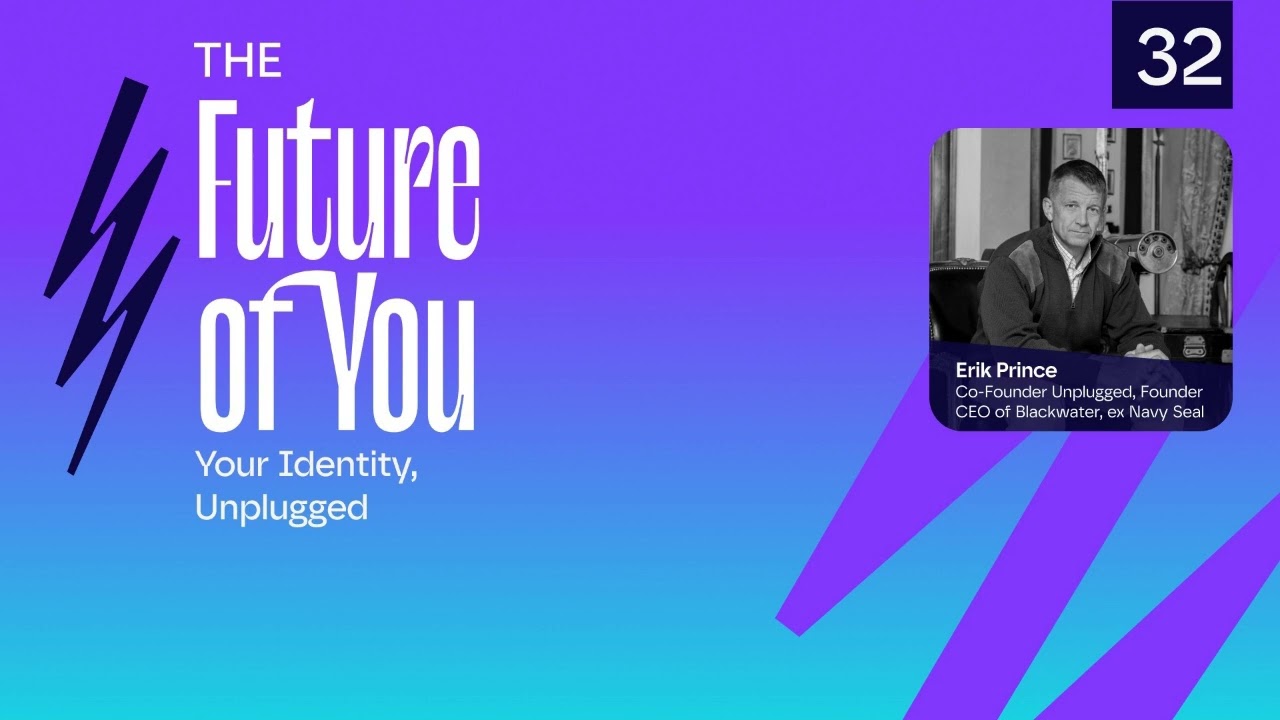
In this episode of The Future Review, host Tracey Follows interviews Erik (Eric) Prince, former Navy SEAL, founder of Blackwater, and co‑founder of the privacy‑focused phone company Unplugged. Prince outlines his career from private military contracting to security logistics in Africa, then pivots to his concern over the duopoly of Google and Apple and the rise of surveillance capitalism. He explains Unplugged’s hardware and software stack – a kill‑switch, a proprietary OS (Libertas), a secure messenger with per‑call key rotation, VPN, antivirus, and an app store free of advertising IDs – and how the device is audited by PwC and a DEF CON bounty program. The conversation expands to broader issues: the FISA extensions allowing warrant‑less data access, pervasive data harvesting by big tech, digital phenotyping, AI‑generated synthetic data, and the growing threat of IoT surveillance. Prince also discusses modern warfare trends, such as cheap FPV drones, the empowerment of small militant groups, and geopolitical flashpoints (Houthis, piracy, China‑US tensions). He ties these themes to the need for personal data sovereignty, free speech absolutism, and a decentralized approach to security. The episode ends with practical details on Unplugged’s availability and a call to protect privacy in an increasingly surveilled world.
Chapters
Welcome to The Future Review. Today's guest is Eric Prince, a former Navy SEAL, a current entrepreneur, and of course, the founder and former CEO of Blackwater, the world's largest and most effective private military firm, well known for never losing a protectee. Erik led the company until 2009, eventually selling it a year later. Following his exit, he moved to the UAE, where he played a key role in helping the government develop a team to successfully tackle piracy in the Gulf of Aden. Now, if you're curious about that chapter of his career, there's a fascinating documentary on YouTube called The Somalian Project. So we've linked to it in the show notes. Eric didn't stop there. He went on to establish Frontier Services Group, a security, aviation, and logistics company focused on Africa, supporting China's Belt and Road Initiative in regions where relying on local security forces wasn't viable. Currently, Eric is the co-founder of Unplugged, a company born out of his concern over the duopoly that Google and Apple have created in the communication space. Unplugged offers a phone that looks like your typical Android or iPhone— well, I think— but without an advertising ID, meaning that you're not being tracked, monitored, and listened to at all times. Eric views Unplugged as a critical response to the invasive data collection practices that have led to government agencies accessing what many assumed was private information, an issue that's even more relevant in the light of the USA's FISA Act and its implications for electronic surveillance. Now, Eric is a man who can speak on a wide range of topics from the Ukraine-Russia conflict and the current situation in the Middle East to the complexities of China-US relations. And if you want to dive deeper into those subjects, check out the show notes for links to Eric's podcast Off Leash and his appearances on the Sean Ryan Show. But in our conversation today, Eric, of course, brings his deep knowledge of warfare, past, present, and future to the table. And we do discuss the evolving nature of modern warfare. But first, we kick off with a conversation about the information environment and the ongoing battle between user privacy rights and surveillance capitalism.
I'm Eric Prince. I was born and bred American. I'm a father and I'm a veteran. But at my core, I'm an entrepreneur and a capitalist. We're building Unplugged to turn the tide on technology that exploits the individual, extracts our personal data and secrets, and harvests our information for the benefit of Big Tech or Big Government. Unplugged is a company founded to restore basic human rights in the digital age. We're empowering you to embrace freedom and to be fearless in a fast-changing world. It's our hardware, our own operating system, store, a messenger, VPN, and antivirus. It's called Unplugged. The Unplugged phone is built with a kill switch, an independent operating system called Libertas, and a proprietary privacy center. It's basically a firewall. It features a kill switch which separates your battery from the electronics so that off means off. You can completely disconnect the location tracking with our firewall. Our Unplugged messenger includes a dump feature. If you are under threat, you can enter a code and it wipes it. Your data is gone for good. Our messenger generates a new encryption key for every call. An important mission needs to be matched with superior quality. The Unplugged phone's camera, speed, storage, and chipset rival premium big tech devices. Because this phone is real. Coming to you soon. You can order a phone today at unplugged.com.
Eric Prince, it's amazing to have you on this podcast. Thank you very much for joining us today.
Nice to be here.
Now, I wanted to talk to you about loads of things. Obviously, there are loads of things to talk about with you, but particularly and recently, this phone, Unplugged. I've seen you talk about it in a few places, and I just wondered if you could explain what it does, why it's different, and why you think it's important that people have this.
Well, thanks. I've been around the communications security signals intelligence space for 20-some years. And as I saw what is first the indispensable counterterrorism tool, ultimately always seems to point— any, any new gadget ultimately gets used by the government against its own people. And so I saw the amount of data collection and surveillance, and I would even say, start to say, abuse of a lot of those tools. And then especially after the 2020 election in the United States seeing how big tech, the hegemony they had in controlling and altering speech from, uh, what could be searched, what would be available in the app stores, uh, throwing people off the platforms. And I just said to a friend of mine, we're never going to change big tech by complaining about it. We have to compete. And so we set about to build a completely independent phone platform outside of the Google or Apple universe because it's really a duopoly. And we did it. And because we had a tech team together already that had built some highly secure phones, they just said, look, we're gonna— we're gonna do this again, but we're gonna make high-grade government encrypted privacy phone available for everyday carry and make it available to everyone at an affordable price. And so now, 3-odd years later, we've done it. And, uh, this is actually one Last year, last fall, we did 500 units as kind of our beta test and moved those around the world. And then we took delivery of the first 10,000 production units in May, and they've been selling very well on a day-to-day basis ever since. The difference about it is, is our phone doesn't have an advertising ID. What really happened— well, immediately after 9/11 was advertising companies started using their data to try to help the government find a needle in a stack of needles. How do you find other people that have the same profile as the 19 9/11 hijackers still amongst the American population to see secondary and tertiary cells? And that really became digitized, and it became a hunt for all this, this big data. And then in like 2009 or '10, and you, when you have the advent of smartphones You have all the apps that are starting to be made. They're free, free. And if you're not paying for something, you're not the customer, you're the product. And so these apps started harvesting everything you do— where you go, what you buy, who you call, what you browse. Every interaction was logged by those apps and sent back, you know, collected on you. And if you wonder why there's such a massive growth of, of server farms and data centers around the DC and major hubs of the internet, it's because that amount of data that's collected, analyzed. And so our phone doesn't do that. So your Apple or your Android running Google mobile services is— has a like a 30-digit advertising ID which tracks your unique device And if I have 2 or 3 places that I know Tracey Follows has been in the last couple of months, I can track your device everywhere you've gone that for the last 5 years. It's shocking the amount of data that's collected. So this phone doesn't do that. Whereas the default of your regular phone is to collect and export all your data, this one actually has a firewall. Which walls off any attempts to collect on your data. It has its own secure messenger. It even has its own kill switch, which separates the battery from the electronics so that off actually means off. If you switch your iPhone off or you switch it to airplane mode, no way, it's still emitting. It's still pinging towers. It's still pinging Wi-Fi, leaving a digital breadcrumb trail wherever you've gone. So we just took what people expect in terms of a phone that can have good, uh, it can navigate It can communicate, communicate securely, great camera, great storage, but its default is data privacy and your sovereignty over your own information versus everything being leaked everywhere. And what really made this even more relevant is in America, there's something called the FISA extension, the Foreign Intelligence Surveillance Act, keyword being foreign. But it's now been everything domestic. And so they went from— the feds would come before Congress and be, uh, were sick of getting yelled at by Congress for buying all this consumer data. And now with this last law that Congress just passed, they, they actually said that any federal agent for any reason can go to a private company that has any of your data, any of your banking navigation, surfing, email, whatever, and to turn it over without a warrant and without even probable cause. So the constitutional protections of the Fourth Amendment and really First Amendment, they're really trying to throw out the window. So this is sadly more relevant now than ever, and it's, it's really the only thing that's standing in the way between you and the federal government is running over any any modicum of privacy that remains.
So what are your terms of service then on Unplugged? Because presumably then, as you say, if an agency came along with, with or without, I don't know, you can tell me, a warrant, are they going to be able to take that device and, and look at any data, or is that what the kill switch is about?
Well, so if they came to us, if they came to Unplugged and say give us everything they have on user XYZ,, and when they registered, they don't have to register in a true name or anything else. They can, they can register with an email or a bogus email if they want some kind of email if they're trying to recover their encryption keys. If they don't, we have nothing, nothing on them. And someone could say, give us the Messenger traffic for that phone. Again, we have nothing because this phone with our secure messenger, if I'm calling you with it, it generates a new encryption key between my device and your device every time. If you call on Signal, right, it's a very popular secure messaging app, it answers right away. Why? Because you're using the same old encryption key you got when you downloaded the app. This generates a new key every time, so it takes like 5 to 7 seconds to connect. This also has a dump switch where if someone says, Tracey, give me your phone, I'm here to inspect it, you say, sure, officer, and you enter an unlock code called the ClearPin data code. It wipes the phone.
Amazing. So what is actually on it? You've got antivirus, Messenger. Trying to think what else. What are the apps on it?
Ah, so we have a very capable VPN, which I can tell you literally works globally. You can surf unfettered in Tiananmen Square, Red Square, or in Martyrs Square in Tehran. It goes through all those firewalls, which is super relevant. Obviously, if you're connecting to a Wi-Fi or connecting anywhere, that's a great point of vulnerability. Now, we have an app store with thousands of apps, everything from, you know, banking, travel, sports, airline apps, navigation, games. Or Twitter or Facebook or a lot of those, but it has— it looks somewhat different because it doesn't have the personalized experience because we prevent the apps from collecting all your data as you're going. But you look, the idea is to be in the world but not of the world, where you control how much of your stuff is permitted out versus the, the standard iPhone Google mobile services experience on Android is 1000% leakage of everything, whether you want to or not, even if you're selecting no. Like, even Apple, it's really, it's shocking. Some of their advertising, they say, yeah, Apple is all about privacy. No, they even say in their, in their, um, company public statements, basically their ad revenue is starting to grow a lot because they're sharing that consumer data.
Um, yeah, because Tim Cook told us that privacy is a human right. Right?
It is with Unplug.
So when you turn your phone off, if you've got an Android or an iPhone, people think the phone's turned off, but it's not, is it?
That's correct.
What's it doing and what can it access?
So what we noticed, we did a test with our device and the other guys' devices, and every night the other two guys' devices send about a 50-megabyte burst of data around 2 to 3 AM. And what is that? That's the phone calling home with your comings and goings and a data update about what that device has done that day. And that's shocking. Ours doesn't do that. But, uh, and so even if you turn it in airplane mode, the phone will do it itself once it connects to a network, any kind of network again.
Yeah. And also I think people think they're kind of safe on something like WhatsApp, but I've had conversations with people on WhatsApp and I've like talked about, let's say, a brand or something like that that I would never have spoken about in my everyday conversation. And then, I'm not kidding you, 2 hours later, I saw an ad for that brand on my Instagram account.
Well, exactly. So there's a reason Mark Zuckerberg paid $20 billion for WhatsApp. When he bought it, it was like 12 people in an office that was like 3 months late on rent, but they paid $20 billion for it. Why? Because every call message, picture, voice note, anything that passes through WhatsApp is analyzed by their algorithm. They might say it's end-to-end encrypted, but when it passes through their server, their algorithm analyzes everything and it's listening. And I learned that, um, that became really clear to me early on when I managed to— I was using WhatsApp and I had pissed off my wife and she sent me a scorcher of a message on WhatsApp. And for the next 2 months, she was getting nonstop advertising from divorce lawyers and from Match.com. So again, I've had, I've had people that I've talked to about our phone and they say, yes, I was talking to my wife, not texting, not mess— talking, the phone just sitting on the nightstand, talking to my wife about needing a new mattress. And the next day we're getting advertising for a new mattress. That's shocking. So if your device is listening to you in the bedroom, imagine what else it's listening to.
Oh, totally. It's why my TV wants to update itself every single day, because I always turn the voice recognition off, knowing sort of deep down it's not really going to make any difference. But it makes me feel like I might be in control of something. I turn it off every single day, and every time I do that, it asks to update, do a software update. And I know it's just kind of, you know, changing the permissions.
Maybe someone needs to make a Faraday bag for a TV.
I could do without my TV anyway. So on Unplugged then, is it audited? How do you prove that there are no trackers, that there's no software uploaded?
So, fair question. Um, we— because we knew people would ask this, and we asked— we ask ourselves this all the time. Uh, obviously we've gone through audits with PricewaterhouseCoopers you know, like a, like a Big Three accounting firm with their IT audit, the same way they do that. We've gone through a lot of third-party penetration testing trying to hack our device, and then we've also done a bounty program at the DEF CON hacker conference. So a year, two years ago, we put out a bounty— anyone that could hack our messenger or our operating system— and, uh, the bounty is still there, and it's more valuable because it was in Bitcoin.
Oh yes, interesting. Might get onto Bitcoin. Um, so my question then is really, if you've got unplugged, which sounds fantastic, but how useful is it in a world where your fridge, your coffee machine, as I just said, your TV, all of that stuff, your Ring doorbell, everything is listening to you, your car, every other device, could they be tracking and locating, listening to you? In future, probably even persuading you, even that kind of happens a little bit now, not just monitoring but persuading you. In a world of all of that, how big a difference can Unplugged make, or what do you see its role being in the sort of information environment, if you like?
Sure, you're right, because the, the Internet of Things has made collection of that data pervasive. I mean, even the, the air pressure sensors in your tires can be collected. It's shocking. Uh, but what does a phone become? It's become the center of all your communications and banking and travel and everything needs. It's become the PC that you just carry around in your pocket, and you do most of it from there. And so if you can start from there with a secure, data privacy-focused device It's the first step in a long journey. It's not the end-all be-all. But if the device that has all your contacts, all your messages, everything else is 100% leaky, then, then you got a problem.
It's almost like it could be an Unplugged world, couldn't it? Like Unplugged is an ingredient that goes into lots of other things, maybe.
Well, and so, you know, we're a, we're a small company growing quickly. We will never be public. It will always— we are, we are here to be an antidote to a, I would say, an overreaching, pervasively invasive digital surveillance state. Yeah, so we'll do, we'll do some laptop, we'll do other variants of this device with the same theme, but, uh, Crawl, Walk, Run, because, you know, 3 years ago we just woke up and said, yeah, we're going to take on not one but two multitrillion-dollar companies. What, because we can? I don't know, it was a— maybe it was a, a dumb thing, but, uh, we're doing okay so far.
Not exactly. I think it's phenomenal. And actually, I was going to ask you, who has built this for you? Because I think you've got some quite amazing people in the team, haven't you, on the tech side?
Yes, our, uh, our manufacturer is, uh, is a Singaporean company based in Indonesia. So all our supply chain is really selected to not come from China. The camera is Japanese, the Sony. The memory is from Korea. The chipset is from MediaTek from Taiwan Semiconductor. What really made this possible in the first place was a guy named Eran Karpen, who is the original guy that developed Pegasus. But Pegasus is an offensive phone hacking virus, but he developed Pegasus before it became offensive to do remote phone service. If you have a problem with your phone the phone company could send you a text, click on it, they take over your phone remotely, fix your problem, and then leave. When it became offensive, he left and he went and built a smartphone, a very secure government-grade encrypted secure phone. And then after he did that, he went on to do pacemakers, the device that is implanted in your heart. And obviously the phone that controls that, you really don't want that hackable because you can literally shut somebody off with a mouse click. In fact, when, when Dick Cheney was vice president, that was the major security threat the Secret Service was worried about was someone hacking his pacemaker.
No comment. Um, yes, that's amazing. Does anybody still, um, use Pegasus? I think Latvia was still using it, weren't they? Is it still used around the world?
Uh, yes, there's a new version, new variants constantly, zero-click variants and all the rest. And so again, having a phone, our phone, which is developed by people that really understand controlling those attack surfaces and minimizing it and making it exceedingly difficult for whether it's attacking through the modem or the GPS or the camera or whatever. I'm not going to say it's unhackable, but we want to be in the last 1,000th of 1% of hackable. Mm-hmm.
Now, you mentioned about Apple and Google, obviously, and we had a conversation before this about where we mentioned AirPods or earphones. Potentially sort of tracking, monitoring your brainwave data. I think most people aren't necessarily aware of all the sort of stuff that is going on beyond just sort of location, environmental data. This whole idea of digital phenotyping, for example, which is basically patient data. They're treating us like patients where they use our actual data from the phone, lots of the vectors that you've just explained, but also a lot of sort of environmental data. And they work out where we are in sort of not only in our physical form, but also mentally. So, Apple said a couple of years ago that they'd like to start diagnosing whether an Apple user, an iPhone user has, for example, depression, something like that. And I find that so nightmarish and so scary because I know where that potentially goes, which is that you are depressed or you are this or you are that. They're diagnosing you. Before you know it, you're off in an internment camp or you shouldn't be reading this media because it's having an effect.
Dangerous for your health.
Exactly. Exactly. It's dangerous for your health. And so I don't know if you have anything to say about that, but I think there are much wider sort of ramifications.
I have plenty to say about that. George Orwell wrote a book about that in 1948 called 1984. And the current trajectory of big tech and big government is very much taking us down that road. And it's really frightening. I was not comfortable with having to communicate on a device that was basically— that the App Store was controlled by some 25-year-old super wokester from Silicon Valley. I wasn't going to live like that. And so that's why we did an unplugged phone. And people can, can like me or hate me or not like my politics, but I'm kind of a free speech absolutist. And I think that It is essential for a free society to have a rigorous debate of the facts and ideas. And let's just look at what is working for society and what's not. And man, the desire for big media, big tech, big government to cover up certain facts is truly alarming. And then, you know, even during COVID I think you saw the, the statist, almost fascist default that some people resort to, and that's again, that is the antithesis of a free society.
Have you been watching the events of the UK over here? Mark Stein always said, uh, described the UK, or has recently anyway, the UK where everything is policed except for crime. I don't know if you know, we have this Counter-Disinformation Unit which was shall I say, deployed during COVID And not only did they surveil MPs, journalists, lobby groups, think tanks, human rights organizations to kind of obviously accrue information on them, monitor them, but they also started to engage in what I would say is disinformation, where they started to put out letters or started to correspond about these people that were under their surveillance and effectively smear them in a sense because they weren't using the facts from the official narrative. That counter-disinformation unit, although it's got a new name now, has been redeployed now in the wake of those riots. So to me it seems like it would be like, like a perfect opportunity to get something like Unplugged so that, um, somebody wasn't necessarily surveilling you all the time.
We're coming. So I can tell you firsthand, I was just in London last week that my unplugged phone worked perfectly, roamed perfectly. And our next production batch will be CE registered, CE compliant as well, so we can sell regularly. And I'm, I'm sure there's enough Britons that are ready to take back communications, privacy, and security that will, uh, will do well there.
Actually, that's the point. Um, it's on AT&T and I think, is it T-Mobile at the moment?
AT&T and T-Mobile, yes.
Have you got on with the telcos in terms of, you know, privacy protection? Because, you know, years ago, and I've worked in telco, I worked in telco a long, long time ago, but for a lot of different telcos, you know, there were some problems there in terms of privacy.
Yes. So here's the thing, you know, even an unplugged phone is a device that has to connect to a tower. So in terms of geolocating, yes, you can, with an actual warrant, you can geolocate the phone. As should be. However, between a good VPN and a good secure messenger and not leaking an ad ID and all the other stuff, it makes all the other peripheral tools that are used and abused by big tech and big, big government— we prevent that.
Okay. Now, one question for you about what's coming. Have you started to look or think about AI or large language models or the introduction of kind of, if you like, synthetic data and where that might fit into the unplugged world.
We have started to look at putting quantum encryption on the device so we can ensure the security of two-way communications. In terms of AI and AI's ability to falsify or fabricate data, I'm not an expert on that.
I was reading a paper not long ago from Stanford and Google, our friends at Google, which is around using lots of the data that they've acquired through generative AI, putting these generative AI agents in sort of a sandbox, and then watching what they did. So for example, they're using them as human proxies. So they're using all of the data that's been collected in these generative AI models, putting them together, watching the behavior. For example, they sent out a party invite, if you like, to these generative AI agents, and they only sent them to some, but all of the agents turned up to the party. That's kind of like the experiment they did for the paper. And it just shows how much information is gonna get transmitted from AI agents to AI agents, not even just for sort of man to machine and machine back to man, it's actually from machine to machine now. So, it's gonna be a very interesting landscape.
Well, last fall there was an article and it said that the average kid in America, by the time they reach the age of 13, has had 72 million data points collected on them. By big tech, 72 million. Every kind of color, activity preference, schedule, all those interactions. And so yes, if you think about that amount of data sloshing around about that kid and the ability for AI to grab onto it, yeah, I prefer to not be digitally groomed as that trajectory seems to predict.
Now, this is all about security, isn't it, Eric? And security is a massive trend at the moment, whether it's national security or personal security, everybody is feeling rather unsafe. Safe and safety and security, but particularly security, has risen as a consumer need, a personal need, a user need in these markets. Where do you think the whole idea of security is going? Well, let me ask you what you think is going on in the world and where you think we might be heading next. I know it's a big question and there's lots of flashpoints in the world, but what are your insights around it?
So I think, I think you can see the global war on terror launched by the U.S. and friends after, uh, 9/11 has proven to be a pretty significant failure. Yeah, there's not been a major attack inside the United States again since then. However, the likelihood of that trend continuing is very, very low at this point. The amount of terror sanctuaries after 20 years of presence in Afghanistan to take it from the Taliban to only turn it back over to the Taliban, an unrepentant, even more aggressive and trained Taliban, and al-Qaeda and ISIS variants. Large parts of North Africa controlled by them as well. And so the, the diffusion of technology and the empowerment of small groups is now more potent than ever. And so you're seeing a systemic breakdown of deterrence, uh, and credibility of the United States, where you have the Houthis, a relatively unsophisticated group of tribesmen from the interior of Yemen, have now shut off the Bab-el-Mandeb. And, you know, like, the first day I was in the U.S. Navy, they trained us— the mission of the U.S. Navy is power projection and sea control, and to make sure those choke points stay open. And the Houthis, now with— facilitated by Iranian weapons, long-range drones and missiles and, and ballistic missiles— have shut that, that waterway off, uh, forcing all the traffic coming from Asia to go around, uh, South Africa. It's a major disruption. I don't think consumers have even fully felt it yet, but that's a a tip of the iceberg of the kind of, uh, of slow unravel of the, the last 70, 80 years that, that has been very, very beneficial for global trade and, and affluence. I think you're going to have a significant breakdown and have much more regional economies because there's a— there's going to be a lot more badlands out there because of the superpowering, uh, I would say the, the amplification of power of of different small groups that can wage problems over extended distances. And now when you think about warfare, the acceleration of warfare, think of it this way. When Genghis Khan put his band of men together, at that point people were walking into battle. So you'd walk into battle at 3 or 4 miles an hour. Genghis Khan figured out stirrups. So now you could have a guy ride a horse, but now he could stand up in the stirrups, and what could he do? He could shoot a bow and arrow fast. So they would ride around the enemy formation showering them with arrows, and so now instead of moving 20 miles in a day, they can move 100 miles in a day, and so it allowed them to really dominate massive areas that has not been replicated since. The, the FPV drone, small racing drone with the goggles, with a, with a beer can size explosive charge on it. Now a guy can drive that remotely 10, 15, 20, 30 miles into a target and destroy it for a few thousand dollars. It's a massive step change in war. It's like going from spears and longbows— think Henry V, Agincourt— to, to not just a wheellock musket but to a bolt-action rifle. It is a massive step change in empowering small groups. And so the, the hundreds of billions of dollars of old-school military equipment is now just kind of inventory because it could be very easily destroyed by that FPV-type drone. So it's going to be a few years until the defensive technologies really catch up. But the advantage is to the small unit attacker right now.
How personalized are some of those sort of remote weapons, if you like? And I think I've heard you talk about them being able to sort of personally identify a target, that kind of precision.
Sure. If you have the ad ID on someone and you have a pretty good idea of where they are, and you can send a drone that can scan and look for a specific face or even for an ad ID and drive into that person.
Yeah, it's a bit like if you— did you, um, see the Slaughterbots video?
It's, it's, it's, it's like, uh, you know, what was the last Terminator movie? So Terminator 6 will be, holy shit, there's, there's just drones out hunting you because you launched a mean tweet or something.
But what's this? How can anybody escape from that? Because it does feel like the civilians are now involved in this, and that actually we could be in a sort of world civil war, if you like. So it's not a war that's fought over there somewhere that's far away, it's actually sort of on your doorstep, kind of in your neighborhood, and that you are some kind of— digitally anyway, you're sort of now involved.
Uh, look, elections have consequences, and you need to elect people that actually believe in liberty and small government and finding a way for free people to solve those problems in a small and efficient paradigm. The paradigm of the statist, the Fabian socialist, you know, the socialist mentality is if we just put the right people in charge, everything will be fine because they know better. No, they don't know better. And, and it's usually the, the smallest innovators figuring it out at the micro level and, and let that scale because they can compete well is still the best way to organize a society, I think. Look, in America, we have a big problem with the federal government because it's become massively too large. It's been— it's like an obese triathlete that it could, it could just because of the dollar being the world's reserve currency and they can print trillion-dollar deficits a year, they just feed themselves way too much in every way on defense spending, on security spending, on welfare spending, on regulatory stupidity. It's really bad. Our state and local governments, by and large, are pretty good because they have to live within their budget. They can't just print money. And there's an internal competitive system that certainly people vote with their feet inside of America. And during COVID and some of the craziness, a lot of people moved to different states that govern differently. Think about Florida. The 2018 election was between Ron DeSantis and Gillum. Gillum was a total leftist and it was only a 30,000-vote margin. So elections really do have consequences because I can't even imagine what Florida would look like if Gillum had been the governor from 2018 to 2022, embracing every kind of COVID madness. People are fleeing. Oh, look, the Tories have done a shit job for the last 15, 20 years. They deserve to get trounced. They've just kind of gone— the Tories have been going downhill on one, on one ski instead of two, on immigration, on a lot of that stuff. So again, elections, they do have consequences. You can see it. There's well-run big cities or well-run cities in America. There's some very well-run states, but there's some big states that are horribly run and people are leaving. And they're, you know, California is one of them.
I think people probably in the The States have taken back more control at a local level though. I mean, they've got involved with their schools or the voting elections and all these sorts of things. And I think there's either a paralysis or an apathy, I'm not sure what it is in the UK, that people haven't quite woken up yet that they've got to be actively involved if they wanna change things because it isn't gonna change unless they actually do participate in it and make the change happen. I think America is much better at that, and it may be partly to do with your political system, but I think it's, um, it's probably something to do with just, just the psychology, the mentality of the nation, actually.
Well, you know what, America was based on the traditions of individual liberty that came from Britain. The Magna Carta visited Washington a couple years ago, and I went and visited, and it was just It was magnificent. I almost wanted to genuflect because the idea of a document that defines a citizen's role versus the state and the idea of limiting government, just amazing. And I've been around the world many, many times. I've been to some great countries. I've been to a lot of really bad ones. The idea of limited government, of rights, embodied of documents that explicitly impair and limit the right of the state to impress on certain things on an individual is unique, and that is well worth defending.
I mean, maybe we can take this from that, that King John was particularly bad, and if he hadn't have been such a, so awful as a king, we wouldn't have had the Magna Carta. So maybe we can take that away with us.
Well, you know what, there's— I guess there's still a saying that I, that I use today that still applies. You know, if you give an asshole a gun and a badge, you get a bigger asshole.
Yeah, well, that's, that's very true. Eric, um, thank you for this. It's been brilliant. Um, your final thoughts on the future of surveillance and unplugged and everything else in terms of personal protection of our own private data?
Look, the big tech guys The 4 or 5 biggest, especially Google and Apple, are two of the largest companies in the world because they are sitting on top of the surveillance capitalism heap, and their entire business is based on collecting and exporting your data. If people are sick of that— some people are not, some people are fine being plugged into the matrix— but if you are serious about your privacy and freedom of thought and your freedom of speech and religion and your freedom of assembly and data sovereignty, then Unplugged or companies like it are worth looking into because I am, I am not one ever going to bend the knee on that stuff.
So where do people go to find out more about Unplugged? Is it a global website or is it different per country?
It's unplugged.com. And we've now started delivering to Canada. And I would say by October we'll be delivering in the UK and Europe.
Canadian truckers really need this.
Dang right they do. Look, so we even have a dating app in our store for people that are unvaccinated.
Oh, do you?
Yes. So again, we are the, we're the natural repository for, for free people free speech, health freedom, etc. There's— so there's quite a few odd ones that are not in the, the Apple or Google stores because again, we are free speech absolutists on that stuff.
I do really worry about that idea that you'll be denied access to a service literally on the basis of your political beliefs. We saw it from PayPal, we saw it with the Canadian truckers and GoFundMe, and we're going to see it again. I know we are. We've seen it with debanking in the UK, very specifically.
Yeah, and well, and it's, um, again, we still live in a free society. It's worth defending.
All right, brilliant. We'll leave it there, Eric. Thank you very much for your time. Fantastic to speak to you, and good luck with Unplugged.
Thank you, likewise.
Thank you for listening to The Future Review, hosted by me, Tracey Follows. Be sure to check out the show notes for more info about the topics we covered today. If you enjoyed this episode, please like and subscribe wherever you get your podcasts. And if you know someone who would love this episode, please share it with them. For more on the future of identity in a digital world, visit futuremade.group/thefutureofyou. To explore the future of everything else, head over to futuremade.group. The Future of You podcast is produced by Big Tent Media.
More from Tracey


Your Face May Be Training AI You’ll Never Use #TrainingData #ArtificialIntelligence #HollyHerndon



Why In-Betweeners See What Others Miss #Futurists #DiaryOfAFuturist #inbetweeners



Pick a System card. Pick a Self card. See your future in the connection #TraceyFollows #System&Self

Your Past, Your Present, Your Future #futurist #futuresthinking #TraceyFollows

