AI Is Accelerating Faster Than Humans Can Keep Up: What Should Finance Pros Do
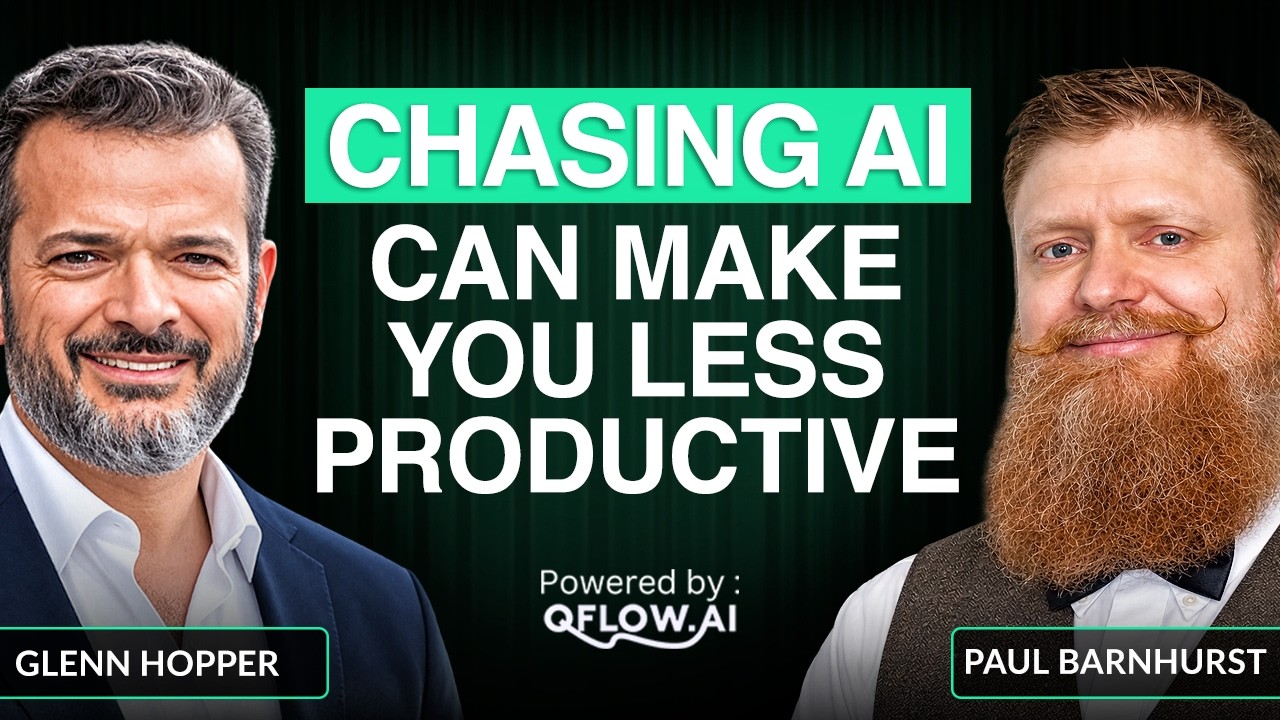
Paul Barnhurst and Glenn discuss why finance pros shouldn't chase every new AI model. Instead, build processes that work with any tool, focus on data and governance, and keep humans in the loop. A survey of 200 finance practitioners found data challenges matter more than cost.
Chapters
Welcome to the Future Finance Show, where we talk about treasury management on Mars.
The whole universe right now, Paul, is too much to keep up with, but it makes you think, where are we heading?
Is this a cliff? What does it all mean? Where does regulation China fit in? And the reality is none of us can clearly answer it.
This is a losing battle just trying to chase what's out there. And I've got a lot more that I researched. I mean, it's pretty interesting to see where we are right now and how much it's accelerating. And I've got a lot of other notes here that we can talk about on the show.
Focus on building good processes that can work with AI and keep an eye on it. It's so easy to create content nowadays.
But maybe not much easier to create quality content.
You need to understand design thinking. How do I design processes? How do I manage workflows? I think autonomous finance is a myth in the sense of, hey, you could just have it fully autonomous. I think there's always human in the loop until we hit AGI.
Understand that this right now is the worst AI we're ever going to have from here forward. So figure it out how to use it, because I hate to say this, and I think our audience, I'm probably preaching to the choir, but if you're Future Finance is brought to you by Qflow.ai, the strategic finance platform solving the toughest part of planning and analysis: B2B revenue.
Align sales, marketing, and finance seamlessly, speed up decision-making, and lock in accountability with Qflow.ai. Welcome to another episode of FP&A Unlocked, Financial Modelers Corner. Oh wait, Future Finance. Glenn, I can't even remember what show I'm recording today. What's wrong with me?
This is part of the reason I had to let go of FP&A today. The whole universe right now, Paul, is too much to keep up with. I have whiplash.
And it is so easy, whether it's good or not, it's It's so easy to create content nowadays.
Yes, content. But should we put a qualifier on that? It's easy to create content, but maybe not much easier to create quality content.
I would agree. I mean, I think it's a little easier in that AI can help you with images. It can help you with video. You know, if you're the one that's gonna put in the time, it can make you a lot more efficient. But unfortunately, there's definitely a qualifier. Most of the content's being released now is not the standard it needs to be. LinkedIn, all our finance people who's scrolling LinkedIn and you're like, why is everybody thinking an AI-generated comment is helpful or post or et cetera? All right. Well, again, welcome to Future Finance. As y'all know, we are sponsored by Qflow. If you haven't checked them out, check them out. Great platform. We're going to talk about today the fact that the race for AGI, AI has just increased incredibly. So we have a few things, going to share a little bit of a tech stack survey, and then kind of talk at the end what you do about it. But where I want to start, Glenn, is you haven't seen yet, a video was released this week that I think sums up this whole race for AGI in a humorous way really well, but it covers, has so much depth in this 30-second video. So we're going to watch it. So if you're, you know, listening to this, I encourage you to go to YouTube, watch this part. If not, you can still hear the video. And then I want your take since you haven't seen it. So it's titled The Race for AGI. You ready?
I'm going to bring it. Yep.
We're going to bring it.
All right.
I'm going to hit play here. Here we go.
You traitor!
Cautious! It's different!
Oops, wrong trend.
Run, damn it, run! Eat my lawsuits, nonprofit boy! GPUs for all your starving We can do tremendous things together. We need to slow down. All right. First time you've seen it. Thoughts there, Glenn?
Yeah, pretty funny and pretty amazing. Every time I watch AI-generated video, I think about, you remember from years ago, the Will Smith eating spaghetti video, just how—
Yes, like 3 years ago.
It wasn't even like uncanny valley. It was just nightmare fuel. And thinking about how far AI video has come, it's amazing. So, but that aside, people ask me all the time. About the AI doomers or the sort of Ray Kurzweil camp of the post-AGI and, you know, super AI. I don't know where this is going. I do think, and just don't get, don't take this as I'm talking out of both sides of my mouth here. That's why it's taken me so long and I'm stumbling, but here's what I'll say.
Glenn is speechless from the video, people. This is a first. Enjoy it.
Here's what I'll say. There is something about how much money all these frontier lab companies have raised, and they have to get a return for their investors. Uh, we saw that OpenAI has delayed their IPO. I think Anthropic is still moving forward for, for this year. I think that talking about the dangers of AI because it's so smart and can do so much is probably ultimately good for them from an investor standpoint, unless they go too far and government steps in and puts blocks in that keep them from advancing. I'm not saying that's right or wrong. I'm not going to opine on, on that. I certainly don't think the current administration is going to do that. But I think that a lot of the fearmongering comes from trying to hype how good their AI is. At the same time, we do need some kind of guardrails. It doesn't have to be superintelligence. That it could get into the hands of a bad actor and do something really bad. Like, I mean, there's hackers out there, the white hats and black hats for years have been an issue. And now everybody has nuclear weapons to, uh, for their hacking. So we do need to have some guardrails and some safety and all that. The whole idea of AI running amok and taking over, I don't, that to me, and Andrew Ng wrote about this this week or last week, but the whole idea that AI is escaping and doing things on its own. To me, that's not a knock against AI. It is, hey, Anthropic and OpenAI, how about you build better sandboxes that they can't break out of? To me, that's where the failure is, not in the technology itself. But no, 100%. I mean, we're racing towards this cliff. We don't know what's on the other side. We know if we pause that we're the potential, the existential threat, the geopolitical, whatever you want to call it, of Well, what if China gets there first? And it's, I get all that too. And also, Paul, we're old. We've been through a lot of technology changes in our life. None has been like this. And I, we don't really know what the other side looks like. So yeah, I get, I don't, I don't know. I don't know if I answered your question at all, but a lot of mixed feelings on that video, but I think it perfectly encapsulates where we are.
Yeah, I think everybody's some mixed feelings and, you know, ton of humor. I love the llama. Yeah, he's sitting there, oh, wrong trend, and jumps on it. And, you know, the lawsuits and great laugh, but it makes you think, where are we heading? You know, is this a cliff? What does it all mean? Where does regulation, China fit in? And the reality is none of us can clearly answer it. I think we all agree there needs to be guardrails. The AI needs to do a better job of their sandboxes. And, you know, where that line is, how we cross it, What happens with AGI? None of us can answer that. And so, but I think it just, it encapsulated so many things that are going on in kind of one short 30-second clip that I thought it'd be fun to start with a little bit for a laugh and a little bit just to remind everybody that, you know, Glenn and I are here learning with all of you. And today what we really want to go through is Glenn wants to share something that he shared with me earlier. That just shows that we've, we're accelerating at such a pace. And I think I'm going to say this right, that it's impossible to keep up. Fair assessment, Glenn. So let's bring your screen up and we're going to kind of walk through this and I'll let you take it where you want. But I think this is a really interesting thing. This is an artifact you created, it looks like, with Claude. And so go ahead and check out on YouTube again. Glenn's been fancy with his Claude building. Matt, and he's just a little judgy.
Firing the AI slop cannon with my show notes.
Just slop cannon with Glenn, brought to you by— no, I'm just kidding.
I guess so. Here's the thing. I'm, I've met a lot of AI experts since, you know, say December of 2022, and these AI experts are really, really good at keeping up with the news and the latest models. And you don't have to know anything about what's going on underneath them. You can just know all the models exist and what they do. And you can have your max subscriptions for ChatGPT, for Claude, for Grok, pay $200 a month to each of them. And, you know, talk about how you're automating your, your whole life. And I'm not discounting that, but it, the problem with that is when you, if you're just spending all your time keeping up with whatever model is winning the latest benchmarks and doing the best, then are you really being productive or are you just chasing, you know, the latest and greatest fad that's out there? Yeah. Um, but, and that it's been hard from the beginning. If you think about the pace of how AI models have rolled out compared, so it seemed fast then, but let's look at some, some numbers on here. So I just, I was thinking about November of '22. ChatGPT 3.5 comes out. Yeah. What was it?
Didn't they add like 2 million users within 48 hours? Like the fastest growth ever, quicker than like Instagram when it launched. Wasn't that the kind of watershed moment?
Yeah. And you know what is funny here though? I think about the adoption rate and sort of the hype cycle and the adoption, you know, from my and your viewpoint, from a consumer side is one thing, but from a business side is another. And I don't have good stats on the business side, but certainly that's accelerating. But just from the technology itself, it took from November of '22 until March of 2023, 104 days to go from 3.5 to GPT-4. And GPT-4 was a significant step upgrade from 3.5.
I remember.
Yep. And then—
People were told to put rocks in their pizza and all kinds of crazy stuff. Or that was more Bard, if you remember that disaster.
Yep. Yep. And I'm going to, we'll talk about Google in a minute in this too. But, and then we go from March of '23, by April of this year, we had ChatGPT 5.5. But we went from 5.5 to 5.6 in only 76 days, and then 5.6 to 6 in 56 days. And then they rolled out Astra and then Sol and Luna, the version 6 of it, within 19 days of each other. Granted, same model, just the smaller versions of it. But 2023, it was every few months you saw a new model and it was hard to keep up then. 2024 and '25, we were adding incredible capabilities, reasoning, computer use, coding agents. And now, like this week, I was doing a live presentation with a big enterprise-level company, and I'd done some, we were going through some of their workflows, and I was talking about the difference between chat and work in Anthropic. Well, that morning—
Cowork.
They merged the two. Yeah, sorry.
Yeah, you said work, cowork. Okay. Just to be clear.
Yeah. Well, when, you know, when you go in the app and you're choosing between, do I want it to just use the chat interface or the, uh, whatever Anthropic calls it?
Yeah. Or work for me, the cowork interface. Yeah.
Yep. Yep. Then the next day they dropped the new 5.5 in the middle of it. And it's, it's so, but prior to it, and this is, I was big on ChatGPT out of the gates and stuck with them really until for most of my work, really until around January of this year. And I thought, I can't believe it. I'm actually going to switch to Anthropic. I feel like the whole professional work world switched to Anthropic.
Yeah. When 4.5 came out, it started the switch.
And that was the case really until August, September, really until Astra 6 came out or ChatGPT-6 Astra or whatever. It's hard to even keep up with the names anymore, but then it was like, oh, Wait a minute, because I probably said on this show, I was telling everybody, I think Anthropic is going to be the business platform and ChatGPT is going to be what's left for the consumers. And boy, have they proven me wrong. I'm blowing through so many ChatGPT tokens right now. It's doing incredible work. I'm on the max plan with that.
So are you finding out, you think Astra is better than Claude right now?
Yeah, right now it is. Yeah, honestly, I'm still using, I have so many coding projects and Claude and I've heard, I mean, I just, and you can now, you can integrate them, like transitioning between them is not nearly as painful as it used to be. So right now I've got ChatGPT and Claude talking to the same folders and I've got this whole elaborate workflow as all of us AI geeks do, but I'm using them back and forth. But in my anecdotal, I don't have an official benchmark, but right now ChatGPT is winning. And I haven't said that since the end of last year. But it's, the problem is like chasing all this, like, I don't, switching back and forth and what conversation did I have where, and it's like, I'm trying to use it to be as productive as possible, but I'm now, people are lighting me up about Muse. I haven't had 2 seconds to look at Muse. I'm getting, like, I should read tech. These are from just friends who know I'm the AI guy. So they're asking me these questions and they're dropping all these crazy, I'm like, I don't even know what you're talking about. And I spent, I spent all day, every day doing this, but I, I guess the point to me that's coming out right now. Well, so let's just look at just this month. So beginning of the month, okay, we've got Fable 5.1 and Mythos 5.1 from Anthropic and Google's kind of doing their things. They've got their 3-point, they've been really focused on their Flash models. And then this Meta comes, the Muse product comes out, which I still haven't used. And then, oh, September 3rd, now we have Astra. By 8th, Muse is going along more. Then we've got DeepSeek with their latest drop, Groq 4.7. I don't know anybody really that's using Groq for anything.
It's, uh, I will add something on Groq. Microsoft is adding it to all, to its models. So in the Excel agent, I think it's beta right now. There, there are some rollouts where you can select Groq. They're adding 4.6 and 4.7 in addition to having the GPT and the Claude's. And now in some situations, Microsoft really hasn't announced this much, but underneath Copilot, they're sending it straight to their own AI. They're not sending it to Claude or Gronk or Copilot. They're using Microsoft AI. So in this announcement time, you know, in the last little while, they've kind of quietly released their own AI in all this. And I'm sure it's a cost savings thing to tune their models for certain cases so they don't have to.
Yep.
pay someone else that can just use their server bandwidth they already have, right? But I thought that was interesting. So keep going. But I mean, just the Gronk one reminded me of that, which just shows as you're stacking all this in there, there's even other things like I'm not seeing on here. Oh, you do have yesterday. Yeah. Opus 5.5, right? Right.
And then an hour and a half later, OpenAI drops their Sol and Luna update to get them to GPT-6. And truthfully, Maybe that's going to help me on some of the tokens. I'm, I'm, it's helping me a lot right now using ChatGPT. But so 5.5, I haven't had a chance to test this for Opus. You know, Opus, one of my biggest problems with Claude was the copy that it was writing. When it talked to me, it was fine. But if I was trying to put together a presentation or a client deliverable and have it help me do that, I don't know. It knows I'm a consultant. So I guess it was trying to do McKinsey speak. But it was, it talked like a crazy person, like, like, like who says these words? What? I don't say that. Why are you saying that? And then, so I was in ChatGPT-6 was, was better at writing. You know, it's, I'm not going to, it's frustrating to think you're going to get AI to help you with something and it ends up taking you longer because then you have to rewrite content. It's like, anyway, but, uh, oh, and then, so that just happened yesterday. So 5.5 drops and then the SOL and Luna models drop within an hour and a half of each other. And then today, because everybody's wondering what is going on with Google, they do announce that their latest flagship model is in post-training right now, and it's going to come out here in the next couple of months. The head of DeepMind said it's going to ship much earlier than year-end. So I think it's going to be interesting to see what Gemini's doing. But I guess my whole thing here is I have to follow it because I'm training on it and I'm using it. in actual client implementations, but this is, this is a losing battle just trying to chase what's out there. And I've got a lot more that I researched. I mean, it's pretty interesting to see where we are right now and how much it's accelerating. And I've got a lot of other notes here that we can talk about on the show, but maybe let's pause there. Tell me what you're thinking. Like, how do you use it in your workflow? What are your clients?
Yeah, the rate of acceleration at this point, I think I go back to Secret CFO. I think many of our audience follows them. I know you're very familiar with them. He, when Fable came out a couple months ago, he dropped a note. Fable 5.0 came out, everything you need to know. And he had an arrow and then down at the very bottom of the post, it was nothing. Get back to work. You know, it was banned a couple of days later by the government and humor got a ton of comments. But the reality is don't, don't chase the shiny toy, build good processes. Some of the best software, and I think the softwares that's going to win are the ones that are agnostic and can allow you to switch between tools and they make decisions on the backend. Because as a human, you're not going to be able to keep up. And if your goal is to always fine-tune and get that 1 extra percent or save that tiny bit of tokens or whatever, it's not worth the effort. It's like the person that has 20 credit cards in their wallet. And tries to keep track of which one to use everywhere to maximize their points.
Yeah, that is a great analogy.
You know, less than 1% of all people can do that, and the time they spend is probably not worth the savings, even though they're like, I'm the cool guy who got a billion points. You know, it's, it's more of a challenge. So just stop trying to do the challenge. Stop trying to keep up. Don't be the points guy. That, that's my take. You know, at the end of the day, I think we all agree these are going to, in many ways, these models are going to become kind of a commodity in the end. They're going to be very similar. It's what we can build around them. It's what we can do with them. There'll be more and more open source. So focus on building good processes that can work with AI and keep an eye on it. You do need to stay current. You can't stick your head in the sand, but don't try to keep up with every change. Just work on building good processes, check every few months. And pick your horse.
Yeah, that really, really great point. And let me bring my screen back up again because this is where I'm having a, it's a bit of a conundrum to know what to train people on. And to me, it's not about, like, if you're training on how to use a model, yeah, I get it. It's like, you, you know, if you've never seen Excel before, you need some training to understand, to get started moving in there. And most of it though, You're going to learn from, once you learn a little bit how to use Excel, you're going to see some other formulas people did. You're going to figure out how to do it for themselves. You're like, what's a slicer? Oh, that's cool. Let me figure out how to make that. Or, you know, whatever the latest, the tech is. But so if I'm training how to use a tool and the interface is changing that often, I think, well, have they, have they wasted their money on, I'm arguing against myself, my own business, but this is, have they wasted their money on training? And I would say no, because you need to get the basics and then you can come in and once you have the basics and you're using it, you start to figure out on your own. So you've got to enter somewhere. So if you haven't been using the tools, you need some basic, you know, this is how to, but what I'm more interested in, the durable skill, what's going to last out of all this is how do I change the way that I work? Is How do I change the way that I work with AI? So to think about that, I just think when ChatGPT 3.5 came out, it was, you upload a spreadsheet or whatever. Well, 3.5 couldn't really do spreadsheets. So you know what I mean? When the models first came out before we got into reasoning and copilots and all that, it was, let me ask you a question. You help me do some analysis and it's just a chatbot back and forth. And that's great. We found a lot of great uses for that. Well, then we started getting copilots. We started getting AI, whether it was companies that came up or built into from the SaaS tools that we use. It was, hey, now we've got AI inside Excel and our email and our ERP. We've got faster keystrokes, faster ways to build models, to find errors in models and all that. So we started seeing usefulness in that. Then we get projects and skills that it's like, oh wow, we're getting, if I have a project and I can have shared context and I share this project, I don't have to come and re-explain everything every time I come in here. And then skills, oh wow, if I do this task once, I can turn it into a skill and do it every time. And then you get scheduled tasks and you think, well, I had the project, I had the skill. Now instead of me having to do this, I can schedule it to run every Monday morning at 8 o'clock. I'm getting, and then, oh, if AI can't handle something, I can vibe code a little app to do it. And now these, that for those watching on YouTube, the agentic harnesses and really full automation by building in code and AI. I feel like this may sound like hubris and maybe somebody can prove me wrong. I have a hard time finding any sort of digital task I can't fully automate. Well, me and my team. I mean, I'm not the, uh, but that I, we could build in a couple of days, whatever your task is from 3-way matching to variance analysis to You know, bank reconciliations, anything that you have a repeatable process in. But so what does that mean for our jobs? What are we going to be thinking about? And the way I look at it is we need to become managers. So everybody had management training for managing humans, but I think that the durable skill that comes out of this is understanding how the AI works. And then yes, all of our finance and accounting skills, those are table stakes. And then from there, We need to learn like process thinking and what, where to apply generative AI, where to apply basic coding, how to architect these, how to put the governance and the guardrails in. And that's like, that's what's going to last out of this. But I don't know what that, what does it mean as these AIs keep getting— and I'm not going to be a doomer because I think every technology that's come before has led to more jobs, not less. But at the same time, these jobs are going to change a lot. This is like, Uh, robotics coming to manufacturing, you know?
Yeah, I, I mean, I, I think I'm gonna be, uh, pump the brakes. Change takes way longer than when the technology's ready. Always has.
The human part. Always will.
If you can bring that back up for one second.
Oh, yep, yep.
I'll add that back to the stage here. Ever feel like your go-to-market teams and finance speak different languages? This misalignment is a breeding ground for failure. Impairing the predictive power of forecasts and delaying decisions that drive efficient growth. It's not for lack of trying, but getting all the data in one place doesn't mean you've gotten everyone on the same page. Meet Qflow.ai, the strategic finance platform purpose-built to solve the toughest part of planning and analysis: B2B revenue. QFO quickly integrates key data from your go-to-market stack and accounting platform, then handles all the data prep and normalization under the hood. It automatically assembles your go-to-market stacks, makes segmented scenario planning a breeze, and closes the planning loop. Create airtight alignment, improve decision latency, And ensure accountability across the team. So, you know, right, you got chat, Copilot, project skills, you have scheduled tasks, via coding, agentic harness, full automation. Great. If you have full automation, I think autonomous finance is a myth in the sense of, hey, you could just have it fully autonomous. I think there's always human in the loop until we hit AGI and we'll deal with that when we're there and what that means. But at the moment, But I think for the training, I think for most people where the focus needs to be is understanding skills and not the technical size of skills. Skills are how to write instructions, learning how to write instructions, when to turn it over to AI, how to do the scripts. It's really about learning orchestration and orchestration is skills and tasks. And honestly, if you learn skills, tasks, you learn the scripts. Agentic harness is just kind of wrapping it all together to me. It's not like it's some whole new thing you have to learn. So that's why I think, I believe the most important skill going forward, and it should have always been for FP&A people, and not all finance people, but some finance, is you have to understand data. Because you got to have the schema, you got to have the context, you have to have a solid data foundation. And all we have to do is look at any Excel model to see many people think in the financial and the accounting ledger and not in a data way. How many people use tables? How many people normalize data? There needs to be better understanding of data. And then you need to understand design thinking. How do I design processes? How do I manage workflows? Whether it's an, you know, a markdown file, whether it's a slightly different thing. And I think from there, the rest will kind of naturally build out if you focus on those things. So that, that's kind of my thought on this whole thing and what people need training on. Like when we train somebody, we showed them how to do projects. We showed them skills. We showed them how to build instructions in Excel. We didn't, you know, we gave a couple different examples, but really focused on if they can learn these basic things over time, it will take off. So that's kind of what I focus on. I'm not going to say that's right, but that's how I think about it. And frankly, that's where I'm at. I'm not using any agents. Yes. Have I scheduled tasks? Yes. Do I get emails every day in my inbox? Yes. Do I use chatbots? ChatGPT, Claude, Copilot, whatever, on a daily basis? Yes, I do. Am I behind? I think so. But compared to most people, I'm not. Like, if I look at what you're doing, I know I should do a lot more and I need more time and there's things I could automate. And so I think if you learn how to do those fundamentals, you'll be okay. And to me, those fundamentals is understanding really the skills, the instructions, the workflow, the orchestration, because that will guide you toward an engineer. Yes, eventually you need to figure out some basic vibe coding. But that's really, again, if you know how to give good instruction, you understand skills, you understand workflow, you can do vibe coding with natural language. You need someone to validate your code if you haven't learned some coding or you need to learn some basics, but I don't think that's a whole new level. Am I off base?
No, no. I mean, that's, yeah. And no, you're, you're spot on. My only thing now that I'm seeing with vibe coding is amazing power, but with that amazing power comes amazing responsibility in that. If you are building an app or coding anything and you're putting it in your GitHub repo or direct on Vercel or whatever you're doing, wherever you're posting, and you don't know about the basics of cybersecurity and things about OAuth and role-based access and, you know, don't put your API key in a public repository, you know, just the basics of that, the cyber risk here, the, the Data security risk here becomes huge. So it's, we, we've heard all the problems that people have had with, you know, just sending out AI generated stuff, whether it's in legal where it's just making, or you haven't heard about this in a couple of years, but where it was making up cases to cite and those were being brought into court, or if it's consultants using it and not reviewing and just giving AI slop to their clients. That was one issue that hallucinations, I'm not saying it solved, But people hopefully are a little bit more careful now. And citations have helped this, but the next, to me, the next big danger is going to be around once people figure out how easy it is to vibe code something, how much trouble they're going to get into because they don't know the basics of cybersecurity because it's never been part of what we've been asked to do. These apps will build everything and you can tell it to make it secure. But if you don't know what you're looking for, I don't know. I think the, maybe the, the Whether it's Cursor or OpenAI or Anthropic or any of the others out there, maybe they are building in the harness that it's going to have better guardrails automatically. But it's, there is a big concern to me when people really start, because people haven't realized how easy and how much they can do with vibe coding yet. So there's, there's going to be some exposure there unless the, the companies kind of figure out if we want people to be doing more of this, we need to put the guardrails in place.
I think we're starting to see The software vendors are putting the guardrails in place within their AI. So, you know, remember we released Maria Nakic and she said, hey, the goal is to have people be able to build their own platform. They're releasing language within. If you do it within a platform, it can add kind of that security and a lot of those guardrails and allow you to build so you can kind of have your own apps. I think K4 has done something similar. I know other tools that could do that in the finance space. And so I think early we often see the software vendors and then AI releases their own kind of version of it. And many of the vendors like, oh, what do we do now? And so I do think AI will eventually get there, but you're right. I mean, we're gonna, and I'm sure we've already had some, we're gonna have some major security issues with vibe coding. I also think vibe coding regards how easy it is. For most companies, you don't want your average employees vibe coding. You're just creating basically macros everywhere that nobody understands, and you're going to have a nightmare. The guardrails and governance that's needed to really have vibe coding used at any large scale at a company, I think is much bigger than any of us realize from a maintenance and a long-term and It's one thing if you're doing it on your own desk and you're running the process and it doesn't go out anywhere. Yeah, let people vibe code. That's much like the Excel guy, but when the next person inherits it, odds are they're going to start over because they don't like the way you designed it. And so—
Good thing I was patient, right? Yeah.
So I'm mixed on this one. I see vibe coding. It's not going away. I think anyone who's trying to vibe code major tools, is a mistake. Just don't do it. It's not worth it with very few exceptions. Workflows, simple tasks, some manual things. Yes, you can get some great benefit, but it's like you said, with much power comes much responsibility. What else do we have on this page? I know we're already in about 30 minutes and I have one thing I want to cover. So what else do we want to kind of run through here?
Yeah, I mean, for me, really that tool level training. It's just, it's, it becomes irrelevant so quickly. But if people take the training and they get in there, you know, then that, that's a good starting point for them, but then they're going to have to keep up with it and know what's changed. Again, I think we've covered that one already is how work gets delegated and what we're doing.
I love your governing point. Who owns each automated process? That gets back to what I'm talking about in vibe coding. Government governance is going to be the issue, not that you can do it. Well, and security.
Yeah. And governance. I mean, that's one of the most popular topics that I cover, whether it's in a keynote or a training or with, with my clients. And that's one thing with agent harnesses is you can build in much deeper and we could do another episode where we dive into harnesses in particular.
I think we do cover that on a future episode for sure.
Yeah. Because it's, you can, if you can, if you can build the harness, then the tracking becomes just built in part of what you're doing. So I don't, you know, it's not like we're going to go save every prompt and response that we get from a chat as part of the audit trail. That's just not practical and individuals aren't going to do that. But if you haven't harnessed the audit trail and you can see, and you have the guardrails and you tell the AI what it can and can't do, and you have the human in the loop and you show with timestamp, this human signed off on this at this point, this is how everything was calculated. Oh, by the way, we can run this again. So it's not just like asking a chatbot. the same question and getting a different answer. This is like all the things, it's kind of like when we were good at Excel, that's how we could stand out in the field. Well, and then after Excel, for me, it became Make and Zapier and N8N and all these workflow automation tools. It's another thing that people had to learn. But now with AI and with what these tools can do, those are all, I know there's still plenty of people using those, but really, I mean, what we're doing with the off-the-shelf features from OpenAI and Anthropic and Microsoft as well, but is building our own agents and doing this. So it's, yeah, like you said, we need to know what the ultimate outcome we're looking for, but the whole foundation of tools is shifting.
Yeah, agree. And anything else you want to share on here? Let's briefly touch on, you had a cost, how that's changed. Let's take 2 minutes there and then I want to share something or Maybe we'll wrap. We'll just see how time goes and I can share mine another day.
Yeah. The biggest thing on cost to me is if you look at on the left here on the screen, the cost per token. So per 1 million output tokens, when GPT-4 came out in 2023, it was $60 per million. Now, if you go down to the cheapest ChatGPT model 6 Luna that was just released, 50 cents per million tokens. Now the difference is you're like, well, wait a minute, everybody's blowing through their budget. The difference is we're burning through so many more tokens. So if you wanted to, you mentioned turning a light off before the broadcast started today, that light compared to what's happening, the data, the energy consumption out of these data centers is nothing at this point. But it's—
My whole house's power is nothing. I think as I told you, the data center they're building in Utah would power the entire state of Utah roughly twice. And that's one data center just for military application.
Yeah. And I'm in Memphis where, you know, Elon Musk's, the big xAI data center is, and it's, there's a lot of pushback locally on that.
Yeah, there's a lot everywhere. It's a, we won't get into the politics of it. We could spend hours on that and piss everybody off, probably depending on how we decide to view it. But, but it's fascinating to say the least.
Yeah. Yeah. I still, my, my son told me this joke a year or so ago. He's, he's not the, it wasn't his joke, but it, I'm crediting him as the one who told me, but I just, I think it's kind of perfectly encapsulates where we are with AI. It's, yeah, everybody's really worried about AI taking their job. And I didn't really take it very seriously, but recently a friend of mine just lost his job to AI and his job was to lie to people and drink 40 gallons of water an hour.
Lie to people.
Nice. Someone told me, someone said this on a panel I was on or somewhere not long ago. They said, um, that, uh, AI was as cheap as it's ever going to be. And I thought, that is not a rule of economics. And you were completely mistaken because this is, you mentioned at the top of the show, it's becoming commoditized. I understand it's exorbitantly expensive to every query that we run and, you know, every model training run and all that. But the, for this to be sustainable, it has to get cheaper. And then whether it's the competitive forces or the technology itself, it's that it's improving. It is going to keep getting cheaper, but we're going to be using more and more of it.
I think there's 2 competing things going on here. There's the law, you know, Moore's Law, right? If we look at computers, how much did it used to cost for 512K? And now, you know, you get a terabyte for what that used to cost. That's going to apply here, but I think there's the flip side of people are going to use more and more.
So the cost— I just ordered a 2 terabyte drive for like under $200. Yeah.
Yeah.
Which I think about—
oh, you're solid state. Yeah. You're going to be, if you're, if you're doing the old, I mean, you're a flash. If you're doing solid state, it'd be like nothing. The old brick instead of, you know, the newer technology. But what I was going to say is I think you have 2 competing things. You have the fact that yes, the cost gets cheaper and cheaper. You have the use going up. What consumers pay now, they may be getting a lot more value, has to increase for these companies to be profitable. So our $100 subscription, you could easily argue is probably worth $500 or your $200. How much value do you get out of your $200 a month subscription to Claude or ChatGPT? Would you argue if you had to pay for the value, would you pay more than $200?
Yeah.
Would you pay $500?
Not across the board. I would, I'd be more selective to pick one, but I had an admin last year. I have an AI admin this year and arguably, uh, better than my actual admin that I had last year. Now it does, It doesn't run autonomously, but the end result with a little bit of nudging from me is, so, uh, you know, I'm just on that alone, but I think about, I'm running some really big client churn analysis type projects.
You're someone who uses it heavily and there's a lot like you. You're saying you're willing to pay 2.5 times. There are a lot of others. I'm going to guess if they told you it was $800, you would make it work as a subscription. You wouldn't cancel it.
Probably. Yeah. Yeah.
Right. Even though you wouldn't like it, I'm gonna guess even at 1,000, you probably wouldn't, you'd be more selective. You might cancel some others, but you would still use one model because you're getting enough value. I don't know.
I don't know. Yeah. It would be very interesting to see where I would draw that line.
Right. 'Cause I know you enough and know all things that automate that I, I'm say, I'm guessing it has to be saving you at least 20 hours a month compared to the old way.
Of probably, at least, probably significantly more than that. Yeah.
Yeah. Probably what, what would you guess? 60?
I would guess, I would guess 40 to 60.
Okay. So let's just split the difference. Let's say it's 50. Let's say an hour is worth, we'll use simple math. You know, the average someone in finance, we'll just use $100. You could use $50, but let's say $100.
Okay.
If it's saving you 50 hours, 50 times $100 is $5,000. Right? So anything less than that in theory is saving you. So if we get to the point where the average person is getting, let's say you're the extreme, the average person getting is 10 times and it's worth $100 an hour. Some it's going to be worth more, some it's going to be a lot less. That's $1,000. These AI to really make a profit have to increase the cost, but as the cost of economics goes down, We're getting more and more value. So you might be getting 5 times what you're getting for that $200 account because the token cost has come down so much, but you're paying more because when they go public, they're going to have to show profit. So that's how I think about, I kind of mix the two together. I don't know if that makes sense, if I'm off base, but I think there are two competing things taking place. So we as consumers are going to pay more, but the cost is going to come down. In the sense of what it's costing to run it. But given that's been heavily subsidized, they have to offset that in charging us more.
Yep. Yep.
Well, I think we'll cover mine another day. I'll just say we did a survey of about 200 people and I'll share one little bit. I won't go into it deep. We'll cover it on another episode because I want to get your thoughts. But basically what we found is those who are using Agentic AI were much happier with their FP&A tools, their close consolidation, et cetera. The number one thing people said that was a pain we did the survey, 2 people said cost out of 120 people that provided a response. Guess how many said data?
Most.
60.
Okay.
Mentioned data. Only 2 mentioned cost. So that's something interesting to vendors. So I want to dig into that a little bit next time, but that's a primer. The other thing we found, if you're a big company, you're probably using Copilot. If you're a small company, you're using Claude because you're not locked in. Finance overwhelmingly is saying, hey, Claude's the tool to use right now. Now, some of the things you mentioned, maybe that will shift again, but time will tell. So I think wrap up, what's the takeaway for our listeners from our, our ramble today, Glenn?
Yeah, the, the, the key takeaway to me is we're all gonna stroke out if we keep trying to keep up.
I've never heard it said that way.
Maybe it's a, that might be a Southern colloquial phrase. If we try to keep up with the latest that's out there, I think pick a tool that you use that works for you. Learn how to maximize that, whether it's Copilot or Claude or ChatGPT or whatever. Get really good at using that. Understand that this right now is the worst AI we're ever going to have from here forward. So figure it out how to use it because I hate to say this, and I think our audience, I'm probably preaching to the choir, but if you're late to the game on AI, it's, you're not too late. I mean, the tools are so good now. You can, you can figure it out pretty quick, especially once you kind of learn, oh, this is helping save me time. It seems like a fool's errand to me to keep trying to chase whatever the latest greatest model is. Just learn how to use the technology, learn how to change your thinking based on the existence of this technology. And figure out what it is that you really add that provides value and lean into that and figure out, okay, this is me, who I am in my role. Now I have a new tool to do my role. How can I get better at that role rather than how do I get better at using whatever the latest AI tool is?
I think you nailed it. And I think you gave me a couple ideas for future episodes. I think one episode would be really interesting to talk about how we need to change the way we lead, the way we manage, talking about the human side of all this. And then the second thing is, like you said, people learn how to orchestrate workflows, learn how to break apart, you know, your workflows, your processes, to write documentation that a system can use to be able to understand context. That's going to apply to different levels in different ways with all of the AI tools. So You know, pick the tool you're going to learn with. Yes. Are some better than others, but it's changing so quickly and they all just, they're, they're all good. You can get benefit from all of them. I don't care if it's Copilot. I don't care if it's Gronk. I don't care if it's Meta. I don't care which one it is. If you can't get benefit from them, that's a you problem, not an AI problem.
Yeah. Well said.
I'm going to close with that. It's a you problem, people. No, I'm just kidding.
Do better.
You know, it's like the old Uncle Sam. We want you for the— oh man, that's definitely a sign it might be time to wrap up. Well, enjoyed this episode. We'll be back with more. We'll show a little bit on the survey. We have some other exciting things coming. But if you have questions, reach out to us. Let us know what you'd like us to cover. We'd love to hear from you. We haven't heard from you. What topics would be most helpful? Send us a list and we'll cover them. Thank you everybody. And until next time, we're signing off. Thanks for listening to the Future Finance Show, and thanks to our sponsor, Qflow.ai. If you enjoyed this episode, please leave a rating and review on your podcast platform of choice, and may your robot overlords be with you.
More from Paul











AI, Excel and the Changing Role of Financial Modelers with Danielle Stein Fairhurst