Tax Reporting Challenges for the 2023 Tax Season | with Padgett Business Services
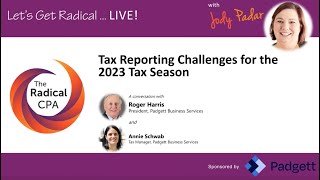
Jody Padar, Roger Harris, and Annie Schwab discuss four major tax reporting headaches for 2023: the 1099-K threshold staying at $20,000 for now instead of dropping to $600, K2/K3 forms for foreign income, crypto treated as property so wash-sale rules don't apply, and ERC credits received in 2022 that require amended returns for earlier years.
Questions this video answers
September 19, 2023
1,200+ hours
$20,000 and 200 transactions
$600
On page one of the tax return (a yes/no checkbox asking about transactions using digital assets)
Chapters
You.
Hey, hey, it's Jodi Paidar here, the radical cpa. And you are listening to let's Get Radical live on LinkedIn. And I'm really excited today because we're going to be talking tax and we're going to be talking technical tax, actually getting ready for this coming tax season because I know everybody's so excited about it and they just can't wait for it to start. And if you haven't already started, I know many of you have priorities started with your 1099 W2s, et cetera. But really excited because we're going to be talking about the tax reporting challenges of the 2023 tax season. So what does that mean? Well, it means with the start of another tax season right around the corner, now is the perfect time to talk about the challenges that we're going to face this year. Let's face it, we know there's always challenges during tax season. So I'm going to be talking with Roger Harris and Annie Schwab, both of Padgett Business Services, about some of the things that tax preparers need to be prepared to be ready to face this year because, you know, tax season is never uneventful. So really, really excited because we're going to be talking technical tax for the next few minutes and really about what tax season is going to bring for us. And the pretty cool thing that you guys might not know is Padgett provided its owners with 1200 plus hours of tax support. So how cool is that for you small tax firm owners who don't have a support system to realize that pageant offers such awesome and incredible tax support for their tax practitioners, which to me is one of the cool things about Padgett. So without any further ado, let's get started. Roger would love for you to give a brief introduction of yourself and who you are and what you do at Padgett.
Jody, thank you. And you get more excited about taxes than anybody I've ever met. So this is the most exciting tax discussion I've ever had. I am Roger Harris. I'm president of Padgett. As you can probably tell by looking at me, I've been with Padgett for a long time, probably almost 50 years, and look forward to talking with you today. It's an honor to be here. So thanks for having us.
Awesome. Thank you. Roger and Annie, can you go ahead and introduce yourself?
Sure I can. I've been in practice for about 25 years. I am a CPA with a master's of Accounting. I started working with Ernst and Young and Arthur Anderson before coming to Padgett. And I've been with Padgett for 12 years in the role as their tax manager and head of franchise operations. So I spend a lot of time, as you mentioned on webinars and tax chats, making sure all of our Padgett franchise owners get the latest news or get help with any tax related client issues that they may have. So we'll get started with this year's tax season challenges.
Awesome. So let's dig in. So, Roger, we know that supporting our tax reporting has challenges every year, right? Like it doesn't matter what year it is, especially you've been through many tax seasons. What do you think will be back this year? And, and is there anything new that we should really be thinking about as we go into tax season and kind of to kind of prepare ourselves for those reporting challenges?
You know, this tax season, I guess, is maybe the first post Covid tax season. And so we probably have fewer things to worry about than we have over the past few years. One of the things that I will caution the listeners and their clients is because the COVID part is over for the most part. I'm not talking about from a health standpoint, but from a tax standpoint. A lot of the credits that were given out have gone away. And people who were used to getting big refunds during the COVID years, I hope they haven't planned on spending that money yet because things like the dependent care, the child advance credit, all those things have gone back to where they were pre Covid. And so a lot of those big refunds will go away. Secondly, you know, we're in a time where Congress is hard to get bills passed. So where we normally deal with new legislation every year, really not a lot that we have to deal with. There was a secure act attached to a spending bill, but it's really not going to impact the 22 filing season. So this is whatever you call normal. I guess we're kind of, kind of back there.
I'm afraid. You're gonna jig set, right?
Like, yeah, yeah, this doesn't, this doesn't make the IRS back to normal, but it makes the tax laws back to normal. So not a lot of new things. Still some hangover, if you will, from COVID but hopefully this will be. Even though we have so many dates to worry about, we keep thinking, well, we're back to April 15th. Well, we're actually not. We're at the 18th. But that's not because of COVID and hopefully that'll always it'll stay the 18th. So that's a long way of saying not much new.
Right. I mean, I think myself, as many practitioners are just hopeful that it's going to be a regular tax year again. Right. I think that's what everybody's hoping for. It's like three years, maybe that tax season is finally over and we're going to go back to somewhat normal.
Right.
So fingers crossed. Like I said, we don't want to jinx it because you never know.
That's right.
So, Annie, one area that I'm sure that a lot of people are thinking about is the whole 1099k thing, right? Like, first we had to worry about it, now we didn't. What's the Scoop on where 1099k is at as we speak and what does that mean for practitioners as well as the taxpayers?
So 1099k is. It's not something new this year. They've been around for a while. And what that is. So 1099ks are informational returns. They're actually a form that you'll get from a third party payment network. So think PayPal, Venmo, those kinds of things. And so what it does is it reports the amount of transactions throughout the year. That's basically what a 1099K is. And it's, like I said, it's not new. But what was new is there was a lot of chatter and discussion right around year end where the 3 threshold for third party payment merchants to issue these 1099s was going to be reduced and reduced significantly. So historically it's been at $20,000 and 200 transactions before. You would be required to give somebody a 1099k and that threshold was going to go to $600. So quite a decrease. However, that has been delayed. So at least for a year, it's not going to go away. Perhaps that threshold may go find a better medium between six hundred and twenty thousand that we'll just have to wait and see. But the 1099ks are still around the threshold from previous years. That $20,000 threshold is now back in place for this year.
Right.
The talk about reducing it to $600 has been delayed at least for now. So that's kind of where we are now. The tricky thing is. Go ahead.
But I was going to say this is, I think, the perfect time to have that conversation with your taxpayers. Right. Because everybody's got a side gig. They're all taking payments via Venmo and Cash App Even though nobody talks about it. And now's the time to have the conversation to say, hey, look, if you are doing this, be realistic that you are possibly going to get a 1099k next year. And regardless, we know as tax practitioners that that income was reportable whether or not they got the 1099k or not. And so to have those conversations, because I think sometimes we don't always open up those conversations. And maybe this is the good example to kind of, you know, connect with your, your tax, your taxpayer and say, hey, what are you really doing with your online business? Or what have you. Are you taking payments? Cause I bet there are lots of practitioners who don't even realize that, that their clients are taking these payments, right?
And, and I think we're going to see more of this kind of thing. The Venmos, the paypals, the cash apps, the. All of these types of transactions, forms of transactions. I mean, it's only going to increase. It's, it's easy. It's. Individuals are using it, businesses are using it, they're paying, they're using it for all kinds of things. They're paying for services, but they're also paying for, hey, mom, here's 20 bucks. Can you get me a coffee or.
Right.
All day, every day going through these types of accounts. So two points. Yes, two points. Here is, although the threshold is back up to that 20,000, it's not going to be the 600 lots to. These merchants probably knew it was coming, thought it was coming, made changes in their system. So I wouldn't be surprised if some 1099ks came out at that lower level. But like you said, regardless of the 1099k or not, if it's earned income, it needs to be recorded. So that conversation is going to be crucial during this tax.
So, so that goes to this whole thing about social business. And I actually think it's interesting because you think about it like my daughter, she's always asking me for money on Venmo, right? But, um, yeah, she, like, she comes to visit and I have to pay her for her gas. So I, I don't know how somehow I end up paying for her gas to come visit me. But regardless, what's interesting to me is again, the social business and people are actually putting in there that they paid for pies. Like, I know, like, I bought my Thanksgiving pies via Venmo, right? And so I wrote pies on it, right? So when you think about it from an audit perspective and that trail and the People who think that Venmo is not going to catch up or the IRS is not going to catch up with this kind of underground or pseudo underground cash society is really kind of interesting from a whole technology and changing perspective. Roger, what are your thoughts on that? What do you think about the IRS having that trail?
A great point that the law hasn't changed, it's just who's going to know about it has changed. And at $600, a lot of people and a lot of things that were taxable before that no one thought to ask or care about. Now you're going to have to ask and care about because the IRS one, the IRS did one really good thing right after they delayed it for a year was they put out some pretty good frequently asked questions and I think pointed out some things that we all probably did or we know people who did it, we have clients that did it that we never thought about before. And the example, and I'll give you this example, let's say you were one of the few people in the world world lucky enough to get Taylor Swift tickets and you got four of them, but you only needed two. So you went somewhere to list those other two tickets and sold them for thousands of dollars and only paid a hundred dollars for them. Well, that's a taxable event. Now I don't know how many tax preparers ask their clients about their concert and sport ticket transactions. Probably none. Well, next year when that 1099 shows up, you will have to ask them. And one little trick that the IRS pointed out, that again, I don't think many of us thought about is so you sold those two tickets and made $1,000 a piece. You still got your two. But something comes up all of a sudden. Taylor Swift's no longer popular and you can't give the things away. So you sell the other two later on for a dollar and you lost money on those. Well, most of us think, well I've lost money here, I made money here, I'll net the two. That's not the way it works. You got to pay tax on the one you sold at a profit, but you can't deduct losses on the ones you sold at a loss. So you're stuck. So your point about talking about it this year and preparing people for it because look, I live in a college town, tickets are sold all the time on StubHub and you and get paid through those leases or we transfer tickets directly through Venmo. It's going to open up. If I would have had a completely different answer to your first question. If they hadn't delayed this, there was going to be a lot of new things this year, all relating around the 1099k. But we got a year to inform our clients and I'll figure this out.
Yeah. So I think it's actually a good thing and I think it's to start those conversations so that again next year when the law does come back or, you know, gets enforced, that there's not so much shock and surprise.
So.
And I will add another thing. It's going to be really important to clients who get, who've never seen these things. They come in the mail, they open their envelope and they have a 1099k. They don't know what it is. Half of them are going to toss it, not even mention it. So I think for tax practitioners, whether you use organizers or however you gather your information from your clients, having that as a yes, no. Did you receive the 1099k? Or these things are going to be more popular. Don't throw them away. When you open the envelop. Save this, bring this to me, I'll take care of it for you. Those kinds of things, One, it'll have let them have a bit of ease. Oh, all I got to do is take this to my tax preparer and they will do what they need to do with it. And also, you know, you won't be at the last minute being like, well, you. Did you get a 1099 K? I don't know. I don't know. Answering those questions, making it more stressful during tax season.
Yeah, that totally makes sense.
First year they come out, people will be walking in saying, what is this? Yeah, next year people be walking in with a notice saying, what is this? Who threw them away?
Exactly.
Exactly.
Because. Yeah, I didn't say this earlier, but just like all the other 1099 or tax forms, when those merchants prepare those, they send copies to the irs. So the IRS has that form under that Social Security number. That's an easy matching notice. An easy matching notice. So.
And there's possibly going to be errors in them, too. But like, that's for next year's problem, Right? It's next year's.
This year's. Talk about it.
Yeah.
If you do get one in there and it is wrong, the first thing to do is to reach out to the person who issued it and see if you can get it corrected. The IRS did provide some guidance through those FAQs that Roger was talking about. You know, how to put it on the tax return if you can't get the merchant to correct it so that you can basically report it on the return so that the matching notice doesn't come. But you're also saying, hey, this was an error, you know, don't worry about this.
So, wow. So that's a lot going on. So. So last year we had all the drama around the K2s and the K3s. Remember that? Like nobody knew what were we doing. There was a lot of drama around K2s and K3s and it was delayed until this year. So, Roger, are we going to have those same problems this year or what's the scoop for this year?
Yes, I mean, now the realities kind of hit us. We do have to deal with them. They continue to try to find what they call safe harbors to eliminate a lot of activity, but it doesn't work perfectly in their world. The short answer is yes. If there are foreign activities within a pass through entity, those K2s and K3s are supposed to be completed. There is a way, if you have no activity at all, you can not complete the K2 K3, but you have to notify the shareholders or partners or whatever that you're not going to do it. And they have 30 days to say, well, I need one anyhow. But now they've extended the date for me giving them a notification to the due date of the return. So that happens to be the due date of their return. So by the time they get it and ask for their 30 days, it's already past the filing deadline. So we've got some, some difficult things there. At the end of the day, what we have to decide and we have to kind of rely on our tax software to some extent. If we have no activity whatsoever that has to be reported foreign activity, our software may just have a box we can check and let it fill in the K2 and K3 and be done with it. But if we choose not to do that, then does our software give us the proper language to communicate to our partners and shareholders that we're not going to do it and that they have the right to request it? So I don't know what percentage of our clients deal in foreign activities or have foreign reportable things. I got a sense most of ours don't have a lot of it, so kind of fall back on what my software allows me to do. The easiest, maybe the easiest thing to do is just put a bunch of zeros in them and be done with it, as opposed to notifying shareholders that I'm not Going to do that.
So essentially giving them a blank one. I mean, like with just no activity.
But again, different software is going to handle it differently. But you are going to have to do something, either complete the sections or notify the shareholders and partners this year.
So that, that's going to be an interesting conversation of like, what's happening, I think, amongst tax practitioners, because I know last year it was all the rage. So now that we're actually having to do it, I think it's going to be again, one of those kind of hot topics that everyone's going to want to talk about.
First year learning curve of software, learning law and learning clients all at the same time.
Yeah. Um, so, Annie, crypto, right. Like everyone is talking about crypto and Sam Bankman fried and what happened and all of those things. How is crypto going to be reported on our tax return this year? I think they moved the box. I think actually the box is bigger on the form.
It might be bigger. It still is on page one of the tax returns. So you're going to have to mark the box. Yes or no. There's going to be a question for every taxpayer that says, were you involved in transactions using digital assets? And there's a yes and no question right there on the, on the first page of the tax return. As far as kind of what's new, the short answer is not much. So there was hope that the IRS would require brokers to kind of do this, what they're calling enhanced virtual currency reporting. However, that has also been delayed. So the typical statements that you got last year with transactions using virtual currency, digital assets, pretty much going to be what you get again. So they're not the easiest to read. I know we've had several clients with pages and pages and pages of transactions. It's going to be similar to what you did last year. The thing this year is that I'm anticipating a lot of losses. We saw sort of the virtual currency kind of tank. And so when you have losses and you think of, you know, trading activity, you think of losses like as if you were doing stocks. Well, virtual currency is not considered a stock or a security. It's actually treated as property by the irs. So wash sale rules do not apply. So now we've got some losses. Likely we're going to see more losses this year probably than we did last year. Reporting statements are really not all that great or clear. And then you have. Excuse me. And then you have to remember the wash sale rules don't apply. So again, another reporting challenge. Perhaps those Enhanced brokerage reports will be required next year, which will be a lot easier for the tax preparers, for the taxpayers to understand what's going on in these accounts. But, yeah, it's going to be.
But I, I think it's definitely like an area that if you haven't seen it, like, you should be ready for it and be ready to start seeing more and more of it. Right. Because I think, I think it's pretty main. Well, I don't know how mainstream. It depends, I think, on your age bracket too. Right. Like who your client base is. Because I think the client base under 40, they're all actively engaged and crazy. Oh, yeah, yeah. So, like, it seems to me that there's a lot more people dabbling in it and interested in it. And so we as practitioners just really need to be aware of it and.
Aware of how those rules. There has been a lot of chatter about making the wash sale rules apply to digital assets. So just because they don't apply this year, that doesn't mean that that's not going to change in the future. You know, there's always the possibility of additional legislation or change in treatment of something. So we really do need to keep, you know, keep an eye on that.
Right. For sure. So, Roger, what about erc? Is it still around? I keep getting these emails all about it. Like, what do we need to know about the ERC and how it applies to our clients, whether they came to us to do the ERC or they had it done by an outside provider. What should we be aware of and what did we be prepared for for this tax season?
Yeah, great question. Because you can't turn on the TV or listen to the radio and not wonder if why, you know, the ERC is still around because a lot of companies are still promoting it. And it doesn't really matter whether we at Padgett did thousands of ERC claims, because our majority of our clients are small business owners and if they qualified, there was a lot of money available. So we did thousands of them. But a lot of practitioners decided they didn't want to do it, they just didn't care to engage in it. So they think, well, then I don't have to worry about it. But now as we're into 2022, because most of the money seems to have been paid to the businesses in 2022 because of IRS delays, even in the retroactive law, a lot of the claims for the money didn't actually get paid till 2022. So if you didn't study ERC and You're doing accounting for the small business owner. You probably just saw that money show up, you threw it into income and moved on.
Right.
And so now when you come to me to have your taxes done for 2022, you've got all those ERC credits sitting there in income. Well, that's not the way the law is written. The law says you have to go back and amend the returns for the year in which the credits were generated. So that could be 20 or 21. So I've got to start asking questions. First of all, did you get an ERC? Whether you bring me a Schedule C or a K1 where you're a partner or shareholder in a business or an investor, I've got to inquire about did you receive, er, ERC credits? Did you, how did you handle them when they came in in 2022? Did you put them in 2022? Because if you did, you got to go back and change. And if you didn't, then I have to go back and amend those earlier year returns to report them. And the IRS has said that there's two areas they're going to look at for their audit program as it relates to erc. One is this whole idea of supply chain interruption as being an eligibility requirement. If you didn't do ERC claims, you probably don't have to worry about that one. The other one is, did you amend the returns as required by law for the credits that you received? So it's a priority at the irs. I don't know how many practitioners even know that those are the rules, because all of us particularly are cash basis taxpayers say, well, I'm just going to put it in the year that I got it and reported as income, not the way it's supposed to be. So even if you never did an ERC claim, ever wanted to learn the first thing about erc, but you do tax returns for small business owners, you're going to have to at least ask some questions. And it may be a great opportunity to pick up some extra money by amending returns. And also it's still out there. So if these people did not go after the ERC claims, you can still go and file for those refunds and then sit back and wait until the.
Yeah, so it seems like it's one of those things that has to be asked of, like on your checklist of what to talk about this year, Right? Like, did you get it? Did you receive it? Even if we weren't the ones, we, meaning the firm, weren't the ones who prepared it for you because those returns are going to have to be amended.
Which conversation you can already see. Somebody's going to bring a K1 from a business. You're going to ask them if that business got the ERC and how is it handled? They're going to look at. How in the world am I supposed to know that?
Right.
And I'm sorry, I've got to ask and you've got to go try and find out because these are usually some pretty big numbers and.
Right.
Mishandling them or putting them in the wrong year because the IRS is waiving penalties, but they're charging interest. So if it's supposed to be for 2020 or 2021, there's some urgency to correcting that as opposed to just letting it sit out there until the IRS catches you. So this is maybe the biggest holdover from COVID that we still got to deal with. Yeah.
And Jody, this is going to affect how people manage their workload during tax season. Because if a client comes in and now you have to go back to the next year when we amend returns, you're amending payroll returns, the entity return, and the individual's return. So it's not a simple, you know, just make a change and check a box that it's amended. It's going to take some time to get it corrected. And you really need to correct the past before you can go forward. So I can see people who never extensions before, they're going to go up your workload. You know, you think it's going to take you an hour to work on this tax return and the whole ERC thing blows up, and now you're spending hours trying to figure out what's going on. It is going to be something. It's going to be time management. It's going to be talking to your clients about it.
The good thing is, is I guess they got the credit. So, like, from a sales perspective, you can say, well, you got this extra money now, it's going to be another four or five thousand dollars worth of work and whatever it is. Right. Like, because it. They're not going to be simple. I mean, amended returns are. They're not going to be simple. So you're going to have to, you know, charge for them as well. So it's gonna be a thing.
So it is a thing. It is a thing.
But you're right, they all got substantial credits and not these dollars in their checking account, so.
Right. Hopefully they didn't spend them all yet, so. Right, hopefully. Right.
Okay.
So audits like the question of. Right. Like, everybody's been talking about the Inflation Reduction act and how it increased IRS funding for enforcements, and, you know, are the IRS agents going to carry guns? And the whole Twitter feed was kind of crazy about it. And now the new house passed a bill last week to zero out that funding.
So.
And it probably won't go anywhere. But what do you think about audits and our clients actually seeing more audits this year? Or is it coming this year or next year or when do you think, like, the IRS is actually kind of going to get on their game and do more of these audits that they're talking about?
I think first of all, we have to define what we. What is an audit? Because a lot of people get a letter from the IRS and they assume that's an audit when it's just a matching notice. But real audits, where they're asking you to produce documentation to, you know, validate an expense, or they're checking your income to see if it's all reported, yes, they will eventually pick up. A couple of things you have to understand is the IRS got that money this year. They've got to go out in a very competitive marketplace and hire people, which we're all having difficulties doing. Then they have to train them in the IRS to have a full revenue agent up and going on their own takes three years. And they don't have a training staff at the irs. So, no, whether it's customer service, revenue agent, whatever, they have to pull their best employees offline to train the new employees. So while we're training new people, we're taking existing people offline to train them. So I don't think, unfortunately, we won't see a big change in customer service or audits in this current year. I think if things are going properly, we'll begin to see an increase in customer service. And when that happens, audits are right behind and they will come. They say they're going to target higher income people. We'll see if that happens. But half of the money that was given to them was for enforcement. So there's a lot of money being sunk into enforcement. And look, we need the proper level of enforcement in a voluntary tax system, because if they expect Jody to pay all of her taxes, you want to make sure I'm paying all of mine. And you only do that with enforcement. But it needs to be targeted to the right people and just enough to, to get that level of confidence in the system. But it's going to happen. But I, I'm not sure it can happen as quickly as some people.
I, I actually think that's probably a good thing. It'll give us a year to kind of level set here. Right.
And I don't expect them to be armed when they come with the audit. You'll be armed, so.
Well, Jody, the money's not, it's not like they just dumped $80 billion in there. It's, it's a spread over a 10 year period.
Right.
So it's not like they, I mean it's a lot of money. Don't, don't get me wrong. And I certainly hope that they in, you know, get rid of the backlogs and increase customer service and turnaround time and processing and update technology. I mean, all of these things have been earmarked as weaknesses. And so, you know, if the money is used correctly, we certainly can expect to see some improvements, some enhancements. And that's really what the taxpayers deserve. I mean they deserve to get their, their refunds timely and their phone calls.
Answered and that 100%, 100%.
They only answered 13% of the calls last year. So that's got to matter.
I know you get the courtesy disconnect. You got to love it. You've been on hold and for your.
Own good, we're hanging up on you.
Yeah, right.
So Annie, we've talked about like how, like it was at the beginning, we talked about how it was going to be uneventful. What are, do you have any final thoughts on reporting channels challenges? I mean, it seems like after we've talked it's not going to be so uneventful that we've got plenty to take care of this next season.
Yeah, the reporting challenges are going to be there. I don't expect to see a lot of new legislation. I don't expect to see a delay in the filing deadline, those kinds of things. And you always, I mean every tax season comes with the brokerage accounts that maybe get amended or you get corrected K1s last minute. That's going to happen this year with all the ERC mishaps, you know, extensions, you're waiting on the pass through entities for their K1. So now the individuals have to extend because they haven't received their K1. All of those things have, you know, those are all traditional frustrations with, with tax season. So I expect that those will, will remain. What I, what I'm hoping for, fingers crossed, is, you know, no, no retroactive legislation. You know, the software companies won't be having to update software for new legislation. All of those things were real tough the last couple of years. So, you know, there's, there's always challenges. I'm just hoping it's a little bit smoother.
Yeah. So, Roger, so, you know, you've been at Padgett for forever, as you've discussed, Right. And you're the one who answers the phone when people call for support. So what's your favorite support call that you answered in the last couple of years from a tax practitioner?
It wasn't the question as much as it was the response to my answer, because I don't remember the question. But after I gave him the answer, the response I got was, oh, so that was. That's what I'll never forget, because now you have to wonder what had already happened before you thought you needed to reach out to us for support. So. But, I mean, you get. We get a lot of things thinking that, you know, this isn't right. And I go, well, that doesn't make it incorrect. You know, this doesn't seem logical. This doesn't. You know, it's. And I get a lot of calls about the IRS because I'm involved in D.C. with the IRS, and, you know, they call me and say they're not answering the phone. Do something about it.
Come on.
They're not answering me when I call them either. So what do you want me to do about it? So they're all over the place. I. I can't imagine Annie gets more than I do. I can't imagine what she gets. But like I said, I'm more concerned about the response than the question because all questions are good. Right. But just don't wait too long to call because then some of the answers are scary.
So if people. Oh, go ahead, Annie.
I was just going to say, you know, you get, you get, you get questions, and sometimes you give that answer and you can see this sense of peace and comfort, like, oh, thank you. Thank you so much for telling me this answer, or, thank you, I was so nervous, I couldn't sleep about this. Or I have to go talk to a client about it. And you can see like, okay, I got this. I can handle this. You know, they find that. That piece, that they're not alone in this. I mean, it's complicated. And a lot of tax law is not black and white. I mean, and what makes sense sometimes.
Is just the ir.
You know, tax law is not always make sense to you. So I do. I, I love those conversations where you can talk to a franchise owner, you can provide peace to. Peace of mind to them as they're helping their clients because all they want to do is help their clients. They just want to make sure they're. They're doing it right.
Right. You know, so, I mean, it seems like Padgett is such a great community for those smaller firms who want that community, who want to be connected and have the opportunity to, to have other people to talk to, because going at it yourself is sometimes scary, especially with all the rapid changes that happen, you know? And I mean, the last three years, like, proved it to us, right? Like, it was like, it just, it seemed to be that much quicker, that much faster. We had to respond. So time flies when we're having fun. I mean, I could talk to you guys for another hour. I'm sure, like, we, we could, we could keep going forever. But, Roger, how do our listeners connect with you? How do they find out what's going on? Where do they find you?
Well, first of all, thank you for having us and we'd love to come back and continue this discussion because there's taxes never end and there's always something to talk about. A couple ways you can reach us, you can go to our website, PadgettAdvisors.com Annie and I are also starting a new podcast that you can go hear some of these same stories if you cut. If you go listen to the first one, you're going to hear a lot of the stuff we just talked about, because as I mentioned, we did it. But it's called Federal Tax Updates and it's through Earmark, and I think you can find it on Apple and pretty much any podcast. But I think the best way, if you just want to learn more about us, just go to pageant advisors.com and follow the directions and we'll be looking forward to hearing from you.
Well, thank you so much both for being on the show today. This has been an amazing conversation. Really excited to really share your tax knowledge with all the listeners out there, because I think there are so many small practitioners who are hungry for this kind of information. They're hungry for just having that community sense and knowing who to talk to, knowing who to call. And, you know, not everything is CPE driven and just being able to share this information has been wonderful with them. I have to give a big shout out to Padgett Business Services, our sponsor today for sponsoring our show and really excited to. To just continue to share this information with you guys. So I'm Jody padar, the radical CPA. You are listening to let's Get Radical live on LinkedIn and we will see you next Thursday at 12 Eastern. Thank you.