In this YouTube conversation, host Robert Ta interviews Hamel about how his family uses AI to create custom educational tools for their 5‑ and 8‑year‑old children. Hamel describes building a small app that teaches his younger child to read an analog clock, and a web‑based motion‑graphics visualization that explains the Earth’s tilt and seasons for his older child. He also highlights his wife’s project, Wonderwise Science, where she uses AI to generate and refine original science‑themed songs that teach concepts like volcanoes. The discussion emphasizes the value of personalized, interactive learning experiences crafted by parents, positioning them as higher‑quality alternatives to generic, commercial children’s content such as Cocomelon. The conversation underscores the practical motivations—educational relevance, engagement, and control over content quality—that drive parents to leverage AI for bespoke learning resources.
Chapters
Outside of the course and your business in AI education, Hamel, what are some personal life cases? Because you have a family, you have young kids, you got to stay coordinated with your partner.
Like,
anything around like the personal life?
Anytime I need to teach my kids something, like I need to teach my little one how to read a clock, analog clock.
Okay.
And so I made a little app for that.
You just vibe coded an analog clock?
Yeah, just vibe coded it with like challenges.
Oh, cool.
You know, like, okay, this is the time. What does it mean? Okay. Like, you know, just make it good for learning. She does like, my older one does Montessori and they have interesting ways of learning math, which is very tactile.
Okay.
Can be, but it can be very confusing for her because she's learned math the traditional way first. And so like, again, like more educational apps. I created an app that, like a web application that shows her why seasons, like how seasons work, like the tilt of the earth and the sun and how the sun is like hitting the Earth and how it interacts also with rotation. Um, that was like really hard for her to understand, but like you can visualize it with like motion graphics, do it in high fidelity. And now I have, I can teach, you know, her things. So like, yeah, my, one of my favorite use cases is education. My wife uses it for education too. She makes songs for the children.
Okay.
To explain topics. So like, yeah, one of her favorite things to do with AI is like help With enrichment of education.
Yeah. Yeah. Okay. So it sounds like personalized learning that is interactive is a core use case in your household.
Yeah. 'Cause I have 2 kids. Yeah.
So how old are your kids?
5 and 8.
Okay. Anybody else that has a 5-year-old or an 8-year-old or anywhere around there, and if you're trying to teach them things and integrate AI learning to bolster their own schoolwork and learning, That's a great use case that Hamel just named, which is, hey, for things like teaching them how to read an analog clock or mathematics from an interactive perspective, that's more practical. Yeah.
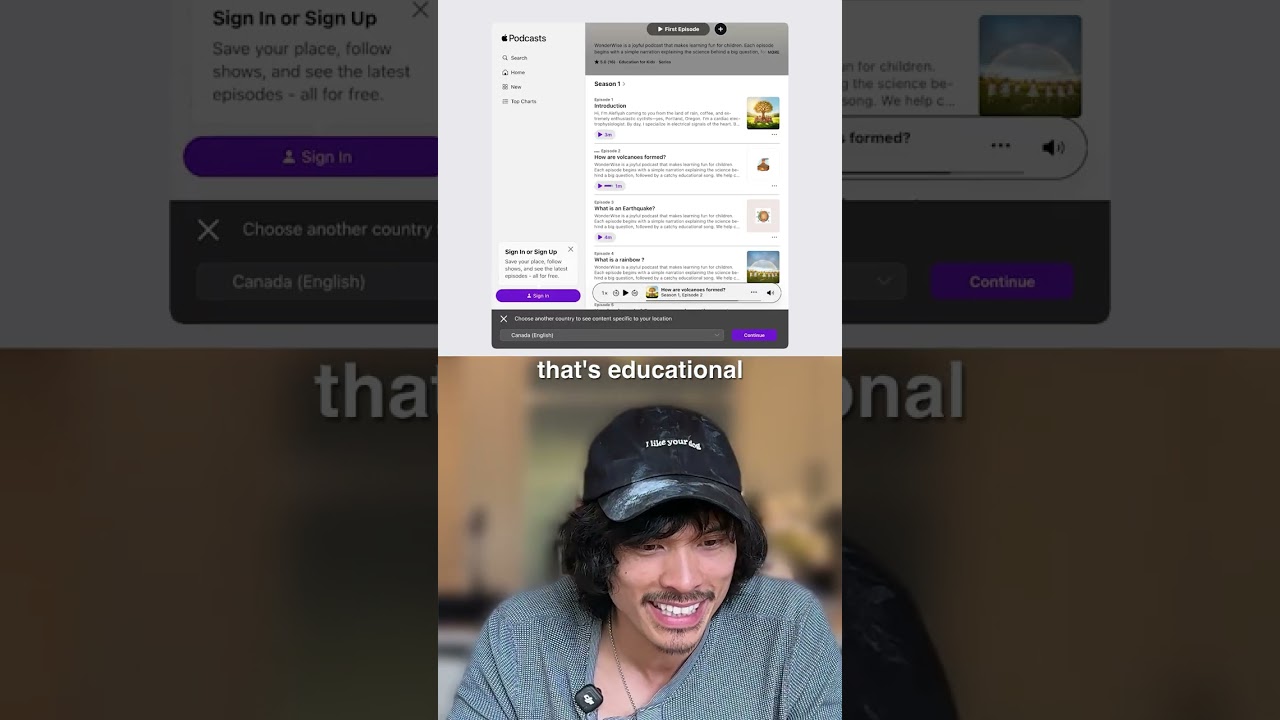
Check out my wife's site. My wife does a lot of this. It's called Wonderwise Science. And, uh, yeah, this is her site. So she's been making these songs. So she narrates the beginning and then she creates a song.
When the pressure builds up, the magma bursts out of the top as lava, along with ash and hot gases. As the lava cools, it hardens into new rock. Over many eruptions, these layers of rock build up and form the shape of a volcano. Some volcanoes erupt often, while others stay quiet for hundreds of years. Most volcanoes are found where the edges of Earth's huge plates meet. Places where the ground is moving and changing. So volcanoes are a part of how our planet builds and reshapes itself. Next time you see a picture of one, remember, it's the Earth's way of letting its magma rise and lava flow. Next is a song that I wrote about this.
Enjoy! Under the ground where it's hot and deep, The earth is rumbling in its sleep. Bubbles of magma start to grow. Up they come and up they go. Deep inside where rocks can melt, the earth makes magma all by itself. Pressure builds, it needs to go through cracks.
Yo, this is a banger. This is so good.
It's good.
It's really good. So good.
She puts a lot of time into these songs. It's not just like slop created. It's like She iterates on it like a lot for like sometimes for days until she likes it.
I could tell.
And the reason why this was created is we were just tired of listening to bullshit in the car, like Cocomelon or whatever that kids listen to.
Yeah.
Complete garbage.
Yeah. Wait, I love this use case, which is get people off of garbage childhood education content and just make your own because you're the parent and now you can use English to make a little app or make And our kids love it.