30 Under 30 Panel: Safe, Sustainable, Affordable Structures
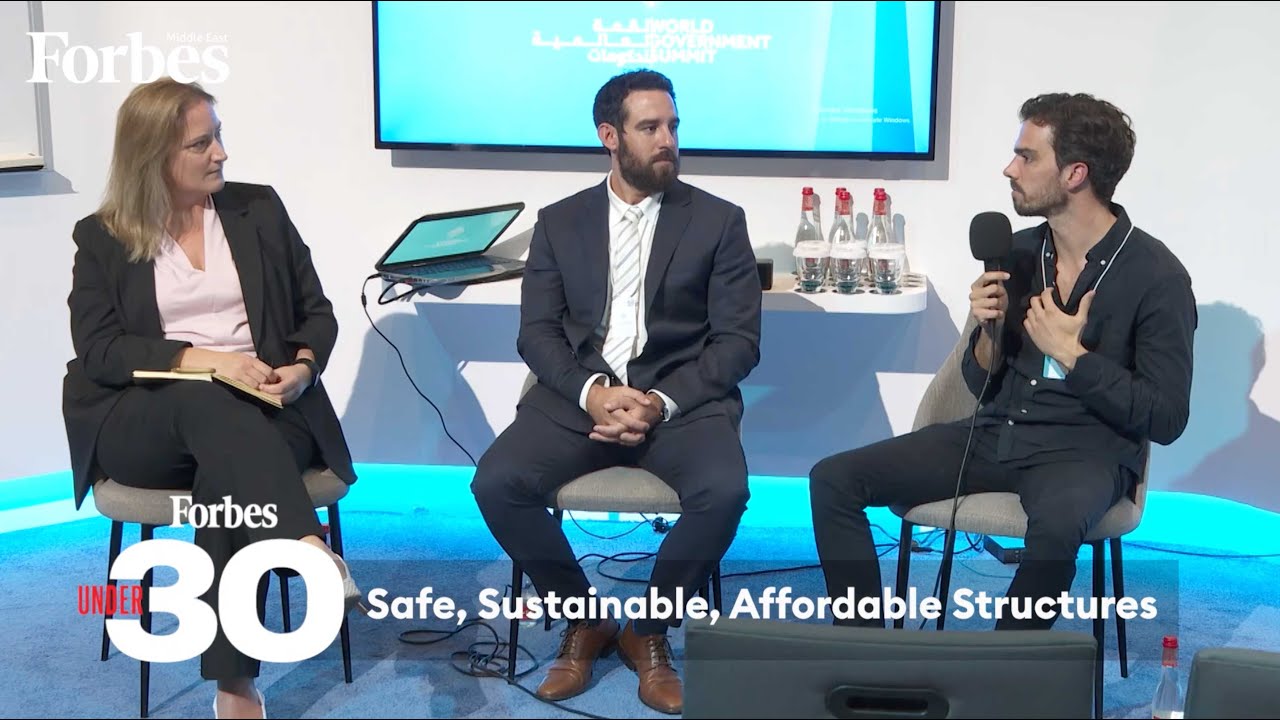
In a Forbes Middle East‑hosted panel, moderator Claudine Coletti interviews two former Forbes 30 Under 30 alumni—Derek Rice, a former natural‑gas entrepreneur now focused on energy‑transition private‑equity, and Thilo Konzok, co‑founder of a property‑ownership platform and founder of D‑Capital, an angel‑investor network. The conversation covers three intertwined themes. First, they critique the narrow public narrative around the energy transition, arguing that wind, solar and EVs address only about 30 % of emissions while natural gas (and nuclear) can displace coal and deliver a 60 % CO₂ reduction, but regulatory and perception barriers limit deployment. Second, they discuss the global housing affordability crisis, noting that simply building more high‑rise units—exemplified by Dubai, Tokyo, Seattle—can dramatically lower prices, yet cultural preferences, legacy zoning, short‑term political cycles, and insufficient incentives hinder rapid construction. Third, they explore impact investing, highlighting “unsexy” but high‑impact opportunities such as landfill methane capture and ship‑routing optimization, and describe D‑Capital’s model of funneling modest capital (€50k) to founders with strong networks to accelerate the next generation of entrepreneurs. Throughout, they stress the need for better public education, longer‑term policy metrics, and a diversified portfolio of solutions to achieve safe, sustainable, affordable structures.
Chapters
I am Claudine Coletti. I'm the managing editor at Forbes Middle East. It's a pleasure to be here. Forbes this year for the summit have brought a cohort of their Under 30 community, which is a global community made up of the world's most impactful, most innovative young entrepreneurs, all of whom were under the age of 30 when they were first recognized. And we have 2 such successful business leaders joining us today to discuss sustainable structures, safe and sustainable structures. And what do we mean by that? Well, we're going to be discussing effective long-term solutions to pressing problems covering housing, energy, infrastructure, etc. These 2 guys— Derek, I believe, is from the class of 2014. So possibly not under 30 anymore. Under 40, that counts, that counts. And Thilo, am I pronouncing that right?
Yes.
Yes, from the— Excellent. Okay, so interestingly, these guys are currently both focused on different businesses to the ones that they were initially recognized for. That's how strong the entrepreneurial spirit is within them. start off with, I'll let them introduce themselves.
Thank you. Again, my name is Derek Rice. When I made the Forbes list, I actually read my description the other day. It's— we were planning to go public. I'll just give you a quick run-through. My brothers and I started a natural gas company in the United States in 2009. This was at the start of the shale revolution, and so we wanted to apply new technology to sort of an old industry. industry, sort of bring that new, new age natural gas company. We got in at the right time. We started with just myself and my 2 brothers fighting over office furniture and grew that into a fairly sizable enterprise. We did end up taking the company public in 2014, shortly after the Forbes list. We split that company into 2. We took the second company public. So we ran 2 public companies for 10 years. 3 years and ultimately got acquired in 2017. That acquisition created the largest natural gas company in the United States. My 2 brothers stayed on with that company and I've pulled back to our next venture, which is mostly private equity focused. So we took some of the funds from that acquisition and we're redeploying that into traditional oil and gas companies. And really over the last 18 months, we've been focused on the energy transition. So We're seeing a lot of super interesting opportunities. Again, this is— it feels like the early days of the shale boom within the United States. It's tons of opportunities, a lot of holes that we're trying to fill with our dollars and our time.
Nice.
So quite far away from, I think, oil and gas, but housing was the first company I was involved in. I'm one of the co-founders of a company called Home, which makes it incredibly easy for people to own property. We hope we enable more people to own property around the world with this, and we also hope that we have an impact on making it simpler and better for people to live in these properties. And I was involved in that very heavily as a CEO until 5 months ago, and now I switched to a company called D-Capital that I'm currently working on, where we try to create more angel investors by taking people like, I think, a bunch of us. You're probably Because you're very close to 40, you're probably already ahead of that stage. But I would put myself, I think, maybe in that category of people who see a lot of their smart friends starting really good companies but don't necessarily have the level of wealth yet to invest in them. So we take money and funnel it to them so they can invest it for us. So we try to create more angel investors in the world.
Thank you very much. So I'm going to start with energy, because, you know, we can't have any form of sustainable structure without reassessing our energy usage. So to you, Derek, like you said, your background is in oil and gas, or started with oil and gas. You're now much more focused on sustainable energy sources. And from what you said in a panel yesterday, nuclear in particular, I think. What are your thoughts on the current drive to energy transition? Like, are we having the right conversations?
The short answer is no, we're not having the right conversations. So I think one of the biggest misunderstandings of the energy transition is like how difficult this thing, this is going to be. I think the world right now is super hyper-focused on 1 or 2 or 3 solutions, wind, solar, Electric vehicles, maybe some batteries. And I think it's people's belief that if we really storm towards those and deploy those at scale, mission accomplished. But the reality is those 3 things only target less than half of what the emissions are in this world. And so the way we're approaching the energy transition, it's the world is focused on maybe 30% of the problem. There's an extra 70% that nobody's talking about. Well, they're talking about it very little. Things like, how do we clean up our food, our agriculture? How do we make reliable energy, not just this intermittent wind and solar? So, I mean, there are so many problems that we need to solve for, and we're just taking a different angle. Not hating on wind and solar. Those have a massive role in the future, but— We're focused on the giant holes. In terms of like how I marry oil and gas and my passion for the energy transition, I think, again, there's many misunderstandings about energy. Natural gas in particular is something that we're very passionate about. If we look at the United States over the last 15 years, The United States led the world in reducing emissions. It reduced emissions by around 1 billion tons of CO2. Now, to put that into perspective, that's like electrifying 400 million vehicles. So like, pretty good. And if we look at what were the reasons, how did we do that? Like, what were the solutions that we deployed? Now, I think most people would say wind, solar, and maybe electric vehicles. Well, we can just do the numbers. Number 3 was solar. It was responsible for 8% of CO2 emission reductions. Wind was number 2 at 31%. The number 1 solution to reducing CO2 emissions was natural gas replacing coal. So it's more than double all of the other renewable solutions combined. So we're trying to say, okay, let's promote natural gas and nuclear to replace the dirtiest form of energy on our planet, which is coal.
And what are your thoughts on What about oil in the oil markets?
Is that not something you guys— We have very minor investments in oil. Look, I think this energy transition, it's going to take 30 to 40 years. I think one of the biggest mistakes some countries are making is they're taking the oil away from their citizens before they have something to replace it. So look, I mean, creating a billion electric vehicles vehicles is going to take 40 years. I think what you're seeing across the world right now, I mean, we are in a full-blown energy crisis. And energy, because of the lack of investment in traditional sources of energy like oil and gas, energy underlies every single industry in the world. And so when you take out a certain amount of oil, it's going to affect obviously gasoline prices, it's going to affect electricity prices, it's going to affect fertilizer. I mean, It touches everything. So we do need to invest in a responsible way into oil projects until we are actually ready to get off of it.
Thank you. So sustainability isn't just about green energy. It's also, you know, growing and maintaining growth in a positive way as our populations grow. From your, you know, from your kind of housing an architecture background, I believe. What are your thoughts on the challenges facing communities and governments in this regard?
Well, yeah, since we're speaking about technology a lot here, I think what's really interesting, and we talked about this yesterday, is all these technology companies that we started in the last 20, 30 years, they created massive amounts of wealth, right? And there's so much more money in private households now, but people don't really feel that much more wealthy. And one of the big reasons of that is that the expenses also grew at the same time. So while it cost my parents maybe €50,000 to €100,000 to build a home, that price now has 10x'd, maybe 5x to 10x. So even though we have all that massive increase in, let's just say, the zero marginal businesses that all these people are building here that created massive amounts of wealth, we don't feel that much more wealthy. And one of the big reasons is housing costs, really. And one of the other big reasons is energy costs. And ultimately, the short answer is we just need to build more housing. I think driving through Dubai especially is a joy to a person who really would love governments to be more open for high-rises and people living there. It's very different to a city like Berlin. And I think a bunch of people from you guys are from San Francisco. And I think I just recently saw a map of the newly built apartments in San Francisco. I think per year it's like 100,000. like buildings or so. It's ridiculously small. And a big reason that is obviously because housing is a really complex problem. It's not always as easy as Dubai makes it seem to be, I can imagine, because obviously these are long-grown old cities and there's neighbors that have interests that need to kind of be taken into account. But I feel like we need to be much more radical in terms of how we approach more housing because there's really good examples around the world like Tokyo or Seattle. who were able to drive down housing prices massively. And the reason they did was a very simple one, is they just added more homes, right?
I think Dubai is quite lucky because it is actually a vast emirate. So if you go to the more built-up areas like Marina and downtown, you get lots of high-rises. But actually, if you go further out, there's massive communities with villas and open green spaces. green areas. But I think, you know, cities like Berlin, you probably don't have the space to have that kind of—
There's a funny tidbit I can maybe share because I'm an architect. I'm a really bad architect, but I'm really interested in architecture. And I think one of the things when I talk to other architects is we feel that a portion of the problem that we're in currently is that a lot of people prefer old technology over new technology. And what I mean by that is If you ask a lot of people who are like 30, building a home, thinking about what their family home looks like, they would hate to live in a high-rise. They want a single-family detached home, right? And part of the problem might be that in the '60s or '50s, especially in Germany, we had like a pre-boom in scaling up architecture and we had really just ugly houses, right? And they had a really bad stigma to it. And I think it sounds like a very emotional reason to this thing, but building a home is a very emotional reason. So I think people have a natural kind of misunderstanding of how great skyscrapers can be, really. And that's why I like cities like Dubai, because I think they do show people what's possible in terms of that. And we just need a little bit of a lower regulation around these areas to have architects be creative.
Okay, so considering that, like, needing more law or different regulations, like, what more is it that you think governments could do, considering, you know, you're from different countries and you have different perspectives, but what more could governments and, you know, business owners such as yourself be doing to encourage more sustainable solutions?
Yeah, I'll go. From an energy perspective, the natural gas industry is Trying to spend hundreds of billions of dollars to build pipelines and infrastructure so we can take our resource, natural gas, ship it overseas, and displace coal internationally. A country like China, they're burning an unbelievable amount of coal, not because they want to. They're doing it because they don't have that natural gas. And just to give everyone some perspective, I mean, when you switch from coal to natural gas, It's the same drop in reduction emissions as from a gasoline car to an electric vehicle. So from the regulation standpoint, we need support from our government to just let us deploy those dollars. We are ready to go. We have labor, we have the materials, we have the funding. But unfortunately, just the regulatory hurdles just are getting in our way and slowing us down. So it's difficult to lift those regulations given that we're deemed a fossil fuel. Just as, I mean, it's, so we need to educate the public about the actual benefits of natural gas and how it actually can lower emissions faster than any single project in the world. So I think a little bit less regulations would help our industry tremendously.
Yeah, maybe a little bit to your point or similar, just framing it differently. And I think first to be said, there's no easy solutions with housing, even though I made it just sound so easy of building more. There's a few million people living in cities and they all have different interests. But if you start looking at interests I think interests are just kind of incentives of people. And what you realize is maybe a portion of the problem might be that the leaders we elect in our country, especially Germany, they're elected over a period of like 5 years maybe, right? There's only so much you can do in terms of urban planning within 5 years. So I think sometimes it's tempting to promise stuff that doesn't really work out in reality. So I think very often we end up with regulations that are just like, ah, rents are too high, let's just limit rent prices, right? And let's have the next guy fix the problem, really, because I just want to be elected. So I think if you want to solve that, you need to go back to the drawing board of the incentives and be like, how can we incentivize our leaders to build cities that are great 30 years from now, right? What are the metrics we want to use? And affordability probably is one we should use, I imagine. A different concept we talked about yesterday, it's a little bit far off maybe, but what would happen if we all wouldn't like own one apartment in the city, but we would all own a share of the city together. Would that drive us towards maybe approving a highway that's really important from an infrastructure perspective much quicker than kind of fighting against it because I'm a neighbor, I have an apartment, it drives down the value of my apartment in particular. So there's a really good guy, Alan Bertroud, who thinks about it. He wrote a book called Order Without Design: How Markets Shape Cities. And it just goes back to free market kind of mechanisms and private companies being allowed to compete in the field. But that being said, it's also quite complex. It's not really that easy.
So going to that point of incentivizing leaders, leaders are incentivized by votes, especially in your economies. And votes come from the people and the people need educating. Right. So, I mean, what are your thoughts in terms of solutions, in terms of educating the public more? How do we do that?
How do you do that, I think, is the question. Yeah, it's something I actually think about a lot. It's how to effectively communicate a complex subject like housing or energy. You know, these are subjects that you cannot capture within 240 characters. It's not something you can put out in a White House press release for people to understand. And so the problem is people condense these very complex things into these little soundbites that leave out 99% of the actual issue. I don't know the answer to better communication these days. I think people's— the way they consume information has been reduced down, and it's just fundamentally different than maybe the way we consumed information in the past. I don't necessarily have the answer. I wish I was a communications expert, but I'm just a geologist. So yeah, I don't have the answer. I'm sorry. That was a long, I don't know.
Well, I'm gonna add to the, I don't know. But maybe, I think the thing is people, maybe it's a different way of looking at it, but maybe it's the same side of a different coin or the other way around. I think you don't wanna educate people, but what would drive people to educate themselves about the issue? Maybe it's the right thing is, and maybe making them feel ownership for the thing, and that could happen by making communities smaller. Actually, you see really interesting housing regulation, for example, happen in much smaller cities when they're self-governed. So maybe we're going to have multiple smaller parts of a city in the future where people feel higher degrees of ownership over this, and maybe we don't, but it could be an avenue to explore.
Okay, so that's our responsibility. We'll We'll work on that, Jamila. Okay, another way of incentivizing governments especially and people is financially. So I'm wondering if there's another reason why this transition is taking too long or people are going for very quick, short answers is because it's actually quite an expensive thing over many years to implement. So I mean, can we Can sustainable solutions be cheaper? And if they can be, then why else do you think people are proving to be a little bit reluctant to take them on?
Yeah, I mean, look, wind and solar right now are the cheapest new forms of energy in the world. Like, I'm an oil and gas guy saying that. The problem is the speed at which you can deploy this is dependent on Many things. Manufacturing, the materials. I think people, their perception is we're just waiting to say go. And then just because we have wind and solar technology that we can just make a transition as quickly as cell phones. That's not going to be the case. It's going to take 30 to 40 years to actually deploy everything. So this is one of these situations where I think everybody has the will or the desire to make the change. I think we as a society sort of have to accept that this is going to take some time. We all want it to happen fast, but like Tesla can only make 1 million vehicles per year. They need to make 50 million vehicles per year and they're not gonna get there until 2040. So like we just need to be a little bit more accepting that this is actually going to take some time and not take away the core energy that we need before we actually get there.
Well, I'm gonna go out on a limb here 'cause I'm gonna join the energy discussion now. 'Cause I think I have one point that's quite near and dear to my heart. And I think one of the most ridiculous things we've done in the last 30 years that created all these problems is that we moved away from this magical technology called nuclear in a way, because we kind of had the solution. And correct me if I'm wrong. And I think it's incredibly important that public opinion supports these new technologies. And I think with nuclear, we had a few events like 20, 30 years back and maybe some events just recently who make us reconsider that we have the solution on hand, right? And I think if we would have spent the last 20, 30 years on innovating even more safe forms of fission and whatever we could possibly imagine doing in that area, we would not have that problem today. If we— now we can't go back and fix it in the past, but I think if we start embracing it now, I don't know if it's unrealistic to assume, but the optimist in me assumes a world where we don't pay for energy, right? Because nuclear seems like a ridiculously amazing technology that could enable that at some point.
Would a future where we don't pay for energy not put you out of business?
Yeah, it would put me out of business, and that would be fine. Like, look, if we have free energy, that's great. That's great for society. I think, like, we want to give people the cheapest, most reliable source of energy so that the rest of the world can use that to grow as a society. It is like the lifeblood of everything. It is the literal fuel. I don't know if that's going to happen. I don't even know how that would work. But yeah, if we figure out fission or fusion or all these other nuclear things, it could happen 50 years or 100 years from now.
So you'll be fine. It's the next generation. So, I mean, another way of changing, changing the world is through you guys. It's entrepreneurship. It's coming up with these amazing new ideas and finding the funding to get them off the ground. You guys are now both working in the investment space, you know, creating new angel investors or actually investing in startups yourself. So how do you as investors ensure that money is going to the future business leaders that can change the world for the better?
So I think we had this conversation or riff on this conversation yesterday together in the roundtable, and one of the problems of Europe specifically is that we're just 10, 20, some people argue 30 years behind in terms of where Silicon Valley is with the ecosystem. And I think one of the reasons is that it typically takes a couple of— a generation of entrepreneurs to exit their companies and make some money to reinvest into the next generation. Then the flywheel starts turning. So we've been thinking about this problem in a way where we're like, aren't there really great people that just haven't generated the amount of wealth yet to be able to angel invest in new companies and be the first ones to believe in more companies being realized? And so The thing we want to build with D-Capital, that's my new company, is take money and funnel it to the people that have access to really good companies. Because they're, for example, founders of a Series A or Series B stage company, and all of their smartest friends come to them anyway for advice. And it would be wonderful if we give them money to kind of put down €50,000 into them as the first check, believe in them, and help them realize more businesses being built.
Yeah, in the energy transition space, there is I don't know, trillions of dollars floating around. There's no lack of capital for these companies. I think one of the biggest things that we're focused on is, again, we're going to need 400 solutions to solve climate change, very different solutions from food to whatever. The unfortunate thing right now, it's the overwhelming majority of those dollars are being hyper-focused into, again, just a few solutions. Tesla has a $1 trillion market cap. Nothing against Tesla, they're a great company. It would be nice if some of those dollars were actually refocused into other sectors within the energy transition space. Pound for pound, like, when I'm deploying dollars into this space, my metric is this single dollar, how much CO2 am I reducing? Putting it into Tesla doesn't necessarily give me a lot of bang for my buck. Hopefully over time, as people understand how complex the energy transition story is, they'll start directing those dollars to really impactful companies that will have a major difference in reducing CO2.
And have you seen any kind of early-stage startups recently that have made you go, wow?
Yeah, I think it's a really good follow-on on what you just said. We had this conversation yesterday where I told you about this one company, right, that seems quite unsexy at the outlook. Definitely less sexy as buying a new car. But what it does, it optimizes routes for these big container ships that are very often waiting outside of ports, and they just idle there for like 8 days or so, and they burn massive amounts of fuel. And it's obviously a fantastic business model because they help them save a couple million euros in fuel each year, which also equates to a lot of CO2, I imagine, being saved. And I think these companies are both great investments. They just look a little less sexy. than cars. And I think people like you understanding that and funneling money into that is probably a good thing.
I have a less sexy company than that. We invested heavily into a landfill company. This is a company that just deals with trash. Methane emissions from landfills is the number 2 source of methane emissions in the world. Number 1 is coal, which is very bad. This company basically just captures this methane that's just naturally leaking off of landfills. Incredibly important to do. And their environmental impact— I mean, no one's probably ever heard of them. They're now a public company. It's greater than the entirety of Tesla. And again, not to rag on Tesla, it's just an example that there are things happening in the world that aren't mainstream at all that are so much more impactful than the mainstream solutions that we talk about. So it's finding those companies And again, like, trash is not sexy and maybe rerouting ships, not sexy, but these are the things that actually matter most. And that's where we're deploying our time and our dollars.
Okay. I think us in the media, going back to the education point, we need to find a way to make these companies sexy and let people know about them because that sounds excellent. We're running low on time. So does anyone from the audience have any questions?
How does the landfill company make money?
It takes that methane, which is natural gas, puts it into a pipeline, or they use it to generate electricity, which powers electric vehicles in the fleet. That's one of the good things about— I'm not— I didn't mean to hate on government too much earlier. Government, their role in creating incentives is really important. So that gas that they collect from those landfills is worth 10 times more than just the gas that we drill for. And so it incentivizes people to actually go out there and collect that gas off of those landfills. If we collected all the gas off of these landfills, there's 3,000 of them, it would be equivalent to electrifying the entire fleet in the United States, 200 million vehicles. So like, what is more difficult, electrifying 200 million vehicles, which is going to take 40 years, or collecting the gas off of 3,000 landfills, which we can accomplish in the next 15 years? So those are the types of things, that's how we approach it. It's bang for your buck, time and money, where are you gonna deploy it?
Excellent, thank you. Any more questions?
You said that switching from coal to natural gas is equivalent to switching in more to electric cars. Can you just describe those lineages?
Sure. Yeah, so switching from coal to natural gas, I mean, this is one of these things, coal and natural gas are lumped together as fossil fuels. Natural gas is closer to a solar panel as it is to coal from an emissions perspective. So again, when you switch from coal power to natural gas power, you get a 60% reduction in CO2. That's just what happens. When you switch from a gasoline-powered vehicle to an electric vehicle, sometimes people think it goes to zero. It doesn't. It's a 60— it's a 58% reduction in CO2. And so like the way we look at it, it's— we look at electric vehicles and say, and say, look, those are great. I mean, we need more of them. We look at natural gas and we say the same thing. These are great. We need more natural gas to displace that coal. We're not picking natural gas over wind and solar. We're picking it with it. I mean, we need all of these solutions deployed together as quickly as possible. But yeah, so like getting people to understand the benefits of natural gas and not just lumping it together as a fossil fuel. It's gonna take a long time to educate people, but I think it's happening today, and I think it's gonna continue in the future.
Thank you very much. We're gonna leave it there, guys, as there's another panel starting in just 1 minute. But thank you very much for joining us, and thank you, guys.


