
EP.1 Artificial Intelligence: Friend or Enemy?
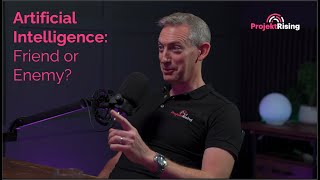
Tim Davies argues AI isn't actually artificial since people build it and feed it data. He traces rapid advances from transformers in 2017 through GPT-4, explains compute scaling from teraflops to exaflops, and recommends tools like Gamma, ChatGPT Pro, and Copilot. He warns of disinformation and job displacement but says businesses and individuals should experiment now.
Questions this video answers
2017
155 (written aspects of the test)
Previously 1.5 exaflops (most powerful), a released one at 2 exaflops, and an unofficial plan for a 50 exaflop machine
Approximately 14 trillion frames
Gamma (presentation writer)
AI, what is it? What is artificial intelligence?
Is it artificial? No. At the moment, it's all very much constructed by people passing huge amounts of data into models that love to learn. But the intelligent bit has definitely changed. Just by using these capabilities, anybody can be smarter and do more, more quickly. There's a lot coming. The capabilities are almost endless, and it's moving very quickly.
Hi, I'm Freya. Welcome to the Skynet Business in the AI Age, the podcast that dives deep into the world where artificial intelligence meets business. Join us as we explore the latest trends, challenges and opportunities in this ever evolving landscape. From innovative startups to established enterprises, we'll uncover the secrets behind the successful integration of AI technologies. So grab a cup of coffee, sit back, and get ready to unlock the mysteries of business in the AI age.
Tim Davies, Good morning. Welcome to the first of our series of our new podcast, the Skynet Chronicles. Why are we here? Why are we doing this?
It's a brilliant question, isn't it? I think we spend a lot of time telling people about certain aspects of artificial intelligence and trying to move them along that curve. Though how we describe moving from ignorance into profitability. And this is a way of us hopefully reaching more people and getting that early part of the education of what's possible done as quickly as possible to as many people as possible. Lots of possibles in there.
Lots of possibles. Everything's possible. Cool. And what do you plan to sort of COVID over the next few however many episodes this turns out to be?
So I think we're going to do two, just on us and our journey, and then we're going to start bringing guests in who will mainly be the owners of companies where we've implemented solutions and anybody else who we think is particularly interesting and would tell a good story.
So anyone who ends up on the.
Podcast, then they will. It means they're interested, they were brilliant and interesting, and that's why they're on the podcast.
There we go. They should be highly privileged. Okay, let's get into this. So, AI, what is it? What is artificial intelligence Intelligence?
Is it artificial or intelligent? It's an interesting proposition. I think. I used to have a lot of fun telling people that AI was neither artificial nor intelligent, and my viewpoint on that has changed. So is it artificial? No. At the moment, it's all very much constructed by people passing huge amounts of data into models that love to learn and then using those results to produce insights and wisdom. But the intelligent bit has definitely changed. So we've gone from a point where they were just capable of giving us a few words in sequence that sounded good to being able to produce genuine insights to be able to pass complex exams that are required to enter certain job roles. And I think now we're looking at GPT4 has the Internet IQ. I nearly actually messed that up. Intelligent quota of 155 on the, the written aspects of the test. Obviously it's not a physical move beyond.
Way beyond the average which is better.
Than 99.7 percentile of people. So just by using these capabilities anybody can be smarter and do more more quickly. And so we've moved from a point where it was just a tool to actually it's becoming a necessity. And those using AI capabilities will be able to out compete those that aren't both on an individual and on a company level. And the level of investment on the capabilities in terms of the compute is astronomical. So we joke about the human capability of a brain being about 100 teraflops and you can now buy a graphics card for 1700 pounds which can be overclocked to achieve 100 teraflops. It's not as efficient, the operating system isn't as good but we're still getting to a capability where intelligence can be bought quite cheaply. And up until June the most powerful supercomputer on the planet was 1.5 exaflops. So 1 million 500 teraflops. There's now one that's been released, that's two exaflops. And there is an unofficial purchase of chips that's been made. Those chips haven't been finished yet by a organization in the United States which is nameless for a 50 exaflop computer. So that will be 50, 25 times more powerful than any supercomputer that currently exists on the planet and capable of a combination of AI and standardized tasks.
And do you expect that that that supercomputer as I'm going to call it, will be an AI machine? Is it going to. Is there anything else that could even be possibly used for?
It could be used for almost any sort of forecasting but it will be used for AI workloads and it's almost definitely American military.
That's a scary thought. Let that one sit for a minute.
Yeah, it's not Skynet.
Oh wait, maybe just for the different name. So you're quickly building a reputation as the AI guy in Peterborough in the east of England. Why? Where did that come from? How did you get to where you are now?
I'm not entirely sure it's mostly by accident, I think. I started playing with computer games very early in my years and in the early 90s, discovered one particular game that I could hack that would allow me to completely change the way the game worked, create new levels.
What was the game?
It was Dune 2, and it would allow me to change which forces were in which position, which weapons were placed where on the board. And you could just create entirely new scenarios, ironically, in a file called Scenario Pack, which is just plain text editing. And so I felt I had a bit of power over what a computer was doing and I fell for it. Hook, line and sinker. Decided to go to uni to study computing. We covered neural nets in the second year and they were covered at a very high level. And the summary was there isn't enough data and there isn't enough compute to do anything sensible with them. Internet grew and grew and grew and so over time that challenge has been resolved. Left uni, wanted to do a job in computing, found myself a Caterpillar at Perkins Engines in Peterborough and spent best part of 14 years doing a variety of different roles across IT. Coding, project management, research management, business transformation, and then ultimately thought done the best two jobs in the company. So it was time to do something else. So I left, bought a classic car, started a wedding car, hair company, bit of a curveball, and then about nine months later got pulled back into the real world of work, started working in remote freelancing, seeing the possibility of connecting people with jobs wherever they were. And that eventually led to us leaving what became upwork and creating Project Rising so that we could solve the project management aspect of how we connect people with customer needs. And then as we were building out the automation, we were leaning more and more into the AI capabilities that were coming online since 2017. Lots of sentiment analysis, lots of pseudo project manager communications managed and created by early versions of GPT3 and just leaning more and more into artificial intelligence capabilities. And I was part of a mastermind group and the coach who runs it routinely said, when are you going to start talking about AI? And I ran out of excuses. And so when I did start talking about AI, we effectively switched almost all of our efforts into delivering artificial intelligence enabled projects and customer solutions. And that's brought us here.
And I guess the timing had to be right as well, because you could have talked about AI for 20, 30 years, but it's only sort of the recent 12, 18 months that it's been a sort of thing that everyone's talked about.
Yeah, I think there was a switch in 2017 when Google invented the transformer model. And that has effectively been the backbone of all of the new large language models and even the frontier models that are multimodal now. And so all AI research pre2017 is essentially out of date unless they're clued up on what transformer models are doing. And then the rate of change since then has been astronomical.
I was going to talk about the rate of change because as I said, certainly when we started talking about it properly, which. And we did it, we did a presentation, it was only about a year ago, to a networking group in Peterborough. And at that point no one had really used any tools with AI. And then when I talk about it 12 months on, everybody's used the big one, everyone's using smaller ones that you know are coming out of nowhere. How do you see that rate of change over the next couple of years?
Well, it's exponential and I think it's a rate of industrial change greater than any industrial revolution we've had before. I think the impact will be more than the impact of electricity. And that took place over 50, 60 years. And we're probably halfway through a transition of the same level of impact. The new capabilities that are coming online are coming thick and fast. We've moved from simple forward token prediction to guess the next word in sequence and understanding a context. So the early versions of GPT, the back end of November last year, were then rolled into ChatGPT as a service, and that caught people's attention of what was possible. And then the subsequent releases of GPT4, the coming Gemini from Google and all of the other models that are coming up thick and fast. I think they've been pretty much a model released every two days in the last last month, but of various sizes, various capabilities. But we're just seeing a breakneck rate of change and everything compounding. So the capabilities that were impossible two years ago. The idea of interfacing and interacting with a chatbot and it being able to extract insight and understanding that we would see from looking at something is now perfectly commonplace. That's now being tied into image understanding with GPT vision, image creation with Dall? E and midjourney. So you can go from a sketch of a website or a screenshot of an application, and you can have not only the understanding of what's on that page, but a description of it, and then it will write the code to replicate it, and then you can ask it to produce some iconography and logos and it can do the whole suite. And that's with technology that's available now, when Google Gemini comes out November, December, the capabilities of that are greater because it's been trained on all of the YouTube data, it's been trained on action data sets. So they took all of YouTube, they broke those videos down into individual frames which were completely annotated in terms of what's on the video, what's being talked about, what's in the frame. So by combining the different capabilities, they've built up this data set. I think it's 14 trillion frames of data which has now been included in the training data set for Gemini. So we've now got something that not only understands all videos, everything that's happened in those videos, but can guess and understand and go beyond that. So how good is the next generation of text to video going to be? When you think a text to image creation now you get perfect photos from midjourney, you can have anything you can imagine created. The volume of images that has been produced in the last year and A half by AI is the same as being produced by photography in 149 years. It's just an obscene amount of capability and volume that's being produced. And a video is just 25, 50, maybe 100 frames a second. If it can do one frame and you roll that out with more compute, you can get to a point where you can produce a video. And we're seeing reasonably capable versions of that in Runway gen 2, which has now been rolled into Canva's Magic tool suite. So anybody, for a very low subscription amount can produce a video of a cat doing whatever they want and post it onto YouTube.
Yeah. Or TikTok or wherever, whichever app is the cool app in a few years.
Absolutely.
So you mentioned ChatGPT, and that's the, that's the app that people have become most. But it's become almost synonymous with AI in the general world.
It has. But in a research point of view, I saw a fantastic presentation a couple of weeks back and the title of the presentation was STFU about ChatGPT. So within the usability and the sort of the general public, ChatGPT is AI within the capabilities that are coming forward and are emerging. ChatGPT is just an application with an interface that happened to hit the mark.
Yeah.
So there's a lot coming. The capabilities are almost endless and it's moving very quickly.
Absolutely. Do you think that we've seen software born, be very successful and die in a very short period of time, shorter than we've ever seen before? So some of the blog writing tools that were based on the initial sort of ChatGPT type technology. Do you see that rate of change in the software and the tools that are available, continuing in that sort of trend where we're going to see things pop up, be hugely successful and disappear overnight?
I think it's inevitable. I think when you've got this rate of change and the level of innovation that's happening, you're just going to get new tools and new capabilities spring up and entire categories of work will be replaced as a result of it. So if you think just about the early copywriting tools to ChatGPT, now, you've got one killer app, which, if the general public are using the free version, they're getting none of the capability that's any good. If they pay the 20 pound a month, then they get access to GPT4.
And that's not a lot of money. For what? For what you're actually getting. If you compare to where we were a couple of years ago, people are paid ridiculous money, but it's that they.
Want something for free. If something's available for free, they'll take it. But the capability shift between that and the advanced data analysis and the capabilities of GPT4 that are embedded in that Pro version, it's unbelievable difference. So will we continue to see apps and capabilities that spin up that are amazing for three, six, nine months a year and then completely replaced by a new technology capability? Absolutely. And I think you've only got to look at the newly released capability in Bard, where you can effectively book an entire holiday up to the point of booking, but it can plan it all out for you. The next version will allow you to book it. So if you can then go from I'd like to go here to I've got a holiday booked, that's an amazing capability and you just see it. It's not actually complicated in terms of what the technology is doing underneath the hood, but it completely changes the way we work and the way that we interact with compute.
That's quite a scary thought to think that a software could take longer to build than it's like, than its usable life is going to be. And when I say longer to build, I mean by a human coding that software. Which brings me on to the scarier side of AI and the things that people are generally scared of. Talk to a bit about the risks around AI. How do you see those coming to the surface and playing out over the next couple of years?
So I think we've got huge challenges around truth. What is true disinformation? And then significant challenges around job displacement. I think when you. When you think about the amount of information that is percolated through social networks, then picked up by news channels and becomes fact, it can happen so quickly. Just very recently, a UFC athlete allegedly hurt his knee during a training exercise. There was one tweet, and then it was everywhere, all of the news. This particular athlete's struggling and isn't gonna be able to make the fight. And it wasn't real. Or at least he says it wasn't real. Who knows what is the truth? But I think that just the way that news can spread so quickly and the ease of creating news. So are we here really, or have we just created digital twins that we moved into a video? At the moment, we're real, but I'm not sure how far off that we are. And as you've seen from the introduction, Freya, who introduces our videos, she isn't real. And so it's quite easy to produce a deep fake of anything that can look like and sound like anyone saying anything that's created. Potentially using the capabilities in GPTs and these language models, you can move to a point where anything can be created to be news spread incredibly quickly across multiple channels. And so the ability to understand and look at something and go, does that feel real? Is going to be more and more important.
But as we do that, and as you said, it becomes more and more important, it's going to be more and more difficult for us to figure out what is real, because the technology is accelerating at such a rate that, you know, Freya looks very real compared to the. The videos we tried to do six months ago on the technology that was available then.
Yeah.
You know, by the time we get six months from now, will it be even more difficult? Will it even be possible to figure out what's real and what isn't?
I think by analyzing the images with a computer, you'll be able to understand and find faults in it. But to the human eye, I don't think you're going to be able to tell whether it's a real or a fake image or video or voice extract or combination of those things. So you'll get to a point where, well, with a bit of luck, we will be able to simulate me so that I can have my digital twin go and do something.
You can drive your wedding car?
Well, no, I just want the speaker, some of the speaking gigs to be covered without me actually having to travel. That'd be nice. But I think it's going to be more and more Difficult to actually understand. Is that real or not? And so the ability to question, to call BS on something and go, that just doesn't feel I can do some actual research. It's going to be more and more crucial. But the majority of people won't do that.
No. And so they don't do that now.
No. And so news will travel, news will become gospel, even if it was entirely made up in the first place. And when you look at the impact of that around elections, around the interactions between Ukraine and Russia and Gaza and Israel, the level of disinformation, possibility, who knows what's true? We've always been able to rely on one or two news services, and if you compare across a few of them, you're likely to get pretty close to the truth. You just don't have that ability anymore.
And you mentioned that you think that the future is going to rely on technology to figure out what's real and what's not. There's a lot of tools out there that claim to be able to prove whether something's been written by something like ChatGPT. How reliable do you think they are now? And where do you see that moving?
They're completely unreliable now and they'll get worse over time.
Okay, so we're going to be relying on technology that doesn't know what it's doing either.
For words, yes, but for image and video, then it's much easier to tell. Okay, but with the written word, there's not a lot of bandwidth within those passages that you can hide information. And so the way that the majority of the is it AI or is it human tools work is they look for similarity between sentence length and use of the complex language in a sentence. And so you can take output from any of the language tools and pass it back with a one sentence on the end, and you'll fool all of the AI content checkers currently. And that's just by specifically asking them to vary the sentence length and use complex language in the sentence. Perplexity and burstiness. There's some buzzwords for you, but that's.
Quite a scary thought in things like education. So where students and pupils are being asked to do coursework on something like history. Let's take history as an example. If the lecturer sets a task around, write an essay around this thing and that thing and all that information is publicly available about that thing, then are we saying that we're currently at a point where students could get away with generating stuff with AI that they shouldn't be getting? And there's no way of checking, I.
Think, get away with is interesting. And I think if you look back to when we were at uni, you would take passages from text, you would change some of the structure, you might change a word here or there, and all of a sudden it was your own. And I think as long as there is an opinion that has driven the creation of that content, then it is arguably still human created. But where you are asking these tools to come up with the concept, come up with structure, to write it all out, and then you submit that as it is, that clearly isn't the student's work.
No.
And it isn't possible to prove that it was AI or not, especially if you've used perplexity and burstiness, because then the tool, the structure of the words and the length of the sentences is undistinguishable from a human.
Yeah.
And then you get to something that can it be checked not for an individual paper, but can you compare it to the rest of the work that they've submitted and see a significant change in quality? Yes. Can you see a significant use of different types of verbiage and language? Absolutely. So are there still ways of checking to see whether it's a bit unusual or suspicious? Absolutely. But even within the academic marking schemes, you can create, and we created a test piece that took a marking scheme for a document and the input from a student, compared the two and gave the score. So you can actually mark the coursework without human intervention, too. So there's a lot of change coming. And I think ultimately written assignments aren't going to be a great measure of testing whether somebody understands something.
And I guess exams, in person, exams will still solve that problem to an extent, because you won't be able to take an AI bot in with you. But yeah, it's the coursework side, isn't it? And all those things that you do at home or somewhere else, you won't.
Be able to take an AI bot in with you. But they're going to have to use metal detectors, aren't they? Because an earpiece, a phone, you can have almost anything. I mean, we could ask a AI agent right now for the answer to something and it will tell us, and we could even have it tell us it as opposed to just write it. So if you combine that with a subtle earpiece, then you could probably get past a lot of the exam system.
We're not here to give students ideas.
No, we're not. And I don't think many students are going to want to listen to this anyway, so I think we're probably safe, probably.
All right.
But if you are operating testing in a school, it might be worth thinking about those metal detector ones for vapes as well as for phones and earpieces.
That's a scary. That's another scary subject. So we talked a bit about the scary stuff and the risks. Let's talk about the more fun stuff.
So before we do, we didn't touch on jobs.
That is true.
One of the jobs.
That's a good point.
And I think the impact on jobs we're already starting to see. So some of the early adopters, those with the most to lose from the current generation of technology, have already started to change their staffing practices to either not hire or to reduce the number of people doing certain roles. With the capability of Barda planning and potentially booking a holiday for you, what impact is that going to have on travel counsellors and the like who are actually researching and booking holidays for people, virtual admins. And you just. You look through the job categories and. And you think, if I was in the bottom two or three out of 10 in somebody in a specific job type, I'd be really worried because the capability will be most quickly adopted by the people who are already amazing at it. They'll know how to ask the right questions to get the most out of these AI models. Because if you just go and type out something, you get crap in, crap out, and obviously that's not what you want to do. But when you understand something completely, you can ask a completely different quality of question and get a completely different quality of output back. So I think we are going to see people who are lower performers in roles be significantly outperformed by people who are already great at their job, who are now great, exceptional and incredibly quick. Because research, writing, all these things require intelligence and sat at a computer can be done almost instantly through AI tools. And so if you're combining a really smart person who's great at their job with AI tools, that pushes them on forward. They'll be unstoppable.
And we've seen that to an extent in just choose one industry, the blog writing industry. We've seen that already because those people who write rubbish blogs, they're a bit crap. They charge really low value for them. They've been replaced already. People can go out. And that was the first big general use case for, for chat GPT. When it came out, people were thinking it was the next blog writer. But then we've seen good blog writers and good content creators who then pick up these tools and use them to help themselves excel. So you feel that's going to spill over to other industries?
I think it'll be everywhere. Anything that requires a brain and sat at a computer, those sort of knowledge worker jobs there is going to be a huge impact over the next couple of years. And we're just seeing it left, right and center. And obviously the blogs was the start, but books now, if you're writing a book and you're not using an AI assistant to help you edit and come up with ideas for that content and rework it and tie it back to the structure and summary of the book, then you're taking time that you don't need to take, that you could be spending on something else. You could be out walking with the dog rather than sitting there editing your own work. And if you apply that to any number of different job types, it's huge. And when we look at code now, over 40% of the code that's submitted to GitHub is AI produced through Copilot. And that capability is now being replicated in a variety of different tech companies software stacks. So you can just say, I want to write a function about this and it'll write the function. You can draw a diagram and say, this is how I want it to look. And you can have a UX built for you that can then be coded into HTML, JavaScript, CSS and will just work. Is it perfect? No, but it's getting you to 80, 90% of the way there almost instantly, which accelerates software development, meaning more things can be done, solutions can be built quicker, and we can get to a point where we're then charging an entirely different cost base for a solution just because you're leaning into the tools that enable you to do something that wasn't possible before. So as much as we look at copywriters, if you look at traditional software development, it's going to go the same way.
Yeah.
If your job is you've written the same code in the same language and you just edit that code, you're already replaceable.
And how do you sit? Because we're here talking about business in the AI age specifically. So that's all great for individuals. How do businesses sort of get hold of, of that sort of accelerated AI ability?
There's a number of ways, I think, generally get in play, break things. So if you're in the leadership of an organization and you haven't started thinking about how AI is going to impact your business, start now, because your competitors have already started thinking about it. If you've not had a play with ChatGPT and GPT4 within the Pro edition. You really should get in and ask it some complicated questions. Lean into those things that normally you sit chewing and mulling over in your head for days and just ask some questions, get some insight and see how possible and how capable that is. And then if you think, okay, what in my business is currently a struggle, how could we either sort it ourselves so that we're leaning into AI and automation, or get a organization in to help us understand to make those changes, do it, because this is the best time of change and if you don't change, you will be left behind.
I like the idea of getting an organization in who knows what they're talking about.
It's always a nice idea, isn't it?
If you know of any, if there.
Were any, that'd be fantastic.
So, yeah, like I said, we've kind of covered this, covered the scary stuff and the, and the important stuff. Let's, let's talk about some of the tools that are out there at the moment and are being used widely. What's one of the, the best tools that we, the one that you're playing with at the moment that you want to talk about?
So one I've had a lot of fun with over the past couple of weeks is Gamma G a M M A app.
Not sponsored.
Not sponsored. Maybe we should be. But no, not sponsored. Gamma is a presentation writer. So anybody that's worked in an office environment over the past 20 years has had exposure and has probably had to use PowerPoint on a regular basis.
Badly.
Badly. Got annoyed with differences between fonts and sizes on different slides, image positions, slide templates, the dreaded master template, not doing what you want. Gamma gets rid of all of that. So you can go into Gamma with just the bones of an idea about what a presentation should be about. So you could say, I want to do a article on cheeses of the East Midlands, which is a bit random. It just popped in my head. I quite like cheese.
Yeah.
And it will then work out this potential structure for the entire presentation, show it to you as bullet points. You can then change those bullet points. You can add in bullets for extra content. And then you hit run. You choose a template. So you're choosing roughly what it looks like. You can edit that look and feel and it will write and produce the presentation for you. All of the content on all of the slides in perfect English, looking nice, looking fancy. You can then present it straight from there, or if you prefer, you could export it to PDF or to PowerPoint and play with it some more in PowerPoint. But you can get from nothing to a presentation or an ebook perhaps almost instantly. And that capability is just amazing because if you've ever spent a lot of time really struggling to get good content in a coherent way using a font size that everybody in the room can read. They always used to say when I was in corporate, the font size should be the size of the oldest person in the room. So if you've got a 60 year old person in the room, all of the content should be point 60 so they can read it. I think that was probably a bit excessive, but you can combine the capabilities of producing a presentation with some really deep capability in content writing. So you could use GPT or Claude's Anthropic by Claude and write something in conjunction with AI that you then pass into gamma and go, okay, make this into a presentation and you've got a presentation within minutes. So I really like it. I think everybody should have a play. We're not sponsored. Yeah, about that. But it's a fantastic app. I'm having a lot of fun with it. I recommend everybody have a go.
Okay, so of the three things that generally make up something that's cool, Quality, price and speed. We've said it's a good app. It gets you 90% of the way there to do a presentation speed, how long does it take you to do a.
Minutes to do minutes to get a finished presentation.
Okay.
And price? I'm not sure, but it was peanuts.
I was going to say don't need a price, just is it not much. Is it chat gbt?
I think it's somewhere between free and less than chat GPT.
Okay, so not much.
So in the scheme of things, if you're making presentations on a regular basis, try the free version. Realize very quickly that you want all of the capability. Hit the button. But the free version will get you a presentation as it is.
Very good. Awesome. I've got a closing question for you. We've kind of covered some of it, so we'll use it as a summarizing question. In what ways do you anticipate that AI will revolutionize the world and how do you encourage individuals and businesses to prepare for it?
The world's a bit. Bit of a big, far reaching question you've got there, Chris.
Yep.
I think it's going to impact the world in different times depending on the access to technology. So western world will have a quicker impact than for example, the majority of Africa. But I think the capabilities are available to anybody with an Internet connection. So if you've got a decent Internet connection, then you can get on board. And I think the impact will be absolutely mind boggling. It's almost impossible for us to forecast what capabilities will come out in a year, let alone two years. And I think we'll see a significant displacement of work as a result of that. As more and more gets taken from the normal drudgery work that nobody really enjoys gets passed off to AI. And I think we'll also start to see significant inroads from embodiment in robots. So factory work, certain types of manual work that are repetitive and dangerous will also be start to be passed off to robotics. We've already seen that a little bit with Boston Dynamics Spot, which is the cute little dog, unless you've seen Metal Heads by Black Mirror and then it's a really scary little killer dog. Yeah. So that will continue. We're going to see huge shifts in capability and those that are leaning into it will be able to do things that they weren't able to before. And then you asked something about how do people get started?
I said, how would you encourage individuals to get started or to prepare for it?
Specifically I'd say get in and play. Pay attention to tech news. Get a feel for who on your favorite social or streaming channel is giving advice on new content that's said in a way that you enjoy listening to or watching. And lean into it when they say, this is what I've had to go and this is how, what it was able to do. Have a go, practice, play, break things. But just get a feel for what's possible. Because if you've got a reasonable idea of what you can do and you're able to say to your management team and an organization or to steer a business in a new direction based on some of what you're seeing, then that can help the entire organization benefit too.
And watch a podcast series about AI.
Possibly, but there's lots of podcast series about AI. We're not going to talk about robots too much, but I do love robots.
Great. Tim, thank you very much. It's been a pleasure. Next time we're here, I think we're swapping places. I think.
Yeah, I'm going to quit.
You're in the master chair and I'll be in that one. So thank you very much.
Awesome. Thank you, Chris.
Cheers.
It.
More from Tim

EP 60: Why Founders Become the Bottleneck — And How AI Changes Everything | Thea Brook









