
EP 25: Navigating the Age of AI
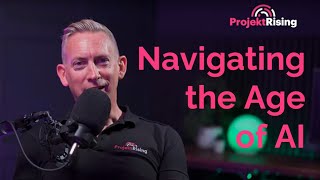
A podcast conversation (host Freya; guest Tim Davies) about the current state and near-term future of AI. Tim argues we are still early in business adoption despite high public hype and investment; expects rapid improvements in multimodal intelligence (text/audio/video) and increasing robotic deployments. He discusses AGI and the prospect of abundance—automation freeing human time—and offers pragmatic advice: companies should identify high-impact problems and run small proofs-of-concept while individuals should experiment with models and raise workplace conversations. He flags ethical concerns mainly around fully autonomous weapon systems and drones in conflict zones.
Will AGI lead to a level of abundance? Well, I think as we're getting to the capability where these models can already perform thinking and analysis tasks better than a lot of people. When that's combined with the embedding within robots and automation, the capability to deliver a lot of the jobs that are done now, a lot of the transport that's currently undertaken by people controlling vehicles, if that gets replaced, what could happen next?
Hi, I'm Freya. Welcome to the Skynet Business in the AI Age, the podcast that dives deep into the world where artificial intelligence meets business. Join us as we explore the latest trends, challenges and opportunities in this ever evolving landscape. From innovative startups to established enterprises, we'll uncover the secrets behind the successful integration of AI technologies. So grab a cup of coffee, sit back and get ready to unlock the mysteries of business in the AI age. What's your take on the current AI hype cycle and where are we really in terms of AI adoption?
Well, yes, there has been a lot of hype around AI over the last 12 months and it's interesting because the news obviously helps with that hype cycle. Promoting things that are are interesting or bad news negative. But also the amount of investment into artificial intelligence companies and tech companies in general seems to be ever increasing. We've seen Nvidia's stock price go through the roof as they're producing these amazing chipsets that power so much of the capability that we're building on now. But we're still really early in terms of artificial intelligence adoption. A lot of people will say, yeah, we're using AI, and they might have created a couple of images on midjourney or spent a bit of time asking a few questions and laughing about the results with ChatGPT. But in terms of business adoption, there have been a lot of proof of concepts, a lot of pilots, but we're still very early in terms of true adoptions that are changing companies. Some of our customers have been on that journey for a couple of years and have made really significant changes, but generally individuals and companies are still very early on in the actual adoption and so the valuation of some of these companies is very speculative. We do expect there to be significant drops in valuations. Some companies will fail, others will be folded and other will get incorporated, but generally there's still a lot more to come.
Looking ahead, what developments in AI do you expect to see in the coming year?
The developments over the next year are going to be fascinating. We're going to see ever increasing capabilities in terms of the intelligence and ability to answer questions within the large language models. The ability to understand content regardless of its modality, so whether it's audio, video, image, words won't matter. And the ability for the models to understand them and natively respond in those same formats will be coming quickly. But we're also seeing developments of similar technologies that are based on different structures. So instead of being based on the transformers like a lot of these large language models, all of the large language models are looking at the ability to understand something based on joint embeddings. So potentially taking a video, making a copy of that video, blocking off part of it, and then feeding millions of these videos into a model to have the model understand the differences between the two videos and in doing so, to build a world model, a level of understanding that these large language models don't because they only really understand words. So we've seen with the text to video model Sora, that it has the ability to understand object persistence, that it has an understanding of physics. We'll see more of these capabilities coming in future releases of technology. And we're already seeing the benefits in that in terms of some of the range robot developments that are taking place specifically with the figure 2 deployment in the BMW Stuttgart factory and how that is working in environments where people would normally work and very effectively too. So it's going to be a fascinating year with lots of technology releases. I think the adoption will still be relatively slow. We are still testing capabilities in many companies, but will move from proof of concepts to prototypes to fully released software and models and robots in a vast majority of businesses.
There's a lot of talk about AGI bringing an era of abundance. What are your thoughts on this?
So AGI, Artificial General Intelligence, is generally described as the ability for an AI model to outperform the average people at the majority of tasks. There are lots of different differing definitions, but really exactly what it means is less important than the impact it can have on society. Will AGI lead to a level of abundance? Well, I think as we're getting to the capability where these models can already perform thinking and analysis tasks better than a lot of people, when that's combined with the embedding within robots and automation, the capability to deliver a lot of the jobs that are done now, a lot of the transport that's currently undertaken by people controlling vehicles, if that gets replaced, what could happen next? So I think we will have a level of abundance in that there will be the ability for things to be done by automation around us. We've arguably had that for many, many years. If you think in your own home about the level of robotics and automation you have, everybody's got robots in their house. They might not realize it, but you have a washing machine, you have a dishwasher, you have essential heating that's on a schedule. These are all forms of automation that over time have become accepted and normal within our lives, but have freed us up to be able to do other things. We don't have to worry about stoking the fire at night over the winter, because a central heating system does that for us. We don't have to manually wash and dry our dishes. We do still have to load the dishwasher, but I think that will change. So as we're getting more and more capable artificial intelligence solutions and robotic solutions using those capabilities, we'll get to a point where mankind has more time. And how we choose to use that time will be fascinating. I've been very fortunate this summer to attend some festivals and spend some time out in nature with my family. And I think those sort of experiences that we can enjoy and how we become more of an experiential species where our time is spent chasing the things that we like doing, will be a fascinating opportunity as AI takes off.
So if AGI does lead to an era of abundance, what will people do when the robots and AI can do it all for us?
So what will people do when the robots and the AI can do it all for us? Well, I think this kind of leans into my previous point. We're looking at a point in time where we potentially have more time, and that's the most valuable thing we have as a species or individuals is our time and how we choose to spend it. A lot of us spend an awful lot of time working, both in a job, but also around our homes. And if some of those tasks that we do can be automated and handed off to other devices or thinking abilities, then why wouldn't we do that? And it'll come down to supply and demand. If enough people are willing to pay for something, then eventually the price of that thing will come down and we'll end up with the ability to spend our time in ways that we choose. How much of that takes us to Ready Player one, where people are sat on devices and playing computer games versus outside in nature will depend on the individual. But I think we have a lot of possibility and potential around us.
For companies that haven't yet embraced AI, what steps should they be taking to prepare?
So what can companies do now to prepare? The main thing at the moment is to look at your business and identify the areas that have the biggest challenge. What are the biggest problems you've got around you in your business? What could you be doing in order to improve that? And that might be coming up with an idea and testing it as a proof of concept. It might be getting a consultancy in to help you discover the potentials of artificial intelligence within your business and what could be automated. But the main thing is really, as it always has been, what are the challenges within the business and what can be done to solve it. And the only difference is that we now have a level of ability in terms of understanding because of these models that can be applied to processes which normally would need people and those people can then be reallocated to better value ad work. So I think it's a key thing is to start small. If you've not done anything, look at the areas where you could do a proof of concept just to test the water on what's possible. If you're a bigger business and you just don't know where to start, then get outside help, get somebody in to guide you through that process of discovery, to look at what's possible, what will be possible and what the best steps are in order to get your people and your data ready.
What advice would you give to individuals who want to prepare for an AI driven future but are yet to get started?
So should people be scared? What can individuals do to prepare? I think this is a great time for experimentation. If you've got half an hour here or there and you're intrigued to see what's possible, then go onto your favorite streaming channel, your social network, choose a topic that interests you and dive a little deeper to see what's possible and then have a go. If you've not already played with a large language model or played with ChatGPT, go and ask a question. If you're thinking about something that you'd search for on Google, try asking an AI to see if you get a different sort of answer. Have a test, have a play, create some images, choose something obscure from the back of your mind that you'd never be able to draw or imagine yourself and describe it using normal language and just see what comes out. I think at the moment now is a great time to test and play. And if you are seeing what you can do personally and then think, okay, how could that be applied to my job? You're probably already ahead of the majority of people within your company, so get a feel for what could be done. Have conversations. Once you've got that understanding with your management team and go, Is it okay if we have a go at this? Do we have an AI policy that means that I can't do this? Have we considered using this tool in this way? Because by doing that, you're positioning yourself for the future and differentiating yourself from your peers.
As someone who is deeply involved in AI, what aspects of AI and robotics concern you the most?
So this podcast is called the Skynet what scares me most about AI and robotics? So I was raised in the time of the Terminator films. I've always loved technology, and I think the potential for individuals, companies, and society as a whole is amazing. But I am disturbed by the use of fully autonomous drones in war zone environments. And seeing what's being done in the battlefields around Ukraine and Russia being talked about in the Strait of Taiwan is pretty scary stuff. And I think when we're looking at fully autonomous weapon systems, those are areas that keep me up at night. But generally, the application of intelligence and robotics in our work and home environments is only a positive thing, and I'm thrilled to see what happens over the next 18 months. SA.
More from Tim

EP 60: Why Founders Become the Bottleneck — And How AI Changes Everything | Thea Brook









