
EP 50: Smarter Selling: Human-led with AI efficiency
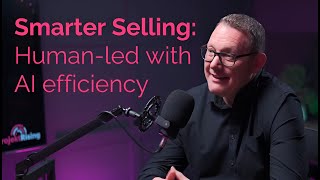
Simon White, a sales trainer, uses ChatGPT daily to draft emails and polish materials while emphasizing what AI can't replace: face-to-face networking and handwritten mail. He's seen clients' conversion rates jump 25% after coaching, and argues that doing what competitors skip—coffee meetings, lumpy mail—still wins deals.
Chapters
Even though I'm out all day today, I'm sure at some point I'll use ChatGPT. I use it every day and it saves me hours, if not probably half a day a week, if not even more than that. It's just improved my writing and it's not just improved the output, but it's also improved me. It's teaching me how to get better at writing. That pushback about another Teams call, another Zoom call. Actually, let's meet for a coffee. There's a lot more of that happening again. I'm finding myself doing more miles, a lot more coffees, a lot more let's, let's meet in person. Yeah.
And I think any organization that isn't going out and networking, doing masterminds, going and seeing their clients, they're missing out on so much opportunity.
Yeah. Found myself saying to my clients a lot this sort of 12 months is you've got to be prepared to do what your competitors aren't. And most of your competitors are happy to send out loads of Mailchimp emails. They're happy to do Teams calls. They love doing all of that. But if you get in the car and go and see people, you pick up the phone, you go and visit, you join networking meetings, you, you, you do things like what we are doing right now, doing stuff like that, putting yourself out there, that's what it's about.
Hi, I'm Freya. Welcome to the Skynet Chronicles: Business in the AI Age, the podcast that dives deep into the world where artificial intelligence meets business. Join us as we explore the latest trends, challenges, and opportunities in this ever-evolving landscape. From innovative startups to established enterprises, we'll uncover the secrets behind the successful integration of AI technologies. So grab a cup of coffee, sit back, and get ready to unlock the mysteries of business in the AI age.
Well, good morning, Simon, and welcome.
Good morning, Tim. Thanks for having me back.
So, Simon White, business Development trainer, trainer of excellent sales teams. What's your preferred way of saying it at the moment?
Developing sales teams. And I'm doing that through diagnostics, consultancy, training, and coaching.
Awesome. Before we dive into that, I want to know the last time you used AI and what you used it for.
I used it yesterday, so that would have been ChatGPT. I don't like typing, so I tend to just talk to ChatGPT and get it to type up stuff for me and then improve the grammar and that kind of stuff. So I would have used it yesterday not in any sexy way. I think it would have been something simple as dictating an email, checking the grammar, and then I'd have copied and pasted it onto the email.
Well, I'm glad you weren't talking to ChatGPT in a sexy way because I don't think it supports it. If you want to go down that path, I believe Grok has a mode that's quite friendly for that.
Yeah, not in an interesting way. It was simply dictating an email, but I would have used it yesterday. I will use it at some point today, even though I'm out all day today. I'm sure at some point I'll use ChatGPT. I use it every day and it saves me hours, if not probably half a day a week, if not even more than that. Plus it's just improved my writing and it's not just improved the output, but it's also improved me because I'm learning. It's teaching me how to get better at writing, you know, because yeah, so that's there. I'd have used it yesterday.
And have you used it to review the materials that you use when you're delivering your training?
Yeah. Yeah. So I've said, I've kind of pasted in stuff that I use and say, is there anything else that I should be including? And that's great because most of the time it's no, you've covered it all. And sometimes they go, well, actually, well, it doesn't say it like this, but well, actually, how about, I think, yeah, that doesn't quite work. Or yeah, that's a really good idea. I could do that. Or sometimes if I might have a day's worth of content or half a day of content, whatever, but I might only need 90 minutes. I'm doing a 90-minute short session. Which bits are going to be most useful? Or can it help me brainstorm an activity that I can use? That kind of stuff. That's something I was using yesterday. I've got, I've got a couple of talks coming up, um, in the next couple of months, and they're sort of, yeah, they're not long talks, like half an hour talks at different kind of business events. And it was just helping me plan out what would be a good title. This is what I want to talk about, what would be a good title, what would be a subtitle, that, that kind of stuff I use a lot. It's like having a PA but without having a PA. I, I love ChatGPT. And my wife, who was very anti-AI when it first came out because she's a teacher and obviously, you know, worried about children cheating and stuff, she loves it now, you know. Yeah, my daughter doesn't like it.
Interesting.
Yeah, she doesn't, doesn't like it. Thinks you should use— she's very academic, she thinks you should use your brain. Um, but, um, you know.
So how old's your daughter now?
She's 17.
Yeah, so she's 17 and she's anti- one of the newest forms of technology. It's interesting, isn't it?
Yeah, yeah. My son's all over it. He loves the tech. You know, when we got here, when I got here today, I took a picture of the tech the guys are here using, 'cause he will love that stuff. And my daughter's not a big fan of AI at all. I'm sure she's used it, but I don't think she's a fan of it. Yeah.
It is interesting, the sort of the natural path that some people take towards tech and where others will push back and avoid it.
Yeah, I've got a close friend of mine, absolutely fantastic guy, very clever guy, but he's resisted having a smartphone all the way through. So he had a BlackBerry, I think that broke, and I'm not sure where he's at now, but he was resisting a smartphone because he used to say the smarter the phone, the dumber the user. And I get that, but, you know, think what all the apps and stuff we use, how much quicker life is. You know, I, you know.
But do you feel like you've got a lot of time back? Because we're saving a lot of time. But do you feel more time rich?
Yeah, because I don't work Friday afternoons anymore, do I? Most of the time it does. There is a bit of creep into that, but yeah, I, I absolutely— it is saving me time. It enables me to either do more work or take more, or finish earlier, or in my case, try not to work Friday afternoons. I think I've only worked one or two Friday afternoons since maybe September, October, so most of the time I'm having that, that time off. So yeah, I am getting that back. Otherwise you just, you're on that treadmill all the time, aren't you? Yeah, yeah, yeah. But I'm not sure I use ChatGPT in the most productive way, but basically I just talk to it, get it to just, you know, dictate my emails and just type it up, improve a few things, a bit of brainstorming. Um, but I don't really use much beyond that. I don't really get it to create— I had it create an image yesterday Um, one of the challenges a lot of people are coming across now when they're cold calling is the pre-screening call if you've got an iPhone. So I was putting together a new slide to go into my, um, training deck, which I, which I wrote, and then I wanted an image of the front of an iPhone with, with my message displayed on it. So I just had ChatGPT just knock that up in, you know, 20 seconds or whatever. So I did use it for that yesterday.
So that Phone screening on iPhone, I love. Yeah, but I'm getting a lot more, um, voicemails than I used to get, and I'm not particularly good at listening to voicemails. But in terms of reducing the number of calls you get, because it goes to that level of filter, you can see and go, well, I'm in a call, but whatever your choice of action is related to that, it is going to change the nature of calling, isn't it?
I personally think it's better for the cold caller. And this is the— and this might be controversial actually, because I think if I cold called you right now and it comes up with a message saying that I need to explain the reason for my call, that's brilliant. I've practiced a, you know, 15-second soundbite. I've made sure it's tailored to you. So I'm not— it does— it sounds like it could be delivered to anyone. It shouldn't be delivered to anyone, you know. And then if you do take the call, it means you're now qualified to a certain level because you know, in my case, I develop sales teams and you've gone, okay, I'll have a chat with him. So some people get scared of it and they're like, oh, another, another reason not to do it. But actually I think it might be an advantage.
Yeah. And it still requires, currently it mostly requires people to actually pick up the phone and make the calls, doesn't it?
Yeah.
And that's been something that a lot of people are very averse to.
Yeah. Yeah.
Obviously we're seeing voice AI creep into this. We've personally been implementing outbound calling for telemarketing, telesales, and a lot of warm and inbound. Do you think that there's going to be more of a shift to AI making outbound calls? Firstly.
Yeah. So in certain sectors, in certain markets with certain products and services, yes.
But, but, and it's the big but, people buy people, don't they?
So I think in the scenario where an outbound call to confirm, maybe some market research kind of calls, confirm you're okay, your car service was— went well, that kind of stuff. I don't think if you're selling complex engineering services, you need to— and you want to talk to production directors kind of thing, that isn't going to come anytime soon. Not saying it won't because AI is moving at such a speed. The challenge with a lot of salespeople is that reluctance to pick up the phone because they've convinced themselves it doesn't work. But actually it does work. It works really well. If you know what you're doing, if you have good data, you know what you've done, you're doing, you've rehearsed it and you're willing to take some notes because the analogy that I always use is imagine you've got a box of ping pong balls and every, you know, is 100 ping pong balls and 90 of them are white and 10 of them are gold. And every time you make a phone call, you take a ping— this imaginary ping pong ball and you open your hand. Oh, it's a white one. Throw it away. That's a no. And if you get enough of those, eventually you'll get a gold one. And that's, that's a nice way of looking at it. So most of the people we speak to, the timing's not right or they don't have a need or whatever. So we're only talking to a small amount of people each time. And a bit like going to the gym, the hardest part of making a, of doing a cold call is that first call, is picking up the phone. And once you've done that first call, the second call is a bit easier. And if you've done 10, now you're into the rhythm. Going to the gym, if you can just put your trainers out near the front door or get your kit ready the night before, the chances of you going to the gym are much higher. You know, one of the things I've been trying to do a lot more is drink a lot more water. So if I put a flask of water next to the bed, when I wake up in the morning, I'm much more likely to drink it and have my vitamins because they're next to the bed than if I have to go downstairs and do it. So I think AI calling is going to be great in lots of sectors, but not necessarily all sectors. And interestingly, and I believe this is the same in lots of businesses, is that pushback about, right, another Teams call, another Zoom call. Actually, let's meet for a coffee. And I think a lot— there's a lot more of that happening again. I'm finding myself doing more miles, even though most my clients are relatively local, a lot coffee is a lot more. Let's, let's meet in person. And that's great advice for most businesses.
Absolutely. I mean, we're a fully remote company, we deliver our services digitally, but the majority of our work comes from warm connection, from meeting people in person.
Yeah.
And I think any organization that isn't going out and networking, doing masterminds, going and seeing their clients, they're missing out on so much opportunity.
Yeah, yeah. I've just joined another networking meeting, networking group myself. So that's two I'm now going to. After this, I've got a meeting, a guy for a coffee in Peterborough. It, it, yeah, people want that face time.
Yeah.
You know, that is, and in the selling process, if you don't ever meet your client, your prospect, so you're going to meet them initially maybe on a phone call or a Teams call, then you're gonna email them a proposal, then you're gonna follow it up via email, et cetera. Your chances of winning it are much lower than if you say to somebody, be great to come to your offices and have a look around and get to meet you in person. So when you go there, you might— you're going to meet them. They might introduce you to other key people who are part of that buying group. You— that might spark other conversations. You're going to have a deeper, a better opportunity to do a deeper discovery call. Then you prepare the proposal, and if it's over a certain value, then it's definitely worth going back and presenting it in person and walking them through it and answering any questions. And if you do all that, your chances of winning are much higher. And I always— a line I've I've been found myself saying to my clients a lot this, this sort of 12 months is you've got to be prepared to do what your competitors aren't. And most of your competitors are happy to send out loads of Mailchimp emails. They're happy to do Teams calls. They'll chase via, they love doing all of that. But if you get in the car and go and see people, if you pick up the phone, you go and visit, you join networking meetings, you do things like what we're doing right now, or you stand up and do, you know, I'm doing a networking group in in March, and I'm the guest speaker. Doing stuff like that, putting yourself out there, that's what it's about. Because I can bet you—
you're going to March.
Yeah, um, I've got booking now into June for that as well. Um, but that's, that's what it's about, putting yourself out there. And even, you know, some of the stuff we often talk about is, is the lumpy mail, putting stuff in an envelope and actually posting it out. And often I'll get resistance from marketing people going, oh no, no, we're doing email. No, no, everyone does email. Every prospect you've got has got 100 emails in their inbox or whatever. You put something in an envelope and it's meaningful and it's memorable and it, and it relates to the copy you've written in it and you put it in the post, or even better, you go and hand deliver it to their office, which reinforces the fact that you're local or whatever it might be, or they're in your territory. That's going to do a lot better than an email.
I was chatting with a young gent who's about to start an AI agency.
Okay.
And he's 18 and he's got great capability but didn't know how to find his first customer. And I said, well, within 3 miles of your house, how many businesses have you got that could be a potential customer? Oh, well, there's loads. Why don't you pick 10, find out the name of the most senior person at that site, and write them a handwritten letter. Say that you're just starting out, here's some of the skills that you've got, here's some of the things that you can do for them, would they be open to a meeting? Will that work? I was just going to send emails, I was just going to send messages. Don't even bother with emails, people don't read them. Yeah, yeah, people open handwritten letters.
Yeah.
And I recited the example of somebody who sent the right arm of a mannequin to a FTSE 100 leader saying, I'd give my right arm for a meeting with you. And they got a meeting.
Yeah, yeah.
You've got to find a way of cutting through.
Yeah.
And so all this sort of content helps in terms of the know, like, trust, but actually breaking down barriers requires you to be different in terms of making that initial interaction.
Yeah. And that was such great advice for that, to that young entrepreneur. And if he doesn't get it with those initial 10, he does another 10 and he tweaks the copy or whatever he, whatever he might do. I had the same experience with my daughter in the last couple of weeks. She needs some work experience, um, so she sent an email, didn't get a response. So I said, right, print it off, let's put it into a letter and go and hand deliver it. She went and hand delivered it, you know, got an interview, got the work experience because she turned up at the door. Because again, her competitors, her colleague, uh, peers at school would have just emailed.
Yeah, or just clicked the apply button on LinkedIn, be one of the tens of thousands of CVs that is written with AI that's been screened by AI. Like, how do you break through?
Yeah, yeah, it's— it— you see, you often see that on LinkedIn, people saying, you know, I've applied for 100 jobs, 1,000 jobs, whatever. And I think, well, how many direct messages did you send to the managing director of that business saying, this, this is my situation, this is my skill set, would you be open to a coffee? How many of those did you send?
Zero. Yeah, it's the path of least resistance a lot of people follow. And actually, if you push your boundaries, you stretch, and you actually try to interact with people, that's where things happen.
Yeah, absolutely.
We can't just hide behind technology. Well, we can, but if you do, then you're not going to achieve anything significant.
I said, and yeah, we often talk about that, you know, as you said to that young, that young guy, you know, looking local to where you live. Why prospect a company for us? You know, we're in sort of, you know, Peterborough area. Why prospect a company in Edinburgh when you've got to drive by 10,000 companies to get there? You might as well just pick where you live and radiate outwards.
I was thinking March is a bit beyond your usual travel distance.
Oh, so when I said March, I meant the month of March.
Actually travelling into the feds.
I'm going to Cardiff in February. There you go. Yeah, I'm okay with that. So, but yeah, most of my work is Northamptonshire and surrounding counties.
Yeah.
Unless it's a very interesting project, which of course I'll go further afield.
So you get to work with all sorts of companies on improving the delivery of their capability of their sales team. What's the standout example of the transition that a company's made from from, let's say, underperforming to outperforming in their sales process?
Well, I've had clients with— have really quick wins. I've got one company in Northampton where they have— they've been a client of mine for maybe 18 months, and they have— their sales guy has 2 hours with me every month, a 2-hour coaching session every month. And within 3 sessions, he'd increased his conversion rate by nearly 25%, his email response rate by 11%, and a load of other stuff. And as a person, he's a totally different guy now, 18 months later, as he would say. And that is what's been wonderful working with him, because it's not just the KPIs, the figures that have changed and how their sales figures have changed, it's how he's changed and how he's developed. And, you know, he says to me, You know, even members of his family say how different he is, you know, now, 18 months later, than how he was. And that, for me, is, is as important as anything else. He will be— he's an incredible guy, and he's only, only a young guy in his 20s. You think how amazing he's going to be when he's 30s, 40s. I mean, he's going to outshine the rest of us. He's incredible. What's wonderful about him is he made lots of notes and he made lots of changes. He didn't just go, that was interesting. He actually went, okay, I like that, I'm gonna work with that, let me get back to you. And then he— that's what I love. So that's probably— that's a good example with him. Didn't just change the business, it's changed him as a person.
And that's amazing, isn't it, when you can see that growth and you know the impact it's having to them in the short term, which will lead to better life experiences. Yeah, wealth and health likely off the back of it too. But fundamentally, you've just made a little change in their mindset And it's helping your client but changing their life.
Well, I remember once I was, we were walking there, their, their offices on like the first, first floor of this building. And he's walking me back down into the reception area. And as we were kind of walking down, he did, it was maybe the one before Christmas or something. It was quite recent. He said, he just said, and he just said, you know, you've made a difference to my life. And I'm, I was welling up a little bit because I thought, wow. I'm there to impart sales advice and techniques and strategies and stuff. But that just made— but really, Phil, that made me feel really good.
Yeah.
Um, but I couldn't have done it without him because he was 90% of that equation, you know, or a lot of it, you know. Yeah, maybe not, not quite 90%, but, but I, you know, I can give the same advice to two people. Yeah. And one of them will run with it and do incredible and the other one won't.
And so you still see both sides of that, don't you? You see people who absolutely shine as a result of the coaching and training that you're delivering, but there'll be others where there isn't a change, where they're resistant.
I had one guy, and this was a few years ago. I can't imagine he'd watch a podcast to learn anything, so he won't see this. Um, but, uh, you don't want to name him just in case? No, I'm not naming him. He was a big fella as well, so we won't name him. And, um, I'd been working with his, with his employer for years, many, many years, and they had this new guy start, but they didn't want him coached or any support for him because he, he had quite a good reputation in the industry. So they said, oh no, he won't need anything. And then a while later, 6 months later, he's not performing, so they— can he have some sessions? And in this first session on Zoom, because he's based quite a distance away, It was that Friday afternoon and he comes on. He'd met me before because he'd been in some classroom training sessions with me before with his team. But, and I said, right, so it's our first session. So can I ask, what would you like to get out of these sessions we're having? And he looks at me and he goes, Simon, I've been in sales 30 years, you know what I mean? And I'm like, that's, and that was it. He was just closed off after that. He didn't, there's me saying, what do you want to get out of them? And he's telling me he's been in sales 30 years. And, and he hadn't. I said, what does that mean, you've got nothing new to learn? He goes, well, 30 years, you know what I mean? And he had maybe—
I do know what he means.
And he had maybe, uh, I don't know, 3, 4, 5 sessions with me. And in the end I had to say to his MD, I said, I can't do anything. He's just not— just doesn't want to learn it. He's got a closed mindset. He doesn't want to do it. I can't do anything with him.
And is he still with the company?
No, no, he, he was gone within a week or so of that. Of that, not because of what I said, but because that's the first time in my career that I've said that to somebody. Yeah, I've never said it since. And that was a few— that was maybe 3 or 4 years ago. I couldn't do anything with him. He didn't want to learn. He didn't want to get better because he thought he was already the finished product. And that's, that's a problem. None of us are the finished product. You and I, who've spoken about this before, we learn every single day. We all learn something new. I'm learning about sales. Every day I'll learn something. Maybe it's on LinkedIn. I see a different way of wording a question, or I was listening to a podcast on the drive over here this morning, and that podcast was with Tony Robbins. So there's always something to learn there. There's always something to learn.
I think we probably listened to the same one, although I listened to it on Sunday.
Is it Diary of a CEO? Yeah, that's what I was listening to. Yeah. But yeah, I mean, there's always something to learn. But there are people out there who don't want to learn new stuff. A question I ask Um, when I— I did a couple of interviews last week interviewing salespeople to work for one of my clients. Uh, we're doing the follow-up interviews this week, but when I'm interviewing salespeople, I always ask this question: what pod— what sales podcast or business podcast or sales-related book can you recommend? What's the last one you read that you enjoyed? The amount of people who can't name one is astonishing, really. It's a question I always ask, always ask it when I'm doing one-to-ones with people, before I start training them, when I'm doing my motivational maps and diagnostics and stuff. I always ask them, name me a podcast or book that you can recommend on sales that you think I'll enjoy. Oh, they can't. And it's shocking.
What's the most recent book or podcast you've listened to? Obviously apart from Diary of a CEO on sales process.
So last week I, as I listen to a lot of audiobooks, I was listening to The Qualified Sales Leader. Now, that's a very interesting one. The first 7 or 8 chapters are like, I was thinking, mm, you know, but actually as you get further into it, some of it is confirming what I already know, which is great. And that's worth reading from that point of view. But there's, this guy has been a chief revenue officer for lots of different businesses. I can't recall the author's name. But you think, well, if I, you know, there's always going to be one or two things from a, from a book. And you think, if I can just get one or two things, that marginal gain, that's the win. I don't need to learn 10 new things, but I can learn one new thing. So yeah, so The Qualified Sales Leader, uh, it's kind of a, um, an orangey-red cover to the book, but I, I'm listening on Spotify. I haven't finished it yet. I've dipped out of it to listen to this, uh, to Tony Robbins. Um, I needed a break.
It's a good session, that podcast interview. I'm currently reading 24 Assets by Daniel Priestley.
Oh, okay. So I've made you—
yes, obviously a fan of quite a lot of his work, but it's another good read. But take me a while to finish it because it's just in and out. I actually do read, but finding time to read is sometimes challenging.
So you're reading it in a real book?
Yeah.
Do you write in that book? Do you actually use Post-its, or do you actually write in the margins? Okay.
You don't like to damage books.
I know, that's what was growing up, wasn't it? You couldn't write in a school book, but I write in the books. So some of my favorite books have just got the highlighter pen or pencils, whatever, and I'm just going through it and I feel a bit naughty. But yeah, I'm just going through. Yeah, so I, I don't stick in Post-its very often. I'm actually writing on the page.
I'm still a big believer of collecting books, and I'll get asked occasionally, do we actually need all of these? No.
Yeah, but yeah, so if you could only read one business book, you know, you're, you know, the old desert island scenario, you're going to take one business book with you that you've already read, what are you going to take with you?
I think probably The Lean Startup, which I think is Eric Ries. Um, it's just a mentality shift on how you approach starting and scaling businesses without throwing lots and lots of money at it.
Yeah.
It's the ultimate counter to the VC Silicon Valley approach of just throwing money at it. Although they still practice a lot of what's in there.
Okay.
Of just how can you be efficient? What processes can you follow in order to make businesses scale? It wouldn't have a lot of applicability on a desert island. I'd actually rather take a book on how to build wooden structures that are gonna survive storms, but I don't have that book yet.
Yeah, yeah, yeah, yeah. A book that I often recommend books. So at the end of a training session, um, because they're all themed on different topics, obviously I will recommend different books. And again, how many of those delegates go out and buy that book, or how many of them don't even write it down, you know? And again, I'm, I'm always watching people. If I recommend a book, obviously I don't have a pen and pad here, so I can't write down the ones you've recommended, but I'd normally write down you know, and research them. And then whether I buy them or not, I don't know, but certainly I'm looking into it. But I always recommend books.
Yeah, we don't need to write anything down from this one. It's being recorded.
Yes. But yes, so I will always recommend books. And then after a training session, I will then normally email their line manager, their sales director with, you know, this is what we covered. These are, you know, my observations. Here's some books I'm recommending as a follow-up. I will, I will put those, those together as well.
So are you working on a book, writing a book myself?
Not yet. Um, I've got all the content in the world that I could. I've probably got nearly 700 slides worth of training, taking everybody from, from managing pipelines through, you know, prospecting and writing proposals and using LinkedIn and closing and objection and qualifying and everything, and how to structure sales meetings. I've got it all. I just at the moment don't feel I'm where— my head isn't where it needs to be to actually start the process. I like the idea of doing it. Um, you and I have mentioned it before, and you've kind of shared with me how I can use AI to help get some of that stuff down into a, into a, into a book format, but I'm not there yet, but you are, aren't you? Am I right in thinking that?
I, I would say I'm in process.
Okay.
Um, I was— I started one after our friend Joe passed, um, on the concept of sort of preparing for the later stages of your life and the end of your life.
Yeah.
And then that's got distracted by one that I'm writing on how you apply AI within business to create unfair advantage. Neither of them are at first draft yet. Well, I guess actually the pre-mortem one probably is, but I haven't shared it for that review. Um, I think the AI one will come first. Yeah, yeah, just because there'll be a time window on where the content in that is applicable. The fundamental processes will last, but yeah. And I never thought I'd be a writer. I never thought I'd be a teacher. I never thought I'd do sales. Yeah, so all the things that you sort of avoid as a a geek. Yeah, lover of computers. You end up, oh, actually parents are teachers and I'm ending up teaching people how to do something.
Yeah.
And I hated sales. I still hate the idea of sales, but actually sales is just telling something people that they need to know that is a benefit to them.
And that's it, it's just helping people. It's just communication, you know. And I've got, I've got professional services clients who don't like the word sales and actually don't like it even used when I'm there. And words like closing, I'm not really using. I'm using, you know, gaining commitment, for example. But I think I will write a book. I will write a book in the next 2 to 3 years. I don't feel I'm quite where I want to be yet. I've got all the— when I'm ready, I can literally take some sort of AI voice you know, note-taker with me to a training session and it can just sit there and listen to what I say because that's my voice and that's my how I do it. And if it records me for 3 and a half hours in a training session, that's, that's, that's quite a few chapters. And if it does it, you know, so I've got all the content, it just probably isn't in the right order at the moment. And I don't think I'm quite there yet. I think there's still some more things that are going to come out of my mind. I've come— I've created quite a few frameworks and things that I, that I've completely created myself from scratch. And I, and I think that— but I think there's more, more of those to come out. So when I've got a few more things that I've created— so it's all right, you know, you— I'm sharing my experience, I'm sharing advice that other people have given me, best practice from different books and things, but I, I want more of the book to be my own, my— from me. And I've got, I've got a lot of that but I want even more, you know. So yeah, so it's there, yeah. So, so with your book then, your AI book, when is that gonna— when do you think, if you had to put a timescale on it?
I, I've made commitments and failed to keep my commitments on that book to, um, our mastermind group. Um, it's an interesting one. I'm, I'm part of an accelerator where every 2 weeks we do a sprint on something, and the sprint that starts today is refocusing on the book. So I've no doubt that will kickstart my energy.
Yeah.
Um, I've probably got two-thirds of the words down in a way that I'm comfortable with them.
Okay.
Got the chapter structure, got all the examples. So it's making good progress, but it's then making sure I put the attention into that when there's so many things that can pull my attention currently.
Sounds like you're a long way down the— a long way down the, the path on that. So that you've done a lot of the heavy lifting already.
Yeah, but I've cheated. So I've used a piece of AI software called Bookmagic, and it, it really is quite powerful.
But you're an AI guy, AI expert, talking about AI. Of course you're going to use AI. It's just, it would be random if you didn't, right? Um, you don't have to share this. I'm sure it's confidential at this stage, but if you've got a title for the book—
I do. But I don't have the subtitle refined quite yet. I'm still wordsmithing that, um, because that will make or break it.
Yeah, I think, you know, they say don't judge a book by its cover for the reason that actually that cover, that, that title of that book could be incredibly compelling, and then the content isn't, or vice versa. The content could be amazing, but, um, I saw somebody had written a book and the, the, the The name of the book was just, I thought it just didn't do it for me. But you know, a book that if I was on that desert island, a book that is a silly little business book, it takes you about an hour or so to read, but Who Moved My Cheese?
Oh yeah.
Do you remember that, right?
Do.
Well, that'd be great on the desert island 'cause it's about not waiting for the coconuts to fall in that scenario. So it would probably be helpful. But Who Moved My Cheese? What a great title for a book.
Yeah.
You know, and you know, and I, I like, I share that with teams as well, you know. If they're stuck in a rut, well, read that book. You can do it tonight, you know. Um, but Who Moved My Cheese is a great book. Another one by Chris Voss, you know, the FBI negotiator, Never Split the Difference.
I've heard the title, I've not read it.
An incredible book, incredible. So Chris Voss, uh, lead negotiator for the FBI, leaves the FBI and writes this book, and it's called Never Split the Difference. Because obviously, normally in business or buying a used car or whatever, you might say, well, The car's, you know, £1,000 and someone offers you £900 and you go, well, let's split the difference, call it £950. You can't do that in hostage negotiation, can you?
You can't say, well, here's half an arm.
Yeah, you've got two hostages. I tell you what, keep one, we'll have the other one back. So that's why it's called that. But in there he shares some really simple techniques for hostage negotiation that you can use in sales and business. Some really powerful ones. That I could teach you— well, not teach you because he taught me, you know, in the book— but I could share with you now, um, one that I could summarize on one slide of a PowerPoint. But if you do it consistently, you will build better rapport, um, have better conversations, people will feel heard, etc. Just— and it's—
well, you can't lead with that and then not share it.
Well, he calls it— it's called— he calls it mirroring. Now, it's not mirroring like you're on a first date and, you know, she touches her hair and you touch your hair and she leans forward, you lean forward. It doesn't mean that. It's verbal mirroring. So it's as simple as when your counterpart is speaking, when they stop speaking, you repeat back to them their last 1 to 3 words, no more than 5, back at them with an upward inflection in your voice at the end. So you're like asking them a question. So if I go home today and, um, I say to my son, you know, what was your, what was your best lesson today, Ben? And Ben goes, oh, today, Dad, it was, uh, science was my best lesson. I would just repeat back, science? And he might then continue and say, yeah, we were using the Bunsen burner to heat up lots of different liquids. Different liquids? That's all you're doing. It means that you pay more attention because you're not sure when they're going to finish speaking. They feel heard, and I promise you, they will never ever ever spot that you've done it. Um, and it builds that rapport, and it's— no, yeah, the only time they spot it, because I, I do this, so I, when I do active listening with my clients, um, we'll use this technique, and I'll say, go home tonight and try it on your, your spouse, your roommate, your friends down the pub, whatever. And then when I see you next week, tell me how you've got on. And there'll always be Obviously some people hadn't tried it, obviously. There'll be some people who go, oh yeah, it worked brilliantly. And there'll always be one or two when, yeah, I tried it on, I tried it on my wife and she spotted it straight away. So then we unpack that a little bit more and it's like, well, if you've never asked your wife how her day at work went and now all of a sudden you're being really attentive, she's going to spot it and that's the problem. So yeah. So if you are going to try it with a spouse, and you've never asked how their day went other than, how did your day go? Yeah, it was good. All right, all right, we went for tea. Then, and you start mirroring them back, um, that they will spot it.
And potentially anybody else who's been NLP trained.
Yes. Yeah. So verbal mirroring is a brilliant one in there. He talks about reverse psychology questions, he talks about labeling. There's— and what is lovely about Never Split the Difference is it's not your normal business book. He's talking about bank robbers and terrorists, so it's entertaining as well. So yeah, so I would highly recommend that to yourself and any listeners. Never Split the Difference. And again, don't try and remember 5 techniques or 10 techniques. Take 1 or 2 away that you can put into practice, and that's the win.
So if you were delivering training to a group of 18-year-olds who are just finishing school where they don't really teach networking, yeah, they don't teach public speaking particularly, they don't teach sales, what piece of advice would you give to them and how many of them do you think would actually pay attention?
Well, I, I do the occasional guest lecture. I did a couple, I've done a couple at, uh, Northampton University. I've got another one coming up at a college in the next few weeks. And it's about networking, really. That's the advice. Get out there, start networking. And a question I always ask people is, put your hand up if you've ever been networking. And actually, every hand should go up because we all go networking. We're networking here today. You know, I was chatting to the guys here, uh, production team before, before you arrived. And we're just chatting. That's networking. As you know, I've got a few clients of mine that have come through my children's hobbies, you know, all the school gates and All of that's networking. It doesn't have to be a bit of an organized business event or anything like that, but it would be to have more face-to-face conversations, to get out there and put yourself out there. Yeah, that, with that old quote, you know, net your network is your net worth. It is so important. And it's not necessarily the best person who wins the business, it's the best known person. Um, so, so getting out there and looking for events, looking for opportunities to, to get outside your comfort zone, a comfort zone and do a talk. You know, for some people, going to an organized networking breakfast meeting and having to stand up for 60 seconds— when you and I, we've been to lots of these— some people will read it off their phone, some people will have a piece of paper, some people will miss the majority of the content and just presume everybody in the room knows what they do, even though there's visitors and they're not really addressing them. But actually, just getting up there and doing that kind of stuff can be really daunting. But getting used to doing that is incredible.
Game-changing.
Yeah.
It's interesting. I took my son along to B&I in Peterborough where there was 50, 60 people in the room.
Yeah.
And he presented about the escape room that he was working at the time. And then when he applied for his apprentice role that he's in currently, in the interview when he was asked about presenting, he talked about not just presenting but presenting to 60 businesses.
Yeah.
At a breakfast networking meeting, was able to share about it, and that confidence shines through.
Yeah, yeah.
But getting to the point of being comfortable speaking is challenging.
Yeah, yeah. I remember my first 60 seconds when I was in my 20s or whatever, my heart was jumping through my chest and it was just crazy. But then I did one last, last Tuesday, and I just, you know, uh, when I was at this new networking meeting I'm going to, didn't even faze me at all. Didn't even— just stood up, and because it was a weird-shaped room, I walked up, stood up, walked into the center of the room, and just spoke for 60 seconds and shared a sales tip with them as well and sat down. And a couple of people came over to me afterwards and said, oh, actually, can we have a conversation? Yeah. And that was, you know, just from doing that. But I don't know if you recall, I don't do it now and I can't do it now, but I used to be a magician before you were going to pull out coins or a card. Then the sound guy will kick off and start dropping coins on the table. But I used to be in the close— I used to be a close-up magician, used to be in the Magic Circle. And you can imagine, you're going to be doing an event, award ceremony, rugby club dinner, something like that, and you walk in, you are nervous because tricks can go wrong, okay? You can drop the cards, you can drop the coin, you can whatever. There's a good chance— I mean, it's probably a 10% chance every trick goes wrong, you know, because of nervousness, your hands are sweaty so the cards stick together, or, or you're cold and therefore you can't even grip the cards properly because sometimes you might be showing a card but really you're showing two cards, but they're only, you know, that kind of stuff. So that was a really good, really good for me to get confident because I was starting to do that in my 20s. So to get confidence in walking in a room of 100 people you're walking up to a table of maybe 8 probably drunk rugby players, and you, you know, and I walk in and go, hi everybody, I'm Simon, I'm a magician, I've been asked to show you a trick. And they're like, what's this? So doing that kind of stuff, although it was great, you know, showing off the tricks and stuff, actually for my own confidence was amazing. But my little tip, when I'd go to an event like that, I'd look for the lone wolves. So it would always be somebody on their own who think, okay, I'll start with them. Then if it goes wrong, only they know it went wrong. Or, you know, that, and then once I'd got done that, I was now on a high. I was like, right now, now I can face the drunk rugby players.
Yeah. The drunk rugby players are always gonna give you feedback and that feedback's critical, isn't it? So that you can learn from it.
Yeah.
It might not always be obvious or in a written form. Sometimes it's gonna be verbal. Sometimes it's just, Yeah, but it was good banter.
It was— you could have, you could have really good banter with them. Yeah. And I'm fortunate because I've always been a big guy, so it wasn't like I was, you know, a real little guy and they were intimidating me or anything. So I was— it was more of a level field like that to a degree. Um, not that I take on a rugby player, obviously, but, uh, but there was always good banter. And I, I, I don't think I, I never had a bad experience. I, yeah, you might have one or two tricks over the years that would go wrong, but then you would just make a joke of it. And I had a couple of really good one-liners that I'd use if anything went wrong. But I never had a bad experience. Most people are there to enjoy themselves in that scenario. But it's great for your confidence. So when you go networking now, or you're standing up in a room doing a presentation like your son did, 50, 60 business people, which is really scary because, you know, it's just a lot of people looking at you and you're worried about your throat's going dry and you're not sure, you're forgetting what you wanted to say. You might have rehearsed it a bit, but now you can't remember it. It's great practice. Yeah, yeah, that's great for him. And he's not very old, is he? Late teens, isn't he? Early 20s?
Yeah, he's 19.
19. So incredible to, to do that. That— I couldn't have done it at that stage.
Yeah, you could.
But I never, never did it at that stage. He's probably— yeah, but I remember just, you know, at university presenting something to, you know, 8 people in your tutor group or whatever it was. You know, if you jump, your heart's jumping out your chest. But, uh, that's brilliant.
I think now with technology, it's getting easier to practice.
Yeah.
And so if you're able to practice and get feedback, you can do that in isolation.
Yeah.
It's still never going to change the nerves when you go to a big room though.
Yeah.
And it doesn't matter how much public speaking you've done, you're still going to get that ball in your stomach. You're still going to get nervous occasionally. But breathing techniques and focusing on knowing your content makes a huge difference, doesn't it?
Yeah. Well, because I knew last Tuesday that I was going to have to do 60 seconds. And one of my clients was taking me as her guest, so she picked me up. And whilst I was waiting for her to arrive, I thought, okay, what am I going to cover in this 60 seconds? So I just ran through my 60 seconds twice whilst I was waiting for her to pick me up, and that was enough. And actually, I could have changed it to anything on the day, it wouldn't have mattered because I know my topic. If you asked me to do 60 seconds on zebras or something, I would—
challenging.
Yeah, I was like, oh, I don't know anything about zebras, but 60 seconds on sales, you know, I've got a lot of content. So and what I'm trying to do when I go networking is always share one piece of advice each time so they don't just get, I know I'm Simon White, I develop sales teams, blah blah blah. And now I'm going to share something that's going to— that you can use today. Oh, wow. And that, that's what people want. They get value from every session.
Tips, examples, and storytelling.
That's it.
If you can share a story that people then go, oh, that 'Oh, that applies to me, I do that.' Yeah. Then you're no longer just somebody saying something that can be ignored. You've got into their mind a little bit.
Yeah, absolutely. Yeah, agreed. Yeah. I love, you know, facts tell, stories sell. I love stories. All my training is full of anecdotes and a lot of it is the mistakes I've made or mistakes I've witnessed or whatever it might be so that they don't do the same. I always say, you know, I'm going to teach you all the mistakes I've made so you don't make them.
So you have the choice not to make them.
Yeah, that's it. Yeah. Yeah. Because, you know, we've all made every mistake going. It's all right for me to stand up in front of a room full of people and say what sales should be like. But actually I've made all those mistakes. I have done that bad cold call. I have been to that meeting and not asked the right questions. I have forgotten to follow up. I've, you know, whatever it is, I've done it. It should be. I'm nearly 50. Yeah, of course I've made those mistakes. Make them a lot less now, but you know.
Yep.
Yeah, so yeah.
So what does the next 18 months look like in terms of the technology impact in your business?
Yes, that's interesting. I think lots of clients are curious about AI. I think a lot of their teams are using ChatGPT, Copilot. I think that a lot of them are finding Copilot to do a little bit more than, than they thought it could. I think they're going to start improving processes. I think maybe their alignment between their CRM system, some of their other systems, will be improved through AI. Whether it affects the, the salesperson on the, on the, on the road, on the call, at this stage I'm not so sure. I think maybe helping them with certainly in role plays, helping them overcome objections, that kind of stuff. I think AI is underused like that. I think AI, you know, take that 60 seconds. If I spoke to ChatGPT, for example, gave it my 60 seconds and then said, critique that, you know, you're an expert in sales, you're an expert in business networking, critique this, tell me how I can improve it, time it, are my words per minute Am I talking too fast, too slow? I think that kind of stuff as well, anything like that. Um, so in the next 18 months, I think we're going to see improvements. I think a lot more people are going to be using it. I think a lot of people, even myself, use AI superficially. I think we're going to use it deeper, deeper. Maybe a lot of people— one of the things I talk to my clients about is obviously having inbox zero, or certainly being top your inbox, but actually using AI to sort through your emails, drafting replies for you to check. All that kind of stuff I think is going to be more commonplace. Yeah. I think for certain sectors, using AI on the outbound calls, on the inbound calls. I tell you a sector I wouldn't want to be in right now, anything to do with chat boxes, chatbots, you know, on a website where you, you know, you type in a query. I think that's going to be all AI. A lot of them are used to have human people any human operators on that. I think that's going to be— that's going to be reduced, reduced, reduced. Certain sectors will need humans, but I think a lot more AI on that. So yeah, I think change is inevitable in everything we do. Um, we just need to adapt to it. That's, that's the thing. Um, what about you? I mean, you're the expert in it. Where do you think it's going to be in 18 months?
I think Every example that we have now is as bad as it's going to get.
Yeah.
So if we look across the different modalities of text, image, audio, video, code as a form of text, the ability to understand and produce those types of output is improving all the time. So you can already produce code that's better written than written by the majority of developers. You can write reports that's better written than the majority of report writers. You can create images that can fill gaps where you don't have the ability to get on site to take photography. You can produce brand videography that is appropriate for scenes that you couldn't afford to film, or to fill the gaps between shots that have been made in order to make something that you were unable to actually capture but was in the imagination of the creative specialist. And that's just going to continue. But for me, the interesting thing is when it cuts across those different modalities.
Yeah.
So you were talking about getting feedback on, um, public speaking. Yeah, we've got a public speaking coaching app which we're launching in the next couple of weeks, Orator. And it— you record a session, it's got modes that are specifically tuned to different forms of networking groups, so you have the, the template for that type of presentation. And then it assesses you based on how you've performed— body language, eye contact, emotional delivery, filler words, the content that you've chosen— and scores you across a series of different metrics and provides feedback on how to improve, and then gamifies that so that an entire networking group can compete to see not only who is the best public speaker that week but who's improved the most.
So it's not just the audio, it's actually seeing your body language as well.
Yeah, so it's analyzing the, the words, it's analyzing the body language, it's analyzing the movement, it's watching where your eye contact is and scoring all of those on a series of different metrics and then feeding back. And that's just being applied currently to public speaking, but it could be applied to almost anything, be anything in the sales process, from the cold calling to how you conduct a first meeting, etc.
Absolutely.
Conduct So I showed my dad an early prototype, and he's been a choral director all of his life, and I'm showing live how it's mapping hand movements and showing what the hand movements are.
Oh wow.
He's like, but that could be applied to improving conductors' performance within choirs and orchestras. And it's obviously a far smaller niche than public speaking, which is the number one fear of the majority of people on the planet.
But I had a crazy idea just popped into my head as you described I mean, what you've done with your father there, it could be used for poker players to spot their tells and things like that. You know, at what point did they have a good hand and what— how did they tell the rest of it? All the— it's— there's so many great applications.
I bet the casino's already doing it to spot for cheating.
Oh yes.
Yeah, yeah, because there's so many indicators, aren't there?
Yeah, yeah.
And obviously they're playing for huge money, so they've been very heavily video monitoring the people playing for years. Yes, but you can pick up almost anything. And so the, the use of what is a simple application of technology— can we extract this insight from video, from words, from hand movements, from body language? And if you can, how can that then be applied? So we're just going to see it cut across in ways that we can't really imagine. Where new applications will be made that just come from one of those really simple capabilities applied in the right way to make a significant difference to a business.
Amazing. And it's incredible. Yeah. And that's launching in a few weeks. You're—
Yeah. In fact, I believe today it's being presented to the founder of BNI in Hawaii. So there's 3 of us that formed the, the structure behind it and come up with a concept.
Yeah.
Somebody that I met at the BNI global conference in Hawaii the first person I spoke to there, and we've started an app together.
Brilliant.
Um, and then it's—
well, there's the power of networking, although that was also the power of leaving your, your immediate area and going to Hawaii.
But, um, you've got to put yourself out there, and you don't necessarily know by putting yourself out there what will happen. Um, you go to an event, you have a conversation with somebody, something might happen. They may refer to you in 6 years' time to somebody that they've known all their life. You just don't know.
Yeah, and it's a big investment in going to Hawaii to do it. And you had to— you were a speaker there, were you, as well?
We sponsored that. So we sponsored the VIP lounge and put a stand up and brilliant, talk to the people. As we were right by the entrance to the main hall, so we got to talk with loads of people while we were there. But it was an opportunity to see a part of the world that I'd never been to before.
Yeah.
And to meet new people who might be able to change lives with.
Yeah. Brilliant. And so it's funny you say there, you know, you, you plant these seeds and you might not harvest them for 6 years or, or if at all. But I'm going to be 50 in a couple of weeks' time and I, and I suspect I'll still be in, in this business or a version of this business in 20 years' time or whatever. So it doesn't matter if I meet somebody today and they pass me a referral in 19 years' time. It doesn't matter. It doesn't matter because this is all I'm doing. Or a version of this as it evolves.
But it's the power of network, isn't it?
Yeah.
It's not what you know, it's who you know.
Yeah. I mean, I, I've got clients of mine now who were clients who, when I was in my 20s, I mean, you know, um, yeah, we, we know somebody who's recently joined our, um, our, our mastermind group that we're in, and I remember selling to him when I was 24. I remember I just got my first company car, my, my new Audi A3, and I drove to his office. He's a few years older than me. He was sales director. I'm this young sales guy still trying to work out how it all works. And I remember selling to him when I was 24. Well, I'm 50 in a couple of weeks' time and I still work with him all these years later. And I've got lots of people that I sold to in my 20s that are clients of mine now because it's that know, like, trust that you mentioned earlier. They know me, they like me and they trust me. And what I do now is a different business to what I was doing in my 20s, but they still, you know, trust me to help them now. And I love that, that, um, you know, I still— there's not just one, there's quite a few clients from my 20s that I still work with now in my late 40s.
Amazing, isn't it? And you never know where those relationships go.
You don't, you don't. And, um, you know, I've got people who were supply— I've got one guy who was a supplier of mine in my 20s He was a business card on my desk. We just used to use him. Then he became a mate. Then he became, uh, it was a best man at my wedding and he's godfather to my kids. And he was just a supplier.
Yeah.
Started off as just as, and just another supplier who'd chase us for payment or whatever it was back then, you know. And, and, and as the relationship builds, they, they become like that. So yeah, you just don't know where, where these things go.
So closing thoughts. Network, build relationships.
Yeah, that's it.
That's all there is really, isn't it?
That, that's, that's it. That's all it is. Sales is just communication. And I think we've got— for me, the, the closing line would be, do what your client— your competitors aren't prepared to do. Whether that's putting stuff in the post, whether it's going driving to see a client, whether it's going networking, doing speeches, doing talks, whatever it is, just do what your competitors are not prepared to do.
Fantastic. What a great way to end. Thank you very much for your time, Simon.
Thanks, Tim. Thanks.
More from Tim

EP 60: Why Founders Become the Bottleneck — And How AI Changes Everything | Thea Brook









