
EP 51: Digital Education First: Building an AI-Ready Society
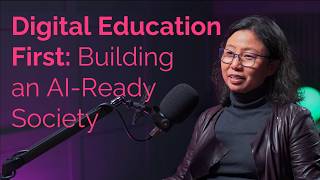
Chang discusses why AI education must start early and reach everyone, not just tech experts. She highlights practical tools like meeting summarizers and productivity agents already in use, warns that without broad adoption SMEs risk being left behind, and emphasizes that lifelong learning and human skills will matter more as AI advances.
Chapters
Digital education is really important, and AI education is also important. The earlier we can bring in that ethical, responsible AI understanding, I think, uh, the better probably we are heading our society into the future. If we don't address that, those areas, I think that's where the danger lies.
So our roles at the moment are essentially in lifting the understanding of as many businesses and people that we can contact as possible and shining a light on what can be done now. But if we're talking to 14, 15, 16-year-old kids, what jobs do you recommend? It, it would be for the good of humanity if everybody would work together on it, wouldn't it?
Yes, absolutely. And I firmly believe that we still have very important roles to play, and that actually means every individual person. Can explore that creative role that we can all share and we can all interact with each other to bring something truly valuable for everybody. Hi, I'm Freya. Welcome to the Skynet Chronicles: Business in the AI Age, the podcast that dives deep into the world where artificial intelligence meets business. Join us as we explore the latest trends, challenges, and opportunities in this ever-evolving landscape. From innovative startups to established enterprises, we'll uncover the secrets behind the successful integration of AI technologies. So grab a cup of coffee, sit back, and get ready to unlock the mysteries of business in the AI age.
Good morning, Chang, and welcome.
Thank you. Thank you, Tim Davies. Yeah, I'm really pleased that I finally get here.
The joys of technology and finding locations.
It's always interesting.
Interesting, isn't it?
Absolutely.
So, starting question.
Okay.
When was the last time you used AI, and what did you use it for?
Oh, AI. I think, um, now AI is part of, uh, my life. I think, you know, working in the generative AI education, especially on executive education, it is quite, um, normal. I think it would be very like a self-denial if we do not admit that we, we use— we don't use AI. So I use AI on a daily basis. And the most recent example is So the most recent example is to think about ideas, how I can generate in terms of the topic that I can bring into the discussions with businesses.
Fantastic. Interesting. And what still scares you about AI?
I think it's a kind of mixed emotions when we think about the opportunities and challenges that generative AI can bring. I think AI itself is a quite big word because within the AI ecosystem, there are a lot of things going on at the moment. And if we think about just from the generative AI, uh, from that perspective, the opportunity lies in how actually individuals, businesses, organizations can actually tap into the potential. It can help the productivity, improve the workflow, and bringing the added value towards, um, the stakeholders, groups that, you know, the communities that they can, they can influence and they can impact on. But at At the same time, I think the danger is without ethical and responsible application of these different tools and platforms, you can have the risks of data breach in terms of the GDPR, for example, personal privacy data could be incidentally, accidentally, or even intentionally led to um, that kind of, how to say, um, unsafety of using, um, AI. Yeah.
Um, we met on the speaking circuit, didn't you, initially at Lincolnshire Manufacturing Conference, and then more recently over at the FEA National Conference.
That's right, yeah.
And it's fascinating, our jobs are essentially just sharing some of what is possible currently.
Yeah.
And helping to lift people's understanding so that they can apply these capabilities, which are marvellous.
Yeah.
Into their businesses and their personal lives to lift productivity, increase revenue, reduce time wasted.
Yeah.
What's your biggest takeaway from any of these events that you've been to in terms of those light bulb moments where you sometimes you see it happen in real time, don't you, with people in the crowd?
Absolutely.
What's been the biggest takeaway for you?
I think I've attended quite a few events and those two named ones that we, we met, I think one of the most impressive takeaway that I feel that has an impact in terms of my understanding about how the community actually can be very open-minded in terms of AI adoption. If you compare the mindset of businesses, individuals in 2025 to 2022, 2023, when generative AI only just, you know, being released publicly, I think there's a massive shift in terms of that openness, as in What do we have? How, how can we actually use these technologies or can we use this technology at all? So the cautious steps certainly have shifted from not being able to make or take any actions based on the strategic thinking to actually businesses started to think strategically, think about the action planning, think about how they can think big and start small. So looking into the tangible added value that they can consider to create using AI tools and platforms, to actually trying it through that kind of, you know, life is, is like through a life learning sort of, you know, process. There is a book about Lifelong Kindergarten. I think that it really describes the idea of how sometimes, you know, as human being, when we see the technology, the emotions that we have attached to the technologies, the, the, the, the mixture of the fear, the joy, and excitement, and at the same time finally grounded into the actionable plans and doable steps. So all of these combine into, how to say, a quite interesting ecosystem development. I think that's the biggest takeaway I have taken from, from these events.
I love that kindergarten approach. I think learning through play is important and how we embed that within the businesses that we're part of and the businesses that we support. Yeah, it is a really, really key difference because if you can get somebody who is comfortable having a go with something, yeah, and sharing their experiences— in sharing, they're already having to become more than just a learner, they're becoming a teacher, which reinforces that learning.
Yeah.
And if you can embed that in a business, then the change is quick, isn't it?
Yeah, absolutely.
So when you're delivering a workshop with business owners or academics, how do you sort of start that process of making people take that first step to embedding within their processes and business?
Yeah, if we look at the OECD's principles of AI, ethical and safe use of AI, I think one of the first principles is to do with the inclusivity. So making the AI tools and platforms accessible. And that means that these are, we can call them digital tools in a way. I think sometimes people do have the fear about artificial intelligence, not because that, how to say, they perceive the immediate danger of it is because we, our knowledge about artificial intelligence previously traditionally lies in, oh, this is a topic area where the computing scientists and the computing computational sort of, you know, professionals is their territory, is their kindergarten, not everyone's kindergarten. So just on that particular note, I think when I deliver, um, workshops to SMEs businesses, um, especially very recent ones like Help to Grow, which is a national program supporting businesses growth, is to look at these technologies in a way as they can provide you with assistance. They can help you to relook at the process of business. And identifying pain points, identifying those repetitive tasks, identifying the tasks that you can actually feel you want to save the time of doing the same thing or doing in a productive way and to achieve double the results or achieve something multiplied in the way that a business feel that they're being creative. They actually spend more time with the customers. They can put that human-centered approach back to the business process rather than administrative tasks become the sea that overwhelms businesses' enthusiasm of engaging what they can produce and what they can produce well.
And can you give us a specific example of one of those sort of admin improvements that can be made?
I think to start with is quite interesting that, you know, businesses nowadays spend a lot of time in meetings, isn't it? So I think meetings is very easy for you to take part in the meeting, prepare the notes, take the notes, and then walk away with sometimes actions, sometimes delayed actions. So with AI's help, with generative AI tools and platforms' help, you can actually summarize the content from that meeting to translate directly into the actionable points. And the notes can be shared immediately post the meeting. And that considerably can save the business and individuals' time in terms of what do they need to do and how quick, how fast they can take the steps going forward.
I don't know why I've not thought of this before, but within businesses, a huge amount of time is wasted in meetings. Yeah, we could use video analysis. Yeah, conversation pieces, who's contributing, to identify the people who are not contributing and are not engaged in a meeting, and they could just be taken out of those meetings going forward given time back to the business, and it would be the easiest piece of analysis to perform. But if corporates in particular applied that, the time savings that would be generated— there'd be salary on salary. Yeah, of additional time created within the business just by looking at, did all of these people really need to be in this meeting? And if we needed that person, did we need them for the whole meeting, or could we have just got them in for 2 minutes to share their piece and go again?
Yeah, I mean, there's one thing I, I do firmly believe. I think everyone can play a critical role in terms of, you know, different types of tasks. It's just to take the time to identify individuals' strengths and areas for improvement. So going, you know, back to that meeting scenario, I think again, it's not just during the meeting, it's before and after. Prior, what kind of actions do you actually input to make this meeting meaningful? What research have you done? What ideas, knowledge, and what skills you can contribute to make the difference. And during the meeting, obviously discussions take place and everyone can bring their ideas to make the collaborative effort. And post-meetings, again, is individual, uh, roles and responsibilities. What differences can you make? So in an ideal world, I think everyone who takes part in meetings should add value. I think that goes back to, you know, what you—
I'm just going to have to make an agent now, literally specing it up in my head.
Yeah.
Meeting attendance agent.
And also I think that sort of, you know, personalization as well as human value. So in AI era, are there any tasks that cannot be done by human being? And if we can identify any of those, what differences the human can make.
So regardless whether they cannot be done by a human as opposed to which ones could be done by an AI.
Yeah. And how we can co-create those opportunities is a big question, I think. Well, which opens up, you know, a series of many other questions, which I think probably that's why we are in this sort of, you know, movements, whether we can call it Industry 4.0 shifting into Industry 5.0, and then also what could happen after that, and how do we call it? Is it Industry 6.0, or could it be—
does it matter what the name is if there's an awful lot of people that aren't needed for the jobs that they used to do?
I think it does matter because philosophically I think how human societies move from one era to another, you have to create some sort of aspiration where people feel that we're motivated. There's a point that we can make the difference to us, to our families, to our societies. And whether we give it this name or that name is debatable. But I think from personal perspective, I do feel that going into when we can observe across the world, across the global sort of, you know, different areas, the power of AI and how fast the technologies actually are heading to, we do need to consider, continue the debates, continue the discussions around this area.
So a lot of people derive meaning from the job they do.
Yeah.
Happily say, this is what I am, this is what I do.
Yeah.
And as we're seeing now, a lot of the white-collar roles that are delivered at a computer, huge elements of that work is being automated.
Yeah.
And we can see a future where entire classes and categories of job are delivered more efficiently by AI and compute than by people sat at a computer.
Yeah.
The same we can imagine happening with blue-collar workers, with industrial robots, domestic robots. You can sort of see a path where a large number of jobs are going to be impacted.
Yeah.
And if we don't have those roles anymore and people are on some form of universal basic or some sort of AI-delivered income, yeah, how do people derive their meaning? What, what will people do?
Yeah, I think, um, obviously we're living in 2026 and the terms that you just used, white collar and the blue collar, they were the derivatives coming from First, the industry revolution and heading to earlier what I mentioned about Industry 5.0 or 6.0 or era of co-creation. So I'm not quite sure what kind of further categories we can actually call ourselves based on our skills, experience, and knowledge. But one thing is certain is we have to continuously engage with this movements. Because if you don't do that, then you lose by default the opportunities how you can participate. And if you actively consider, and I think this is the human power, the human brain versus the artificial intelligence or artificial brain, is creatively and collectively, what can we use, or when do we decide what functions AI can head to? So that at the moment are still hopefully being controlled by human being, um, rather than artificial intelligence, training artificial intelligence and completely removing the human elements out of the equation.
If we look back at the previous industrial revolutions, obviously there were Luddites who were smashing up the mill machines, Thrashers doing something similar effectively. We can, we can imagine there's going to be some fairly strong pushback.
Yeah.
To this industrial shift because thinking the cost of intelligence is trending towards zero. It's going to get cheaper and cheaper to do things without a human in the loop.
Yeah.
And therefore quicker and quicker, and that will lead to significant displacement. So there's going to be pushback and not everybody's going to be able to be brought on that journey of how we co-create, how we coexist with AI, AGI, ASI potentially.
Yeah.
So our roles at the moment are essentially in lifting the understanding of as many businesses and people that we can contact as possible and shining a light on what can be done now so that they're on the journey to coexisting with AI.
Yeah.
But if we're talking to 14, 15, 16-year-old kids, What jobs do you recommend?
Oh, that's interesting because I know you have children, right? I also have children and both of them are in a secondary school. So they are this generation which is classified, if you're going into the academic research, is Gen Z. And then what's after Gen Z is Gen Alpha, and after Gen Alpha it will be Gen Beta. So these generations, certainly the job markets, the futures of economy will shift. Or is being shifted already from different areas of the world. And in terms of the skills, knowledge, and experience, I do feel the digital education needs to be enhanced because the understanding is the foundation. The learning has to be the foundation where the future of human being, where we're heading to, will be decided. So as much as we can say AI can exponentially, um, how to say, the advancement of AI can be exponentially explored and the impact can be seen and observed and witnessed throughout the whole world. But at the same time, the governance, the digital order, for example, digitalized order, which I think this is very likely after the World Economic Forum, which just, you know, started yesterday from Davos. That's the Scenario 1, which is the foundation of the future before 2030 hits, how each country, each economy could look into that digitalized order. And that is a very complicated, I think, movements. And it requires every single citizens, I would think, in any type of economy to be part of it. So individual agents will be playing really critical roles in, in this. And then this order, it doesn't necessarily always mean, you know, from the top down, because we look at the economies coming from the East and West and from different sort of, you know, beyond the country borderlines. We can, we can see that the different approaches in terms of the digitalized order And there are a few interesting terminologies I recently come across. One of them is called digital altruism. So data altruism, sorry, data altruism. So to what extent we are willing to contribute our personal data for the good cause, for the good societal environmental impacts.
Not ads, good cause.
For the good cause. Yes. That's something I'm hoping that, you know, again, is that kind of nature, the nature of human, the good nature part obviously, uh, can help us. So for going back to your question, as in what kind of jobs, um, will this younger generation, um, they will be engaged in or they will need to be prepared for, I think I won't be able to define the job titles because the job titles are evolving on a daily basis. And as the AI advances, we can see the job market, the shift as well. So the traditional engineering, for example, nowadays, I think in the future, would it be AI combined with the traditional sort of, you know, methods and ways and the medical studies. Again, they're already using robotic operations in different sort of, you know, areas. And certainly there are some other movements and other progress in terms of different, job area or job markets. So digital education is really important and AI education is also important. The earlier we can bring in that ethical, responsible AI understanding, I think, uh, the better probably we are heading our society into the future. If we don't address that, those areas, I think that's where the danger lies.
I think there's also a counter to that. So while we want the— anybody really, never stop learning.
Yeah.
Um, learning little bits every day is going to make us far more capable contributors and individually capable. But with the, the youngsters and the people that are coming through the education system, focusing on how to people how to interact, how to comfortably have a conversation, how to go to networking events. Yeah, just those old school skills actually are going to be more and more important because if we're able to hand off some of the, the thinking, the repetitive admin activity, actually the time that we spend in front of people having conversations, building rapport, getting to understand them as people, those are going to be the real differentiators. Yeah, because people who choose to live entirely online wearing their Ready Player One glasses, spending their time in computer games. They will be able to do that.
Yeah.
But the people that will really succeed will be those that can go out, have a conversation, present on anything, be comfortable interacting with new people.
Yeah.
And we really don't teach that.
I think that's really a good point, and I certainly, I completely agree in terms of the human-to-human contact and human-to-human communication skills. I think the schools are doing, to a certain extent, good jobs in terms of, you know, educating the children in terms of how they can use literacy, numeracy skills, how they can actually interact with their peers, how they can, you know, be involved in different activities. From day-to-day sort of conversation with my children and also observing how secondary education, primary education, which I feel like is my life, sort of lifetime, lifetime kindergarten, is I learn with my children and I'm able to see that kind of development, progress they make throughout the different experience and different stages of their life, depending on the communities, depending on the opportunities. And I think they're always really interesting moments. You see, ah, That's the time that, you know, you are more confident than last time, or you are becoming someone that I feel you can step out, you know, from that safe, comfortable zone into an area where you are probably feeling unfamiliar with, or you feel a little bit strange or feel discomfort with. So I absolutely feel it's so important, along with the digital education, which I addressed earlier, that human-centered education, which means that the peer learning, active learning, involving human being, involving the society, bigger community, would be really good for the younger generation to, to progress, to tackle, you know, the future challenges.
And you've come from a background of academia, and we're now seeing large volumes of students completing their degrees. And not being able to get that first role. And the level of unemployment in relatively highly educated young people is increasing. What can be done to help with that?
I think this goes back to before I, I changed my role from a full-time academic to a full-time involving myself in supporting business as the director of CG Vision Consultancy. Um, it's quite interesting because we talked a lot about the graduate attributes, and I think higher education institutions, not only in the UK but also across global, um, uh, scenarios and contexts as well, is universities are feeling the responsibilities more and more strongly around how they can stimulate that kind of motivation and inspiration for students when they just enter the higher education, the first day, the first step they get to that university, and how do they actually see themselves in 3 or 4 or 5 or 6 years' time, what kind of person or professional they can be, and to create that kind of value towards that particular, you know, different contexts. So integrating the employment or employability skills, and instead of having a bolt-on sort of approach, which means that let's create an employability module, let's look at how can we—
Working on our CVs.
Yes, working on our CVs, which can be very critically important. I think that kind of integration, the incorporate the skills into the subject content and also bringing that cross-disciplinary context. So for example, marketing, we don't just teach the students how to become a marketeer. And marketing, according to McKenzie, this was from 2016, McKenzie already described the marketing function is a war room function. Basically, if a company wants to head towards the right direction or, you know, aim for the growth and, uh, um, enhancements, they have to consider working together across different functions to be able to bring in, um, the stakeholder engagement, to bring in the potential possibilities, to translate that into the business values. Now, if we only teach the students subject only content and knowledge, we're not going to be able to compete with AI, how to say, lecturer, because the depth of the knowledge could be above and beyond within that module, within that guarded lectures or seminars. But by bringing different contexts, by bringing different disciplinary knowledge and expertise, we then can create what actually is the simulation of the real world. And the businesses, very often when we speak to business professionals, directors, or any, anybody who are involved into businesses, you can't be a one-trick pony. So within the traditional higher education outputs, shall we say. We're trying to create a specific role, and that specific role can be the expert in that particular area. And I'm not denying that, you know, expertise still is valued. But then at the same time is we need to see that knowledge that you build— individual students have constructed with the support around them— needs to take them to the next stage where the learning should be extending from the university. So learning doesn't stop when graduate finishes their final line and then taking that graduate certificate from the ceremony from the vice chancellor. So yeah, the extended learning—
If it does, we're screwed really, aren't we?
I think I'd rather not to think in that way. And I think the universities are doing, at the moment we can see, the, the current status of all different universities, especially I think in the UK, when we look at the program validation, revalidation, how actually the knowledge can be integrated to bringing the students that kind of challenge-based learning, bringing the real business challenges to the lectures, to the seminars, getting the students to have close contact with businesses and bringing those case study scenarios into the real lab for the students to work on. I think that's the, the, the, the, the direction where, where we need to head for.
Because the fundamental challenges within business doesn't change.
No.
But the rate of technology improvement right now is outstripping the pace that the curriculum can be updated. Yeah. Things that were possible 6 months ago aren't going to be represented in curriculum until another year or more and they're already out of date.
Yeah, I think if we compare, for example, if this is something that we tend to use with students is when you use academic literature research, you look at the textbooks. How long does it take for a textbook to be published? The research goes into at the early stage towards writing up, editing, and getting it published. It normally take— could be, you know, 3, 4, 5 years. And at the moment, with obviously technology enhancement, I think the publication process can be much quicker. And then journal articles, for example, it could take up to 1 to 2 years to get a journal article or several journal articles, depending on the topic, depending on the research objectives, can be published. So when we look at the traditional knowledge. So for example, if we look at the conceptual theoretical frameworks that has, um, have accumulated, you know, human wisdom through research, through, um, robust, you know, debates and discussions until they formalize into something that is tangible, um, with the citations that we can quote and we can use to build the knowledge towards the future. So that cannot be denied, as in the value it has already created for us. But what we also need to pay attention to is how rapid and how robust the knowledge can be created and co-created with AI. And that timescale is unprecedented. Yeah. So if anyone, let's say, submitted, any students submit a particular essay or a thesis or some type of, you know, presentations, if they don't look at the current industry reports, they don't look at the white papers, they don't look at influential sites, you know, source of information, then there's a big important part being missed.
And we're seeing now that papers are being released They're being peer-reviewed on X. Yeah. The repositories related to them are being immediately made available. People are iterating on that. So a paper that was released on the 31st of December that I was reading over the weekend.
Yeah.
People are already iterating on that research using what was released to produce better versions. In 2, 3 weeks' time, there'll be another paper on that topic and the pace of advancement because of that rapid release.
Yeah.
It's not to the same level of critical analysis that you'd get in a peer-reviewed journal. No, but it's being checked, it's being validated, it's being improved on in real time. And that's just leading to exponential improvements in almost every aspect of AI right now, because everything is being released quickly to a global community that can then be worked on and evolved. So we're seeing just iterative ramping of release rates and capabilities, and I don't see where it stops. Do you?
I don't think it will stop, but on the other hand, I think that kind of critical skills, as in how you decide what sources you will be using to create what kind of knowledge, and that on its own, I think the process, um, is gonna be polished and adapted and also learned by individuals. In terms of that time, that kind of timescale, it's frightening, obviously, but at the same time, it's exciting.
It is exciting.
It's exciting. That's why I wanted to bring a different level of emotions as well. It's like, you know, when you think about how can we actually redefine that sort of role previously human has taken and then the pace that we needed to evaluate and critique individual sort of, you know, piece of opinion or type of arguments. But just because generative AI is that powerful that you can conduct a literature review with much more added perspectives bringing into the discussion. But I think that human— keep human— keeping human in the loop to validate the information is also really important to bringing that critical elements into where you are going to head to and what kind of arguments you are going to create and you're going to construct and how willing you are going to still be open-minded to see what else can be done, or those what-if scenarios that can bring in the enriched, enriched content that truly will bring the differences to, I think, different types of researchers.
So the process I just described is effectively still humans studying a concept, using AI to accelerate the process of developing it. Publishing a paper which was probably co-written by AI, that's then being analysed by people who are using summarised versions and abridged versions and analysing the repository with AI. But there is still very much human in the loop. We can already see examples where people are doing a form of validation using swarms of agents that have different roles, different thinking hats, different critical evaluation techniques, and from different labs. To evaluate concepts that are being delivered and critique and improve them quicker than we would be able to if we were involved as humans. At what point do we stop being involved in some of those processes and just trust the capability of AI's decision-making over ours?
I think that is a very tricky question. I don't think we should ever How to say, um, unless we know the 100% accuracy of what AI produces. And on that ground, I think in manufacturing sort of context, that is already achievable in terms of accuracy on the production line with the full automation. And there's no wastage of any resources. But when it comes to the knowledge, when it comes to the concepts, theories, when it comes to conceptual sort of, you know, um, area where the knowledge can be passed from individual to individual, generation to generation. Our involvement of that is still not there yet. So how can we say that the information we put in, we use AI to co-create, would be 100% accurate? Nobody can say that at the moment.
But has it ever been 100% accurate when it's been human-based?
No, no. That's why I think in academia, um, we, we actually teach students on day one about how to create this academic hedging, which means how you use cautious language, um, to illustrate a particular point or opinion or argument. That you wanted to share. So you would never be able to say, I have done 100% of research on this topic using 100% of the resources. There's always a context, there's always a time constraint, there's always limitations where you have to admit. So on that ground, I don't think it would be ever possible that we can say in terms of, you know, if we talk about the publication as in completely trusting AI, using AI to publish, and, you know, human— we can just step back behind the curtains. I don't think that's the right way of doing it anyway. But then on the other hand, I think that kind of human intervention, human contribution, human creativity, human analytical skills needs to play part. It's just within this potentially low risk, depending on the research areas, obviously. Not, not all areas are are low risk or minimum sort of, you know, risk areas defined by OECD or defined by the EU AI Act. So in these areas where the low risks lie, how can we bring in that kind of artificial intelligence and human intelligence and into meaningful conversations, meaningful discussions so that we can both— and could see beyond, outside of the box, that type of dynamics.
Because we make decisions based on sample size and statistical significance.
Yeah.
And that's effectively— sometimes it's just down to gut instinct. You see it in people who are effectively doing that in their head. Often we'll rely on the pure maths. Have we got a large enough sample size that's diverse enough that's delivering a result that has enough of a likelihood that it's true? But we're already handing off some of that decision-making.
Yeah.
And if you look at, rather than just the research space, a country basis, economic policy being made based on individual choices and then backtracked when it was a mistake or was not thought through. Do you see a point where as a, a country or a region or a world level, we give decision-making on economic policy, on laws, to something other than people?
That's a very interesting question, Tim Davies. And I can relate to, relate to that scenario from my personal experience, as in to what extent I feel I'm actually enjoying it, or to what extent I will feel uncomfortable. Okay, so I was in China, I was traveling, visiting my family and friends in China in September, and just before I left China, flying back to the UK, I stayed in Shanghai just went a little bit of, you know, touristic sort of adventure. And I was thinking, oh, I want to make that decision whether I should be taking a bike, rent a bike, or walk from point A to point B to see the, you know, to do a little bit of sightseeing. And it was really hot in September. So using an app that I got recommended to download on my phone, which is linking to the map, to the orientation, I was given 3 different options, which was very interesting. So the 2 options involving me cycling, but one of them was giving me— the app was giving me the option as in, this is really hot, this is a hot day, and this is the route that you would be recommended to take so that you can cycle in the shades. Now that's very interesting because I was thinking, well, actually I don't want to always expose myself to the ultraviolet. And it would help with, you know, choosing where you can see the trees and the streets and then, you know, people passing through quite urban sort of scenario. So I was thinking, ooh, that's interesting. So it has taken my personal needs without me actually thinking, not making that decision, giving me the options, letting me make a choice to do what I need to do. It's a very anecdotal, obviously, type of story that I'd like to share. And I think that's really brilliant is, you know, that immediately has helped me to build the trust is like, I want to use this app, this app will tell me point, point from point A to point B, times I'm going to spend, and then which would be the best route to use. And that is, I think, the decision without me involving me, but I think as an individual, I'd like to know, for example, if I go onto a website, if I shared my personal data due to various reasons. So for example, downloading white paper from different websites, and I'd like to know in clarity the terms and conditions, how far my data will be used.
And obviously you're going to read the 25 pages of the terms and conditions.
I think that's the— I think like everyone else, sometimes, you know, you have this at the back of your mind, you want to read, you know, lines in between the lines of where exactly would be the pros and cons of giving your, your, your, your, your contact details. But sometimes we make that personal decision, as in, I'd like to give my personal details, I'd like to download these resources, I'd like to just stop there. Okay. And I think that would be where the trust needs to be built between the people who, who, who holds the data who may use your data for the purpose of what further actions they're going to suggest, they're going to recommend, that they're going to contact you, they're going to communicate. And, and it varies. Again, we're talking about a wide range of, you know, terms and conditions, and I'm not going to exhaust you in this podcast recording. But I think that data ownership, data Democracy, data altruism, all of these terminologies need to be defined, defined in a clear fashion, defined in a clear manner. And again, the purpose of how the data can be used for what purposes needs to be, how to say, mutually agreed. And I think that is very, very important. The data sovereignty, is actually not just the, you know, for countries, is, is for individuals as well.
And I think you're right, but equally I'm not sure it's going to happen because the requirement for it to happen would require some pretty significant legislation.
Yeah.
And generally legislation comes after the effect. We all wear seatbelts when we're driving now, but the only reason we do is an awful lot of people died from not wearing them. So the move for ownership and clarity over who owns what data, when for the past 15, 20 years people have been sharing everything with Google, with Meta, Apple to an extent, and others, obviously.
Yeah.
It's almost like it's already escaped. We don't have control of our data. So how we get back to that point I don't know where we've got control over the full ownership of all of our data when so much is already out there. Every time we watch something, every time we listen to something, every time we use our bank, every time we use a card, the state, the banks, the companies are watching and using that data. How do we get to a point where we, we have that ownership and control again?
It's very difficult to answer that. I, I completely admitted that I don't think that I have an answer. And then certainly I think I'm also constantly learning in the process as well. So for example, um, last year I went to one of this data, big data and AI expo in London. And what struck me when I entered the, uh, I think O2 or Olympia, one of this, um, big, um, big venues, there was a big light box that's right lit in the center of the stage. That says no trust. So I was quite taken aback, um, as in like trust and no trust. Do we trust? To what extent do we trust, you know, um, that data sovereignty or the data usage? And to what extent the no trust needs to be built? So I can't answer that question as in how do we take back the data we've already have given away regarding ourselves. But I think it's never too late to start looking back onto the basic principles of the data protection. I think that again, inclusivity is important, but at the same time, the ethical usage, the responsible usage of data are paramount. And that is something I think not only, you know, from individual practices, professional practices, especially for the big tech companies as well. I think if you look at Google, if you look at Microsoft, if you look at OpenAI, if you look at, you know, all these big platforms and big tech companies, They do put forward those principles of AI, those principles of, principles of data usage. So those are something that we need to by default implement into our practice, but at the same time try to build the trust. So I think giving the credits of Trust the building, trust the worthiness, but at the same time, making sure that we have the governance, the framework, the stages where we can intervene. We can, um, how to say, um, stop, let's say, if the guardrails are being pushed to the wrong direction.
And as consumers, we already can't trust anything we see or hear. We know that audio can be cloned. We know that videos can be created from anything. Essentially, you can't trust video anymore. You can't trust really anything that's being shared. And yet the AI labs are implementing fingerprinting. So all of Google's content that's produced by AI has SynthID on it. Yeah. Um, OpenAI use something similar, watermark it. Yeah, yeah. Even in the text that's output by these models, they're they're outputting in such a way that they can take it back and say, okay, this was our content.
Yeah.
But as general consumers, we don't really know. And there will always be someone somewhere that develops a solution that doesn't have those water markings in place.
Yeah.
So we can't trust anything that's put in front of us anymore, really, can we?
I think it's, um, you know, this goes back into How do we sometimes, you know, I don't know whether you have had experience as in when you were in like primary school education and secondary education and you think, ooh, this is something I'd like to do, but I don't know how to do it. And I want to find the shortcuts. And hence, you know, students sometimes they cheat in exams and then, you know, in universities we tackle the plagiarism, for example. So going back to What you mentioned earlier about the audio, video content, text content that can be simulated, can be created without the human efforts. Probably the majority of the efforts that we previously would have to put in. And this kind of information that we produce can be called using deepfake technology. Deepfake technology has already been used in businesses It's just people don't want to call it in that way. And the deepfake technology can be used for the good causes and can be used for not so good things. When we think about the misinformation and disinformation, again, there's a lot of information that can be created to harm individuals, to harm reputations of businesses. To create that social instability. But then at the same time, I think when we see this type of things do happen, it's a kind of urgent cause for us to make sure the education needs to, from the grassroots, to bring in that understanding and critical mindset, critical thinking, and critical evaluation. About what can you trust, how you can actually interpret the information so that you can draw that kind of, you know, conclusion or a conclusion that opens up for future research and future sort of learning. So just around that, um, your question earlier is how can we as consumers feeling that we can trust businesses anymore, that they're not using the information to create that kind of misinformation or disinformation. I think again, that kind of goes back into the data governance and also the ethical and responsible using of AI technology. It's, it's very important that we understand the different tiers of the risks that can be associated with the production of using AI. But at the same time, I think within this complex different tiers, there's also areas where you can think creatively. For example, you wouldn't think David Beckham could speak 12 languages talking about a good cause for a charity organization. Now that technology nowadays, he can record his voice and he can speak 12 different languages broadcasting to the global audience to bringing that human-to-human connection. If he starts to speak Chinese Mandarin in front of me, I would feel really— it's quite impressive, isn't it? And I think that kind of, you know, connects people. But on the other hand, if we think that, you know, the online security that can be you know, that can impose certain high risks of using fake videos, using fake voices, using fake images to create social instability, then that is— I think that there should be legislations to tackle that kind of area.
Yeah. So what one thing are you most excited about from AI in 2026?
I think we have talked a lot already about generative AI. In 2026, I think is agentic AI, I think is going to thrive. The agentic AI using AI agents taking part into taking certain actions in the ecosystem, in the digital economy. I think that's quite exciting. I recently attended, I went to this conference, it's called CoCreate, and that was the first European conference that Alibaba hosted in London. And to understand what this AI system called Asio, to actually using AI tools to source, bringing the supply chain, bringing this timely delivery door to door with almost like a promise, you know, within 7 days or 14 days, I can't remember what exactly the specific days that business can benefit from that timely service and then straight away bringing the ideas into the market. That has shortened dramatically comparing to, I don't know, 1990s or early 21st century where the e-commerce, you know, when we are looking at just using the channel to influence, but you are not actually connecting the dot to dot, creating the whole ecosystem. So from that perspective, I think Obviously, Asio is not the only one. I think, uh, they're quite big players, you know, um, in, in other markets are doing something similar. But what I wouldn't want to see is, um, with this kind of ecosystem, the best thing to happen is small business, medium enterprises can also thrive within this kind of ecosystem. Not just businesses being taken away by the big tech companies. What I wouldn't want to see is businesses, if they don't adapt, if they don't engage with this kind of movements or explore how the AI ecosystem can influence and impact their businesses, they're losing the competitiveness, they're losing the edge where they can actually have a market share. So that is something I feel, um, It potentially could happen, but I wouldn't like it to happen.
I think it's highly likely unless more people are talking about how to deploy AI and helping businesses on that journey.
Yeah.
Because I think success for us in the next 3 to 5 years would mean that the number of SMEs in the UK has significantly increased rather than all power and all jobs, all money rather, flooding towards the tech companies. Enabled hundreds of thousands of small businesses to be more successful through this technology, that many, many people are benefiting from the AI revolution rather than the power all flowing to the few. Yeah, that would be success for me. But it's going to be an interesting journey.
I think it will be interesting journey. And I think in this journey, um, I'm willing to be impressed and I'm willing to witness ethical progress and also that kind of enhancement where the collaboration and co-creation actually truly happens. I certainly do not believe that any country should be the only winner of the whole competition, let's say, if we see it in a— as a sort of like a race sort of analogy. Um, in terms of that kind of co-creation, I also feel, for example, if you think about, um, manufacturing as an example, between the manufacturer to the market, there's a, there's a, there's a journey, right? So manufacturer will need a supplier to supply, to be able to manufacture and manufacture the products that they manufacture will need to have the market and the customers to engage. So all of this process literally requires human being to connect a dot to dot. The automation can help to certain extent. It will not replace every single dot of, of that kind of, you know, process. And, and then for that reason, I think it is, I think it's a promising future in a way. That I'd like to see. Obviously we talk about potentially there might be some geopolitics that actually set up the barriers amongst the countries or amongst the sort of, you know, mindsets between people. But what I would like to see the future is all countries working together. What stops them from doing that? Um, why can't they work together? To co-create something. So working, you know, that's— I, I guess that's what United Nations built for. It's not for me.
I couldn't agree more. I think it's going to be— again, it's going to be challenging, but the, the opportunity ahead of us, if we get it right, is fantastic. And nobody wants more silos. We don't want a world that's arguing and at war. We want to be moving forward as a species. So I think that's a fantastic way to end the podcast because it would be for the good of humanity if everybody would work together on it, wouldn't it?
Yes, absolutely. And I firmly believe that we still have very important roles to play. And that actually means every individual person can explore that creative role that we can all share and we can all interact with each other to bring something truly valuable for everybody in the, in our society and across countries.
Fantastic. What a great way to end. Thank you very much for your time.
Thank you, Tim Davies.
More from Tim

EP 60: Why Founders Become the Bottleneck — And How AI Changes Everything | Thea Brook









