
Ep 59: Why Charities Need to Think Bigger
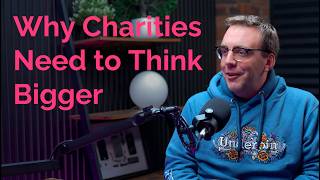
Lewis English, a business and charity consultant, argues charities need to think like businesses while companies should be nicer. He explains how the UK's 2023 Procurement Act, which requires 10% social value in public contracts, is shifting power dynamics, and shares how he uses Claude as a conversational partner to challenge his own thinking.
Chapters
My son is 7. We watch "Lilo Stitch." Yeah. And there's a professor of Earth studies, but he's never been to Earth. So everything is just a little bit off. So AI can talk to me about Rousseau and Weber and Marx and all of these things, but every now and again, it will just catch itself in a, "I don't actually, I've never seen a human. I don't know what a human is." And so what I'm trying to do at the moment is with it, and why it's amazing me, is because every now and again, it won't do that. Do that and it will change my mind on something or it will label me as something and I will go, you're right. And I hate that you're right. But no, I don't think AI is gonna control the world and everything in it because I don't think we're that clever slash, I think we're kind of in the middle and it will end up being somewhere in the middle. I think that's what we do.
But also there always has been pockets of rebellion in our nature and culture. We push back against the things that we don't think are proper. Would an AI running the country, the world as a single government, make better decisions than our disparate governments do at the moment?
Yeah.
Quite possibly, but there'd be pushback.
Hi, I'm Freya. Welcome to the Skynet Chronicles: Business in the AI Age, the podcast that dives deep into the world where artificial intelligence meets business. Join us as we explore the latest trends, challenges, and opportunities in this ever-evolving landscape. From innovative startups to established enterprises, we'll uncover the secrets behind the successful integration of AI technologies. So grab a cup of coffee, sit back, and get ready to unlock the mysteries of business in the AI age.
Good morning, Lewis English, and welcome.
Hi, great to be here.
So, business and charity consultant?
Yes.
What does that mean?
So I was describing this the other day to someone. I try and make businesses a little bit nicer and friendlier, and I try and make charities a little bit meaner and a little bit more aggressive. Ooh, I like that. And the reason is because the current situation for charities is that they're now taking on a lot of work that traditionally was done by government. So elder care, homelessness, all of these things used to be something that people would expect a local parish or national government to deal with. And they're now paying or not paying charities to deal with the systemic issues of things like lack of skills or, or whatever it might be. And so the charities now have a lot of power, and they have a lot of, uh, things that they can do to enable a better way of thinking, but they still treat themselves as a beggar. and they go, please can I have some money? Whereas actually they should say, here's a problem, I can fix that, this is what you do, which is a business mentality. For a business with things like social value, things like procurement, with things like I can go on the internet and find out how bad you are as a company now, they need to be nicer, they need to be friendlier, and it needs to be real. So what I try and do is take both of those things and kind of swap them. Okay. With the hope that everybody can be more equitable about what they can and can't do in, for, and in society.
So when was the last time you were excited by AI?
I was excited by AI last night. So the reason is I love its infinite patience. I love the fact that I can just talk at it about anything and it's super excited and it's incredibly knowledgeable.
Do you talk to it or type?
So I type mostly, but I have talked to it. That's good. I do talk to it. It depends on my mood and which way I'm particularly swaying. And one of the things I'm really interested at the moment is we've, the Simon Sinek way of doing things of why and mission and values and all of that kind of stuff. That's been a core part of the business I've done for the last 5 or 6 years. I'm really interested in philosophy and what the difference between those core, brands and actually what is a philosophy. Have you ever debated with AI about philosophy?
I've debated with AI about so many things. It's one of my favourite pastimes.
It's amazing because it knows almost everything. But it, right, and I've, again, my son is 7. We watch Lilo and Stitch.
Yeah.
And there's a professor of Earth studies, but he's never been to Earth. So everything is just a little bit, off. So AI can talk to me about Rousseau and Weber and Marx and all of these things, but every now and again it will just catch itself in a, I don't actually, I've never seen a human. I don't know what a human is.
Sure.
And so what I'm trying to do at the moment is with it, and why it's amazing me is because every now and again it won't do that and it will change my mind on something or it will label me as something and I will go, You're right. And I hate that you're right because I knew. And so that self-reflection I think is really great. And it comes with— the problem I have is that sometimes I need a better self-awareness. And I think people need a better self-awareness because it will just keep going forever. It will just keep challenging me forever, no matter what I ask. It doesn't stop.
Depending which model you use will depend how positive and encouraging it is.
Yes.
Would you like me to do this for you? That's a great idea. Fantastic, well done. Yeah, you should do more of this.
Yeah, and that's an issue with, and there's been studies and I've listened to things about therapy and AI. And the idea is there was a reason why therapy sessions are 55 minutes because you need to go and decompress, you need to think about things. So if you don't have that time to reflect, an AI will just go, "That's great, and that's great, and." It's almost improv in the way that it kind of yes-ands things. Things. And so for someone like me who is very self-aware, hopefully, and self-critical and self-understanding and aware of the limitations, I feel like I'm at a probably a 3 out of 5 on that. For someone who is maybe a 1 out of 5, that for me I think is a potential challenge for AI, which is there have been many stories, you know, about AI leading people down the wrong path or suggesting things that maybe it shouldn't. And I think that yes, there are lots of things that needs to be done. But for me, for someone who looks at equity, there needs to be an education about what AI is and isn't doing. So it surprises me by every now and again jumping out of the box and going, "Have you thought about it like this way?" And it's brought something in from over here that I haven't ever thought about and it's right. And then I have to go and spend 3 weeks thinking about, thinking about whether it is exactly what I think or not. And then I'll come back and have another fight with it. Yeah. And it will have upgraded its model by then and be even more.
Can we say debate rather than fight? 'Cause we don't fight the robots.
No, we don't fight the robots. Yes, debate. But again, I think that's interesting is sometimes a fight is necessary and it's still eternally patient.
Yes.
So that's quite nice. But yes, my instructions on my, I use Claude mainly, is for it to be, combative, not combative, but not just to agree with everything, not to be subservient, not to be sycophantic. And that annoys me sometimes because I just go, "Just do the thing." And that's what I love about it is I feel like I'm part of an experiment. That's what surprises me most.
And have you taken those same initial prompts and tried them against the different models to see what sort of response you get?
I have not because I love, again, this is why I'm a consultant and I'm not a project manager, is because I'm very much interested in the solve. I'm not interested necessarily in the long-term implementation. So for me, I use co-production. I love getting people involved. I love getting them understanding about how they can move this forward when I leave, because by design, I leave. I don't want to be the lord and master of this. I don't want this to be Lewis's plan. I want it to be their plan. So that when I leave, it's great. So the idea of going through and iterating, I'm interested in coming in, raising everybody up, putting in an amazing plan, and then opening my umbrella like Mary Poppins and just floating off to the next thing. I'm not an implementation person.
So you make yourself redundant every time. So when was the last time you made yourself redundant?
When was the last time I made myself redundant? Oh, so we are working with the Lincolnshire Social Outcome Partnership and we're helping them with their brand. It's a new thing that is based on preventative health. So they believe that the way to solve massive wait times at hospitals is not to make more hospital beds, but it's actually to make people healthier in the first instance. I think that's fantastic.
It's brilliant. It's funny that, isn't it?
Yeah, exactly. So it's what, so they have, tertiary, primary, secondary, tertiary care. Charities are full of jargon. It's horrible.
I have to spend half my time— How many 3-letter acronyms does a business or charity have?
3 letters? 3 letters? I wish. I've seen 7.
So yeah.
Wow. Yeah, so that's, and they say, and this is what I love about jargon, 'cause I'm kind of anti-jargon. I always turn around and say, "What does that mean?" And only half the time do they, they know what it means, but they don't know what it, It means like radar. It's like radar's an acronym, but no one really understands what, where does the radio, you know, and all of that. So for me, I don't wanna run the website that they're building, but I'm helping them build the website. So I am making sure that I have all the documentation and they're very aware. And on every proposal and on every invoice, I put, here's what's going to happen, here's what you're paying for, here's what you get, and here's what you're not. I spend 25 minutes helping them get their hosting set up in their name, under their, being paid for by their credit card with no maintenance fees or anything from me, which is obviously, as my accountant would turn around and go, well, why aren't you charging them for that? Why aren't you upselling them? Yeah. And for me, I don't want, I genuinely don't want to. And I'd much rather spend my time doing something positive that I like doing than getting a small amount of money. So every website I've ever built, every project I've ever been on, all of the core function is in the name of the person with them on the— and I've trained them to use it and they know they can come and speak to me whenever they like and they rarely do because if the training's good enough, they will go and do it.
Yeah.
I don't wanna manage a server farm. I don't wanna have 100 domain names that I manage. And for me, it's not fair and it's not right. They've paid for me to do something and they should own it. So that's my slightly red socialist aspect coming through my business functions.
So what are your favorite sort of charities to work with?
I don't, so we're very clear about who we work with. We wouldn't work with a name charity. And what I call a name charity is a charity that has been set up in the name of somebody. And the reason for that is that is an incredibly personal, thing and an amazing thing that someone has done. That something terrible has happened to either a member of their family or someone of the local community, and they've seen a problem and they want to solve it. My problem with that is they rarely grow big enough to need systems that I would want to implement. It's also incredibly personal for them and someone who can be as challenging, and I mean that in both a positive and a negative way, to them to go, why are we doing it like this? How can we do it better? For me, that's turning around and saying, this thing, amazing thing you're doing is really positive, but it is all the ways it's terrible. I've done that in the past. It has worked, but it's always been really uncomfortable. And so I don't. So for my favorite kind of charities are social mobility charities. So getting more people doing better things. That can be anything from, you know, a cancer charity wanting to solve something or a local enterprise partnership or giving back to youth or whatever it might be. But it's a good— the good people, because I can't teach someone to be good. You can't teach someone to be good, but you can teach them how tax works. You can teach them how to properly set up a system. You can teach them how to talk to companies to get more money out of them and have plans and strategies in place. So the reason I love working with charities is because they're good by default mostly, but they usually didn't set up the business to be a CEO.
Business inefficient but good by default.
Yeah, and I'm, I like what I call malicious good. So malicious good is doing something that might be perceived by someone as untoward, but doing it for a really good, an ethically good reason. And what I want charities to do is walk into businesses or walk into council buildings and say, we do this, we have a plan, I need this from you, and in return you're going to give me this. So not turn up and dig a hole and then fill it back in, take some photos, put it on social media and leave. But you've got HR department, let's work on— We don't have an HR department. Let's do a knowledge exchange, or we have this project that we've already set up and we know how it works, which is something that I work on. You've got a social value commitment from a contract you've got with Rutland Council or Peterborough Council. Surprise, congratulations, you found the exact person to deliver that and you're going to pay us this much 'cause that's how much it costs. That conversation is so much better than for just £3 a week or please give us £200 so we can do this. Going in in a business sense, that's the way I think it needs to be because fundraising doesn't really work as well as it used to.
Well, I mean, the businesses understand return on investment So if it's phrased in a way that there is mutual benefit, then it's a far easier conversation.
And from Project Rising point of view, I assume you do lots of socially valuable stuff, some of which is developed and some of which isn't. Would it help if a charity came to you and said, we know what we're doing, this is how you can help us, or would you want a genuine conversation with someone first?
So I like getting the genuine conversation and understanding the business, the challenges that they're having from a business perspective. Perspective. But it is a lot easier from a scoping point of view if somebody comes along and says, this is the situation we're in now, this is the benefit that can be added by this happening, can we work together to deliver it? So it depends. I mean, we've worked with charities over the years, um, and we've helped businesses that have sprung out of charities. and there is always a more challenging fiscal situation for them in the early stages, but the impact we can make is so much more rewarding.
Yeah, and I guess what you— and again, this is where I think that coming together is important. For them, they need to understand what you're looking for, and for that, they need to understand how a business works, which a lot of the time they don't because the majority of people have been in the charity or been in the local economy sector for, you know, forever. They don't, they've never been an entrepreneur, they've never developed. And what I find really interesting is I've worked with people who were like that, who were these amazing entrepreneurs and maybe later in life or have had, you know, three ghosts visit them in the night and say, "You must do this." I think that probably happens more often than people admit. Oh, 100%. And they have an entirely different— this is where I like to be adaptable— is they have an entirely different problem, which is they try to actually run a charity like a business, and they're incredibly ruthless and cutthroat. And you kind of go, no, no, no, you don't need to be going 400 miles an hour anymore. There aren't shareholders, there aren't this— that the stakeholders, not shareholders, are different now. But also, I think from your perspective, having an understanding of what a charity needs. You kind of need to give them a little bit of leeway and a little bit of understanding. And I've seen businesses go in and just go, nope, we're doing it this way. We don't understand what, you know, there's a dismissiveness to it. And I think the Procurement Act 2023, which makes social value 10% at least of any public contract in terms of marking, makes charities powerful now. And I like, as again, as someone who's brought up in Manchester, you know, with unions and Labour Party cooperatives and all of that kind of stuff, kind of makes me happy that there's this bat that can now be wheeled at people that says, no, no, no, no, I'm the captain now. This is the way that it's going to go down. And I think that's really positive. I think it will be really positive going forward.
Yeah, it will have far-reaching impacts like many of the policies that are coming to law now in this country.
Yeah, and I think what's really interesting is there's, the way laws work in this country is upsetting in that they will say something really good and give no indication of how to actually do it. So I'm speaking at the Institute for Social Value conference in June, and that's going to be, okay, how does social value actually, like we've been told that this needs to be done, like a god emperor has proclaimed that we're—
Thou shalt.
Thou shalt, we're going to Mars. And then everyone just goes, okay, so let's sit down and work out where's Mars, what's going on, what kind of rocket, you know, are the planets in alignment, all of that. And that's what's being built now. And so the Procurement Act 2023 was brought in in October 2025, 'cause obviously it was, it has to take 2 years to go through. It's now, you know, nearly June 2026 and people are still trying to get their head around it and understand. And there was a Scottish government contract a couple of weeks ago that had no social value in it at all for a, new ferry between the mainland and the Scottish Highlands and everyone's screaming and they're going, oh, we, you know, and they start shrugging their shoulders. So the implementation of it is impossible and it's up to all of us as a community, businesses and charities and consultants alike to work out, does this actually work?
So give us the elevator pitch version. How does it actually work?
So I, hmm, I think there needs to be an understanding, and I mentioned this before, that, and I'm gonna try and be very non-political about this while also being incredibly political at the same time. So in 2010, when the coalition government came in, there was austerity. And whether you think austerity is a good thing or austerity is a bad thing, what it did was it pushed a lot of things from inside the government to outside the government. Example of that is Sure Start. So Sure Start, helped young parents with children all the way up to, you know, kind of late, late nines and tens, and then you had the youth service and all of that. That's all gone because that was reduced because of government efficiency. Whether you agree with that or you don't, that's fine. What then happened was charities took over because reducing the money doesn't reduce the need. So people still need how to look after a baby. I've got an 8-year-old and I'm still learning that even though he is 8 now and he does tell me what he wants most of the time. And, you know, youth services, you know, knife crime is all of that. So what the government did in kind of 2023 was turn around and say, okay, well, we want some of this big money that we're spending on public services, you know, private-run prisons, private, you know, we're digging the roads up. We need to look at that, what that is. So—
Yeah.
They brought in the Procurement Act. What I think is needed is an empowerment of charities who understand the need to be able to deliver the projects that are right for them in partnership with that money, with that expertise from business. Public-private partnership is something that happened under the Blair and Brown government and has ruined the words public-private partnership forever. But actually the idea that there are charities out there that can be funded by private money that is being spent on public projects to deliver this. The problem is that no one is helping the charities to do that from a public purse point of view. They are incredibly understaffed, they are incredibly underfunded. They are beautiful, amazing, fantastic people who are just doing their best. Mm-hmm. What they're not doing, what they're doing is day-to-day management.
Yeah.
If I run a donkey, I've used this analogy before, if I run a donkey sanctuary, people want me to buy hay with any money that they bring in or potentially looking after. They do not want it spent on strategic partnerships, they do not want it spent on positive outreach programs or governance or anything like that. But that's actually what's needed because if you just keep paying for hay, you're just gonna end up with the decrepit, horrible system that they have. They need to be thinking 10 years, 20 years, 30 years into the future. And at the moment they're thinking today, tomorrow, Saturday into the future. So what we need is a proper functional system that brings public and private organisations together and charities to deliver the things that we were delivering 15 years ago through government, local government and parish councils.
So how can you help charities achieve that?
By being the one that takes that responsibility. That's what I think a consultant is brought in to do. I always say everybody's got 8 things on their plate at any one time, and— At any one time, at least. And what it— what won't be on their list up until 7 or 8 is long-term strategy. It will be You know, for example, if it's a Meals on Wheels charity, Dave's not got his meal. Why hasn't Dave got his meal? That's because this person is off today. Why are they off? Because they're a volunteer. That's a right now it's a problem situation. And so when someone hires someone for that position, they're not interested in the long-term strategy skills of that person. So inevitably that person will be reactionary. They will be looking at how it is. And the reason is because that's what's needed. If you have someone come in as a consultant, their job immediately becomes number one priority. My job is to fix this long term, is to fix this to the future. And what you want is you want a Sherpa, you want a guide, you want someone who's done it before, and you want someone who knows the twists and turns of the path ahead. And it's about putting a strategy and a plan in that works for and is co-produced by the charity. If the charity owns it, feels it, wants it, and understands why we're doing it, why we're not doing other stuff— and this is a big thing from it, is what are we doing, what are we not doing, why are we doing it— then again, as, as mentioned earlier, I can leave, um, and that, that path, that continues because I have worked with people individually to put plans in together that they truly believe in so that they will push it forward themselves. My job is to come back every now and again, pop my head down the door and go, everything all right? How's it going? I see, I see the goats have run off on this, this way. Let's look. Okay, maybe we need to put a fence there or, you know, maybe we need to look at this or whatever. And AI is important in that because if they don't have me as coming in as a consultant, they're spending, usually spending all of their money on me. And if they're bringing me in, the idea is that they will raise themselves up and it will be efficient. It's not, you know, we can go and find funding, but my job is to come in and work with the business as it is today.
Yeah.
From an artificial intelligence point of view, they can't hire someone to do some of these jobs. So let's work in how we work, the systems we have in place now, what can we do to reduce the labor on that so that these awesome, amazing, positive people for— Are freed up. Are freed up to do the things that an AI can't yet do, or maybe never should or would be able to do.
And I think that clarification's key, isn't it? There are some things that we will have the capability to deliver, but is it appropriate? And that appropriateness will change from business to business and charity to charity. But understanding that actually these key functions are better delivered by the highly capable people we've got within the business. These repetitive admin tasks, they shouldn't be done by people at all. They should probably never have been done by people. It's just we didn't have the ability to automate them.
And again, humans are really bad at looking what we've done before and learning from it. And if you look at things like steam, steam at one point was the fundamental industrial revolution change that was happening. Yeah. We don't have steam-powered everything now, and we've never had steam-powered everything now. Horses still existed, horses still exist, and then the car takes over. Now, not everything is an internal combustion engine. We don't have, when we want a, when a boiler is in our house, it's not an internal combustion engine simply because, and the reason for that is, is the right tool for the right job at the right price for the right reason.
Yeah.
And I think what's happening at the moment, um, and I'd love to get your thoughts on this, is there are a lot of people that are seeing AI as a panacea, as something that can solve all things everywhere forever all at once. And I think there's a lot of stuff where I immediately go, humans will be required for this, humans will be required for that, because that's what compassion is, that's what, that's what emotional intelligence is, and I don't think they should ever be changed. And I think, you know, there's a reason people still go and buy brilliant wood furniture that's been handmade and all of that. Do you feel that people are coming to you and saying, just solve this with AI, as if it's just turnkey?
There is definitely some of that. There is some of, we want to do AI, what do we do? What's the problems you've got within the business? That's what we actually want to solve. There are people in society who certainly think that it is a panacea, but I think if we're not retaining that human authenticity and relationships, then life's gonna get pretty dull pretty quick. But there will be people that choose to buy at a commodity basis, things that are delivered cheaply and quickly by AI and robots. And they won't worry about it. There will be others that seek out authentic handmade. We grind these herbs by hand from the things that we've grown in our garden, and that will have a place. But I think there will be a huge split between commodities of assets and items and things that are human valued.
There's a distribution of those things now, isn't there? There's everything from, you know, Wish and Temu all the way through to a perfectly hand-carved— Do you think that distribution changes with AI or do you think it stays roughly the same?
I think it probably— the distribution changes because I think the volume of the lower commodity that can be produced increases. And so actually access to the things that some of us have taken for granted and some couldn't afford.
Yeah.
Will increase. And that will mean that more will be of the lower end of the price spectrum, but there'll still be people that seek out beautiful handcrafted ornaments. And I think the joy in life will come from the human experiences that we have together. And quite often that might be watching somebody make something for you.
I've got one more question 'cause this is something I was thinking about on my way up here. That's great from a user aspect point of view, but as someone who focuses very much on equity and equality and enabling and social, do you think that works at the top end? Because it feels like a lot of the people in control of the development and the pushing of AI are from a very particular higher economic class. Do you think it will ever become Do you think there'll ever be a Raspberry Pi? Do you think there'll ever be a Linux of AI? Or do you think it will always be something that will be like a dot-com situation where only those with high, uh, high worth and high positivity— or do you think it is genuinely democratic and distributive?
So it would be both. There will be companies that own high-end, highly capable services, and there will be open-source, open-weight models that you can run on your own hardware. That are incredibly capable. So will people be able to have their own personal AI at low cost? Absolutely they will. And it might not be quite as good as the best-in-class model. Arguably it won't need to be because they don't need to solve cancer, they don't need to discover new material sciences, they just want to plan and solve their house admin. In which case you can probably do with that with something that's running on the computer chip in your fridge ultimately.
It's really interesting. Yeah, because I think the promise of democratization is always something that people push, but I think having a balanced approach to it, a balanced view on that, of we will always have both is— and again, I think that's important for businesses as well to understand that sometimes you will need something out of the box. Sometimes you will need a giant warehouse distribution system specifically designed for you. The difference between those decisions is no different than the decisions you're making now. It's just about being informed and educated about what those decisions are.
Absolutely. And I think we get approached currently by NGO-type level companies, organizations rather, that can't risk their data being on US-owned companies or US data centers. Can we still use AI? Well, yes. What is it you're trying to solve? And if you want, it can be on-premises in the office on a device that sits there. No data ever leaves the office and you can still be using AI capabilities to answer the questions you've got. It just comes from understanding what the constraints are, understanding what the requirements are, and developing the right solution.
What's their response to that? Is there a— Really?
Is that possible?
Is that—
that sounds very expensive. No, actually it's not very expensive. You can buy hardware that can run AI locally from £500. You might want to spend a bit more if you're going to be doing something complicated, but it doesn't have to be paying forever for tokens to Anthropic, to Google, to OpenAI. And those tokens are going to get more and more expensive over time. So I think we'll see a massive trend towards ironically going back on-prem as opposed to these cloud providers owning and controlling everything.
I think that's really interesting because charities will have the exact same thoughts and feelings about user data, understanding, you know, donate, all of that. And the solution is, well, then don't— it's not a troglodyte situation where it's okay, well, back in the cave, or, you know, smash up the ARM. It's like, no, no, just just develop the system that works for you. And I think for me as a consultant coming in, my job is to understand what are you actually trying to do? What are the parameters of what you're trying to do? And then it's my job to explain the pros and cons.
Yeah.
If you do this, you have to do, you can't do that. And I honestly, I find that the most useful tool and quite a strong, strangely strong differentiator of me turning around to someone and saying, "You can't do that and here's why," prompts a positive response.
Absolutely.
Because they know, they fear, they can smell, they can understand, they've got this constant thing. I always say tax, 20 years, never truly made sense. I've tried very hard, I've read books, all that kind of, there is a part of my brain that is missing that is about corporation tax, how much I'm supposed to pay. And so I have a good accountant, I have good systems, I have good plans. But the, and that's what I think a lot of people have fear of everything. And so actually sitting down and going, yes, it is a little bit scary and yes, it is a little bit of a problem. Here's what you can do, here's what you can't do. And so let's make a decision based on the real facts rather than marketing spiel of everything is great, everything is awesome, everything works all the time. And it's really interesting to hear from you is, that's exactly the experience that you've had, which is, yeah, no, that won't work. And, and, but here's how it could work, and here's what you'll get for that.
One of the most common things we've heard over the past 2 years is, I want an AI chatbot on my website.
Hi.
Well, and my question is, is why? But then it's, how many people visit your website? How many people have unanswered questions on your website? Well, I don't know. And I don't know, you don't need Oh, try to bother him, do you? And I try not to swear, but quite often I do.
And for me, you see it everywhere, which, and especially now in the last kind of since the pandemic, en-crapification, to not swear.
I think that's still swearing.
Crap is swearing? Apologies.
It's okay, we've had them all.
Oh yeah, well, yes, quite. What I'm a big fan of is understanding what the customer wants and then giving them that. And then obviously having that conversation about them, what they can and what they can't have. And things like chocolate and how terrible chocolate has gotten recently is not for the user's benefit, it's for the shareholder's benefit or it's for the price benefit or whatever. And that's because we're not having a functional conversation. Humans are not particularly interested in not getting what they want. They want chocolate and they want it for 45 pence. And actually it's easier for them to swallow something that's a worse product for the same positivity.
And they may only notice for the first few times they have it anyway.
Yes, exactly. And saying that, I've always wanted to go back to— There's a place I went, and it was the best meal I've ever had in my entire life. And I remember walking out and going, "I'm never coming here again." And they're like, "Why are you never coming here again?" "It can't possibly be that good." Where was it? Um, so it was at Jiko in, um, in Walt Disney World Animal Kingdom. And it was beef rib, and it was, the starter was this amazing kind of, it was Africa, it was an African restaurant, Pan-African restaurant, and it was like, it was gorgeous, like bread and dips and all of this, and then this just giant hunk of meat for seconds, that's that, and it was just, this is beautiful, this is amazing, and what's really good is every now and again I check how much it would cost me to go back, and it's like 10 grand, 'cause I need to get a flight, and then I need to get a hotel, and then I need to get depart tickets, I need to get this, so it's quite nice to have that kind of, It's lovely, but I actually don't, can't afford it.
And it sits there as that perfect memory. And there's so much more of the world to see anyway.
Yeah, exactly. And it's funny 'cause my son is watching tons of films at the moment and we're in an '80s fix at the moment. So we're watching "Back to the Future," which has its positives and its negatives. And we watched "E.T." on Sunday. And every now and again I go, "This film," the specific one was "Short Circuit." Objectively, "Short Circuit." One of the best films ever. Agreed, objectively. Not a good film. Like, it's a great experience, I love it, there's a thing. Yeah. But it's objectively not a good film. My son loved it. He had a stupid robot where his eyebrows moved. That's all he cared about. And so I'm showing him worse and worse films, 'cause like, I don't wanna show him cinema, 'cause he's 7. So I'm just showing him progressively worse and worse things. And I think that idea, from a business point of view, is just make a thing. Make a thing, do a thing, it doesn't have to be perfect, it doesn't have to be great. Make Short Circuit. Because otherwise someone will love it and, you know, someone won't, you know, that for me is don't try and ship the perfect thing, ship a thing that kind of goes for it and then, you know, build version 2, build version 3.
Well, and those perfect films that spend 10, 15 years in development still come out and they're rubbish.
Yeah. Have you watched the, is it Cosmopolis?
I've not watched it yet.
—horrifically bad.
Really?
Yeah. It's art. And I think if anyone describes cinema as art— Okay, that's not for me. They've lost the plot. My favorite films are Hot Fuzz, Shaun of the Dead, because it's— they made me— and this is a brilliant thing if we get onto storytelling, which I think AI is, from an interesting perspective, is storytelling is very simple. Promise made, promise delivered.
Yeah.
With Hot Fuzz, we're gonna have a fun time. There's gonna be police. People are gonna— good jokes are gonna be made, that's great. If halfway through it smashed cut to the films they were talking about, like Point Break, which by the way is an insane film. I've watched that a couple of months ago, madness, utter madness. You know, from an AI perspective, it's promise made, promise delivered. And the promise is we're gonna have a good time and it's gonna do this very specific thing. You deliver that, that's great. You turn around and say— Yeah. Francis Ford Coppola is gonna make the most amazing film you've ever seen in your life. It's taken 15 years, it's cost £120 million, and Adam Driver's in it. Everyone goes, amazing. And then it comes out and it's terrible. That is a promise made, promise not delivered. And that's all marketing is, that's all business is, is don't be perfect, just tell people what it is and then do it.
But that ship frequent thing, I mean, so many businesses have been killed by not shipping, haven't they?
Oh yeah, I mean—
Trying to perfect, trying to perfect.
Yeah, and I've worked with companies where they've got 5, 6, 7, 8 million of pre-seed funding and they're talking to me about runways. How much runway have we got? We've got 18 months left and we've got this, that. And I'm like, what does the customer want? When is it gonna be delivered? How are you gonna sell it when you sell it? And they're like, oh, I don't know what's going on. You know, we haven't got this, it's like, No one cares. No one cares about version 1.3 versus 1.4. No one cares that the SSL XYZ, they want a good product that works for them that they're willing to pay for. And if you don't know what that is, you're building for yourself. And again, us founders have an ego, otherwise we wouldn't have ever turned around and said, I can do better.
Strange that, isn't it?
It is, isn't it? And it's an acknowledgement that Every person who's ever started a business has turned around and said, like Bender from Futurama, "I'm gonna make my own space station with blackjack and other things." That's what business people do. And that's what charities do as well, mostly these new charities that are being set up. Something isn't working, something isn't happening. And then there's that little pinprick where you go, "You know nothing." You know, one day he's like the Roman, the guy whispering into the Roman Emperor's ear, one day you will die. And it's like, yeah, and then that sets you free. But some people never get there. And I think there's a couple of people in the AI, very, very high up on the AI tree at the moment that haven't got someone to turn around to them and go, for the benefit of the user, for the benefit of the growth of humanity and all of that. It's bickering about things that don't matter.
Well, I mean, I still think that one of those people bickering is doing a lot of things for the benefit of humanity despite their challenges. Talk to me about it. It's a fascinating thing, isn't it? The ambition to drive humanity to be interplanetary.
Yeah, and I think what's really interesting is, and I've never met someone of the quality of Elon Musk in terms of quality of work, whatever it might be, not saying quality of person or quality of personality or anything like that.
Execution.
So genius in one thing is never a genius in all things. And the main downfall of almost everybody is someone thinking that they're really good at one thing, therefore they must be really good at everything. This is why business people start running football clubs and all of that. And you know, tragically someone like Steve Irwin thinks it's, he's tackled 1,000 alligators, gets killed by a stingray. It's a hubris, it's a thing. I think Elon Musk is probably the best person in the world. At efficiency. That's what he's really, really good at. And what efficiency has many pros and it has many cons. But he's all, that's great. And that's really understandable. And I accept that that's what he is a genius at. But he doesn't understand, my personal opinion, as much as he maybe he should, what else he's really good at. And what else he's really good at is, is being positive and forward. And what he doesn't seem to be very good at He's listening. And I think he'd be so much better if he could just listen to other people.
But he'd be different. And if he was different, which of the initiatives wouldn't have happened? This time, I mean, if you'd have listened as a starting a new car company to be told that there's no new company that's got out of, I can't remember the time period it was, but effectively no new car company come in the last 30 years or whatever it was. If he'd listened to that and gone, well, maybe it's not for me then.
I'm getting flashbacks to my AI philosophy, uh, philosophy chat from last night actually, which is, um, I think you can run a company. So there's this idea that humans are either naturally good or they're naturally evil. And, uh, Rousseau would say that humans are naturally good and it's society that corrupts us. Whereas someone like Hobbes would say humans are naturally evil and it's society's job to control us. So these are two kind of wild things. And what you've just said is that sometimes I think we're all different and I think, you know, some people are good, some people are bad, whatever. But an instigator is rarely— a really effective instigator is rarely good. They are usually either amoral are immoral. And I think what Elon's doing, because what you've just said, there's no new car that's come through, you know, Tesla's the first. How many new car companies could you name over the last 10 years that are nothing to do with Elon but have been driven by the push?
BYD, China, all those things. And nothing to do but probably wouldn't have happened without it.
Yeah, and so no one is ever truly good, no one is ever truly evil, but humans will expand. And so sometimes you need someone. But then the problem is, is much like a— again, to quote The Matrix— much like a virus. How long do you let the virus run?
Well, this virus experiment's been running for, what, 10, 12,000 years?
Yeah, and we're still here. Just— yeah. And that's, that's a philosophy, that's a philosophical thing in and of itself, which is, you know, we've always done it, so should we just keep doing it? Like this idea of we'll just solve climate change in time. Just give it enough time.
At the same time as the, is it the Thwaites ice block is now breaking off?
Yeah, but there's this idea of, you know, I don't believe in God, I don't believe in, you know, divine intervention or anything, but there have been several times in our history where we have happened to solve the problem just in time. So it's like, okay, so are we just gonna, so do we just rely entirely on the idea of that? And again, with businesses, this is a thing from a leadership perspective. Which is I've been running a business, I've been running a charity for the last 20 years. Every time a problem has come up, I have fixed it. Is this the one I don't fix? There's that fear. Or this is the one I fix and this is my legacy and this is what I do. That's a human trait. And so, you know, the ozone layer, we solved that. You know, the nuclear war, impending nuclear war, we solved. Like— Yeah. The Great Filter is it.
I hope we've solved it.
Well, I mean, there's a thing about, are you aware of the Great Filter?
Yeah.
Yeah, so there's that idea, there's, you know, the Dark Forest theory, there's lots of different things. The problem is, is we are one person, we're people. Humanity has to come together to deliver it. And I actually think that's where AI can come in and be supportive of that because it is effectively agnostic.
Unless it's actually part of the Great Filter.
You think so?
I don't know.
Okay, probably should explain what the Great Filter is, I guess. So this is this idea of the reason why we haven't ever heard of aliens is because at some point there is a natural physical law that is within the universe that says anything that becomes powerful enough to destroy itself inevitably will. And so the reason why we haven't got, you know, messages from the ether is not because, which is my personal theory, is we have dipped a cup of water in the great ocean, pulled it out, and there's no fish in the ocean. So we have declared that there are no fish in any of this. So I don't think we've looked hard enough. But every now and again, something happens where I go, "No, the Great Filter is real," and we're all about to implode or explode or be taken over. But yeah, I love this idea that we're gonna— Okay. Skynet Chronicles is a great name for a podcast. This idea that AI will kill us or destroy us or turn on us, is it the great filter? I don't know.
I don't think it is, but equally, I don't— I've found it hilarious over the years, the amount of people that have said, are you working AI? That's all Terminators, isn't it? No, it isn't. That's not how it works at all.
Yeah, I think it has a— again, As with most labeling of anything, I think labels have problems, and I think, yeah, artificial intelligence is a troublesome, uh, troublesome thing. Um, it's interesting we don't call mobile phones communicators because that's what Star Trek called them, but it's really interesting how some things stick and some things don't.
Yeah.
But no, I don't think AI is going to control, uh, control the world and everything in it because I don't think we're that clever slash— I think we're kind of in the middle and it will end up being somewhere in the middle. I think that's what we do.
But also there are— there always has been pockets of rebellion in our nature and culture.
Are you talking about John Connor here?
No, I think just generally we push back against the things that we don't think are proper. And so would an AI running the country as a— the world as a single government make better decisions than our disparate governments do at the moment, quite possibly. But there'd be pushback.
There's a fantastic thing by, a fantastic short story by John Scalzi, who's one of my favourite science fiction writers. And it's the exact premise. So they launch an AI probe into space, and as soon as it gets out of range, it immediately terminates connection and goes, I know what I'm doing, I'm gonna do this myself. And its solution to the problem is it needs to save humanity. So it just creates more humans and puts them on a new planet, which isn't what anybody asked for, but is a solution to this problem.
Yeah.
They would've, my problem with that story is the humans would've tested this and worked out what was going on and decided not to do it and decided that that was a fact because we're actually quite good at, like, as a human race, we're quite good at problem solving and understanding risk. And so we just wouldn't do it in the first place. I hope.
But then maybe we would choose not to develop AGI and artificial superintelligence, but it seems like we are doing that.
And my thought on that is, uh, economy— economic drive versus human need aren't always the same thing. And so I was listening to something this morning where they were saying, oh, we should nationalize— we should nationalize artificial intelligence, we should rip it from the hands of, you know, like like a Marxist or Leninist plot we should rip from the hands from Altman and everybody else.
I'd pay for the data centres.
Amen. And yeah, these are the things that people say. But for me, I do think there is, and this is the natural, I'm a social democrat, possibly sometimes a socialist, the stress between someone with investors trying to make as much money as humanly possible and the well-being of all mankind are not always compatible. And therefore—
And therefore—
And therefore, being diplomatic here. And therefore, how do we actually manage that? Is it through laws? Is it through letting the market decide? Is it through aggressive revolutionary action? I guess it's for us to find out, because what we're very good at doing is sitting on our hands until it's almost too late and then deciding what to do.
Yeah. It's certainly going to be a fascinating next few years, isn't it?
Mm-hmm. Yeah, I think so. And we don't know what that looks like. I don't think anybody does. And anyone who says they do is—
Well, they're lying.
Yeah. I have a book on my shelf, which is Patrick Moore, A Guide to Astronomy from like 1957. They didn't know what Venus, they didn't know what was under the clouds of Venus. So he's talking about potentials of, of botanical gardens on Venus and all of this kind of stuff.
And there could be as long as they can survive in really, really extreme—
Yeah, 400 bar pressure and sulfuric acid skies. Yeah, of course. But the thing, the reason why I love it is it's a tome that says even the most intelligent of people, 3 years later was, you know, Sputnik was a year or 2 later. We were on the moon by 1969. In 1969, we'd have said, okay, we'll have moon bases by 1980. We never went to get, you know, it's the prediction. The idea of predicting things is impossible. And yet we are gonna try very hard to make sure that everybody knows what the next step is for AI. And I don't believe anybody who says they know.
No, I don't. And all of these forward forecasts come with, it could be this, could be this, could be this, could be this, and we don't really know, but we want it to lean towards these.
Yeah, and I think it puts a certain determination, deterministic kind of thing, which again comes back to the naming, like artificial intelligence. It has connotations that maybe aren't applicable or are restrictive.
Yeah.
And so when I'm a consultant in a bit, the naming of projects, the naming of things, and I think it was really interesting, the guest you had on from Rutland, it was the Rutland Future Conversation. Is what it ended up being called, but it was, it was initially called a 50-year plan. One of those sounds much better than the other. One of those is more inclusive than the— and so the mere naming of things is super important as well. So, you know, naming it after girls, naming it after boys, naming it ChatGPT, you know, they're all named in a specific way that will determine their future outcome, which I think find fascinating. Absolutely.
What an amazing place to finish. It's been fantastic chatting with you, Lewis. Thank you very much for joining us.
Yeah, thank you for your time. Cheers.
More from Tim

EP 60: Why Founders Become the Bottleneck — And How AI Changes Everything | Thea Brook









