
Ep15: The Voice of Innovation: AI's Leap into Conversational Futures
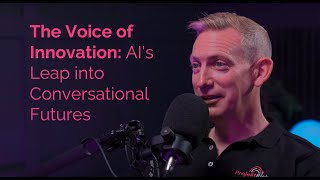
A conversational podcast episode (Tim Davies interviewed by Megan) about recent advances in voice AI and practical applications. The discussion describes voice cloning (ElevenLabs demo), real-time voice agents (AI receptionists, sales/reminder bots), and a legal/paralegal use case (Flow Loop trials producing documents from long calls). The hosts also cover ethical, legal and security risks (deepfakes, consent, strike-related pushback), and emphasise human+AI collaboration rather than full automation.
And that's what's recently happened with the ChatGPT voice launch, where there was a bit of a pushback because the voice sounded just like Scarlett Johansson from her role in her. And OpenAI claim it wasn't her voice, it was a voice actor's. But they've still had to pull it due to the pushback. Sure. So we used a piece of software called 11 Labs, recorded 90 seconds of me talking to the camera, and based on that, it was able to produce a clone of my voice that could then be told to say anything. I think in a year's time, we can pretty much forecast two years, three years. People talk about this AI hype cycle. Are we on the up or are we on the down? Towards the trough? That you can't say, oh, no, AI is just not living up to what I thought it would do. Maybe that particular technology isn't perfect. Whatever capability we're at now is as bad as it's going to get and everything is improving all the time. Sounds a bit like the conversation we had yesterday evening. People, people, people, People helped by AI.
Hi, I'm Freya. Welcome to the Skynet Chronicles Business in the AI Age, the podcast that dives deep into the world where artificial intelligence meets business. Join us as we explore the latest trends, check challenges and opportunities in this ever evolving landscape. From innovative startups to established enterprises, we'll uncover the secrets behind the successful integration of AI technologies. So grab a cup of coffee, sit back and get ready to unlock the mysteries of business in the AI age.
This morning we've got a bit of a twist on the usual podcast. I'm being interviewed by our lovely Megan. She's nervous, she's pretending not to be, and so I'm doing the intro before I hand over to her to interview me. So, good morning and welcome.
Morning. Thank you. It's nice to be here. So we're going to talk about voice AI and the advances in voice AI that have progressed, I guess, through the recent months and years. Can you tell me a little bit more about that?
Sure. So we've had automatic voice callers for many years, and they've mostly been rubbish. They follow a specific pathway, like if you imagine a flow diagram where it does thing one, depending on that answer, chooses the next thing to do, and sounds roughly human, but has no dynamicism. It can't move fluidly. It just has to follow the set process. And quite often we go, can I talk to a human please? Can I talk to a human please? Human please, Human please. Until it actually Gives you somebody that you'd like to talk to and have a conversation with. Recently, that's begun to change so that now we can have fluid, dynamic conversations with voice AIs that sound like whoever we want them to sound like. So we could clone my voice and have a very flat and boring conversation, or we could take somebody like Scarlett Johansson or Tom Hiddleston and have versions of their voice so that it sounds engaging, enthusiastic, but can have a very structured conversation. And what we can do with that then becomes fascinating.
So you talk about Hollywood actors and actresses being used. They have been on strike, haven't they, because their voices and things will be used.
Yeah. So we can't actually use their voices, but we can use people who've got voices similar to them in style and nuance.
Yeah, yeah.
Um, if you take somebody else's voice without their permission, that's obviously a copyright infringement. But there are an awful lot of very highly capable voice actors who will produce voices which sound similarly like. And that's what's recently happened with the ChatGPT voice launch, where there was a bit of a pushback because the voice sounded just like Scarlett Johansson from her role in her. And OpenAI claim it wasn't her voice, it was her voice actors, but they've still had to pull it due to the pushback. So now you can't talk with Scarlett Johansson on OpenAI's products. Unfortunately.
On my first day working at Project Rising.
Your first day, that was a long time ago. How many weeks and months was that now?
Almost five months now. So not that long ago. I remember it still, which is good. Yeah. On my first day, you played me like a short, I don't know, couple of minutes of you talking and I couldn't tell it wasn't you. I think now I can, but I think at the time I was just in so much shock and awe of everything that I was learning, like steep learning curve. But. Yeah. Can you tell me how you made that?
Sure. So we used a piece of software called ElevenLabs, recorded 90 seconds of me talking to the camera, and based on that, it was able to produce a clone of my voice that could then be told to say anything. Now, because I was in the home office talking into a microphone, I didn't think about putting sort of different sorts of sounds of voice into it. So I can hear that it's quite flat and it doesn't really sound like me. But for the purposes of demonstrations, when we put it into slide decks, people can't tell the difference. And it's it's incredibly powerful, but it's gone from being something that you had to pre program to something that you can pretty much use live. And now with the latest voice AIs, it's got the latency, the sort of time of response is quick enough that you can't really tell it's not that person you're talking to. And that's happened very quickly considering it's months.
Yeah, yeah.
But the good thing from there is that we can now have a telephone bot where we can talk to AI. We can put in a receptionist that has specific purpose, that says specific things, that has an understanding of its role. But we can then also combine that with the ability to interact with something else to achieve an outcome. So we combine this voice synthesis with some mild agentification where we're giving it the ability to take action. Then we can have a receptionist that can answer the phone, can ask for somebody's phone number, email name and can book a meeting in their calendar that's aligned with the availability in our calendars. All in the flow of a conversation. And when you start to think, okay, we can take this ability to have a conversation and then get an outcome from it, as well as having a rewarding conversation for the individual who's made contact with this voice AI, it starts to open up some really interesting possibilities.
Yeah, definitely. And it's available 24 7, so you're not going to need to.
Doesn't sleep, think about.
Yeah.
Doesn't need holidays.
No dentist appointments, hair appointments. It's just much easier, isn't it, to be able to find and source people who can take on that role in people's jobs instead?
Well, I think if you look at our organization, we're pretty lean, but it gives us the ability to have a service that we wouldn't have time to man properly otherwise. Because we might be talking to customers, we might be off site presenting, we might be in meetings. Whereas now we've got an ever present ability to have a receptionist who doesn't care if they're calling from Singapore in the middle of the night or, or California in their late afternoon because they can still perform the same function while we're able to actually have lives or almost.
It's just a massive saving as well for businesses, isn't it? If you're a small business who needs that you rely on your phone being picked up, it's so important for your business to be able to book appointments and things, even just doctors and things like that might even be able to benefit from it. But you. Yeah, you might be such a small business that you can't afford to take on a whole other person. So this is kind of a better solution, a cheaper all round. Yeah. Kind of solid option, I guess.
I agree. I think we're giving people the ability to work on the things that interest them rather than the things that are. That get in the way of being productive.
Yeah.
And there are some really interesting edge cases with this. So we can have it answer, ask and gather answers to long lists of questions. We can have it follow a sales script. We can have it reach out to people to give a reminder, a friendly voice to make sure somebody's doing what they should do. So just in terms of a few applications, we can create a reminder service so that people can keep in touch with their relatives and make sure they're getting the reminders to do what they need to do when they should be doing it. We can answer phone calls as a receptionist, we can take detailed paralegal type conversations where we can take a domestic abuse victim through a very rigorous conversation where we're extracting a lot of information, do it in an incredibly human way, but not have the impact on the paralegals who are having to take these calls back to back to back and write up the reports. So we're helping with a mental health issue there too. And as a more extreme example, where you've got marketing consent, you can also create the ability to have sales callers where an AI can follow a script perfectly every time, can handle objections and can generate the required outcome. That one has to be very carefully managed though, because you don't want to be calling people without permission or against consent.
Yeah, I think you're right. It's going to have so many different benefits to so many different roles. Yeah, the paralegal and the, the mental health side of things, that's.
Yeah, it excites me too. I think we've got quite a few of these projects where I'm just absolutely itching to show the world what's possible. But because it's wrapped within a customer project, we've got to make sure the customer's ready to launch it before we shout too widely about what we've been doing. But taking this evolution of the ability to produce a sentence out of early versions of GPT to the ability to produce long form content with the later versions of GPT3 to what we have now with Claude 3 Opus and GPT4O, where we can have interactive back to back conversations and produce incredibly long content or analyze long Content. But now making that dynamic and live with voice is breathtaking. So you can have a conversation while on a walk with a dog, with an AI, with where it's following a process to get the outcomes that you want. I use it to as almost a reflective aspect. Within my monthly month to month I do an analysis of where I am, what's working well for me, what do I need to work on. And rather than sitting and thinking writing it, I have a conversation with an AI and it makes all of the notes and it asks all the probing questions and just the fact that we can do that now is amazing. But you wrap that into a commercial application that is trying to solve a specific customer need with a customer who's pushing it and has product market fit and is promoting it correctly. The potential is amazing.
Yeah. And it's moving so fast, isn't it? Like the AI world, it's just progressing so much that you never know where it's going to be in like a year's time, do it? It's going to be, I think in.
A year's time we can pretty much forecast two years, three years.
Yeah. Crazy.
Yeah. I mean the rate of the compute per dollar is trending towards zero for a particular cycle. So you can do more for less. The amount of data around us is increasing at an exponential rate. So we can use that data combined with that masses and masses of compute to solve problems that we couldn't solve before. And all the time money's being invested into different edge cases that are incorporated into the general capabilities of AI. It's an amazing time to be in software development.
We're not going to know when, we're not going to know when we're talking to a human and when we're not in not too far future it's going to be are you real?
Well, and that raises some serious questions around security within an organization. I mean, you and the rest of the team regularly get emails from Tim asking for things. If that was then a phone call, is that more convincing? If you were getting it by email and phone call at the same time, does that breach a company's multi factor authentication checks? So when I'm talking to corporations and I'm saying you need to have passwords that you use for specific content, you need to have authentication across multiple channels. So if somebody says make this financial transaction or make this strategic change, you validated it in a multitude of ways to make sure that it has actually come from the person that said it has. Yeah, because we're not going to Know, you're right. It becomes incredibly easy to produce comprehensive deep fake clones and use them for nefarious purposes.
And we're clued up on it. You know, we're, we're the types of people where I'm always cautious, I'm always thinking, you know, is this call legit? Is this email legit? I've sort of got myself into quite good habits.
I'm not swearing in the email.
It's probably not everybody is like that, you know, not everybody's quite so clued up on how advanced these things are now. And they're going to be the people that sort of fall into. Fall into the traps, unfortunately, aren't they?
Yeah, I mean, social engineering's been the main way of data hacks and data being lost for a long time. It's not about hacking a system. It's far easier to hack a person to persuade them to do something that they think is the right thing. Click on this link, answer this phone call, take this action. You can see how it can very quickly become incredibly persuasive. And so that training and education for our customers of these are the things you should be looking for. These are the preventative measures you need to put into place. Critical.
Absolutely. I mean, should we talk about Flow Loop as Flow Loop?
Well, you, you said a name, so we'll talk about the concept. I think.
Yeah.
The concept is a paralegal service to answer domestic abuse victims, to gather information from victims of domestic abuse where traditionally a paralegal will have a detailed conversation with them and off the back of that they'll assess whether it's appropriate for financial support. I forget the technical term for that, but there's a government application process for aid, whether it's likely that there's enough evidence to support a claim and to have a supportive conversation with the individual who suffered abuse. And so this particular concept within the company Flow Loop is to help take these calls. So there will initially be a human to human interaction.
Yeah, they'll be for the start, isn't it?
Absolutely. Then they'll be passed off to this very friendly sounding voice AI who will phone them. They will have a conversation over a phone call. That phone call could last 50 minutes. We're currently trialing two different technologies to see which is the best fit. But they're basically different twists on voice AIs where we give them a guidance to follow. With one, there is more of a supported pathway. So it's a pathway with a prompt and supported objection handling. The other one is a prompt. Really, it's quite similar to how you might ask midjourney to produce a beautiful photo. It's a very detailed prompt, but nevertheless, it is a. These are the things you do, this is the way you act, this is your tone of voice, these are the ways of handling objection. And these are the questions you need to get answered. And then with both of them, they can follow the conversation flow dynamically to try and get to the right outcome. So we're testing these two different technologies on a limited set of the questions, but ultimately it will ask a series of questions over a long conversation and off the back of it, produce four different documents for this particular family law company. And then we'll see where it goes. Because obviously you need to then get really solid test data. It has to be used in anger. We've got to check that the content is gathering all of the information it needs to. So before it can be put into the hands of actually having those real conversations, it's got to be tested aggressively. So we've built a very simplistic front end which allows you to specify who you're going to call, and it's not Ghostbusters, their number and any other particular details, and then to trigger two different calls. And those two different calls are essentially the same thing with the same underlying questions, but against these two different technologies. And then we've got a dashboard where we can compare the performance of them. We can see the entire transcript of the conversation, we can see the questions and answers that were asked over the conversation, and there's an opportunity to give feedback, both in words and a score. And so from that, we'll be able to relatively quickly say which of these technologies is most appropriate. We know that there is another significant player about to enter this industry. Um, they've got a bit of a habit of releasing amazing technology and pulling it all into a product that might or might not be called ChatGPT. But at the moment, OpenAI haven't integrated phone and text message calling directly into their product. By the time this podcast goes out, that might have changed because we've seen early signs of the API endpoints. So we know that they are testing that capability, but it's not something that's publicly available yet or even beta available for us to play with. So we know that more technology changes will happen, but if we know the way to ask the questions and we've got the sort of prompts right, then they'll be pretty much lift and shift into a more capable technology. Yeah, so it's a really exciting use case because we're able to have detailed conversations, extract the information, and then do something with that information. In this instance, produce documents. But it could be submit information to downstream systems.
Yeah. Once you break down the different stages to any of these projects that we're working on, they always have kind of a similar flow to them, don't they? They're very. Obviously, we break it out into different. The process and create flow diagrams and things like that for them. But there's always kind of the. The idea in the first place. Then you have the content that we're actually putting into it, whether it's training or recording something. And then there's the product at the end of it that's produced reports or like you say, recordings, notes that are taken, things like that. So it's. That's one thing that I think I've learned in the last few months is it's not as daunting as it seems. When you first take on a project, there are similarities in the processes that you undergo. In order kind of get from A to Z.
And we're using these common building blocks. So it's like Lego. We click together. Okay, we need to analyze some audio. Well, that's that technology at the moment, it's whisper. That changes over time. Okay. We need to produce an image that might be one of three or four different technologies, and that changes all the time. We need to produce a video. Well, yesterday Runway three was released. By the time this comes out, that was weeks ago. But we see these technologies being released very frequently. But all it really does is replace the building block within the technology stack that we're clicking together to solve a problem. It might need a slightly different input, it might get a slightly different output, but it is really just. Okay, unclick that block. Click in this block. Happy days. And so we can build applications that are seemingly very, very different, but have a lot of commonality in their core stack, which means we can make them quickly.
Yeah. And that means better all around, really, for everybody, isn't it? You know, it means we can produce projects for people much quicker. It means they typically might cost less because we're, I guess, taking less time. And people at the end of it get what they need nice and quickly.
Absolutely. And I think we've got so much potential with just what's around us at the moment. And the fact that these voice AIs are available now, and they weren't really any good until a few weeks ago.
Yeah.
And just taking this. Okay, now you can do this on top of. You can already do these things with AI. It's not to say any of it's perfect, but the rate of capability improvement is fascinating. It's continuous and exponential and so we see new capabilities and ever improving capabilities all the time. When people talk about this AI hype cycle, are we on the up or are we on the down, towards the trough? And it's like this because there's so many different technologies coming in that you can't say, oh no, AI is just not living up to what I thought it would do. Maybe that particular technology isn't perfect, but there are so many competing technologies that are all under this umbrella of AI. We know that as whatever capability right now is as bad as it's going to get and everything is improving all the time. So people who just go in and go write me a poem about blah blah, blah in chatgpt free and don't know the difference between the toggles on 3 versus 4 versus 4.0, they're not necessarily getting the best possible output of the technology that's there at the moment, but in three months time, everything that's there is going to be out of date.
Yeah, the amount of people that I've spoken to, who they will say, oh yeah, I've used ChatGPT and you know, oh, it's all right. And then I say, the first thing I ask them is, but are you using the paid for version? And I guess 95% of them say no, I've just got the free version. And I'm just like, just use, use the paid for version, it's cheap, pay for it, it's worth it. Because the comparison between the two answers that you get asking the exact same question is insane. And I think people who I'm already having that conversation with, they're already engaging with AI. So you kind of think, well, you know, you're already partway there, you're not ignoring it, you're not dismissing that AI is a thing. So you're already kind of part way there. So, so just nudge them a little bit further and, and see what they can find out. Because it's, it's worth it, isn't it? Like I've, I've done the comparison myself and the, yeah, the difference is insane.
And even with the free version, although you do now get some of the more capable on a very limited basis within free, but Even with just ChatGPT 3.5, the basic version, you can achieve things that you couldn't do previously. You can save significant time. So for an individual just playing with it and just getting a feel for. Oh, I can rewrite that email in seconds or I'm struggling with this particular topic. What can I. Some ideas to start. Start with. You can achieve so much so quickly. I had somebody share their terms and conditions with me for something to do with a rental property and I think they just got off the shelf terms and conditions and they weren't quite right for the type of arrangement that he wanted to use them for. And I pasted it into Claude 3 opus on bianthropic and said, Find me the clauses in this terms and conditions that aren't appropriate for rental properties. It found them. Now rewrite those clauses so that they're appropriate for rental properties as well. It did. I shared it with them and they'll be part of his terms and conditions. It wasn't something that was heavy legal language anyway. It was a small business with basic terms and conditions, so the changes it had proposed were appropriate. They were light edits, but it would have taken me a long time to review it and suggest something he would probably have paid a lawyer. Whereas actually it was a super quick edit.
Yeah, it's interesting what you can do on there to do with legal businesses. Anything to do with legal, I guess. I mean, I've been exploring, haven't I, the concept of a legal admin assistant. And I think you can kind of, if you know the right prompts and things. And I guess again, because we're in that world of AI, we can sort of know how to prompt better and what things to write that make the prompt more successful to get the right results. But there is a lot that we can now do on our own, isn't there, without the needs of professionals. Definitely. I mean, like you say, we're a business of, you know, not too many people, so we work efficiently and those are the things that we can get done ourselves.
And I think it's taking the power of these large language models and the basic prompting, augmenting it with retrieval, augmented generation, where we're giving it specific examples of what's good.
Yes.
Telling it in a careful way to only use those and to not make things up, checking that it hasn't made anything up. So preventing this hallucination problem. But then you can achieve all sorts of amazing things. And so it's just we've got these large language models, they're like a brain, but sometimes they make mistakes, giving them specific input, reading material, checking that the response lines up with the reading material. And it's not that complicated a concept and really, that's all retrieval, augmented generation, backed up by hallucination checks is it's a way of making sure that the output from these large language models is.
On topic and correct and even the example can be. So I've recently been working on the case studies that we've now got on the website and I used AI to, to generate me the first one and tweaked it a little bit and once I was happy with it, I then used that as the example going forward so that they all have now a uniform look to them. But again, in my prompt it's not like, don't be too specific, don't stick to this template too specifically, just use it as a guide. But you can tell it all of this, can't you? But as soon as you've got that example, provide that example, make it into an assistant so you've got it there as and when you need it. So as and when I get new case studies, I can just literally get the transcript, paste it in, hit go and it produces a case study that's in keeping with the others that we have.
Giving away secrets. But yeah, it's so easy, isn't it? I mean, you've effectively given this.
It's knowing how, isn't it?
This model I writing style and an output type that you want to achieve. You're giving it the input and going, use this to make that. And it does.
Yeah.
Now is it perfect? Not necessarily. But we're not suggesting full automation for these. You still want a human to check the, check the output, make sure it's right and that's the same for everything. You're not. We're not generally proposing full automation.
No.
Because if you do that, you're adding in risk and removing the abilities of humans to perform what they're best at, act in combination with this technology.
Definitely. And I'm going and visiting the people face to face, having those conversations which then become the case studies. Because that's important still, isn't it?
Yeah.
So, yeah, there's still a lot of human interaction involved in the creation of lots of things we do.
So you've got a guided interview process up front. Yeah, we've got a set structure within the AI and automation that we're following to produce a draft of the output that then draft of the case study you review. If you're happy with it, you paste it into the CMS and it's there on the website.
Yeah, easy.
It's not, it's not complicated. No, but the skill is in the guided Interview up front, creating something that's repeatable in the middle, but still having that human touch at the end to make sure it's right.
Definitely.
So it's the combination of humans and AI is where we have the most impact at the moment.
Yeah, absolutely. I think it would be a mess if I, you know, the very first, you know, bunch of questions that AI offered me for the case study, questions that I kind of stick to, I guess as a whole, if I took the first lot of those, if I automatically sent them in an email or something to the person I want to ask the questions to, it generated the very first version of the case study and it automatically just uploaded it straight onto the website. It would be a mess.
It's the definition of crap in, crap out.
Exactly.
You've got to have that and fine.
Tune it as well. Yeah, yeah. So it's still worth it, isn't it, to put that time in yourself?
I think so. And I think that's where we have the potential to make the biggest impact with AI is augmenting people. Some of the processes can be automated almost exclusively through AI and automation, but many shouldn't be. And we should be getting something to 90% checking it's correct.
Yeah.
Making sure we're happy with it and then submitting it to the downstream systems.
Definitely. Yep.
Sounds a bit like the conversation we had yesterday evening.
Interesting.
People, People, people. People helped by AI.
Yeah, exactly. It's, it's definitely there to aid us, but it's going to be a long time before it's, you know, taking people's jobs away and eliminating whole roles, isn't it? And it's about getting people on board with it all, I guess, at the moment, isn't it? We're in a transition period and don't really know how long that's going to last for. We're still going to need all the tradesmen, I guess, for a long time.
And I don't think the need for people goes away. People buy people.
Exactly.
And if those people are more efficient because what they're doing in the back office doesn't involve menial, repetitive, manual and tedious work, then they get to spend more time peopling. For some people that's a good thing. For others, they'd rather hide behind a computer screen in an office and play with code.
It's just free time.
Not saying where I am on that spectrum.
Yeah, it's time freed up to do whatever you like with. Yeah. Better quality of life and things like that.
Well, thank you very much. For being the hostess with the mostess.
Thank you for inviting me.
More from Tim

EP 60: Why Founders Become the Bottleneck — And How AI Changes Everything | Thea Brook









