
Ep9: Behind the A.I. curtain,
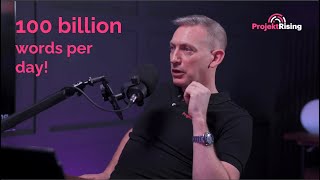
Tim Davies and Chris explain how AI actually works: transformers, tokens, and large language models. They cover practical tools like Whisper for speech-to-text, 11 Labs for voice cloning, and Sora for video generation. Gemini Pro now handles up to 1 million tokens, but voice cloning poses real fraud risks.
We'd been using GPT3, which became the backbone of ChatGPT for about 15 months before ChatGPT was released. 100 billion words per day is being output by ChatGPT. 100 billion 1 1/2 million words a second.
1 1/2 million words a second.
It's just mind boggling amounts of numbers. This tiny little model can run anywhere, doesn't need to be run on super aggressive big servers, and it gives you the ability to put audio in and get text out.
Hi, I'm Freya. Welcome to the Skynet Chronicles Business in the AI age, the podcast that dives deep into the world where artificial intelligence meets business. Join us as we explore the latest trends, challenges and opportunities in this ever evolving landscape. From innovative startups to established enterprises, we'll uncover the secrets behind the successful integration of AI technologies. So grab a cup of coffee, sit back and get ready to unlock the mysteries of business in the AI age.
Tim Davies, good morning.
Good morning, Chris.
AI expert, business owner, family man, and also now the go to AI spokesperson for BBC Lincolnshire.
Apparently so very exciting. Strange, strange world we're living in.
So today's podcast going to be a bit of a quick fire. Let's get some questions at you, see what you come back with.
Okay, so I'll try to get straight.
Into people know who we are already. So before first question then, what is a Transformer? And I don't mean the cool robot.
I was going to say, well, Autobots and Decepticons, not those. Okay. 2017, Google. Some Google employees released a paper called attention's all you need. And it was effectively a method of teaching a computer to absorb and process large amounts of words, to guess the next word in sequence. And that technology is the basis for the majority of the AI capability we have now.
So the AI capability is still guessing the next word in most of the large.
I would say guessing the next.
Okay, okay.
And we'll come on to what that might be because it depends on what you put in.
Okay, nice. Okay, and how does that, if at all, relate to tokens?
So tokens are like bits of words. Think of them as sort of 3/4 of a word broken up into the logical bits as far as a computer might see them. So we add ing or li to the end of a word. Those would be a token. Everything before it would be a different token. So generally they're broken up into making the English language easier for a computer to understand. And now actually every language, we do the same tokenization process where we just take chunks Lots of words. Break them down into bits that are easy for the computer to be fed into these learning algorithms, the transformers, and then once they're trained, they can output and guess the next word in sequence.
So with a word like happily, where we automatically read it and understand what it means, does that mean that the happy bit and the li bit would be separate tokens? Potentially, yes. And it would understand that. Okay, thanks.
Because it then just knows how those words are generally correlated.
And when we say it knows, what do we mean? LLMs.
Yeah. Large language models.
So what is an LLM?
Large language model is taking that transformer model and feeding it unbelievably large amounts of data. Think all of the books in the world, all of the content from the Internet that isn't on 4chan and porn channels, packaging that up, Wikipedia data and feeding it in. And then having this algorithm learn and absorb all of this information effectively. Build connections between synapses, although it's really just weights within a monster spreadsheet. And then that process, when it's run on computers at scale, can be asked a question and based on that training can answer the question with the context and with its understanding of the connection of words to give compelling English or any other language or any other type of response, depending on whether it's large language model or something else.
Okay, that makes sense. And I think one of the. Still one of the most used and sort of synonymous terms when we talk About LLMs is chatgpt. It's been around for 18 months now. It was the original. As far as most public facing models.
Go, I would say it was the original application.
Yes.
The models had existed for quite some time before them.
Okay.
We'd been using GPT3, which became the backbone of ChatGPT for about 15 months before ChatGPT was released. We'd built some capabilities that were incredibly.
Similar, but rising colder was quite a cool.
It was quite cool for its time, wasn't it?
Yeah.
But ChatGPT has been brilliant because it's got the attention of what could be done. What could be possible.
Yeah.
And has drawn in unbelievable amounts of people and the amount of data it's processing per day. Give me some checking my.
Give me some stats.
They reckon it's now 100 billion words per day is being output by ChatGPT. 100 billion 1 1/2 million words a second.
1 and a half million words.
Just mindboggling amounts of numbers.
Wow. Okay.
And what could you do with all those words? What is being done with all those words? Because it's not just blogs anymore.
No, no, far from it. Okay, if we get some time at the end, we'll come back and have a think about that. What's the difference between dense and sparse when we're talking about AI?
So when we talk about these models, they are huge sets of weights within a file which is run on large compute to guess an output, to guess that output in sequence. The cat sat on the mat because it was flat or being extra guesses that the model is making. A dense model like GPT3 is effectively all of that brain fires every time it gets a question. Okay, which is good in that you're using the complete capability of that mini brain if you like, but it's not efficient in terms of compute and it's not necessarily the best way of getting an answer. Sparse models, sections of that model fire in order to solve a question. So instead of the whole brain needing to work out where am I now? You know, in a little bit of your brain or I'm sat in Stanford. And that doesn't take your whole brain to work out the answer to that question. Sparse models have that same principle, effectively that's being answered with a subset of the data.
Okay, makes sense. Whisper. Well, not Whisper, but Whisper is an up and coming and now quite a popular tool within the AI toolbox. Talk to me about that a bit.
So Whisper was a brilliant little piece of Software written by OpenAI, released as public domain, which is now pretty much the primary way for all speech to text translation in compute. This tiny little model can run anywhere, doesn't need to be run on super aggressive big servers, and it gives you the ability to put audio in and get text out. And that text out is more accurate than any model prior to it. So great little piece of code, open sourced because they saw the benefit it could give them developed to allow there to be more training data for these models. Because if you've already used all of the text in all of the books, all of the research papers, all of Wikipedia, everything else that's on the Internet, apart from 4chan, there's. Then you're left with what else do we give these models to increase their knowledge? And audio, Obviously there's a lot of audio around. So now that also can be used as training data and Whisper's enabled that.
Can you give us an example of how Project Rising's used Whisper in a project or a piece of work or something that we've done for a customer?
So we use it in a lot of different applications. But a good example is the disrepair reports that we do for Cube, where we take an audio file from an on site visit by a building surveyor and we export that to text. We then perform natural language processing on it to extract the juicy bits of information that we need to populate the report. And that wouldn't have been possible without Whisper. It might have been possible, but we wouldn't have had the same level of accuracy. So it wouldn't have been as autonomous as we can make it.
And that's the key thing, isn't it? We're using Whisper to do something which is now quite basic in the AI world, because we need the output to do something much cleverer with where it comes to language recognition and all that.
Sort of good stuff. So building blocks of capability, how we stitch them together to make a solution that works for a customer.
Good stuff. So, on the subject of audio, another big thing that's come has become quite popular on some of the social media channels now is voice simulation and being able to put your own voice into songs and have yourself sing songs you'd never be capable of. It seems to be the popular way of using it. But talk to me about voice simulation.
So we can now sample almost any voice from as little as 90 seconds of audio and create the ability to replicate that voice pretty accurately. I can hear the difference in my own voice. My family can too.
Yep.
But when we use it in a presentation, people don't believe that it's simulated.
No.
And that capability was really made incredibly effective by 11 labs and has continued to be grown on since then. Excuse me. If you listen to TikTok or YouTube content, you're going to hear the same voice used again and again and again. It's a deep, inspiring voice, but it's using everything. No, mine's on there, but mine's not called Tim Davis. Thankfully, with that capability there comes some significant risks. So this year is an election year in a lot of countries across the planet. We're getting a massive increase in the number of robocalls where the call to a person is fully simulated. We're on the cusp of seeing more and more of that in a corporate environment as a method of fraud. Obviously, we all receive the emails that say, oh, can you urgently call me? Or you've won millions of pounds or contact this Nigerian prince. But if I called you on your mobile and it sounded like me and I was asking you to do something that becomes higher level of confidence trick than a written communication, I wouldn't just.
Say higher, I would say that's an order of magnitude higher. That's not just a little bit better. That's like you said, if I had a robo caller call me with your voice and it was interacting with me as I was talking, I don't think most people would have the, even the, even the foresight to be able to call that out as a possible fraud.
I think the good thing is that I know how much I swear and none of the models know which languages and which words I choose. So I think we're probably safe.
Safer for sure.
But it's a risky area and I think with the. There's a new release, Amazon based tts and they're actually holding that back until probably after the elections for risk of the damage it could do. But there's still more elections, more capable.
And by the elections, they just mean the US elections.
Well, I think if you look across the planet, there's a huge number of elections this year. It's not just the U.S. so that.
Saves it for one year, but that.
Puts it back while we develop more methods of coping with this.
Makes sense.
Ongoing use of technology fraud, which has always happened.
Yes.
It's just to a greater extent in terms of that level of confidence trick.
And with all of the voice simulation that's come, we've also now got avatar and lip sync sort of technologies coming as well, which is even scarier when you put those two things together.
What.
What have been the sort of the biggest developments in avatar and lip syncing technology.
So at the moment the latency isn't there for live interaction risk, but it is breathtaking for the production of a quick presentation. We use Synthesia in our podcast introduction.
And Freya at the beginning from Synthesia, she is now six months old, probably.
Nine months by now.
I'd like to redo sort of that piece of work and see if there's much.
The lip sync will definitely be improved, as will some of the expressions.
Do you think we should redo it for the next podcast?
Maybe, maybe. We probably won't get around to it though. Truth be told, there's a lot going on. It's a nice idea. So Synthesia, you can effectively give it a script. That script can be be written by you or written by a large language model. And then take that and convert it into really a series of slides with different backgrounds for different bits. You can choose the avatar, you can choose the avatar position, you can choose where in the script to add in specific expressions or eye movements or hand movements so that it feels more real.
And does this go. Does this go back to what you were saying at the beginning when you were saying you were talking about AI and its ability to guess the next. And I said word and you said not necessarily word. It could be guess the next frame. Is that how that sort of technology works?
Not really. They're using a lip syncing model and they're tying the movements to the words through that lip sync model. It's not slightly the same use. Yeah. But it is still amazing the improvements they've made.
Yeah.
So synthesia, fantastic bit of kit. There's another application which we use called Xhuman, which is more on the earlier stage development, let's say. But with that we can feed it images and get back video. So we can combine a model that is built based on an image with a script that we feed it and we can then get a talking avatar which looks roughly like it's real and syncs to the words that it's saying, but the latency is not there. It just takes a little bit too long to be usable in a customer facing application at the moment.
So when, so when we're talking about this, a lot of people think, oh, that'd be great because we can have a chat bot on the website, for example, which is a real person. It looks like a real person has the lip sync, can interact live. We're not quite there yet.
So you can do all of the bits where it looks like a person, it lip syncs, it sounds like the right person. You can get pretty close with all of that.
Okay.
But you might be waiting 90 seconds for it to come back with a response while it thinks about, you effectively have to break it into sections. What did the person say? What's the response to that? What's the response then? Being passed to a voice simulation. Then tie that voice simulation to the lip sync, then return it and those building blocks connected together take a bit too long to be convincing. So you can do it. You can probably get it quicker than that. For short answers, you can cheat where you stream bits of it instead of doing sentences or paragraphs, but it's, it's still not quite right.
So there's only so far. I suppose you can go with making it say, let me think about that at the start. To be able to buy.
It's not a great user experience if it's saying the same thing every time or just using those sort of coin phrases to fill gaps. So when we're asked about it, we say, just not yet, wait a few months, it's coming Though it's coming and it's coming quickly, we're seeing just huge rate of change in everything. But for live chat bots, I wouldn't use it yet, but for presentations, for videos on exhibition stands, for demonstrations of future capability, then it's brilliant.
Good stuff. Let's change it up a bit. What is a vector database?
A vector database is a way of storing embeddings in space.
So my next question, what is an embedding?
So an embedding is a way of taking text or really any other type of information and converting it into a floating point vector. Think of squiggly lines in space with more dimensions than our brains can picture.
Okay.
So we take a section of text, we convert it to an embedding using this embedding process, which gives us the squiggle in space. The vector database stores those squiggles and we're then able to search against it and get a really quick response in terms of which are the closest match. So we can then combine that into an application to very quickly find the right information that matches the request and combine that to give the customer output.
Very technical. Thank you.
It wasn't too technical. I did do the squiggles.
You did the squiggles in your hand, which made it much more accessible for people like me. Thank you.
Can't do 50 dimensions. Confuses me.
That's true. What is rag R A G?
So retrieval augmented generation is effectively an extension of vector database. It's where you combine a vector database with a large language model or a chat engine so that you can ask a question. You can then search for that answer within your vector database or any other source. But vectors are very efficient for this type of return. You then augment the generation with a chatbot with that particular piece of information you've brought back. And you can be really specific saying only use this in order to reduce the amount of hallucination that you're likely to experience in an application. So the combination of vector, RAG and LLM gives us the ability to produce a industry or application specific solution which only knows about the things it's allowed to know about and only says about those. So we can put some good constraints and rules around that and give legal answers or information that only exists in the specific library of a specific business.
Yep, that's quite exciting. A business like that last point, I think is quite exciting. Being able to have your own data accessible in that way is quite a powerful thing for a company.
We've got a. I'd say a potential customer at the moment, they haven't quite signed.
By the time this goes out, they.
Probably will have done. We'll probably have built it by then. But they've got a library of books that their traditional engineers have used forever. They cannot get the youngsters to look at them. The youngsters just want to look up the answers on YouTube. So this solution will allow us to take that digitized version of the library, to run it through optical character recognition. So we've got the raw text of all of those books to break those into chunks, turn those chunks of data, of words into embeddings, populate a vector database and then inst an answer bot to only use the information from that vector database and to say which book, which page, which chapter that piece of information came from, or those pieces of information came from. If it's from multiple chapters from multiple books. But you'll be able to accurately see, okay, this is the right information. We know it's come from our trusted sources and I can go and check it. More detail in this book here.
Yeah. So from book to squiggle to brain and then refer back to book if you need to check the source.
Yeah, it's all about squiggles.
It's all about the squiggles. OpenAI and Chat GPT or their Chat GPT have talked about assistants quite a lot over the last six months or so. What is an assistant?
So they've also talked about GPT. GPTs are the dirty, data hungry versions of assistants. Assistants give us the ability to build a limited application that has access to certain information with a limited amount of rag built in so we can feed in documents. We can create an assistant that has a specific goal and objective. For example, one we built the other day to check for clauses in a contract when you built just the next. Yesterday, wasn't it? In order to secure msa so that we.
Yeah, exactly. We had a master services agreement sent by a potential customer who wants to do some work with us. It was 57 pages long.
And all.
Yeah, my human brain can't cope with that much attention to detail all at once, so. Exactly. That we built an assistant. You could just check through and call out anything that's risky. Anything that's not sort of in line with what we'd normally accept given the parameters I gave it did it very quickly.
Well, we had Meg who started with us, what, two and a half, three weeks ago?
Super Meg.
Yeah. She built an assistant over the last two days to help with case studies. So prior to joining with us, she hadn't had any exposure to using AI tools, we've now got her building assistance and solving problems with them. The good thing is we can then combine multiple assistants within an application so you can have a situation where a customer wants to work on this particular type of asset within an interface. It chooses which assistant is effectively using behind the scenes. So you're able to leverage this technology from OpenAI and build it into an application that is able to use the right one at the right time to solve a problem.
Very cool. Text to image the capabilities when you think of where we were 18 months ago when we were talking about Dall? E in the first versions of midjourney, being able to take text and make images with seven fingers, three legs and weird faces. Where are we now?
Where are we now versus where we'll be when Sora's out? Where we are now is we can produce photos that are indistinguishable from the best photos ever taken. We can produce artwork that is specific for a brand, we can produce content that is appropriate and on topic for any brand. And it's having a huge impact on the photography artwork pack creation because it's just quicker and easier to use some of these tools. And it's gone from being just text to image to being image to text to image. Effectively where you can have an image, you can say this is what I want different done to it. And it happens. So obviously we had stable diffusion midjourney Dall E. Dall E being integrated into ChatGPT for paid subscribers. So paid subscriber on ChatGPT can effectively ask questions with GPT4, can use the advanced Data analysis tool, can then use any retrieval augmentation that they want and then have the output of that produced into an image. None of the tools are perfect at handling letters yet they're not great at bias management because they are effectively trained on a huge amount of data and the biases within that data are still present in the output. So the age old if you ask for a CEO, you're getting a middle aged white man in an office. There are ways of overcoming that. We can't talk too much about our way of overcoming that at the moment, but we might be able to in the future.
We definitely will be able to in the future.
Well, it depends on the confidentiality agreements, but there are are ways around it and there are ways of effectively augmenting that data to get the outputs that you want. So there's problems with bias, there's problems with letters, but if you think text image, a single Frame. If you've got 25 frames, that's a second of video. If you've got 50 frames, that's a second of high quality video. So how you then take this text image capability and produce something that can compellingly produce video output is really just scale.
And a lot of what we're talking about is. Now there's a phrase out there, multimodal, which I think is kind of summarizes what you're talking about being able to put in and get out different types of media, not just text, like it was when we first saw AI explode into the public realm. Can you just describe what multimodal means?
Yeah. So large language models were words in words out. Multimodal is multiple in, multiple out. So Gemini Pro and Ultra are Google releases of multimodal models. There's an argument to say that GPT4 combined with GPT Vision and Whisper potentially is, but really that's a different type of solution rather than true or multimodal. But the ability to give an image in and get an understanding of that image. So the GPT Vision does that. You can give it an image and you can get text out, you can give Gemini video image words and get an understanding of what's going on in there. So it's really just the ability to go beyond just words to solve problems that are bigger than just language.
You mentioned Gemini Ultra, Gemini Pro. Can you talk a bit about them?
Yeah. So OpenAI have been leading with models, foundational models really, for quite a long time. Despite the fact that Transformers as a model, as a paper came out of Google, Google and DeepMind's integration took a while and I think really it was the shock of the impact of ChatGPT that forced that to happen more quickly, so that the DeepMind team were integrated and began working on common solutions with Google. And Gemini came out in three versions. It came out in a version that you can run on a mobile device. It came out with Pro, which was initially available, and then more recently Ultra. The capabilities across them. Pro was about the equivalent of GPT 3.5, so it was available in free ChatGPT. Ultra was of the order of GPT 4. And then very, very quickly afterwards, Pro 1.5 has been released. And in some ways Pro 1.5 is superior to Ultra. So which model came from which? History within Google and DeepMind isn't public domain yet, but at some point there'll probably be a TV show about it. But I suspect that one capability was coming out through DeepMind. One of them was coming out through Google and then 1.5 is probably a combination of their efforts. 1.5's got a rather bizarre capability. We talk quite a lot about context windows, which is effectively the amount of working memory these models have. Early on, we could handle 4,000 tokens within the context.
Now we understand what tokens are. Bits of words. That's good.
So 4,000 tokens, think 3,000 words. So the combination of all of your interactions with a chatbot up to that 4,000 tokens, 3,000 words, it knew what it was talking about. If you went beyond that, it was probably managing it by deleting parts of that previous conversation those context windows have extended. We've hit, I think, 128,000 within some versions of GPT4. Claude 2 had a version that in theory could do far more. But it struggled with a test called Needle in the Haystack, where if you inserted a sentence in a book and gave it the book, it might not always find that sentence. So it's great being able to handle all of that information, but if you can't find all of the detail in there, that's not a lot of use. Gemini Pro 1.5 has come out with a 1 million token window, which is an awful lot of words.
So we've gone from, do you say 4,000, 4,000 tokens, 4,000 tokens 18 months ago to a million tokens today.
A million tokens. And that doesn't have to just be text. So Gemini Pro can understand tokens of images, of video, of words. So 1 million tokens of words is a lot of words. If you take that down to hours of video, it's a lot less, but it's still an impressive ability to understand what's going on and extract information from it. And the tests around sort of the needle in a haystack are coming out really, really strong. So I'm excited by what can be achieved with Gemini Pro 1.5. And that's before they've even started talking about ultra. So breathtaking improvements from Google and talking.
About breathtaking, you mentioned Sora earlier, which at time of filming is a fairly new release. I don't think it's even available publicly yet.
Yeah, I think they only announced it last week.
Yeah. So what, what is Sora and why is it exciting and why is there such a hum about it?
So Sora is a text to video model. At the moment, the most capable text to video models aren't great really in terms of you wouldn't be able to use it for a brand advertising content to consumers. You can make some cool little snippets, you can maybe do some moving around a pack shot, but the detail and the just the general quality isn't there. It's quite jagged, quite clunky in its movement. Sora is a model that's been developed by OpenAI that, from the demonstration videos they've released so far, produces breathtaking photorealistic videos with an understanding of physics. And that's not an understanding of physics that's been programmed. So one thing we've sort of jumped past, we should come back to on Gemini ultra, was the YouTube training data. But while sticking on Sora for a minute, what they've been able to do by feeding it large amounts of both tech, both images and videos of differing resolutions. So they haven't quantized it all to be square, to make it nice and easy to consume. They fed it all sorts of different resolutions of images and video. And they've given it a huge amount of compute. And what they've seen is the difference between 1 times 4 times, 16 times compute is the difference between it not being recognizable as a dog, to being a dog playing with a girl to being a video of a dog playing in the snow. Detailed.
Wow.
And if you continue to increase that compute, you get the capability with these sort of emergent understanding of physics that haven't been programmed in. So there's a video that I love of a puppy walking from one windowsill to another windowsill. Feet placement, perfect, shadows perfect. Something a little bit weird, the tongue and the ear at one point. But in terms of the improvement in the capability from those little clips that Runway 2 can produce to what's being demonstrated with Sora is amazing.
So it understands light and shadow. It manages to do something with light and shadow.
Whether it's right, it looks like it understands more than light and shadow. It understands object permanence.
What is object permanence?
So if I put this cup outside of my line of sight, I know the cup's still there. Unless there's some big bolt on the table or somebody comes along and steals it, I can reach out and it's still there. So my brain understands the permanence of that object. What we've seen in some of the videos from Sora, specifically Minecraft ones, is cameras panning and objects still being in the correct space, despite the fact that they can move within that 3D space.
Wow.
So the understanding of placement accurately and the physics capabilities in terms of flight, movement, gravity, contact with it, it's amazing what it's producing. And it has a great impact in the future towards games development, but also towards training worlds. So if you're thinking about how do you train a robot into how to move around an environment? If you can create absolutely billions of hours of limitless movement video and feed that in as training data, you're effectively giving the ability to train on something that isn't real synthetic data.
Yeah.
But is representative of the world.
That's terrifying.
Hold on to your seats.
You mentioned you want to go back to talk about YouTube's training data for Gemini Ultra. We're running out of time, so go back and talk about it quickly.
Okay, I'll be quick. So YouTube's a lot of. An awful lot of videos on there.
Yeah.
And when people started populating and updating their videos and uploading them, nobody really thought about it being AI training data. Google have converted all of the videos on YouTube into 14 trillion frames of data.
14 trillion.
14 trillion, right. A frame being a subset of an image, effectively a single frame of data, but it augmented with what's going on in the video, what's in that frame identified by computer vision, to create an awful lot of information that then can be fed in to gain an understanding of effectively any video. So you then combine that text understanding, that audio understanding, with all of the information that's on YouTube. Gemini can probably fault, fix a television and electrical wiring, how to do pottery, how to do anything you want. Because the information's already there on YouTube.
But so is wrong information. There's not every YouTube video about fixing a telly is. Right. So it's got both.
It's got both. But it's also got the benefit of scale. So if something happens, more times than not, it's more likely to be true. And so it. You get that same bias from the video data that you get from image data. Yeah. But it. It's still a great source of information.
Absolutely. No denying that Sanctuary World Model is something next on my list that I want to just have a chat about. So what is Sanctuary mod?
So Sanctuary are a robotics company. They are probably the leaders in terms of the degrees of freedom of movements of their hand, the control mechanisms, the sensors that they've got built into those. And they're populating those robots into a variety of different manufacturing and coffee shops and all sorts of other places. But they've effectively solved that world model. So instead of having to account for a world model and it happening by accident within sora, they have started with World Model first. So instead of the sensors being live data, the sensors update the world model on where something is. So I've just moved that cup to there. I updated my model to say where that was. I didn't rely on my hand holding onto it to tell me still in my hand. So they've built that capability and that's going to be incredibly powerful for them as they move forward as robotics company and I look forward to playing with one of their robots.
Let's get a robot. Sounds good. I'm going to skip down the list a little bit. I think Chat RTX throw you.
It is going to throw me.
What is CHAT rtx?
So Chat RTX is the ability to interact with a large language model on your device without any data traveling across the Internet. So it's Nvidia's cards, the 3000 and 4000 series. If you've got one in your laptop or computer, you can set it up, you can install a large language model locally and you can chat with it with access to your documents without any of that information passing it onto the Internet.
So are we now at the point where the hardware capability means that we could run large language models locally and avoid the risk or the perceived risk of people's companies Sensitive data being used in training models worldwide?
Yes, but limited language models. So not the latest, greatest, most powerful?
No, of course not.
But ones that are fine tuned for a specific use case? Absolutely.
So if a company's got sensitive data that they're not comfortable sharing with the back, you know, OpenAI's large language models GPT4 they can now run it locally.
Potentially on every single device, on every.
Single device within a company's.
But they could also run it on a server within their own data center on site. So it doesn't need to be the ChatRTX model where it's running on a specific device. It could be that they've got a large language model sat in a data center that is their data center on site and that data never leaves their network effectively.
So we're now at the point where we've got the potential to run large language models siloed with no Internet connection if we don't want it running locally. Data protected. Yeah, very cool. I'm going to go back one AGI. Talk to me about AGI jumping up.
And down my list. I am just to throw you AGI Artificial General Intelligence. Lots of different definitions. The easiest one to understand is it's the capability of a model or a technology to perform the all of the knowledge work tasks of the average person.
Okay.
So if you think of everything that you can do at a computer. If we can get an AI model to do all of those things at a computer as well as you can.
Yep.
We've exceeded that definition.
Are we there yet?
No, no.
Do you think we will get there soon? How soon?
I'd be amazed if it's more than 18 months.
So very soon. Yeah. Because I suppose if you think where We've come in 18 months with this stuff, it seems to be an exponential.
It's the compound of those developments. So I think we've got one on there about compound AI. I'm still going to talk about it, but it's where we are combining different capabilities within a single interaction. So we've been doing that compounding within our applications, but it's becoming more of a capability at a specific AI level that it has the ability to do lots of different things. So if you think about the ChatGPT premium plan, the advanced data analysis GPT vision GPT4, the retrieval augmented generation, it is a compound AI. It can do lots of things. If you look at the capabilities of Gemini Pro, it has that. It's already a mixture of experts. It's a sparse model where it has these bits that do different things well and it knows how to pass the information to the right bit to do the right task properly.
And do you think the recent story around Altman's $7 trillion story, is that related at all to the way that AGI is being developed? Or is it. Is that something completely different?
I think that's. There's an argument to say that they, they know how they can get to AGI and it's a scale issue.
$7 trillion is.
7 trillion is enough to buy Microsoft and Apple outright based on their market capitalization. 7 times the valuation of every chip company on the planet. But if you look at the cost of training models, it's increasing by an order of magnitude roughly every year, not quite perfectly. And if you carry on that growth, 7 trillion doesn't seem like such a big ask, but it's what you get for that investment. And if with a fraction of that, they achieve AGI, and that AGI has the ability to perform a lot of the tasks that people don't want to do, that don't like to do, or they're not very good at, at a personal and at a company level, the output that can be delivered because of that capability is huge. And realistically, the profit that can be generated for a company that achieves it is almost off the scale. So whether they can get 7 trillion will depend on who they're allowed to go to under US regulations, whether the wealth funds in Saudi and the others have got that level of capability, especially with their own building and aspiration production.
Projects and the risk appetite. Because it's all well and good. Someone like Altman saying, I know we can do this, but it's still a risk.
It is a risk, but I think they've got the building blocks. And I think if you look at the progression within the foundational models, the capability of Sora, the rumored capabilities of Q Star, then these things together show that if you apply enough scale and compute to the problem, then you're getting mighty close. You're certainly getting leaps more capable than we have now. And what's achievable now is already breathtaking.
So we're in a very exciting time. I know last time we had that we spoke on this podcast was probably two months, three months ago. And some of the stuff we're talking about has now been dwarfed by what we can talk about today. Big, big question then. So 12 months time, you know, it's February 2025. What does the world look like in terms of AI?
I think AI has a pervasive impact in terms of almost every business. The businesses that are using it are outperforming the businesses that aren't. And the capabilities are beyond that of a lot of the employees within a company. So I think we're not looking at you're going to get rid of all your employees, but the employees using these capabilities will mean that the company can perform a lot more things that they weren't ever getting around to are being done brilliantly.
Are those businesses slightly outperforming or are they dwarfing competition?
Dwarfing. I mean, already a business that is using these capabilities is dwarfing those that aren't.
Good stuff. I think we're going to end it because we're way over time. Okay, thank you very much. Nice to talk as always.
Fun for fun.
More from Tim

EP 60: Why Founders Become the Bottleneck — And How AI Changes Everything | Thea Brook









