Unicorns and VCs from Silicon Valley - Genspark, AGI House and Cresta - at Expand North Star 2025
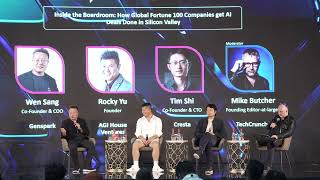
Wen Sang, Rocky Yu, and Tim Shi discuss how AI agents are scaling from consumer tools to enterprise software. They compare go-to-market strategies: bottom-up product growth versus top-down partnerships like Palantir's model. Fortune 500 firms and government agencies are driving inbound demand, while pricing shifts from token-based to outcome-based contracts.
Chapters
Now we're coming to another session that looks into the USA. VCs from the Silicon Valley, what are the insights that we can get from the boardroom? How do global Fortune 100 companies get AI deals done in the Silicon Valley? That's what we're now going to find out. We dig deep into this topic, and to guide you through this conversation, we have no one else than Mike Butcher, the founder and editor of pathfounders.com and the former editor-at-large at TechCrunch, and he will be joined on stage by Wen Shang, who is the co-founder and COO of Genspark. And what you need to know about Genspark is they are building AI agents for the future of work. With him on stage, we have Rocky Yu, the founder and CEO of AGI House, and that's a premier AI elite community with AI founders and researchers. And then we have Tim Shi, the co-founder and CTO of Cresta, who helps really Fortune 500 companies transform their customer experience. So let's welcome the panel to the stage.
Welcome!
Great to have you.
Hello everybody. I hope you're enjoying Expand North Star. It's a Really great to have you all here. We're going to be dipping our heads into Silicon Valley here, and although the subject talks about global Fortune 100 companies getting AI deals, in reality startups like this are actually dealing a lot with large companies and selling them their software. It's kind of like a new wave of of SaaS to some extent. And in the middle here we have Rocky Yu, who's the founder of AGI House Ventures, which is a fascinating project you'll hear about in a moment, which is very much part of the AI revolution in Silicon Valley right now. But perhaps if we just introduce our panel a little bit more. Wen Sang, who's co-founder and CEO of Genspark. Genspark's raised several hundred million dollars right now. When you are doing a lot with big companies at the moment, you're very much in, in agentic right now. Tell us more about what's going on.
Absolutely. First off, so excited to be here and thank everybody for being here. So JetSpark AI is a Palo Alto, California-based technology company. We build AI agents for knowledge workers. What that means is in the past, human beings like us, knowledge workers like us, may be founders, investors, bankers, consultants. We have to do work ourselves. We learn how to use these software tools like Microsoft 365, Google Suite, Slack, Notion, Salesforce, you name it. But we do the work. Now with Jens Bark Super Agent, we do not do the work. Our Super Agent does the work for you. Essentially, you open up genspark.ai, you let your super agent know if you wanted to create a slide deck or you wanted to build a financial model or you wanted to write an investment memo or you wanted to get a meeting summary for your in-person meeting notes out of your Apple Watch. The agent does the work for you and it gets to 60, 70, 80, 90%. We as human beings, we give it the final touch. And everybody works like a boss. And with that, what we get is time back into our own hands. Now you could decide to go on and then accomplish more, or you could say, "You know what? My job is done this week. I'm just gonna have a 3-day work week." That's what we're trying to provide to all of our users. So to what Mike said earlier, we've been very fortunate since the launch of our Super Agent Suite back in 2014. Back in April, we've had tremendous growth. After the session, I'll actually do a quick spotlight announcement, but for now, yeah, back to Mike.
Oh, is he going to announce some news on stage, are you?
Yep, yep.
Hold in there for now.
Oh, you're holding it? Oh, that's no fun. Well, you can talk to me about that later if you like. But moving on, obviously we've also got Tim Shi from Cresta, now to some extent playing in a similar kind of space, but also in AI, but very much about real-time guidance for human agents working with generative AI, conversational AI, call contact centers. What's your approach to this space right now?
Yeah, we work— we are more like a partner to businesses. We actually sell and work with large Fortune 500 companies like United Airlines.
Hold it a bit closer.
And we, we're really like a partner to these companies. So we will very high-touch approach, work with United Airlines to help them, listen to them and understand what their needs are and build a full transformation approach to their call centers. And we, we basically meet where customers they are because not every company, especially the legacy industries, are ready for large-scale, like, you know, generative AI transformation today, but they may be ready for some use cases and maybe some portion of their teams get ready to use it. So we meet where they are. We start here, listen to what their needs are and start transformation from one use case and initial rollout and eventually to like a larger scale like transformation.
Right.
I see. And then of course, Rocky is working at AGI House Ventures. Now, AGI actually is an actual— AGI House is an actual house, which I've been to and shot video at. It's a fantastic house down in the Bay Area. You can drive to it. It's got a pool. It's got guest rooms, and it also has become very much a center of the explosion of interest in AI right now in Silicon Valley because they hold multiple events and hackathons, and it's very much an engineer geek-led approach to the whole AI. I don't want to steal your thunder. Tell us all about, tell us all about what's going on right now, how it's all going, what kinds of things are happening there, because this is really, I think, very cute, very fun and fascinating, very much at the coalface of what's happening in Silicon Valley.
Thank Thank you, Mike, for the intro. Yes, actually, we're very honored to host Mike a few months ago in our home. It's based in Silicon Valley in Hillsborough. It's about 20 minutes south of San Francisco, 9 minutes from the airport, SFO. So it just started off as a literary house, which is like a haven for people in the world early days, the end of 2022, the founders of OpenAI, Anthropic, Google, like Sergey Brin, would come hang out, talk about foundation model early days. And then ChatGPT comes out. That's where the whole world was curious, what's this large language models? But the people who knows about those, the model, train those large language model, will hang out at Asia House. So we become the center of all this attention where we take a lot of opportunity to bring all the venture capital like Sequoia and Drisan, all the big Big VC funds sponsor our events. Like Mike said, we host a lot of private dinner discussions around models early days. Then on weekends, we host 100, 150 people hackathons to build applications around the foundation models. That's where a lot of the early companies, like you said, Perplexity, LangChain, Llama Index, and Cognition, the founders would hang out at Asia House before they even start the company. Now, most of the AI-native companies that you see today, in Silicon Valley probably have been, has something to do with the AGI House. Actually, we actually host the founder of James Park, Eric, when he was still brainstorming his idea before he started James Park. He was at AGI House. And then Tim used to live at AGI House. Very honored to have a very relevant crowd here. So, the mission of AGI House actually wants to push in the frontier AI research. So, we, as the name suggests, AGI, that's our goal. And then the second is help the— because we believe in the technology so powerful, want to help accelerate adoption of technology in the rest of the world.
That's what we do. Amazing. Well, sort of cleaving to the subject, what generative AI has produced effectively over the last couple of years is a sort of a new layer of software as a service. So instead of structured data being quite hard to work with. You're having to build heavy-lifting engineering projects around corporate systems, whether— or vertical data sets, you name it. Unstructured data— generative AI can deal with unstructured data in a far more, you know, cleverer way, smarter way. And that's led to the explosion of these new kinds of companies. But you still have to sell into the enterprise a lot of the time, don't you? So, I mean, when, what, when you're trying to pitch your product to partners, how do you approach it, and, and what kinds of uplift are they looking for from your kinds of products?
So when it comes to Genspark, we've been truly fortunate in a way that initially we only launched our product for individuals. Primarily it's prosumers, right? There's a young man called Matthew. He's based in Michigan, graduated college and wanted to start his company one day by himself but didn't have the capital. So he would contract restaurants and barber shops to build websites for them, charging them $5,000, $6,000 a pop. And before, he would hire developers offshore, but now he pays Jasmark $25 and voilà, he has his whole website built and he still charges his clients $5,000, $6,000. So initially we built our application, our platform for, you know, solopreneurs like Matthew and a lot of the, you know, consultants who are consulting for restaurants to help them to secure bank loans before they have to hire people to count the traffic, build models. And now they just ask Jasper to get the financial model done, get the research done, get the pitch deck done, and then go into meetings together with their clients to secure bank loans. Now coming into June, July timeframe, all of a sudden, we're getting a lot of inbound inquiries from the corporate world or the enterprise world that goes to PE firms in Japan, investment banks from London, even government agencies from Dubai. So as of today, Dubai Electricity and Water Authority is actually a client of ours, a major one, a big one, and we're very fortunate to have them. And also oil and gas companies from Bogotá, Columbia, consumer electronics companies from Korea. So people started to reach out. When we asked these folks, how did you hear about us? Why did you reach out? And they all reached out. We didn't have any team plan or enterprise plan at the time. We didn't even have a webpage for the enterprise clients. They reached out to us through our support@jazzspark.ai email. And they told us, look, On the one hand, when we get pressure from the boardroom, of course, our board is asking us to adopt AI. But at the same time, a lot of our individual employees use you guys and they push it to our IT department. They push it to our leadership saying that I want to have this for my work. It's going to save me so much time and let me focus on high-value stuff. That's how it happened.
Right.
And because of that, we followed our clients' needs and launched the Team Plan, Enterprise Plan, after we've seen a lot of inbound inquiries.
So, right, so you've got a lot of inbound engagements. What about Cresta? Is it getting the same kind of thing? And also, are you working in the Middle East as well?
Yeah, I think that, right, we were started like about 7 years ago, and I think it's very different times because I think initially you would need a lot of data for the AI to work well.
Well.
That's why we took more like a Palantir approach where we work with companies, work with them to ingest their data and figure out what is the high-value use cases to deploy. I would say that this is one interesting approach. There are also— I like, like, Jan Spark's approach, which is more like bottom-up, which is like you find use cases where you can roll out a product where there's individual developers, so users will adopt it. Typically, we see that both work— approach can work pretty well, and it depends on the nature of your product. It depends on the amount of data you need to use and the integration you want to build. Depending on like what kind of enterprises you serve, you can like take different approaches.
I see. And but AGI House, you guys, I mean, the hackers come— they're coming up with things.
Are they—
do they think about B2B applications or to SaaS applications? Or do they think more at a consumer level?
Absolutely. We actually host multiple B2B sessions, enterprise adoption sessions. So early days, actually the reason why we host hackathons is trying to get a sponsorship to pay the rent, because expensive house, like a $68 million house. And as we grow, actually we, it's like what you said, like just amazing how the market tells you what to do. We got so much inbound requests from all the major, like Google Cloud, Amazon AWS. They signing a multimillion-dollar contract with us. They want to do this. It becomes the enterprise. We become the distribution layer for the developer ecosystem and the enterprise customers for them to attract the talents who want to build on the enterprise side. So we host actually multiple enterprise sessions. in LA J-House.
Oh, I see. So you are focusing— I know, I presume those are popular as well.
It is very popular. I think if you see what's happened in the last 2 and a half years, the early days is all about foundation models, how to make the models like scaling the intelligence. And then later is about the frameworks, the infrastructure. And later, and afterwards, last year or so, it's all about verticalized agents, which is about enterprise adoption. Working as agents.
But yeah, you got a point to make.
I was just going to say a lot of people don't know these days the hardest club to get in in the San Francisco Bay Area is not the clubs in SF, it's Rock House for the Saturday hackathons. You can't get a ticket. It's absolutely an elite community.
I disagree. I got an Uber there. I rocked up. No big deal. Yeah, there's no security.
A normal Tuesday is dinner with Jeff Dean and Sergey Brin from Google, or Mohnath Khosla from Khosla Ventures.
So I'm sure it's a lot of fun. But, but both of you, Tim and Wen, I, you know, what I'd like to know is like, you are obviously building these new layers of platforms for especially agentic platforms for corporate and enterprise, but what kind of moat do you have? Against the up-and-coming other startups who are trying to compete against you? What moat have you built to stop them coming in?
I would say one big moat is having a better product that you build into different touch points within the customer journey, and once they start with you and they use you more, they become dependent on you, right? So that becomes a a part of their workflow. I think even though that we're talking about agents, we still have like humans that are using those agents, right? And that become part of their day-to-day life. And once you have these agents being part of their enterprise workflow, it's pretty hard to replace it because you're kind of like the octopus where it like tentacles into the different systems.
Right. How about you, Wen?
And for us, Mike, I would say our take is the conventional wisdom of moats in Silicon Valley is no longer valid. We have a rather unconventional take. Reason being, today, the large language model landscape shifts very quickly, right? Everybody's releasing the world's best model on a daily basis, essentially. The disruptors, you see the disruptors being disrupted all the time, right? Back in '22, when it comes to code generation, everybody's talking about Copilot. And then it's WYSIWYG and cursor, and now everybody's talking about cloud code. So when it comes to such a fast-shift technology landscape and environment, our view is there's no moat. There's no moat. Yes, you can still hit product-market fit, you can still have good traction, but there is no way you could just say, we're all set, let's just optimize, we're good for life. No, no, no, you cannot stay still. So because of this understanding of, or this view of the world, our philosophy is we have to get onto the constant innovation. We have to constantly create more values for our clients, for our users. That is the only way to survive and thrive. And one more thing to support that, I'd say the good news is with all the LLMs, coming out today, the cost of building software applications way lower. I'll let you in on a secret for everybody here. 80% of our code is written by AI. Our human engineers, they focus on two things: product and technology.
Okay, right. We only got a couple of minutes left, but I mean, I think I want to get into just the last couple of minutes of the access to compute and AI models. And as you said, when the costs are coming down, interestingly, consultancies, the amount of money consultancies can charge now is starting to collapse because the clients are starting to go, hey, half of this stuff is produced by AI, so I want a discount. So the consultancies, their business model is definitely big trouble. But in terms of the technology companies, your costs are obviously access to, you know, your costs are going down. You're not hiring junior developers anymore, so you're getting less cost that way. You're using AI copilots to produce software. That costs are going down. Yes, talent is still expensive, but is access to compute going to be the differentiator for your companies? or will the cost of that also come down eventually? Tim?
Yeah, I would say eventually there will be, I think end-to-end, you will optimize the product from the model layer to the product and it will become one thing. Ultimately, it's like what is the value you deliver to enterprise customer? Because when they buy software, they're not just buying a product and a bunch of features, they're buying the ROI. They invest in $1 million, they're getting $10 million out back, and that kind of transformation, that kind of cost saving or revenue increase is what they're getting out of it.
All right. What do you think, Rocky?
Yeah, depends on the objectives of the company. If they are trying to scale the user base or they are trying to have the clear ROI. So we do see in both cases they invest a lot in compute. I would see recently a company called Higgsfield. They also have a similar trajectory. They grow from 0 to 50 million AI in 5 months. And then the founder was like literally traveling around the world to find the cheapest computer, just at whatever cost that he can get. So we see a lot of those examples currently. The market is just at this stage, yeah.
What about Wen? What do you think?
Well, there are two things here. One is the cost. The other is kind of the top line, right? So I was actually just on this panel last week, SF Tech Week, with the co-founder of Anthropic, CEO of Windsurf, and co-founder of, uh, uh, uh, Lovable. We were just talking about, okay, with this new token economy, how is the pricing going to change for software? In the past, subscription is basically the dominant, right? But now, uh, what we're seeing is, on the one hand, a lot of the applications I just touched on, they're using this, uh, utilization or token-based consumption kind of a model. But then there are also companies like Cognition you mentioned, they're charging, I think, $120,000 per seat for their enterprise solution. Why? Because this is outcome-based pricing. What that means is it's not just about the tokens you consume or the work you do, it's about the results. So I'd say in the future it's absolutely possible for individual-based applications, people are continuously, you know, using this consumption-based kind of pricing. But when you are willing to take responsibilities for the results, you can charge a lot more, right? And when it comes to the cost, our hope is, you know, at the end of the day, there are 1,000 models blooming and the cost of inferencing all goes down to electricity. That is the world we want to live in because we believe AI is going to be important for us, for everybody's daily life. And it's like water, it's like air. That is the only way for it to be.
Well, this is definitely one of the things I hope that we'll be able to do is reduce the cost of compute, reduce the cost of the environmental impact as well of some of these data centers that are producing. But ladies and gentlemen, we run out of time, but I want to say thank you very much to Wen Sang from Genspark, Rocky Yu from AGI House Ventures, and Tim Shi from Cresta, and from me, Mike Butcher, where I'm launching a new media title called pathfounders.com. Hang on, go and check it out. But for now, thank you so much, and we'll see you later.