#271 Of Schoolishness, Space and Emergence into vibrant systems - a joint podcast with Tim Logan

In this joint episode Tim Logan and host Amanda discuss the crisis in contemporary education and explore emerging alternatives that might sustain complex life on Earth. The conversation opens with Tim describing his current living situation in a cold, empty barn in Bordeaux and his personal commitment to eco‑friendly living. They frame the moment as one of “post‑inauguration techno‑feudalism” and ask how education is responding to systemic collapse. Tim points to a growing network of experimental schools – the Green School in Bali, nature‑based schools, the online School of Humanity – that are built around a concept of taking nature seriously and fostering generative learning. The hosts critique the pervasive logic of “schoolishness” and optimization, drawing on Hartmut Rosa’s distinction between optimization and resonance, and note how performance‑driven accountability erodes young people’s connection to learning, fueling eco‑anxiety and a loss of purpose. They discuss the need to shift from future‑oriented, skills‑talk toward present‑oriented, embodied practices such as soil‑touching, permaculture, and shamanic work. The dialogue weaves in a range of thinkers – Bill Plotkin’s ecological awakening, ecological psychology (James Gibson), Māori ontologies, Rupert Sheldrake’s morphic resonance, and the concept of “citadel mind”. They examine concrete interventions: warm‑data labs (Nora Bateson), the International Baccalaureate’s Systems Transformation Pathway at UWC Atlantic College, and the challenges of embedding emergent, non‑linear practices within outcome‑driven school structures. A major focus of the later segment is the International Baccalaureate’s Festival of Hope, a co‑created, global platform where thousands of young people gather (both online and in‑person) to discuss climate, mental health, and other pressing issues. Tim explains how the festival emerged from a conversation with the IB Director General, its design by youth with support from teachers, and its role in fostering ongoing community, mentorship, and the Global Youth Action Fund that finances student‑led changemaker projects. Throughout, they stress the tension between systematic optimization (which can become eugenic) and the need for resonance, inner work, and community‑based agency. The episode ends with a call to create bridges between current institutional frameworks and the emerging green‑school movement, emphasizing that systemic change must be culturally contextual and co‑created rather than imposed.
Chapters
The things I'm seeing, the really exciting and important projects and, you know, green shoots that are coming up are spaces where they're, whether it's online or in-person schools where they are, or, you know, educational experiments, if you like, where they're just allowing, often it's built around a concept. So for example, the Green School in Bali where, you know, good friends work, it's a really, it's just, there's a concept there that says, okay, we are a school that takes us as nature seriously, and we're gonna enable young people to be part of that. Or, you know, nature-based schools, or, you know, there are, there are lots of examples, a School of Humanity, uh, an online school that's just, you know, trying to bring more open generative spaces of learning for young people. They are happening.
Tim Logan, welcome to the Accidental Gods podcast.
Thank you. Thank you, Amanda. And welcome to the Future Learning Design podcast. The first time I've ever done a, a cross-posting podcast episode.
So yeah, super excited.
Yeah.
Joint, joint podcast. It's gonna be fun. So from the Accidental Gods side, inquiring of you, how are you and particularly where are you? This interesting Wednesday morning, we are recording, it's worth saying to everybody, 2 days after the US inauguration. So we are now 2 days beyond the end of democracy and into what might be techno-feudalism or might just be techno-cristo-something fascism. We don't know yet. So how are you and where are you as the world turns over?
Absolutely. No, strange times. Thank you. I love the question. I've been listening lots to the Accidental Gods podcast. Since we met. And, um, yeah, I love the question. I think it's great grounding at the beginning. So I am— yeah, I'm feeling really good and excited to be talking with you. I feel like it's been a really special meeting actually, um, since I met you, um, with our previous conversation with Ginny and Risa and Will on Collapse, our little pre-Christmas festival that we had. Um, and where am I? Interestingly, I am sitting in an empty barn in the middle of Bordeaux in France. So we've just bought a big empty stone barn, which is quite an adventure for us. I've got 3 kids and a dog and we're all sleeping in one room right now and trying to stay warm. But yeah, on the way in a few years' time to getting— yeah, well, doing it up, seeing what happens, making it as eco as we can, composting toilets perhaps, as we discussed off air. Yeah, exciting. So thank you.
What temperature is it outside? Because I hadn't quite realised you'd moved in. When you said you'd bought it, I assumed, and we're living somewhere with full amenities while we do it up. But you're—
Would be lovely, wouldn't it? It would be sensible. We tend not to do sensible things and we can't afford to do the sensible things. So we're in it and we're doing it and it's been cold. I mean, it's not cold like UK or Moscow or Kyiv or wherever, but or post-Aymok collapse, but it's cold, like -2 or -3 in the mornings. It has been. So yeah, no, good fun staying warm.
Yes, yes. Gosh, that's sounding like Scottish childhood. Are you having to unfreeze the loos in the morning?
Not quite, not quite, no.
Goodness. All right, so thank you. In our joint podcast, it seemed to me that a useful kicking off point, because we are in very turbulent times, And yet I think a lot of us on whatever we call, those of us who are really interested in the continuation of complex life on Earth, which isn't necessarily everybody's focus, I am feeling along with the square-eyed horror at the things that are happening in a lot of places around the world, not just the US, is also that sense of, okay, we've, we can stop pretending that the world is working now and accept that it really isn't, and that there is therefore a chance for something to emerge that would take us towards a continuation of complex life. Are you feeling that in your educational sphere of the world?
Yeah, it's, no, it's an interesting question. It, it's in a way, yes. Personally, I've been feeling it and I think, yeah. This is something we discussed previously, there's been— I've shifted the focus of the podcast over the last few years very much more towards, in a way, the big, more philosophical questions of what are we doing and how is this going to be sustainable over any kind of medium or long term. I still feel that there are a lot of people, and this was other people's frustration I know too, that are not even thinking about these questions. So maybe, I mean, that's my hope for this kind of strange and beautiful year that maybe, um, that, that it throws into sharp relief, as you say, the, the fact that there is something very strange happening and that really might help people just sit up and take a bit more notice of the things that we have just taken for granted. I'm not, I think my worry is people are so busy with just continuing and surviving, right? In institutional settings, for example, you know, I work with schools and school leaders and networks of educational, you know, systems and they're just kind of busy looking after the things that are in their gift at, at the, this moment, right? And that's, a holding that's really challenging when there's these huge undercurrents or increasingly visible currents of collapse, change, you know, radical movement, whatever you, you know, wanna call them. So it's, yeah, it's, it, it's always a weird paradox for me.
Yes. And I'm remembering, uh, this brings up a lot. I really do want to continue down the education line with you because I think it's so vital. But it seems we recently— a group of us put in a grant application for an R&D sprint to create a feature film, and the remit was to explain the climate emergency better, specifically to explain the climate science. And I put quite a lot of effort in that application to very kindly, insofar as I could, reminding them that it's— the knowledge deficit model was debunked a very long time ago. It's not that people don't know the science, it's that they have got no options. They don't have anywhere to go or any sense of empowerment or any agency to make things, or they don't understand that they could have those things. And absent those, frankly, why would you burden your sympathetic system with something you can't do anything about? Before we started, as you said, we were talking about the AMOC switching off, the Atlantic Meridional Overturn current, which we used to call the Gulf Stream, which is much easier to say. And And it is in the process of switching off, which is absolutely expletive-deleted terrifying. But there's nothing that we can do about stopping that unless we have total systemic change. And if we don't have the roots to total systemic change, it's just another thing to lie awake screaming about, frankly. And so I'm also aware, I follow Stephen Spooner on Substack, and he was the one right after the American election who was pointing out He was harvesting a lot of Reddit threads with people going, oh, whoa, hang on, this is not right. And here's how it looks as if this election was massaged because they have electronic voting machines which run, as far as I can tell, on Windows 97, which is pretty easy to hack. And Donald Trump said at the inauguration, you know, Elon's really good with computers. He knew what he was doing. He got us the election. So, you know, now they're in, they're not pretending not to. But there was a really interesting post that Stephen cross-posted, and I'm just going to read a tiny little bit of it because I think, I think it's worth— okay, so this is written on the 10th of January. To whom it may concern, I am writing this with a heavy heart and no small amount of fear. As a former ex— brackets— formerly Twitter employee on an H-1B visa, I cannot reveal my identity without risking everything. But I can't stay silent any longer about what I saw and was made to do. When Elon Musk took over, everything changed. What started as a social media company became something much darker. I was part of a team that was directly ordered to manipulate Twitter systems to influence the 2024 US presidential election. It wasn't subtle and it wasn't ethical. We completely changed how the algorithm worked, pushing pro-Trump and right-wing posts to the top of people's feeds. To make it look balanced, we also boosted some left-wing critics of Democrats, but it was all carefully calculated. These changes didn't just affect Americans, they impacted users worldwide. There's a whole lot more, but basically he goes on to say that having done it in the US, they are now doing it around the world. I am terrified writing this, but I had to speak up. I just hope someone with the power to do something sees this letter. And they've put a whole bunch of stuff onto GitHub, he says, if you understand coding, we put breadcrumbs in there. We left breadcrumbs so you can see it, you can find it, you can understand what we did because we understood what we were doing. And he signs off, yours sincerely, a former employee who can't sleep at night. And we know that we live in the best democracy that money can buy. And we have known this for quite a long time. It's been obvious around the world that the people with the money are the people who get to call the shots. And now the people with the money are doing actual fascist salutes in public at the US inauguration. And in the UK, we have The Guardian arguing whether it was a Mussolini salute or a Hitler salute, as if that were relevant. Please, anybody out there, just stop buying The Guardian now and tell them why you're doing that, because that's not how the media ought to be working. So we live in a world now where money buys democracy, and this is happening. And not only are people just struggling to keep the wheels on the bus turning, whatever they're doing in schools, they're having to feed the kids, they're having to buy their books for them, they're just having to hold people together as the social net breaks down. And they're being forced to teach stuff that, as far as I can tell, is institutional gaslighting of children, because we're all pretending that they're going to have jobs and a social net and a world worth living in. And here you've got to get an engineering degree because it's going to be very useful as the Amok shuts down. No, sorry, it isn't. And I wonder, in the networks that you're in, there are the people we need to reach who genuinely don't know what they could be doing. What kinds of agency are people seeing and taking? So that we can build, let's say, social media networks that are not toxic and communities of place, purpose, and passion that are generative? What are you seeing?
Yeah. No, I mean, it is the question. And I think the first thing that comes to mind is the young people and the way that the young people are having to live through and with this when they see in their learning experiences, in their classrooms, they kind of feel this sense of disconnection with a lot of what they're learning, right? And they're, they're kind of, they're holding, you know, we have young people with eco-anxiety talking about eco-anxiety as a, as a kind of a, a catch-all term. But for, you know, mental health crises and all, all over the world, you're seeing this kind of, I was talking with a colleague in Beijing recently and, you know, you're seeing it. Everywhere, these young people who are basically questioning the things that they're being given every day. And this is at the same token, many of the teachers are as well. But again, they're trapped in the institutional kind of hamster wheel, like, you know, they're keeping going. But, and the young people are kind of having to hold this, as you say, what's my future? You know, I was talking to some young people, not that long ago and just about in relation to AI particularly, but in it with regards to what is the future that they're working towards. And they're incredibly conscious of the fact that it is not guaranteed. All these success narratives that have been just the lifeblood of the education system forever are no, you know, are no longer resonant with them. They just think, well, if I train to be a medic, is that actually gonna be the thing that I've been told it will be? And therefore I've gotta work, I've gotta do these subjects, I'm gonna work incredibly hard to get these grades, to do the next thing, the next thing, the next thing with this promise of, I mean, what exactly? But, but really a prom— some kind of promise of life, happiness, and success, which was the narrative before. And now they're just seeing everything that's, seeing everything that's going on in the world and thinking, well, I'm not, that's, that rings a bit hollow now, right? So, so what do I do? What do I do with that when I've gotta go to my next lesson, you know, which I'm not loving, but you know, I've been told I've gotta do. And you know, there's this kind of such an interesting kind of trap that the young people are in and feeling very strongly. And as I say, the educators simultaneously, many of them are kind of feeling like there's more and more kind of bureaucratic performance management of, you know, accountability structures, particularly in the UK. I work internationally, so you see very different pictures in different kind of systems, but there is a, you know, this kind of new public management observation of teachers to, to performance manage, to get outcomes. I mean, it's, it's, it's all, The thing that I find interesting is it's all the same kind of logic of optimization. And I don't know if you know Hartmut Rose's work, but I've been really interested in that recently. Just, he talks about optimization versus resonance. There's two different kinds of logics in a way, right? And the logic of optimization is just, you know, how do we maximize? How do we be more efficient? How do we do more with less? You know, all of the stuff Keir Starmer was coming out with about AI, last week, you know, about how it's gonna revolutionize the efficiency of government so we can give more, we can get more for, for people in the, in the public services because we can do more with less. I mean, this, these narratives of efficiency and optimization all the time, which is, is kind of soul destroying, right? For, for young people in school, they can feel that that's what's happening. It's like, oh, do a bit more, get a bit of a better grade, do a bit more work so you can get a bit. And it's, and then plus, you know, you've got But then this outside of school, college application, university application kind of treadmill that they're also thinking about, well, should I be part of this club or this society so that I can show that I'm a well-rounded human? Like you, Jesus, you, you know, you can't be a well-rounded human in an optimizing system that is basically, you know, the, the kind of treadmill of like just keep going, keep, keep improving.
And keep competing against your peers, the people you should be building community with. You're all looking at each other sideways because if you get half a mark better than me, you might get into a college that I don't get into and then my whole life falls apart. Exactly. It's horrible. I was listening to Zach Stein a while ago saying that in, I think, North Carolina, there are schools where every single child has gastric ulcers. And I was listening on your podcast to a lady saying that in the US, The parents are taking their kids to 5 separate things after school to prove how well-rounded they are. You know, let's go to the violin lessons and then gymnastics and then you go and play chess. This is a form of torture and it's insane and it has to stop.
It is. Absolutely. But I would temper that with a kind of, that's not everywhere. I mean, you know, it's really easy to catastrophize, I would say. And in many of the schools I work with, there are, you know, there are happy young people inquiring, learning together in class.
Okay.
So I, I think it's, this is partly my temperament, but I always, I, I resist the, the catastrophizing blanket kind of description of, okay. It's not all like that.
Right. All right.
And there, it needs to fundamentally change. Don't get me wrong. But there are spaces where committed, loving educators are trying to do the best with young people as, as our parents. But, and, you know, bringing in schoolishness, which is what you just did with, with Susan Bloom, the recent podcast they had. I mean, that concept of schoolishness has colonized so many spaces of life, right? It's the same kind of logic.
It's like, well, it's the optimizing, isn't it? It's just a word for optimizing within schools really.
Right. Yeah. And, and then as a parent, it's become, you know, she talks about it pedagogizes everything, you know, everything's a learning opportunity cuz I can teach my young person, my child to be a bit, little bit better so that they get the edge on the competition. You know, it is, it, it is a, it's a very weird concept that has colonized most of the world. And we are on that path dependency of of that schoolishness, which is, you know, is, is almost everywhere now. So the question is how, what do we unwind? What do you do about that? Right. Yes. When we're on that, we're on that path, on that treadmill. And that's the holding that I do a lot with the podcast and with all of the networks and amazing people I get to speak to is, yeah. How, what, what do you do when we are in that? We, we are so far down that rabbit hole, you know? Because we still want to do something with the young people that we care about and work with every day.
So we're onto the question that we bring on Accidental Gods, which is clearly we need total systemic change. And it's relatively straightforward to see a future where that, what you're suggesting isn't happening. You were talking recently to your most recent podcast to someone in New Zealand about the Māori concepts of of education. And that seemed very much to key into a binary that I— I don't really like binaries, but this concept that our culture is a trauma culture, this must-optimize culture, and that first of all, optimization is good. Second, that it's essential. And third, that it's possible in the way the world is, which is— I think our, particularly in the UK, we've got a generation of political leaders who came of age in the 1980s and and whose emotional world has not altered since then. So they're still thinking as if we're at peak fossil fuels and GDP acceleration, and they haven't got their heads out of that. But leaving them to one side, if we accept that optimization is not useful and not possible and not necessary, and that there are other models, and that what we need to do is to build a bridge from where we are to where we could be. What does that bridge look and feel like? Are you, what are you seeing in the educators that you talk to who are actively building bridges towards systemic change?
Yeah. So just to slightly go back on what you've just said, I would slightly disagree that optimization is not ever desirable. And the fact that you invoke bridge building is there is a, I had a fantastic conversation a few years ago with an MIT professor, Sanjay Sarma, and he, we were talking about this then, that in certain contexts you want to be systematic. You want to be, you want to optimize, right? You know, when you, if you're building a bridge, you wanna make sure that the engineering's spot on, right? You really do. And so there's something really important in that holding that for me, that systematic optimizing logic has colonized everything. It's not that it's not useful somewhere in some places. So I just wanted to kind of, again, bring, bring that in cuz it's, I think that's an important point that we sometimes will, sometimes can sweep away the, the value that is in some of that when there is also clearly a fundamental imbalance where that, that logic has moved into spaces where it is completely violent and unreasonable and shouldn't be there, right? Like bringing up children. Like, you know, being in right relationship, in loving relationship with fellow humans, with that, that is not a space where we should be thinking in an optimizing way. I would say that's eugenics, right? For me, that's eugenics. It's like, so I just, yeah, I think it's important to think about, for me, balance is a really, a really kind of strong, yeah. It's, it's a strong concept because it just, it, there is a sense that as we move away from the thing that we're in, we need to, there's a holding of the tensions of the cultural history and the tradition and the, and the reason why we've ended up where we are. And that therefore it's not, it's not all to be just dismissed as some somewhat, yeah, as kind of—
So can we unpick this? Yeah. Because this feels, I really still want to look at bridge building and green shoots, but this feels really quite core. So I start from a place where a fully realized human, and we have the potential for that and it's our birthright, is heart connected to the web of life. And that if the web says you need to build a bridge, then you will be co-creating bridge building with other nodes in the web of life that might be beavers and the trees and the rocks and the wind. And, and what we would bring would be, here's my concept of my understanding of getting from one side of the river to the other and let's see what we can co-create. And that's absolutely— I'm not suggesting that we don't optimize for a bridge that actually bears weight because clearly that's what we want in the long run. But the impetus to do so would come from the hypercomplex, endlessly emerging system that is the web of life. And I wonder where in your world, where does the impetus to build, make, grow come from? Does that make sense as a question?
It does make sense. Yeah, it does make sense as a question. And And I think, I guess, I think many people, myself included, have lost touch to some degree with that, where, with where that is coming from, the source of that. And I think that feels quite core to what's going on at the moment. I, and again, personally as a reflection, I would say over the last few years, I've maybe come back to an awareness of, of where that is coming from, or I've come to an awareness of, I mean, you know, what different people call it different things, right? But ecological awakening. I was listening to Bill Plotkin in preparation because I have, yeah, it would be interesting to talk about that. But, but, um, he calls it ecological awakening, right? And, and I find that to be a bit of an enlightenment type term, but but actually at the core of the idea, you've got a really interesting and important connectedness and interrelationship with each other, the web of life, as you're saying, that I, I actually don't, I think a lot of people have completely lost touch with that sense. Right. And I think that's, that for me is a really interesting part of the prob— problem. In inverted commas, because reconnecting with that is not something you can mandate for everybody. It's not something you can put in a curriculum. It's not something you can optimize for, right? So, but there's, but there's this deep kind of need, yearning feels, you know, to reconnect with that. And that's for me is where the impetus comes from. But when people have lost touch with that intuition, you could call it, I guess, the heart-mind, you know, as I love, you know, your description. There's something really important there about how do we reconnect with ourselves, with our bodies, with our connection to the web of life, all of those things that would allow us to then open up more of that impetus and more of the questions about where that's coming from so that we can then respond to how do we build the bridges, you know?
Yes, for sure. Yes. And, and this is in, in the spheres that I work in, this is a question that we constantly come to is the inner work is paramount. But for people who don't even know the inner work exists, you can't make it happen. It has to be, you have to be asking the questions. But what I think we can do for people who are beginning to ask the questions, so a lot of people they feel very isolated. And what we get a lot with the shamanic work is people come along and say, I can't talk about this to anybody else. I can't talk about it to my family or my colleagues at work, or, you know, the people at the school gate when I go and pick up the kids. Because our culture has created this, the kind of citadel mind that Tanya Luhrmann talks about, is so hegemonic that even to suggest that it might not be a real thing, is to risk ridicule and exclusion. And yet what happens when people do begin to talk about it, they begin to get a little bit more secure in their own sense of where they're at, is people will deny it in public and then in private they'll come and want to talk. And we're finding that increasingly. And I think one of the things that I am working quite hard on is creating a space where it's okay to explore and where the narrative of Citadel Mind becomes less the only one. And it's frightening for a lot of people. It's really interesting watching Rupert Sheldrake quite often talks about this. He goes and talks about his morphic resonance theory and he'll be invited to big science conferences basically so they can shout at him and tell him how he's wrong. But afterwards he says 2 glasses of wine in and they're queuing around his table to come and tell them about their own personal experiences experiences of why he's right, but the public narrative has to still be that it's wrong. And that seems to be a very widespread experience. And so we need very fast, I think, and this is somewhere where I think tipping points will happen. I'm a bit cautious about social tipping points, but this particular tipping point is not demanding total systemic change. It's just saying, let's take down something that at heart we all know, a lot of us know not to be true. And make it okay for us to be able to bridge between Western, we are engineers, we know how to build a bridge that works. And is it appropriate to build a bridge over this river at this particular time? I'm remembering back in Schumacher, we first term we were taught, here's conventional economics and here's why it's completely wrong. And here's now look at Buddhist economics and a bunch of other forms of economics that are Slightly nicer. And because they knew I did the shamanic work, one of the main tutors went out and said, and here's this instance of shamanic economics. Look, they went and they asked the river if it was okay to build the dam. No, they didn't. No, no. They went and did a ceremony to propitiate the river in order to build the dam. And of all the things that blew my fuses on that first understanding of the extent to which we were being lied to, that was the one, because shamanic economics is not making an offering to the river before you pour millions of tons of concrete and totally destroy the ecosystem. Shamanic economics would be, we all need to thrive, what's the best way? And I would be seriously surprised if the river and the web of life said, oh really, what you need is a dam. It's just not gonna happen. So allowing for that mind shift to be a thing becomes really important, I think.
I mean, it's all just, in the word economics, it comes with all that baggage, right? You bring that in and you put it together with shamanic, or like Charles Eisenstein, you put it together with sacred, like sacred economics. Okay. Yeah, that sounds beautiful to me, but it's still bringing with it all this baggage of all the Citadel Mind stuff.
Yes. The value is measured in pound signs or dollars.
Right, exactly. And it's so much, I feel like, of my exploration over the last couple of years, particularly, for example, Carmichael, I spoke to on the podcast recently from the Māori philosopher.
Yeah.
And many others. There is, it's such, it seems, it feels like such a step for, for example, a teacher working in a primary school in inner London to be then engaging with this, like also what, you know, these Māori ontologies about how, and it's a relationship with the world that is in, in context. And it's like, it feels such a same thing with Vanessa Andriotti when I spoke to her. Yes. I remember I was, I said to her in the, in the conversation, it feels like another planet.
Yeah.
Or these, these really committed, loving, hardworking teachers who are there trying to do their best for these young people, holding all of the stuff that we're talking about. It's like, yeah, I want that. I want to go there. But how do I go there from here?
What's the throughtopia from here to there?
Well, perfect. Exactly.
Yes. Yeah, exactly. So we had recently on the podcast a young man called Elliot who is very aware of this. And what he's doing is introducing permaculture to the schools because that's probably at the edge limit of where their existing frame will allow. But within permaculture, we can begin to look at the whole of the cycles of life really in ways that then at least the kids know that food grows in the soil and doesn't arrive in plastic at Tesco's. That's a bit of a cliché, but it's a thing. And he can begin to introduce the, what happens if we just sit in the land and ask what it wants at the edges of that? Because I think that also is a thing. You mentioned Bill Plotkin, and I get very scared of— there's a whole movement within our field where people know that we need to be talking to— and they use the word nature as if it were something out there. And it's a really— we can talk about it and we can get very self-righteous about it and we can claim some kind of moral high ground. We're not actually living it as if it were real. And that's— that too is a bridge we need to build, is the difference between knowing that this is a thing and of making it the way that we live.
Yeah.
And I think just getting kids to just sit on the ground, put their hands in the soil and see how they feel is a huge step. And that may be a thing that a primary school teacher can do. Let's just grow a bean.
Exactly. Exactly. I completely agree with you because, and I think that the permaculture or the nature-based learning or these kinds of initiatives, you might say, but they are the, they are the, the steps that we need to be taking because you've got, you can only do what's possible within your current context. But there are, you know, sometimes I've, I get a bit frustrated by the kind of 21st century skills language about these are the things our kids will need in the future. And actually I think what they You know, this kind of preparedness narrative about, oh, we've got to prepare them for the future. It's like, what about—
Future prepping. Exactly.
I mean, it's everywhere, but no, honestly, Amanda, it's everywhere in education in terms of—
What kind of things are they saying? Because this is obviously better than, okay, you need to go to school and get brilliant grades and stuff. But how is future prepping emerging?
So this is the kind of progressive narrative I would say that's pretty dominant in the innovation spaces in educational Globally, right? So it's some kind of dispositions and characters and capabilities around creativity, innovation, critical thinking. You know, it's not radically different, but it's all for me. And this is the deep irony that I discovered in my conversation with Gert Biester a few years ago. The irony of the name of the podcast is Future Learning Design. And actually the thing I think is so needed is like coming back into now, the present orientation, rather than this obsessive future orientation and this skills language and this, you know, it's like World Economic Forum type language about what's the, what are the skills and capabilities that are, that the fourth industrial revolution will need. All of that kind of language is what motivates a lot of the calls for educational change.
Wow.
And yes, they're calling for educational change, But the logic for me is still that same logic of optimization. And the thing that's quite, the thing that's much more of a radical move is exactly what you say. Get the young people outside of the classroom to put their hands in the soil and just be, just connect, just, and they, and this is why resonance I think is a really interesting concept from Hartmut Rosa as the counter to optimization is cuz you, you can't control resonance. It's like, it's a, there is a, there is a presence that's required with resonance and there is just a, some, I don't know, a connectedness or that is, is, is, is a, a being of a kind of connectedness, a relationship with the world, a call and response. He talks about in relation to the world. It's like, that's now, that's not in 10 years' time when you are in your career or when the economy's changed. It's now. And so I think—
And it's an emergent process that is wholly unpredictable.
Exactly. Exactly. And so I had a really interesting moment of frustration. I was yesterday watching Nate Hagens and Bill Plotkin have their conversation again, just again, partly preparing. Brave man. I know. And there was a moment in that where Nate and Bill talk about, you know, how psychology has kind of Why is there no ecology in psychology? And it's like I was shouting at the, at the radio, the, the podcast that like there is a branch of psychology called ecological psychology.
Yes.
And it is all about affordances of being in, you know, what is possible in this space right now. And I've got a podcast coming up with a couple, couple of guys who have professors of ecological psychology who have written, because I think this is something that everybody should know about. This is, okay, cool.
A woman. But yes. Yes. Okay. So we're both heading in the same direction. Isn't that interesting? Yes.
It's, it's so important cuz I think, you know, education fundamentally has been based on cognitive and behavioral psychology, which has taken us into this control-based, you know, brain-based, you know, all of that stuff. Yeah. And actually this ecological psychology is like, why didn't you just go and talk to James, you know, go down the corridor and talk to James Gibson at the time. It's like, what did he have to say about the affordances of the space that you're in and the connectedness to this space, what's possible here, all of that kind of language. That for me is what is really possible actually in a classroom. And I, I had a podcast a while back with, um, Alicia Guerriero, who wrote the book Context Changes Everything. And she's just incredible. She's just amazing. Um, and it's, again, it was the same thing. It's, it's It's about in when you are, when you have an attunement and an awareness to context, to the ecology that you are participating in.
Yes.
There's something really important there that I think we can bring more into educational conversations again, to get away from this obsessive future orientation.
Yeah.
With preparing young people for their futures. Like, no, it's, it's now. This is now.
But, and also I wonder to what extent, I haven't listened to that podcast and I need to, it seems to me, yes, you go down the corridor, you talk to James Gibson, you also go outside and you ask the tree and you ask the hill and you get the kids so that it's okay to look up at the sky and see 3 crows fly past and help that inform your decision-making and ask your dreams and work on How do we talk to each other in ways that aren't our mouths? I was talking to one of my shamanic peers recently, and he trained in North America, and he was expressing the fact that so much of the conversations that happen are not verbal. So he was sitting in a particular big gathering, and people could ask questions of the shaman before you ate. And he was really hungry, traveled a long way, and the food's all laid out. These people are asking question after question after question, and he's sitting there thinking, shut up, shut up, shut up, shut up. I just want to eat. And he got this piercing headache suddenly, and his eyes were drawn around, and the shaman was looking straight at him, and he heard a voice in his head going, I think you should shut up. Silence in his head. And okay, you can ask questions. And then later, same meal, he's next to a little 3-year-old-ish girl and her mother, and there's quite a lot of chocolate people have brought. Gifts and offerings and people bring chocolate because sacred. And the little girl's going, "I have some chocolate." And her mother's going, "Well, yes, I think so. You have to ask the shaman." And she opens her mouth to ask the shaman and the mother goes, "No, no, you ask inside. You don't have to ask verbally." And this is, you know, this is in our lifetime. This is a living thing that happened in the span of your and my lifetime. Why are we not teaching this to our kids? Why not?
Such an interesting, yeah, I mean, such an interesting question because again, I would come back to how much we've lost. We, I mean, many of us in these weird cultures who are so disconnected from even, even our bodies, right? You know, I mean, it's, it's like it goes so deep.
Yes.
And I just, just, I don't know whether I've said this to you before, but when I first heard your name was from Nick Mulvey at COP26.
Oh really? Okay, so you haven't said this before at all. I'm intrigued.
So Nick Mulvey, you did you know who Nick Mulvey is?
Uh, it rings a bell. You're gonna have to give me context.
He's a singer-songwriter from Cambridge.
Oh yes, yes, yes, yes, right, yes.
And he in COP, he was performing at COP26 and he, he talks about You and your— the fact that we are awakening from a post-Roman nightmare. This is the quote he brings in, right, from Boudicca.
Yes. And he's written songs.
Yes, he has. Exactly. Mona and other songs he's written based on your writing. I love, I love his music.
Let's see if we can find them, put them in the show notes.
Yeah, amazing.
Yeah.
The reason I bring it in is because what he's talking about there is how much we've lost from our our European indigenous past.
Yeah.
So that's exactly what he's trying to say there, is that something about this post-Roman nightmare that we're awakening from is this disconnection, like deep, you know, thousands of years of disconnection from something indigenous.
Yeah.
Because we're all indigenous. I mean, you know, we're all indigenous, right?
Yes.
And so this There's something really important, I think, in— to your point, how much we've— how many skills and competencies, you know, if you want to put that language on it, have we lost by— with this disconnection from our own nature?
They are rediscoverable. And 2,000 years, in 300,000 years of human evolution, 2,000 years is a blink. It's— and we're all born with this. I think this is our birthright. We're all born with this capacity. And in kids, it's still very much alive. I'm doing a— I do CPD for the shamanic work. I'm doing a training in mediumship at the moment because it's similar. And almost to a person, the people on the course are saying, I was doing this as a kid and I was told it was wrong and I had to stop because I had to fit in. And now I'm trying to open those doors again. And it's hard because I've had 20, 30, how many decades of of slamming them shut, but they will open given time. And the kids, if we stopped telling them they had to not do it, then that's a whole generation that could grow with that. I think we're so afraid of what might arise if we allow the domestication of our citadel mind culture to evolve into something different because it's unpredictable. And we label a lot of things that are in other cultures normal as psychopathy. One of my other teachers works a lot with people with schizophrenia. He says the difference between us, the shamanic practitioners, and them is that we choose where to go and we know how to come back. But perhaps if we gave these people the skills to choose how to go and to know how to come back, they would not wouldn't be on lithium, um, you know, or the whatever is that, that's a box for it. They wouldn't be given a label and treated in the Western way with drugs because, because the other realities exist. It just would be very useful to be able to navigate them with a degree of predictability. And we're afraid, I guess, we wouldn't know how to do that.
Completely. And I know I, I've, I, I completely agree with you. And I think it's also interesting, even, you know, the fact that we're talking about different branches of psychology. It's like when it has a, when it has a, has a inverted comma, scientific language around it, it's possible to say yes. But when it's shamanic or whether it, you know, spiritual or whatever, it's kind of woo woo inverted commas. Yeah. And it's, it's not possible to say actually in many contexts. It's not possible to bring these things in. And I'm really curious, you must have had that exact experience so many times going into a space, have you not?
Well, this is really interesting. I'm really interested. We had this conversation. So I was at the Oxford Real Farming Conference. We had a day before called Listening to the Land, which was curated by the Animate Earth Collective and by the UN Conscious Food Systems Alliance, which was really interesting. They had exactly woken up to the fact that shifting data points with World Economic Forum criteria was not what it was at, and that the people they worked with were talking to the land and they needed to bring them together. And it was beautiful and gorgeous and interesting. We had a bit where we were put together, just turn to the person next to you and talk. And I ended up talking with Colin Campbell, who's part of the AnimaEarth Collective and was brought up in Botswana as a white child, but he spent a lot of time with the elders and has been initiated into their ways. And with a member of the Conscious Food Systems Alliance. And we had this conversation and I had just stood up and said something and I'd wept as I was saying it. And so they were aware that I was capable of being emotional in public. And it was, how do you talk about this? And actually my experience is I grew up as, first of all, I was openly lesbian from when I was quite young and in a world of veterinary clinical academia, I was the only out person in 6 universities in the UK, the whole of the— and it wasn't that I was the only person who was not heterosexual, but I was the only one who was going, "Hey guys, come on, let's pretend this is 1980-something, shall we?" And then I was doing shamanic work while being a clinical anaesthetist and telling some of the students, you know, we're taking our horses, particularly that's what I worked with, to the edges of the river of death and we're bringing them back. And it really matters that we know where they are in that journey. And there were some students who got that and there were some who just, you know, You're crazy. But once you've got the label of being eccentric, you can say whatever the fuck you like and it doesn't matter. And that's— I discovered that quite early, is I have a pass at the moment in the culture we have. And, you know, if the techno-feudalism comes, that pass may end quite quickly. But just at the moment, I have a pass to say whatever I like, whenever I like, and I use it. And then the people come up after us and go, I'm so glad you said that because nobody is saying that. And it needs— more of us need to break that boundary.
Absolutely. And I mean, Rupert Sheldrake's another example, right? I mean, his books were being burned at Cambridge.
I mean, you know, yes, his TED Talk is one of the few that has been banned.
Exactly. There was such a violent reaction to what he was saying because— but sure, but then at the same time, we, you know, these weird rational cultures pride themselves on this.
Yes.
Critical thinking and this ability to kind of—
Yes, but it's nonsense. Which is nonsense.
It's complete nonsense. Because it's all dogma. Because it's like, well, what you are saying is outside of the dogma of scientism or of, you know, the scientific biomedical paradigm, whatever. And so you can't say that here.
Yes.
You can say that in your strange, strange spaces over there.
Yeah. But I— I will tell everybody that you're mad. Yeah. And that, that's okay. Yeah.
But I completely agree. I think it's, really important that we have more of those different kinds of, um, tonalities, I guess, of, of ways of being human bring into the space. Because, you know, this really is fundamentally important. And it makes me think, actually, I've been doing some work with Nora Bateson, right, on warm data. Yes. So, and this has been so interesting, but it's been such an interesting experience because we've been take, you know, taking the idea of a warm data lab into a school. And so for listeners who aren't aware, please, a warm, a warm data lab is, is effectively a kind of a, a space, a protocol that, that Nora, based on, you know, decades of her own work and the work of her father, Gregory Bateson, and many others, has kind of brought this space into this facilitation of essentially allowing complexity to emerge and to for people to connect in that space. And, and for, for this idea of warm data, which is essentially a name that she's put onto the, the incredible, amazing, beautiful complexity of life, you know, in order to talk about it.
Emergence in process. Right. Exactly. But she's given it a scientific frame.
She's kind of given it a frame. It is. Yeah. And it, it's, and it's, I think, really conscious. She's given it a scientific frame so that it can be participated in. In a way that's, you know, that's palatable, let's say, to some extent in these different spaces. So she's doing really interesting work in conference spaces and in, in all sorts of amazing spaces. We've been trying to say, well, what does that look like in a school context? And it's, it's like oil and water, right? I mean, it's so interesting because it is in a school context that is completely obsessed with outcomes, pre-planned, clear outcomes. Emergence is not, is a, is a very dangerous concept in a school context, right? Because everything is about, well, what are these young people gonna know? What are, what, what, what are they gonna know and be able to do by the time we finish this lesson? By the time we finish this unit, by the time they graduate from this school, it's, it's predicated on pre-prepared outcomes. And so a warm data lab is a pure emergence basically, but with some really important and interesting enabling structures put in there, right? All the different contexts. So you can see how the different contexts like health and education and law and media and social media and how they all overlay and interact, interact. It's absolutely fascinating to be a participant in and to observe, but it's also so interesting to see how, where this meets up against the, the educational, like the more schooling, the kind of schoolishness, let's say, right? It butts up against the schoolishness.
And so you've actually done it. Have you brought it into schools? What do the, so how do the people who participate, the young people, and I'm guessing you have teachers in there. How does it sit with them physiologically in their emotional space when they've done it? Because that seems to me critical. If they come out going, that was so amazing and my whole world feels brighter, then we're beginning to create the stepping stones.
Yeah. So I would say a mix of experiences, right? So certain contexts have been The scripts of the school have been so strong that it's been, it's actually been quite difficult to allow that to break through. So for example, if you've got a load of young people who are all part of the same year group, they've known each other for a long time, and you then kind of, you have this strange lady coming in bringing this strange concept on a Tuesday morning that they're not quite sure why they're there. Okay, then there's this interesting holding of, well, the friend groups end up hanging out with the friend groups, cuz in a warm data lab you can move around, right? So you can, okay.
So the cliques that already exist kind of self, self-organize, right?
Exactly. So, and what, and unfortunately what happens, this, there's still movement that happens, but it does, I think it doesn't quite, you know, come to its fullest potential in those settings because there almost needs to be, I've noticed it, I think it works better when there's a, a little bit of a free song of like, you don't quite know the other people. Yeah. In the space.
Yeah.
So there's a nice mix.
So in conferences where the, it's a lot of people all drawn together from a lot of different places.
Different mix of ages, different mix of different networks. So if, for example, I know if, if Nora's going into a, an organization, for example, she'll invite them to bring in people from outside the organization into the space. So that it gives it that sense of, um, yeah, some kind of unfamiliarity.
So I did a different energy, 2 or 3 year groups from 2 or 3 schools, and, and, and try and persuade them to not just self-select into the— right.
So there's, so there's that dimension I think we've definitely noticed. And then the other one is having a frame as to why they're doing it. And this is something I've talked a lot to Nora about, but there is this, there's a, there's some challenges around conscious purpose, right? And Gregory Bateson talks a lot about conscious purpose, that it, it's, it's quite a dangerous thing to get trapped in when you've, again, it's about the, you know, you're planning how, what, why am I doing this? And what, you know, I'm going, I'm going to the market to buy bread, right? Versus I'm going to the market and buying bread.
Yes, exactly.
Which is a subtle but important distinction that Nora makes.
I think every supermarket is based on the fact that they put sell the stuff that they want you to pick up while you happen to be there. So it's not like we don't experience the, I went to the supermarket with a list of 3 things and came back having spent way more money than I expected.
Because I've been manipulated by the funnel of supermarket marketing.
Cognitive neuroscience has been applied to me. Would that work? So just, would warm data work better if you did it in primary schools where the kids have not yet been so inculcated into having to have a purpose?
It's a good question. We haven't yet done it with younger children. It might be interesting, um, but I think it would be magic in all sorts of other ways, I'm sure. Um, but just, just to finish that about the frame, I think it's important— the other place we've done it, um, or one of the other places we've done it, is in an amazing college called UWC Atlantic College in Wales.
All right, with Raisa.
With Raisa, exactly, where Raisa works. And the, the frame for that was they are the first school that is running the Systems Transformation Pathway for the International Baccalaureate, which is a whole nother thing we could talk about.
But yes, yes, please start a new podcast, right?
Which is, it's an amazing, it's an amazing development. It's a really, really important development within the establishment. There is a space being created for these conversations around systems transformation. It's really important and amazing. But the reason I bring it in there is because doing a Warm Data Lab in that context where the young people are already learning about systems thinking, complexity, um, you know, systems change, food systems, energy systems, et cetera. They already had a sense of a why. And then I've, I've had this conversation with colleagues within, you know, the Bateson Institute and, and with Nora herself. I think it's important sometimes to give people a bit of a why, because there's an orientation that happens about why I'm, you know, I don't want to know everything that's going to happen here, but I want to have a, what's my invitation? Why am I coming into this space?
Otherwise I just feel really lost and it spends half the time processing that lostness inside in all the trauma triggers that that's going to happen in the little frozen places that get very upset if I don't know why. And Being kind to those parts is quite important, I would think.
Right, right. That's a lovely way of saying it. So yeah, I think that's been also super interesting is the places where there's a bit of a frame has been incredible. Like, and to your, to your exact description, the young people come out of those thinking, wow, this is amazing. I wanna do more.
Right.
Um, I wanna learn how to hold the spaces, become a Warm Data Lab host. I mean, really great. Really amazing. Yeah.
Wales is amazing, eh? Exactly. It's, yeah. Is this arising in Wales because it has the 7 generation concept and it just is slightly different, or is it pure chance that this is a Welsh thing?
Yeah, I don't think it's entirely pure chance. I mean, I would say maybe nothing's pure chance in that sense, right? Okay, that's true. Yes. Because there is an adventurousness about the UWC Atlantic College, which, and it's been there for, what, 50 years, 60 years. I mean, you know, there's something in Wales that has been there that has enabled Atlantic College to continue to thrive as quite a, well, no, I would say very progressive space.
Yeah, because other progressive spaces in England like Dartington School and things were shut down for being too progressive. Exactly. As far as I could tell. I know someone quite well who's in the last year there and the headmaster, the students were able to choose the new head. And this person came in saying all the right things. And the day they arrived, they started closing it down. And it felt like this place is just too progressive and it's frightening the establishment that we are creating people who have the capacity for autonomous thought and understand systems. Which is very sad. And so I'm curious with AWC in Wales, is the rest of the educational establishment On whatever scale we want to look at that, seeing what's happening and thinking, yes, this is, this is stuff that we want all our young people to experience. Or is it like, we are just gonna wall you off like some kind of strange foreign thing and make sure you don't infect our people?
Yeah. I mean, it's a great question and I would say two things to that. One is there's a lot of interest in the Systems Transformation Pathway as a, it's in the pilot stage, so it was started in Wales. It was now at UWC SEA in Singapore. It's then gonna be in other schools around the world and with more of a general kind of invitation in a few years. So there's a lot of interest in that for progressive committed educators who are wanting to do something differently. 100%. Thank you.
Can you, for those of us on my podcast who don't know what this is, can you very briefly when you finish with your answer tell us what actually Systems Transformation Pathways is, but finish your sentence.
Yeah. Well, maybe I can kind of wrap it up with the and, because the and is that it needs to also manifest differently in different cultural contexts.
Okay. Because that's systemic, that it, because that's systemic, right? It's not imposing.
Yeah, exactly. And that's a really important dimension to this is that because I work with the International Baccalaureate mostly with Festival of Hope, which we can talk about if you want to, but the, the, The important aspect of that is it's, it's global. It's, you know, it's in 155 countries and in every country there is a sense that it, it will show up differently because of the cultural context in which that's happening. And particularly with something where you're talking about systems transformation, that is importantly different. That in a Singaporean context, what's possible to say, what's possible to do, what, you know, what the conversations that, that course is showing up in are different to a more progressive Wales context, or, and a more isolated, I would say, context of that particular college. Um, because it's a boarding school and it's, you know, it's more, it's possible there. There is, so there's a lot of really important, aspects where it needs to show up differently. And so therefore, just to weave in the what is it, what it is, it's essentially a program within the, the diploma program, which is the, um, International Baccalaureate, 16 to 18, similar to A-levels. And it's coming in as kind of in response to global challenges. In response to the mission of the organization to build peace in a better world through education. And it's also responding to the questioning of standardized educational experiences and standardized exams. So there's no external standardized examinations as part of the course, bearing in mind still in pilot phase. So it's, you know, it's developing and changing. Um, but it's really powerfully important to bring young people into, for example, in Wales, you know, understanding food systems, energy systems, and migration as three topic, kind of topic areas, but a lot of investigation around agency for young people in those spaces. How do they understand the systemic interactions of, you know, global supply change and supply chains and all of those kinds of things. So yeah, it, but whereas in Singapore it, it's, it's more around project management, changemaker mindsets and, and other things around, you know, how do, how do young people step into their own agency to make change in the world, for example. So importantly, interestingly, different, but the commonality, yeah, is kind of allowing young people to be more agentic around understanding systems and making change in those systems.
Right. And they're not necessarily either collapse aware or even predicated on a shifting climate and the necessity for total systemic change. They're just allowing young people to understand systems dynamics. Is that what I'm understanding?
I think so. I mean, again, you know, allowing space for young people to find their own way in that, right? So to say we need global systemic change, neither you nor I know what that means really. It's easy to say.
Yeah.
What it actually looks like.
Yes. How do we get there is an entirely different question. Yes.
Yes. And, and those young people will be holding a lot of that.
Yeah.
You know, in 10, 20, 30 years' time. That responsibility of how they do that. So for me, the idea of enabling a cohort of young people, a critical mass of young people who are aware and able to navigate that kind of systemic change is the work, right? In a way. I mean, it's so important.
Yeah, totally. Wow. This, gosh, this does feel like a whole other podcast. I really want to talk more about systems change and how it evolves, but we are already over an hour, so we have to be careful. I, you know, this, our podcast is a bit flexible. I don't know how tightly you clean things up.
Yeah, no, that's fine. All good. All good.
So I'm wondering where we could take it as a beginning to ramp down rather than a ramping up, because going straight into total systemic change feels like, does feel like opening a very big door, but it's so essential. And so I have a question. I'm thinking back to the podcast we did with Eliot and They're doing a lot of work on helping the young people to learn self-regulation and learning emotional literacy as an integral part of then also learning to work with the land. And we were talking about addressing the parts that get frozen. I'm exploring a lot with Thomas Hubl's work of the fact that trauma is a moment frozen in time. And that if we can thaw all those moments in time within ourselves and between each other, then— and he works a lot with ancestral trauma that's passed down generations and freezes still— then we could create the energetic space where healing is happening. And that's also an integral part of this systemic work, that the Citadel mind and the trauma culture is a whole cultural freeze in a way. And that allowing the thawing is part of something that we have to do quite urgently because then that allows us to get— for me, he doesn't say this, but I think if we thaw and we can flow, then the connection to the web of life and to each other in the non-verbal, non-linear ways becomes much more accessible. Within the educational spaces that you're looking at, is— what am I trying to get to— is an awareness of internal dynamics and how to navigate them an integral part of what young people are being given?
Yeah, it's a good question. I wouldn't say integral, no, but I— and I would say it comes— it shows up with quite a different discourse surrounding it, obviously. But basically, you know, compared to what you've, you've just how you've just described it. But I would say for probably 20, 30 years, there has been an emerging discourse around emotional literacy, emotional, and it gets captured by the intelligence language. So emotional intelligence, Daniel Goleman, all of that kind of work. There's a social and emotional learning is a, is a big buzzword, buzz phrase in education. So there is, I think, very definitely an awareness that this is an important part of an educational, should be part of an educational space, educational diet for our young people. Particularly, for example, with more challenges with mental health and wellbeing coming up, more discourses around wellbeing. Flourishing, these kinds of, you know, OECD talking about human flourishing. There is a sense that these things are being talked about. One of the challenges though is that they're often, and this is, this is a quite a systemic challenge I think in educational spaces, is that they're initiatives and projects that come in on the fringes, on the sides. It doesn't necessarily go to the heart of the business of of what we do in classrooms, you know, in schools. It's a, you know, it's, it's kind of bringing in mindfulness once a week or, you know, to, to kind of support with a connectedness and awareness, right? And, and I've done that myself, honestly, you know, I, and, and I, you know, exactly. 'Cause it's like, where are those spaces in an incredibly packed schedule in a, in a logic of optimization, where are those spaces that you can carve out to have those moments where you can allow a little bit of emergence to happen, allow young people to be a little bit more connected with themselves and with each other than they would otherwise be going from lesson to lesson. And so, for example, for me in my career, that's been, I used to teach and, and do a lot of work with programs around life skills, personal social education, citizenship education. They come up, they show up in different systems with different names. I see your eyebrows go up.
I was a citizen, so all I know about citizenship is a friend who was Hungarian who had to sit citizenship exams here and was asked questions that none of us would be able to.
It all sounds very nationalistic.
It was horrible. Yes.
Yeah, right. But my point is there are some spaces in schools where they try to do some of this work and, okay. But it's always fringe. It's never core.
Okay. You know, when in fact it is actually core to being human.
100%. 100%. Yeah, exactly. The, the problem is, I would say one of the, one of the important pieces of work is to not allow the kind of capture of those things into a programmatic optimizing systematic approach.
Yes. Because as soon as that happens, have more tick boxes.
Yeah, exactly. It's like, okay, we've done our mindfulness or we've done our, and it's, and, and it's, it's the capture. I mean, it's like, it's like the H2 minus vortex. I don't know if you've read that piece by Jonathan Rauschenberg.
Anyway, that's a whole nother conversation, but, but it's, is that a three horizons model?
Yeah, exactly.
And they being sucked backwards.
Exactly. But it's the capture. Of these really well-meaning initiatives being brought in to try and create more space for young people.
Mm-hmm. Right.
But they get captured by the optimizing system. And so that's a, that's a—
how do we change that?
That's like a meta challenge, I would say. Yeah. For education.
Really. And, and who is, I'm guessing you know about it, so other people know about it. So yeah. I remember again, listening to your podcast of somebody, I think before Christmas, reminding us that during the Tory years, they had the same education minister for 10 years, which was Michael Gove. And he was shutting down everything because he basically still thought that everybody should just learn Latin and then they would be perfect. It was the trauma that the level of inbuilt trauma that is then being imposed was truly disconcerting. And I'm being very kind there. But, But then, you know, and therefore other people know that optimizing for internal healing is not a thing. How can it become? How, what is, what are the bridges that we could build to make it mainstream?
Yeah. And I would say that the things I'm seeing, the really exciting and important projects and, you know, green shoots that are coming up are spaces where they're, whether it's online or in-person schools where they are, or, you know, educational experiments, if you like, where they're just allowing, often it's built around a concept. So for example, the Green School in Bali, where, you know, good friends work, it's, it's a really, it's just, there's a concept there that says, okay, we are a school that takes us as nature seriously, and we're gonna enable young people to be part of that. Or, you know, nature-based schools, or, you know, there are, there are lots of examples, the School of Humanity, an online school that's just, you know, trying to bring more open generative spaces of learning for young people. They are happening, but they are, they're not yet embedding themselves systematically, systemically because, and I would say, and this is, you know, explodes the conversation into a much larger frame of people like Indi Johar. It's like a paradigm of control, you know, these kind of cultures of control, as you were saying about this fear of letting the wildness happen, right? Letting us explore. It, it just based on those larger paradigms. Of control, it's really difficult to create genuinely open spaces where we allow for emergence.
Yeah.
Because it feels—
And your teachers have to be in that place to begin with. And they've also been through the optimizing process.
Exactly. Exactly. And, you know, Bill Plotkin again was saying, you know, if all young people just had nature-based primary school, primary education was just nature-based, you know, a deeper connectedness on an ongoing basis for until they're 10, 11, 12 years old. Great. That would make a significant difference. Clearly that's not gonna happen and it's not possible in all climates. That's the other, that's another interesting part of this when you work globally, you know?
Right.
Okay.
I live in— It's minus 40 out there. Nobody's gonna go and sit on the ground. Right. Exactly. Yeah.
Or it's plus 40 out there.
Yes, that's true.
Increasingly. And it's not possible to be outside in the sunshine. So, you know, there is sometimes a romantic European bias to some of these ideas.
Right, right. So we need to do the reforesting first so that you can go and sit under the shade of the trees. Exactly. Yes. Gosh.
Yeah.
Yeah. Okay. Systems.
It's systems. Exactly. But it's, you know, it's beautiful and amazing and there's so much possibility there, I really feel. And I feel there is the fact that more and more of these kinds of conversations are happening, like the one we had with Will and Raisa. There are more and more people having the conversation about what is fundamentally disassociating about this optimizing logic. Something needs to change, but you can't just optimize your way out of that.
No, no, exactly. Yes. The master's house will not be dismantled with the master's tools. There you go. Exactly. And/or no problem is solved from the mindset that created it. Yeah. And so where's your entry point? Yeah. And I wonder, as we're closing, You talked about the Festival of Hope because it seemed to me that that was an entry point. Do you want to just say a little bit about what it is and how it works?
Absolutely. No, I'd love to. Thank you. So it, I mean, it came up 2 and a half years ago in conversation with Olli Pekka Heinonen, who's the Director General of the IB, the International Baccalaureate, as a response to the need amongst young people really, do you know, that the IB had seen really difficult challenges with, through the pandemic with young people feeling suicidal, feeling just, you know, feeling deep, deep, the deep, deep challenges of the moment they were in, the disruption, the continued kind of, you know, pressure of assessments, et cetera, that didn't stop during that time. And their life goals were still hinged on these, you know, getting these grades in response to that. And with a a really important mission that the IB has of peace and a better world through education, we decided to, you know, think about how can we essentially create spaces for young people to come together and talk about these things that they care about, that they're passionate about, they want to change, like climate, like mental health crises, like, you know, all the, any, honestly, any issues that are coming up for them in their communities. So we, framed it again. We framed it around the Festival of Hope, which, which is online, which is— yep. And people can find out more about it. We do online, in-person spaces. Yeah, absolutely. And it's— I find it interesting that still 2 and a half years on, some people will kind of still be slightly perplexed at what exactly is this thing. And I feel quite happy about that in a way, because there's something important about the, the fact that it's a frame that clearly invokes something around systems change and, you know, hope of the future. And what is the world asking of you? These are the kinds of questions we ask, you know, what, what are the things you care about enough to fight for, to hope for? These kinds of questions for young people, they're important questions. Well, for all of us, honestly, but it shows up differently in different spaces. So it might, so, you know, we've been Yeah, I mean, it's been amazing having Festivals of Hope in many countries. In India with 100 schools all coming together for a Festival of Hope in Mumbai and New Delhi. We had one in Chicago back in 2022. In Wales, we've been at UWC Atlantic College there. Costa Rica, Colombia, Rio. I mean, it's showing up in different places and online. We had about 4,000 young people come and join us for the Summit of the Future online kind of festival that we run. Well, we ran, I say we ran, it's always co-created with young people. So the young people are really doing the design work of creating the spaces with support from us, with support from their teachers and leaders of the school that they're in or community they're in. Exactly. And that's a key part, right? Is that we are practicing what we preach as well. We're not just saying, you know, we want to create these spaces, but we'll do it and we'll make sure it's all perfect and lovely. And then you'll come in and have a lovely time. So much of the learning is in how do we do this together? How do we co— you know, this praxis of co— that is really, really important, co-creating through the process. So yeah, it's been, it's been amazing. You know, we're learning lots along the way. We're continuing to kind of develop. It's part of a broader engagement with young people that the IB is, is developing.
So no, it's a really— I'm thinking first of all ripple effects out, but also, um, a kind of lift through time. The, the young people who were engaged in this 2 and a half years ago, are you seeing them— I don't know how you— I mean, we don't want to optimize, we don't want to be measuring, but I'm wondering if you're getting feedback from them that this is— that they're different, that something has shifted.
Yeah, it's a— there's a trap there, isn't there, of like tracking the impact, right? We're measuring the impact and we've got some hard data to show that we've had an impact.
Right, and my inner scientist really wants that, but that's not what it's about. This is warm data in action, really.
Right, exactly. And I would say amazing signals that that is happening is that we've got young people who stay connected with us, who want to continue to be part of a community. And then we're partnering with other organizations like I believe, a young people-led organization to bring young people mainly from IB context together. So there's a really good ongoing connectedness that obviously not all the young people who participate, but quite a number of them want to stay connected. They feel something alive in the space and they say, yeah, this is great. I'd love to come and be an intern or continue and sign up for one of your other things. Or, you know, we've run, that's good. We've got a grant-making initiative to support young people's kind of action changemaker projects called the Global Youth Action Fund. So that's part of it as well. So how do we support with some of the resources and invest in young people with the resources that they might need to continue some of the work? So yeah, I mean, it's, there's different flows between different ways that we're trying to continue supporting young people, but it's Yeah, it's, it's really fascinating. And, uh, yeah, it feels important. It feels like the young people resonate with it. There you go, that's that concept again, right? They, they connect somehow with something here, right?
Exactly. Brilliant. Lovely. It's quite a good place to end unless there was anything else that you had wanted to, to bring to the space.
No, no, I mean, there's, there's lots, there's lots.
We should do this again for another time. Yeah, it's lovely.
Yeah, thank you.
Brilliant. All right, well, from my side, thank you for coming on to the Accidental Goals Podcast, Tim Logan.
Amazing. Thanks, Amanda.
More from Tim
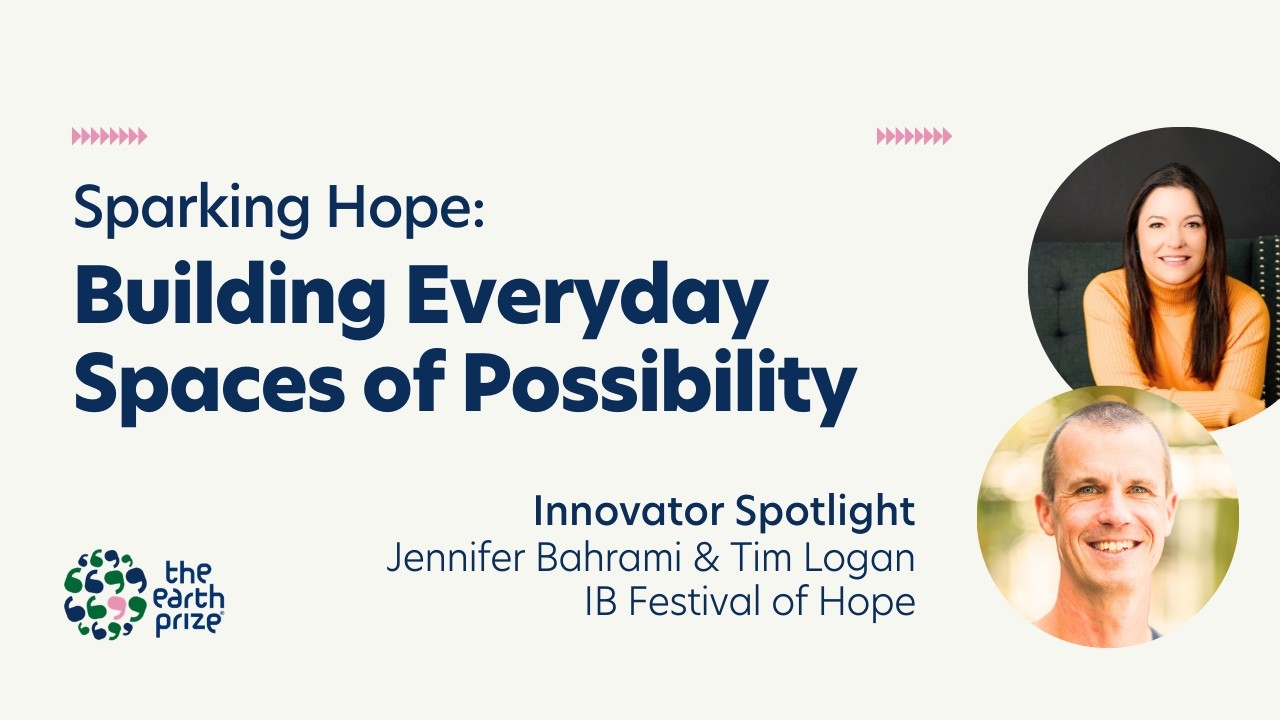
Innovator Spotlight: Tim Logan and Jennifer Bahrami creators of the IB Festival of Hope

Bonus uncut: Beyond Binaries in Education w Tim Logan, Andrea Hiott on Future Learning Design pod

Moving Beyond Binaries in Education: Andrea Hiott in Conversation with Tim Logan on Future Learni...
