AI Cheating Crisis: Why Schools Must Change Now | Filtered with TJ Walker
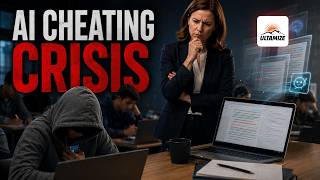
TJ Walker warns that AI cheating tools like "humanizers" and "autotypers" make student essays undetectable. Two-thirds of American students use AI for schoolwork. Walker argues take-home essays are broken and proposes in-class oral defenses, controlled writing tasks, and transparent AI assignments where students show all prompts and revisions.
Chapters
Ultimize. A New York Times story today says student teaching is becoming almost impossible to detect in the age of artificial intelligence. Students are being marketed tools that don't just write papers for them, they humanize the writing. They fake typos, they fake deletions, they fake revision history. They slowly type the essay into Google Talks so it looks like real students that they're grinding away. In fact, the student may have been eating a sandwich and watching YouTube. This is a serious problem. But here's the part many teachers don't want to hear: if your entire teaching system collapses because a student can now fake a take-home essay, maybe your teaching system was already too lazy. Technology changed. That doesn't mean teaching is impossible. It means teaching has to change. Let's start with the facts. The New York Times reports that a whole new industry has grown up around helping students use artificial intelligence to do schoolwork without getting caught. These tools are not just ChatGPT. They're more sophisticated than that. There are humanizers that rewrite AI-generated text so it sounds less robotic, less formulaic, less like a chatbot. That just swallowed a college admissions brochure. There are autotypers that slowly drip words into a document so it appears as if a student typed the paper over time. Some even add believable typos, deletions, fixes, and revisions. Why? Because teachers and professors have started checking version history. If 1,000 words suddenly appear in a Google Doc at 11:59 PM, That looks suspicious. So now the cheating industry says, no problem, we can fake the process too. This is no longer a kid copying from Wikipedia. This is not the old days when a student plagiarized from Encarta and forgot to remove the phrase "click here for more information." This is industrial-strength fake learning, and it's being marketed directly to students on TikTok and YouTube. Some of the ads are subtle, some are wink wink, some are basically saying, hate writing? Great, let the machine do it and fool your teacher. The Times story also reports that about two-thirds of American students are using AI regularly for schoolwork. Now, not all of that is cheating. Some of it is legitimate, some of it it's brainstorming, some of it's outlining, some of it is asking for explanations, some of it is what future professionals will absolutely need to know how to do for their jobs. But some of it is cheating, and a lot of it is gray area, and the old detection game is becoming a dead end. Teachers buy AI detectors. Students buy tools to beat the detection. Companies sell detection. Companies sell evasion. The cat gets bigger. The mouse gets bigger. Pretty soon the cat and mouse both have venture capital funding and a podcast. So yeah, this is a real problem. But the wrong response is to sit around wringing our hands and saying, oh no, technology has changed, therefore education is over. No. Education is not over. Lazy education is over, and good riddance. If you're a teacher or a professor and your entire model is go home, write a paper, bring it back, and I'll pretend I know whether you wrote it, then yeah, your model's broken. But that doesn't mean students can't be taught. It means you have to teach differently, and I know that means more work. Too bad. Teaching is work, or it's supposed to be. If students are using AI to fake thinking, then teachers need to create assignments where students have to demonstrate thinking in real time. For starters, students need to know they're going to be called on in class to stand up, speak, summarize, argue, and answer questions. Not once a semester, not as a cute little participation point, but regularly, ideally every week. If a student submits a brilliant essay on the causes of the French Revolution, fine, stand up and explain it. What's your thesis? What's your strongest piece of evidence? What's the best argument against your position? Why did you reject it? What did you really learn from this research? What would you change if you had one more week? If the student wrote the paper or seriously worked with AI to develop the paper, they should be able to answer all of those things. If they stare at the floor like you just asked them to translate ancient Sumerian while juggling fire, we've learned something. That doesn't mean every quiet kid is a cheater. It doesn't mean every shy student should be punished. Teachers need judgment, but students should understand that written work is not the end of the assignment. It's the beginning of the conversation. Students need to learn how to speak. They need to learn how to defend an argument. They need to learn how to summarize. They need to learn how to be challenged without melting into a puddle of wounded self-esteem. Because in real life nobody cares if your essay had a lovely introduction, if you can't explain what you believe and why. Executives had to do this. Lawyers had to do this. Doctors had to do this. Engineers had to do this. Salespeople had to do this. Citizens in a democracy have to do this. If you can't explain your own thinking out loud, maybe it wasn't your thinking. Second, there's nothing wrong with making students write under controlled conditions. Give them 4 hours. Put them in a classroom, give them a computer with no internet access, no phones allowed, no smartphones, no earbuds, no little glowing rectangle of temptation hidden under a hoodie. Just the student, the assignment, the sources provided, and the blank page. I can already hear the complaints. Well, that sounds old-fashioned. No, it sounds like finding out whether a student can think and write. A classroom computer not connected to the internet is not child abuse. It's not a human rights violation. It's not a Dickens novel. It's a test of whether the student can organize ideas without outsourcing every sentence to a machine. And if a student has been using AI for every writing assignment all year, this will reveal it very quickly. Suddenly the elegant take home essay becomes an in-class essay that reads like a raccoon stepped on a keyboard during a power outage. That's useful information. Teachers need to see what students can actually do, not what they can purchase, not what they can prompt, not what they can launder through a humanizer, but what they can do. Would you like to be the sort of successful person who is dominating news, at least in your industry? Well, if so, it's time to up your skills. At ultimize.com, I've created online courses to help you do that. Now, here's the thing, no obligation. You can get a free course on communication skills, a free course on how to build better habits. All you have to do is go to ultimize.com. That's U-L-T-A-M-I-Z-E dot com. No obligation. Go there now. Third, and this is the part that anti-AI panic crowd misses, Teachers also need to learn how to grade work produced with AI, because AI is not going away. Oh no, the workplace of the next 30 years is not going to say, please write all reports with a quill pen while sitting near a candle. No. Executives, analysts, consultants, journalists, researchers, managers, and entrepreneurs are going to use AI. The question is not whether they use it. The question is whether they use it intelligently. That means school needs 2 kinds of assignments. One kind says, no AI, show me your own unaided ability. The other kind says, use AI, but show me exactly how you used it. Show me your prompts. Show me your first draft. Show me the bad answer the AI gave you. Show me how you challenge the AI. Show me where it hallucinated. Show me what sources you double-checked. Show me the second draft. Show me the 10th draft. Show me the 40th draft. Show me what changed between the first machine-generated slop and the final human-edited insight. Because that may become one of the most important professional skills of the next generation. Not merely asking AI for an answer, but having the patience and judgment to revise, interrogate, verify, reshape, and improve the answer until it becomes— Perfect. Useful. Most people will stop at the first draft. That's the new laziness. The machine gives them something plausible and they say, "Eh, good enough." But good students should learn to say, "No, that's generic. This is shallow. This is wrong. This has no original angle. The evidence is weak. This paragraph sounds like a grant proposal written by a depressed airport kiosk." That is a skill. Teachers can grade it. Grade the process. Grade the prompts. Grade the revisions. Grade the fact-checking. Grade the student's explanation of why the final draft is better than the first draft. Grade whether the student added judgment. Because in the AI age, the final product alone may tell you less than the path the student took to get there. The old assignment was, write me an essay. The new assignment can be, "Show me how you think." That's actually better. And frankly, some teachers don't want to hear that because it means they can't keep assigning the same paper they assigned in 1997 and pretend the world hasn't changed. I'm sorry, but if your lesson plan can be defeated by a teenager with TikTok and $12 a month, the problem is not just the teenager. The problem is the lesson plan. Mm-hmm. Yeah, students should have integrity. Yes, cheating's wrong. Yeah, parents should care. Yes, schools should have rules. But teachers and professors can't simply say, students are cheating with AI, therefore learning is impossible. That's surrender. And teachers of all people should not surrender to ignorance. The entire job is to adapt, adapt to how people learn. Mm-hmm. The blackboard changed teaching. The calculator changed math class. The internet changed research. Wikipedia changed plagiarism. Smartphones changed attention. Now AI is changing writing, thinking, and assessment. That's not the end of education. This is the next assignment for educators. And the answer can't just be detection software. Mm-hmm. AI detectors are unreliable. Honest students can get flagged, dishonest students can evade them. And now companies are selling both the lock and the lockpick. That is a ridiculous arms race. It's like hiring a fox to guard the henhouse and then paying the fox's cousin to sell the chickens disguises. Teachers need to move beyond catching and toward demonstrating. Demonstrate your knowledge. Demonstrate your argument. Demonstrate your process. Demonstrate your ability to answer questions. Demonstrate your ability to write when the internet is off. Demonstrate your ability to use AI without becoming a ventriloquist dummy for a chatbot. That is the future, and it might actually produce better students. Because let's be honest, the old system wasn't perfect. Yeah. Plenty of students wrote boring papers they didn't care about. Plenty of teachers assigned essays nobody wanted to read. Plenty of grading rewarded length, jargon, and proper citation formatting more than actual thought. AI is exposing the weakness of that system. A chatbot can produce the assignment in 12 seconds. Maybe the assignment wasn't doing what we thought it was in the first place. That doesn't mean stop teaching writing. It means teach writing more seriously. Teach speaking, teach argument, teach revision, teach judgment, teach skepticism. Teach students how to use tools without being used by them. Because the real danger is not that students will use AI. The real danger is that students will let AI think for them and never notice the difference. This is what teachers should be fighting. Not technology, but intellectual passivity. The student who asks AI for a first draft and then works through 40 revisions, checks facts, improves the argument, and can defend every sentence orally might actually be learning a lot. The student who hits generate, runs it through a humanizer, autotypes it into Google Docs, and submits it without reading it is learning nothing except deception. Those are not the same thing. Schools need to know the difference. Teachers need to know the difference, and assignments need to be designed to reveal the difference. So yeah, this Time story is alarming. Student teaching is getting harder to detect. The tools are getting better. The marketing is shameless. The arms race is real. But this is not a reason to give up. This is a reason to get serious. Make students speak. Make students write in class. Make students show their process. Make students defend their work. Make students use AI transparently when AI is allowed. Make them prove they're not just passengers in their own education. Technology's changed. Fine. Then teaching has to change. That's not the end of education. Mm-hmm. That is education. I'm TJ Walker. This is Filtered. Have a great weekend. Ultimize.
More from TJ





The Breakout Cases - What Actually Caused Famous Speaking Career Breakthroughs | Ultamize

The Red Circle Sessions Finale - Build the Speaking Career You Came Here For | Ultamize

Two Stages, One Logo, Two Completely Different Realities - Main Stage vs Independent Events | Ult...

Pre-Reset - Why Repetition Builds Better Speaking Decisions | The Red Circle Sessions | Ultamize

Your Decision, Your Framework, and What Happens After - Build Your Speaking Career First | Ultamize

The Red Circle Sessions Trailer - The Speaking Career Truth Nobody on That Stage Will Tell You | ...

The Two-Minute Ultamize Reset - Your Platform, Your Audience, Your Voice | The Red Circle Sessions