AI Is Replacing Jobs Faster Than Anyone Expected
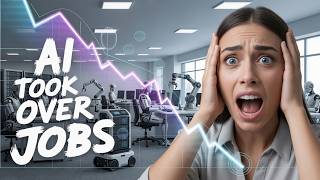
Matthew Gallagher built a billion-dollar e-commerce company with just two full-time employees by using AI for coding, marketing, and customer service. Economists warn AI is eroding entry-level jobs, making the career ladder's bottom rung disappear. The message: learn AI faster than your peers or get left behind.
Chapters
Ultimize. According to a New York Times report by Aaron Griffith, Matthew Gallagher, a 41-year-old entrepreneur and former aspiring actor, has built a company called MedVie into a massive business, and he did it using artificial intelligence and almost no employees. Gallagher launched MedVie with about $20,000 and a collection of AI tools. He used AI to write code, create marketing, generate ads, handle customer service, and analyze business performance. In its first full year, the company generated— get this— $401 million in sales. This year, it's on track to reach $1.8 billion in revenue with essentially 2 full-time people: Gallagher, the founder, and his brother. Let me repeat this so that it sinks in. A billion-dollar scale company, two people. This is not a thought experiment. This is not a TED Talk fantasy. This is real. Now let's talk about who this guy actually is. Matthew Gallagher did not come out of MIT with a PhD at age 23. He did not come out of Stanford. He doesn't even have a college degree. He briefly attended college and dropped out. At one point, He moved to Los Angeles to pursue acting, which, let's just be honest, is not the traditional path to building a billion-dollar company. That's usually the path to sharing an apartment with 4 roommates and explaining to your parents that things are about to take off. And yet this guy figured something out. He didn't invent new technology. He didn't raise venture capital. He didn't build a giant team. He took an existing business model, selling prescription health products online, specifically GLP-1s, and he used AI to do almost everything faster, cheaper, and with virtually no people. Now let's talk about who should be absolutely terrified by this story. If you're a venture capitalist, this is your nightmare because your entire value proposition is we give you money so you can build a company, but What happens when founders don't need your money? When one guy with $20,000 and AI tools can build something doing hundreds of millions of dollars in revenue, you're not early-stage capital anymore, you're optional. And it gets worse. If you work in a big company, layers of management approvals, meetings, compliance, strategy dicks, 5 people CC'd on every email, you should be even more concerned because your competition is no longer other big companies, it's Matthew Gallagher. It's one guy working out of his house, building faster than your company can schedule a meeting. While you're circling back, he's collecting revenue. While you're aligning shareholders, he's launching products. That's not inefficiency anymore, that's extinction. Now, here's the part that makes this story incredible. This is one of the most motivating business stories you'll ever hear because it completely destroys the old myth about who gets to succeed. For decades, the formula is go to a top school, get the right credentials, build the right network, then maybe, maybe you get a shot. This guy skipped all that. No pedigree, no great connections, no funding, and still massive results. Why? Because he focused on one thing, using artificial intelligence to solve problems people are willing to pay for. That's it. This is the new reality. It's not about your resume. It's about your resourcefulness. If you obsess over how to use AI to solve real problems, there's enormous opportunity for you. Not guaranteed success, but real opportunity. The kind that didn't exist 10 years ago, 20 years ago, 50 years ago. Now let's be clear, this is not a fairy tale. Not everyone is going to build a billion-dollar company. I get it. But that's not the real takeaway. The real takeaway is this. The barriers are collapsing. You no longer need a huge team. You no longer need massive capital. You no longer need permission. And when those barriers fall, the advantages shift away from institutions toward individuals. Gallagher himself admitted something almost funny and incredibly revealing. He said he doesn't want to hire more people, not because he can't, not because he doesn't see how it would help the business, or because he doesn't see how it would help the business. Think about that. For 100 years, growth meant hiring more people. Now growth means not hiring people. So yes, this story should scare a lot of people, but it should also wake people up because the message is crystal clear. The future belongs to people who adapt faster than everyone else. And right now there are opportunities everywhere. You just have to stop thinking like the old system and start building in the new one. I saw this story and it really reminded me that I could be a lot more successful, not if magically some big company gave me a lot of money, not if magically 10 great co-founders wanted to join me with some new venture, but simply by using tools available for free or near-free more effectively. Now, I do subscribe to the paid version of ChatGPT. I'm not endorsing it above any other AI. It just happened to be the one I fell into. I am constantly amazed at its ability to do research, solve problems, come up with frankly creative answers, do things that I would otherwise need a giant team of consultants to do. It's all at my fingertips. It's at your fingertips too. So folks, we've all got to figure this out. We can't all be like this guy selling $1 billion a year of GLP-1 drugs. And to— I didn't perhaps clearly specify what he did. He is not creating GLP-1 drugs. He's not the factory creating the drugs. He's marketing it. He connects people to the doctors and the prescription, but he's figured out a way of doing the marketing, the website, the customer service, the sales, all of that. Only with his brother. And the implication from this article is he didn't even really need to hire his brother, but it was kind of lonely working at home all the time. Now, Sam Altman, a couple of years ago, the founder of OpenAI, predicted that we were not that far off from a one-person company starting a billion-dollar startup. You could quibble and say, well, this isn't a one-person company, it's a two-person company. Still, you know, so often when there are predictions about the future, it takes 40 years to do what people said will happen in 18 months. For so much of my life, I heard about, you know, video phones, '60s, '70s, '80s. And then all of a sudden, it seems weird not to have a video call. With someone on FaceTime or something like that. So new technology predictions often take a lot longer than you think. In this case, it didn't. You know what's funny? People spend years trying to figure things out when most of the time they already know what to do. Speak more clearly, be more confident, build better daily habits. The issue isn't knowledge, it's follow-through. So if you're listening to this and thinking, yeah, I should probably work on that. Don't overcomplicate it. Just go to ultimize.com and get the free course. There's one on communication. There's one on habits. Pick whichever one hits you first and just start there. Simple, free, and actually useful. President Trump has fired Attorney General Pam Bondi. And no, the real lesson here is not that she was too principled, too ethical, or too independent. That would be absurd. Pam Bondi lost this job because in Trump's eyes, she failed at two assignments that mattered most. First, she was not aggressive enough in delivering punishment against his enemies, regardless of the fact that they hadn't committed crimes. Second, she failed to manage the Epstein disaster in a way that protected him politically. That's the real story. Now, there's been a lot of reporting on this from everywhere, and it makes it very clear that under Bondi, the Justice Department pursued investigations involving political opponents, including Senator Adam Schiff, Letitia James, the New York State Attorney General, and James Comey, the former director of the FBI. It also notes that Trump publicly pushed Bondi to investigate his political adversaries more aggressively. Telling her in a social media post that, quote, we can't delay any longer. So let's stop pretending this was some normal personnel change over performance. Okay? Her problem was not that she wouldn't fight. Her problem was that even after all the fighting, it still wasn't enough. Pam Bondi was not fired because she was too soft on Trump. She was fired because she wasn't effective enough for Trump's criminality. The reporting says Trump wanted his political enemies investigated more aggressively. That's a polite way of saying he wanted their heads on a spike delivered to him or on a platter. And Bondi's Justice Department was already pursuing people like Adam Schiff, Letitia James, and James Comey. Think about how extreme that is. You could spend your time using the Justice Department to chase political opponents and still lose your job because the boss thinks You didn't go far enough. That tells you everything. This was never about justice. This was about utility. Pam Bondi's role was to act like the nation's top law enforcement officer while serving as an instrument of one man's anger and pettiness and bitterness. And in the end, even after all the loyalty and all the public ugliness, she still got tossed aside. That's not strength. This is servitude with a title. Now let's get to the second reason she blew up: Epstein. Because this is where Bondi became politically useless. The BBC and New York Times, other major outlets, all reports saying that Trump grew increasingly frustrated with Bondi, particularly over her handling of the Epstein files. Bondi had promised transparency. Well, Trump didn't want transparency. He wanted selective disclosure to make his opponents look bad, to make Democrats look bad. That's not what he got. There was supposed to be transparency, including talk of a supposed client list, but later the department said no such list existed. Then millions of files were released only after Congress forced disclosure through legislation. The handling triggered bipartisan backlash. From a communication standpoint, that's catastrophic. She was handed a political grenade and told to make it disappear. Instead, it exploded in slow motion, dribs and drabs. And that is why her firing matters, because if you're in a role like this, your job is not merely to lie. Plenty of people in Washington lie. Your job is to lie successfully enough to protect the person who puts you there, and Pam Bondi failed. Here's why Pam Bondi really became expendable. The Epstein files were supposed to be managed in a way that protected Trump politically. Instead, they became a rolling communications disaster. Bondi promised transparency, then the department said key things have been led to expect or the things people had been led to expect did not exist. Then Congress had to force the release of millions of records, and both parties were angry about how it was handled. This is not message discipline. This is not narrative control. This is a collapse. And if you work for someone like Trump, collapse is the one thing he will not forgive. He can tolerate cruelty. He rewards that. He respects that. He can tolerate dishonesty. He likes that. He rewards that. He can tolerate chaos, but he cannot tolerate— he absolutely cannot tolerate failure if you're doing some dirty work on his behalf. That is why Bondi had to go. Now add in the way she carried herself in public, and it becomes even uglier. When Congress questioned her, Bondi often didn't act like a serious public servant defending the credibility of the Justice Department. She acted like a belligerent partisan. The BBC notes that in one hearing she called a Democrat, quote, a washed-up loser. That matters because once you sound like that, you're no longer communicating authority. You are communicating fear and contempt. You're telling the audience that you cannot defend your conduct on the merits, so you're going to substitute Nastiness for clarity. And that may thrill partisan hacks for a day, but it destroys your credibility over time. Pam Bondi's public style told the whole story. She wasn't communicating like the Attorney General of the United States. She was communicating like an angry fixer, like a consigliere for a mobster. At one hearing, instead of calmly answering oversight questions, she just attacked The Democrats, nasty names. Oh, you dodged the draft, you're washed up loser, nastiness. This is not toughness. This is what people do when they cannot defend themselves with facts. And here's the bigger lesson. If your job depends on serving power, you still have to make power look competent. You still have to make the message hold together. You still have to keep the operation from looking like a circus. Pam Bondi couldn't do that. She made it look mean, sloppy, defensive, and panicked. And that's why even loyalty could not save her. So what's the real takeaway? Pam Bondi was not fired for refusing to play dirty. She was fired because she could not play dirty effectively enough. That's the brutal logic of the story. Reporting shows Trump wanted more aggressive action against his enemies, and it showed he was increasingly frustrated by Bondi's handling of Epstein files and attacking his enemies. She wasn't attacking. Now put those two things together and the message is unmistakable. She was hired to be useful, not to be fair or just or honest or to impose the laws of America. She was hired to be useful. She was expected to weaponize power against adversaries and contain politically dangerous fallout. And in Trump's judgment, she failed at both. That is why she's gone. So no, history will not remember Pam Bondi as some misunderstood patriot who got a raw deal. It will remember her as someone who degraded herself for power and still got discarded. That is the final humiliation. She did the ugliness, she absorbed the disgrace, she made herself the face of it, And when she stopped being useful, she was thrown overboard anyway. This is not just a political downfall, it's a moral one as well. You know, as much fun as it is to constantly point the fingers at Donald Trump and how awful he is, and I've certainly done that, he couldn't continue perpetuating awfulness without loyal henchmen and henchwomen like Pam Bondi. At some point, as the good senator from Oregon has pointed out, there will be a Nuremberg 2.0 trial, and Pam Bondi is going to be brought up on this trial. And I think we are going to find that she is not just guilty of crimes violating crimes of the United States and the United States Constitution, but crimes against humanity. I really do not think it's going to be enough to take away her law license. I think the various crimes she's committed are going to need much more serious punishment than that. The real lesson here, folks, is look, we're all ambitious at some level. And once you enter the political arena, unless you are your own candidate, it's very unlikely you're ever going to work for someone where you are in 100% alignment on every philosophical issue, every policy issue. No one's asking for purity. I've worked for politicians before where I didn't agree with them on every issue. But I've never worked for someone where I thought their entire purpose is completely immoral and illegal. Their entire purpose for holding public office is to destroy our Constitution and to enrich themselves corruptly and to dissolve democracy and turn it into a monarchy. I've never worked for someone like that. And if you are ambitious and you decide to do that, you've got to realize if it doesn't go all the way, because at some point there will be a new administration that is sane, that believes in democracy— could be Republican, could be Democrat— and when that happens, Bondi and people like Bondi are Well, they're in for Nuremberg 2.0. Quick thought before we move on. If you're like most people, you don't need another idea. You need something that actually sticks because the real game isn't learning once. It's seeing the same useful message enough times that it finally becomes automatic. That's exactly why I created Ultimize. So if this show is giving you even a little value, go to ultimize.com and grab a free course. There's one on communication skills. One on building better habits. Just pick one and start. It takes about a minute to sign up, it's free, and it's actually designed to stay with you. Ultimize.com. A New York Times article by Ben Castleman reports that economists who once dismissed fears about artificial intelligence destroying jobs are now warning that major disruption could be coming and that policymakers are not prepared. For years, economists rolled their eyes at AI panic. They said, we've seen this all before. New technology comes along, people worry, and then everything balances out. But now they're changing their tune, not because AI has already taken over the job market, but because they've started to believe it might. And it might happen fast. Daniel Rock, an economist at the University of Pennsylvania, put it bluntly to the Times: AI hasn't hit the labor market yet, but it's coming. That's the story. And if you're early in your career, this should not just interest you, it should scare you. A New York Times report says economists are now warning that AI could soon disrupt the job market in a major way, and we are not ready. Here's the part you need to understand. If you're young, just starting out of college or trying to restart your career, you are the most exposed because one economist said something chilling. Tools like AI can now do the kind of basic work that used to be given to entry-level employees. That means the bottom rung of the career ladder is disappearing. And if there's no first rung, how do you climb? This is not a future problem. This is happening right now. And the only people who are going to survive it are the ones who learn how to use AI better than everyone else. Now, Here's where this gets even more serious. The article explains that economists still don't see massive job losses yet. Great. But under the surface, there are early warning signs. Research has already shown that employment is declining in entry-level jobs that are highly exposed to AI. And one researcher said something that should hit you hard: I really don't know anything a college student can do to my team that AI can't. Think about that. That used to be your job. That used to be how you got in the door. Now it's being automated. Let me give you the most important line from this entire story. I don't know anything a college student can bring that AI can't do. I, I know I'm repeating myself, but that is a direct warning because entry-level work, the stuff you used to do to prove yourself, is disappearing. Research, basic writing, analysis, data gathering— AI is already doing it faster, cheaper, and in many cases, better. So if your plan is, I'll graduate, get an entry-level job, and work my way up, guess what? That plan may not exist anymore. You need a new plan, and that plan starts with one thing: learning how to use AI better than the people you're competing against. Now, here's the part where most people misunderstand the story. This is not just about disappearing jobs. It's about jobs being reshaped. The article says more than half of jobs could be transformed by AI in just the next 2 to 3 years, not necessarily eliminated, but changed, which means your job might still exist. But the version of that, you know, today Mm, gone. And if you don't evolve with it, you become irrelevant. Here's the mistake people make with AI. They think either my job disappears or I'm safe. That's not how this works. According to economists, more than half of jobs are about to be reshaped by AI, not eliminated, reshaped, which means your job still exists, but someone who knows how to use AI will do it faster, better and cheaper than you. And then what happens? You don't get fired. You just don't get hired in the first place. That is the new risk. Not losing your job, losing your opportunity before you ever get one. Now, let me shift this because this is not just a warning. This is an opportunity. And this is where you need to act today. If you've ever had a job, if you've ever been paid for anything, If you have any skill at all, you should be talking to AI right now. Not tomorrow, not next week, today. Here's exactly what you should do. Go to any AI tool. Could be free, could be paid, whatever you use, and start asking it questions about your life. Start with this. Here are all the things I've ever been paid to do. List them, everything, big or small. Then ask, 'Can I make more money from these skills?' See what it says. Then, 'What business could I start with these skills?' Then ask, 'What services could I offer online, perhaps? How can I charge more? What are 10 ways to package my skills into something people will pay for?' And don't stop there. Here are more questions you should be asking. What problems can I solve that people will pay for? What industries need someone like me? How can I use AI to do my job faster? What tasks in my job can AI replace? And how do I stay valuable? What skills should I learn in the next 30 days? How do I build a one-person business using AI? That would be a nice question to ask. Nice to know the answer to that. What services can I offer that combine my skills with AI? How can I stand out in a world where everyone uses AI? What income streams can I build starting today? What should I stop doing because AI will replace it? This is the new game, and the people who win are not necessarily the smartest, not the most educated, not the most experienced. It's the people who adapt fastest. Because the article made one thing very clear, we don't know exactly how this plays out, but we know it's coming and we know it could happen fast. So if you're young, if you're starting over, if you're in the middle of your career, you have two choices: ignore this or use it. Because AI is not just a threat, It's the single greatest leverage tool ever created for individuals. And the people who figured that out early are going to do unbelievably well. Everyone else, they're going to be asking, what happened? I think of my own career and the first job I ever had right out of college. I was working for Ketchum Public Relations in New York City for the princely sum of $5 an hour. And I was given big old print directories of media, TV outlets, radio outlets, newspapers, shows, producers, editors, writers, hosts. And I was asked to put together lists that could then be used to have me or someone else call. All of these things could be done in about 2 seconds. With artificial intelligence. So I might not have ever gotten my first job, and it wasn't the most significant job of my life, but taking me, the little boy from North Carolina, into the big city for the first time, even though it only lasted 2 and a half months, did help reposition my career. It made the whole concept of a career viable to me. I think even 15 years after that, 10, 15 years later, a job I did for an investor relations firm, writing so-called white papers about clients and their industry. I would spend sometimes 2 days, get at the time, I think it was $500 a day and writing a let's say a 3,000-word white paper. It's something ChatGPT can now do in really less than 10 minutes for free, and it's going to be better than what I wrote 20, 30 years ago. So I wouldn't have been eligible for that job if starting out today. So this is the real problem. You can fixate on and say, oh, woe is me, or you can try to do something. And the thing to do is get off Facebook, and apologies, those of you watching me on Facebook now, stop watching the TikTok entertainment videos and start asking questions of your favorite AI. Ask questions about how you can be more useful, how you can make money, how you can enhance your career. Do it. Right now, let me ask you something. How many times have you heard a great idea and thought, that's really useful, and then never used it again? It happens to all of us because without repetition, even the best ideas just fade. So instead of just collecting more information, do something different. Go to ultimize.com, U-L-T-A-M-I-Z-E.com, and grab the free course. You can start with communication skills, or building better habits. But the key is it's designed to reinforce the message so it actually sticks. If you're already listening or watching this, you're halfway there. Just go to ultimise.com and take the next step. All right, thanks. We'll
More from TJ





The Breakout Cases - What Actually Caused Famous Speaking Career Breakthroughs | Ultamize

The Red Circle Sessions Finale - Build the Speaking Career You Came Here For | Ultamize

Two Stages, One Logo, Two Completely Different Realities - Main Stage vs Independent Events | Ult...

Pre-Reset - Why Repetition Builds Better Speaking Decisions | The Red Circle Sessions | Ultamize

Your Decision, Your Framework, and What Happens After - Build Your Speaking Career First | Ultamize

The Red Circle Sessions Trailer - The Speaking Career Truth Nobody on That Stage Will Tell You | ...

The Two-Minute Ultamize Reset - Your Platform, Your Audience, Your Voice | The Red Circle Sessions