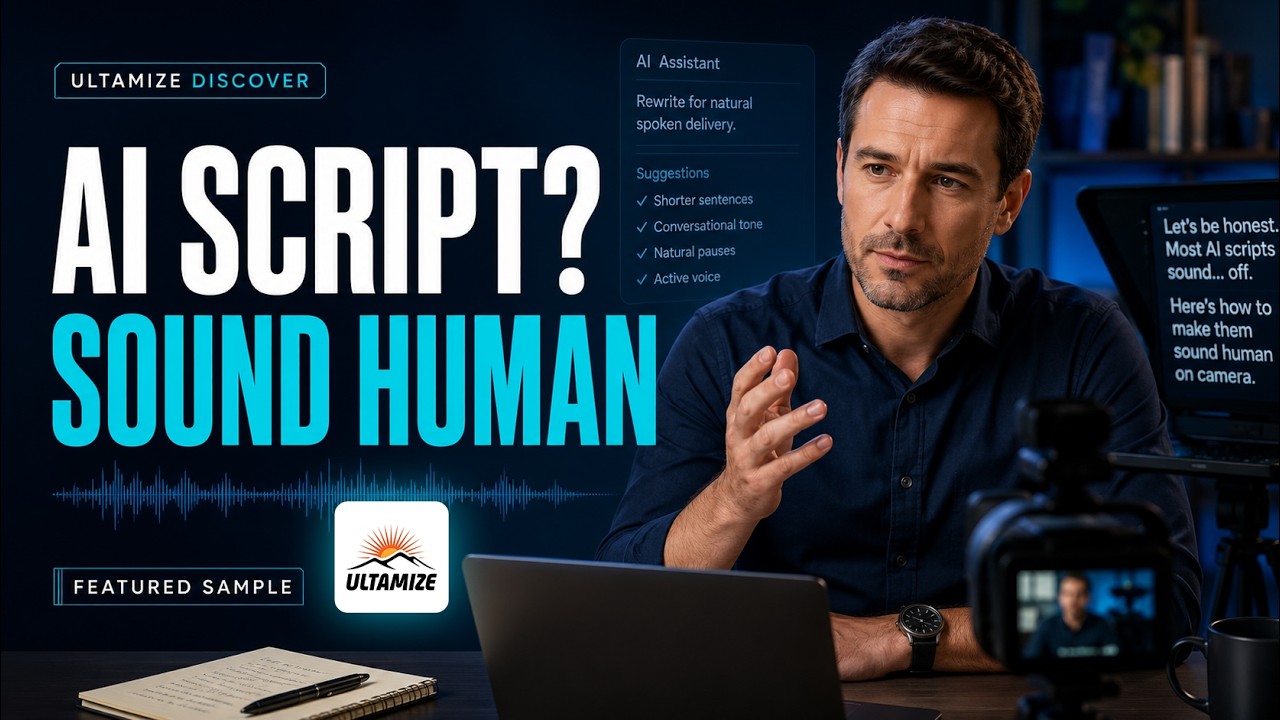
TJ Walker explains why AI scripts sound robotic and how to fix them. Record yourself speaking, transcribe it, and tell the AI to match your voice. Push back against AI's tendency toward polish by asking for short sentences, repetition, and informal phrases that sound like actual speech.
Chapters
Today on Ultimize Discover, you're getting a short practical sample from the Ultimize universe. Use this on its own, take one idea and apply it today, or go deeper at ultimize.com. Ultimize is the world's largest personal development podcast, audiobook, and online learning network. Ultimize. Here's the fastest way to stop sounding robotic when you use a script. Do not start by writing. Don't even start by asking AI to write. Start by talking. Record yourself speaking naturally for 3 minutes about the topic. Then transcribe it and tell the AI, this is my voice. Match this. That's the missing step. Most people sound robotic because they're reading words that were created before their real voice entered the process. So the script sounds polished, but polished is not the goal. Human is the goal. In this limited series, I'll show you how to use scripts, teleprompters, and AI without sounding stiff, fake, or overproduced. You'll learn how to write for the ear, not the eye. You'll learn how to use repetition, pauses, short sentences, and natural asides. Oh, you learn natural asides, all right. And you'll learn how to make scripted content sound like you're simply talking. Because the teleprompter's not the problem. The script is often the problem. And once you fix the script, everything gets easier. Thanks for joining me in this limited series podcast. I'm your host, TJ Walker. Even with all the advances in AI, there's still a very clear tell. You can usually tell when something was written by AI, not because it's wrong, not because it hallucinated something, But because it feels off, a little too clean, too structured, too consistent. And that's the problem. AI is designed to produce polished language, language that is efficient, language that avoids repetition, language that follows all the rules. But human speech doesn't work that way. Human speech is kind of uneven. It has variation. It has repetition. It has moments where we slow down and moments where we speed up. AI smooths all that out, and in doing that, it removes the humanity. Here's a simple example. An AI-generated sentence might say, "It's important to understand that effective communication requires clarity, consistency, and deliberate practice." Okay, fine, but it doesn't sound like something you'd say. Now compare that to this: Communication matters. It really does. And if you want to get better at it, you need clarity. You've got to have some consistency and you really, really need to practice. Same idea, completely different feel. One sounds written, one sounds like it was just spoken. So here's the issue. If you take AI output and read it as is, you are inheriting that artificial structure. You're inheriting that stiffness, and then you're trying to deliver it naturally. Well, that's a tug of war, that's a mismatch. That's why it feels hard. So the solution is not to avoid AI. The solution is to reshape it, to break it, to simplify it, to add back the things it removed. The repetition, the short sentences, the natural phrasing, because AI can give you a great starting point, but it's not the final product, or at least its first or even second draft had better not be the final product. You are. And once you understand that, you stop expecting AI to sound human and you start making it sound human. At this point, you understand the concepts. Now I want to show you exactly what I do. Not theory, not general advice, not pie in the sky stuff, but what I actually do, the actual instructions I give AI. Because this is where most people fall short. They understand what they want, but they don't tell the AI clearly enough. So here's the framework I use. I don't say make this better. I don't say make this more engaging. That's too That's too general. That's too fuzzy and abstract. Instead, I say something like this: Rewrite this in a conversational speaking style. Use short sentences. Break longer thoughts into multiple sentences. Repeat key ideas for emphasis. Do not remove repetition. Add natural phrases like "here's the thing" or Let me explain. Keep the tone informal and spoken, not polished or written. That's it. That is specific. You can use that exact phrase. This is actionable. That gives the AI direction. Now here's what matters. You may need to run that instruction more than once because the AI will try to clean things up again. It will drift toward polished writing. You gotta really push, push hard, push back. You refine it. The AI works for you. Don't forget that. You say specifically, you say, shorter sentences, more repetition, less polish. This is a process. It's not a single prompt. And here's something else I do. I compare. I take the AI version and I read it out loud. If it feels even slightly stiff, I adjust it. I don't accept, eh, good enough, almost good, because almost good still sounds artificial, and that's what we're trying to eliminate. Don't forget that. Now, over time, something interesting happens. You get faster at this. You start recognizing patterns immediately. You can look at a paragraph and instantly know where it needs to be broken, where it needs repetition, where it needs a conversational aside, And eventually you start writing prompts that produce much better results on the first try. But it starts here. Clear instructions, specific direction, and a willingness to refine. Oh yeah, you're gonna need to refine because the AI is not gonna do this perfectly on its own the first, second, or even 10th take sometimes. You have to guide it. By the way, quick question for you. Have you ever noticed how easy it is to consume content and how hard it is to actually do anything with it? I mean, you can listen to 100 episodes, read 10 books, and your habits are exactly the same. That is the gap most people never close. So, if you are listening to this and thinking, yeah, I want to actually improve, go to ultimise.com. We have got free courses there for you, either on communication skills or building better habits, and it is designed to get you to actually use what you are learning, not just hear it once. No cost, no catch. Just go to ultimize.com and start. Ultimize.