AI Soldier Robots, Helmet Law Costs & Energy Crisis Explained
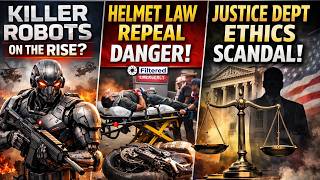
In this solo‑host commentary, TJ Walker surveys five current‑affairs issues, weaving together data, expert quotes, and personal reflections. He begins with the emergence of the Silicon Valley startup Foundation’s Phantom MK1/MK2 humanoid combat robots, noting their $24 million U.S. military contracts, projected 30,000‑unit annual production at roughly $20,000 each, and the ethical dilemma of delegating lethal decisions to machines. Walker then shifts to a Michigan study showing that repealing the universal motorcycle‑helmet law in 2012 raised hospital costs per crash victim by 26% (about $5,785) and added $4.5 million in annual uncompensated care, arguing that personal‑choice policies impose hidden public expenses. Next, he critiques a Justice Department proposal to route attorney ethics complaints to an internal review, warning that it would erode the professional duty of truth‑telling, weaken a key check on executive power, and undermine the rule of law. The third segment revisits the 2023 collapse of Silicon Valley Bank, describing the federal bailout, the perception of a “bailout” versus a rescue, and the subsequent political backlash as tech billionaires turned against Democrats, illustrating the futility of buying loyalty through financial favors. Finally, Walker examines the widening war with Iran, detailing how the conflict threatens the Strait of Hormuz, spikes global oil prices, forces U.S. naval mine‑clearing missions, and creates cascading economic and strategic fallout, while questioning the lack of clear political objectives. Throughout, Walker intersperses personal anecdotes, rhetorical questions, and calls for humility and broader consultation in policy‑making.
Chapters
Ultimize. Coming up, the age of the robot soldier may be arriving faster than most people realize. A new study finds that when states repeal motorcycle helmet laws, hospitals and taxpayers pay a price, a steep price. The Justice Department is proposing a change critics say could make it easier for government lawyers to mislead, actually lie to courts. 3 years after Silicon Valley Bank collapsed, Democrats are still confronting a brutal lesson about tech billionaires and political loyalty. And the widening war with Iran is showing yet again how easy it is to start a Middle East conflict and then how hard it is to control the economic, military, and political consequences. All that and more today on Filtered. Welcome to Filtered with TJ Walker. Hi and welcome. Thanks for joining me. It is Friday the 13th, where we consider that good news here at Filtered. Every so often, every 7+ years, my birthdays are Friday the 13th since I was born on December 13th. So I hold no ill will towards Friday the 13th. Let's dive right into the top story. A Silicon Valley startup is openly building what sounds like science fiction and looks like a nightmare. A humanoid robot designed for war. Foundation's Phantom MK1 can handle weapons, assist with breaching operations, and is already being tested for military uses, including in the Ukraine. Supporters say robot soldiers could save human lives, reduce battlefield trauma, and eventually make war more precise. But, and there's a big but, critics warn that once machines are built to fight, the political and moral barriers to war get weaker, not stronger. A government can hesitate before sending young Americans, or citizens of any country, into combat. It may hesitate less before sending machines. The bigger danger is not just that these robots malfunction. It is that they normalize a future where killing becomes automated, Accountability gets murkier, and warfare feels more like a software problem than a human catastrophe. This isn't progress, this is profound moral escalation. Okay, I'm not going to hold out to you that there are easy answers on this. This is a complex issue, and we as a society, we as a world, are going to have to navigate this together. Let's look at some more of the facts. Again, the Phantom MK1, it's a humanoid robot and it looks scary. It does look scary. Developed by a San Francisco startup. It has $24 million in US military research contracts. Now, I have no evidence, I've seen no reports that it's doing anything significant in this Iran war, but it does have contracts with the Army. Navy, and Air Force. It's being tested in the Ukraine. Now, the Ukraine is already using a lot of drones on all sides. The war in the Ukraine has cost at least 350,000 lives according to a variety of experts. I've seen many, many estimates much higher than that. The Phantom MK2 is planned for release in April which is just a few weeks away. Future production goals are 30,000 robots annually. The target cost is to get these down to about $20,000 per robot, so very inexpensive compared to a human life, not that you can easily put a price tag on a human life. Now, here's what Mike LeBlanc said. He's the co-founder of this company. He says, "We think there's a moral imperative to put these robots into war instead of soldiers." Yes, I can definitely see if your country is under attack or you're helping another country that's under attack by some sort of evil dictator, it would be nice not to have to send soldiers from your own country to die. It would be nice to defend yourself from foreign intruders or to defend other countries from tyrannical oppressors. With machines rather than having your own soldiers die. That, I understand that, but unfortunately it's not quite that simple. Jennifer Kavanaugh of the Defense Priorities Military, she's a Defense Priorities military analyst, she says, "The appeal of automating things and having humans out of the loop is extremely high." That's what she told Time Magazine. But Bonnie Dougherty of the Harvard International Human Rights Clinic said this, Technology is moving rapidly toward full autonomy, and there are serious concerns when life and death decisions are delegated to a machine. As we saw earlier this week, there was a oops, kind of a mistake, and the United States military bombed a girls' school, and 176 people in Iran were killed, most of them children. Who's to blame if you send a robot there and the robot is programmed one way, but it's all of a sudden killing people willy-nilly, harmless civilians waving a white flag, and the robot doesn't see it and just starts shooting? Who's accountable there? Is it the software company? Is it the robotic company? So There are some tricky issues here. I wish I could tell you I had all the answers. I don't. The big question, of course, is if all the great military powers of the world have these, does it increase the odds of more wars or does it decrease the odds of war? If you knew, if you started something with another country, all of a sudden your entire country would be overrun with robots killing everyone, maybe you wouldn't do it. But is that how it's going to work? This is yet another reminder why those of you who say, uh, AI is too dangerous, let's just halt all AI research. This has been a message, don't hear it as much in the last year, but it's certainly been a theme coming out of Silicon Valley and elsewhere. For the last 3 or 4 years. Here's the problem with this. If one country, for example, China, develops a general AI first, and they can then use that to build the world's greatest robots and robot soldiers, and they can be the first in the battlefield, then there's really nothing, absolutely nothing, stopping them from taking over any country in the entire world without having to use nuclear weapons, without it blowing back and harming their own atmosphere and their own people. Do we want China to have that? Now, I can think of a lot of people, including in the United States, who wouldn't want the current regime in the United States to have this power. But do we want other countries to have the power? So these are tricky questions. What do you think? I'd love to hear your opinions on this. Robot soldiers, is it going to increase the odds of more wars, or is it something so powerful, kind of like nuclear weapons? Say what you will about nuclear weapons, but after World War II, nobody has started a world war, at least not until a couple of weeks ago. Jury's out on that one, but nobody's used nuclear weapons on another country since World War II. So sometimes a new technology comes out, it's so incredibly powerful it deters things. Is that what this is going to do with robot soldiers? I don't know. Post your comments, I'd love to hear from you. I don't have it all worked out. Post your comments right here on YouTube if you're listening on any other podcast platform. That's fine, but try to work your way over to the YouTube channel. Just search for me, TJ Walker, filter with TJ Walker, and you will find us right there. Okay, we're going to move on to issue 2, motorcycle helmet laws. A new study out of Michigan offers a blunt reminder that so-called freedom can come with a very expensive public bill. After Michigan repealed its universal motorcycle helmet law in 2012, Hospital costs for crash victims jumped— they soared— 26%, or about $5,785 more per patient. Injury severity also rose more sharply than in comparison states where helmet laws stayed the same. Researchers say the damage does not stop with the rider. Trauma centers absorb unpaid costs, especially when uninsured patients arrive with devastating head injuries that require require immediate care. That means hospitals, insurers, and ultimately the public end up carrying part of the burden. The larger point is simple: when government weakens basic safety rules, the consequences do not remain private. They spread. The rhetoric is personal choice, but the real-world outcome is more severe injuries, more financial strain on emergency care, and a healthcare system forced to subsidize preventable harm. Okay, so this is an issue that people get very emotional on, and there are plenty of states— I think I'm in one— where people think it's my God-given right to scramble my brains and become a vegetable if I want to. Look, I do think that in a free society you should have the right to kill yourself slowly if you want to smoke cigarettes, for example, if you're an adult. But the idea that in a society we can't come together and come up with some rules that just make us not slaughter ourselves needlessly, that that's really a crazy idea, I don't buy that. I don't think it is a horrible, horrible abridgment of my rights that I have to wear a seatbelt. Seatbelts save thousands of lives every year. And there is a line. Should you be able to buy one Coca-Cola? Yes, even though it's bad for you, even though it can lead to diabetes, even though it can lead to death, early death. I'm not prepared to tell you that the government should be such a nanny state that we should ban buying a Coca-Cola. But some things are just so easy to do, it requires so little of someone, and saves so many lives. I just have a hard time justifying not having a law like helmet laws, in part because I don't want to pay for you idiots and imbeciles who say, well, I have the right to not wear a helmet. Then you get in a crash. What would have been a minor scratch, now your brain doesn't work for the rest of your life. And I, as a taxpayer, have to pay your $100,000 tax bill. Now I got to pay for your Medicaid the rest of your life. I got to pay for your disability insurance the rest of life because now you can't work because you can't think. So if someone could truly, truly opt out of that, you could make a case people have the right to do that. But are we going to live in a society where we say to someone, okay, you made a mistake, you didn't wear a safety helmet at age 18, so now we're just going to let you die in the streets because we don't want to pay for your healthcare? I'm not comfortable with that either. And I don't think people are actually in that situation. Are comfortable with it. Let's look at the facts again. Michigan repealed their helmet law in 2012, so it's been 14 years, and they had a lot of crashes to analyze around the country. 5,280 patients were from Michigan. They looked at 14,405 patients from other comparison states. So when they compared it The hospital costs, the medical costs went up 26%. I don't think that's even fair though, based on the true cost. Let's say your hospital costs were $5,000 more, but you're never able to work again because you can't think because you broke your brain. What kind of cost is that? They added it all up. It was $4.5 million in extra hospital spending annually just because people were so stupid as to not wear a helmet. 9.5% of crash patients were uninsured. So if you have insurance, okay, maybe someone else paid the hospital bills. But what about your disability insurance that you got to have Uncle Sam pay for for the rest of your life? So count me in on being in favor of helmet laws. It's such an easy, easy thing to do. It takes 2 seconds to put a helmet on your head. And if you're anyone, uh, who has a similar haircut to mine, shall we say, it's also a great way of reducing your chances of getting skin cancer on the top of your head. So there's a win-win there. I'm TJ Walker. This is Filtered. Lots more to come. Filtered is brought to you by the following. Want to advertise here? You better be legit. No crypto, no junk food, no supplements. Go to tjwalker.com/advertise. Want to become a better speaker, leader, or communicator? Start with the TJ Walker Success Library. It's 5 of my most practical books covering everything from public speaking to media interviews and persuasive messaging, all for only $9.95. I've trained presidents and Fortune 500 CEOs, and now you can get the same wisdom in a fast, affordable format. Go to tjwalker.com/books and download your copies instantly. Thanks for listening. If you like today's episode, you'll love my online courses at mediatrainingworldwide.com. Check them out now and level up your skills. The Justice Department is now backing a proposal that critics say would make it harder to hold government lawyers accountable when they mislead or even lie to the courts. Under the idea, ethics complaints against Justice Department attorneys could be diverted away from independent state bar investigators and route it into the department's own internal review system. That matters because lawyers are not supposed to function like political spokespersons. They have a professional duty to tell courts the truth. According to critics, this change would weaken one of the few remaining checks on executive power by insulating government attorneys from meaningful outside discipline. The concern is bigger than any single brief or hearing. If judges cannot trust the government lawyers standing in front of them, then the legal system itself starts to corrode. Courts rely on facts, candor, and professional consequences for dishonesty. Removing these guardrails and the executive branch gains even more room to manipulate the truth without paying a price. Okay, it's very easy these days to get intimidated by people saying, oh, you criticize the Trump administration, you suffer Trump Derangement Syndrome. Uh, you're saying these people are worse than, uh, certain figures in 1940s Germany. Okay, timeout, folks. There is such a thing as a slide from liberal democracy to authoritarian regimes. There is such a thing as going from a liberal democracy, or even a republic, to a dictatorship, to an authoritarian regime. It's happened in a lot of places. It has certainly happened in places like Hungary, which is a great country. I've been there many times, but it's not really a democracy. Now, a wit once said, democracy is where an incumbent can lose an election. If you have an election and the incumbent can't lose, it's not really a democracy. That's essentially what has happened in Russia. That's what has happened in Hungary. And it's what many people fear is about to happen in the United States. And when you give lawyers who work for the Department of Justice the ability to lie, to just say Candidate X got more votes in the 2020 election than Candidate Y, and the facts don't bear that out, you have a real problem. Because political figures, politicians can say things, but when you are an attorney in a court of law, you're supposed to be held to a higher standard. We are supposed to be a country based on the rule of law. The rule of law has rules for lawyers and what they do in courtrooms. They can't just lie. They can make a defense using facts selectively in certain contexts, but you can't out-tell— you can't just out-and-out tell a lie. And what we've seen from this administration again and again and again is an insistence to tell lies. It starts from the top, it filters down to the Attorney General, now it's filtering down to every aspect of the Department of Justice. And if you call yourself a conservative, if you consider yourself a libertarian, if you believe in rule of law, democracy, and capitalism, this should concern you a great deal because this is a This is a proposal, it's complex, it's not gonna be the number one thing debated on CNN or MSNBC or even Fox. It did get some play in the New York Times today, but this is a profound change. Here's what one federal judge had to say about this, talking to the Times. The court is left with little confidence that government lawyers can be trusted to tell the truth about anything. Deborah Pearlston also told the Times, rules requiring lawyers to serve as honest officers of the court have been adopted by every state and the District of Columbia, and now this Trump Department of Justice wants to change that. Facts, no less than law, constrain government power. If government attorneys can just lie and get away with it and not face professional censure, not risk getting their bar license taken away. It gives even more power to an executive branch to say and do anything they want. And that, my friends, is pretty much the end of democracy. It's certainly the end of the rule of law. Want to communicate like a pro? Go to mediatrainingworldwide.com. Millions have already transformed their speaking skills. Why not you? This show doesn't run on a lot of corporate sponsorships or big media backing. It runs on caffeine and your support. If you like what you're hearing and want to say thanks, you can buy me a coffee. Really, just go to buymeacoffee.com/tjwalker. It's quick, it's easy, and yes, it helps cover editing, hosting, and staying relatively ad-free for as long as possible. buymeacoffee.com/tjwalker. Your $3.95 makes a real difference. Happy anniversary. Happy 3-year anniversary to Silicon Valley Bank and the big bailout it got from you and me. 3 years after Silicon Valley Bank collapsed, the The political lesson looks clearer than ever. The Biden administration stepped in to stabilize the crisis with this bank and guaranteed all deposits, including amounts far above the normal FDIC limit, protecting a huge amount of money tied up in Silicon Valley startups and investors. The intervention likely prevented a broader panic, but instead of buying goodwill, it became another example of Democrats helping the tech elite only to get political hostility in return. Many of the loudest figures who demanded action during the crisis later moved toward, toward sharply toward Donald Trump and the Republican right. The deeper point is not just hypocrisy, though there was plenty of that. It's that Democrats keep acting as if enough generosity toward billionaires will eventually produce loyalty. It will not. When politics becomes a competition over which party can deliver more power to wealthy tech power brokers, Democrats are playing a game they are unlikely to win. So I'd forgotten about— I remember at the time, and, you know, people like Marc Andreessen, the biggest Trump supporters, David Sachs, the AI tech czar for Trump, all these guys had tons and tons of money in Silicon Valley Bank. And all these guys love to talk about how libertarian they are, how bad the federal government is, how bad regulation is. But the minute their bank went belly up, what do they do? They want crying, moaning, and groaning. Please, please, please, please, please give us a big bailout. Now, they didn't use the word bailout, And unfortunately, Biden didn't either. He didn't want to remind people, oh, this is kind of like 2008 where the rich people got bailed out and the middle-class people lost their homes. They didn't want to remind people of that. So a little reminder again, Silicon Valley Bank collapsed in March 2023. The bank was heavily invested in bonds that were losing value because of rate hikes. Tech startups made up the majority of Silicon Valley Bank deposit. I had friends running startups who had their money in it, and it was a very scary several days. And then they were able to breathe a sigh of relief because Uncle Sam bailed them all out. Now, what it's supposed to do is guarantee deposits up to $250,000. But if you're a startup and you have $20 million, and all you get is a quarter million dollars, you're out of business. Lots of panic. So tech investors demanded— they demanded big government come to the rescue, and they shouted and they yelled on their little group apps and on Twitter every day, and they got what they want. And then they turned around and gave billions of dollars to Donald Trump. Elon Musk gave $300 million himself. Now this comes from a fantastic story in Slate, one of my favorite online publications, I guess it used to be called a publication. It was really kind of the first serious internet-only journalism vehicle started by Michael Kinsley and Microsoft way back in the day. It's gone through various iterations, but I would recommend you go to slate.com. And check out the story yourself and go there at least periodically. So here's what David Sachs said. Again, this is just 3 years ago. Where's Powell? Where's Yellen? Stop this crisis now. He wanted big government. He wanted the chairman of the Federal Reserve. He wanted the Secretary of the Treasury. Those are the names he was referencing to step in and take care of him. Coddle him, make him feel good, give him welfare. That's what he wanted. And what did he do with that? He turned right around and denounced all Democrats as anti-business, anti-technology. You hurt our feelings. You said the tech people weren't always brilliant, always on the side of the angels. So even though you bailed us out, 'Even though you kept me from losing millions of dollars, you hurt my feelings because you didn't say I was the greatest private sector entrepreneur in the world deserving of sheer unmitigated praise, so I'm going to go all in on your opponents.' That's what happened to the Democrats. The hypocrisy is rich and people need to be reminded. I forgot about it. So thank you, Slate, for mentioning it. Alex Kirshner said this to Slate: Everyone involved decided not to call Silicon Valley Bank what it obviously was, a bailout. So this was kind of a conspiracy. You know, a lot of conspiracies people talk about are nonsense. This actually was a conspiracy. People got together and maybe they didn't meet in dark rooms over cigars, but they all decided it was in their best interest not to call a bailout a bailout because that would hurt the feelings of the tech lords who wanted millions and millions and millions of tax dollars to bail them out. They like to think of themselves as these Ayn Randian strong-willed individualists who don't need government. And it also served the needs of the Biden administration that didn't want to be seen as just giving another bailout to rich people when someone who can't pay their own mortgage doesn't get any bailout. So what do we do with this? The Democrats have got to figure out a different strategy because at some point, if we still have a democracy, They are going to have power again, again, if our democracy doesn't completely slide into complete autocracy. They're going to have to figure out a different way of dealing with these Silicon overlords, these billionaires, because they don't appreciate anything. When times are good, they say, "It's all because of me, me, me." When times are bad, not only are they the first ones at the government trough, they demand not a bigger piece of the pie, they demand all of the pie. And then they want to tell you, oh, I didn't take any pie. So happy anniversary, Silicon Valley Bank. Moving on to our last issue of the day, war and unintended consequences. Oh boy, this is not looking good. The widening war with Iran is becoming a classic lesson in why Middle East wars so often spin far beyond their original rationale. The initial bombing campaign may have showcased overwhelming force, but the aftermath is exposing the real danger—consequences that no one can neatly contain. Iran has responded by threatening shipping in the Strait of Hormuz. Not just threatening, they've been stopping it. It's a choke point for about one-fifth of the world's oil. Tankers have been attacked, mines are appearing in the water, and energy prices have surged. Europe's already fragile industry, especially in Germany, is taking another blow from rising fuel costs. American forces are now facing the prospect of dangerous escort and mine-clearing missions, even as U.S. service members continue to die in operations tied to the conflict. This is the recurring pattern. Starting a war is the easy part. The hard part is everything that follows: inflation, retaliation, accidents, alliance strain, and a strategy vacuum where military force outruns political planning. Okay, this is an ugly mess, folks. There is a reason, I believe, that this war—and it is a war—is the least popular war that has been waged by Americans in more than half a century. There's virtually no political support for it. The vast, vast majority of Americans are saying, why are we here? Look, Our soldiers are dying. My gas is going way up. Interest rates are up. Trying to get a mortgage is now harder. This has all happened in the last 2 weeks. Why are we doing this? Typically, political leaders explain it. That's what leadership is. You're a political leader of a country. No one expects you to actually be on a horse or in a tank fighting the war. What they expect you to do is to use reason and use your communication powers to explain to people what are we doing, why are we doing it, what do we hope actually is accomplished, how do we win this thing, how do we end this thing. Now that's a handful of questions. If you think you've heard an answer Congratulations to you, because no one else that I've talked to has heard answers to any of those questions. And yes, let me do the obligatory throat clearing. Yes, Iran, bad guys. The regime running Iran since 1979, horrific, horrible to women, horrible to citizens, horrible to dissenters, horrible if you believe in democracy. Horrible for the region, great for terrorism. I get all that. But may I remind you, the world is filled with political leaders that Americans don't particularly like. There are easily, by the strictest of definitions, half a dozen theocracies in the world. If you don't like Iran, why aren't you going after the other theocracies? That's funny. I don't see Trump sending in bombers to Saudi Arabia. If theocracy is so bad, why not there? If we like democracy and that's the only good form of government, why aren't we going and attacking every monarchy in the world? There's still plenty of those. Obviously, that would strike most people as nonsensical. The United States is not simply going to wage war against dozens of countries just because we don't like their political leadership. And that seems to be what's happening here. So here's the big calculus that I think the Trump administration missed out on. They thought, well, we have more power, we can bomb them and they'll just say, oh well, we give up. It is true the United States has a stronger military and can bomb buildings, but what they didn't factor in is what if they don't care about buildings? What if the mullahs running Iran don't care about buildings? They still have control over the populace. Maybe there was a bunch of strong dissenters that could have been a part of a spontaneous uprising to take over. But because of the timing of the— how the US did that, those were largely killed. Those people were killed by Iranian powers. So there doesn't seem to be any faction in waiting ready to take over this country. So again, what's the goal? Now, to be fair, President Trump has stated his goals for Iran But also, to be fair, they change every day, sometimes every hour. They certainly change what's coming out of his mouth, what's coming out of the Defense Department's mouth, what's coming out of the Secretary of State's mouth. All of it's different. And now we see the world is slowly, and sometimes not so slowly, turning into chaos. Oil prices skyrocketing. Chaos in economies with economic planning for manufacturing in places like Europe. We see Americans fueling jets have faltered and been attacked. We see the loss of human American human life. Now, for those of you who voted for Donald Trump, You may well remember his message in 2016, his message in 2020, his message in 2024. No more of these ridiculous endless wars. He said it, and to give him credit, he pretty much did that in his first term of office. But now it seems like every other day he's attacking someone. And while it may have, at least for now, seemed quick and painless with what happened in Venezuela. This is a bigger deal. Venezuela is a small, relatively insignificant country. Iran is a large country, a geopolitically significant country in its region and the world. And you know what else is significant to the modern world? As much as I love solar power and wind power, guess what? Oil's still really important. Oh, but TJ Walker, the United States is energy independent now. We don't need their oil. That's not how it works, friends. There is a worldwide marketplace for the commodity known as oil. And if all of a sudden 20% of it isn't there anymore, it's going to cause massive demand, massive spikes up in prices everywhere. That's simply the way things work. So every single day there seems to be some unintended consequence. Oops, we didn't think about that. Oops, we didn't think about that. So my real message here for you is be humble, learn from other people, listen to people. Doesn't matter if you're the president of a country, president of a one-person consulting firm. Before you take drastic action, especially if it has a huge impact on human beings' lives, Maybe ask opinions from people, and maybe ask opinions from people who don't always agree with you. Bring in other voices. Get countering opinion. Have a little self-awareness. Realize that maybe you don't know everything. If we had political leaders who had that attitude, we might not be in this mess. Now, to be fair, maybe there's some magic solution, and 2 weeks from now the war is over and we have some new regime in power in Iran that is respectful of sovereignty of other nations, that doesn't promote terrorism, that respects human rights of their citizens, and no more death anywhere. Maybe it happens. And maybe the moon is made of blue cheese and is quite tasty. I'm TJ Walker. This is Filtered. Thanks so much for joining me today. If you got any value out of today's show, please like us, follow us, share the show, subscribe to it, and follow. I'm TJ Walker. By the way, quick program note. I'm going on vacation, so we're going to be having next week Monday at our regular time, we're going to be showing you some other podcasts that have our new podcasts coming out of the Ultimize Podcasting Network. So I'm going to be off all next week out skiing out west with family, having a great time, trying to practice what I preach as far as personal development, which is it is important to have vacation time, downtime to refresh your brain, your mind, your body. So hope you have a great week, whether you're on vacation for spring break or whether you're working. I will see you in about 10 days. Thanks so much. Take care.
More from TJ





The Breakout Cases - What Actually Caused Famous Speaking Career Breakthroughs | Ultamize

The Red Circle Sessions Finale - Build the Speaking Career You Came Here For | Ultamize

Two Stages, One Logo, Two Completely Different Realities - Main Stage vs Independent Events | Ult...

Pre-Reset - Why Repetition Builds Better Speaking Decisions | The Red Circle Sessions | Ultamize

Your Decision, Your Framework, and What Happens After - Build Your Speaking Career First | Ultamize

The Red Circle Sessions Trailer - The Speaking Career Truth Nobody on That Stage Will Tell You | ...

The Two-Minute Ultamize Reset - Your Platform, Your Audience, Your Voice | The Red Circle Sessions