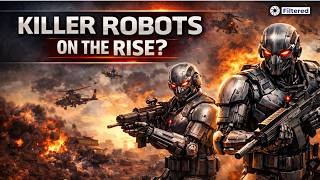
In this YouTube monologue, TJ Walker examines the emergence of humanoid combat robots being developed by the Silicon Valley startup Foundation, focusing on its Phantom MK1 and upcoming MK2 models. He outlines the robots' technical capabilities, current U.S. military contracts, testing in Ukraine, and ambitious production and cost targets (30,000 units annually at $20,000 each). Walker presents the arguments of supporters—who claim robot soldiers could save lives, reduce battlefield trauma, and make warfare more precise—through co‑founder Mike LeBlanc’s moral‑imperative framing. He contrasts these with critics such as defense analyst Jennifer Kavanaugh and Harvard human‑rights scholar Bonnie Docherty, who warn that autonomous killing lowers political and moral barriers, creates accountability nightmares, and risks civilian casualties, citing a recent U.S. bombing of a girls’ school in Iran as an illustration. Walker then explores broader geopolitical stakes: a potential AI‑driven arms race, especially if a nation like China achieves general AI superiority, and whether robot soldiers could act as a deterrent akin to nuclear weapons or instead make war more likely. He concludes by inviting viewers to weigh in on whether autonomous weapons will increase or decrease the odds of conflict, acknowledging the complexity and lack of easy answers.
Chapters
A Silicon Valley startup is openly building what sounds like science fiction and looks like a nightmare: a humanoid robot designed for war. Foundation's Phantom MK1 can handle weapons, assist with breaching operations, and is already being tested for military uses, including in the Ukraine. Supporters say robot soldiers could save human lives, reduce battlefield trauma, and eventually make war more precise. But, and there's a big but, critics warn that once machines are built to fight, the political and moral barriers to war get weaker, not stronger. A government can hesitate before sending young Americans or citizens of any country into combat. It may hesitate less before sending machines. The bigger danger is not just that these robots malfunction. It is that they normalize a future where killing becomes automated, Accountability gets murkier, and warfare feels more like a software problem than a human catastrophe. This isn't progress, this is profound moral escalation. Okay, I'm not going to hold out to you that there are easy answers on this. This is a complex issue, and we as a society, we as a world are going to have to navigate this together. Let's look at some more of the facts. So again, the Phantom MK1, it's a humanoid robot., and it looks scary. It does look scary. Developed by a San Francisco startup, it has $24 million in US military research contracts. Now, I have no evidence, I've seen no reports that it's doing anything significant in this Iran war, but it does have contracts with the Army, Navy, and Air Force. It's being tested in the Ukraine. Now, the Ukraine is already using a lot of drones, on all sides. The war in the Ukraine has cost at least 350,000 lives according to a variety of experts. I've seen many, many estimates much higher than that. The Phantom MK2 is planned for release in April, which is just a few weeks away. Future production goals are 30,000 robots annually. The target cost is to get these down to about $20,000 per robot, so very inexpensive compared to a human human life, not that you can easily put a price tag on a human life. Now, here's what Mike LeBlanc said. He's the co-founder of this company. He says, we think there's a moral imperative to put these robots into war instead of soldiers. Yes, I can definitely see if your country is under attack or you're helping another country that's under attack by some sort of evil dictator, it would be nice not to have to send soldiers from your own country to die. It would be nice to defend yourself from foreign intruders or to defend other countries from tyrannical oppressors with machines rather than having your own soldiers die. That I understand that, but unfortunately it's not quite that simple. Jennifer Kavanaugh of the Defense Priorities Military, she's a Defense Priorities military analyst. She says the appeal of automating things and having humans out of the loop is extremely high. That's what she told Time magazine. But Bonnie Docherty of the Harvard International Human Rights Clinic said this: technology is moving rapidly toward full autonomy, and there are serious concerns when life and death decisions are delegated to a machine. As we saw earlier this week, there was an oops, kind of a mistake, and the United States military bombed a girls' school, and 176 people in Iran were killed Most of them children. Who's to blame if you send a robot there and the robot is programmed one way, but it's all of a sudden killing people willy-nilly, harmless civilians, civilians waving a white flag, and the robot doesn't see it and just starts shooting. Who's accountable there? Is it the software company? Is it the robotic company? So there are some some tricky issues here. I wish I could tell you I had all the answers. I don't. The big question, of course, is if all the great military powers of the world have these, does it increase the odds of more wars or does it decrease the odds of war? If you knew, if you started something with another country, all of a sudden your entire country would be overrun with robots killing everyone, maybe you wouldn't do it., but is that how it's going to work? This is yet another reminder why those of you who say, uh, AI's too dangerous, let's just halt all AI research. This has been a message. You don't hear it as much in the last year, but it's certainly been a theme coming outta Silicon Valley and elsewhere for the last 3 or 4 years. Here's the problem with this. If one country, for example, China, develops a general AI first, and they can then use that to build the world's greatest robots and robot soldiers, and they can be the first in the battlefield, then there's really nothing, absolutely nothing stopping them from taking over any country in the entire world without having to use nuclear weapons, without it blowing back and harming their own atmosphere and their own people. Do we want China to have that? Now, I can think of a lot of people including in the United States, who wouldn't want the current regime in the United States to have this power? But do we want other countries to have the power? So these are tricky questions. What do you think? I'd love to hear your opinions on this. Robot soldiers, is it going to increase the odds of more wars, or is it something so powerful, kind of like nuclear weapons? Say what you will about nuclear weapons, but after World War II, Nobody has started a world war, at least not until a couple of weeks ago. Jury's out on that one. But nobody's used nuclear weapons on another country since World War II. So sometimes a new technology comes out, it's so incredibly powerful, it deters things. Is that what this is going to do with robot soldiers? I don't know.