AI Tom Cruise vs Brad Pitt Shocks Hollywood + GLP-1 Culture War, Free Buses, Pet TV
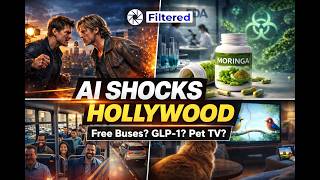
TJ Walker covers five stories: an AI-generated Tom Cruise vs Brad Pitt video that triggered cease-and-desist letters, a salmonella outbreak in supplements that hospitalized three people, why American kids became picky eaters, GLP-1 drugs forcing body-positivity influencers to reconsider their message, and free bus pilots in NYC and Boston that cut costs and boosted ridership.
Chapters
A 15 second AI video of Tom Cruise fighting Brad Pitt has Hollywood lawyers reaching for their cease and desist letters. A so called miracle supplement is recalled nationwide after illnesses and hospitalizations. There's a reason American kids are such picky eaters. And get this, it didn't start with the kids. A former body positivity influencer says the GLP1 revolution forced her to rethink everything. Free bus rides sound like wasteful socialism until you look at the numbers. We'll be doing that in the program today. And believe it or not, pet TV is becoming a big, big deal. But are your cats and dogs actually enjoying it or are we just projecting all that and more today on Filtered. Welcome to Filtered with TJ Walker. Hi and welcome to the program. I'm tj. Thanks so much for joining me. AI Cruise Pit fight spooks Hollywood. According to The Times, a 15 second AI generated video showing Tom Cruise battling Brad Pitt on a rooftop triggered alarm across Hollywood. The clip created using Sea Dance 2.0 from ByteDance, looked cinematic. It was polished and disturbingly real. Industry leaders fear tools like this could bypass actors, writers and studios altogether. Now I'd like to show you this video, but I can't. I don't want to get a cease and desist letter. Disney has sent cease and desist letters and the Motion Picture association called the activity infringing on a massive scale. The concern isn't just about likeness rights, it's about jobs. If a two sentence prompt can generate blockbuster quality action, studios may be tempted to cut labor cost. Scratch that, they're not tempted. They're going to reduce labor cost any way they can. Supporters call it innovation, critics call it existential. Now I would urge you see if you can find this clip again. I can't show it on this program. Those of you listening on the podcast know you can't see the video anyway. But it is amazingly realistic when you see Tom Cruise and Brad Pitt essentially fighting. I mean, the staging is nice, the lighting is great, the music, everything seems fantastic. And the reaction from a lot of those in Hollywood are like, oh my God, we're dead. We're over. This is it. Let's look at some more facts. So ByteDance is sort of the parent company where this was placed. They're valued at half a trillion dollars. They've got a lot of clout behind them. The Jungian SAG AFTRA representing actors obviously are not too happy about this. They want informed consent in advance. Now Disney's trying to get in on all things artificial intelligence. They struck a $1 billion OpenAI deal last year. And they are allowing people to use OpenAI and mixing it with characters. So they're kind of conflicted about this. On the one hand, they say, no, no, no, no, we don't want to violate and put out a business. Actors, directors, producers, set designers. On the other hand, they're saying, well, maybe we do. Let's be a part of this new cutting edge technology. Here's what one screenwriter told the Times. This is Rhett Reese. For all of us who work in the industry and devoted our careers and lives to it, I just think it's nothing short of terrifying, actual terrifying. If you're a screenwriter. The creation process is more natural and efficient and allows users to control their creations like a true director. This is from a ByteDance news release. Reese also says, if I could wave my magic wand and make AI go away, at least in the creative field, I would absolutely wave the wand. Well, that's what people said about the, you know, the loom and the cotton gin and a lot of other technologies never seemed to work. That magic wand never came about. That's what the people who sold horse buggies and horseshoes said about the car. It didn't really work that way. Let's look at some bigger picture issues. You know, there was a time when Hollywood was afraid and terrified of computer generated graphics. Now the big fear is AI technology historically displaces creative labor first. Now there are those who say, oh, everything AI does is slope and it's never going to be as good as creative as a human being. I don't know about that. Look, I'm in a creative field. I make money. I have an income career based on being creative. I've created hundreds and hundreds of online courses. I've created and published books. So I have a stake in this. I gotta tell you, I'm not so sure that AI isn't already better than a lot of human creativity in a lot of areas. Certainly when you look at the Hollywood blockbuster, the standard ROM com, they're really all the same. Maybe one of them has Jennifer Aniston, maybe one of them has Jennifer Lopez. But really, can't we just admit they're formulaic? And if it's one thing AI is good at is discerning formulas and following formulas, and they're just good at it. I like James Bond movies. I've been watching them my entire adult and adolescent life. But are you really trying to tell me that an AI can't create a James Bond movie? Certainly as good as you Know, a mid tier James Bond movie. I don't buy it. As I've said before, I'll say it again, I don't think we're more than a couple of years away from the number one movie at the box office worldwide being something a 17 year old did entirely on their computer with zero budget. Or maybe other than their monthly wi fi budget, I don't think we're that far away from that happening. AI is lowering the barrier to entry for filmmakers everywhere. Now you could obviously make a case, okay, copyright law, intellectual infringement would prevent someone making a movie starring Tom Cruise and Brad Pitt without their permission. Okay, but what if you had two characters and they looked like a combination of those two guys? Or you took Brad Pitt, Tom Cruise, George Clooney, and whoever your favorite punk heartthrob is, and you told AI create someone who looks different enough in that no one can claim artificial intelligence stole their, their image, their likeness that I see happening. This is easy to say, Tisk, Tisk, you shouldn't have used these famous actors without their permission. But does anyone really care about the actors if they're 20 years old? I mean, to a 20 year old, these guys are really old guys. These are grandpas. These guys are my age. So if you're 20 years old and looking to take a date out to a movie night, what do you care about what grandpa's doing? If you can have some AI generated hunky looking person, some beautiful woman, is there a chance it might not be more popular? So these are terrifying times, I think, for anyone in the Hollywood industry. But really any creative industry is now facing the reality that AI is good. It's getting better every day, and it is improving at a much, much faster rate. And I'll be honest with you, I don't know what these unions are going to do. If you represent actors, if you represent producers, if you represent writers, it's nice to be entrenched and say, we want our rights, we want payment, we want to be treated fairly. I'm on board for all of that. The problem is, what if the Hollywood studios aren't a part of the puzzle anymore? What if the owners of movie theaters realize, why am I dealing with these people? Here's a really smart 16 year old who's created a great movie. It's already had 3 billion downloads for a part of it on YouTube in the first 24 hours. Why don't I put that movie in my theater and charge the same amount and maybe I keep more for myself? And this 16 year old is going to become instantly worth $100 million. What do we even need Hollywood for? That's a tough question. I wish I had an easy answer. I wish I knew an answer that would make everybody happy, that would not result in mass unemployment for people who devoted their lives to their craft of acting, screenwriting, directing, producing, all important skills. But the one prediction I will make is the moviegoers, the people who really keep the movie industry going are frankly, are not people like me. They're generally not people with gray hair or with little hair. It's teenagers going to the multiplex Friday and Saturday night and creating that first big weekend. And that's what often propels the long term lifetime value of a movie. Whether it ever makes a profit, whether the director gets to do another movie, whether the actors get big bonuses for their next movie. It's all about quite often that first weekend and that first week. I'm not rushing out to watch the movies then in the theater. I've got a nice home theater. I'm going to wait for it to be released on some streaming platform. So I'm essentially irrelevant. If you're not going out to movies when they first launch to the public, you don't really have a vote. The people who have votes quite often are teenagers, people in their early 20s. And I'm not convinced they care about whether a Hollywood screenwriter can afford to have his mansion in Beverly Hills. I'm not sure they are concerned about whether Brad Pitt can have a whole bunch more wives and have and or adopt a bunch more kids. I'm not sure they care about Tom Cruise anymore and whether he can donate more money to Scientology or any other culture. I don't think young people care about that. What they care about is, is this entertaining for me right now just on what I'm seeing. So we got to get ready, folks. And who knows you're watching me. I'm a real person today. Maybe an AI clone or some AI generated program will do a better news analysis show with a personal development fair than I will. Now. I do have my own clone, so I'm trying to be on both ends of that equation. What's your plan? It's very easy to sit back and say, well, you know, they came for the Hollywood stars and that didn't affect me, so I didn't complain. What if it does come to you? We're seeing it creep in on every single industry. And I say this not because I think AI needs to be stopped. I'm not a Luddite, I'm not anti technology. But I am a realist and I do see it creeping. I mean just the other day I had a potential legal situation where normally I might have needed to engage a lawyer to write a very sternly written letter to someone I've done business with with intentions to pursue things in a litigation route. And a very inexpensive lawyer would have had to have charged me 1500 $2000. It would have taken at least three hours work. I was able to have ChatGPT do it in about 60 seconds and the letter had the exact intended results that I wanted. I saved $2,000. That benefited me. But some lawyer didn't get business. So this is affecting every single industry. This is a marquee one where the stakes are so high. I mean if you spend a hundred million dollars on a movie and it bombs, that can completely destroy an entire movie studio. It can put you out of business. It can ruin entire careers. On the other hand, if you can make a movie or let's say nothing or tens of thousands of dollars or even a million dollars, forget making $100 million. If you can make $40 million on a million dollars or less of an investment, well, you now have a cash cow the likes of which the world has never seen. You're going to be everyone's going to want to do business with you. So the stakes are are extraordinarily I'll be following this. I don't have all the answers together. You and I are trying to piece together what's going on in the world so we can figure out a strategy so we all survive.
Imagine having a communication coach who never sleeps. Meet your new secret weapon, the TJ Walker AI clone. Go to TJ JWalker AI and start getting custom coaching 24 7. No scheduling, no hourly fees. I train presidents, prime ministers and Fortune 500 CEOs but the same exact communication I've delivered to world leaders is now available to you online anytime@mediatrainingworldwide.com whether you're speaking on camera, pitching a client or handling a crisis, you need these tools. These aren't fluffy motivational videos. They're practical, battle tested techniques to help you speak clearly, competently and persuasively. Go to media trainingworldwide.com and take your communication to the next level.
Miracle Morning Supplement Recalled According to Newsweek, Ambrosia Brands has voluntarily recalled Rosabella Morning a capsules after possible salmonella contamination linked to seven illnesses and three hospitalizations. The capsules were marketed from a so called miracle tree and sold online including TikTok Shop. Federal agencies are Investigating whether contamination came from a specific raw ingredient supplier. Salmonella can be especially dangerous for children, the elderly and the immunocompromised individuals. The company urges customers to dispose of affected lots immediately. The broader issue highlights how supplements are regulated differently from prescription drugs, often after problems emerge rather than before. Okay, let's dive a little deeper here. I'm almost being a little euphemistic there, saying it's regulated differently, it's not regulated. You can basically, as I've mentioned before, go to your sidewalk, scrape dog poop off, put it in a little capsule, sell it to people and say, hey, the FDA doesn't want you to eat this. The medical establishment doesn't want you to know about that, and you can sell people garbage. The only time the law kicks in is when the body count goes up or all of a sudden you have so many people headed to hospitals, then maybe the law kicks in. So buyer beware. Look, we all want the idea of some miracle pill. I don't want to eat healthy, I don't want to exercise. If I just find this one magical pill, I'll be healthy, I'll be strong, I'll have great muscles. I have a six pack ab. Everybody wants that. I want it. And unfortunately, that sends people to hospitals that desire and it makes a whole lot of scammy, sleazy, skeezy supplement makers. Rich. Anyone who's followed the vitamin, the supplement industry for very long knows it attracts a really sleazy crowd. It's been a part of the multi level marketing scheme world, scam world since the beginning of multi level marketing. But even when it's not a part of a multi level marketing scheme, quite often it's just garbage. There's been study after study after studying showing that almost regardless of the supplement or the vitamin or the pill or the tablet, it either has no positive impact on your health or has a deleterious impact on your health that actually harms you, in some cases can kill you. So why do we keep buying that scam? Why do we keep buying the myth that oh, take this green powder, oh, take this magic pill? It's unfortunately because we as human beings like to be lied to. We do. I like it, you like it. I like to be told I'm brilliant, have beautiful head hair. Everybody loves to be lied to. And unfortunately, that's what I fear the vast majority of supplement makers are doing. So to be clear, I'm not giving you medical advice if your doctor specifically prescribes to you B12 and thinks you have a B12 deficiency and tells you which tablets to take, by all means, follow the advice of your doctor. But the idea that you're going to say, hey, Brian Johnson seems like he knows what he's doing. He's really rich. He takes 140 pills a day. I'm going to take 140 pills and tablets a day. Please, I beg you, don't do that. You could be doing massive, massive damage to your kidneys, to your liver. And it may be all you're doing is creating a different colored pee. Why waste your money on that? You've heard me say it before, I'll say it again. Eat real food. If you actually eat salads, not with all sorts of gloppy, sugary salad dressing that you get at McDonald's or at your local grocery store, but a little oil and vinegar, eat fresh vegetables, eat leafy greens. Eat real fruit. Eat meat. If you are a meat eater that isn't highly processed, that isn't slathered in sugary sauces, deep fried breaded with lots of extra carbohydrates and tons and tons and tons of sugar and salt, eat relatively unprocessed meat and food. Eat the rainbow. Eat food of differing colors. And no, I don't mean purple gummies. I mean arugula. I mean kale, I mean bananas, mangoes. Eat the spec. If you do that, the chances are extraordinarily slim that you need any supplements or vitamins because you'll be getting them from real food. Let's take a look at what others told Newsweek for this story. Customers who have purchased the lots above are to dispose of it immediately. Do not eat, sell or serve the product. This is ambrosia having to say this because they've already injured people and put them in the hospital. Moringa. And I was mispronouncing it, it's called. Moringa is an interesting plant known as the miracle tree due to its impressive nutritional composition. This is according to Kelly Hopeley, a nutritional therapist. But again, there is no miracle plant that's going to make you perfectly healthy. There isn't. Plants are good, variety of plants are good. And let's say something is really healthy for you in its natural plant form. By the time it's sliced, die, dice, desiccated, dried up and put into a little pill, you don't really know what you're getting. That's the problem with all of these. And according to Ambrosia, Ambrosia Brands is conducting this recall voluntarily and takes this matter very seriously. Okay. When people are already in the hospital and people are sick. You don't get brownie points for recalling your product. That's making people sick. Let's look at some more facts. The US supplement industry exceeds $50 billion annually. Now, is it a smaller industry than the United States healthcare industry and the United States pharmaceutical industry? Yes. But the idea that it's this small mom and pop little industry where everyone is the little guy and a good guy, no. There are a lot of bad actors in the supplement industry and they face almost no regulation. Social media influencers are constantly hawking it because they get paid a lot of money. It's payola, but it's not illegal payola. It's not under the table. They tell you, hey, this show is sponsored by AG1 and all these other, all these other pills, potions, supplements. And I gotta tell you, when I'm looking at a healthcare podcaster, a health guru, a personal development guru, and the first thing they do is try to sell me some magic potion that supposedly gets all the healthy green stuff I need without actually eating a vegetable or lettuce. That's when I know they've already been bought off. That's usually enough for me to say, I'll listen to one episode. But they care more about their pocketbook than they actually care about helping people. Every one of these companies, they like to use natural in their branding implies safety without proof. You know what else is natural? Hurricanes, typhoons. Arsenic is natural. Imagine I said, hey, get TJ's a good old fashioned natural elixir. It's completely natural. Take it every day. I do. Turns out to be arsenic. Well, I didn't lie to you. It's natural. But it's arsenic and it will kill you. So don't be fooled by someone telling you that just because it's all natural, it's good. It's a scam. It's an absolute scam. Now, these global supply chains complicate contamination tracing because they can each say, well, it's not my fault. It was this factory in Mongolia somewhere. Don't blame me. You don't really know what you're getting. That is the beauty of going to your local grocery store and getting a head of lettuce and getting spinach. And yes, I know those can be contaminated sometimes too. Make sure you wash it properly. But in general, eating fresh fruit and fresh vegetables, much less likely to cause you health problems than ingesting all sorts of pills and potions. I do think we need here in the United States stronger FDA regulation. In Europe, they're much better about that than they are in the United States. Here our politicians have been bought off. When you say, oh, I don't want to pay for my politicians ads, this is what you get. The politicians then go to interest groups. They go to people who manufacture things like scammy sleazy supplements. They take money from them and then give them what they want. They give them no regulation. The whole idea of, well, the free market solves the problem. No, we want regulation. Do you want someone taking over your local water supply and giving you poison and half the population dies and you're thinking, well, what the free market decide now, you know, to go to another water company? Well, it's too late if half your family's dead from poison. This is a perfect example of how you need regulation. The free market doesn't solve problems like this and faith in self policing just ignores real public health issues. So beware. Have I ever taken a vitamin or a supplement? Yes, I certainly don't take vitamins regularly and I looked very skeptically at any and all supplements. What I try to do, and it's not fun is I try to eat healthy food at every meal.
We'll be right back after this break.
Want to advertise here? You better be legit. What?
No crypto, no junk food, no supplements. Go to tjwalker.com advertise.
Most people can't.
Afford a full time coach. And even if you could, good luck finding one who's available when you need them. That's why I created the TJ Walker AI clone. It's built on my 40 plus years of real world coaching and training. You get my exact advice, style and frameworks instantly. Ask it how to handle a tough question. Get feedback on your elevator pitch. Rehearse your next big talk. This is the next generation of communication coaching. It's smarter than an app, more personal.
Than a course, and always ready.
Start using it today at tjwalker AI.
You'll wonder how you ever did without it.
Want to advertise to ambitious, upscale professionals who actually care about communication success and Results? Go to tjwalker.com advertise and no, we don't take ads for crypto supplements or junk food.
Why American Kids Become Picky Eaters in the New York Times, historian Helen Zo Viet argues that American children were once adventurous eaters, happily consuming oysters, cabbage, turnips and bold flavors as recently as in the 19th century. Widespread pickiness, she writes, is a modern phenomenon fueled by 20th century junk food marketing. Companies like General Foods and Nestle promoted child pleasing products, fragmenting family meals and reshaping expectations. Snack culture reduced hunger at dinner. Personalized food replaced communal eating. Today's narrow kids menus may be less about biology and more about branding. The claim pickiness wasn't inevitable, it was engineered. Okay, let's look at some more facts here. This is fascinating because one of the things we'll be talking about in the show today is why we all are guilty of certain conventional wisdom that just turns out to be wrong. We have to keep our minds open to new facts and new information. This op ed in the New York Times to me was eye opening. I really had no idea that as recently as the 19th century, kids supposedly really enjoyed eating all kinds of vegetables and oysters and things that so many kids these days say, I'm not going to eat that. According to this author, this health expert, there is a lot of evidence that children enjoyed bitter food, spicy food, sour food. Until the 20th century, the concept of pickiness was rare. Now you could argue, well, T.J. of course, people starve to death. 90% of the world suffered starvation and famine for most of human history. Okay, but even beside that, that's not what the author's really talking about. What she's suggesting is that we have essentially perverted our children by giving them all this heavily processed sugar and that once you taste it all the other range of foods loses its appeal. And it's sad and it's harming people's lives now. 1960, a craft ad promoted mild golden Velveeta, which isn't really cheese, and confession. I ate a lot of Velveeta cheese growing up. I don't think it helped me. General Foods started marketing child specific products. Nestle expanded factory processed foods. Before you know it, we had Goldfish, spaghettios, targeted children, Twinkies, Pop Tarts. Wow, I remember those. Again, sad to say, I ate a lot of pop Tarts growing up. Now I still feel great at age 63, but who knows how I might feel or how much longer I might have lived if I had not been subjected to to all of that food. Let's not forget obesity and eating disorders were extraordinarily rare throughout human history. And obesity, certainly extreme obesity, was practically non existent until about 1980. But that's when all the snacks and all the sugary foods just became an avalanche, affecting us everywhere. You can't even go to a gas station without having 10,000 sugary products marketed to your face. The author in the Times contends mass childhood pickiness is a modern phenomenon created largely by junk food companies. I Have to tell you, I had not thought of that before. I just assumed. Well, all kids like sugary treats and all kids like pasta. Okay, but what if they're not subjected to that? What if it actually was an extremely rare thing? I mean, when you look at the ounces and pounds of sugar that human beings ate until about 150 years ago versus today, I mean, it's just shocking. It's like this versus that. And those of you listening on the podcast, I'm holding my fingers together closely, I don't have the stats in front of me, but it's like a pound of sugar a year versus 100 pounds of sugar. I mean, the amount of sugar, processed sugar, artificial sugar that everyone in America eats, even if you're not going to candy store, because it's engineered into everything it's put in our bread. I mean, good luck going to a typical grocery store, for that matter, a Costco, and trying to find any bread that doesn't have sugar put into it. So the other message that this author says is mass childhood pickiness isn't parents fault, it's the product of historical forces. Okay, I get it. But if you're a parent, you do have a choice. When you go to the grocery store, it won't make you popular. Believe me, I am extraordinarily unpopular in my household when I go to the grocery store because I look at labels and if something has sugar in it, processed sugar, artificial sugar, I don't buy it. But it can be done. It definitely can. It can be done. We're all subjected to reminders. Advertising. Advertising works. Why do McDonald's and Coca Cola and Pepsi and Budweiser spend billions and billions and billions of dollars a year on advertising? They don't do it because their best friends work at TV stations and radio stations and Internet, website. No, they do it because it works. When you bombard people with messages that, hey, this is tasty, this is going to be fantastic on your tongue and your mouth and your belly. It works on us, it works on human beings. Unfortunately, healthy food, less processed food, doesn't have an advertising budget. And that's why we have this situation. I see this all the time when I'm out with other families when they're kids and I'm trying to order healthy food and get my daughter to eat healthy food. And the other parents say to their kids, okay, do you want french fries with your butter pasta? Like really? That's what you want your kids to eat? French fries and butter pasta? Heavily processed white pasta with butter on it not a vegetable insight yet. Tj, I know potato is. French fries are made of potatoes, but you and I know when it's heavily fried it's extremely harmful for you. It's not healthy at all. Not a fresh vegetable inside. I should have said not a green leafy vegetable anywhere. And it's just sad. I mean these are people often educated, intelligence, successful, prosperous. And they're feeding their kids garbage like, oh, you know, I don't want to cause a conflict. Little Timmy only likes french fries and chicken nuggets and pasta. He's a picky. No, he's not a picky eater. You let him become that way and we're all paying the price for this. And the price is shorter lives, less healthy lives, less of a health span. You know, a lot has talked about why did the French, why do The Italians live seven, often 10 years longer than Americans do? And why are they vigorous at the end? Not just sitting, filling up a chair, watching cable news in an old folks home, yelling at the news. Why do we see people 85, 95 walking to market every day in villages in France and Italy? It's because they're going to get real food. They're eating real food, they're cooking real food, they're serving meals with real food for multiple generations. And that's really the key to not just a longer life but a longer health span, which is something we all want. So if you're a parent, my advice to you is realize if you think your kid's a picky eater, yeah, we can blame the fast food industry, good luck changing that. But realize some of the accountability. It's mine and it's yours and it's every single parent. If you constantly expose your child to real food, they can and will have a taste for it if you give them the option. Do you want real food that's healthy versus more and more heavily processed sugar filled junk food? Yeah, they're going to opt for the junk food every time.
Want a shortcut to powerful communication skills? Download the TJ Walker Success Library. Five of my best selling books for only 9.95. Go to tjwalker.com books instant access. Big impact. I've had entire YouTube channels wiped out overnight. So if you enjoy this show, don't.
Lose track of me.
The Safest Way is my newsletter, substack.com@tj Walker Success. Sign up for free and you'll get exclusive commentary, live session alerts and first access to new tools. Again, that's substack.com just search for TJ Walker or go to substack.com J WalkerSuccess.
Your direct line to everything I do. Body positivity meets GLP1 reality. In a new York Times opinion video, former body positivity influencer Gabriela Lascano says the rise of GLP1 weight loss drugs forced her to reconsider the movement she once championed. With 18% of adults in America reporting they've taken GLP1 medications, weight loss has become normalized again. Lascano says, quote, loving yourself at any size sometimes becomes an excuse to ignore health risks. Others fear the return of toxic thinness standards. The cultural question, can you love your body and still want to change it? The movement now faces tension between medical data and identity politics. Okay, so this is a tough issue to talk about. I won't kid you. But I also won't pull punches. I'm going to say things here that I think are in the best interest for you, your family, your life and your health, even if it strikes some of you as insensitive. I've said this before and received a lot of criticism, but I'll say it again. Much, not all, but much of the body positivity movement is really just an excuse for apologists for big corporate food industries and the candy makers, the junk food manufacturers, the soda pop manufacturers of the world to take advantage of you and kill you and reduce your life, shorten your life, shorten the quality of your life. The body positive positivity movement has been essentially a smokescreen, a cover to protect corporate interests that are trying to make a lot of money selling you garbage to eat. Having said all that, do I think that you're a bad person if you're overweight? No. Do I think you should hate your body? No. But I do think that you should love yourself enough and love life enough to do everything you can to make yourself feel good and make yourself healthy. And when I say feel good, I don't mean simply that sensation of ice cream on your tongue going down your throat into your belly. I get it. That feels good. I had some ice cream yesterday. I'm not holier than now. But the idea that you can be wildly obese and hey, it's just as good as any other lifestyle. It's just as good as any other body type. I'm sorry, it's not true. Yes. There are things, such as cultural norms where someone says, oh, I don't like your skin. It's too dark. It's better to have light skin. Horrible. Racist. A cultural form of oppression, not endorsing that. But folks, we got to be real with each other and be honest with each other for a couple of hundred thousand years. The basic genetic code of human beings hasn't really changed. And until about 45 years ago, obesity was incredibly rare. I'm talking incredibly rare. When I was a kid, 50, 55 years ago, there was one heavy kid in the class, and these days he wouldn't even be considered heavy. It was rare. If you doubt me, look at any pictures. You know, look at pictures of Woodstock, look at pictures of college kids, kids at camp in the 40s, 50s, 60s, even 70s. And you say, oh my gosh, everybody's skinny. No, they weren't skinny. They were human beings who ate three meals a day and didn't have this idea of let me snack all day long, it's been two hours, let me go to Starbucks and get a drink filled with cream and lots and lots of sugar and syrup and goo every thrift. People didn't do that in the 40s, 50s, 60s and 70s, desserts were occasional. So it did fascinate me to see this video from this former body positivity influencer. Apparently she's received a lot of criticism from former members of her community. There is a controversy, there are some who, who say, hey, we have to love all large bodies, no matter how large. And if anyone even tries to lose weight, they're essentially fat shaming themselves, and that wouldn't be good. Sorry. Wanting to improve yourself is not a bad thing. Wanting to learn more is not a bad thing. Wanting to become stronger is not a bad thing. Giving yourself goals of exercise, daily exercise, eating healthy, nutritious 20, 220, 300 calories a day of food that is not heavily processed, that doesn't have lots and lots of sugar, processed carbohydrates and salt added is not a bad thing. It tends to be the thing that makes you live to 85, 90, 95, as opposed to getting diabetes at 45, having hypertension at 50, stroke at 55 and heart attack at 58, and dying at 59. I'm sorry, but it's. Some things are better than others. Living to age 85, 90, at what by every historical measure would be considered a normal weight, is in fact superior to having 20, 30, 40, 50, oftentimes in America, a hundred pounds of excessive fat, it is superior. Now, is one person a better person than the other? No. I'm not saying you are a bad person if you are obese. I'm not. Should you be loved? Yes, you should. But certain behaviors cause certain Destruction to the body. You may think I'm a wonderful person. I love it. I hope you do. But if all of a sudden on the show each day I'm drinking two bottles of wine and I tell you I drink a total of three bottles of wine a day, you might still think, well, TJ's a nice guy. He's an honest person. He's transparent. But you might also think, maybe TJ shouldn't drink three bottles of wine a day. Oh, but I feel fine and I look good, let's say. That's what I'm telling you. I think a part of you, it's okay. It doesn't matter. The human body is not designed to drink three or four bottles of wine a day. Tj, figure out how to stop drinking three or four bottles of wine a day. Maybe you go back to a glass or two. Maybe you don't drink any wine a day. Why don't you try that? Now, I'm not saying it's directly analogous. I'm not saying anyone who's overweight should simply stop eating. No. I am suggesting it's almost a mathematical impossibility to eat 2,300 calories a day of relatively unprocessed food that's not filled with sugar, salt, processed carbohydrates, and be obese. You can tell. Well, tj, I've tried every diet. Really? Why is it throughout human history we never saw wildly obese people when they were eating? Mostly unprocessed? Why is that? Because talk to any doctor, human genetics have not changed for a couple hundred thousand years. Something has. What has changed is eating garbage food all the time. Am I telling you, go out and take a GLP one? No. There's a tremendous number of side effects that are quite harmful. I'm going to leave that to you and your doctor. I'm not here giving medical advice, but I do think that anyone, any human who cares about their health has to try to protect and preserve their own body. And there's a million different theories about all kinds of stuff. But there is consensus that if you eat mostly relatively unprocessed food, if you eat lots of fruit and vegetables, heavily unprocessed vegetables, salads, you drink water, which is what I'm drinking in this cup I'm holding up. Instead of drinking sugar and drinking calories, it's almost impossible to be obese, which means you dramatically decrease your odds of getting type 2 diabetes and stroke and hypertension and heart attack and all the other things. So I'm glad to see this body positivity expert talk about receiving new information and getting a different perspective on things and realizing that, okay, being positive about people's human moral worth is a good thing. Shame is not especially a great motivating factor for anything. But no, not all diets are created equally and not all of them are equally as valid. Now there's a saying in the health community and the weight loss community, all diets fail in the long run. And on the one hand it is true. But on the other hand, find anyone you think of who is physically fit. I don't mean good looking, I mean physically fit, who looks like they have the right proportion of muscle and flesh on their body. Now look at what they're eating. That diet works. So in a sense, all diets work. If you consume a diet that is filled with excessive calories, devoid of nutrients, you're going to have a negative effect on your body. Now it is true if you try to go from eating a horrible, horrible junk food diet all the time and 2 or 3,000 more calories than you need a day, if you try to then just eat celery, you're going to give up. So to that extent, yeah, diets fail. But anyone you've ever seen who has a healthy weight, their diet does work.
Like what you heard. Don't let the algorithm bury us. Subscribe now@substack.com jwalkersuccess want direct access to me live? Want to unlock bonus episodes, behind the scenes takes and full access access to my premium courses? Then become a member today. Just go to TJ Walker.com members and.
Choose your preferred platform, YouTube, Patreon. Whatever works for you.
This isn't just another subscription. It's a full access pass to the tools, coaching and content that can transform.
Your communication and career.
TJ walker.com/members I'll see you inside.
Free bus rides. We're going to talk about that in our next issue right now, coming up. And thanks so much for joining me. This is Filtered. I'm your host, TJ Walker. Every day we look at the top business, technology, health and culture stories of the day and analyze it through the prism of personal development skills. How you can improve. Issue 5 Today, free bus rides and the Surprising economics in the New York Times. Emily Galvin Almanza argues that free bus programs deliver more than small rider savings. In New York City's Pilot, ridership rose 30% on weekdays and 38% on weekends. Assaults on bus operators dropped 39%. Boston tried this. They saw boarding time cut by 23%. Meanwhile, New York Transit Police overtime jumped from $4 million in 2022 to $155 million in 2024. This was chasing the people who were trying to jump over the turnstiles to get into the subway and in the buses. And eliminating fares reduces enforcement costs, court cases, jail strain, and administrative overhead. The bias challenge. When we hear free, many instantly think, oh, wasteful socialism. And I was guilty of that, overlooking that roads and parking are heavily subsidized, too. So this was a fascinating article. I would recommend it to you. It's in today's New York Times. Emily Galvin Almanza writes it. And it really challenged my beliefs because I was one of those who heard in the recent mayoral campaign in New York City, the person who became mayor said, oh, I'm going to have free buses. And there's a part of me that thought, well, that probably be a nice idea, but can the city afford it? It's going to cost too much. That's one of those things where it just seems unrealistic. I thought that, and I'm pretty sure a lot of mainstream centrist people thought that. Certainly conservatives and Republicans thought that. It turns out I was wrong if you really look at the facts. Let's look at some more of the data. In Boston, saw their boarding times go way down. Makes sense if people are not fiddling with cash and looking for a card and going through one at a time. And people can just get on. You get on the bus much faster. The buses move faster. There's less traffic, there's less. Fewer traffic jams. Everything makes it. It's more attractive to other people to use it. You have less pollution in the city when this happens. So again, the police, the amount of money spent on policing, the enforcement. New York City apparently did not enforce this very strictly in 2022. They had $4 million in overhead costs or overtime costs for their police. It jumped up to $155 million. So more than $150 million extra was spent just trying to enforce people, oh, yo, you didn't pay for your fare. We're going to arrest you now. It absolutely clogs criminal court systems, and it's a big, big problem. Now, they had a free bus pilot. It ran in 2023 and 2024. Multiple cities have tested the fair elimination, and what they're finding is it either breaks even or they come out ahead financially when you take into account all the charges. So here's the part that I had not given enough attention to. The article points out in detail that in so many cities, especially a place like New York City, you've got a lot of poor people. Poor people are trying to get to a job so they don't have enough money for fare. They take the risk. Well, if I don't get on the bus, I won't get to the job, I'll be even poorer. So they break the rules that get on the bus. Well, now they're caught, now they don't get to the job, they maybe lose their job. They've got to go to court, they've got court fees, Fine. It puts them deeper and deeper and deeper into a financial hole. And you know, this is a part where it's just easy to forget about people like this. But there are, whether it's the bottom 20, 25%, 30% of Americans, they just don't have much money and they're trying to work. They're not on the streets begging for money, they're not begging for more welfare. They're just trying to get to the job. And transportation is very expensive in America between cars, tolls, parking and even buses. So there's a number of biases here that I think have an impact. One of them is just success bias. If you think, well, I've got a car and I pay for bus fare, why doesn't everyone do that? Well, not everyone. As lucky as you are and as lucky as I am, and I was guilty of that. This is a huge, huge problem. Legally. Many people have gone their whole lives and I'm fortunate enough to be one of them. I hope I'm not jinxing myself without ever being a part of the legal system. Never been arrested, never had to show up for a court date for anything other than jury duty. So it's easy to forget about how stressful that can be and how expensive that can be. And if you're living on the margins, if you're living paycheck to paycheck, even going to court one day could result in a smaller paycheck. That means you don't pay for rent. Now the city has a homeless problem. What if that could be alleviated or at least drastically reduced by having free buses? Now, I'm all in favor of efficiency, but the people who want to automatically and reflexively in a knee jerk way, say that you can't give people free buses because it costs too much. Have not really looked at all the expenses associated with it, all of the overtime in the police, all of the court cost. And certainly if you're worried about violent crime, why in the world do you want Violent criminals getting off easily because they can't even work their way through the court system. Because our court system is filled with all of these people who just couldn't afford to get to work that day to pay the bus fare. Why do we want to punish and penalize law abiding citizens other than the fact that they couldn't pay their bus fare and let violent criminals out or get less scrutiny or not have the police paying attention to them because they're so busy trying to find, oh, this person didn't pay the full fee for their bus. So it really did make me think a little differently. Most people who write in the New York Times on policy issues or economic issues don't rely on public buses. Most people who opine on cultural issues don't have to rely on public buses and confession. When I am in New York City, which is quite frequently, or if I'm in other cities, I pretty much never use public buses for an issue that's a little bit related to this, frankly. I had just graduated from college, had moved to New York City, was carrying my entire life possession in one bag and I think a pillow under the other, trying to find my way to a friend's house who was nice enough to put me up for a few days so I could find a cheap apartment. I got on the bus. At the time, the bus fare, this would have been 1985, the bus fare was 50 cents. I had a 50 cent piece and I put it in the. The coin receptacle for the bus went and sat down. I was the last person to get on the bus. Driver goes to the next stop, all of a sudden he turns around and says, what idiot, what imbecile put a 50 cent piece in my bus? Here, it's broken. What are you doing? I'm sitting smaller and I'm trying to be invisible. I'm slinking down in my chair. So I inadvertently slowed down the bus that day and I think I cut off relatively quickly. I did not confess to my crime. Now, I did pay the proper amount, but the bus driver and the coin machine on the bus, it took coins back then, was simply not built for a 50 cent piece. So I slowed it down dramatically. I slowed down the commute. This happens regularly, not because of 50 cent pieces. They don't really even take coins anymore, as far as I know. But if everyone's got to get on and fumble and fool with it, it slows it down. That means many people who otherwise wouldn't mind taking the bus, don't take it so the streets are filled up with Ubers and personal cars, which means more pollution, which means everyone's punished because things are much slower now. We're so used to looking at so many media stories through the prism. What does Elon Musk think? And one Ship Bezos thing. Billionaires don't take buses, but tens of millions of Americans do. And they tend to be the ones who have the least clout. They're probably not busy doing their own YouTube shows on this issue or podcast about it. They're busy just trying to scrape by, pay the rent, keep a roof over their kids heads and buy some food. And they're just short. And I had no idea how much this clogs up our court systems and all the other unintended effects. That's what made me reassess it. So I stand corrected. Free buses are not an expense. They actually save money and improve the quality of life. Okay, we don't really have time for our sixth issue. I was going to talk about Pet tv. There is this phenomena now. It was. It's getting major attention in major media about supposedly TV networks, YouTube channels, one of them called Dog TV that's drawing millions of people in and their animals. One feline favorite has 3.2 million views of animated mice. Its views. Its views. The overall channel has gone to 150 million. Now, what's really going on here? Obviously humans are doing it. Do these animals really care? I don't know. We don't have time to go into it. But I just wanted to put that out there in part because it's a big world. If you think everything's already been created and there's no chance for you, you're wrong. Somebody created Dog TV in 2013. It was originally a $4.99 monthly cable channel and apparently it's doing well. People are making money. Not what I want to watch, but some people like it. So keep thinking about how you can be a creator in this world and somehow add value to some person or maybe just to adult. I'm TJ Walker. Thanks for joining me. Please review the show, leave your comments and share the show with others. And I missed some comments that did come in. Dr. Shalini Law says. Great to see you, TJ. I taken a course from your public speaking a long time ago and learned a lot. Well, Dr. Shalili, good to see you. Thanks so much for Shalini. Thanks so much for stopping by today. Great to hear from you. I'm T.J. walker. See you tomorrow.
More from TJ





The Breakout Cases - What Actually Caused Famous Speaking Career Breakthroughs | Ultamize

The Red Circle Sessions Finale - Build the Speaking Career You Came Here For | Ultamize

Two Stages, One Logo, Two Completely Different Realities - Main Stage vs Independent Events | Ult...

Pre-Reset - Why Repetition Builds Better Speaking Decisions | The Red Circle Sessions | Ultamize

Your Decision, Your Framework, and What Happens After - Build Your Speaking Career First | Ultamize

The Red Circle Sessions Trailer - The Speaking Career Truth Nobody on That Stage Will Tell You | ...

The Two-Minute Ultamize Reset - Your Platform, Your Audience, Your Voice | The Red Circle Sessions