Apple AI Glasses, Musk on TikTok & Instagram Business Collapse
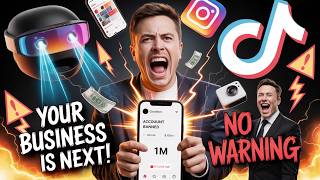
TJ Walker examines Apple's incoming AI glasses and their privacy risks, then argues why creators can't rely on one platform. He cites deleted accounts as cautionary tales and outlines a strategy: master one channel, then diversify through email and owned assets.
Chapters
Ultimize. Apple is reportedly working on AI glasses, and I have to say, I've never been more excited and more creeped out at the exact same time. According to reports, these glasses will have cameras, microphones, speakers, and AI that understands what you're looking at, which means for the first time in human history, your glasses will be smarter than most people you know. And let's be honest, that bar is maybe not that high. Still, on the surface, this sounds amazing. You're walking through the woods, and instead of thinking, "That's a nice tree," your glasses say, "That's a 47-year-old southern live oak suffering from mild fungal stress. And by the way, you're out of shape." That's helpful. A little insulting, but helpful. You're looking at the night sky, and suddenly you've got a better astronomy lesson than if you'd gone to the Hayden Planetarium. You're traveling in Italy, and instead of nodding politely while pretending to understand the menu, your glasses are like, "Relax, you just ordered cow stomach. Cancel immediately." This is the upside. This is the dream. Every moment becomes a TED Talk. Every walk becomes a masterclass. Every awkward conversation becomes, well, slightly less awkward because now you've got AI whispering in your ear like a nervous best man at a wedding. But let's talk about the downside. Because the downside is we are about 2 software upgrades away from turning Earth into one giant reality show. You're at dinner with friends telling a story, and suddenly you're thinking, wait, is this being recorded? Is this being analyzed? Is this being uploaded to some teenager's TikTok account titled "Middle-aged guy thinks he's funny but is really lame"? And the answer is probably yes. We're moving into a world where every human interaction comes with a little voice in your head saying, This could go viral, and not in a good way. Not, "I discovered penicillin." More like, "I mispronounced quinoa and now 12 million people hate me." That's not progress. That's social anxiety with Wi-Fi. And think about teenagers. Teenagers already have enough pressure. Now we're giving them a device that says, "By the way, every word you say might be recorded, analyzed, judged, and mocked by strangers." forever. Great, because what teenagers really need was less willingness to talk to each other? I don't think so. We've already got a generation that would rather text someone sitting next to them than actually talk to them. Now we're giving them glasses that can fact-check their feelings in real time. Hey, I think I like you. Glasses: statistically unlikely. Romance is dead, killed by firmware. And then there's the privacy issue because these things are basically cameras on your face, which means every time you talk to someone, you're thinking, "Am I in a conversation or am I in content?" That's a different world. That's a colder world. That's a world where you don't fully relax around other people. And when human beings stop relaxing around each other, relationships suffer, trust suffers, The real connection suffers. Now, to be fair, Apple is probably the least creepy company when it comes to privacy that could do something like this. But that's like saying, don't worry, this lion is the least hungry lion in the jungle. But Apple does have a track record. They don't usually invent categories, but they do perfect them. They didn't invent the MP3 player. They didn't invent the smartphone. They took existing ideas and made them so good, you couldn't not use them, which is exactly what makes this more dangerous because if Apple nails this, everyone's going to wear them, not just the nerds, everyone. And that's where we hit the real issue. At what point do we stop using machines and start becoming extensions of them? At first, the machine helps you, then it guides you, then it anticipates you, then it replaces you. It's like GPS. At first, it helped you get somewhere faster. Now, half the country couldn't find their own house without it. We've outsourced navigation. Next, we outsource memory, then judgment, then curiosity, then why not conversation? Hey, how are you? Hold on, let me check with my glasses. And now you're not even talking to a person, you're talking to a committee of algorithms. Wearing a human face. That's the line we're crossing. And I don't know exactly where the line is, but I know we're getting closer. And here's the final fear. What if this works too well? What if it's so immersive, so entertaining, so informative that people just stop engaging with real life? Because let's be honest, reality already has tough competition. You've got streaming, gaming, social media, infinite content. Now you're adding augmented reality with AI narration. At some point, a large percentage of humanity might just say, you know what, I'm good right here on the couch. This is on— not because they're lazy, because the artificial experience is better, at least seemingly more stimulating, more rewarding, more addictive. And that's where you don't just lose jobs, you you lose drive, you lose ambition, you lose the messy, frustrating, unpredictable experience of being human, which by the way is where all growth actually happens. So here's the bottom line. These glasses could make us smarter, could make us more curious, more informed, more capable. They could also make us more passive, more anxious, more dependent, more disconnected. Same technology, two completely different futures. The question isn't whether Apple will build something amazing, they will if they do release it. The question is, will we still be amazing after we start using it? So here's my other fear of something like this. I could just imagine, you know, back in my days when I lived in New York City, I can imagine a giant black-tie social event, networking event for singles. And I'm gonna be fair to both sexes here, but I can certainly imagine women wearing the glasses and their AI telling them instantly the salary and net worth of every man in the building or in the room. Guess who's gonna get all the attention? Guess who's gonna get shunted aside? And I'm not picking on women. I could easily imagine men having something that gives them AI about, you know, someone's finances, their educational background, projection on their IQ, their class level. And we can have these tools that seemingly enlighten us but really exclude, exclude, exclude. And now we've got nothing but 1,000 angry people fighting over the same 3 people. That could be a real dystopia. You know what's funny? People spend years trying to figure things out when most of the time they already know what to do. Speak more clearly, be more confident, build better daily habits. The issue isn't knowledge, it's follow-through. So if you're listening to this and thinking, yeah, I should probably work on that, don't overcomplicate it. Just go to ultimize.com and get the free course. There's one on communication. There's one on habits. Pick whichever one hits you first and just start there. Simple, free, and actually useful. Elon Musk may have just done something. Oh, we got the wrong graphics up. Sorry about that. Okay. AI can do a lot of things. It can't do everything. It can't force me to put the right graphics up at the right time. Sorry about that. Okay, Elon Musk. He may have just done something shocking. He might be posting on TikTok. Yes, Elon Musk, the man who bought Twitter, renamed it X, and spends half his waking life posting on it, may now be hedging his bets like a nervous day trader. A verified TikTok account using his handle posted a slick video— SpaceX, Tesla, Neuralink, the whole Elon cinematic universe— sent to @ad astra, which is Latin for please buy our IPO. Now, we don't even know if it's actually him, which is perfect, I guess, because we're now living in a world where the most powerful man in the media might not even be sure which accounts are his. But here's the part that actually matters, and it's not about Elon. It's about what this says about media right now, because this is the most important lesson in modern communication. Even if you own a platform, you still don't own attention, or at least not everybody's attention. Think about that. Musk owns X, hundreds of millions of followers. He can post anything he wants anytime he wants with zero filter, and he can tell his staff, put your thumb on it and make it go further. And yet now he's possibly on TikTok, possibly on Instagram. Why? Because even owning the stadium doesn't guarantee everyone shows up to your game. The world media is now so fragmented, so splintered, so atomized. There is no everyone anymore. There's no national conversation. There's no, I'll just go to one platform and reach the world. The world is gone, or at least it's splintered. Now you have 1,000 mini worlds, a TikTok world, an Instagram world, a YouTube world, a podcast world, an X world, and they barely overlap sometimes. It's like high school, but instead of cliques, it's algorithms. And everybody thinks their lunch table is the whole universe. So what's Musk doing? He's doing what every smart communicator eventually realizes, you have to be everywhere. You have to be platform agnostic, even if you own one of the platforms. You cannot fall in love even with your own platform. You have to fall in love with distribution because ideas don't win anymore just by existing. They win by showing up repeatedly everywhere. And this is where I'll tell you something that may sound slightly self-serving, but also happens to be true. That's exactly what I try to do with Ultimize. Same ideas, same core messages distributed across every possible platform. Now it's true, I don't have a reach as large as Elon Musk, but it is why I do video, audio, short form, long form everywhere, because I don't assume anyone will find me. I assume the opposite. I assume most people will never see my best ideas unless I chase them down across platforms like a polite but persistent salesperson. Now, here's the counterpoint because there's always a counterpoint. Yes, you can spread yourself too thin. If you try to do everything at once, you end up being mediocre or nonexistent everywhere. You don't master anything. You don't build momentum. You don't learn the nuance of a particular platform. So there's a real argument for dominating one platform first. Get good at it. Okay, build an audience, understand the rhythm, the tone, the psychology. But, and this is the part most people miss, you cannot stay there forever because unless you're Elon Musk, you don't control the platform. And if you don't control the platform, You're renting your audience. At any moment, the landlord can change the rules, change the locks, evict you, or just decide that your content, eh, no longer interesting according to an algorithm that was designed by someone who thinks memes about cats are more important than your life's work. You can get banned, shadowbanned, deranked, or just quietly ignored. And there's no appeal. OK, there is an appeal, but no one will ever listen to you. There's no customer service line where you could say, excuse me, I I had my career yesterday. So the real strategy is this: master one platform, then expand, then diversify, then repeat. Because in this environment, resilience beats brilliance. The people who win are not necessarily the smartest. They are the most distributed. And here's the irony. Even Elon Musk, the guy who owns the platform, is acting like he doesn't trust the platform. That should tell you everything you need to know. When the landlord starts shopping for other apartments, you should probably pack a bag. Now, there's one more layer to this that's a little bit funny. Musk has spent years criticizing platforms like TikTok and Instagram, saying they're addictive, saying they make people unhappy, saying they're basically digital mind control machines, all of which is true. And now he might be posting on them, which just proves my favorite rule of communication. Everyone hates the media, until they need the media. It's like people who say, I hate networking, until they need a job. Then suddenly they love networking. Hi, how are you? Remember me? We once met in 2007. Same thing here. You can hate the platform. You can distrust the platform. You can warn everyone about the platform. But if that's where the audience is, you go because attention is the currency and you don't get to dictate where it lives. You have to go where it already is. So the takeaway is simple. Don't build your strategy around loyalty to a platform, build it around loyalty to your message and your message, your willingness to deliver that message everywhere, relentlessly, consistently. Because in today's world, if you're not everywhere, you're nowhere. And if even Elon Musk understands that, you probably should too. I'm gonna have a part 2 on this topic in just a moment, a very sad case of a woman who Lost her entire business overnight because Instagram, like that, said bye-bye. I'll be honest with you, most people don't have a learning problem, they have a consistency problem. They'll watch something, listen to something, get fired up for a day, and then life takes over and everything resets. That's exactly the gap I'm trying to fix with Ultimize. So if you're getting something out of this show right now, go to ultimize, ultimize.com, U-L-T-A-M-I-Z-E, and get a free course. There's one on communication skills, one on building better habits, and the whole idea is to make this part of your daily routine, not a one-time thing. It's simple, it's free, and it actually works if you use it. ultimize.com. A woman built a 6-figure business on Instagram. 7 years of work, 30,000 followers, a podcast with millions of downloads, a real community. People depending on her for support. And then one Friday afternoon, it was gone. Not temporarily down, not reviewing your account, gone, deleted, locked out. No appeal, no explanation, no human being to talk to. Just an email that basically said, thank you for building your business on our platform. Now please disappear. This story is not an anomaly. It is the business model. If you're building your livelihood on one platform, And I don't mean to pick on Instagram. It could be any of them. I need to say something to you that might sting a little. You don't have a business. You have a lucky streak at a slot machine, and the casino can pull the plug anytime it wants. They can kick you out anytime they want. Because let's be very clear about something. Big tech companies are not your partners. They are not your friends. They are not your community. They are not your safety net. They are a casino with better branding, and the house always wins. Why are guys like Mark Zuckerberg and the leadership at Google so insanely rich? It's not just ads. It's not just scale. It's not just innovation. It's because they don't have to deal with you or me. No customer service. Those people cost a lot of money. There's no customer service. There's no real escalation. No human being saying, hey, this person just lost their entire livelihood. Maybe we should check the facts of the situation. Maybe we should fix that. No, zero, zilch, nada. You can lose your business and the only thing that still works perfectly is your monthly billing. Hey, sorry we deleted your account, but just to confirm, you're still paying us $15.99 a month, right? That's for some platforms. Obviously, Facebook doesn't charge, Instagram doesn't charge. Unless it's for advertising, that's not a glitch. That's the system working exactly as designed. And I say this as someone who makes nearly 100% of my income from technology platforms. I'm not anti-tech. I love the stuff. I use it every day, but I never forget what it is. It's transactional. You're not the customer. You're the product. I'm the product. Your audience is the product. Your attention is the product. And the moment something goes wrong, Hey, you're completely on your own. I'll give you my own story. 10 years ago, my YouTube account gone overnight. No warning, no explanation, just, uh, bye-bye. No, here's how to fix it. Just gone. Years of content, millions of views disappeared. And I did what everyone does. I begged, I emailed, I tried to pull strings. I promised to spend a fortune on advertising. I tried to find a human being, nothing. It was like trying to get a refund from a vending machine. Hello, I just lost my entire business. Silence. And here's the part that really hurts. That one's on me. Now, fortunately, I didn't put all my eggs in one basket. It wasn't all in one platform, one pipeline, one point of failure. So, when it failed, it didn't destroy me. But there is a lesson here, and it's not don't use platforms. Use them, exploit them, maximize them, but never depend on them exclusively. Because the moment you depend on any one of them, you're vulnerable. You have to think like a paranoid entrepreneur. You wake up every morning and say, "Is my account still there?" That's not anxiety. That's awareness. That's reality. That is how I feel. On certain platforms. Because if your business cannot be, or if it can be deleted by an algorithm, it's not really a business. It's a lease or a hope, and the landlord doesn't know your name. So what should you do? You diversify. You spread your content. You spread your audience. You build redundancy. You build backup. You build resilience. You build emails. You don't say, I have 100,000 followers on Instagram. Ideally, you say, I have 10,000 followers on 10 different platforms because one of them will disappear, guaranteed. It's not if, it's when, even if you did nothing wrong. And here's the final mindset shift. Stop thinking of platforms as homes. They're not homes. They're not even rented apartments. They're highways. You use them to move people to places you control. Your email list, your websites, your communities, your products, assets that cannot be turned off by someone in a hoodie in Silicon Valley who just decided your content wasn't aligned with community standards, whatever that means this week. So yes, use the platforms, make money from them, grow from them, but never trust them. Because the second you trust them, you're one email away from unemployment or bankruptcy. And if that sounds harsh, good, because the truth is harsh. But it's also liberating because once you understand the game, you stop playing like a customer and you start playing like the house. So please be careful. My heart went out to this woman who had essentially a business helping other women in need. Sounded like a great business and just gone overnight. Which is why right now what I'm doing is I'm streaming live on YouTube. I'm streaming live on a couple of Facebook pages. I'm streaming live on LinkedIn. I'm streaming live on Twitch, on X, sometimes Instagram. This video will be put on every one of those platforms as a standalone. Then each story is edited into an 8-minute or so story placed on all those platforms. Then each story is sliced and diced into 2 or 3 shorts each, and those are put out. So I'm on roughly 10 platforms, 30 different pieces of content on all of them. So it's kind of 300 at-bats. I hope YouTube doesn't ban me tomorrow. I hope Facebook doesn't ban me tomorrow, but if they do, my attitude is going to be, see you later, I don't need you. I hope that's your attitude as well for any social media platform or tech company that
More from TJ





The Breakout Cases - What Actually Caused Famous Speaking Career Breakthroughs | Ultamize

The Red Circle Sessions Finale - Build the Speaking Career You Came Here For | Ultamize

Two Stages, One Logo, Two Completely Different Realities - Main Stage vs Independent Events | Ult...

Pre-Reset - Why Repetition Builds Better Speaking Decisions | The Red Circle Sessions | Ultamize

Your Decision, Your Framework, and What Happens After - Build Your Speaking Career First | Ultamize

The Red Circle Sessions Trailer - The Speaking Career Truth Nobody on That Stage Will Tell You | ...

The Two-Minute Ultamize Reset - Your Platform, Your Audience, Your Voice | The Red Circle Sessions