Cars Are Suddenly BRICKING! What's Going On?
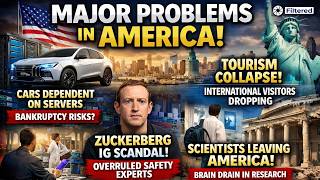
In this solo‑hosted episode of Filtered, TJ Walker weaves together five major news threads and frames them through a personal‑development lens. He begins by warning that modern, software‑defined cars can become "bricked" when the companies that run their cloud back‑ends fail, citing Fisker’s bankruptcy and the collapse of Better Place’s battery‑swap model. Walker argues that vehicle ownership now depends on corporate longevity and calls for consumer caution and possible regulatory safeguards. He then shifts to a sharp decline in U.S. international tourism, attributing the 6‑10% drop to restrictive visa fees, invasive social‑media checks, and a broader anti‑immigrant stance, warning of billions in lost revenue and the erosion of America’s soft‑power. The episode moves to Meta, where Mark Zuckerberg testified that he overrode 18 expert warnings about Instagram beauty filters that could harm teen mental health, highlighting the tension between free‑expression rhetoric and profit‑driven design, and comparing the case to historic tobacco litigation. Walker next examines a "brain drain" in American science, reporting massive NIH and NSF funding cuts, grant cancellations, and post‑doc layoffs that are driving top researchers abroad, threatening biomedical breakthroughs and economic competitiveness. Finally, he outlines a historic wave of congressional retirements—61 lawmakers stepping down—explaining how burnout, polarization, and a corrupt‑perceived system are emptying institutional knowledge. Throughout, Walker intersperses personal anecdotes, calls for skeptical consumer behavior, and promotional plugs for his coaching services. The episode concludes with a listener question on active listening techniques, which he answers with practical note‑taking advice. The overall narrative links technological, economic, and political instability to personal agency and the need for better decision‑making skills.
Chapters
Ultimize what happens when your car still has wheels and a motor but the server behind it dies. America is now the only major destination losing international tourists and the numbers are getting worse. Mark Zuckerberg tells a jury he ignored 18 experts warning Instagram filters harm teenagers. US science is facing a brain drain as funding cuts push young researchers abroad. And Congress is seeing a huge wave of retirements with one one lawmaker saying he dreads actually winning re election. All that and more today on Filtered. Welcome to Filtered with TJ Walker. Hi and welcome. Thanks for joining me. When Car Companies when car Software Companies Go Bust According to ours Technica, modern cars aren't just machines anymore. They're rolling software platforms that often depend on remote servers for key functions, updates, diagnostics and sometimes even access. That creates a new kind of breakdown. Not mechanical failure, but digital abandonment. The article points to Fisker's collapse as a real world war warning in the uk, hundreds of oceans were delivered before the company went bankrupt. That's a particular type of car they manufactured. At least one owner ended up with a vehicle that wouldn't start and no functioning support pipeline. The piece also highlights Better Place, an EV infrastructure company whose server dependent battery swap model collapsed in 2013 after burning through $850 million. And when the back end system shut down, many cars were effectively bricked. The bigger point is chilling. In the software defined era, your car's lifespan may depend as much on corporate survival as engineering. If the servers go dark, the driveway, not the repair shop, can become the end of the road. So this is troubling. Now it's been obvious to a lot of people that cars are really no longer cars. They're essentially computers on wheels. And if you buy a computer for a long time now and the operating system is Microsoft, you kind of didn't have to worry. Yeah, viruses could attack. If your operating system was Apple, you didn't really have to worry. Things could be repaired. Because while it was a little dicey for Apple back in the day, nobody recently is worried about Microsoft or Apple going out of business, or for that matter, Google. But new car companies sort of pop up all the time. And this story illustrates how risky it is to essentially buy a new car company. Not because the car is poorly manufactured. It could be a beautiful piece of engineering. But a car is no longer a car. It's simply a vessel for new software updates coming in constantly. If the company goes out of business, you're kind of out of luck. Let's look at some more facts. Again, Fisker filed for bankruptcy. In 2024 they delivered 419 of their oceans model in UK. The ocean weighed 5,500 pounds. A pretty pretty hefty heavy car. Fluence Ze sold Israel into Denmark. There was a 6 year 62,000 mile Fisker warranty, a 10 year 100,000 mile battery warranty. But if the car company goes out of business, you're kind of out of luck. Here's According to Stuart Mason told this publication Ars Technica, he's the founder of the Car Expert When a modern car software misbehaves, you don't fix it yourself. You call the manufacturer. So you know, I still think of the days when I was a kid, 60s and 70s and so many people in my neighborhood, the dad typically like to fiddle with cars, rebuild cars, take cars apart. You can't really do that anymore. Everything is so wildly sophisticated. So much technology, you need so much software just to do an update on a car. The ideas of simply tinkering, they don't work. Stuart Mason also says if they don't, the consequences might not be that Android Auto simply stops working, but instead an airbag deploying at 70 miles an hour. I hadn't even thought about that. But what happens when the software company goes out of business? You're driving along, there's no updates and wow, you're driving at 70 and a software and an airbag goes off. That obviously could cause death and destruction. So some bigger picture things that we all have to think about. Cars are shifting from mechanical things to software defined platforms. I think what that means is as a consumer, you've got to really look at the reliability and the stability of the company. I hate to say this because I don't like to just favor and give all my business to old entrenched companies, but when I hear a story like this, it really makes me think I better stick with a proven, proven reliable brand that I'm not afraid is going to go bankrupt anytime soon. Now, my family tends to be partial to Mercedes Benz. We have a couple of them and they've been around for more than 100 years. I might be tempted to go to a newer brand or whatever the most sophisticated technology EV is on our next car purchase. But seeing this makes me realize I've got to make sure whoever it is, they have a long, long track record, they have deep pockets, they are profitable so that they don't go out of business. So what sort of protections do consumers deserve? So it's easy for a government to say, okay, if you sell somebody a car, you have to maintain service for 10 years or something like that. But if the company goes bankrupt, what are you going to do? You can't really force a company to come back to life if it's gone out of business. Now, the industry is trying to have some self regulation, but that's not going to help with public safety. If we have cars on the road where they're no longer getting tech updates, it would appear that there's got to be something where you can turn it. And I'm saying this not as a technologist, as you'll quickly be able to deduce, but it seems there's going to have to be some master switch that says, okay, this car will continue operating as it is and things will not automatically shut off because you're driving down the Highway 70, 75 miles an hour. Whether it's the airbag turning on or your brakes turning off, obviously people can get killed that way. There has to be some safety device, some either kill switch to make the car completely unusable because you don't want it to become unusable while you are in the middle of driving it. Let's look at some more facts here. Now, planned obsolescence is now coded into vehicles, apparently, which if you continue to pay and get updates, I mean, that's part of the profit model for a company like Tesla, is they want you to pay every month for more software. Similar risks are seen in smart home devices. Okay, but if your blender all of a sudden stops working, nobody's going to get killed. Maybe your cake isn't quite as tasty, maybe your daiquiri isn't quite as smooth, but the consequences are much, much lower. Smartphones start to lose updates after five to seven years. Well, people are kind of used to and conditioned to. Okay, I can't remember last time I had a smartphone for seven years. For me, it's more two, two and a half years. It's just time to upgrade. But there's a huge difference between spending an extra $900 on a phone every two and a half years versus an extra hundred thousand dollars for a car. I don't think anyone, no matter how wealthy you are, is really expecting to have to buy a new car every two and a half years just because of software updates. Now, according to this article I was referencing, the McLaren F1 cars require 1990s laptops to operate at some point. What happens if you don't have a 1990s laptop? McLaren is highly respected sports car, very expensive car, but there are all these gaps when it comes to technology. And of course, the big fear is server shutdowns can equal mechanical immobilization. I wish I could tell you the government has some solution. I don't know what that is, unfortunately. We as consumers, I think, are going to have to be very, very skeptical of putting our trust in a new company. And that doesn't make me feel good. We live in a world where so many incumbent companies, the big companies, the Facebook, the metas of the world, can simply stop. We'll be talking about meta later on in the show. Can simply stomp out competition, buy them up. It's been said there's never been a better time to be an entrepreneur and a startup founder. That's true in the sense that you can start businesses with very little money and without having to raise a lot of venture capital. That part's true. As far as taking a brand new idea and turning it into a billion dollar company. No, this is not necessarily the golden age. Because huge incumbents, whether it's Google, whether it's, Whether it's Meta, whether it's Amazon, can either gobble you up or stomp on you and grind you to bits to the point where you can't compete. So it doesn't make me feel good to say you better not go with that new car startup. But given the risk factor of these cars controlling our lives in a box going 70, 80, 90 miles an hour down the highway and the software just failing, it does seem at first blush to be way, way too risky to simply put your faith in the hands of a brand new company. So I'm gonna. First of all, I hope not to buy a new car anytime soon, but if I do, it's not gonna be with a brand new startup, even if it's raised $850 million. Because that money can go like.
Like what you heard. Don't let the algorithm bury us. Subscribe now@substack.com J WalkerSuccess want direct access to me live? Want to unlock bonus episodes, behind the scenes takes and full access to my premium courses? Then become a member today. Just go to tjwalker.commembers and choose your preferred platform. YouTube, Patreon, whatever.
Whatever works for you.
This isn't just another subscription. It's a full access pass to the tools, coaching and content that can transform your communication and career. Tjwalker.com members, I'll see you inside.
According to the Times, the New York States was the only major global destination to see a decline in international travelers last year. With foreign visitors down 6% and the slump Continued into January with inbound visitors down another 4.8% from January 2025. The sharpest drop is Canada. Not surprising. Canadian visitors plunged 28% in January compared with January 2024. Other key markets like Germany and France also declined, while Britain showed only marginal growth. The story ties the downturn to tougher entry policies, including a $250 visa integrity fee, more aggressive device searches, and the potential requirement for some travelers to provide up to five years of social media history. The World Travel and Tourism Council warns that could mean up to $15.7 billion in lost visitor spending. With the World cup coming, tourism leaders hope for a rebound. But right now, uncertainty is acting like a tax on travel. Okay, what are we to make of this now? There's been a lot of talk in America presidential campaign in 2024 last year about how we need to preserve and protect manufacturing. I want to step back a minute and let's define manufacturing a little differently than as typical. Manufacturing typically means you have a factory, you build some tangible product and it can be shipped. I would maintain that's an outdated reference point. A part of what United States is great at is manufacturing experiences. People from all over the globe traditionally have loved coming to the United States to essentially manufacture the experience of a great vacation, of learning about a different culture. And that is being destroyed by current specific policies emanating from our nation's leaders. Let's look at some facts again. Tourism down 6% last year when it's going up around the world because as the world has a higher and higher percentage of middle class people, middle income people, they love to travel. It's not something where only the top 1% can do it the way it was in 1890. So travel is going up, tourism is up all over the world except for the United States and Canada really sent a message loud and clear. Apparently Canadians don't like to be mocked, ridiculed, told their freeloaders, which has happened. Canada doesn't like to be told, oh, you should be one of our states. You're not a real country. Apparently that's insulting. Who knew? And so they're voting with their pocketbooks and their visas and their cars because they're not driving across the border into the US so we have a decrease of 11 million visitors this past year. Also apparently visitors around the country, around the world don't like to be played for suckers. This idea that they have to pay a penalty, an extra $250 for a visa, an integrity fee. You know, I spend a fair amount of Time outside the country. And I do talk to people from other country who are on vacation, touring, whether it's in Asia, in Europe, and they resent this. They're like America, hey, we've been there before, we've had good times. But we're not going to subject ourselves to this nonsense. We'll wait it out until there's. Regime change is essentially their message. So the big sticking point is being charged $250 a visa fee. That's just something most countries do not do. Then there's the issue of having to go their social media feeds for the last five years. I mean that's just wildly, wildly offensive to people all across the political spectrum, among tourists worldwide, it's just offensive. Especially when they're so used to America lecturing everyone out, be like us. We're the place for freedom of speech. We're the, we're the only country that really believes in freedom, except not for you. You don't have a freedom to express your opinions on social media. So the hypocrisy is a bit thick. It's just a bit too rich for a lot of tourists around the world. And unfortunately, so many economies, so many communities in America depend on tourism. And it's not just New York City and Orlando, it's places like the little towns next to Mount Rushmore. It's so many of our great national parks which are also suffering decay because of budget cutbacks. So it's kind of a shame. 12.2 million total Florida visitors reported, but that's down 1.2%. Now this is an industry that's used to seeing double digit growth. I'm here in Florida and the whole tourism seems to be growing by leaps and bounds every day for the last three decades where I've lived here on and off, not in the last year. July Europe bookings down 14%. The French have reduced coming to the United States by 40%. So. Well, who knew? Who wants the French? They're rude and smelly. That's a bad stereotype. It's not true. I would love to see more French people coming to the United States. They bring culture, sophistication and some cross pollination of insight. They're not coming here, so America's becoming more insular. And I have to tell you, sorry if this sounds crass, it's not hurting me. My business isn't dependent on tourism. It is harming a lot of taxpaying Americans, many of them from so called red states, conservative areas, rural areas that have a national park, that have waterfalls and Kayaking that people like to go to. It is affecting people right here, where I live in Florida. And these are people who voted for the current regime and its policies of thumbing its nose at the rest of the world. So perhaps these people are going to start voting their pocketbook. Let me share with you a few more perspectives from Eric Hansen with the U.S. travel Association. He said when 11 million international visitors aren't showing up, the result is billions of dollars in economic loss to the travel industry. So if you voted for a current regime with the idea it's going to make the economy better, and all of a sudden you own a hotel or you own any kind of tourism related business and you're going bankrupt, maybe you want to think twice about who you vote for next time. I'm sorry if that sounds crass, but if you're voting for someone who's saying, we don't like the rest of the world, we think the rest of the world is just filled with stooges, saps, Marx. People are trying to take advantage of us, so we're going to take advantage of them. Don't be surprised when they don't want to come here and give you their money and give you their dollars, their currency converted into dollars. Felicity Morgan's a British traveler. She told the New York Times the following. These are the kinds of measures you expect from China or countries in the Middle east, not from America. She's talking about the fingerprinting of people coming, the paying of extra fees, but specifically asking to see the social media post for the last five years. Oh, you criticized one of our politicians. Shame on you. You've already spent a fortune flying to New York City or Orlando or Las Vegas. You know what? You criticized our dear leader. Go back to your own country and you just lost thousands and thousands of dollars. Apparently that's not an appealing proposition to a lot of people. Kind of easy to see why. Okay, so where, where does this take us? At some point, Americans who own businesses related to tourism are going to have to start voting their pocketbook. You know, we live in a culture where we talk about how awful it is. People are always voting their grievances. It's not necessarily bad if you vote for a grievance that's harming you and your family. And there's actually proof and evidence. If you live in rural Idaho and you've never seen anyone who doesn't look just like you, a lily white who's lived there for 100 years, and you're voting for a politician because you're so worried about illegal immigrants coming in. Maybe you're worried about the wrong thing. If you live in rural Idaho and your business is entirely dependent on tourism and your tourism is down 50% because Canadians who used to like to come to your area aren't coming anymore because they think you hate them or your country's leaders hate them, maybe that's a real issue. Maybe you should actually vote on that issue now. Florida tourism typically acts as a bellwether for the rest of the country. The fact that it's down so much is not a good sign. Germany has updated its US Travel advisory, essentially saying to its own citizens in a polite way, you really need to think twice about going to America. Not a nice place, not a respectful place to people from our country and other countries. Again, if there were a worldwide recession going on, you could say, okay, everyone's taking a hit, we're taking a hit. That's not what's happening. Tourism globally is booming. Europe, never been better. Asia, never been better. They're getting our dollars. So this is essentially offshoring a huge sector of our American economy. It's not widgets, it's not pens, it's not coal. But it is something America is renowned for, is creating experiences, manufacturing experiences in the form of travel and vacation. And it's all being thrown away right now. If you don't like it, there is a solution. You're going to have to think a little more seriously the next time you go into a voting booth.
We'll be right back after this break.
Want to advertise here?
You better be legit. No crypto, no junk food, no supplements. Go to tjwalker.com advertise
Most people can't afford a full time coach.
And even if you could, good luck finding one who's available when you need them. That's why I created the TJ Walker AI clone.
It's built on my 40 plus years
of real world coaching and training. You get my exact advice, style and frameworks instantly. Ask it how to handle a tough question. Get feedback on your elevator pitch. Rehearse your next big talk. This is the next generation of communication coaching. It's smarter than an app, more personal
than a course, and always ready.
Start using it today at tjwalker AI. You'll wonder how you ever did without it.
Okay, Mark Zuckerberg and Meta in the news again. Zuckerberg overruled not one, not two, but 18 experts on Instagram filters, according to the Australian Financial Review. Mark Zuckerberg told a Los Angeles jury he overruled staff and 18 experts who warned Instagram beauty filters could harm teen well being. Meta had temporarily suspended the filters in 2019 to review them. And all 18 experts reportedly concluded they posed a well being risk. Zuckerberg testified that he reinstated them because he worried about free expression, calming restrictions, paternalistic and saying he wanted to err on the side of expression and less harm was clearly proven. The trial sits inside a larger wave of lawsuits arguing social media platforms deliberately design addictive products that harm young people. Internal documents cited in court suggest Meta new beauty filters could encourage body dysmorphia and related teen health concerns. And internal communications describe Instagram in addiction like language. If the plaintiffs succeed, it could help set a precedent not about what users post, but about whether the platform's design choices themselves create liability. Okay, not surprising here. Once again we see that Mark Zuckerberg was given a choice. Do what's right. That could save lives, make more money. If you're Mark Zuckerberg, you're probably thinking, what's the catch? Let's make more money. So everything you can do to addict people more means more eyeballs on Facebook, means more advertising revenue you can generate from sponsors, from advertisers. And so that has been the push again and again and again. So let's again take a look at some of the facts. Again, it wasn't one or two experts, it was 18 experts who all warned this was harmful. Instagram temporarily suspended these filters in 2019. The case was filed by a 20 year old plaintiff. That's why there's this lawsuit going on. There are 4 million children under 13 estimated to be using these Meta platforms. And so people are getting on it. Snap and TikTok settled pre trial and there are a lot of other lawsuits going on here. You have to assume Mark Zuckerberg's thinking, okay, I should have done that. If my concern were to keep kids from killing themselves and feeling depressed, cutting themselves and ruining their lives, I could have. But my obligation is first and foremost to stockholders. And anything I can do to generate revenue, I'm going to do. That's his philosophy and his theory, I'm sure is okay. If I got to pay one or two or three billion dollars here in settlements, that's the cost of doing business. If I want to make an extra hundred billion dollars over here, we're talking about big, big money. So I don't think really anything is going to change unless the magnitude of the fines, the punitive damages is increased, you know, a thousandfold. Something that would be truly a hit to the company's bottom line. Now, many people are comparing this to the 1990s and the litigation against tobacco companies. And if you're under a certain age, this may seem bizarre, but there was certainly a time when all the heads of tobacco companies said, well, no, there's no evidence that tobacco is addictive. That's just a rumor. That's fake news. They didn't use the term fake news back in the 1990s, but that was essentially it. Zuckerberg, like all the big tech barons, they hide under Section 230 of U.S. code, which shields platforms from liability. They are categorized as just a platform, the way the old AT&T phone company was a platform. And if you called up and said something nasty to your best friend on the phone, some third party or some politician couldn't sue AT&T for something nasty being said because AT&T was just the platform. Plus there's the niggling little detail that only two people heard it. When you say something really nasty or you project an image that, for example, every young woman has to have perfect skin and have proportions of Barbie, it's not heard by two people. It's permeated throughout our culture and millions, tens of millions, sometimes hundreds of millions of people see it. So that's really the difference. That's why it's not particularly a controversial opinion these days to think that, okay, big platforms really are media companies, they call them social media companies and they should be held to the same standards. When media companies do things that are libelous, damaging, destructive, they're held accountable. Facebook and others get off scot free. Now they, they claim to make it so you're not supposed to join by a certain age, but they don't really enforce it. It's pretty easy for young kids to get into social media these days. Lie about your age, have an older brother, sister, click a button. So the concept of age gating, in theory, it happens sometimes, but not really. And it's causing real problems. So again, in a nutshell, this may sound odd to some people, but. But when young people, pre teens, young teens, especially young girls, see image after image after image, where every other girl they see, apparently their own age, has eyes twice as big as normal, perfect facial features, tiny waist, everything else proportionate like a Barbie doll or society's image of perfection, that takes a toll on young psyches and apparently it leads to a lot of depression, self harm and even worse. And that's why not one, not two, but 18 experts told Mark Zuckerberg, don't do this, don't put the filters back on. And yet he did it anyway. At some point this is going to have to be regulated and I don't mean just a law that can easily be ignored and then a small fine being paid. It's going to have to be enforced in real time. Otherwise we're going to see this problem grow and grow and grow. I'm TJ Walker. You're watching and listening to Filters. This is the show where we look at top business, technology, economic and culture news of the day and filter it through the lens of personal development skills. All with the goal of making you healthier, happier and more successful in your personal life as well as your professional life.
Like what you heard? Don't let the algorithm bury us. Subscribe now at substack.com@tj walkersuccess want direct access to me live? Want to unlock bonus episodes, behind the scenes takes and full access to my premium courses? Then become a member today. Just go to tjwalker.com members and choose your preferred platform, YouTube, Patreon.
Whatever works for you.
This isn't just another subscription, it's a full access pass to the tools, coaching and content that can transform your communication and career. Tjwalker.com members I'll see you inside. Before we dive in, quick question. Are your communication skills helping or hurting your career? Fix that in 20 minutes a day. Visit mediatrainingworldwide.com Real skills, real results
A Brain Drain Killing American Science According to the Guardian, sweeping cuts to US Science funding are triggering a brain drain, with young researchers leaving the country or abandoning career paths in biomedical research. The article cites nearly 8,000 grants canceled across NIH and the National Science foundation, more than 1,000 NIH employees fired, and over 10,000 postdoctoral experts lost from the federal workforce last year. The piece uses antibiotic resistance as a vivid example of what's at stake. The CDC warns of more than 3 million U.S. infections annually from drug resistant bacteria, killing up to 48,000Americans and nearly 5 million deaths globally. Linked to resistance the story also describes hiring freezes, lab disruptions and at least 50 NIH training programs being shut down while European universities openly recruit American researchers for what some call scientific asylum. The long term fear is economic as much as medical biomedical research is a pipeline business, and if you choke off early career talent now, the missing discoveries show up a decade later. Okay, this is a troubling story, and it's a part of a trend. It's related to our story earlier on. The United States alone among the world of major travel destinations becoming unpopular and people not wanting to come here. Now we're essentially telling the smart people of the world don't come to the United States. Now the United States is, has had a good run, let's not kid ourselves. It is still a huge economy, it's still a thriving place. A lot of people still want to come here. But it's about who wants to come here. There's been so much political angst in our country about essentially poor people trying to move to the United States through illegal immigration. What's talked about less is what is so often made America great isn't just people coming here survive or trying to escape political persecution, economic atrocities. But what's also made America great is quite often the greatest minds in the world. People who genuinely want to create new scientific discoveries have flocked to America for two reasons. Number one, our universities here were able to educate them, especially at the PhD level, better than the education they could receive in South America or Europe or Asia they came here. And number two, they could have careers here. And certainly if they got a PhD and they've already worked and they're establishing excellent work credentials and working for major companies or starting their own, they were granted citizenship and H1B visas pretty easily. And in general they created so much of a positive impact for our economy. It worked out well for everyone. There is a reason why the United States is the richest country in the world, at least by some measures. It's because we have made it relatively easy in the past for the smartest hard working scientific brains to come here. We'll know more now. We're saying to those people, we don't really want you. Instead we're saying, if you have $5 million and you're willing to bribe us, well sure, then we open up our doors. Then we give you the red carpet. Then we give you the gold ticket if you already have the gold. But the most brilliant scientific minds in the world are not rich when they're 22 years old. They're just not. By and large you have to take a risk on them, a gamble on them. But if someone is brilliant and just been accepted to a PhD program at Caltech or MIT, you know what? It's not very risky letting them into your country. Chances are pretty good they are going to become an economic powerhouse. They're going to make a lot of money and spend a lot of money in the United States. And we're telling them no, we're making it harder. We have these new hundred thousand dollar price tags on an H1B visa that works well if you're Apple or if you're Meta, you're a big rich incumbent and you want to attract someone who is clearly at the top of their class at the top university in India or in China. Yeah, Apple can do that. But there's a whole host of other people who would like to come here with great technology skills, great medical researching skills, and they don't have a big job waiting for them at Apple yet. They would do fantastic in their research. They would provide economic stimulus to our economies. Maybe they want to come here and do their own startup. Well, if you're doing a startup, you don't have an extra hundred thousand dollars sitting around to pay government fees. It's. It's absolute absurdity. Let's look at some more facts. Half of United States Nobel science winners are immigrants. We're essentially saying we want to get rid of our Nobel Prize winners in science, other areas too. So it's pretty sad. Let's look at some more facts going on here. Again, I mentioned 8,000 NIH grants canceled. We've lost 10,000 postdocs from our workforce. We have 11 to 1 departures versus higher. People are leaving faster than they're coming in and being hired. And it's sad. According to Ian Morgan, who told the Guardian, this is an NIH postdoctoral fellow, right now, there's no way even to apply to start your own lab at nih. That was traditionally a major career path for many of our brightest minds in America. If we stop doing the work, we lose the war. Morgan also said we are leaving discoveries on the table. This is from Donna Ginther at the University of Kansas. So, look, if you don't like a criminal climbing over a fence at night to get into your country and steal your chickens, okay, I can't quite relate to that, but all right, you're welcome to have that opinion. But when you're talking about brilliant scientific minds, people are in the tops of their class studying biology, medicine, chemistry, computer science, who want to come to America, who want to strike it rich, who want to start businesses, and you're saying no to them. You're really harming your own community. You're harming yourself and you're harming your country. And you can get away with that for a little while. You know, United States has a strong infrastructure, but it can fall apart. Because let's not forget, what makes the United States special isn't just our geography. Although arguably, we do have the best geography in the world for a major country with borders of the Atlantic Ocean and the Pacific Ocean and countries that at least until recently, we were on very friendly terms with. We didn't have to worry about them taking over Canada and Mexico. And with so much natural energy. United States does have the best geography. But you know who else has a lot of great geography? A lot of richness in minerals and natural resources? Africa. So having good geography is not enough to make a culture rich and successful. It's about the human element. It is about the society, the form of government and how it treats people. That's really what it's about. Too much government controlling everything. You could be like Fidel Castro's Cuba. No one wants to go there. Too little government. You could end up like Libya. Do you want to be in Libya? A failed state? Libya is a place where you can buy a slave on a street corner. I'm not talking about in 1860, I'm talking about in 2026. So what America got right was that right amount of balance, the rule of law, things that made rational sense for the short term and the long term. I worry we're losing that. So much of America's soft power, its influence came from the fact that leaders of countries all over the world spent a lot of their life living in the United States. You can go to a parliament after parliament, you can go to the ministerial house after ministerial house throughout Europe, Asia, Central America, and you're going to find people who said, oh yeah, I spent four years in America going to college. Oh, I did my graduate studies in America. Oh, I worked for the World bank in Washington or New York City for 10 years before I went back to my country and started my political career. That is a huge, huge part of the cultural power of the United States and we're throwing it all away. It's a shame. I'm TJ Walker. More in a moment. Want to communicate like a Pro?
Go to mediatrainingworldwide.com Millions have already transformed their speaking skills. Why not you? This show doesn't run on a lot of corporate sponsorships or big media backing.
It runs on caffeine and your support. If you like what you're hearing and
want to say thanks, you can buy me a coffee.
Really?
Just go to buymeacoffee.com tjwalker it's quick, it's easy.
Easy. And yes, it helps cover editing, hosting and staying relatively ad free for as long as possible.
Buymeacoffee.com TJ Walker, your 395 makes a real difference. One live coaching from me, bonus episodes, full course access. It's all waiting@tjwalker.com members join now.
People are leaving Congress left and right. According to the Washington Times, at least 61 members of Congress, 52 House members, and nine senators have announced they'll retire or leave at the end of the term, making this the biggest wave of departures in more than three decades. Brookings data cited in the story suggest it's among the largest in roughly a century. The departures include major Senate names like Mitch McConnell, the former Republican leader, and Dick Durbin, a leading Democrat, plus many House members running for Senate and governor. The article frames the exits as a mix of burnout, polarization, and frustration with legislative dysfunction. The defining quote comes from Representative Jared golden of Maine. He said, quote, I don't fear losing. I now dread the prospect of winning. That's the sound of an institution losing its ability to persuade even its own members that the job is worth doing. High turnover can mean renewal, but it also means loss of experience, committee leadership, and relationships that make legislation possible. In a closely divided Congress, that kind of churn can make dysfunction even worse. Okay, what's really going on here? I'm here not to play politics. I'm not spokesperson for any party. I'm here as a sane, sensible centrist. So I'm going to tell you what I think is really happening. There's what people say and what they're really thinking and what they tell people when there's no reporter around. What you're finding is members of Congress are leaving because they hate the institution. It's frankly a horrible job for a couple of main reasons. If you are a Democrat, you hate being a member of Congress because you're completely shot out of power. You are treated like dirt. You're essentially irrelevant. And so you have nothing to do but get on the phone and beg people for money. Because unlike most democracies, we not only allow for absolute corruption, we encourage corruption. We essentially say, if you're not corrupt and willing to go to people who want special favors from you, and wink, wink, nudge, nudge, hey, give me some money and my door's always open to you. Hint, hint. If you're not willing to be corrupt, you're not eligible to run for Congress. I mean, that's essentially what our message is to prospective candidates of any party, very different from what happens in most democracies in the world. So that's the problem for the Democrats. If you're a Republican, you're in the majority. You might be a committee chair. You might think, wow, I have real power. This is my chance to enact policies to make the world better? Well, oh, no, it's not. Because we have a Congress that has completely abdicated every serious responsibility. It has every responsibility enumerated in our U.S. constitution. Leaders of Congress have essentially said, nope, we wash our hands of it and we give it to dear Leader down in the White House. And occasionally, and I mean occasionally, when Republicans say, oh, wait a minute, we have power, we have, we have authority, we get to do stuff. We're supposed to control taxing, spending, tariffs. That person is punished severely. It only takes one tweet, it only takes one nasty bit of invective posted on Truth Social. And that Republican is inundated with hatred, bile, threats to their person, threats to their family and friends, viciousness where they are hounded out of public life and they feel like they are legitimately victims of terrorism. And besides that, they instantly have a primary opponent. They instantly have all their funding dry up. Their careers are completely ruined. So they're in a very awkward situation. They have to act impotent, do whatever they're told by a boss whom most of them have absolute contempt for, or they have to do what they think was their constitutional right, their constitutional duty, and they're instantly punished and their political career is over. So is it any wonder why so many are leaving them again? Let's look at the facts. 61 lawmakers have announced already, and it's early in the year that they're leaving Congress. 52 in the House, nine in the Senate. Highest retirement rate since the 1990s. In 1992, we saw 72 voluntary departures. That was another big year, and it's kind of evenly split. 30 House Republicans are departing, 22 House Democrats. And you have some people who've really been a long time now. Mitch McConnell's been there for 41 years. You can make the case. All right. It's time for people really, really old in their 80s and 90s doddering to leave. But there are a lot of people who are not that old. Someone like a Jared Goldin, very young, and he says he's dreading the prospect of winning. It's simply no fun. Here's what Senator Cynthia Loomis told the Washington Times. I have come to accept that I do not have six more years in me. The energy required doesn't match up. So if you watch movies and TV shows, being a member of Congress looks glamorous. You're debating the role of government and society and making the world a better place and solving all sorts of problems, wars and hunger and climate change. It Looks really glamorous. But the reality is you're constantly shuffling along. You're on planes, constantly going back to your district for every kind of meeting. You're going to boring committee meetings. And every second of the day there's pressure on you to get on the phone and kiss up to wealthy contributors, saying, please, please, please, give me money, give me money, because my opponent's going to kill me or destroy me with TV ads. And you don't actually get to pass any legislation, not just the out of power party, which these days is the Democrats. The Republicans don't get to pass any legislation because everybody hates everybody so much. In part because as we were talking about in the last segment with Mark Zuckerberg and Facebook, Facebook and all, social media has given such a voice to extremists and anger. Everybody's angry with everybody. So the idea of actually putting together a bipartisan coalition to enact legislation seems quaint. It just isn't really done anymore. And, and the most anyone can ever do is put together a coalition that maybe kind of sort of keeps the government from shutting down for another two weeks. Ask yourself, would you want to be the CEO or a top officer of a company where the only thing that company does is figure out how to stay in business for two more weeks? I think after a while, you'd feel kind of worthless. And that, unfortunately, is what I think is the mindset of many members of Congress. Today I take my hat off to people willing to run for high elective office. I'm about to attend a FundRaiser in Jacksonville, Florida for a friend who is bravely sacrificing career time, energy, money, personal wealth to run for Congress. I applaud someone willing to do that, but it's increasingly questionable use of time, money and energy and effort if you want to make the world better, given the absolute corruption going on emanating from our White House today. So I think we're going to continue to see more and more members of Congress say, I've had enough across parties until we solve the real problem. The problem is, frankly, the rot emanating from the White House today, like what you heard.
Don't let the algorithm bury us. Subscribe now@substack.com jwalkersuccess
okay, we are going to hop into our last segment of the day. This is where I answer your questions. Now, we haven't done this in a while, but we're, we've had a lot of people say, when can you bring that back? That's our favorite part of the show. So this question comes from Maria. She is a student in my course Listening skills, the ultimate workplace soft skills. The question is, how can I apply the listening techniques from this course to better understand my colleagues and reduce misunderstandings at work? Well, part of what I teach in the course on listening is you have to essentially do what's against human nature. It's simply human nature. I'm guilty of it. You are too. When you're in a meeting and people are talking, the human nature thing to do is to think about, oh, as soon as they finish, I can say this thing, I want to seem smart or I want to ask a question about what I think. That's human nature. The problem is when you're doing that, you're not actually listening to what someone else says. So this takes active practice, changing human nature to build a new habit that will make you more successful at anything. Now, this is true for anything in life. I mean, it's the easiest thing to do is to eat junk food and watch tv. If you want to be healthy, you have to eat unprocessed, healthy food, turn off the TV and go for a walk or a jog or a hike or play pickleball. So you have to force yourself into habits that create results you want. If you want to have more collaborative engagement with people you work with, if you want to reduce misunderstandings, you have to actually listen to them. My recommendation, some of you might not be familiar with this. Those of you listening on the podcast, I'm holding up a pen. What I actually recommend is when you're in a meeting with a colleague, have an old fashioned pen or even pencil, an old fashioned piece of paper. And when someone else is talking, take notes. You're not transcribing everything they said. You're not the stenographer, but you're writing down key elements of what they said. If you're doing that, it's very hard for you to think about. Here's what I'm going to say next to make myself sound clever or smart. You don't have time for that. You're going to write down what they say. You think, okay, I write that down. Then I get to say what I want to say. Wrong. After they're through talking, you need to ask some follow up questions. So you want to say, sanjay, I want to make sure I'm getting this right. So what you're really saying is. And then you're glancing down at your notes and you're summarizing what they say. So several things can happen. A. If you're Getting it right. Sanjay now feels like, wow, tj, really listen to me. That's weird. That's rare. That never happens. I now like TJ more. People like to be listened to. It's the ultimate compliment. Or let's say I got it wrong. Sanjay can say, well, tj, that's not quite right. Here's the nuance that didn't get through and they explained it in more detail and now you can get it. So either way, whether you're right or wrong, it helps facilitate greater understanding. It reduces the chances of misunderstanding. So that's really what I recommend, Maria, is get in the habit taking notes. And you may be well, tj, you know that's old fashioned. I take notes on my phone. If you're on your phone taking notes, the person who's speaking is going to assume you're doing updates on Instagram to make Mark Zuckerberg richer. They're going to assume you're placing a bet on cowshe. They're going to assume you are working on your grocery list or responding to your spouse or your romantic partner. They're not. They're going to assume you aren't really listening to them. If they see you looking at them most of the time and jotting down, taking notes, then they're going to assume you're going to listen to that you are listening to them. And that in and of itself is going to reduce misunderstandings, reduce resentment because they're going to feel you respect them. And you know what people do when they feel you respect them, they respect you more. They listen to you more. Maria, good luck. I hope you have great relationships with everyone you work with. I'm TJ Walker. Thanks for joining me today. We're here every day, Monday through Friday looking at top stories of the day, filtering them through the lens of personal development skills and communication. Thanks. Have a great weekend. See you Monday.
More from TJ





The Breakout Cases - What Actually Caused Famous Speaking Career Breakthroughs | Ultamize

The Red Circle Sessions Finale - Build the Speaking Career You Came Here For | Ultamize

Two Stages, One Logo, Two Completely Different Realities - Main Stage vs Independent Events | Ult...

Pre-Reset - Why Repetition Builds Better Speaking Decisions | The Red Circle Sessions | Ultamize

Your Decision, Your Framework, and What Happens After - Build Your Speaking Career First | Ultamize

The Red Circle Sessions Trailer - The Speaking Career Truth Nobody on That Stage Will Tell You | ...

The Two-Minute Ultamize Reset - Your Platform, Your Audience, Your Voice | The Red Circle Sessions