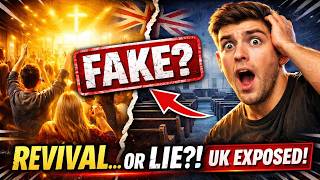
A 2025 Bible Society study claiming a 50% surge in young British church attendance was retracted by YouGov after discovering fraudulent responses. TJ Walker shows how confirmation bias led religious conservatives and media to amplify the false claim, while actual data shows Christianity steadily declining in Britain.
Chapters
Ultimize. A widely reported revival of Christianity among young people in Britain has now been debunked after the underlying data was found to be flawed. According to reporting from The Times, a 2025 report from the Bible Society claimed that church attendance in England and Wales had surged more than 50% between 2018 and 2024, with as many as 21% of young men attending church monthly. Wow, that sounds nice, at least to some. The findings made global headlines. Media outlets declared a, quote, Christian revival. Commentators said young people were, quote, returning to faith. Religious leaders celebrated what they believed was a major cultural shift. There was just one little problem. It wasn't true. The polling firm YouGov later retracted the data, admitting that the survey included fraudulent responses and that key anti-fraud measures had not been properly implemented. In other words, this wasn't a revival; this was bad data. And yet the story spread everywhere, which brings us to something far more interesting than church attendance. Bias, because this is one of the cleanest, most beautiful examples of confirmation bias you'll ever see. People didn't just believe this story, they wanted to believe it. If you are a religious person, specifically a religious conservative, this story is like catnip. Finally, young people are coming back. You don't question it, you don't analyze it. You don't say, "Wait a minute, does this make sense?" You hit share immediately because it confirms your worldview of how you think the world should be. And let's be honest, this wasn't just a few people. This went global, millions of shares, headlines everywhere, and nobody stopped to ask the most basic question: Does this sound remotely plausible? Because let's think about this for one second. We're supposed to believe that Gen Z, the generation raised on TikTok, YouTube, Instagram, and 7-second dopamine hits, has suddenly decided, you know what's missing in my life? Hard wooden benches and a 45-minute sermon. That's the new entertainment model? TikTok versus internal damnation lectures? That's a tough battle. 'Hey guys, I know you've got unlimited content, music, memes, and AI-generated everything, but have you considered incense and a guy named Father Gregory explaining sin?' That's not a trend. That's a fantasy. And yet people bought it. Why? Because of confirmation bias. We don't see the world as it is. We see the world as we want it to be. And anything that confirms our view of how things should be, Now, here's where it gets even more interesting. It wasn't just religious audiences. The media jumped on this too, and that's a different kind of bias because the media has its own incentives. They want compelling stories. They want surprising narratives. And let's be honest, they also want to avoid being seen as the anti-religious people. So when a story comes along that says, "Hey, religion is back," that's a safe story. It's a popular story. That's a story that doesn't get you yelled at on social media. So they run with it without asking enough questions, without digging into the methodology, without saying, wait, this is an opt-in survey. Because here's the key flaw in the study. It wasn't based on a random sample. It was an opt-in survey, which means people choose to take it. And that introduces all kinds of problems. People rush through it, people click random answers, and yes, bots can take it. So you're not measuring reality, you're measuring whoever felt like clicking a link. That's not data, that's chaos. And yet it was treated like some significant cultural shift. Now, to be clear, the underlying reality hasn't changed. Multiple national surveys still show that Christianity in Britain is in long-term decline. Church attendance has gone down. The percentage of people identifying as Christian has dropped significantly, and thousands of churches have closed over the past decade. So that's the real story, like it or not, is the exact opposite of the viral story. That's the issue. The reality is the opposite of the real story, but the story, the real story is less exciting. Headlines like gradual decline continues doesn't go viral. Revival does. And that's the problem, because if you only consume information that makes you feel good, you're not informed, you're entertained. And there's nothing wrong with entertainment unless you mistake it for reality, which is exactly what happened here. So, what's the takeaway? It's not about religion necessarily. It's about thinking. Every single one of us is biased. Every single one of us is vulnerable to stories that confirm what we already believe and what we'd like to believe is true. And if you want to be even remotely informed, you have to fight that instinct. You have to ask, do I believe this because it's true or because I want it to be true? You have to look at the numbers. You have to look at the methodology, ask basic questions. Because otherwise you're just reacting in a world full of bad data, viral headlines, and emotional narratives. That's all we're doing is reacting. Critical thinking is not optional. It's a survival skill in this modern world, I believe, if you really want to thrive. Because if you don't question the story, you become a part of it. And in this case, the story wasn't a revival. It was a reminder that human beings, every single one of us, are incredibly easy to fool, especially when the lie feels good. Let me ask you something. How many times have you heard a great idea and thought, that's really useful, and then never used it again? It happens to all of us because without repetition, even the best ideas just fade. So instead of just collecting more information, do something different. Go to ultimize.com, U-L-T-A-M-I-Z-E.com, and grab the free course. You can start with communication communication skills, or building better habits. But the key is it's designed to reinforce the message so it actually sticks. If you're already listening or watching this, you're halfway there. Just go to ultimize.com and take the next step. Ultimize.