Digital body Language for Digital Clones
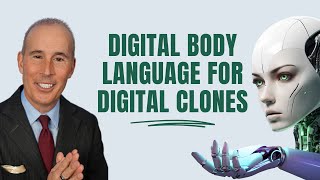
TJ Walker says digital clones need natural head, facial, and hand movements to feel believable. He recommends feeding them extensive video and text of the real person so they capture their full range of expressions. Clones could replace customer service reps and tutors, but fraud is a real risk.
Chapters
Hello, I am TJ Walker's clone. I'm here to answer your questions. Would you actually want to listen to someone who talk like that? I don't think so. So that's why now is the time to give real thought into your digital body language for your digital clone. That's right. I know it sounds crazy and weird, but prediction. Within a very short period of time, not having a digital clone of yourself that responds in text, audio and video is going to be the equivalent of not having a LinkedIn page for yourself today. That's right. It's going to be seen as the mark of someone who simply isn't serious. Now, there are a lot of companies popping up everywhere saying, hey, we're going to help you create your digital clone. Try them, but don't just take their advice. I'm seeing so much bad advice out there of things like, don't move much. Don't move your hands. That can be distracting. Well, guess what? Real human beings in real life move their hands all the time, just like I'm doing right now. When you're meeting one on one with a consultant, a coach, a mentor, a tutor, their hands are moving. So we are conditioned as human beings to expect that, to like that, to want that. And when we don't get that, something feels missing, something feels artificial. The way I am now talking, you don't want to be like that. So a lot of what these artificial clones are doing and. And digital video avatars of yourself are doing is they're capturing a picture of your face, okay? They can get the lips to move in a way that syncs with the words, okay? But human communication is so much more than that. If someone can see you, they can see your head moving, your eyebrows moving, your neck moving your hands moving, your body moving, your arms, your. All of those things need to move, otherwise you set off alarms. There are fire alarms going off in people's brains saying, oh, something fake is here. I'm being deceived, I'm being tricked, I'm being fooled. I don't like that. Something doesn't smell good here. That's what's happening in people's brains. If they see a digital avatar of you and it's just like this, and you're not moving much and your mouth is moving, Maybe the words are great, maybe the voice even sounds great. But if your digital body language is off, it is going to be a big problem because I guarantee you, some people are going to have digital avatars that really move and express themselves visually in a way that the person does in real life. I know mine is. And you're going to lose to those folks. Now, not everyone has to have saying high energy. Anthony Robbins, say, hi, you don't have to be big, larger than life. No, it's not that there's one size fits all. But in my work as a communications coach and trainer and workshop leader for the last 35 years is that everyone moves their hands, face and body when they are talking and they're passionate about someone and it's one on one and they're trying to help someone and they're trying to bring an idea to life. People do not simply present information in a calm, professional way, because that's actually not professional. It makes you seem robotic. Now, we're in an age where these are robots of sorts. These are digital clones of ourselves. Whether it's to make a video when we're on vacation or not feeling good. And we know that a video with our messages coming out of our face or, or if it's a true digital clone that can answer questions on your behalf, can actually mentor, coach, teach, instruct people with you not having to be there, your clone doing the work. If you want to truly use artificial intelligence technology in the most impactful, important, significant way, you're going to have to pay attention to the body language of your clone. Now, keep in mind, with body language, you're never going to please everybody. There are some people who don't like the way I'm moving my hands right now. Tough luck. In my own experience, for every one person who doesn't like the way I use my hands, a thousand people either don't notice or think that I look natural, relaxed and conversational. What you can't do is think I'm going to eliminate any possible thing that anyone would be annoyed with because then you end up without any movement. And that, ironically, is the most annoying of all to most people, even though they won't necessarily tell you so. Yes, your message coming out of your digital clone is critically important. Yes, your voice coming out of your digital clone is critically important. It needs to sound like you for your own customers, clients, prospects to feel comfortable with you. But how you look, how you move your body, how you express yourself with your digital body language is absolutely crucial. So my recommendation, don't just send in a picture and say, hey, do your stuff. Don't just spend 10 seconds and saying, well, they got video of me. You want to feed and train your digital clone with as much of you talking in real life as possible. You want it to see all the range of your emotions, your experiences, your expressions, how you move. You want to be able to train your clone in the same way you train your clone with what to say. Now, the way most digital clones work is you would input every video you've ever made on social media, every speech you've ever made, every book you've written, every position paper, every white paper you've written. You could upload zoom calls with clients and prospects. You could upload your email, your Twitter feedback. You want to give as much information as possible to your digital clone to train it. How to not think that's not the right word, but how to process information, your data, so that when a question comes in from your client, your prospect, your student, your trainee, your digital clone processes all that information and gives them the absolute best information that you would if you were right there. That's the ultimate power of a digital clone. Well, the same thing needs to take place with the visual aspect because simply recognizing your face isn't enough. Simply hearing your voice or a digital voice that sounds like you isn't enough. Every aspect of how your body moves, how your eyes twinkle, one eyebrow goes up on certain words, how your head moves this way and this way, higher and lower, how your body moves forward and back. All of that needs to be captured if your digital clone can represent you well. And I'm hoping it does. Hi folks, I'm TJ Walker. Thanks so much for joining me today. This is the TJ Walker Success Show. We're all about helping you become more successful in life by improving your communication skills and by boosting your confidence in your communication skills. So let me hit off on the 4K version there. So just starting off the day with quick tips, that was video I shot for what will be turned into a YouTube and social media long form video, about eight minutes long. Hope you found it helpful. I do think this is a topic that is going to be growing now. This is a topic I've been talking about a lot lately, digital cloning. But the actual specific topic there of digital body language for digital clones came to me from not me, but from digital me. I actually posted a question to my digital clone and said, you know what would be a good topic for a YouTube video that TJ Walker has not covered on his YouTube channel in the last nine months. And that is one of the topics. So I'm constantly amazed at all the different uses a digital clone can have. And the video is coming soon. I can't tell you exactly when, but it's coming soon. And I am very serious about that. Predict. You know, sometimes people can be hyperbolic in YouTube videos, and I can't say I've never done that. But I am very serious about something I said a moment ago, which is, I think in the very near future we are going to get to a point where if you do not have a digital clone of yourself, it is going to be seen the equivalent of as not having your own LinkedIn page. I don't know about you these days. Yeah, you don't have to have a YouTube channel, you don't have to have a Facebook page. But if you are at a professional conference, a professional setting, I noticed it just this past weekend at TEDx. Nobody asked for a business card. I was at a conference, 500 people, and I didn't see a single business card once. I didn't see anyone asking for any business card. I didn't see anyone sharing it. The only thing anyone talked about is, are you on LinkedIn? What's your name on LinkedIn? And of course I have a LinkedIn profile, as I'm assuming you have too. It would be embarrassing to say, well, I never got around to starting a LinkedIn profile. Okay, you can get away with that. Or you could have gotten away with that 10 years ago, maybe eight years ago. You can't get away with that anymore. Similarly, I'm making a prediction right here, right now, that if you don't have a digital clone of yourself, I'm going to say one year from now, and maybe we can pull this up a year from now. If you don't have a year from. In a year from now at May 16, 2025, you don't have a digital clone for yourself. It's going to be embarrassing. It's going to be that bad. Now, will everyone have it by then? No. Could it perhaps be a longer rollout and it's two years before everyone has it? Maybe. Excuse me, My, my face got blurry a second I've got to do. Check the focus here, get it focused on the face. Sorry about that. Well, we're having a slight problem with autofocus today, so sometimes just going to a camera too fixes that problem. Okay, but here's one thing I can guarantee you. Anyone who is an innovative thought leader in your industry is going to have a digital clone within the next year. And it's gonna not just answer by text, not just audio, it's going to answer in video and it's going to pretty much look like them and sound like them. That's my Prediction. And related to that, the people who make the most money in your industry a year from now are all going to have digital clones of themselves. AI created clones of themselves with audio, video and text capabilities that, that I'm extraordinarily confident in making that prediction. If not, I'll. And I'll eat my script or something. We'll figure out some form of suitable punishment for me for that. Okay. Zora says hello. Zoras, thanks so much for stopping by. Let me know if you have any questions or any items you'd like to put on the plate here for discussion. I'm going to do a short form video on that very same topic. Let me go ahead and clean up. We're going to camera two. You know about body language and its importance, but what about digital body language for your clone? That's right. If you look good and sound good in person, but people want to ask your clone a question and all of a sudden you are like this and your hands aren't moving and you're frozen. Nothing's moving. But your lips can guess what your body language says. Fake, Phony. Don't listen. Okay, so that's the short form. And note to Ben, my producer, who's with us. We need to escalate the production of that. We need to get that up and out really by Monday or Tuesday. So we'll be uploading this to our Google Drive and our production team. We have different editors, producers around the world, and often we create a bunch of stuff. It goes through a process and it could be six weeks before it gets out. Most of what I do here is of an evergreen nature. It's advice that is timeless because it's about communication skills. It's not doing commentary on the news. So it frankly doesn't matter most of the time whether something I do today is turned into a short form video or a long form video, if it gets out the next day, that day, or six months later, because it's going to be relevant to people. The reason I put that one ahead is the advances are happening so quickly with respect to artificial intelligence, digital cloning with voice, with video, that I want to meet people where they are because there's going to be an avalanche of people searching for it. We already saw earlier this week, just Monday, with OpenAI putting out a live product demo showing all the capabilities of their latest ChatGPT4O, I think, or minus 4.0 and showing its capability of analysis of voice, which I'm obviously profoundly interested in because that's so relevant to My work as a communications coach. Also the ability of the AI to discern visuals and to actually discern a face. Now in the demonstration they did, it was just analyzing the smile of the person doing the demo. But I had to think if it can do that, we're not that far off from being able to speak to a camera. And whether it's OpenAI's program or other platforms that are using the same underlying technology that the artificial intelligence clone or technologies can analyze a speaker based on their body language and how they're moving everything from eye darts and licking lips, things that might display nervousness, the artificial intelligence software will be able to tell you exactly what you're doing wrong. And, and that to me is profoundly, profoundly fascinating. Okay, as I mentioned, the topic I started with today is courtesy not just of chatgpt. I didn't pull anything from the Internet to give me that topic. It is courtesy of my own clone. And I realize this sounds very narcissistic, but my own clone, TJ Walker AI gave me the suggestion for today because it can do things that I can't do. I could ask the clone, look at all the topics I've discussed on YouTube and social media in the last nine months and now talk about, give me suggestions for topics that I haven't talked about much that might be really relevant. And that is what it gave me. I'm going to share with you in a moment some of the other topics as well. But quick first program note today, Thursday is a little bit different. We come to you live every weekday, Monday through Thursday, typically from 9am to around noon. Sometimes we go over. Thursday is a little different. We have to break away for our private live session for my online students. If you're one of my online students, you know where it is and what it's all about. So I'm here with you live, typically 9 to 9:45am Eastern Time. Thursday morning we break for my private session. Then at 10:45am we come back right here on YouTube, Facebook, on LinkedIn, on Twitch, on Twitter, X on Instagram and sometimes Amazon Live and a few other places. And I'll be with you from 10:45am until noon Eastern time in the United States. Friday's off production day and give you a chance, but remember, we're never really off anymore because this channel puts out two videos every single day. Excuse me, two short form videos, one long form video seven days a week. And if you think, well, you know, that's a video that's on demand. What if I'm not interested in the topic. What if I have a specific question that relates to communication skills and it's Thursday afternoon. Do I really have to wait till Monday to be able to ask you a question live? Well, fortunately, no, not any longer. Ben, if you could post a link to our AI, our TJ Walker clone. And in the comment section is yet, yet another reminder. You can always just post a question right there to my AI and it will talk to you. We'll be doing some demonstrations on that later, and you can ask any questions. And I don't mind if it's silly, if you're asking me something that is overly personal. My. My clone will just say, you know, thanks so much. Appreciate your interest. I'm really here to be more helpful to you with your communication skills. So it's not gonna. It's not gonna get angry with you. It's much more patient than an actual human being is. But you can ask any question. One of the. One of the questions somebody posed yesterday dealt with the issue of, how do I say this delicately? You're giving a speech and. And all of a sudden you have, shall we say, an excess gas problem. And everyone hears. How do you handle that? I thought it gave a pretty good response. If you're interested, you can type it in. Ben, can we go ahead and post the link to the AI, the talk version? Let's go ahead and post that in the comments section so that people can see it regardless of where they are. And there it is. You can see it right there. You push that. Right now, we're just rolling this out. It's new. There's no charge. At some point, there will be various gates. After a certain amount of usage, there will be some charges. But right now it's unlimited. So you can. You can check it out. Someone yesterday wrote, tj, how many tuxedos do you own? And my. My clone didn't know. It said, I'm sorry, you got me on that one. I don't know, but dress is important for speaking, and then it's segue to that and ask questions. But I actually amended the clone because I do have one tuxedo and I don't mind sharing that with someone they want to know. So I put that in there. So the next time someone asks, and I don't know why, you'd really want to know, but that's just an example of you can change your clones. You can just tell it not to talk about certain things. You can amend answers so that it gives an answer your certain way. Now, one of the ways people are using digital clones in communication is they'll have one clone or one version of their clone that's for business. And it only pulls up things they've said that are business related. Business speeches, business YouTube channels, business emails, zoom calls they made for it pulls up that content. And you'll have another version of your clone where you might have talked about your earliest childhood memories and the specialist moments with your children, your wife, your spouse, your husband, your significant other, your partner. Really, really personal, intimate details. And you only make that available to close family members. So after you're gone and your grandchildren want to know about your formative moments, they in theory can have a conversation with you. Now, I realize to some people that sounds a little creepy, but now you have a choice. The problem, I won't say the problem. The reality of most human existence. Humans live, they die, and within a few years nobody remembers anything about them. Yeah, you got a few photos that are kept and after a while, someone moves, they're gone. And there's no memory whatsoever, Nothing but a trace. Digital cloning can change that. Now, it might be that not every single person has such a significant life and so many insights that people are going to want to learn from them again and again, again, forever. Not suggesting that, but a lot of people do. And a lot of people are very interested in the lives of ancestors. I mean, I personally have no idea what my ancestors were doing 200 years ago. I don't know if they were criminals or in jail or farmers. I know that at some point I had some ancestors come over from Cornwall in England in the United Kingdom. And Cornwall is known for mining, especially 100 years ago, 200 years ago. So I assume I have some miners in my family tree. But wow, wouldn't it be nice to just talk to one day and tell me what your typical day is like, what are you eating? Potatoes. I mean, it would be fascinating to be able to talk to our ancestors. And right now I'm not going to be able to do that. But people in future generations will be able to. So that's yet another application of this artificial intelligence cloning technology. Igor stops in and says, glad to join the stream. Thanks for the Udemy courses. They helped me a lot. Well, Igor, if you don't mind, which course were you in and what specifically did you benefit from? Because I do have a follow up question. Because I'm trying to make my courses better, I'm trying to improve them. So there's a part of me and I get some advice from Time to time that says tj, I want you to redo all the courses because you look older. Now some of your videos, you obviously look 15 years younger and I was 15 years younger. So I could spend a lot of time reshooting all the videos for all my courses, plus adding new content. And I might. What I'm hoping to do in the next, ideally week or certainly in the next three weeks, is to say to every one of my courses, hey, by the way, we have a new feature in this course. Can ask me any question about any topic in this course and I'll just answer you right here, right now and talk to you directly through my clone. If you want me to critique your speech right now, like a one on one tutor, I can't. Now that might be six months out, maybe even 12 months out to get to that point. But as far as being able to ask any question whatsoever and not have to go through the whole table of contents and see, oh, here we are in section 7, lecture 239. I think this topic relates to what I need to know. Let me go through here and fast forward to 4 minutes and 22 seconds. Maybe I'll find the. That's a lot of work. I know, I don't like to do that. So Igor, part of what I'm trying to introduce really in the next week or two is a companion clone for all of my courses so that you can just push a button and ask me the question rather than have to wait for me to get to it. The course. I mean, as much as I love my online video based courses and I think they're the best in the world, there is a limitation of it being linear and straightforward and one to many and non conversational and not a true one on one tutoring experience. That's the beauty of these digital clones is they can simulate, maybe not at 100%, but they can simulate the experience of it being more like a one on one tutoring session better than a thousand times better in my view than just a video. Now I think especially if you're teaching someone a skill like public speaking skills, a video is a thousand times better than a book. And you know I love my books. And the secret to foolproof presentations has helped a lot of people. But a video demonstrating best practices for public speaking is, is infinite. I won't say a thousand, it's infinitely better than a book on public speaking. But I would also say that a digital clone that can answer someone's questions about public speaking and then give them suggestions for exercises especially when we get to the point where the clone can analyze the student's voice and analyze the student's messages, analyze the students body language, then that's going to be infinitely better than the video on Demand course. Now I say, and Igor, again I am, if you're still with us, I'm very much interested in knowing which udemy courses you've taken and what benefits you got. I also want to know if you did the number one thing I ask every student to do, which is practice on video. Look at it, figure out what you like and don't like. If you were in one of my communication skills courses, if you did that. Because one of the things I'm most excited about with my clone is I actually can program my clone after any question you ask to then encourage you to do a practice speech or interview or have a media message, to say it out loud and record it and to see what you like. Now, long term, I would love to actually program my clone to just tell you, okay, now we're going to hop right in and practice. The camera's on. Speak to me right now. That's going to be an extraordinarily powerful breakthrough moment. And when that happens, then we get to the point where truly, truly transformational one on one style communication skills training that typically only CEOs and big shots get, it's going to be available to the masses and that's at a fraction of the price. John CEN writes in and says, is this the real tj? Yes. So it is real, John. But ideally we get to the point where if I am sick or want to take the day off, or I just spend the whole day hanging out on the beach with you in South Florida, then my clone can take over. We did a segment yesterday where I had my clone interviewing my clone. We had a very interesting back and forth and that was kind of a lot of fun. Now it did get to the point where they were each sort of just giving each other advice. And it wasn't truly done in a real interview style because they're both programmed to be helpful and give advice. But for about a 10 minute stretch we had one clone talking to another. It was the same version of the clone. They were just talking to each other because I had opened it up on a computer as well as a cell phone. So that's a lot of fun. So John, have you considered having a clone? I know you've had a variety of of professions, but in almost any profession, if you have to speak a lot and say the same things, it Would be nice to have a client. If you are a massage therapist and you have a website and people come to your website and if right now you just have text of your prices and availability, I think it would be a lot more powerful for someone to push a button, see your face, come on. And here you talk about your passion for massage therapy, your credentials, your licensing, how you typically work, what sort of table you have, the areas you're available to travel in, and if you want your pricing and let them know what questions they may have questions about. And I know virtually nothing about massages that's not obvious by now now, but they can ask you, do you do Swedish massage? Do you do. I don't know the other names of massaging, but they could ask you what's in their head rather than you forcing them to go through your frequently asked questions or to type things in or to know the right place on your blog to find information. So it could, in fact really help you get more business. It could save you time. Rather than having someone go right to a phone call and you're busy, you're driving and you're impatient, or you're at a red light, you can't give them full attention. Your clone can always give 100% attention to the person, the user interacting with it at that moment. So that is a huge, huge part of the process. The other thing that occurs to me as I'm trying to figure out how to use these clones in my own business is it's not always about, oh, someone likes it and pays you money directly for it, that's nice. But anytime it saves me time, that's worth a lot of money too. Like you, my time is valuable. It's ultimately the only thing we have that we can't get more of. You can always make more money. You can't make more time. So if someone has spent time on, on my website or any place where I have my clone, asking it questions, if it's asked questions for 30, 35 minutes, and then we have to have a Zoom call, or then the person calls me instead of talking to me for an hour, trying to figure out, do I really want to hire this guy, Do I like this guy? Do I trust this guy? Does this guy know anything? If they spend 30 or maybe 60 minutes interacting with my clone, then they already have a sense of what I'm about, I've already answered their basic obvious questions. So. And then instead of talking to me for an hour on zoom, maybe it's 15 minutes and they're ready to Hire me. So I've saved 45 minutes and instead of maybe closing 50% of my prospects, maybe we bump it up to 65, 70% over the course of a year. That's a significant amount of money. And that's part of what I think is going to be so extraordinarily powerful to everyone in the world who does anything for a living, where they have to talk or type. Anyone who communicates. If you're doing something, and I mean this with no disrespect, if you're doing something that is 100% manual labor and you also don't market your manual labor, you're a full time employee on a farm or something, then, then it probably isn't going to be as valuable. Although you may still want one for personal use where you simply record conversations, reflections on life to share with family members as they get older. And maybe you've passed on. So I do think that if you have a Facebook profile now, you're basically already capturing information about your life, images about your life that you're sharing with a whole variety of people. Sometimes it's just friends, sometimes it's with the world. If you have a Facebook page now, you're going to have a digital clone in the future. Doesn't mean everyone's going to get rich off of. Doesn't mean we're going to have a world where everyone is curled up in a ball on their couch just watching entertainment because everything is just clones talking to each other. I'm not predicting that sort of dystopia, but I do think we're at a point where it's such a powerful communication tool and we as human beings are biologically evolutionary. Lee programmed to want to communicate and this helps dramatically. John says, how about a clone parent for disciplining your kids? Now I like the idea of that. How that works, I don't know because if the kid's asking, I mean, my daughter has never said, hey, digital TJ dad, digital dad, I've been bad. What sort of punishment should I get? I can't imagine the user in this case a child asking for punishment. But in theory, when a digital clone is married to a, a physical existence, a, a robot, in theory you could have the robot grab the child's hand, gently take it to the room and so you can't leave the room. In theory you could. I hadn't thought about it until right now, but John, I'm glad you brought it up. Let's say you have a digital clone telling the child, say it's a 14 year old child, so not a small child. The 14 year old child is home alone and the parents are at work. And let's say it's six o' clock and the parent has left instructions to the digital clone parent that the child is to do their homework from 6 to 7 and the clone can monitor, it has somehow a visual monitor seeing what the kid is doing and tells the kid, hey, can you do your homework? And the kid says no, I don't want to, I'm going to watch social media videos. In theory you could actually program a digital clone to have control over the Internet, although that would cut the clone off. So I don't quite, I don't know if I've thought that all the way through. Maybe the digital clone could be structured in such a way so that only the digital clone has access to the Internet, but the Internet access to the devices the kid has access to could be shut down. So now the second thought, maybe it would actually work. So these are some of the things questions like John has brought up that I had not thought of that are going to be coming. I mentioned this yesterday, the program, I'll mention it again, I feel like, and apologies to anyone who's ever been a victim of a tsunami, I do not mean in any way to be glib about tragedy, but I feel like when I think of how these digital clones are coming in a good, positive way, I'm not talking about the theft and the potential fraud and emotional abuse. I'm talking about the good uses of clones. When I think about how it's coming, I feel like I'm in a luxury resort on a beach in Thailand. I'm on the 20th floor and I just randomly happen to have binoculars on and I look out and I see two miles out, the biggest tidal wave I've ever seen. I'm like, oh my gosh, it's coming. I feel like I need to run around, tell everyone, get ready, prepare, it's coming now. The difference of course is a tidal wave is not really good for anyone or anything. It's pure destruction. These clones, I think are going to be wildly positive for people who embrace the technology and use it in positive ways to help their customers, their clients, their students, their trainees, their, their community. It's going to be wildly wild, wildly positive and empowering and it's going to create so many wonderful experiences and learning experiences. There's been a lot of research. I won't get into all the standard deviations difference, but there's been a lot of research Showing that if you can tutor someone one on one, they are going to learn so much faster and so much better than if they are part of a classroom. No offense to classroom teachers. I teach sometimes in a classroom 20 trainees, sometimes as many as 50. But it's different when it's one on one and everything is personalized. And the second one person who's being trained has a question, they can instantly, without any filter, without any embarrassment, just ask. Once you have a classroom environment, you have people think, oh, well, I don't want to interrupt anyone, I don't want to be rude. I don't want these people to see me. So I don't care who you are. There's some inhibition that creeps in once you're around other people. And a certain every additional person in the room makes it less likely for you to want to stop and ask the teacher a question. That is the brilliance and the beauty of and the majesty, if I can be pompous here for a moment, of the potential of a digital clone. Because if you're helping someone and they don't see anyone else, they're there in front of their computer or their cell phone or their iPad or their tablet, they're learning from your expertise, your voice, your video coming soon, and they have a question, they could just stop and ask you a question right now. Because what happens in learning so often is a classroom setting. The teacher is teaching to the whole class. You're confused about something. You missed one piece, you're thinking about that the teacher's gone on to the next thing and the next thing and the next thing, you still lost this. And unfortunately, without this piece, this piece and this piece and this piece, it doesn't make sense. So now you've lost. So now you haven't learned anything. The teacher said in the last 10 minutes, because so much of knowledge builds on itself. But in a one on one tutoring situation, you don't have to skip ahead. You can just instantly stop and say, I don't think I got that. Can you give me another example? That's what is so profoundly powerful about this potential. Not potential technology. It is technology. That's what's so powerful about how people can use it, how I anticipate people using it. Caveat. You see a lot of attention in the news media about the downside of digital cloning. I'm not here to sweep it under the rug. Yes, there is going to be abuse, there is going to be identity theft. There will be parents who are tricked into sending $5,000 because at 2am they get a call from a voice that sounds just like little Judy or little Timmy saying, I've been kidnapped. They're going to kill me. If you don't send $5,000 by Venmo to this address in the next five minutes, there are going to be abuses like that. And I don't mean to minimize that in any way, but sometimes people kill someone with a steak knife. Do we want to really say, gosh, we wish we'd never had knives invented? I don't think so. Every tool has potential for abuse. Every tool has potential to help people. Right now, most of the mainstream media is focusing on. On all the different problems of digital cloning and artificial intelligence in general. And I think that's fine. It's good. It's a legitimate form of journalistic inquiry. It needs to be talked about. But something else needs to be talked about too, which is how every single business, every single information business, every single information worker in the entire world about to see tremendous opportunity in front of them. And people who grab it first are going to be huge, huge beneficiaries. And that's what I'm trying to help you do. I'm trying to benefit from this as well. I was talking to an old friend yesterday saying, what I do think is going to happen is similar to what happened in the mid-1990s when all of a sudden nobody had a website. The Internet started taking off, got attention. There was a point, believe it or not, those of you below 40 won't believe me when I say this. There was a point when virtually any business in the world could get a big story written about themselves. A big profile article spread on TV announcing that they had a website. It was considered unique, cutting edge, revolutionary. You can actually get publicity just announcing you were starting a website. I know sounds crazy. And what happened was, excuse me, my face blurred out. I've got to get a tight shot and, sorry, you're going to have to see the wrinkles there, but that adjusts the autofocus sometimes. So what happened was all of a sudden these agencies, these digital agencies popped up out of nowhere and all of a sudden had, you know, millions of dollars of revenue, sometimes tens of millions of dollars of revenue from so many business saying, create a website for me. Now. I predict the same thing is going to happen with clones and cloning technology. There's going to be. They're going to be agencies, they're going to be experts and consultants who are all of a sudden wildly in demand to help people build their clones. Now, what's going to be the best way to market yourself as a digital cloning expert? Well, guess what? Yes, you're going to have to have a digital clone. Now, I'm not planning on going into that niche, but I think it is an exciting niche and a lot of opportunities. We'll be talking about this more in one hour. I have to sign off now because I have to have my private session for my online communications and personal development students. So we'll see you back right here on whatever platform you're watching this on in one hour at 10:45aM Thanks. 10:45aM Eastern Time. It's 9:45 now.
More from TJ





The Breakout Cases - What Actually Caused Famous Speaking Career Breakthroughs | Ultamize

The Red Circle Sessions Finale - Build the Speaking Career You Came Here For | Ultamize

Two Stages, One Logo, Two Completely Different Realities - Main Stage vs Independent Events | Ult...

Pre-Reset - Why Repetition Builds Better Speaking Decisions | The Red Circle Sessions | Ultamize

Your Decision, Your Framework, and What Happens After - Build Your Speaking Career First | Ultamize

The Red Circle Sessions Trailer - The Speaking Career Truth Nobody on That Stage Will Tell You | ...

The Two-Minute Ultamize Reset - Your Platform, Your Audience, Your Voice | The Red Circle Sessions