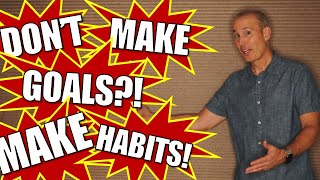
TJ Walker argues that people should prioritize concrete daily habits over vague, aspirational goals. Using examples in weight loss, writing/publishing, and career advancement, he shows that success comes from consistent, realistic daily actions (e.g., eating unprocessed foods, writing 500–1,000 words daily) rather than unattached target outcomes like becoming a bestseller or losing a fixed number of pounds.
Chapters
Everybody has goals. You're told to have goals in school. Your parents, your teachers tell you that. The motivational speakers tell you you must have goals. You must have goals. But let's be honest. There's a real problem with most people's goals. They're kind of written in fairy dust. They're ephemeral. They're disconnected from any kind of reality. Oh, I want to lose 40 pounds in the next month before pool season opens. I want to be a professional basketball player. I want to be a star rapper, even though I've never written a piece of music or learned an instrument. Many things that people call goals are just general, vague, fuzzy wishes, and they're little more than people saying, I want something for nothing. I want to be rich and famous. And yet I don't really want to have to work hard or do anything to warrant or justify being rich and famous. So that's the big problem with goals. So I want us to dig a little deeper and figure out what's really going on here. How can we, in fact, make our goals meaningful? There has to be a stronger linkage between the goals we have and the actual activities, the things we have to do to support the goal. I well remember at age 18, being a freshman in college, and it seemed like every other student I met said, I have a goal of becoming a doctor. I want to be a surgeon. I want to be a doctor. I want to be a heart surgeon. I heard that from half the students I went to school with at Duke University. Here's the problem. An awful lot of them did not have the goal of studying organic chemistry every day and mastering the concepts of organic chemistry and learning chemistry and actually learning how chemicals in the body interact. That wasn't really their goal. Their goal was, I want to say I'm a doctor because then my parents will be pleased and proud of me. Other people will think I'm cool. People will think I'm rich, or I will be rich. I'll have respect in the community. That was the goal. Guess what? Those are all absolutely horrific reasons for wanting to be a doctor. If you don't genuinely love science, you don't really want to know how the body is put together. You have no business being a doctor. So that's the real problem, is the goal of being a doctor was completely untethered to the habit of wanting to study chemistry really hard and having a passion for chemistry and biology, as opposed to liking prestige and a title, money. And that's what I see as a problem for so many people. Similar to so many people's weight loss goals. You know people, I know people, whether it's January 1st, I'm going to lose £35 by pool season or beach season. And they'll have the goal. They may tell people they have the goal. They may post on Facebook, they're all right, everybody hold me accountable, I'm going to lose 35 pounds. There's nothing wrong inherently with having that as a goal, but it is 100%, completely, absolutely meaningless if you don't tie it down to highly specific habits that you start today, not a month from now, or a month before beach season starts. But right now, it's meaningless to say you have the goal losing 35 pounds unless you tie it to a habit. Now, the number one way to lose 35 pounds or any amount of excess weight is to completely change what and how you eat your diet starting today. And when I say the word diet, I don't mean you have to go Atkins or Paleo or milkshake or Weight Watchers. You. In fact, I beg you not to do any of those things, but we'll leave that for another day. The easiest way to lose 35 pounds and it's not easy, is to start eating all of your meals and snacks as very healthy food. Real vegetables, unprocessed food, things that don't come in packages, bags and boxes, but actually going to the produce section, your grocery store, those are real habits. Avoiding all processed sugars and processed foods in general. That is a specific habit that you can do today if your goal is to lose 35 pounds. If you do those things, you will lose weight. Now, you might not lose 35 pounds in four months, but if you lost eight pounds and four, four months, that would be a lot better than staying the same or gaining weight. So I believe in a case such as weight loss, your goal should be to change your habits. Not a set £35. You may need to lose £35, but the focus should be on changing the daily habits. If you change your habits and you go from eating hamburgers, french fries, ice cream, desserts, fruit juice, colas all day long, and all of a sudden you're eating salad with just oil and vinegar dressing, not the gloppy sugar filled dressings, and you're drinking water instead of coke and you're eating apples instead of chocolate chip cookies, you're going to lose weight. You don't have to be a PhD in biochemistry to figure that out or have a PhD in nutrition. You will lose. That should be your focus, not just this arbitrary My goal is losing 35 pounds. Another big problem with goals is it's often set. If you tell yourself my goal is 35 pounds and you lose 29, well then you're a failure. You fail to reach your goal, that can be psychologically devastating, destroy you feel like you're a failure. Whereas if you focus on your habits every single day you ate healthy, you're a winner. You deserve a pat on the back, you deserve to high five yourself a fist bump. So psychologically it's much more upbeat to focus on daily habits because then you can have a win every day, you can have a win throughout the day. Every healthy meal you eat is a win. If it's simply a goal of losing 35 pounds, any one meal you eat isn't going to have an impact typically. So there's no way to stay psychologically up and feeling good about the process. And if you don't feel good, it is easy to just slide back and say, ah, this isn't working. Why am I bothering? It's too much trouble. Let's look at another example. I encounter people like this all the time in the speaking world. I used to be president of the National Speakers association, the New York chapter. And people would come all the time. Oh, I'm a teacher, I'm an aspiring speaker and I'm going to be a New York Times bestseller and I'm going to do this and I'm going to be on a stage with Anthony Robbins and they would come for a meeting or two and, and I never hear from them again. The goal of being a New York Times best selling author is a goal a lot of people. And sure, I would love to do that, but I would argue that that's kind of a worthless goal because then you could write a great book, sell a million copies over 10 years, help a lot of people really be the most important book in your subject matter. And you're a failure if it didn't get to be a New York Times bestseller. Therefore it's a goal you failed at. I don't think that should be your goal or it shouldn't be the main thing you focus on. What I think your real goal should be is if you have great important ideas you want to share with the world, then you should have a goal of, I am going to write 500 words a day or a thousand words a day on my area of expertise and I'm going to share these words with as many people as possible, maybe in a blog, maybe using it as a script for an online live show maybe as content for online course. And then at some point, I will put it together as a book. And in the process, I'm going to try to create a tribe of people who care about my ideas, who care about my insights, who benefit from them, and I'm going to try to be as responsive to them as possible. And I'm going to listen to their suggestions and their ideas. What do they like, what do they not like about my ideas? And I'm going to shape it and form it and refine it and make it better and better and better. And then I will publish a book, either myself or with a traditional publisher. And I'm going to tell the whole world about it. And I'm going to keep telling the world about all the ideas in here. And you know what? The book might become a New York Times best seller, it might not. At that point, it won't matter because you are a winner at your daily habits. You're a winner because you wrote every day. You're a winner because you expanded your audience every day. You're a winner because you helped people. You're a winner because you put your ideas out there. And you're a winner because a lot of people, if you do it this way, actually read your book and you had an impact. So that's what I think is so much more helpful to people than just saying, I have a goal of being a New York Times bestseller. And yes, I realized that Mark Victor Hanson and Jack Canfield did say they had a goal of being a New York Times bestseller when they did their first Chicken Soup of the Soul book. I understand that, and I understand that Jack Canfield talks about this in the Secret. But what he didn't have time to say or what was left on the cutting room floor of the Secret is that he was writing every day for decades before that book came out. He was giving speeches all over the country, doing workshops all over the country for decades before his book became, became a success. It was the daily habits. It had other books. There were so many things they did. It was the tremendous work. Talk radio shows, 5:00am, 10:00 clock at night. They worked and worked and worked and worked. It wasn't simply, oh, I'm going to sit back and create a vision board. Oh, I see my name on the vision board of being a number one New York Times bestseller. I've seen it now. It will happen. That's kind of the Cliff Notes version of the Secret. And let me tell you, it doesn't work or it doesn't work. Unless you work an additional 16 hours a day for two decades, like a Jack Canfield does who's an extraordinarily hard work worker. So that's what I want you to think of when it comes to this whole issue of goals, having goals of being a writer, you can do it. You cannot control whether you succeed. The goal of being a New York Times bestseller, there's so many things in play. What other books came out that week, the season, the news cycle. There's a lot of things you cannot control. You can control whether you are going to write every single day. You are completely in control over that. And I don't care if you have 12 kids and a full time job, you can write. Tolstoy famously had about 12 children. He wrote War and Peace. So you can't use other excuses. You can use an excuse for not finding a publisher in the old days. Nowadays you can publish yourself. You can use an excuse of, oh, Harry Potter came out. I didn't get to be a best seller. No, nothing sold that week my book was launched. But you have no excuses when it comes to you simply deciding, I am going to write today and every day because that is the habit that I care about. Here's the big problem I see for so many of us, myself included, when it comes to goals as human beings, we lie to ourselves. We just don't really tell the truth. We say our goal is one thing, but we really have no interest in doing the actions on a daily basis, forming the habits it would take to reach that goal. And this is where I think successful people are a little different. They it's not that they don't have big goals, but their goals are realistic enough that they figure out what habits do I have to do in order to reach this goal? And once they've analyzed what the habits are, if they realize they're not willing to pay the price, then it's no longer a goal. It needs to be somewhat realistic. So, for example, a lot of people tell themselves, oh, I want to run a marathon. Because you know what, it sounds really cool at a party to say, yes, I'm running on the marathon, the New York City Marathon, next week or next month. There was a time when I started telling people I was going to run a marathon when I was about to turn 40. Then I realized I don't really want a marathon. I want to be able to tell people I ran a marathon, but I have no interest in running a marathon. We lie to us. I did lie to myself for a little while. I did Fess up and realize this is not something that's for me, it's for bragging rights to others. If you want to run a marathon, but you're not willing to run more than a mile a day, you're never going to be in shape to run a marathon. If you are willing to run several miles a day and then build up and do the certain sequence that they recommend, then it's possible. But if you hate running and you've never run more than a mile in a day, and you're not willing to run more than a mile a day, you're wasting everybody's time talking about running the marathon. Now maybe you run a mile and then you walk the next 23 and it takes you 14 hours. I guess it's better than sitting around and watching tv. But you didn't really establish the habits you need to be a marathoner. It's kind of a joke. I believe that every big goal you have needs some stress testing. You need to really hold that goal up to the light, analyze it, test it, poke it, prod it, and then analyze it in terms of what are the daily habits I would need to acquire in order to make this goal come alive. And if you're truly honest with yourself, you realize it's not what you want. I realized I did not want to have to do practice runs of 13 miles to really get ready for that marathon. I don't like running. I run every day now, but I only run for 60 seconds and I'm perfectly okay. Going to my grave, I hope in a hundred years not having ever run a marathon. You've got to be honest with yourself, really figure out what's important. Because there's lots of things we'd like to have. We'd all like to have all kinds of things. We might like to be a billionaire. I might like to have six pack abs. Even though I'm at basically my proper weight now, I don't have a six pack abs. Believe me, I'm not going to take my shirt off for you. But all things being equal, I would love to have six pack abs. But when I really analyzed the daily habits that would be required for me to get six pack abs, I realized I would have to basically eat nothing but lettuce and carrots. I would have to probably reduce my calorie intake by 50% and I would probably have to spend two hours a day in the gym. For me, it's not worth it. I don't really care If I have 6 pack abs. If you could snap fingers or wave a magic wand. Sure, I'd take it. But the habits required to create six pack abs are not something I'm interested in. So I'm not going to waste your time and I'm not going to post on Facebook, hey, everybody, in 90 days I'm going to have six pack abs. It's simply not a realistic. Many people when they start their careers tell themselves, oh, I'm ambitious, I'm going to be the CEO. I'm going to be the CEO of this company. And they wash out because they think of themselves as too good to do low level work. What do I want to take that assignment in the year for in Costa Rica? I want to be here where the action is, in London or New York. And they're constantly telling themselves they shouldn't do this job, they want the next job, they want the next job. If you look at how many CEOs became CEOs, quite often they didn't aspire to be CEOs. They got a job and they focused on it. They did the absolute best they could at that job. They tried to learn everything they could. If their company said, you've got to go to Ecuador for six months, they just went. They dove in. They learned as much as they could. They helped as many people as they could. They did whatever they could for their organization, whether it was a private sector business, whether it's a government, a United nations entity, they just focused on that job. People saw that, they got promoted, they went to the next job, they did the same thing and they worked their way up. It's often those people who end up the CEOs, they didn't necessarily have it as a goal, but their daily habits were so strong, their work ethic was so strong. The habits of always learning more. The habits of helping every customer, client, colleague, boss and junior level person. The habits were so strong, it just propelled them further and further and further along in their career until eventually they became the CEO. This is why I think it's. I'm not saying you can't have habits or goals, but sometimes they can be counterproductive. If they take you away from habits, then they're not helping you. I've heard no lesser a success story than Oprah Winfrey say famously that she doesn't have goals. I think what she really means by that is what I'm talking about. She focuses on doing a great show today. She focuses on great habits, doing one thing today to make people feel a little better, to make this show better, to make this network better. Rather than saying I'm gonna win 12 Emmys this year, I think she focused on on the day to day, how do I make this the best possible show? And that is what made her really successful. So sure, have goals in life, but realize that's not what's really important. What is important are habits that you want to fulfill on a daily basis that you are willing to fulfill and focus on those habits. Your success will come. If you're not willing to do the work, if you're not willing to do the habits you need, you're not going to be able to reach that goal. I never had a goal of being a paper boy, growing or a paper person they call it. This is back before the Internet and newspapers had to be delivered, hand delivered. I never had that goal. But those who did realized it comes at a price. It comes with the habit of having to get up at 3:30 in the morning because you got to go get the papers, wrap them up and deliver them. So do not waste time with goals unless you're going to focus time figuring out exactly the habits you need to make that goal come alive.
More from TJ





The Breakout Cases - What Actually Caused Famous Speaking Career Breakthroughs | Ultamize

The Red Circle Sessions Finale - Build the Speaking Career You Came Here For | Ultamize

Two Stages, One Logo, Two Completely Different Realities - Main Stage vs Independent Events | Ult...

Pre-Reset - Why Repetition Builds Better Speaking Decisions | The Red Circle Sessions | Ultamize

Your Decision, Your Framework, and What Happens After - Build Your Speaking Career First | Ultamize

The Red Circle Sessions Trailer - The Speaking Career Truth Nobody on That Stage Will Tell You | ...

The Two-Minute Ultamize Reset - Your Platform, Your Audience, Your Voice | The Red Circle Sessions