Electrolyte Drink Truth, Meat Stick Health Risks & Justin Timberlake Lawsuit Explained
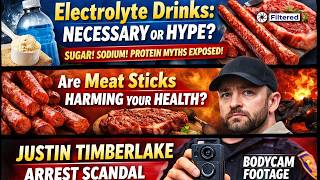
In this episode of the Filtered podcast, host TJ Walker provides a rapid‑fire commentary on five distinct news items, framing each through a communication‑focused lens. He begins by debunking the hype around electrolyte drinks, citing AP‑reported medical experts who say most Americans get enough electrolytes from water and diet, and warning that many of these products are loaded with sugar, excess sodium, and potentially harmful potassium levels. Walker then turns to the surge in processed meat‑stick snacks, referencing WHO classification of processed meat as a Group 1 carcinogen and highlighting the high sodium, nitrates, and added sugars that raise cancer, diabetes, and mortality risks, while recommending whole‑food protein sources as safer alternatives. The third segment covers Justin Timberlake’s lawsuit to block release of police body‑camera footage from his 2024 DWI arrest, outlining the legal tension between privacy claims and New York public‑record law, and noting the potential Barbra Streisand effect of trying to suppress the video. Walker then discusses former Goldman Sachs CEO Lloyd Blankfein’s recent New York Times interview and memoir, focusing on his reflections about the 2008 financial crisis, the backlash over his “doing God’s work” remark, and the broader lesson about soundbite risk in media. Finally, he reviews a CNN poll showing a majority of Americans oppose U.S. strikes on Iran, critiques the lack of clear presidential communication about war objectives, and contrasts this with historical war‑justification messaging. Throughout, Walker intersperses promotional plugs for his media‑training services. The episode serves as both a news roundup and a case study in how messages are crafted, distorted, or missed in public discourse.
Chapters
Ultimize. Electrolytes are everywhere, but doctors say most Americans don't need them. Protein obsession is driving meat stick sales and raising cancer concerns. Justin Timberlake is suing to block release of police video from his DWI arrest. Lloyd Blankfein is reflecting on Wall Street Trump and that infamous God work comment. A new CNN poll shows most Americans oppose US strikes on Iran, and the Department of Education is facing backlash for honoring Charlie Kirk with a banner outside its headquarters. All this and more today on Filtered. Welcome to Filtered with TJ Walker. Hi and welcome. Thanks for joining me today. Let's dive in. Electrolyte drinks and powders are booming in popularity, fueled by social media influencers and promises of rapid hydration, but according to the Associated Press, medical experts say most— and I want to stress most— Americans simply don't need them. Electrolytes help regulate fluid balance in the body, and they are lost through heavy, heavy sweating, but doctors say that for workouts under 2 hours, plain water is usually sufficient. Healthy kidneys already regulate sodium and other electrolytes efficiently. Many of these drinks contain added sugars, and some have extremely high sodium levels. While elite endurance athletes may benefit from tailored electrolyte replacement plans, experts stress that the average gym-goer or office worker is unlikely to need supplementation. In fact, most Americans already consume more sodium than recommended, sometimes way more, because salt is added to processed foods across the diet. For the vast majority of people, these products won't provide meaningful benefits and could provide some harm. So let's dive into this a little deeper. I'm here in Florida. Gatorade was developed at the University of Florida in 1965 because players, when you're playing a football game and 300-pound people are jumping all over you and you're running a lot, you can lose 18 pounds per game. So it arguably makes sense if you are a college or professional football player. Most of us don't do that. If you're exercising for less than 2 hours, water is sufficient according to most experts. And again, I want to point out I'm not here giving you medical advice. I'm simply distilling a summary of mainstream medical opinion, health opinion, as far as habits that will increase your health. So you've got to consult your own doctor. But here's the problem. So many people see some incredibly good-looking, perfect body person on Instagram hawking some electrolyte package powder. Maybe, oh, I want to look like that, let me buy that. That's not what got those people looking like that. They look like that most of the time because they eat really healthy food and they exercise all day long. You don't want to do that. I don't want to do that. Let's not kid ourselves. You're not a 19-year-old full-time health training influencer blessed with genetic goodies to make yourself beautiful. So let's be real here. The problem with so many of these so-called electrolyte drinks is they add tons and tons of sugar or substitute sugars. Those are harmful to you. Those are not good at all. Excess potassium can be dangerous. The zero sugar versions reduce absorption efficiency. And again, it's starting from a false premise that somehow you go jog around the block once or twice and you're going to be deficient in salt. Chances are you have way too much salt in your body if you eat any food from a restaurant, if you eat any food from a grocery store that's not from the produce aisle. Chances are you're already eating way too much salt. Well, let's look at some of the additional analysis provided by the Associated Press. This is according to Hunter Huston, a Vanderbilt University nephrologist: taking an electrolyte-enriched drink just for health purposes probably isn't doing much. According to Julia Zampano of the Cleveland Clinic, she told the AP electrolytes can help especially with heavy sweating or exercise, but for most people They're not something you need every day. And according to Mark Siegel at the University of Florida College of Medicine, yes, the same University of Florida that created Gatorade, you're getting extra sugar and there's no reason for rapid absorption of sodium because you're not sodium completed. Basically, you're being scammed. Now, again, if your doctor specifically prescribes to you electrolytes, by all means, don't listen to me. Listen to your medical doctor. But that's not what is driving the sales of all these electrolytes. It's being driven by advertising. It's being driven by so-called health influencers who are trying to make a quick buck. Because nobody makes money doing what I'm doing right now. And those of you listening on the podcast, I'm drinking a glass of tap water. Urging you to drink tap water doesn't create a revenue model for me or any other influencer or commentator or podcast host. That's why you don't see people talk about it that often. You make money by talking about little green potions or little electrolyte potions or magic green-yellow drinks that allegedly solve a problem that isn't a real problem. The real problem for most of us, let's face it, we're not exercising enough. We're not drinking enough water. We're not eating real, relatively unprocessed food. We're not eating fresh produce. That's the real problem. But you can't make money off of that. Influencers can't pose with a nice stock of broccoli and get influencer deals. So let's delve into some more of the facts of the issue. Again, average American already gets too much salt. Extra sodium is especially bad for people who are already too sedentary. And I hate to tell you, if you sit at your desk all day long, 12 hours a day, and you go walking or running for a half an hour, it doesn't really make up for the fact that you're living an extraordinarily sedentary lifestyle. The kidneys already regulate electrolytes naturally. If you're running marathons every day, fine, take some electrolytes, drink a Gatorade. But make no mistake about it, potassium overdosing can be dangerous. And there's a lot of different variations of potency of these— of sodium put in these electrolyte drinks. And perhaps the worst of all, these sugar-free versions, because they really mess up your absorption, not to mention your blood sugar levels. So the problem with all of these electrolytes, they're not really targeting the professional triathlete. They're not really going after the professional marathon runner. Why? Because there's only a handful of those in the world. It's too small a market. They are targeting the out of shape, quite often tubby person who wants to be an athlete. The person with a 48-inch waist looking at the person on Instagram with the 28 or 24-inch waist thinking, oh, I don't actually have to exercise more or eat less garbage food and stop snacking all day long. I can just take a magic potion, a magic pill, drink a magic drink, and I'll be better. And it's not, it's a shortcut that doesn't work. So please, I beg of you, don't get scammed. Now, when I was a kid, I drank Gatorade because I wanted to be cool. I wanted to be an athlete. It didn't make me a better athlete. It made me a mediocre athlete who drank a lot of sugar water. So be careful when you're being played the fool. If you are buying something because you think it's going to make you more athletic Vast majority of the time, no. What's going to make you more athletic is getting off the couch, putting your cell phone down, and going out and playing a sport. That is what will make you more athletic. To be clear, medical experts say salt deficiency is extremely rare outside of extreme exertion. So you're at the country club, you're at the local club, and you just had a big lunch and now you're playing tennis for an hour and 10 minutes, you really don't have to stop and gorge yourself with Gatorade or get a glass of water and pour electrolyte powder in it to get through to the hour and a half mark. You really do not. Water is sufficient. So again, who could use electrolytes? People running marathons. I know I started training for a marathon in preparation for my 40th birthday, and I started doing it. I thought, you know what, I hate running. Why am I doing this other than to be able to brag to people, hey, I just ran a marathon? So I didn't do it. If you love running marathons, by all means do so, but if you're not running marathons, don't tell yourself drinking Gatorade or taking some electrolyte powder is going to increase your odds of finishing, winning, or even running a marathon. It just isn't. Again, according to medical officials, the people who need electrolytes, they're running marathons, ultra marathons. They're training for more than 2 hours in extreme heat. Now, I do live in South Florida, and there is often extreme heat, but it's unusual for me or anyone I know to actually be out exercising for more than 2 hours. You can also be professionally monitored for sodium loss. If, if that's the case and your doctor's saying, hey, these test results show you are not getting enough sodium, by all means consider adding it. But otherwise, I strongly urge you put this in the camp of people hawking supplements, vitamins, minerals, snake oil. There's so many ways of con men and con women, but still mostly con men, trying to part you from your money with a gimmick about not getting rich quick, but getting healthy quick, getting thin quick. And it is all— not all, but mostly predominantly a scam. So please, please beware. There are no shortcuts. Drink water, exercise more, eat real food. Like what you heard? Don't let the algorithm bury us. Subscribe now at substack.com/@tjwalkersuccess. Want direct access to me live? Want to unlock bonus episodes, behind-the-scenes takes, and full access to my premium courses? Then become a member today. Just go to tjwalker.com/members and choose your preferred platform—YouTube, Patreon, whatever works for you. This isn't just another subscription. It's a full access pass to the tools, coaching, and content that can transform your communication and career. TJ Walker www.media-training-worldwide.com/members. I'll see you inside. Before we dive in, quick question: are your communication skills helping or hurting your career? Fix that in 20 minutes a day. Visit www.media-training-worldwide.com. Real skills, real results. Meat sticks and the protein craze. America's obsession with protein is reshaping grocery aisles, and one of the fastest-growing snack categories is meat sticks. But food journalist Elizabeth Dunn warned on a HuffPost Am I Doing It Wrong podcast that processed meats carry well-documented health risks. The World Health Organization classifies processed meats as Group 1 carcinogens, meaning there is strong evidence they cause cancer in humans. Studies link higher meat consumption, especially processed and red meat to increased risk of cancer, diabetes, and overall mortality. Meanwhile, US meat consumption rose from 109 kilograms per capita in 2018 to, to 117 kilograms in 2023, and it's projected to rise further. Experts say most Americans already meet their protein needs through regular meals. Whole foods such as beans, lentils, nuts, seeds, grains, and vegetables can provide sufficient protein without the added sodium and preservatives found in processed snacks. Okay, this is another one of these health trends that's really about parting your money from your wallet, not really about what's good for you. Let's look at some more facts. As I mentioned to you, meat consumption is way up. We have the highest reaches of our government, people urging eat more protein, eat more protein. Sure, it's true some people don't get enough protein. If all you do is snack on bagels all day long and drink Diet Coke, yeah, you're probably not getting enough protein. But not all protein is created equal. So here's the problem with the processed meat. When you're buying meat on a stick, chances are they're not taking a completely healthy, fresh roasted piece of salmon or piece of chicken, sticking it on and handing it to you. That's not what you're getting. You're getting something larded with tremendous amounts of sugar, salt, fat, preservatives, and these are known carcinogens. Smoked— look, I like smoked foods. It's tasty, but it is a known carcinogen. So the idea that you need to actively go out and eat more meat and buy meat on a stick for your health is preposterous. Yeah, I'm not your doctor. You've got to talk to your doctor. You may want to talk to a certified nutritionist. All I can do is take the body of knowledge that is most widely accepted in the mainstream health community and try to distill it to you so that you and I can have better habits and figure out how do we navigate this world where we are being bombarded with advertisements after advertisements, social media messages, influencing messages, all trying to convince us something that isn't true is true in order to make money off of us. And this is sadly yet another one. This claim that we all need to eat more meat and therefore we need to eat more processed meat on a stick is an absolute absurdity, absurdity. So again, these meats on a stick are linked to higher rates of cancer. It's linked to diabetes risk. It's linked to higher all-cause mortality. And the idea that you can only get protein from a steak or a hamburger is absolute nonsense. A cup of cooked spinach, 5 grams of protein. A cup of raw peas, 8 grams of protein. A cup of wild rice, 6 grams of protein. But TJ, I don't like vegetables. Well, guess what? You don't like cancer either. So figure out some kind of vegetable or nut. Personally, I get a huge proportion of my own protein intake from nuts. I put a lot of almonds cashews, walnuts, and seeds. I put that on my oatmeal every day or my whole wheat cereal. I typically eat one or the other on a daily basis. So again, this came from the HuffPost podcast, Am I Doing It Wrong? Elizabeth Dunn says the data is very, very clear. I mean, like decades of large-scale reputable studies that show that the higher in meat your diet is, the higher your chances of getting cancer, of getting diabetes, of all-cause mortality, meaning just basically dying younger. Now, correlation doesn't mean causation, but why do you want to go out of your way to do something that is so heavily correlated with death and all of these diseases? The problem with meat, especially here in America, those of you in France and Italy, you're doing it pretty well. Those of you in Asia, traditionally you've done it pretty well, meaning you get small portions of meat. I know when I'm in Asia, it's not uncommon to get a 2-ounce, 3-ounce portion of meat in a meal, and it's interspersed among a lot of vegetables. But here in America, you go to a steakhouse and you can order a 64-ounce steak. The smallest steak you can get sometimes is 10 ounces, which is way, way too much. The standard metric many dietitians recommend is if you're eating meat, it should be about the size of a deck of cards, which would be a little thicker than a cell phone but not quite as big as, say, an iPhone Pro, which I am holding up right now. And these are portions that, if you're going to a restaurant, are hard to get. You may want to do what my wife and I do if we are eating meat, steak, fish. We get one entree and we split it for the two of us, and that is plenty of protein. So why are we eating all this? Well, it's because billions of dollars are being spent advertising to you. Again, you can't advertise— you can't spend a billion dollars advertising fresh fish because you can't monetize that. You can only monetize it if it's TJ's salmon lollipop on a stick where it's got my name and my face on it and it's got tons of sugar and salt and fat on it that makes it delectable, but unfortunately carcinogenic. So I'm not selling that, but that's just an example, obviously. This is once again an example where public health costs exceed private profit gains. It just costs too much in our public health. Processed meat is classified alongside tobacco carcinogens. Now it's true, you don't usually see the skull and crossbones when you're buying meat on a stick, But perhaps we should. So I'm urging you, I'm highly recommending, don't get the meat on a stick. Have I ever had one? Yes. Have I ever had beef jerky? Yes. It can be tasty, but it is disgusting. Now, plant-based protein requires fewer natural resources. That's a benefit to going to plant-based seeds, nuts, I urge you, do not eat more and more meat because you've read the hype from certain influencers. Oh, more protein, more protein, more protein. You might need more protein, but it doesn't even have— it certainly doesn't have to be in the form of meat on a stick, because that's what's being advertised. That is what's going up. Walnut sales, almond sales, to my knowledge, have not seen a huge spike in sales recently. Why is that? Is it because it's not a good source of protein? No, it's because there's no money to be made. One individual company can't make a ton of money promoting almonds or walnuts because then every grower would benefit from it. So that's a general rule of thumb. If you see a particular food being advertised, Quite often that in and of itself is a great reason to not buy or consume that food because chances are it's only being advertised because it's a particular brand that has their own formula, just like the magic secret formula for Coca-Cola and Kentucky Fried Chicken. What do those two things have in common? They are nutritional disasters for you. So when you see food being advertised, ask yourself, is it being advertised because it's got so much garbage in it it's killing me? A few more facts. According to the World Health Organization, processed meat is a Group 1 carcinogen. It's linked specifically to colorectal cancer. Not a fun one. And that's on the rise, especially among young people, because so many young people are eating processed foods and things like meat on a stick. 50 grams of processed meat daily, you have an 18% higher colorectal cancer risk. They're often 400 to 600 milligrams of sodium per stick, these so-called meats on sticks. Some of them contain up to 30% of your daily sodium requirements in one serving. So it's basically impossible not to overdo it on sodium eating even one meat stick if you factor in what you're gonna eat for the rest of the day. They have all sorts of nitrates and nitrites. Nitrites can form carcinogenic nitrosome. So folks, I'm not a doctor and I don't purport to be. I am trying to bring to you the news And when you start seeing all sorts of things with words you can't pronounce in ingredients on a package, that alone is a reason to rethink your selection at the grocery store. Look for things that have one ingredient. If you buy walnuts and the ingredients are walnuts, you're— unless you have a walnut allergy, you're in pretty safe ground. If it's walnuts and it has sugar and salt and 18 other or 25 other names and preservatives on it, you probably shouldn't buy it. Increased meat associate— meat consumption associated with type 2 diabetes risk. There's sugar added. They often lack fiber. It's just not a good idea. So what can you do? You want more protein? Okay, almond. I like almond butter. I think it's fantastic. Peanuts, pistachios, hemp seeds, chia seeds. Believe it or not, I'm consuming chia seeds right now in my tea, and it's filling, it's healthy, and it has protein. Pumpkin seeds, plant-based whole foods. Lentils have protein, chickpeas, black beans, tofu, edamame. Great stuff. Careful not to get edamame with tons and tons of salt added. Oats, wild rice, quinoa, all have a lot of protein. Spinach, broccoli, peas, as I mentioned at the top of the segment. Other balanced sources of protein: Greek yogurt, eggs, cottage cheese. So please, I beg, if you're looking for more protein, fine, But please don't get the meat on a stick. If you want to make a rare, rare indulgence, okay, you'll probably be okay. But other than that, avoid it. Filtered is brought to you by the following. You don't need a new degree. You don't need another expensive coach. You need the right communication habits, and I'll teach them to you in just a few minutes a day at media training worldwide.com. I've created the most comprehensive library of online communication and personal development courses anywhere. You'll learn public speaking, media training, persuasion, executive presence, and more. These are the same methods I've taught to world leaders, but now they're affordable and accessible to everyone. You can start for free and upgrade anytime. Go now to MediaTrainingWorldwide.com. Confidence isn't a personality trait, It's a skill and it's trainable. Most people can't afford a full-time coach, and even if you could, good luck finding one who's available when you need them. That's why I created the TJ Walker AI Clone. It's built on my 40+ years of real-world coaching and training. You get my exact advice, style, and frameworks instantly. Ask it how to handle a answer a tough question, get feedback on your elevator pitch, rehearse your next big talk. This is the next generation of communication coaching. It's smarter than an app, more personal than a course, and always ready. Start using it today at tjwalker.ai. You'll wonder how you ever did without it. Justin Timberlake is suing to block the release of police body camera footage from his 2024 impaired driving arrest in Sag Harbor, New York. According to the Associated Press, Timberlake's attorneys argue that releasing roughly 8 hours of footage would reveal intimate, highly personal, and sensitive details and cause severe and irreparable harm to his reputation. The footage includes his roadside stop, field sobriety testing, and several hours following his arrest. Timberlake pleaded guilty last year to a reduced non-criminal traffic violation and paid a fine, completed community service, and served a 90-day license suspension. Village officials say they are reviewing the footage in accordance with New York's public record laws, which generally requires release of police body camera recordings. A judge has asked both sides to seek a possible resolution. The dispute centers on privacy, transparency, and how public records apply to high-profile defendants. Okay, so Justin Timberlake, in my mind, is someone who has a pretty good reputation. He's been in the public eye since he was a child Mouseketeer, has led a life relatively devoid of public scandals. He's come close to it. He's come on the edge. He was in an infamous Super Bowl situation where he was with Janet Jackson and a boob popped out. But really, when you look at so many celebrities who do obnoxious things, criminal things, assaulting people, he seems to me to be a pretty serious professional. I do have a conflict of interest, I guess I'll share with you. I think it's really funny when I've seen him perform on Saturday Night Live. I'm not a fan of his music, although I did once sort of stumble into a concert, and he is a consummate showman, hardworking and talented. Not the sort of music that really appeals to me, but that's okay. Why are we talking about all this? Because I do think he blundered, not just by drinking and driving. Now, he claims he had one martini, Fun fact about martinis though, they really are the equivalent of about 3 normal drinks. I mean, the ounces of vodka put in a martini is enough to put a lot of people over the legal limit. So make a note, if you're going to be out drinking and tell yourself, well, it's just one, the body should be able to process that, don't drink a martini. That's not legal advice, but that's just between you and me. So again, the facts: he was out in Sag Harbor, which is a part of the Hamptons. It's a fancy-pants place out in Long Island. I was not staying there at the time, but I was really just a few dozen miles away. I remember it vividly. It did get attention. Here we are back in the news again. There is something called the Barbra Streisand effect, where if you're a celebrity and you complain about something, you get 10 times maybe 100 times more attention to the thing you wanted to keep hidden. Barbra Streisand did that famously for her wedding, and it got even more attention from the paparazzi than ever. So it may be that if he had just not said anything, if his lawyers had not said anything, it wouldn't have been that interesting to people. Maybe not. I don't know what is in this footage that he really thinks could be so detrimental to his image. I mean, if you've been arrested and you're a public celebrity or anyone, it's natural to be embarrassed, to be embarrassed. Maybe he was crying, maybe he was blubbering. This was now a couple of years ago. Is that really going to ruin his career? How many people say, you know, I like his music, but I saw him crying, and I don't know if he's crying, I didn't see the footage, it hasn't been released yet. How many people are going to say, I see this guy crying and blubbering, and now I'm not going to listen to his music anymore? I don't think that's particularly likely. Here's what he put in his lawsuit: the footage at issue depicts Deppishiner in an acutely vulnerable state during a roadside encounter with law enforcement. Now, in general, law enforcement, especially these days, wants to be seen as on the side of, we're not hiding anything. So law enforcement has in their interest to put out the footage, because this is not one of these situations where somebody was just beaten to death. By all accounts, he was not harmed in any way. He was treated respectfully. And if you are a wealthy, relatively young white celebrity in an extremely fancy, expensive sports car stopped in the Hamptons, they're going to be pretty respectful, believe me. So, there's certainly nothing likely to be in the footage that would make law enforcement look bad, so it's really about whether Justin Timberlake looks bad. What is the public interest of releasing footage like that? Well, you could certainly make the case that there is a principle that Anytime law enforcement interacts with the public, it should be transparent because we want to see, A, did they treat someone respectfully and not beat them up, especially if they appear to be someone who's not a member of a very powerful group? The second thing is we want to make sure that the person is not given a free ride just because of who they are. Now, he was ticketed He did go to trial, or he did make a plea deal. So it's not like they said, oh, you're a celebrity, let's just escort you home, because that happens in real life. And I know people it's happened to. So the law doesn't treat everyone equally. You can make a case that the public has the right to see how people are treated. We've seen recently in Minneapolis how certain people are treated, it might be a nice contrast to see how other people are treated if they are perhaps of a different power dynamic. Sag Harbor Mayor Thomas Gardella says, "We're trying to be as transparent as can be with this footage." Again, if you're a politician, a mayor, a police official, it's in your interest to show, "Hey, we treat everyone fairly." Now, Justin Timberlake did put out a public statement right after this happened. If you've had One drink, don't get behind the wheel of a car. Now, by all accounts, he has behaved in an admirable way. He didn't say it was fake news. He didn't say there was a conspiracy to get him. He didn't claim he was innocent. He didn't claim that the president of Venezuela had tampered with the the measurement, the breathalyzer, to make it look like he was drunk. He didn't do any of those things. He pled guilty, paid his fine, and did community service. In my mind, that puts him in a good light. I certainly don't think it's a good thing to drive drunk, but it certainly seems like he did the right thing. Now, what's the real message I have for you? If you're a celebrity, don't drive. I don't know why anyone wealthy and famous would ever drive. To me, that's insane. The chances of you doing anything wrong and getting blamed in the media and it becoming a circus, pretty high. So I beg you, if you are a celebrity, Don't drive ever. Certainly don't drive at, I think it was way after midnight, don't be driving late at night. It's asking for trouble. Am I saying celebrities forfeit their right? No, you don't forfeit a right, but the ramifications are very different if you get caught doing things that other people, no one else would care about doing. And this happens a lot of times with celebrities. Okay, I get it, you've got to quarter million dollar, half million dollar, maybe a million dollar sports car. You want to show it off, do it on a Saturday afternoon around 1 o'clock. That would be a good time to show off your car. But late at night after dinner, drinks, party, leave that to someone else. Go watch the old HBO show Entourage. You didn't see Vinny driving the car. He had his brother driving the car. Get yourself an entourage. Certainly Justin Timberlake, at your stage of your career, with your wealth, with your success, with your fame, get an entourage. And that way, if you do want to drink, no one's going to care, no one's going to notice. So Justin Timberlake, is this going to be something that destroys your reputation regardless of what's in the video? I have a hard time imagining what could be on this video that would really make his fans turn against him, especially now that so much time has passed, and because of the fact that he hasn't done anything since then to harm his reputation severely. Now, I realize some of you don't like him for other reasons, for things that have come out regarding Britney Spears. We'll leave that to another day. Again, I'm not some big Justin Timberlake fan, but the idea that he's been around other people, whether it's Janet Jackson or it is Britney Spears or others who've gotten into some PR problems, I don't think that necessarily rubs off on him. Will he be able to survive this crisis to his reputation? Yes, I think he will, regardless of what's on the video. We'll be right back after this break. Want more? Grab my 5-book success library for $9.95 at tjwalker.com/books. It's the fastest way to level up your communication. Imagine being the most confident person in the room, whether you're on Zoom or on stage. That's what thousands of professionals are learning to do right now through my online communication courses. At Media Training Worldwide, you can access my complete training library on demand, affordable, and actually effective. Whether you're preparing for media interviews, client presentations, or TED-style talks, I've got you covered. Check it out, mediatrainingworldwide.com. You'll never wing it again. Want to advertise here? You better be legit. No crypto, no junk food, no supplements, Go to tjwalker.com/advertise. Former Goldman Sachs CEO Lloyd Blankfein is reflecting on his career and the 2008 financial crisis in a wide-ranging interview with The New York Times DealBook. Blankfein questioned whether the financial crisis contributed to today's political popularization and the rise of Donald Trump, pointing to public anger over the perception that wealthy institutions were bailed out while ordinary Americans suffered. He defended Goldman's risk management and said that if banks had handled risk the same way his firm did, the banking crisis may not have unfolded as severely. Blankfein also addressed his infamous "doing God's work" remark, explaining it was meant as humor but was misunderstood at the time. He discussed his interactions with Trump, and broader debates about debanking controversial political figures. The interview accompanies the release of his memoir, in which he reflects on leadership, criticism, and the long, long shadow of the financial crisis. Okay, Lloyd Blankfein is not someone you see in the news much now because he's been retired for a number of years as the CEO of Goldman Sachs. Goldman Sachs has a unique position in American pop culture because it is seen quite often as the most powerful private institution in the country because so many of their top executives are extraordinarily wealthy. Many of them are billionaires. And there's a revolving door between Goldman Sachs leadership and being Secretary of the Treasury. And so many wildly influential positions in America, in the American government. His new memoir Streetwise talks about his years as CEO, 2006 to 2018, and it is interesting to see his reflections basically saying what a lot of progressives, liberals, Democrats have said, which is, yeah, the wealthy got bailed out, The average citizen didn't, and he can understand why there's resentment. So quite often it's easy to caricaturize a CEO of Goldman Sachs as sort of just this evil, one-dimensional plutocrat, and maybe they deserve it sometimes. I do want to talk specifically about something he had said, and he addressed it in this interview. He says, quote, when I said something like, I'm sorry, I can't talk to you, I'm off to do God's work. Who today would take that as making an ecclesiastical statement? Because people know me now. Then they didn't know my sense of humor. People were horrified that I would invoke the name of God. So here you had Goldman Sachs which is like everybody else getting massive bailouts, essentially being subsidized by taxpayers. And their strategy traditionally has always been, we don't talk to the press, we don't talk to the press. And full disclosure, I have worked for Goldman, I have done media training for Goldman Sachs executives after they left Goldman Sachs. To my knowledge, I've never worked and taken money directly from Goldman Sachs. So I don't think I have any real conflict of interest there. But they've always had the attitude of our, you know, our work speaks for itself and we put the spotlight on our clients, which did work for them for a while. But the problem is during the crisis, they became the focal point. They became seen as sort of the poster boy child, poster child of government bailouts where the rich get taken care of and everybody else Not so much. So, one of the times when he was cornered by the media, he basically said, "Oh, I can't talk to you. I'm off to do God's work." He was being silly. He was being sarcastic. A lot of people took it seriously. These people at Goldman Sachs think they are doing the work of the Lord. They think they're so high and mighty. They're so noble. They're gods themselves. A lot of people interpreted it that way. And you can understand why, given the status they have so often, where almost any executive at Goldman Sachs is considered worthy of serving in a cabinet of a president. It almost gets to that level. So they're given a lot of credibility from a lot of people, and with that becomes more scrutiny, and it also comes more resentment. The reason I wanted to put a spotlight on this is I do want to show you the power of a soundbite. Here we are almost 20 years later, people still remember him saying, "I'm off to do God's work," because it came across as haughty. It came across as attacking the reporter. It came across as, "How dare you question me? I'm so noble." Again, not his intent. It also, at least to some people, did seem funny, the idea that the CEO of Goldman is doing God's work. So it was a perfect soundbite. It was emotional. It was attacking. It was an absolute. It had humor. So those of you who've heard me talk on this show before know I teach politicians and political leaders and others how to package their messages with soundbites so they have control. Believe me, this is not what he wanted to see. This was something he did off the cuff because at Goldman, as far as I know, they don't really do media training. One of the things I was fascinated by in this interview with Andrew Ross Sorkin in The New York Times is Blankfein essentially admitted it was a bad strategy for Goldman to say we don't have to talk to the media for us to just stay above the fray. We're too big, we're too much a part of our culture. And I think he's absolutely right. These days, certainly if you're a big institution, certainly if you're getting a lot of government money directly or indirectly through legislation, subsidies, Fed policies, if you're benefiting a great deal from our society, you have an obligation to explain yourself, here's a little tip. If you're Jerry Seinfeld, use comedy. If you're not Jerry Seinfeld and you're head of a bank or any government organization or any large publicly traded company, leave the humor at home. Don't use humor when speaking to the media because not only can it be misinterpreted, it will be misinterpreted. Want to communicate like a pro? Go to mediatrainingworldwide.com. Millions have already transformed their speaking skills. Why not you? This show doesn't run on a lot of corporate sponsorships or big media backing. It runs on caffeine and your support. If you like what you're hearing and want to say thanks, you can buy me a coffee. Really, just go to buymeacoffee.com/tjwalker. It's quick, it's easy, It's easy, and yes, it helps cover editing, hosting, and staying relatively ad-free for as long as possible. buymeacoffee.com/tjwalker. Your $3.95 makes a real difference. Want live coaching from me? Bonus episodes? Full course access? It's all waiting at tjwalker.com/members. Join now. Okay, a new poll has come out, and 59%— this is according to CNN— 59% of Americans disapprove of the U.S. decision to strike Iran, while only 41% approve. A majority, 56%, believe a long-term military conflict in Iran would not go Well, okay, folks, this is not primarily a political talk show. You can get that at MSNBC, you can get it at Fox News Channel. What I'm trying to do here is analyze, impart messages, and how messages are communicated. So there's a lot going on here I do want to talk about. Republicans— let me be fair— Republicans overwhelmingly support the strike against Iran. With Democrats, only about 7% support this. Overall, the vast majority do not approve. Currently, 59%, that's almost 6 out of 10 people, do not approve of the strikes in Iran. 41%, or say 31%, strongly disapprove. 16% strongly approve. 60% say Trump lacks a clear plan. That is the part I want to analyze here. So regardless of your position on this war— and it is a war, President Trump called it a war— regardless of your position, it is accepted among Democrats, Republicans, liberals, conservatives, libertarians, or whatever, that when a chief executive of the United States wants to go to war, they need to be able to explain it to the public, to voters, to the constituents, why we are doing it. Because you're asking for a huge sacrifice. You're asking Americans to sacrifice lives. Some have already been lost. You're asking them to sacrifice lots of money. Hundreds of millions of dollars have already been lost just on planes that have been blown up. You're asking them to sacrifice hits to their own pocketbook and the economy, because these things can be wildly disruptive to the economy. So presidents historically, regardless of what party, have really felt the need to be able to justify going to war. By most accounts in history, President Franklin Delano Roosevelt wanted to come to the aid of our allies in Europe to fight Hitler, but he couldn't really come up with a justification that he thought would convince the average American in 1939 or 1940. He couldn't make the case, and there was in fact a large, large contingent of Americans who said, leave us out of that, not our problem. Let Europe fight its own battles. It was only when Americans were bombed in Pearl Harbor by the Japanese that Franklin Delano Roosevelt felt he could communicate to the average American why we need to go to war. At that point, it was a pretty easy thing because Americans, even ones who were previously isolationists, said, okay, this has crossed a line. This has gone too far. We have been attacked. Americans have been killed on American soil. This is something we have to fight back on. Well, as far as I can tell, nobody in Iraq has bombed or killed anyone in Hawaii or Kansas or anyplace else. If they have, certainly not been communicated by the president or anyone else. Here's what President Trump said to CNN: I don't want to see it go on too long. I always thought it would be 4 weeks, and we're a little ahead of schedule. What does that even mean? Schedule for what? First of all, what is the goal here? Let's look at, for example, President H.W. Bush, George Herbert Walker Bush, what he did in a different Gulf War. He said, our goal is to remove Saddam Hussein because he attacked another country, Kuwait. We are not trying to take over the country, we are not trying to take over all the oil, we are not trying to get more territory. Our mission is one thing, to remove Saddam Hussein. And He got approval from the Congress before doing so, and he lobbied allies all over the world, convincing them to join the cause. Now, you can agree or disagree with how George Herbert Walker Bush did that, but there was a process. He spent a lot of time communicating to people why he wanted to do it, what the goal was, how the mission was defined, and how they would be able to leave. Nobody has any idea what the plan is as far as President Trump's mission here in Iran. Is it regime change? No one really knows. Okay, you killed the leader. What's going to replace it? Are you really going to get rid of everyone associated with that ayatollah? Pretty hard to do. Who's going to take over and lead the country? Thousands of potential leaders were killed by that government only a few weeks ago. Maybe the time would have been better doing this back then. You can't go back in time. What is our real goal here? Do we think that Iran is simply going to start electing Democrats, little d? Are they going to have a nice little parliament like in Denmark? What is the goal here? What are we trying to accomplish? How will we know if we accomplish it? Maybe you're a lot brighter than I am and you know what they are, and you've heard the president say this, but I can tell you most Americans have absolute no idea what we're doing in Iran, why we did it, especially when you contrast it with what's going on in the Ukraine. I mean, their President Trump has said, uh, that's Europe's problem, let them handle it, I don't want to pay for it. If people don't like political leaders there and fights going on, let them deal with it. Why doesn't that apply to the Middle East? Saudi Arabia and Israel don't like Iran. First of all, nobody likes Iran, but Saudi Arabia and Iran wanted to see this happen. Well, if Trump can tell Europe, hey, you take care of Ukraine, your problem, you spend the money to do it, why didn't he just tell Saudi Arabia and Israel, hey, That's your part of the world, your sphere of influence. We want our sphere of influence, you know, the Americas. That's your problem, you deal. Why didn't he say that? A lot of people are very, very confused, rightfully so. Now, you can say a lot of Democrats are opposed to this because they would oppose anything Trump ever does. You could make that case, fine. But so many of his supporters And former supporters like Marjorie Taylor Greene say, look, this is the guy who said, I'm the peace guy, no more wars, no more America being the policeman for the world. And now he's attacked 7 countries in the last year. What is going on here? It seems crazy and nobody knows why. So let me be fair here. President Trump can be an excellent communicator. When he wants to communicate a message, he can do it. If he wants to say, "Vote for me because I'm gonna put up a border wall and I'm gonna kick out all these immigrants and all these people from other countries," he's really good at communicating that message regardless of whether you like that message or don't like it. He's a very good communicator. He's very good at saying, "Hey, it's Biden's fault we have too much inflation. Vote for me and I'll reduce prices day one." He's very good at communicating messages when he wants to. He has great message discipline. He spent years and years and years spreading the false claim that Barack Obama was born in Africa. He spent years and years and years spreading the false claim that the 2000 election was stolen from him. Great message discipline. We'll debate another day how much that was demagoguery and not based on truth, but it was great communication. So part of what we do here at Filtered is we analyze top stories through the lens of communication skills. And from my vantage point here, I'm not seeing any communication happen. From the White House as to why we've gone to war? Why are we doing things where now the president, the former president of Russia, Medvedev, is now saying this could be world war? And folks, Russia is not what it used to be, but they still have a lot of nuclear weapons. Is there, are there really any Americans who think Wow, Iran was bothering me so much last Wednesday that I'm willing to go to world war. I'm willing to take the risk of getting into world war. I don't think you'd find more than a handful of people who really believe that. And yet here we are. So the president has a real task ahead of figuring out how to communicate why did he do what he did, what does he want to have happen, how will we know there's success, and how do we end this thing. He's got to be able to communicate that. And in the past, there have been situations where we go to war, all of a sudden the country rallies around you. The country rallied around George W. Bush after 9/11. We're not seeing that happen here, in part because there's nothing obvious. Now, you can make the case, certainly, as many did, that Bush's response to 9/11 was irrational, like, "The Saudis attacked us and their people, and now you're going after these other countries." Putting that aside for a moment, There's nothing that even if you squint your eyes the right way would be an argument convincing to most Americans that Iran was a threat to America today or last week. Sure, you can make the case that they're a horrible government, repressive, treat their people horribly, but you know what? You can make that case with dozens of governments all over the world, we don't just bomb and kill their leaders. That's a pretty extreme act. And I'm not even gonna get into all the reasons for why that's unconstitutional and a violation of international law and a violation of executive orders from the Ford administration, and just a bad idea for a lot of reasons. We don't even have to get into that. It's just confusing to people. Part of political leadership is doing the right thing. A part of political leadership is communicating doing what you believe to be the right thing. The big fear many have is Trump doesn't know why he's doing this. It's not that he's keeping it all secret. He really has no idea. It's just yet another example of him saying, oh, how can I change the topic of everyone's talking about me and the 13-year-old, that report that I buried from Epstein files last week. How do I change the topic? I know, let's start a war in the Middle East. Well, it did a good job of changing the topic, there's no doubt about that, but that's not a real rationale anyone else would find compelling. One of the things that we've heard from serious journalists like Kara Swisher is that Trump is now calling people like Jake Tapper at CNN and their White House correspondent and others, essentially workshopping different concepts. What do you think if I said this? What do you think if I said that? And these are so-called mainstream reporters that he normally bashes and says they're biased. He's personally spending his time calling these reporters, trying to figure out, how do I look good with your audience? Bizarre, bizarre behavior. Will he come up with a good way of communicating this? Maybe, but the clock is ticking. I'm TJ Walker. This is Filtered. I appreciate you joining me for the show today. Please leave your comments. Right here on YouTube or any social media platform you see it. Also, please subscribe and follow this show on all podcasting platforms or whatever your preferred one is, and on any social media platform. Thanks so much. See you tomorrow.
More from TJ





The Breakout Cases - What Actually Caused Famous Speaking Career Breakthroughs | Ultamize

The Red Circle Sessions Finale - Build the Speaking Career You Came Here For | Ultamize

Two Stages, One Logo, Two Completely Different Realities - Main Stage vs Independent Events | Ult...

Pre-Reset - Why Repetition Builds Better Speaking Decisions | The Red Circle Sessions | Ultamize

Your Decision, Your Framework, and What Happens After - Build Your Speaking Career First | Ultamize

The Red Circle Sessions Trailer - The Speaking Career Truth Nobody on That Stage Will Tell You | ...

The Two-Minute Ultamize Reset - Your Platform, Your Audience, Your Voice | The Red Circle Sessions