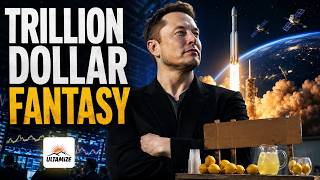
In this commentary, TJ Walker uses a vivid lemonade‑stand analogy to illustrate how SpaceX’s market valuation ($2.58 trillion) is wildly disconnected from its financial fundamentals (≈$18.7 billion revenue and a $4.9 billion loss). He shows that applying SpaceX’s 138× revenue multiple to a child’s modest lemonade sales would absurdly value the stand at $144 k–$1 million, underscoring the irrational “price‑to‑fantasy” metric investors are using. Walker then critiques the hype‑driven pricing, contrasting SpaceX with cash‑generating giants like Microsoft and Amazon, and warns that such overvaluation could seep into index funds and ordinary retirement portfolios, creating systemic risk if the hype collapses. He draws parallels to the crypto bubble, arguing that the market is valuing myth and Elon Musk’s personal brand rather than concrete earnings, margins, or competitive realities. The piece concludes with a cautionary message that investing in a company priced like a prophecy is dangerous for long‑term investors, and includes a brief promotion for his Ultimize learning platform.
Chapters
Ultimize. Imagine your 5-year-old starts a lemonade stand. You want to encourage initiative. You buy the lemons, you buy the sugar, you find a pitcher, you get the plastic cups, you drag a little chair outside and help make the cardboard sign. First Saturday morning, your kid sells $20 of lemonade. By the time you add up expenses, you spent $25. So technically the business lost money, but who cares? Your kid worked. Your kid learned, your kid showed initiative. Then at the end of the day, your child says, Mom, Dad, I'll sell you my lemonade stand for $144,000. I think you'd say, sweetheart, uh, that's insane. But it's not insane. It's just your child thinking like Elon Musk, because that's roughly the math of SpaceX. According to recent public reporting, SpaceX had about $18.7 billion in revenue last year and lost, lost about $4.9 billion. Yet the stock market has recently valued it roughly $2.58 trillion. Let me repeat that. $18.7 billion in revenue, a nearly $5 billion loss, $2.58 $1 trillion in market value. That means investors are valuing SpaceX at about 138 times annual revenue, not profit, revenue. There is no profit. This is not a price-to-earnings ratio. There are no earnings. The earnings are negative. This is a price-to-fantasy ratio. So let's go back to the lemonade stand. Your child sells $20 of lemonade on Saturday. If we generously assume the child does this every Saturday for a year, that's $1,040 in annual revenue. Now value that little cardboard stand the way investors are valuing SpaceX. $1,040 times 138. That lemonade stand is now worth $144,000 for a 5-year-old kid with sticky hands and a business that lost money on day one. Okay, but let's be even more generous. Let's say this kid is a lemonade visionary. This is not some lazy Saturday-only operation. This is a 7-day-a-week lemonade disruptor, $20 a day, every day, rain or shine, winter or summer, whether people want lemonade or not. That would add up to $7,300 in annual revenue. Now, if you value that at the SpaceX multiple and your child's lemonade stand is worth about $1 million. A $1 million lemonade stand and it still loses money. If your child came to you and said, 'Dad, I made $20 today and I lost $5. I'd like you to value my company at $1 million.' I don't think you'd say, 'What a bold entrepreneur.' You'd say, 'Did Elon Musk teach you math?' And if the kid wanted a $3 million valuation, Fine, at the SpaceX multiple, all your child needs to do is sell about $60 worth of lemonade per day. $60 a day, and it's a $3 million company. No profits required, just vibes, just hype, just a dream that one day this lemonade stand will dominate 80% of global hydration. Now that sounds ridiculous because it is ridiculous. But that's the kind of logic being applied to SpaceX. And before the Musk fanboys start screaming, yes, SpaceX is a real company. It launches rockets. It has done impressive things. Okay. Starlink is real. Satellites are real. Rockets are real. I'm not saying SpaceX is Theranos with a launchpad, but valuation matters. Price matters. Math. Price matters. A good company can still be a terrible investment if the price is insane. If I offer you a perfectly good hamburger for $9, fine. If I offer you the same hamburger for $4 million because one day it may become the dominant sandwich platform in the solar system, you are allowed to ask whether I've been drinking rocket fuel. Would you like to be the sort of successful person who is dominating news, at least in your industry? Well, if so, it's time to up your skills. At ultimize.com, I've created online courses to help you do that. Now, here's the thing, no obligation. You can get a free course on communication skills, a free course on how to build better habits. All you have to do is go to ultimize.com. That's U-L-T-A-M-I-Z-E. Ze.com, no obligation. Go there now. Microsoft makes enormous profits. Amazon makes enormous profits. These are gigantic, proven, cash-gushing companies. SpaceX, by contrast, recently lost almost $5 billion on less than $19 billion in revenue. And yet investors are valuing SpaceX in the same neighborhood as Amazon and Microsoft. This is not investing. It's celebrity worship with a brokerage account. This is what happens when markets stop valuing businesses and start valuing mythology. Elon Musk has become less a CEO than a religious figure for a certain type of investor. They don't ask, what are the revenues? What are the margins? What are the risks? What's the competition? What's the cash flow? They just ask, is Elon involved? And if the answer is yes, they throw money at the screen like it's a slot machine blessed by a Martian pope. But Musk's recent record is not a clean record of miracle after miracle. The Boring Company didn't solve traffic. Hyperloop didn't revolutionize transportation. Twitter, now X, didn't become a free speech utopia or a money machine. It became a stagnant, chaotic, brand-damaging mess. XAI and Groq are not obviously transforming the world. Cybertrucks are not exactly replacing F-150s in every driveway in America. And now we're supposed to believe SpaceX deserves one of the biggest valuations in corporate history because someday Starlink dominates the global internet market. This is not a business forecast. This is fan fiction written in Excel. Do people understand what would have to happen to justify this? It would mean Starlink and SpaceX growing into an economic monster that defies competition, regulation, national security concerns, local telecoms, fiber networks, mobile carriers, governments, geography, and common sense. Mm-hmm. The valuation assumes not just success, it assumes complete world domination. It assumes that everyone from Manhattan to Mumbai to rural Brazil to suburban France to corporate Korea to the European Union to the Pentagon to every telecom regulator in the world just shrugs and says, "Sure, Elon, you run the internet." That's not an investment thesis. That is a sci-fi movie where the villain wins in the first act. Now, here's where this becomes more than a funny story about Wall Street losing its mind. Because if SpaceX were just a private club for billionaires lighting cigars with their own money, fine, let them gamble. Let them buy Martian tulips. Let them pay trillions for a company losing money because the CEO posts memes at 3:00 AM. But SpaceX is public now in this scenario. That means this madness can spread into ordinary people's retirement If SpaceX becomes one of the biggest companies in the market, it can eventually end up in index funds. It can end up in 401(k)s. 401(k)s. It can end up in target date retirement funds. It can end up in the portfolios of teachers, nurses, firefighters, office workers, and people who do not know they are indirectly betting their retirement on whether Elon Musk can justify a valuation almost as large as Microsoft. That is the danger because what happens if the spell breaks? What happens if investors wake up one morning and decide SpaceX should be valued like a normal company? Let's do the math. If SpaceX is valued at roughly $2.58 trillion today and investors decide actually a company with $18.7 billion in revenue and negative $4.9 billion in profit should not be worth almost as much as Microsoft. What is the normal valuation? Let's be generous. Microsoft trades at a high multiple because it's wildly profitable. It has huge revenue, huge margins, and huge earnings. SpaceX does not. Still, let's be generous. Give SpaceX a Microsoft-like revenue multiple of 9 times sales. $18.7 billion times 9 is about $168 billion. That means roughly $2.4 trillion of market value disappears. Poof, gone, vaporized. That's not a correction, that is a financial asteroid strike. If you value SpaceX at 3 times sales, still generous for a money-losing capital-intensive company, it's worth about $56 billion. That means more than $2.5 trillion vanishes. If you value it at one-time sales, which for a money-losing capital-intensive company wouldn't be crazy, it's worth less than $20 billion. That means more than $2.56 trillion disappears. That's the kind of number so large it stops sounding like money and starts sounding like a Pentagon procurement error. A $2.5 trillion wipeout would be almost like erasing an Amazon-sized company from the stock market. Would be like vaporizing a giant chunk of American paper wealth because investors suddenly remember that rockets are cool, but losses are still losses. And yeah, maybe I'm overstating the direct crash risk. The stock market is huge. SpaceX would not be the entire S&P 500. Index inclusion has rules, although Musk seems to have convinced them to break the rules for him, not surprisingly. Not every dollar would be held by ordinary workers immediately, fine, but the danger is real. When one company becomes valued in the trillions based on hype instead of fundamentals, and that company is tied to one of the most volatile celebrity CEOs in history, That is systemic risk. What happens if Musk retires? What happens if Musk has, shall we say, health problems? What happens if Musk gets bored? What happens if Musk gets into a fight with regulators? What happens if Trump's political power fades and the crony capitalism premium disappears? What happens if Musk announces he is literally moving to Mars and we'll never see him again? Except as a glitchy hologram demanding more subsidies. The valuation depends on myth, and myths are fragile. Microsoft does not depend on one man's aura. If the CEO of Microsoft retires, your Excel spreadsheet still opens and ruins your afternoon. Amazon does not depend on one person tweeting at 2:14 AM. If Jeff Bezos goes full Bond villain on a yacht, Packages still arrive. But SpaceX at this valuation is not merely priced as a business, it's priced as Elon Musk's magic wand. And magic wands aren't audited. This is the same psychology we saw with crypto. For a while, people believed Bitcoin could do anything, replace money, replace banks, replace governments, free humanity, make every 27-year-old with a podcast rich forever. Then the story kept changing. It was currency. No, it was digital gold. No, it was a hedge against inflation. No, it was a store of value. No, it was a Trump trade. No, it was whatever sentence would keep the price from collapsing that week. SpaceX is not identical to Bitcoin. SpaceX has real assets and real services. Rockets exist, satellites exist, but the valuation has the Same smell. It's the smell of people saying, don't look too closely at the numbers, look at the story. And the story is always bigger than the business. The story is Mars. The story is humanity becoming interplanetary. The story is data centers in space. The story is Starlink swallowing global internet. The story is Elon saving civilization between posts. It's exciting. It's cinematic. It's also not a substitute for earnings. At some point, a company has to make enough money to justify its price. At some point, a lemonade stand has to sell enough lemonade. If it doesn't, you're not investing. You're participating in a mass hallucination with a ticker symbol. That's why this SpaceX valuation should scare people. Not because SpaceX is worthless, because SpaceX may be worth a lot and still be grossly, grotesquely overvalued. A house can be beautiful and still not be worth $900 million. A car can be fast and still not be worth the GDP of Finland. A lemonade stand can be charming and still not be worth a million dollars. And a rocket company can be impressive and still not be worth $2.58 trillion. The question is not whether Elon Musk has done impressive things. Okay, he has. The question is whether investors have lost the ability to distinguish between a real company and a religion or a cult. And right now the market is not valuing SpaceX like a company, it's valuing it like a prophecy. Prophecies can be inspiring, but they make terrible retirement plans. Mm-hmm. I'm TJ Walker. This is Filtered. Ultimize.