Episode 11: “Innovating Leadership with Dr. Nikolai A. Behr”
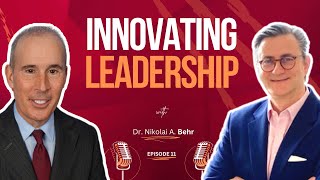
TJ Walker interviews Dr. Nikolai A. Behr (Munich-based media trainer, PhD in environmental politics). Behr discusses cross-cultural communication differences across European countries, his media‑training methods (body language, voice, interview prep, crisis response), and practical tips for leaders (clarity of message, listening, empathy, preparation). He emphasizes incremental environmental messaging, the role of job/security in persuasion, and experiments with VR and digital clones for training.
Chapters
The first experience was really CNN watching in Europe. And that was a very interesting time in the, in the 90s, mid-90s, from starting mid-90s, we could watch it now. The communication comes in. You have to still be able to communicate with and to explain your position.
Here in the United States. It seems that so many people who do care about global climate change do care about global warming. They're always on the defensive in terms of their communication skills.
But you have pushed people to ideas for the environment. You have to show them how critical the situation is.
That's kind of the standard archetype of a motivational speaker in America. Does that work as well? And do you still see that in Germany? Our special guest today is arguably the most renowned media trainer in all of Europe. He's fluent in multi languages. He's the founder of the German Institute for Communications. And unlike here in the United States, where pretty much anyone can call themselves a media trainer, he has tremendous credentials. He's got a PhD in environmental politics, an actual doctorate in environmental politics. He has an mba. He is versatile in all aspects of finance politics. He's worked with prime ministers, presidents of major companies and corporations and countries around the world. It is my great honor to bring with you, to bring with us today to the program Dr. Nikolai Baer. Nikolai, thanks for joining us. How are you today?
Fine, thank you. Tj, Great to see you again.
Great to see you. And I want to just dive right in and get your sense of cross cultural politics, media communication, because unlike me, I'm one of these ugly Americans who only speaks English. So I, I do have that, that disadvantage of having a, a bias where I look at things through a particular lens. You're there in, in the heart of Europe, you speak multiple languages. You're constantly having to juggle between different cultures because you have so many cultures there. What is it like? And how do you adjust your own trainings, whether you're preparing someone to give a speech or a media interview or to host their own podcast, factoring in all of these different cultural language nuances.
So thank you very much, TJ for having me and I'm glad to be able to talk to you about my work a little bit. So, indeed, we have a lot of international clients and especially, especially since the COVID pandemic. So we did always online training for, I say, eight years maybe now, and we offer seven languages with our training. So I don't speak seven languages.
Seven languages. I don't even know if I could name seven languages.
Well, you know, in Europe, we have a lot of languages. So you get to use. To use some Italian, some Spanish, some French, if you go in different restaurants or you go there on holidays. And you have to adapt a little bit. And indeed, the culture is different in every of these countries, and journalism is different, politics is different, and the style of leading companies is a little bit different. But what they all have in common, that the main working language, meanwhile, is English. So I worked in the industry for a big German or big Munich car manufacturer with sporty cars for seven years. So in there, the working language was English. And even before I was a lot of times in the United States. So that's where we met and we found out we're doing practically the same job. And after I left the industry and founded my own company here in Munich, Germany, I went out and looked for clients where I can bring in my expertise as a former TV journalist, as a marketing manager. And one of the first rules I learned, and I learned it already as a young journalist when I did TV interviews, is to listen. And that's the same in all of the cultures. You have to.
It's much more fun to talk, though, and to have everyone listen to us. Right?
Yeah. So sometimes it's hard to. Yeah. First listen to them.
Yeah.
And they will tell their problems. And sometimes if you are empathetic enough, you. You kind of feel, what's the real problem there? And, well, there's a wide range. What we can do, we do body language training, we do voice training, we do. We do a lot of interview preparation. We do preparations for general annual meetings, we do preparations for union meetings, for crisis situations, for press interviews. So back to your ct. Each and every situation, you have to adopt back to you.
Let's say you're working with a major CEO of a significant car company. How do you actually teach someone to be empathetic or to have better listening skills? Because many CEOs get in this bubble where everyone's hanging on their every word saying, yes, boss, right away. And it could be. It can be isolating and it can sometimes encourage bad habits because the person's used to just barking orders.
Yeah. There are still these CEOs who just barking orders. And for them, it's hard to adopt these new leadership styles, but if you can give them examples and you work with them and you do the training and you have the training together with some of their employees and you show them on a practical mode how it is if they listen clearly. And we have some exercises where you have to really listen to someone precisely to get the whole picture. And that's all about communication. It's the picture I have in my mind to bring the message across that you got the same picture in your mind. So we have so many doors where we open them and we just get a word or a sentence and think, oh, yeah, this is this situation. And we mostly don't imagine, well, maybe there's completely different meaning of this word or this sentence. And that's what we have to work out when doing the messaging. Apart from all the body language stuff. Yeah. When we just go to the. To the message. How to bring the message from the CEO to his customers, to his suppliers, to his team.
Now, you work with people in Germany, obviously, but Americans, Brits, French, Italians, all over. What to you is the biggest difference and how beyond the fact that the language can be different, what is the biggest difference in how leaders use language differently and listen differently? Walk us through some of those cultural differences that when you take on a new assignment, it you have to be aware of. Because I remember once making a huge blunder. I was training a bunch of Italian semiconductor executives, and we were in Paris, I believe, and I said, they said, what do you want for lunch? I said, well, let's just bring sandwiches in. You know, we got to get through this, get more, more time on camera, because time is so precious. And they informed me, tj, that is not how we do things here. And they practically implied I was a naked savage for suggesting that, like, we're going to have a proper meal, there's going to be a tablecloth, wine will be served, and we're going to have a proper lunch. I said, okay, and it was a great lunch, but.
And we would spend a long, long time there.
I was guilty of bringing my own American approach to things. So I made a mistake. Tell us, how do you prepare for different cultural nuances when you're in training or about to do a training with people?
So you could have done so in Germany. That's the difference between Germany and France. So in Germany, we're much more looking for productivity and have a short. Just lunch. Just a short lunch. And there it could work with the sandwich, even though most people eat a proper lunch here. But before going to a different culture on the language base, just see two different countries next to each other, like Austria and Germany. There's a huge difference in how journalists or how CEOs talk to other people. So in Germany, very directly, yeah, we say what we want. We are not very much polite. In Austria, if you do it like this, you won't be successful. I once trained the Austrian head of business of an international pharmaceutical company and the training was in Germany because all the heads of the different countries were assembled in Munich for this media training. We did the interview training like a journalist and asking tough questions on the pharmaceutical research, on why it's so expensive, on all this stuff. And out of a sudden he stopped and said, no, that's not the way we do it in Austria. What happened? No, I've never experienced a journalist so unpolite like you. Okay, what happens if a German journalist goes to Austria? No, I don't do this. I don't do this. And it took maybe 20 minutes for the press officer to persuade him to finish the training. He was so upset. And it was a real new experience for me. I knew that the Austrians are, compared to the Germans, are much more polite, but they really refused to work with you if you don't have a certain standard of politeness. And I don't consider myself as an unpolite person, but I can attest to that.
You're a paragon.
And you. The tradition in German politics is not to look too much to the rank, even if it's a minister or head of state or company boss. You try to talk to them on eye level and you're tough. And that's completely different in Austria, for example.
So that does raise the question, though, of what do you do if you're training someone. The custom of dealing with the media is one way for their country. And. But they're telling you, hey, I may have to go on the BBC or CNN or Al Jazeera. So, you know, they, at some level, especially if it's a crisis, they could receive journalistic inquiries from all over the world. I faced that dilemma before, especially if I'm dealing with, let's say, a political figure. In the Middle east, they're used to extraordinarily deferential media. They're not going to get that. If all of a sudden the London Times or CNN is calling. How do you balance what they're used to with what they might face? Because if you plan for everything they could face, it may jeopardize your relationship, but they think you're too rude.
Yeah. So when going to an unknown territory for them, we have two traders or two ladies who do intercultural training and look specifically into the country's specifics for the normal business language, for the normal international appearance, especially in business programs, in economic reports, there is a certain standard which is not reflected too much on the individual standards of politeness or procedures in these countries. So first of all, be smart, always be polite, be decent, but be clear, strong and concise with your message. Don't confront people, especially not in face of their employees in other countries. So there are certain techniques you should consider when going abroad, but in general, the most important is to have a clear message, to know what you want and to listen to your stakeholders.
Nikolai, let's step back a minute. You're younger than I am, but you're old enough to have seen a lot of change in the media landscape in your country, in your part of the world and worldwide. Who, growing up, were your role models as communicators and as media personalities. And is that what drove you into an early career as a journalist?
Well, one role model really was Larry King. I watched him a lot and that's probably the reason I'm wearing a lot of times this vest here. That's always my Larry King style.
The vest.
And when I do my many years, I usually wear this.
And for many years he, he wore suspenders.
Yeah, I'm not that old.
Believe it or not, I used to host a show on Larry King's first radio show in Miami Beach. It had, it was a thousand watts. If you drove more than 10 blocks away, no one could hear it. But I, 30 years ago, I was in the same chair he had been in 60 years ago. So his broadcast career ended up going a little, a little further than mine did. Who else were your role models?
Well, you know, in German tv we couldn't see that much from, from the US for example, so we, we had local German ones, a lot of, lot of very good ones, but they were never very famous in the US So what I really liked was when I could see it was the reports of Walter Cronkite, I can remember. And the first experience was really CNN watching in Europe. And that was a very interesting time. In the 90s, mid-90s, from starting mid-90s, we could watch it. And that was very, very good to see.
And let me just give a quick shameless plug. CNN's first White House correspondent ever will be our guest next week on the program, Bob Berkowitz.
So had to get, wow, very good.
Very good to get that, that plug in there.
And a couple of years ago, I, I could meet Wolf Blitzer in Munich. He was there at the ceremony for the international CNN Journalistic Awards. And I met him, I could talk to him. And it was very interesting because he was also one of these icons of, of modern journalism for me.
And then what was your path into journalism yourself?
Well, I. I started doing at that time. It was all analog with a V edge S camera and doing yeah, like little movies with. With. With my co students in school. And the project never finished because it was very difficult to edit. We had to have two VCR recorder and have to simultaneously start them and record. And editing was really hard that time. And later I joined the private radio in Munich when they started and made reports with them. And then I started my career here in Munich with TV White Blue, which was a local radio, a local TV station in Munich, just for the area of Munich. And that was pretty new because before in Germany we had just three big channels, two nationwide and one regional wide. So that was for the whole of Bavaria. But local news was pretty new in the end of the 1980s, beginning of the 1990s. And I joined them and I was there a reporter. And it was a very interesting time because at that time they just invented mobile phones. But there were really big suitcases and you had a car batteries. They were as big as car batteries, like car batteries. So now I was called from the editorial board, well, go to there, there is an accident or go meet this politician for an interview or so they constantly called me up, where I had to go as a flying reporter. And then we had these tapes and we had to send them with a taxi to the TV station. And then in the mid afternoon I went there with a car back to the editorial room and we edited together for the 7 o' clock news. So that was really interesting time where I learned a lot on. On journalism on. On tv. And later I. I joined the Bavarian television in. In Munich, which is the regional one for whole of Bavaria and part of the first German channel network. And then I also worked for the first German channel network.
And is there any, with all these stories and years in journalism, is there any one story that you were really proud of, where you feel like. Well, I put a spotlight on something that got attention in a way that other people didn't and that you're proud of.
Yeah, it was my first report which was broadcast at the Bavarian television. I was just like an intern there, accompanying experienced journalists. But one day the. The head of the editorial board said Nikolai, can you go to the parliament and just film some, some. Some news about the. Oh, now I missed the German, the English word for household. The budget. Well, the budget of the. Of the Ministry of Cultural Affairs. And well, they had their press conference. It was quite boring. It was 40 people there, maybe 20 journalists and 20 parliamentarians. And there was the. The minister, the head of the ministry, and he was talking and we were filming with the, with the camera guy and said, oh, God, that's so boring. And then I went during the press conference to the front and asked his press officer, can we have an interview with the minister? And while he was talking, still next to me, and then he said, what's going on? And I said, well, for Barbarian tv it said, yeah, go out, I follow you. And then we installed our camera nicely on the balcony with the view over all of Munich. And maybe two, three, four, five minutes later, the minister appeared. And then out of a sudden I had the idea, oh, my God, what should I ask him? I have no clue about the topic. So I asked, okay, dear minister, what's the bad thing on your budget? And he, he went red. And you're absolutely right. I wanted to employ more teachers, I wanted to employ more this and that, and I needed more money for sports and blah, blah, blah. And so he brought all his ideas out, which he couldn't do with the budget. And so then I got some more ideas, found some more questions, and the interview went wrong. Event went well, well for you, but.
Maybe not from his standpoint.
Yeah, he was quite good then. He was very experienced. But the first moment was. And then I went back to the station and the head of the editorial board came and said, nikolai, do you have this 30 seconds report? And usually it would be made with a narrator telling the story while showing the picture of this boring press conference and said, yes, I have it, but it's so boring. So I asked the minister and asked for an interview. And he said what? He refused to give an interview on this, on this topic. He said, no, I didn't interview. Okay, let me show it. Okay, that's cool. Can you make 60 seconds out of it and say, okay, I'll do it. Then later he come back and said, wow, do you have some more? Can you make 90 seconds and say, okay? So. And I did the 90 second piece out of this interview, and it was broadcasted in the evening news. And later he came and said, nikolai, from now on, you're journalist here at Bayruch.
Great.
That was the first interview.
Great success story. Now I hear that. And my own media training cap comes on and says, wow, that was what, decades ago. But you still remember the body language, which is why it's so important to. To look the way you want. Because if you can have the best messages in the world, if you look incredibly upset or angry, it has such A memory staying power. So that's. I'm wondering if you took the same lesson away. The second thing that jumped out at me from your, your story is just the power of asking. You ask someone in different contexts to give you an interview. Quite often they will. And that's a great lesson in life for anything. Just ask for things. Don't accept that. Oh, someone won't do that. But I want to know what other lessons you took away from that interview.
From this interview? Well, first of all.
The German official. Yeah.
First of all to prepare an interview better. I was not expected to do this, but to go into the topic and do a proper research, which I usually usually did with my, my topics and yeah, be.
Well. But even there, I'm wondering is, is one of the lessons. Don't be afraid to just ask.
Yeah.
A really general question because sometimes people will project something very specific that they were trying to hide. And, and you could have researched for maybe 10 hours and not come up with that by asking a general question. He kind of read into that negativity and took it in different ways. Is that, is that one of the lessons?
Absolutely. Absolutely. Have more courage to ask for something. Yeah. If you don't ask her, she will never say yes to you. You know, that's, that's a, that's a rule in life. And a lot of times we are, yeah, is it decent? Or we, from our education, we say, oh, no, I'm not sure if I can do so well ask. And if the other person says no, then okay, but at least you have tried it.
Great words of wisdom from our expert. What are your five top or handful of top tips for communication and public speaking that you really stress to people? Whether you've got five days to work with them or five minutes. What are your top tips?
Be clear with your message. Live what you say. Check beforehand your target audience. Yeah. Who is it you're talking to? What do they love, what do they hate and what are they afraid of? And then create really a clear message, a core message that everyone can understand. And then give good examples, Give some numbers, not too many. Yeah, I do a lot of trainings in the technical departments and they, they tell you about every machine. 200 technical details. It's too much. You cannot process this. So the normal human can process maybe three different data. So stick with them. If someone is interested, he will ask for more. But don't deliver too much at once and don't speak too uptight, maybe is the English word for it. So don't speak in Your company language speak as you would speak with a teenager. They're quite inquisitive, they like to know everything, but they don't have the language ability of a grown up. So I think that's, that's quite a good idea.
Great tips. Nikolai, do you have any, one tip that surprises people the most where they think, well, I don't, I haven't read that in the public speaking books or that is counterintuitive to people or any, any tip that you find is, is unique. And people say they really haven't heard that before.
Water, Clear water.
I'll drink to that.
For two reasons. Water is for your voice chords, what oil is for your combustion engine. But second and most important, medical researchers found out that if you're slightly dehydrated, which most people are who work in office environments, your brain is up to 35% less able to process or to help you or to work properly. So you have up to 65% left of your brain capacity if you're dehydrated. So that's not good. If you communicate. Yeah. And CJ asks you something, you should have the hundred percent, so you should drink 100.
Yeah. Great tip. I appreciate that. If you could share some of your top crisis communication tips for how you advise politicians and other leaders how to talk. Whether you want to use this, this particular news story is an example, or if you want to pick your own, I'll let you judge.
Well, when it comes to crisis communication, you don't have general tips in general, you have to look into every case, into every situation, and every situation is different. What all these wars and crisis show is that it's better to talk and to negotiate as long as you can. On the other hand, if you try to negotiate with the devil, you have to be strong. You cannot negotiate with the devil if you have your bare hands. So there are crisis situation and crisis situations, and usually when we work with companies, we talk maybe about the effects of crisis and wars. We have a war right here, 2000 km away from where I'm standing now. And the effects for the German and the European economy are tremendous. Much more than Covid. Yeah, that's the biggest crisis in your.
Energy supplies and many other aspects of your economy.
Yeah. And I mean, there's two big markets who just fell away, broke apart or broke away. And so we don't do any negotiation in wars in a political way, but we're talking about the effects and some tough decisions for companies. And there we have to gather all the necessary information. Sorry, we have to see the other person's perspective. And then we have to prepare internally before we start any negotiations. And it's always good to have a team of negotiators. So you have one person who is negotiating and you have one person in the background who is like the head of the negotiation team. So therefore the negotiator can always say, okay, I take this position, but I have to talk with the head of negotiation in my company. That's always good to have such a team, not just a one on one situation. And with most communication situations, preparation is key, active listening is key. And to have a clear strategy when you know what you want. That's the first part. And then also draw a line how much you could give in this specific situation, how much you can give away from your position to still have, okay, agreement for yourself. So it's not always possible to have a win win situation, but it's mostly possible to have a, a position where you, you keep your face and don't you use your face. If you look into the mirror.
I do want to bring up another contentious political issue, and that is climate change and environmental politics. And I know that's an issue near and dear to your heart because you actually have a doctorate in environmental politics. I do want to give you a heads up. In a few minutes, I'm going to ask you to do something. It may seem peculiarly American, but I'm going to do something with you that I like to do with every guest, and that is to give two minutes on the screen, no questions. I just want you to promote. We try to encourage people to embrace speaking on behalf of themselves, whether it's a job interview, a new business pitch, and get comfortable talking about how they help other people and what they're good at. So I want to give you a heads up to promote any aspect of your business. Think of your ideal client, your ideal American client, whether it's General Motors, if their executives are watching this. I wanted to give you an opportunity to promote your website, upcoming books, documentaries, anything you want to promote. And I'll. I actually take myself off the screen and let you just promote in a very undiluted way. So that will be coming up in a minute. I want to get your, I want to pick your brain as a strategist now, because here in the United States, it seems that so many people who do care about global climate change do care about global warming. They're always on the defensive in terms of their communication skills and their communication messages. Because the people who want to say well, global warming is a hoax. And this whole environmental stuff, it's just a way of attacking big businesses. They are often, and this is not my belief, they're often more successful at communicating to voters. In fact, without going into all the politics. There is a, a major presidential candidate in the United States this year who has been a president before and says that his first, you know, one of his first actions is going to be to roll back every pro environmental policy to make it virtually impossible to buy an electric cars because he wants people buying more coal and gas and putting it all out in the environment he seems to be getting right now. He's leading in the poll. So something the environmentalist movement is doing. No matter how many facts are on the side, they're not communicating effectively. They're constantly coming across as scolds, as people who want to take away your fun, make you bike to work instead of driving in a nice car. They're constantly people who, who seem to be getting it wrong. Because if you have a cold day and day colder than normal, it means there couldn't be global warming compared to the other side. So I want you to put your strategist hat on if you could, in at least in the US political context, which I know you're familiar with. How can environmentalists and politicians who support stronger environmental policies communicate effectively? Because I just see them constantly on the defensive.
From my point of view, a lot of them are too radical. I think if you do smaller steps one by one, you can reach the same goals. Yes, the situation is drastic. It's a really bad situation. The environment is in on how people.
Can communicate more effectively. Pro environmental messages.
Yeah. So it's a big topic and it has a lot to do with education. So if there's a big guy telling the people everything is hoax. Well, they should watch the weather. The weather cast, you know, they should see the statistics on how much more this thunderstorms are in the recent years, how much more floodings are worldwide, how much the rays of the, the, the average temperature is in all continents. That are facts. That not, not alternative facts. These are facts, scientific facts. And the point is discussing these things with people who do not have the ability or the access to proper education.
That'S hard.
That's really hard. And they fell usually for people who have radical simple solutions. But we live in a very complex world and everything works together. It's like this little, how you call them, these wheels who go into each other, you know, and turn every machine. So one effect causes another effect and this causes Another effect. So it's not that simple in saying, no, we just don't care and it's a hoax. That's wrong. And a big, big percentage of the world sees it and believes it, and we have a lot of effects. And you cannot say that's not true. Well, you can.
It does bring up the.
So for the environmentalists, I think it's important not to be too radical in what they demand. They should go for smaller steps and the resistance is too big. If they say, well, we should stop selling combustion engine cars, they should say, okay, tax them more than other vehicles or tax.
Even. That position is now seen as too radical in a lot of parts of the country. Here in the United States, the idea that you would give any favor to an electric car, for example, is under attack. And in certain states, the one I'm in right now, you can be fired from your job for even using the. If you are a government official using the phrase global warming is seen as so politicized. So there's certain challenges that, to me, that brings up a much bigger issue which I know as a communicator you have to grapple with. We live in a world now with social, social media fragmentation, filter bubbles.
What's about the freedom of speech?
And there's freedom of speech issues. But one of the issues that I find myself grappling with and so many others is if you believe in freedom of speech, which democracies tend to value, it does seem to favor those who are willing to tell the biggest lie. Because if you just constantly spew lies and you have another side that's committed to factual discourse, rational discourse, they're spending all of their times correcting lies. And then people hear the lie over and over again. That becomes the template. And I'm wondering, how do you advise. How do you advise a corporate client, for example, that is subjected to certain opposition where there's just so many layers of lies upon lies that if you spend all of your time trying to debunk the lies, your own positive message never gets out. Or it seems to be a radical position because of an infrastructure of lies that have been built around it.
So if I see the big corporates, even the big American corporates, they very well see the effects of global warming and the environmental problems. It's much more a certain political wing in the US who denies it. In Europe, for example, there's just a minority who says that's not true and that's all hoax. So most accept science here, but we have to go step by step. You Know if we, for example, what the German government did to be very radical within the last two years with, with heating systems in Germany, we're not allowed to have any more gas or any more oil, for example, or any more electrical, usual electrical ovens. We have to go with solar panels, with wind and with these exchange systems, air exchange, warming, I don't know how the correct word is in English for that. It's too radical because you have people who just ordered a new heater and they cannot build it in their house or they cannot afford the other one, or it's, it's not suitable for their personal environment. But you have to push people towards ideas for the environment. You have to show them how critical the situation is. But one point is important. People first of all need their jobs and they need their food and they need their security. And if they're afraid of this, they won't listen to environmental problems because the others come first in their hierarchy. So you have to do both. And well, I'm not in the position to give the US or any US politicians good advices. We have enough problems here in Germany. But sometimes you have to bring it in a real perspective. What Germany can save in Energy and CO2 in one year is blown out in China in three days. Last year I was two times in Egypt and the bigger area of Cairo, the capital of Egypt has 27 million inhabitants and there's constant smog. If you fly in to Cairo, you barely can see the roads or the streets even in a clear day because it's so much smog there. If you see this, then you come home and ask yourself, okay, and why we're not allowed to have a diesel car going in the city center of Munich. That's ridiculous. You know, for some people it's too radical. And now the communication comes in. You have to still be able to communicate with the people and to explain your position. But in the last maybe two decades, people stopped talking to each other. They started more talking about each other and got their information not from their neighbors or from the community where they engaged in former times. They got it exclusively from social media and from their social media bubble, not from the other bubble who might have a different opinion because they want to hear their own stuff again and again and again, like an echo chamber, and want to have this good feeling because if someone else is saying the same stuff, what I'm saying, usually then I'm pretty good.
Well, I'm right part of a community where we're the good guys against the bad guys. Over here yeah, it is a. And it is a harmful dynamic that we can all fall into that we.
Have a big community. And the big community is the inhabitants of this planet. And if we destroy it, then is no more, no more good life on this planet, you know.
Well, Nick, I appreciate you going big. Nothing is more big picture than the entire planet and the fate of the planet. Let's drill down and go really deep into something for a minute in tactical areas. Because a lot of people who watch this show are interested in communication skills, communications training and I'm always interested in different approaches. If a CEO comes to me for a day of training, it's typically we have dinner the night before we start for the day and I'm going to get them on camera for a dozen little speeches or media interviews. And it's we role play, watch critique again and again. But that's not the only way of doing it. Tell us how you what a typical engagement is for you, whether it's a CEO or a top executive. They come to you and say, hey, I just want to get a lot better at my media skills or presentation skills. How do I work with you?
So it's a shift there. So let's start 15 years ago, usually I got a call from the press officer in let's say 70, 80% and they say my CEO needs this and that. Nowadays it's say 50, 60% the HR department or the HR department for the top management calling me and maybe only 20% press officers and maybe 10% the the CEO office by itself. So the awareness is already different. And most of the modern leaders know they need someone to coach them, to support them with their messages, with their appearance on important communications. Yeah events. And we have coach CEOs who call me two days ahead and say, well, I have this big meeting. Do you have still time for meeting or can you give me an online coaching for this? And others who do on a regular basis like say four times a year, plan it couple of months in advance so you have everything in between. Usually when we have a training meeting, we don't meet the evening before. That's very rarely, but it's a good idea. I try to invent this. Usually we start in the morning, make some research together what's important for them in their message. And, and I ask them, okay, what would be your message to this target group? And often we change a lot within the message itself before we start talking about the appearance in front of the audience. And then we do a lot of training with the camera together and sometimes I have the camera with me. Usually we have a camera person, a camera lady or cameraman doing the job to give it a more professional environment. And for some people, it's really stressy if they have the big lights, if they have the microphone and a big camera.
Now is that good, Is that good or bad? Because I've heard people say, oh, we don't want to stress our people out. And I always say I want them stressed. If they can't perform in the stress of when no one's going to see it, how are they going to perform when the real CNN is there? So how do you view.
That's the point.
What's the appropriate level of stress to give in a training is really the question.
It depends a little bit on your experience. And imagine some football or basketball trainer doing just the training. With softballs, it wouldn't work. Yeah, you have to have the, the actual ball. You have to have the actual foot force you, you need for later. And if they fail, well, then they fail, but then they learn from their failures and it's documented on camera. And you, you see every round and they're getting better and better. And that's the great. On our job, T.J. in the evening, they're all happy because they see a big progress. I've, I've practically never had a client who did not seem progress. Well, I had once a lady, she did not saw the progress and she had no progress because she didn't want it to. Yeah, she refused to do it. She, she refused.
What do you do? What, did she refuse to be on camera or did she have to be there, change things?
I told her and I showed her and she didn't believe it. I mean, sometimes that happened, but in 17 years where I have my company now, but usually you see this great, great progress and that, that's, that's so helpful in our business. If, if we see. Sorry, my screen went black again. Oh, I have to work on this.
Your energy saving devices are doing their job. They're saving.
Yeah, yeah, yeah.
But we can see you and hear you clearly. That may be an indicator I am stealing too much of your energy and all of your time. We do appreciate it. Let's switch gears a minute. I do want to offer you the same courtesy I give all of our guests and apologies if this seems to stereotypically hyper promotional America. But what I want to do is hear you promote because we try to encourage people and empower people to feel confident when they are promoting their businesses, their craft, their service, their expertise. So I want to do is just give you a couple of minutes and you can set the stage as far as whether you're speaking to a convention of automotive CEOs and you like their business, but really sell us on what you do. And if you want to encourage us to sign up for follow up with you on LinkedIn or your website or any of that, feel free to do. I'm going to step off. I'll be here. I'm not leaving, but I'm going to step off and I want to just hear you promote and tell the world about what you do and what you're happy about doing.
Hi, I'm Nikolai and I like to help you with your messages, how you bring your messages to your target group and how to make clear, concise and empathetic communication. If you're interested, you can look me up on the Internet. You can subscribe my newsletter. It won't be very often because I usually work with CEOs and executives on their communication and do not have that much time to write my own newsletters. I'm sitting in Munich, Germany, but I have a lot of international clients from all over the world, especially big companies also from the US who work in the German or European market and are not so familiar with the European environment, with the European communications environment. And if I can help you there, I'd be really glad if you contact me. And I thank TJ Walker for this possibility. It's a very interesting show and I like to watch it with a lot of interesting guests and now I'm one of them and I'm very proud of it. Thanks a lot, TJ and if I can help you, just contact me.
Great. Thanks, Nikolai. I want to sort of end our program by looking at the future because I've known you now for a long time and you're always experimenting, whether it's with panoramic view video, live video. What technologies fascinate you the most in terms of really helping you and helping your clients communicate more effectively? I know I'm. I've become obsessed lately with digital clones and what they can do. But I want to know what you're focused on. What are you testing? Because you're always testing new things as well.
Yeah, maybe you remember I had this 360 degree VR goggles where we do the media training if someone has stage fright. That works quite well and I will probably update it when we, when we will have the, the new Apple Vision Pro. It's, it's not available in Germany right now, but I will be in The US in, in August and we'll have a closer look to it. Maybe we can work with that as well.
Can you walk us through that? What, what is that? How would that help someone if they're nervous about public speaking? How would you use that?
Well, we, we can simulate different environments and we go step by step from a small room with just two colleagues to a bigger room, like a seminar room with 20, 30, 40 colleagues to a big audience in a huge theater. And you let people give their speech and then you see their reaction, you see their body language, you see their voice change from room to room. And even if they know it's not a real environment, after, let's say one or two minutes, they're fully into this situation. And for them it's a softer approach than to go from around of 10 people to an audience of a thousand people. So that's very good. And we liked it. We were like a pioneer here. I've never met someone else doing this. We started this in 2016 and we still like it. We do now a lot with avatars. We experienced a lot with them with this digital clone we did a series on.
Let me follow up on that. If I could. Do you have a digital clone? Like if I go to your website and I spoke German, could I have my question?
If you have my YouTube channel, I have an explanation why you need media training In I think 15 languages. And most people don't even realize that this is a clone. For me, it's obvious because it's, it's, it's a wide angle video which was, which, which created the clone. And we will probably update this, but it was just the experiencing. And I can tell you I was invited last year for a, for a keynote in Cairo, in Egypt on fake news and deep fake. And first of all, I presented them my digital clone on screen, telling them in Arabic, watch out, there's an analog guy coming and telling you something about deep fake and fake news. Don't believe him. He's completely analog and he's from Germany. And they stared at it and said, that can't be. It's unbelievable. How did you learn Arabic so good? He said, no, that's, that's a clone. And I said, well, how, how good was the Arabic? And I said, nikolai, this Arabic is so perfect. Probably only two professors on the University of Cairo could speak that kind of Arabic. It's too good. So, and, and by the way, we've had, right now, it's just a little bit of fun.
One second. We've had Some people asking to see your YouTube channel. I just want to remind them if you scroll up in the comments earlier in the comments we, we've posted a link to Dr. Bear's YouTube channel and you can, you can fish around and look for that as well.
Oh yeah, Unfortunately I have two YouTube channels. The English one has not so many hits, so I gave you the German one with an English playlist. But the avatars I think are on the other one. And it's, it's Dikt Media training. Maybe they can find it this way by YouTube or if they, if they sent me a message I will, I will send them the link and it's very funny and we have posted your.
LinkedIn page and they can reach out to you there as well. And we'll try to post the correct link in the show notes as well. Do you envision a day or maybe you're already doing it? Can your clone actually conduct a training with a client at this point? Can it answer people, listen to them, respond to them?
I think for some basic training, definitely yes. I mean we did training together some like the trainings we did where it's pre recorded. You can bring a lot of information across with a clone.
For, but can't listen to because that's what I'm spending all my time on frankly is I've built a clone using it. It's not my technology, but it's Delphi AI. I've fed in all my books and YouTube and courses. So now if you go to it, you push a button, you ask it a question and in fact I did it earlier, I said, hey, I'm going to be interviewing Dr. Nikolai Baer. How can I make this interview interesting? And it would talk to me and gave me suggestions for questions to ask and things like that. Will your clone be responsive at that level or is it more giving out pre recorded video messages?
Yeah, at the moment it's pre recorded video messages because I had not the time to be honest, to go deeper into that. But I know it's possible right now and it will be much easier in the next couple of months to program it like this. If you're experimenting with ChatGPT for example, and you feed them with all your informations, they really give very clever answers. And a lot of my clients work with, on, on their website with chatbots who are programmed by just reading all the informations in, in they could provide from the company and they can give quite proper answers. So yes, we can do this for like group trainings, for introductionary trainings. To certain fields of communication.
It's exciting times to be a communicator. And this can save, absolutely save a lot of time because our clones can be available 24 7. Speaking of time, I appreciate all of your time today. Very Special thanks to Dr. Nikolai Baer for being our guest today on the TJ Walker Success Show. Thanks again.
Thank you very much, TJ. Have a great time and all the best for your show.
All right, thanks. Thanks, Nick. I appreciate it. Take care and say hello to your family for me.
Definitely. Right, you too.
Thanks a lot. And we'll, we'll send you the links to the finished shows too, when we get them. But this one will actually be up, you know, second we stop the live feed. It goes on as a live on demand. Yeah.
Okay, great.
All right, so let me ask you about. And because a lot of our viewers, you know, this is what we call the post show, which we show sometimes in there. And I want to be respectful of your time because I know we've kept you a long time. So tell me if you remember, what ideas did you get from last year that you've used? Because I went to their conventions for many years and I kind of stopped going because I felt like the proportion of bad ideas I got was too high compared to the good. I mean, I don't mind bad ideas if I get. I don't mind 20 bad ideas. If I get two really good ones I can act upon that, make a difference. But I just found after going a number of years, the percentage of bad ideas I got to good was out of whack. And there were just so many people there who didn't seem to have any revenue model at all and were just kind of fishing around for a hobby. And the vanity of wanting to be able to say, I'm on stage speaking in front of a lot of people. So that's kind of. Kind of why I stopped going. But things could have changed and I may be out of touch. So do you remember anything that really jumped out at you that was particularly valuable that you hadn't heard from any place else that you acted upon?
So I think the big difference from the US To Germany is the level of enthusiastic engagement with the audience on stage. And that's so much different to Germany. And I think we can a lot learn from that and the connection between the audience and the stage, the artist performing on stage. And an important point is in that, that you can see on stage the. The higher the level of empathetic communication and honest communication comes from the Stage, the higher the engagement is in the audience. And that, that's quite a big stage there for a couple of days. I mean, there was thousand three hundred people or thousand five hundred people. And most of the of the speakers had a really, really good connection to their audience.
They have a lot of good speakers. There's no doubt. I remember the first convention I went to, I was thinking, wow, some of these people could stand up and read a phone book and I'd be on the edge of my seat.
I mean, it was Les Brown, you know, I mean, he's a legend. Yeah, but in the end, his, his messages are so simple, but they are clear. And you, you see that he believes what he says and he, he, he, he walks and lives what he says.
He is a great speaker. I met him at an NSA conference and yeah, it, but let me ask you, how does the motivational market work in Germany? Because here Les Brown is sort of the, you know, this epitome in some ways a standard of a motivational speaker. He grew up not far away from where I am right now. He grew up in Miami, very poor, didn't have any parents. I think his grandmother, aunt raised him, was a twin, was labeled. This was the medical term they used at the time. I think educably. Had every kind of disadvantage thrown his way and he made it, became rich and successful. And his message is, you know, as a motivational speaker, if I could be born with absolutely no advantage, no education, being labeled mentally deficient, if I can be successful, you can do. And people like, wow, if he can do it, what's holding me back? That's kind of the standard arc archetype of a motivational speaker in America. Does that work as well? And do you still see that in Germany?
It's different in Germany. We have now a generation where they try to do it, and some are successful there, But it's not as common as in Germany. So Les Brown is not so famous over here. Here. The only guy who's really famous, the only American one, is Tony Robbins. He is quite famous from the Americans. But in Germany, it's really a language thing. So there are some German motivational speakers who have a very good living, but their show is not so big like the ones Tony Robbins or Les Brown are doing. Usually I have not to do with them so much, you know, because that's a B2C business, and I'm so much more into B2B business. But you can learn a lot from them. And for example, one person really hit me. I forgot her name, but she is the CEO of the Dallas Mavericks. And she had a really hard childhood and she is now one of the most influential ladies in. In sports management worldwide. I mean, she is really working with these big basketball guys and all the. The management and promotional stuff and all the, the. The big money behind it. And she is such a decent and lovely person, a strong woman, made an exceptional career. And to meet persons like her and to talk to persons like her, that was really incredible.
We'll have to check her out.
Like the founder of Netflix. I met the founder of Netflix. Very, very brainy guy. Mark. I don't. Mark Rudolph or something like that.
Well, there's Reed. Reed Hastings is one. Oh, Mark Rudolph. I've read his book. Yes. He was the original, original founder who, who left very early on, but very.
Interesting persons and, and also to meet the other. Other persons, you know, and, and see what made them to become a speaker or a coach.
Yeah.
Probably years, it's always the same, but for me, it was really, really good, really good experience. Give it another try.
Who knows? I may, I may see you there.
Who.
Who knows? I know I gotta respect your time. We have to say goodbye.
This, this time this year, they have a youth conference and I bring my son with me. He attends the youth conference. So you could bring your daughter. It's from.
That's a good idea.
10 years till 17 years. Great.
Well, she's in that bracket. She's 11 now.
Yeah. Great.
Well, say hello to your son and your wife and hope to see you soon.
Okay. All right, take care.
Bye Bye.
All the best for you and your family. Thanks.
Take care.
Bye.
Bye.
More from TJ





The Breakout Cases - What Actually Caused Famous Speaking Career Breakthroughs | Ultamize

The Red Circle Sessions Finale - Build the Speaking Career You Came Here For | Ultamize

Two Stages, One Logo, Two Completely Different Realities - Main Stage vs Independent Events | Ult...

Pre-Reset - Why Repetition Builds Better Speaking Decisions | The Red Circle Sessions | Ultamize

Your Decision, Your Framework, and What Happens After - Build Your Speaking Career First | Ultamize

The Red Circle Sessions Trailer - The Speaking Career Truth Nobody on That Stage Will Tell You | ...

The Two-Minute Ultamize Reset - Your Platform, Your Audience, Your Voice | The Red Circle Sessions