Episode 2: “Mobile Homes: The Hidden Real Estate Goldmine”
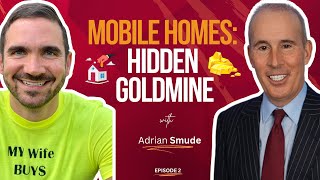
Adrian Smood went from eviction to building a mobile-home rental business. He explains why factory-built houses are undervalued, how to start investing in them, and why the stereotype of mobile-home residents doesn't match reality.
Chapters
I do think you have to have self awareness to make money in any kind of real estate business.
You are completely right. And most people don't realize what you realize. There is a personality type but I only teach what I actually know, what.
I actually do through the forum of the books. But also an online course or a day long seminar or what. How are you doing it?
Day long seminars, video courses and then going to other people's events and speaking making they were putting permits for tall buildings. They're getting a higher taxes on that and they need it. If you're watching we've got these nice beautiful older ones then we have really beautiful newer ones and then some other ones here that are in the middle. Yes, all three of those are styles that you can learn to invest. And I know there's even houses being built now where they build the wall and it gets shipped out.
HGTV the real lives of Beverly Hills Real estate agents. Let's face it, real estate is glamorous. Big beautiful mansions everywhere, beautiful people getting rich all the time. That's where to make money in real estate.
Flip.
Buy something for a million, put a few things in, sell it for 2 million. That's where the excitement is, right? Well maybe, but maybe not. Our guest today is an expert on making money through mobile homes. Not quite as glamorous but you know what is glamorous? Money. Our guest today was once evicted from a place he was renting and that started him down a path of wanting to be independent, to own his own reality, his own homing, his own home and shelter. I'm very happy to bring with us a best selling author how to buy buy mobile homes. Our special guest today is Adrian. 5,000 square feet. It's got a swimming pool, it's got a tennis court, it's got an acre, nice landscaping. I've got another house. It's a mobile home. You can have either one. I'll give it to you and you get to sell it for the profits. Which one would you want? Most people I think are going to say TJ give me the 5,000 square foot house. And yet there are houses like that where I grew up in Charlotte that you can buy for 6, 700,000. Whereas right up the street from me in Florida, a little place called Briny Breezes. It's a mobile home park. Every mobile home there now sells for more than a million dollars. So what's going on? I've never lived in a mobile home. Tell us starting from scratch what is a mobile home and how did you get Involved with this?
Well, I've never lived in a mobile home either actually, but I have owned a bunch. I still own a bunch of them. A mobile home is essentially a house that they built in a factory a long time ago. Pre 1976, every state had their own laws about them. So I kind of joke around as a wild, wild west of mobile homes because they were all built a little different. Now we have a good code because they're built in a factory. There's oversight. That's actually a lot better than a house that's built, built on site. So there's not as many shortcuts that happen with them. But then they bring it to the land and they place it there. You mentioned a mobile home park. That's a really popular way. We have a bunch of mobile homes all in one little condensed area. It helps provide a lot of housing. Or we can also have a single unit mobile home on some land where you own the dirt and you own the home. You get the privacy, you get control. And it's the affordable housing space, the workforce housing space. The first time home buyer space. Especially today with rates that have gone up so much. So that's how. That's about mobile homes. How I get into it though? You asked me that as well. So I was an evicted tenant, as you mentioned. I got into real estate. I had the single family houses, but then I really wanted more cash flow, so money coming in every month. And that's when I found mobile homes. I talked to really seasoned investors that had been around, been investing for longer than I had been alive. And they all talked about mobile homes at some point in their career. I said, all right, I'm going to try these because, well, they're obviously smarter than me. They've been in the business a long time. I bought my first one. Honestly, I got addicted to the cash flow. I've since switched my entire business over to buying and renting single unit mobile homes, the home and land together. And then word got out because, well, I wear a bright yellow shirt all the time and I talk about what I do and people started asking me to speak and teach and that's actually what led to me writing the book.
So what do people learn from the book? I know that when I mentioned mobile homes to friends who are in real estate, quite often they will say, yeah, you can make money there. But the problem is if you're renting it, you're dealing with people who are often in very bad spaces in life. And it's not to say that, you know Rich people are better than poor people or middle class people are better than poor people. But they have shared with me their concern that you're dealing with people where it's uncomfortable. You've got a single mother who just lost her job. She hasn't paid her rent in two months. Do you want to be the person who has to evict the single mother with a child?
Well, that is the extremely common stereotype. And I'm going to be a little politically incorrect and use the term trailer trash. You know, the Netflix specials and I.
Have heard the phrase before.
Yeah, you know, it makes fun of all that. We get that stereotype, but it's not true. It's like any stereotype, it's not always true. I'll tell you, a lot of our residents, most of our residents, blue collar handyman, handy woman, and they take pride in their home. And it's a little ironic, the scenario you bring up. My second mobile home ever, I rented to a single mom with her kids and she sent me pictures within a week of how she's made it her own home. And Spruce spruced up the place and made it her home. And what I didn't know until after we signed the paperwork, she was homeless the next day and she's still there today. I've never had to evict her or anything like that. We have very low eviction rates. It's the affordable housing space. People want to move somewhere and stay. Now, yes, there's areas that they're not so great of. Areas what? You could find apartments there, you can find houses there. But all of a sudden you put a mobile home and this stereotype comes up. We haven't found it to be true. We buy in areas that people want to live and we look for people that want to live there a long time and make it their home for their family. And that is the business we're in.
When did you write the book and how does the book impact your. Obviously, for any author, if someone buys your book and you make money, that's nice. But for most nonfiction writers, myself included, book service, business cards, book service, deal flow. Walk us into how the book plays a larger part of your entire business.
I wrote the book about two and a half years ago. It took me four or five months to write it. I partially wrote it because I didn't think I'd ever write a book. I was in remedial classes all through school, so English and writing was not what I ever wanted to do again. But I like to do hard things and I Actually heard on a podcast about writing a book. It hit me the right way. So I hired a coach, started writing the book. Now the book is a journey from me starting as evicted to tenant to retiring my wife at 29 years old. And through it I teach stories about actual mobile homes, how to invest in them. So it's an inspirational story and it's a education for mobile homes. And then what else is it for? Yes, I have some education. You know, some people take all information in the book and they go act on it. And then some of us want more information. We want a little more confidence in our videos and more of that. Then I do have education through there. That. So the book is a really good business card, as some people say. And it's just opened up more doors. I mean, I'm here and I have a book.
So your. The book is out. What's the, what's the profile of someone who reads your book and then actually uses it? Because I'll give you a little confession about my own real estate journey. I've had a family member very interested in, in real estate. I thought, okay, let's go into the real estate business. So we bought a rental property in Jersey City, New Jersey, under the. The premise that that was the only place left in the entire world where you could buy a property, get to Wall street, get to downtown Manhattan with one train in less than a half an hour. That's the only place in the entire world you could buy property for less than a million dollars. So that was our investment thesis. We bought a home, fixed it up, had tenants, had management for a while. After I bought the house, I said, maybe we'll do more of this. So I went out and bought 50 books on real estate, every kind of real estate, including once on mobile homes. Quickly came to the conclusion that I did not have the right personality to be in the real estate. Nor did my family member want to deny, nor did my family member, because we can't stand boring details. We can't stand due diligence. We can't stand calling for plumbers to get the best bid and finding. And we can't stand running security checks on tenants. And it occurs to me that really most people don't like those things. And it takes a special type of personality to make it so. We lost money on that investment and we lost it in a time where the property values appreciated 25%. So imagine how poorly we would have done if there had not been massive appreciation. So I say that as a caveat to anyone watching this I do think you have to have self awareness to make money in any kind of real estate business. Because the reason I think, Adrian, you do well is you have the tenacity. And I'm just, we don't know each other. I'm just guessing here. You have the discipline and the tenacity to do a lot of boring stuff and to look at boring details and to do due diligence that most people aren't willing to do so with that is. And I'm going to try to be quiet and not not have a long monologue more in this interview. Let me give you the opportunity just to respond to that.
Oh, I loved everything you were saying. You were completely right. And most people don't realize what you realize that there is a personality type. So I learned before I got into mobile homes that multifamily was not for me. I was very fortunate to get to have lunch with a big multifamily investor. And I walked away from it like no, these just aren't for my personality type. And so I found a lot of things that weren't for me which gave me a smaller amount of items that were for me and mobile homes. What do I really get out of it? That I'll say keeps me going with it is I get to help people that are in a different special niche of a class that don't normally get helped. So that's where I get my emotional fulfillment. Why don't I fix and flip them? Because that sounds terrible to me. It's. It's work. I would be burned out. I would probably go belly up. I don't get the emotional value out of the before and after. I get the emotional value out of helping the person out of their home that needs to sell but doesn't know how to get rid of the home. And there's not a lot of people helping. There's tons of people helping apartment owners and single family house owners. There's not as many that are because of some of harshly the stereotypes. So I get those emotional values. Yes. I have to do these boring things over and over again. I'm not going to say I love those, but I knew I had to get through it. I'm very fortunate today that I grew the business to a point where I have a office manager, she's stay at home mom and she likes doing those things. So I looked for someone that could fulfill the pieces that I don't enjoy. And she does. And you know, so we start building a team with it.
Right Adrian, I want to extend the Same courtesy to you that I give to all of our guests here. And it aligns with our purpose here. We're all about helping people be more successful by communicating more effectively and more confidently. And part of that is taking every opportunity possible to promote. And a part of that is not being dependent on someone asking you the right question or things being lucky that day.
So my book, how to Buy Mobile Homes, of course it's yellow because everything I do is yellow. It is about my journey from starting out as an evicted tenant all the way through actually past the moment that my wife got to retire at 29 years old. Through that journey, I teach you about mobile homes. So if you're watching, we've got these nice beautiful older ones, then we have really beautiful newer ones, and then some other ones here that are in the middle. Yes, all three of those are styles that you can learn to invest in now through the journey. It's also an inspirational story. Honestly, that wasn't my goal. My goal was to teach about mobile homes, but I've had many people say that they took the inspirational story from it. So lots of friends and families and then friends and friends that are not even looking to buy mobile homes took things out of it. Somebody I was talking to last night actually mentioned that he changed the way he does his affirmations because of a little chapter I have in the book that has some mindset in it. If you're looking for learning how to buy mobile homes, you want to just know a little bit more about them, maybe see if this is the item and direction for you or you're looking for an inspirational story. It's an easy read. And why is it an easy read? Well, because I wrote it. I'm not maybe the smartest book smart. I was in remedial classes all through school, and while I was writing the book, I learned I'm dyslexic. So my inspiration to you is if a dyslexic guy can write a book, a dyslexic guy can buy mobile homes, so can you. I know there's something in here that you can take and improve your life, and I'd love for you to take it, improve your life, and then let me know how it is.
And I will say as a caveat, this show is not an investment show. I'm not giving any investment advice. I'm not personally advocating anyone embrace or avoid mobile home investing or any other type of investing. I can say as a part of your due diligence, it's hard to go wrong with reading a book about a field where you're considering investing because a book is a pretty small investment of anyone's income, regardless of your annual income. So I do feel safe saying read books on any area you're looking at as opposed to, you know, a $50,000 investment seminar. There's a certain. I won't mention his name. We're not political here, but there's a certain well known, very large orange character in American culture who used to sell $50,000, you know, get rich quick on my, you know, be a part of my real estate thing. And so there's. There is a history of a lot of people talking about how to get rich with real estate, but who are actually selling a dream and in some cases a fraud of how to get rich on real estate and taking advantage of people. So buying a book is a way of avoiding that, I think. Tell us about your own business, though, as far as. And again, I don't want to seem overly negative here, but I'm old enough to remember the Carlton Sheets infomercial pounded away for decades of no money down. You can get rich quick on real estate and you don't have to pay a penny. Just spend $2,500 on my CD kit and my DVD kit and my VHS kit and you'll get rich. You're selling a book here. You're not really selling that. But tell us what part of your business is the mobile home business and what part of your business is teaching people how to make money from mobile homes? Because those are very different businesses, even though they're related.
Yeah. So everything you said, I have taken into account when I started my education business. So I live off of my real estate business, my mobile homes, and it's very important to me that that is what I live off of. Do I make money on education? Yes. But I only teach what I actually know, what I actually do. So I mentioned earlier that I don't fix and flip mobile homes, so I can't teach that. I bring in a friend that he's the best person I've ever met and he's done over 150 of them now. So I bring him in to teach him because I understand him. I know his morals and ethics. The education side, it partially came because of what you kind of alluded to. There's a lot of education out there that's not education. It's a massive for profit. And they never teach you anything. You could have already bought a mobile home or for. With all the education. Now, I am also a Student of education. So I, I've got, I'm buying confidence, I think, when I go buy education and I'm learning how to do it. So I do that now. I teach it because it fulfills me. The Lifestyle rei, the education business has become a passion business.
And let me just point out, for anyone watching this, they can go to lifestyle-rei.com that's the, your overall umbrella website that really talks about that. We're posting a link to your website and all your social media in the comment section, in the description on YouTube, and in the show notes when this appears on a pop video and audio podcast. So people who want to know more, they can reach out to you in a variety of ways.
Yeah.
What do you do when you're talking to a family member where it's going to be awkward next Thanksgiving if they lose a bunch of money? Tell me the best advice you give to a family. And let's say I'm. Let's say I'm 23 years old and I've maybe just finished college. I've started a job. I'm not that crazy about it. And let's say I'm kind of handy. I've always liked doing things with my hands and I have through my college, job and scholarship, whatever. By the way, this is not my profile at all. But let's say I put together 10, $15,000 and I come to you and I say, hey, Uncle Adrian, I'm thinking of getting in. I hear you talking about this mobile. I'm thinking about getting into it. I want you to coach me. Now, what kind of a conversation would you have with me? First of all, to see if you think this is a really good fit for me. And if it is, what would be the next steps?
My first step that is TJ let's meet for coffee at 6am and whatever day. Because if you say no to 6am you're not serious about doing hard things. So that gets rid of, fortunately, 75% of the people.
That's a great tip.
Yeah. I learned it from one of my friends in Wall Street. He, he calls it the 6:00am rule. Yeah. And then, yes, I would give my book and say, read this. Does it resonate at all? And then assuming it does, I'm going to ask for some key takeaways. What did you really, like, not understand through there? And if it's no, hey, this isn't for you, Great. As you mentioned earlier, less than $20, you learn something you don't want to do and you start checking off Those items you don't like. So now you have a smaller, you have less.
That's always a great investment. In my, in my book, if you can spend less than $20 and learn how to avoid something that could have spent taken thousand hours of your life and thousands of dollars, that's a great investment right there.
The other piece of that is, I totally agree, I tell people that all the time. But I also want people to understand at least enough about mobile homes. If they're in the real estate space, because eventually they're going to get a seller, contact them with a mobile home. And what most people do is say, I can't help you. I want them to at least understand enough to be able to help the seller out and of course, make a little bit of money while they're helping them out. Back to my nephew, tj, I'm going to tell you next to just start making offers. Start going, actually before the offer start going to mobile homes, look on the mls, look on Zillow, look anywhere that you see properties for sale. And mobile homes are there as well. They are listed, all there. And just start looking at them because you can read everything in the book, but you got to go and touch it and see it to fully understand it. So start walking them, looking at them, talking to sellers. So that's a big fear that we have when we're starting out, just talking to the person we're buying from. And then it's going to be making offers. And an offer is the same thing as going to a garage sale and looking at something and saying, would you take $5 for that? You say, sure. Okay, well, I'm not committed to it, but it's an offer. And when one of my coaches, Bill, told me that, it just relieved a lot of stress and pressure because I thought an offer, if you said yes, I had to do it. Yeah, once we put it in ink and everything. But if it's a verbal offer, we're having a conversation and that just relieved a lot of stress. So it's biggest thing though, with mobile homes, really any business, real estate or not, is we get paid for solving problems. So I love to go talk to sellers and sit down and talk about the challenges that they have. Mine, it's the mobile homes. And then how can I solve their problems? And then hopefully I'm gonna make some money. It's not always me. It's sometimes it's just like I'm not the person for you. You need to talk to Jeremy. He's a realtor and he can sell it for you. That's the best option for you.
And how much of your. How much of your business is about building rapport with someone who is selling? They have two offer, maybe they even have a higher offer. But it seems like you know, some big mean private equity company and they, they like you. How much of just your ability to have rapport and speak to people helps with your business?
TJ, as you said earlier, we don't know each other, but it's like you've been watching my life. That is my niche. That is how I am different. If you just want a big cash offer, sorry, small cash offer, you just want it from a big firm. I'm not really the person, but you just mentioned someone that may have a higher offer. That's one of my favorite stories. About a year and a half ago, a couple, they were buying me breakfast so that I would buy their home. This is our third time meeting. Right before he signs the agreement, he looks over to empty chair and he says some really colorful language. I wish blank, blank, blank, blank was sitting right there right now and had to watch me sit sign this. He was referring to someone else had offered more money than me, but was not a very nice person. Apparently. I don't think this person is never asked. And I sat there, we talked and talked and I treated them with respect. So they sold it to me because of that. I explained everything out how I make money, every little detail of everything in my business, and they sold it to me even though they had a higher offer. So it's building rapport, I think is one of the most important things in any business.
And correct me if I'm wrong, I've always heard in the books and I've never bought a mobile home or lived in one, but what I've always heard is mobile homes don't appreciate. It's a cash flow business. But you can't, you can't buy a house for 20,000 mobile home and think, well, I'll be able to sell it for 25,000 in three years. It doesn't work that way. Correct.
Well, my net worth sheet says different. Okay. It says that they've about tripled in the last few years.
But you're not selling them.
Correct, I am not selling them, but I could sell for more. Okay, let's dive into that a little bit more. The topic of it, does an appraiser go out and look at a 1960s mobile home and say, yes, this is worth more? Probably not. Does the land go up in value? Yeah, we're not making more land. Now there's two other reasons that the value will go up. As the investor, I will pay for money coming in. I'll pay an ass for an asset, a stock, anything. I'm looking for money to come in. Well, rents keep going up. So there's a value to money coming into me. Now the person that lives there, there's a value to a roof over their head. You know, you may not want to live in a mobile home, but it's a step up for someone.
Sure, they are being homeless, that's for sure.
Yeah. And we had a lot of those scenarios that this is a big step up. No, that's in the rental world, in the fix and flip world, if you're in the 1990s or newer, those are appreciating a lot right now. And one of the big reasons is, is people buy payments when they buy a house. What can they afford monthly? Well, we've had rates go up. So all of a sudden people can't afford the houses and they're looking, they're like, well, I really. Mobile home wasn't the first thing on my list. But I want an acre, I want to live in this area. We want to buy something. Well, now they can afford it. So that's actually driven the price to go up a lot in the last few years because people buy payments and they want the land and the privacy and they're willing to buy a mobile home. Now when you fix and flip them and you do it the right way, it doesn't look like a mobile home. You can remodel them and look just like any brand new house.
Tell us what went into. When did you go from just a guy in a regular T shirt who bought a few houses to really thinking about. I want to communicate that I'm a real expert on this and I'm going to do it in the form of books, T shirts, logos, backdrops for video interviews. You put a lot of thought into communicating every aspect of the verbal, the non verbal, the visual part of what you're about.
But it all started when I was buying mobile homes. And it started with this T shirt right here. My wife buys mobile homes. I needed a way for people to come to me. So if I'm in central Florida where I buy them, you don't see me in public without the shirt on. And it became, I became known as the mobile home guy. All in central Florida and then around the country wearing a bright yellow shirt. I picked yellow because I liked it. It's bright, you know Once I started doing some more research, it fulfills a lot of my vision and sunshine and happiness and joy. Well then when I started education, I went, well, like, I gotta keep the same color.
And what was the concept behind my wife buys it as opposed to I buy it? What was the thinking?
Some of this I knew at the time and some of this I've learned in hindsight. Women are better for marketing. I mean, guys rather talk to a lady and ladies rather to. It's. There's an energy level, like as much as we want to be approachable guys, or we still have a little bit more of a ego energy, I have found they're so women are a little bit calmer and then a third party is typically better than I. And we are the person next door. So as we mentioned, I want to sit down and talk to you. So my branding as a T shirt fits me. If I was a big company and multi color logos and professional stuff, then yes, I would, I needed to have a suit on or something, it would be different. So I believe we have to go back to our personality where we feel natural and comfortable, then use that as our marketing. And I feel comfortable in a T shirt. If, if I had to wear a suit every day, I would feel a little stiff. It's just my personality. And probably if I put you in a bright yellow shirt right now, you'd be like, it's not professional. There's no right or wrong as long as we do what is for us and our personality. So why I love and the color, I keep the color, keep going all the, all the time, the same color. That's why the book is yellow, the backdrop, because it fits me and people know me by the bright yellow guy.
And tell us about your mastermind group because we have a lot of viewers and community members here who are thinking, okay, I'm not really interested in buying a mobile home, but wow, I've been an author like this guy. I speak like this guy. I have a podcast like this guy. I would love to be able to start a mastermind because that involves me speaking, making money from my expertise. Some ways it's less real. You're not having to allocate a lot of capital to buy a property. The mastermind. You can be a very pure and relatively simple, profitable business. Tell us about your masterminds.
Yeah, so I started in a mastermind that's one of the biggest, like accelerations of my personal life and my business. And I was in there and that was a mix of business.
And so you Were a member of someone else's.
Someone else's. Yep.
You don't have to. Do you want to share who it is and how that was structured and what they charged?
Life and air. And there's a coaching aspect of that as well. So there's the group mastermind, but then we also have a coach. And so I don't know what the current costs are. So I'm grandfathered in. So I'm not going to speak on the cost of it. But it is an ongoing cost. Like it's a pay to play. You pay up front and you pay forever while you're in it. So then fast forward a few years. I'm still in it, doing well. I mean that's where some of the shirt came from was from talking in there. I'm at a conference and someone talks about they're starting the mastermind and I purposely do not go talk to them because I'm like, I love masterminds but I don't have the bandwidth for another. One of my mentors said, did you go talk to Derek about his mastermind? I said, no. He grabs my arm and walks me over there. So, okay, it's one of my mentors. So I go over there. And the long story short, I joined Derek's Mastermind Circle Trust. I'm still a member of it. Why am I in two? Well, they're, they have different people, different networks and the two different ones, Derek's is a little bit more. Has more people in the education space and more access. So he's another mastermind. So he has. His network is heavier in the education space and one day in there he's like, you love these masterminds so much. Why haven't you started your own? Never thought of that. I think about it for a little bit. I call my friend Dave up and I said, hey, would you want to run a mastermind with me?
Yeah.
And so he was already a coach and the Life in Air ran one. So then we started elite level Mastermind and we had to figure out like, well, why are we going to be different? Like, how are we different? There's, I don't know. My guess is hundreds of thousands of masterminds out there. We decided our niche was going to be for high level real estate investors, real estate business owners. And we haven't found the best way to sell this. I'll say putting quotes there. We did this actually for a little bit of a selfish reason. We're like, we wanted to create another room that we take a turn in. So not all masterminds, the people organizing it, take a turn that have people that we get to hand pick that we want to learn from. So there's a little bit of selfish, like we're. Like, we want to learn from you. We want to be in the room.
Let me clarify for our viewers and listeners. There are different types of masterminds. There are some where everyone just comes together, shares ideas, no money changes hands. What I think of is the more common one is there's one sort of guru. They might not like the word guru, but there's sort of one intellectual thought leader who's an author, expert in the field. And then other people pay to be a part of that mastermind. And the leader is often doing something, whether it's once a week or once a month, where it's live on Zoom or in person, but there's different types of mastermind. Tell us what you're talking about. So we're on the same page.
Thank you for clarifying that. Because I forget sometimes that there's the different styles. So all three of these that I'm in, I think of it as my boardroom of advisors. So we go in there and it's a closed room. Yes. Sometimes it's on Zoom. And then we also meet in person. And what said there, it stays there. So that's whenever I can say, hey, I'm having a trouble with this, if it's personal or business. And then everyone gives their advice. It's pretty.
I'm sorry to interrupt, but just for clarity, is it there's one founder who's an expert and people are paying that person, or is it just a group of people together? No one's paying anything, so everyone's paying.
So the one that I'm running, they're paying Dave and I, and we're not so much the experts, quote, unquote. We are the organizers. You know, we have it make sure everything's timely and running. But we're not the coach that's directly. You know, like, we're not the person on the pedestal. Every.
They're a coach for this or it's. The coach is not a part of the mastermind.
Uh, not the. Not the one that we run in the life and the other is a coach. There is someone that kind of runs it and is going to be talking more. We'll say so ours. And then also the circle address. It's everyone's job to speak up whenever it's something that they can speak on because it's uncommon that you have a problem and someone in the room hasn't experienced that problem before because problems just repeat themselves and we just always think, oh, I'm special, I'm the only person that's ever had this problem. And then everyone gives you feedback. So it's a big conversation. And then your job is to go and take and do something with that feedback. You know, it doesn't get solved right there. So that is the style of Masterminds I've been in and I enjoy the most because it become like family too, because you grow together, you know, you know stuff about each other that maybe no one else in the world knows, like not even your family. Because you're, you're open and authentic.
And are you sharing? I mean if it's, if you meet once a week, are you sharing for 15 minutes once a month on some aspect of your business expertise that you could think would help or is it more just completely convers, you know, comfortable conversation, like people sitting around having coffee.
Both you either, you know, I'll say on most of them there's like a monthly zoom call and it's kind of like giving some celebration, wins some challenges. Sometimes it might be five minutes a person. And then, well, yesterday actually we were on one and I think someone had a 45 minute turn, you know, out of a two hour call. That's a long. But he was the one that needed to get poured into at that moment. So, you know, so everyone else just takes a shorter turn or you know, maybe you'll have a phone call later and now sometimes there'll be a topic that comes up and everyone's like, I want to know more about that. You know, tj, you're the expert on that. Can you set up another call? And the people that are really interested in that topic, we'll just all learn from you. We do that as well because it's a give environment. That's a very important thing I think in Masterminds is you have to be authentic, open and willing to pour out into the other people.
So there's clearly a lot of different benefits for you for this. If we could just for a moment talk about the as a business model. Because we do have a lot of people who are part of this community who are speakers, authors, experts, consultants. Everyone's heard of Masterminds. Some people have tried them. I don't know many people who've tried them and made them a business model, a primary or significant revenue driver. And I, I don't want to ask you anything that's confidential, but if there's anything you do want to share about how you make money from it or advice you have for people of like, how do you start it, how do you charge? Because you could spend five hours a day marketing this and end up with nothing six months later. Some people, you know, I have books on my shelf here from mentors on mentorships who claim, oh, I've got a 10 figure mentorship for this and I'm making $2 million from this one. They make it sound easy. Is it something that's a significant revenue driver for your own business or is it more just a piece of the puzzle that puts everything else together?
I think you can run it two different ways. It can be a lead funnel for your other businesses and education, or it can be a standalone business that it brings in money. I would say to starting out, who is your avatar that you want in that room? A mistake that we made is we said we wanted high level real estate owners, like business owners, not people starting out. Well, we charge too little and when people are at a higher level and they see a low price and they're like, well, there's no value there. There's an upsell because we do put a value on dollars. So now we charge $10,000 and that's for one year. We've been told that that's still not enough. It way that we decided to run. It includes all of your zoom calls. Ten months a year, we meet twice a year in person, we get an Airbnb. So one of our other niches is we keep our small about 10 people is all we want in there. Which from a pure business side is not the best model because more people obviously is more money. But we wanted to keep it an intimate group. You grow quicker, you really build bonds that way. And I do believe that is a longer stick rate, meaning people are going to stay for multiple years whenever you build those type of bonds. So we, you know, provide the Airbnb, the food and everything. So basically you just show up, you have to pay your own way there. You know, I've got friends that have been in 50,000, $100,000 a year masterminds and they said they got value out of it that increased their business. So you really do need to research the person and make sure it's they are going to be able to provide the value with a group and then you can commit the time. You know, we have a lot of people that we would love in the group, that they would love to be in the group, but then they're like, you Know, I don't know that I can commit the time because you're talking once a month for an hour or two on a call and then you have to fly out for a few days. Not everyone has all that time. And a lot of the time it's. The time is more valuable than for us. Let's say the $10,000.
The old saying, you can always make more money. You can't make more time.
Yeah, yeah. Because return on the investment, business wise, is always huge. Because if you go and give and say, hey, this is my challenge, and then you do something with it, everyone accelerates.
So tell us about the communication process of going from someone becoming aware of you to saying, okay, here's $10,000 for you to put more meetings on my calendar. Some people, that's Chris. The last thing I want is another zoom. You obviously had to do a lot of things that signal credibility, that signal authority, that signal expertise. Walk us through this process because a lot of people are listening saying, wow, that sounds like a nice model. But how do I really position myself in front of someone to get them to think, okay, I will write a check or give a credit card to this person and say, take $10,000 of my money so I can meet with them on a zoom call once a week or month and fly across the country somewhere. Tell us the various steps. Are they on a newsletter list with you for two years? Have they already read a book? Have they come to free webinars for three months? Tell us about this funnel and this process of communication.
I'll give you how we did it. And I cannot say this is the right way or the most productive way.
What's been the right way for you? Apparently?
Yeah, yeah. You know, everyone has their own journey.
Yes.
With it now, I was already in the education world. I had already built a good name for myself. And then when.
What do you mean by that?
A good name like. No, no.
Education World. Did you have an online course? Did you teach you a community college or what?
So I already had the lifestyle rei. I was already educating people on real.
Estate investing through the forum of the books. But also an online course or a day long seminar or what? How were you doing it?
Day long seminars, video courses, and then going to other people's events and stuff.
Speaking.
I had made my name there and it wasn't even that long after I'd done that. And Dave had already. He doesn't go around speaking, but he already had his name and cert his own worlds. We reached out to, you know, our contacts we go in through like, okay, I think this might be the right person for the fit. And we're going through and we just invited them to a free Zoom mastermind. And we held that. I want to say it was three or four months completely free. And some people kept kind of coming back. Now we were learning at the same time, you know, what's working, what's not working. And we go through that and then we say, all right, you know, now we are switching this over to a closed room and it's going to be a pay to play. So some people stuck with that.
So what was the drop off rate? What was the rate of people willing to come for free versus the ones willing to pay?
It was pretty big. I'm 70, 80% dropped off. Very few of them actually stuck every month. Now I will say, don't do a free one. The few people I know that have ran them have all said, do not do a free one. Because people don't commit. They don't show up every time. And that's one of the most important things of a mastermind. People need to show up or you haven't. People don't.
It's human nature. People don't value what is free. If I spent a thousand dollars for a Broadway ticket in two months, I'm going to show up. If you call me at 4 in the afternoon, hey, TJ, got free tickets to this show tonight. You want to come? You know, maybe. And if something better comes or someone says, let's go to dinner, might not go. I mean, that's just human nature.
That's exactly it. So then now we have, we've met in person, you know, we got some testimonials coming back and so now we start sharing that I'm more of a social media guy. So I, I post about things and it's not, I believe in the 80. Give, give, give. And then, hey, by the way, I have this for sale. So I like to give in a lot of different inspirational ways and funny, goofy stuff. And then we just started giving opportunities. And then people started saying, all right, well, I want to talk about it. And it started becoming almost overwhelming. And Dave and I are not the most perfect, organized, got to make sure we do all. So then we made a Google form. Hey, fill this out first. So that also gets rid of some. Rid of. That's not the best terminology, but it feeds out, weeds out some people that are not very serious because the questions they're asked. Are you committed to attending 10 Zoom calls and forget?
Forgive me if this sounds like a stereotype, but I, but I've heard this from people in the industry and I just. Anecdotally, I've noticed it myself. The real estate industry in general does attract an extraordinarily high percentage of non serious people. Am I really being a mean caricature artist if I say that?
No, unfortunately, I believe in the education space for real estate. It's something around 97% of people that buy the courses don't do anything. I mean, if I can help change it 1 or 2% and feel good. But that is a staggering number of people that don't do anything. That's one reason I'm. One of my biggest things always tell people, is take some action.
Yeah, I mean, I don't think I've known. This sounds horrible and forgive me if I offend anyone. I don't think I've ever met a really, really, really flaky person in my life who didn't at some point say, oh, I'm a real estate broker, or I'm signing up for the. I'm taking about my. About to take my real estate brokerage test again. There's some excellent real estate brokers, people who are massively successful and hardworking and smart and educated. I don't mean to say that with a broad brush, but in general, it is an industry with low barriers to entry. Exactly where it seems like, oh, I can get rich quick.
I was. It's a sexy industry to be in. And wealthy people are usually involved some way in real estate. They may not own it. Maybe they privately own, lend to it. You know, it gets talked about a lot. And yeah, it seems low to get in. And it can be legit. You mentioned the no money down. That's legit. You can do it. I've done those deals. But is it realistic on your first deal?
I don't know.
That's. That's a tough one. It wasn't for me at all. But so it's. Yeah, you got to put the time and effort and you have to stay committed. It's a long process. Yeah.
Well, Adrian, looking at more broadly, we do have a housing cost crisis in the United States. And I mean, I remember my old town that I lived in in Huntington, New York, and Long island is sort of a poster child for horrible zoning policies where it became almost impossible to build anything other than a single family home on an entire acre. Which is nice in some respects, but it makes everything extraordinarily unaffordable for people of average or below average income. And Also for all the restaurants and businesses that have to work in that area that need employees, it makes it impossible for those employees to live there. We've seen certainly on the coast, whether it's California, East Coast, New York, Florida. Housing costs have now gone from, you know, the historical. You should have, you shouldn't buy a house that's more than three times your annual income to things where like six times in ten times. So there's a housing cost crisis in America that I think there's pretty solid agreement across the political spectrum. You can, you can differ on whose fault it is or what the solution is. But there's also, I've seen an explosion of interest in, in prefab housing, in manufactured housing, not necessarily the mobile ones that we think of on wheels of modular housing of 3D printing houses. I mean, some artificial intelligence experts say you're going to be able to get a plot of land that's far enough away from a major metropolitan area where it's inexpensive and have artificial intelligence robots and, and 3D printers build homes in a way that's maybe 90% less expensive than the current model. I'm wondering from your vantage point, what do you see the future with modular homes, factory built homes, 3D printer homes, and what that is going to do to the rest of the real estate industry. Because I personally think, you know, the house now in so much of America that was $200,000 built the traditional way 10 years ago, and now in some places where I am in Florida selling for a million dollars, some of those are going to go way down. When artificial intelligence, 3D printing, other technologies are even shipping improvements, make it so that you can bring in a house from Sweden, assemble together that it could really reduce traditional values of a lot of these houses. What are your thoughts on the housing market in the future?
Well, I completely agree with you that we have a housing problem. It's actually, I don't think it's just in America. I think it's in most countries these days. I don't, I never thought of it as it. Is it going to affect the traditional house? I'm sure it will in some markets. I don't know that at this point we're even going to be able to keep up with demand. So if we can just get some of these things going to keep up with demand, I don't think that's going to make the pricing of traditional housing go down. The 3D printing model. It's funny that you say that somebody in one of my mastermind groups in the Life in their group. He's looking into that because he can no longer build a affordable house. So he builds about a thousand square foot houses. So not the biggest. It's for usually a single guy or girl that live there. He's like, I can't even make money on that anymore. So he's starting to look at other options because he wants to still provide affordable housing. New builds, he likes doing it, but he's looking at the 3D printing. Of course we want it to be safe and done the right way. So the government's been a little slower on some of that. So that's one of the holdbacks. Shipping containers that's kind of of worked. Again, these are all smaller ways to build. I like you mentioned the, the prefab and the modular. I like that world a lot because we can do it maybe a little faster. It's in a controlled environment so that everything can happen faster. The same person's putting the same part on. There's inspections and I know there's even houses being built now where they build the wall and it gets shipped out. So it gets assembled on the land but it gets built somewhere else so they can again do it cheaper. I think we need that. Is everyone going to want to live in one of those? No, but it's going to help curve the accelerated of the traditional housing and people need housing and they need housing they can afford. And I don't believe everyone is a homeowner. You know, everyone doesn't want to own something. Actually right now, personally we're renting and she wants to buy something. Like I don't want to come home and fix anything right now. You know, so there's a. Relate to that. Yeah, a renter. Yeah, we're gonna buy relatively soon. But like when that toilet flapper goes, I want to call someone up. I, I'm tired of making the repairs. So we need to find where that balance is. But we need housing that's affordable and then everyone can make their own choice. I love the direction I like to follow it. I'm more of a conservative investor even though I'm in these old mobile homes. But it's got a very long track record. That's what I look at is conservative. Now I take a little bit of money and invest it in someone. So my speculative percentage of my investments. Yes, because we don't know what the laws are going to do and then how people are going to like them. We may say they hold up to hurricanes and then the big hurricane comes through. We're like oh actually no, it doesn't. So I need some time tests to make it my, my pure bread and butter business. What?
And forgive my own ignorance because I'm still thinking back as a Kid in the 70s, a tornado came and it was all the attention was about anyone in a mobile home has got to get out, has got to get out, has got to get out. Have there been improvements that there as far as as being hurricane ready?
Yeah. So they make mobile homes today that can withstand 165 mile per hour wind. That's a pretty serious hurricane. The simple of what they're kind of doing is there's literally a metal strap that goes through all the walls, all the roof, all the way back down. It's all single and then that gets anchored into the ground and they have those every so many feet. So your home is strapped in the ground. They can make those. I mean unfortunately we don't invest in any of those because again, I'm an entrepreneur, cash flow investor and those don't provide the cash flow. But if I was going to put a new home down, especially in Florida.
Yeah, I mean as I, as I mentioned, I'm right down this, I'm in Palm Beach, Florida County. I'm right down the street from a community called Briny Breezes where It's, you go five feet in either direction and everything is a 7,000 to 10,000 square foot, 40 million dollar mansion and then you've got a trailer park. But they all sell for more than a million dollars now is my understanding.
Yeah, and let's touch on that real quick because we talked about the affordable housing and some municipalities not liking that mobile home park anymore. So why would governments not like a mobile home? Because mobile home bar, I mean they provide affordable housing fast and cheap.
But I can, I mean I can tell you the answer to that. It's not a pretty answer, but the answer is government listens to its constituents and the constituents say, you know, I want my property values to only go up. So I don't want anything anywhere near me that cost less than what I paid for. I mean that's clearly what happened. Where I used to live in the town of Huntington, Long island, where everyone there is like, I paid X, I only want property values to go up. And that's frankly why they don't want any low cost housing, any subsidized housing, any poor person housing or trailer or trailers. And Long Island I think is notorious for, for so few trailers or for mobile homes being allowed for that very reason.
That's Definitely one. Another one is a lot of our cities and municipalities are struggling money wise like they need they don't want to raise taxes, but they kind of need to. If the municipality charges property taxes, do you think they get more property tax on a trailer park or a 10 story building? It's the big building. So in let's say St. Pete, Florida they were paying the trailer parks to pack up and sell because that it was never officially said. So I do have to put that there. But it makes sense. They want they were putting permits for tall buildings. They're getting a higher taxes on that and they need it. I mean they're a business to the municipalities. How they spend the money. That's a whole nother conversation get into. But so from a business side they don't want trailer parks. That is one reason the mobile home parks are more popular in the rural areas. We don't build very many a year in the whole country. It's I don't remember the number but it's way less than 100. It's usually a few dozen. They're usually in the more rural areas. I'll throw one more thing out there for the people that are still if they're still listening and think that mobile homes are crazy. Well I commend you for still listening this far into a topic you think are crazy. But you know Warren Buffett has been one of the biggest mobile home investors for quote me I think it's over a decade now. So he's Birthworth, Hurt Hatchway. Sorry I can never say that his name of his company Berkshire Hathaway. Thank you tj. They're the larger stakeholder in Clayton Holmes. So he's been in it a long time and he's a pretty smart man.
And if you look I've driven by his house in Omaha. He's in the same house he bought he paid $25,000 for in 1959 or something.
So yeah, I love that about him. He's such a brilliant person to study.
Fascinating character and Adrian, we appreciate you fascinating our audience today. We want to say a special thank you to Adrian Smood. If you want more information, check out any of his social media links. We posted those in the comments in the show description as well. His main website is lifestyle.rei. and you can always check out his book. I personally am a fan of purchasing books because you'll never find a greater concentration of expertise learning, study research than in a book. Even a poorly written book is generally going to have a lot more insight than what you're going to see on the front page of a reputable newspaper. So the book is again, how to Buy Mobile Homes, available on Amazon. Adrian, thanks for being our guest today.
I appreciate you, TJ thanks for having me and providing a space for all this value for everyone to listen to.
More from TJ





The Breakout Cases - What Actually Caused Famous Speaking Career Breakthroughs | Ultamize

The Red Circle Sessions Finale - Build the Speaking Career You Came Here For | Ultamize

Two Stages, One Logo, Two Completely Different Realities - Main Stage vs Independent Events | Ult...

Pre-Reset - Why Repetition Builds Better Speaking Decisions | The Red Circle Sessions | Ultamize

Your Decision, Your Framework, and What Happens After - Build Your Speaking Career First | Ultamize

The Red Circle Sessions Trailer - The Speaking Career Truth Nobody on That Stage Will Tell You | ...

The Two-Minute Ultamize Reset - Your Platform, Your Audience, Your Voice | The Red Circle Sessions